MENU
Close





Can a garment look recycled without ever having lived a previous life? With John Galliano's Re{form}, Zara turns the visual language of upcycling into a commercially irresistible illusion.

Can a garment look recycled without ever having lived a previous life? With John Galliano's Re{form}, Zara turns the visual language of upcycling into a commercially irresistible illusion.
October 12, 2026


When Zara first announced that John Galliano would “re-author” its archive, the language encouraged a seductive interpretation. Here was the world’s largest fashion retailer handing one of fashion’s great reconstructors a pile of existing clothes and asking him to make something new. In 2026, with Europe tightening its treatment of unsold stock and circular fashion moving from fringe practice into industrial policy, Re{form} sounded almost perfectly timed.
Galliano really did work from existing Zara garments. He cut, reversed, enlarged and rearranged them, moving pockets and questioning their original proportions until they became working prototypes for a new collection. He has described these clothes as Zara’s archive, while also acknowledging the strangeness of applying that word to garments that were essentially sitting around.
Upcycling has developed a remarkably legible visual vocabulary. A raw edge suggests that a garment has been cut from something else. Contrasting panels imply scarcity or improvisation. Exposed seams suggest construction interrupted and resumed. A jacket turned inside out carries the romance of discovering a previous object hiding beneath the new one.
In genuine upcycling, those gestures usually emerge from material circumstance. An existing garment has dimensions the designer cannot simply wish away. A deadstock textile comes in a finite quantity. Damage has to be avoided, incorporated or repaired. The old seam remains because the cloth really had another life.

Re{form} keeps the evidence of that struggle after removing much of the struggle itself. A freshly manufactured hem can be made to look unfinished. Newly sourced fabrics can be joined to resemble salvage. An intentionally misplaced seam can evoke reconstruction before the garment has ever been reconstructed.
This is why calling the project conventional greenwashing would be imprecise. Zara has not sold Re{form} under an explicit promise that these retail garments are upcycled, and criticism is stronger when it respects that fact. What Zara has achieved is subtler: the collection absorbs the cultural authority of circularity without making circularity its production system.
That may be more consequential than a bad sustainability slogan. It suggests that fashion has learned to separate the appearance of responsible production from responsible production itself.
At Dior, Chanel or Balenciaga, an archive contains decades of patterns, embroidery samples, couture records, textiles, sketches and proprietary construction history. Zara built its influence through another form of intelligence: speed, scale and rapid interpretation of what consumers were already beginning to want.
Re{form} turns that velocity into heritage simply by changing the vocabulary. Stock becomes archive. Manipulation becomes re-authorship. A mass-market garment acquires provenance because Galliano has touched its logic.
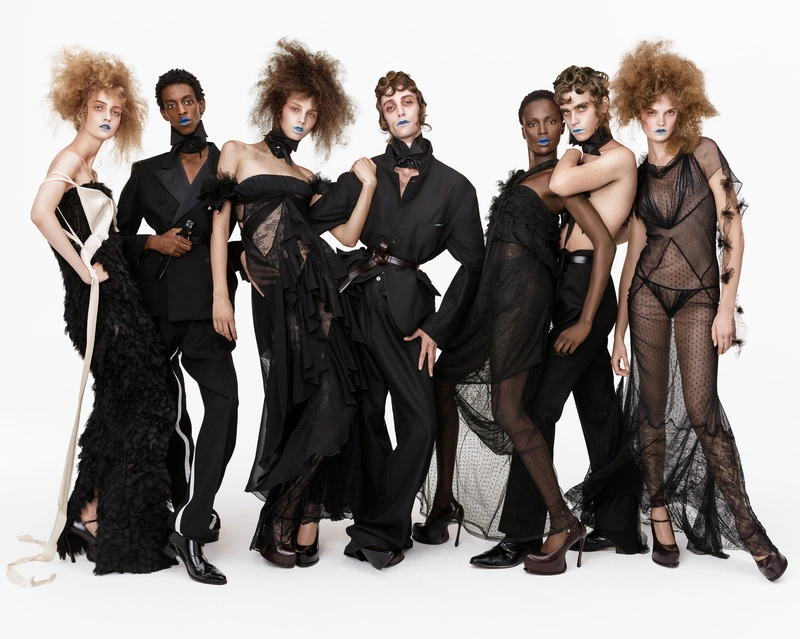
His intervention is genuinely impressive. The designer has never needed an extravagant textile to establish character. Move a pocket far enough around the body, alter the relationship between lapel and shoulder, extend a shirt until its original category disappears, and an ordinary garment begins behaving theatrically. John Galliano told that he had no intention of simplifying his thinking for Zara, and the strongest Re{form} pieces support him.
Yet the project reveals an obvious imbalance. Zara supplies manufacturing capacity, global distribution and capital. Galliano supplies the history, perversity, romance and almost all of the mythology.
Re{form} does not uncover a hidden Zara design language. It allows Galliano’s language to make Zara look culturally deeper.
Existing materials arrive in inconsistent quantities. Garments vary in size and fibre composition. Colours fade differently. Some pieces are damaged. Everything has to be collected, identified, cleaned, sorted, graded and cut around what is physically available. Production cannot assume identical rolls of cloth arriving on schedule.
The designer working with discarded material has to submit to the material’s previous life. Industrial fashion prefers material to submit to the designer.
Re{form} manages to keep Galliano’s fantasy of constraint while returning Zara to the comfort of repeatability. Once his altered prototype produces the right silhouette, manufacturing can reproduce that idea in consistent sizes and quantities without sourcing thousands of suitably identical old Zara garments.
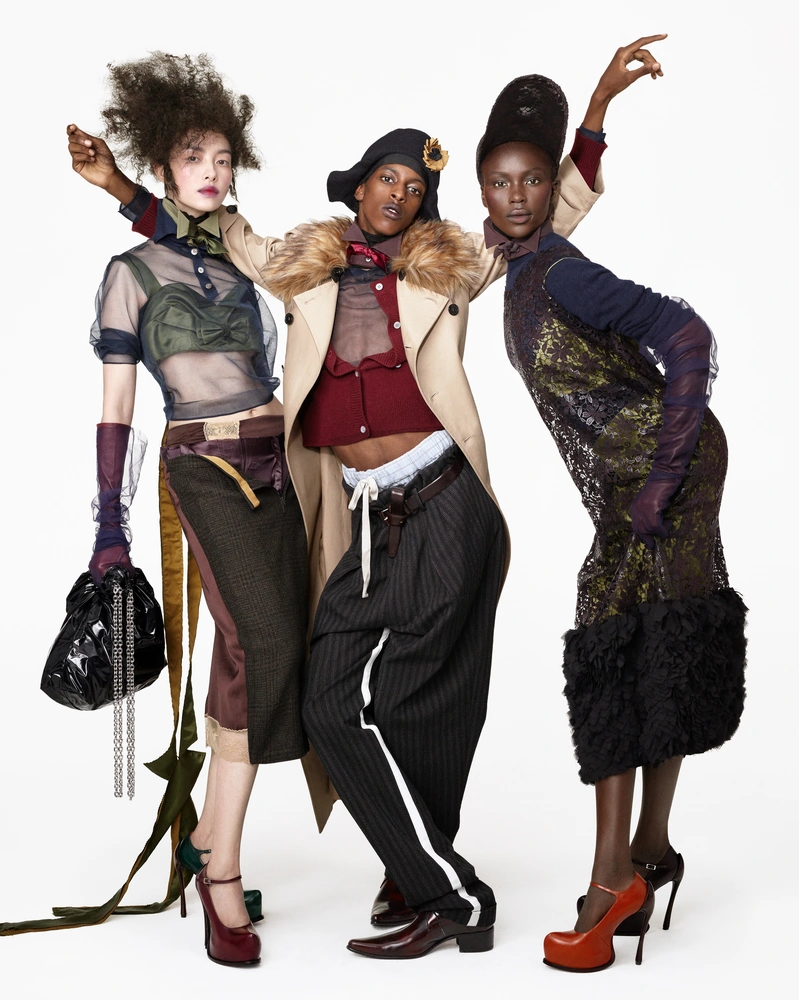

Creatively, this is an efficient way to design. Environmentally, it solves a very different problem. Calling it upcycling would confuse design research through reuse with production through reuse. One uses an old garment to generate an idea. The other uses existing material to reduce the need for newly produced material.
The second is harder because the difficulty is the mechanism, not an unfortunate obstacle around it.
From 19 July 2026, large companies operating in the European Union have been prohibited from destroying unsold clothing, clothing accessories and footwear except under specific exemptions. Companies are expected to prioritize selling, donating, repairing, refurbishing or remanufacturing usable goods. The European Commission estimates that between 4% and 9% of textile products placed on the European market have historically been destroyed before use.
There is no evidence that Re{form} was created to satisfy this regulation, and it would be careless to imply otherwise.
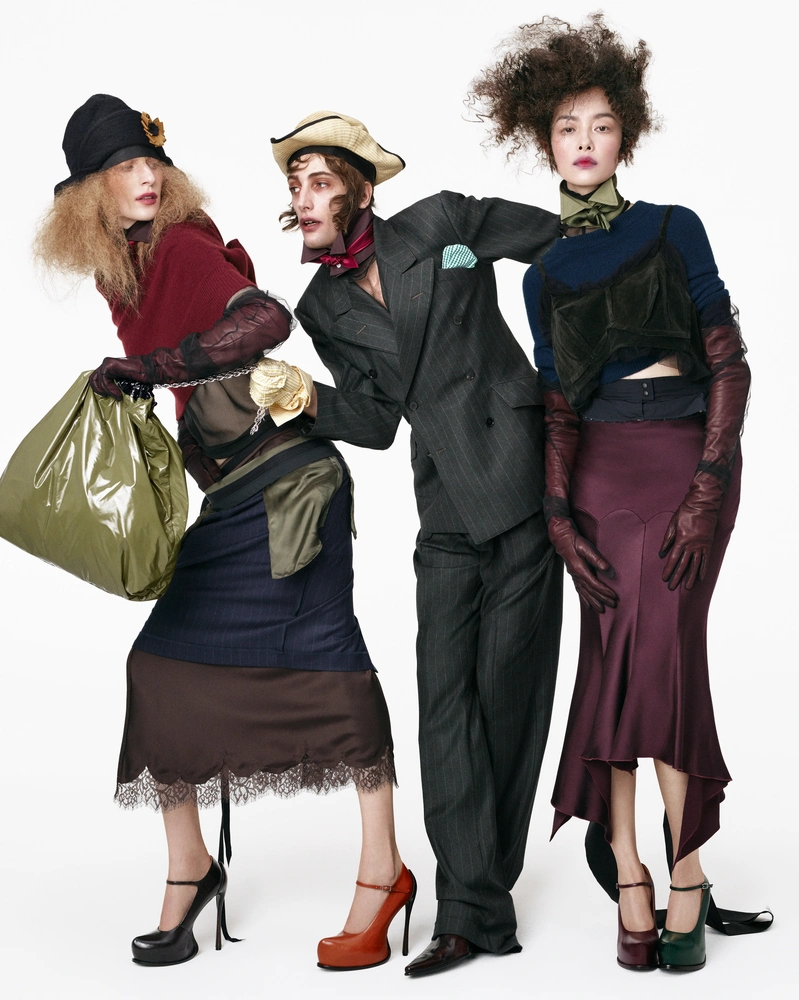

At precisely the moment surplus has become a regulatory and economic liability, one of fashion’s biggest retailers produces an extraordinarily glamorous image of returning to what already exists.
Yet Re{form} does not present a system for absorbing Zara’s surplus into future production at scale. It presents the image of a master designer discovering value in old clothing, then uses that discovery to produce another collection of new clothing.
Visible repair, patchwork and reconstruction gained much of their cultural force because they resisted fashion’s worship of pristine newness. They made previous use visible. They allowed wear, accident and scarcity to shape design.
Now those same signals have become desirable enough for industrial fashion to manufacture from scratch.
A raw hem becomes a finish. Patchwork becomes a surface treatment. Wear becomes styling. Evidence of age can be placed onto a garment before the customer has lived in it for a day. Fast fashion has learned to sell the aesthetic of resistance to fast fashion.

And consumers are willing to pay considerably more for it. Re{form} pushes Zara into territory that would have sounded almost absurd a few years ago. Vogue reported pieces including a $999 chiffon dress and a $759 faux-fur coat, while strong early demand produced significant online sell-outs. The collection’s limited physical distribution, including a Paris mansion presentation, added another layer of luxury psychology to a retailer built on mass availability. Galliano’s authorship clearly has monetary value, and it should. Fashion is more than the cost of fibre.
But this particular premium creates a magnificent contradiction: the appearance of salvage has become a device for creating new scarcity, new prestige and new consumption. The anti-consumption aesthetic has been successfully commercialized.
Zara gains Galliano at precisely the moment it wants to occupy more elevated cultural territory. The collaboration surrounds him with the machinery of high fashion, including Steven Meisel’s imagery and the broader ecosystem of major fashion creatives, while the clothes themselves are presented as something approaching couture thinking at industrial scale.
Galliano receives something equally powerful: mass cultural access. That exchange became particularly charged after the Metropolitan Museum of Art’s proposed 2027 Galliano retrospective was cancelled following backlash over honoring a designer convicted in 2011 after antisemitic and racist remarks. Galliano again acknowledged responsibility for the harm caused when stepping away from the exhibition.
Only weeks later, Re{form} offered another kind of institution through which his work could return to the public. A museum would have asked audiences to assess Galliano’s legacy. Zara asks them to purchase it.
This hardly makes the collaboration a calculated rehabilitation scheme, but its cultural function is difficult to ignore. Galliano re-authors Zara clothing, Zara re-authors itself as a serious fashion patron, and retail participates in re-authoring Galliano’s place in contemporary fashion.
Re{form} reforms almost everything around the clothes except the material system producing them.
That is why the collection deserves sharper criticism than either applause or accusation. Galliano’s design process is imaginative, technically sophisticated and more ambitious than most high-street collaborations. Zara deserves credit for allowing genuine authorship to survive industrial translation.
Yet the project also exposes an uncomfortable stage in fashion’s sustainability conversation. Circular fashion has become culturally powerful enough that its scars can be reproduced as style, its vocabulary borrowed as prestige and its constraints simulated without changing the fundamental appetite for new production.
An inside-out coat can be manufactured. A raw seam can be manufactured. Even the appearance of a previous life can now be manufactured.
Re{form} proves that fashion has learned how to imitate the evidence of change. The harder achievement will be changing the system so that the evidence is real.