MENU
Close





In the secluded Vallée de Joux, Audemars Piguet finds its creative vocabulary in the landscape itself. From sculptural high jewelry to intricate watchmaking, the Swiss manufacturer transforms the poetry of its birthplace into an enduring expression of luxury craftsmanship.

In the secluded Vallée de Joux, Audemars Piguet finds its creative vocabulary in the landscape itself. From sculptural high jewelry to intricate watchmaking, the Swiss manufacturer transforms the poetry of its birthplace into an enduring expression of luxury craftsmanship.
October 9, 2026


The Vallée de Joux has always kept its own time. Hidden among the Swiss Jura Mountains, its landscape moves through an annual rhythm of frozen lakes, deep forests, shifting mountain light and exceptionally clear night skies. For generations, its inhabitants have translated an intimate familiarity with nature into mechanical ingenuity. During the long winters, watchmaking flourished inside modest workshops, where extraordinary complications were assembled through patience, precision and skills passed between families.
Founded in Le Brassus in 1875 by Jules Louis Audemars and Edward Auguste Piguet, Audemars Piguet emerged from this tradition. Its identity remains inseparable from the valley's geography and the collective culture of craftsmanship that developed there.
Today, the relationship has acquired a compelling artistic dimension. Pebbles are interpreted through sculptural gold, forests inspire gemstone compositions, and the evening sky finds a second existence in technical ceramics. Across watchmaking, high jewelry and architecture, Audemars Piguet continues to explore how the character of a place can endure in an object small enough to rest against the skin.
Among the manufacture's recent explorations, the Établisseurs Galets offers one of the most literal translations of the Vallée de Joux into wearable art. Inspired by the water-smoothed pebbles surrounding the Lac de Joux, the creation abandons conventional watch geometry in favour of irregular curves and flowing proportions.
Developed through the Atelier des Établisseurs and presented in 2026, the timepiece belongs to a contemporary revival of établissage, the historical Swiss watchmaking system in which independent specialists collaborated under the direction of an établisseur. This approach reconnects Audemars Piguet with the artisanal networks that sustained the region's horological development long before modern integrated manufacturing became standard practice.
The Galets is particularly remarkable for its approach to luxury craftsmanship. Its asymmetric gold case surrounds an oval natural-stone dial, stripped of conventional hour markers to give the mineral surface uninterrupted prominence. The initial design incorporates turquoise and tiger's eye, allowing natural variations in colour and pattern to shape its visual identity.

Across the bracelet, individually shaped yellow-gold links reproduce the irregularity of river stones. Each link possesses its own geometry, while miniature ball joints allow the bracelet to move fluidly around the wrist. The gold components are hollowed to reduce weight and accommodate individually cut stones.
This seemingly effortless construction required extensive collaboration. Designer Xavier Perrenoud developed the sculptural form, jeweller Nadia Morgenthaler engineered the articulated bracelet, and specialist Mario Senape contributed to selecting and cutting the stones.
Within the case, the manually wound Calibre 3098 was developed from Audemars Piguet's historical Calibre 3090, with its architecture adapted to the unconventional silhouette. Hand-finished bridges continue the pebble-inspired theme into the mechanical interior.
The Établisseurs Galets celebrates a particular kind of sophistication: the ability to preserve the irregular character of nature through the exacting discipline of human hands.
Audemars Piguet's Royal Oak Joaillerie collection expands this conversation into the territory of contemporary high jewelry.
The Royal Oak, conceived by Gérald Genta in 1972, established a distinctive architectural language through its octagonal bezel, exposed screws and integrated bracelet. Its geometry has remained remarkably adaptable, evolving through material experimentation, precious metals and elaborate gemstone setting.
With Royal Oak Joaillerie, those familiar codes take on a new identity as standalone jewelry. The collection explores how the watch's structural principles can inform necklaces, bracelets and earrings, with the Vallée de Joux providing an additional source of artistic expression.
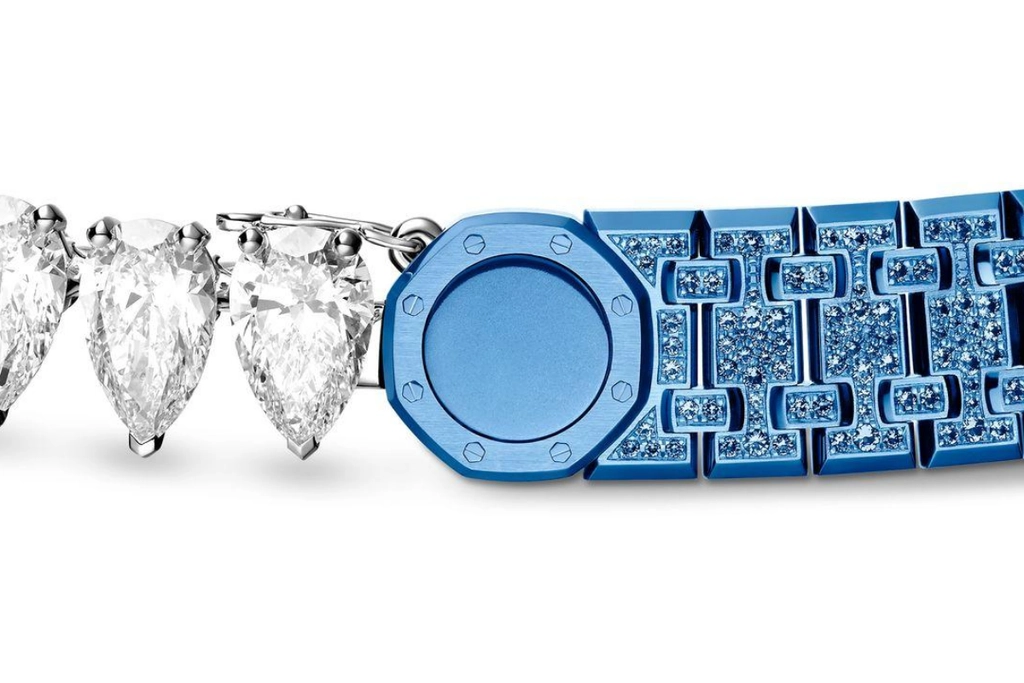
The Dream of Joux line draws from the valley's changing landscape, evoking frozen lakes, floral forms and celestial light through coloured gemstones and carefully composed surfaces. The relationship between precious stones and natural phenomena is especially compelling. Gemstones possess their own optical behaviour, absorbing, reflecting and refracting light according to their mineral structure and cut.
Their placement becomes a means of constructing an atmosphere.
The Risoud Eclipse line explores a darker visual language, taking inspiration from the Risoud Forest beneath the extraordinary light of a celestial eclipse. Black titanium, emeralds and diamonds create a composition of contrasting luminosity. The intense darkness of the metal allows the green stones and brilliant diamonds to acquire a striking visual presence.


The technical sophistication of high jewelry lies partly in orchestrating these relationships. Gemstones must be selected for suitable dimensions, tonal consistency and optical character, while their settings must provide security without disrupting the intended composition.
Through Royal Oak Joaillerie, Audemars Piguet demonstrates how a design originally developed for mechanical timekeeping can evolve into an independent jewelry language. Its recognizable structure survives, even as its purpose shifts toward artistic expression.
The night sky above the Vallée de Joux has long occupied a special place in Audemars Piguet's visual imagination.
Its most recognizable expression is Bleu Nuit, Nuage 50, the deep blue associated with the original Royal Oak dial introduced in 1972. The colour possesses an unusually complex manufacturing history, revealing how natural inspiration can develop into a demanding technical pursuit.
The original dial was produced by Stern Créations using a galvanic treatment that required exceptional control over immersion time, temperature and chemical composition. Minute variations could alter the finished colour, creating subtle differences among early examples.
The name itself has a technical origin. Bleu Nuit identified the blue colour, while Nuage 50 referred to a black additive introduced into the protective varnish. The poetic association with a cloud emerged from the way the pigment dispersed through the liquid.
Decades later, Audemars Piguet revisited the historic shade through contemporary production techniques, including Physical Vapour Deposition for improved chromatic consistency.
The colour has also migrated into high-tech ceramic, an especially demanding material for such a specific tone. Developing a reproducible shade required several years of research, followed by meticulous component finishing to emphasize its depth and interaction with light.
Applied to Royal Oak Offshore chronographs and other contemporary Royal Oak references, the ceramic brings a distinctive material expression to a colour deeply associated with the manufacture's history.
It is an intriguing intersection of scientific precision and atmospheric memory. The darkness of a mountain sky, once observed by generations of watchmakers, has become a repeatable material characteristic, engineered through contemporary technology and completed through traditional finishing.

Beyond its celebrated blue, Audemars Piguet has developed a nuanced approach to green, drawing on the evergreen forests surrounding Le Brassus.
One notable example is the khaki-green Grande Tapisserie dial developed for Royal Oak models. Achieving its particular shade required eighteen months of testing, with artisans seeking a colour reminiscent of the light moving across the region's spruce forests.
The dial's intricate guilloché structure contributes significantly to the effect. Its geometric relief produces variations in brightness as the watch moves, allowing a carefully engineered surface to suggest the shifting appearance of a natural landscape.
This relationship between optical depth and material construction is essential to the manufacture's approach. Colour becomes an experience shaped by texture, finishing and the movement of light.
The use of natural stone introduces another dimension. Mineral dials, including those fashioned from stones such as malachite, possess patterns formed through geological processes. Their visual individuality presents both an aesthetic opportunity and a technical challenge, because the material must be cut into a delicate component suitable for a precision timepiece.
At this scale, luxury craftsmanship becomes an exercise in translating natural complexity into controlled construction. A stone retains its individual character, while the mechanism surrounding it operates according to tolerances measured in fractions of a millimetre.
For Audemars Piguet, the mineral world and mechanical discipline can coexist within a single object, each bringing a distinct understanding of time.

The most expansive expression of Audemars Piguet's relationship with the Vallée de Joux exists beyond the wrist.
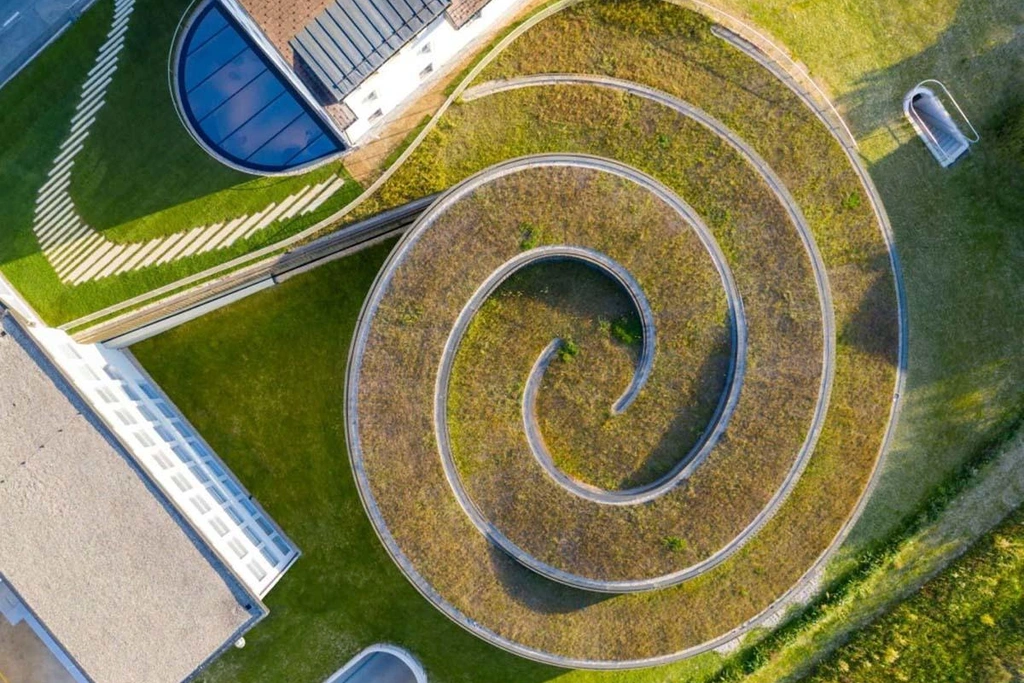
Opened in 2020, the Musée Atelier Audemars Piguet translates the manufacture's philosophy into architecture. Designed by Bjarke Ingels Group (BIG) and realised with Swiss architectural practice CCHE, the museum connects the company's historic birthplace with a contemporary glass pavilion that curves across the landscape.
The building's spiral configuration follows the geometry of a watch spring. Visitors travel inward along a gradually changing path before moving outward again, encountering the history and evolution of mechanical watchmaking through an architectural interpretation of horological movement.
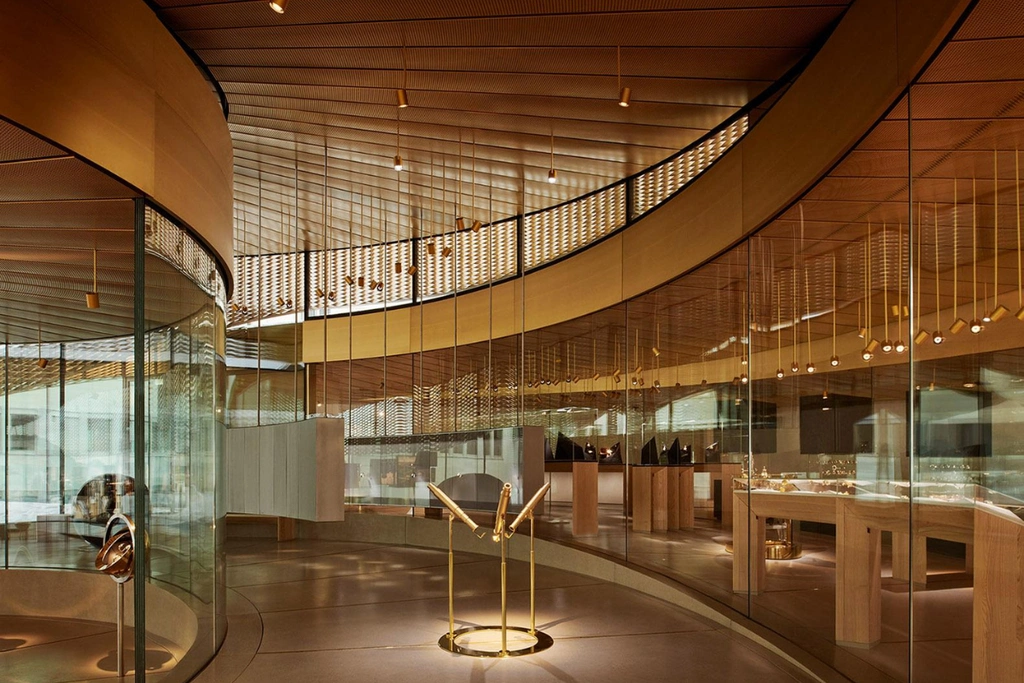
Its curved structural-glass walls establish a close visual relationship between the exhibition spaces and surrounding meadows. Natural light enters the interior, while a brass mesh helps regulate environmental conditions.
The floors offer an especially intimate connection to the site. Terrazzo embedded with stones collected from the Vallée de Joux follows the natural gradient of the terrain, incorporating the valley's physical material directly into the building.
Here, architecture and horology share principles of structural precision, careful material selection and highly coordinated specialist labour.
Visitors encounter approximately 300 timepieces spanning more than two centuries of regional watchmaking history, while the building itself acts as an additional exhibition object. Its curves, surfaces and movement through space articulate the same fascination with precision that defines the mechanisms on display.
The museum also reveals an important distinction within contemporary luxury culture. A manufacturer's heritage gains substance through the preservation and continued practice of specialized skills, making architecture another means of sustaining that knowledge for future generations.

Luxury is increasingly concerned with provenance, particularly as advanced manufacturing makes technical perfection achievable across industries and continents. For Audemars Piguet, the Vallée de Joux provides a deeper understanding of origin, one that encompasses generations of specialized knowledge, intimate regional relationships and a landscape that continues to stimulate creative invention.
The Établisseurs Galets offers a compelling vision for the future of this tradition. Its contemporary design depends on an almost forgotten collaborative production system, revealing how heritage can support experimentation without restricting it to familiar historical forms.
There is something quietly radical in allowing a pebble, a forest or the colour of an evening sky to influence an object of extreme technical sophistication. These references carry no fixed measurements or instructions. Their interpretation requires artistic judgement, material intelligence and the willingness to pursue forms whose manufacture may prove exceptionally difficult.
In that sense, Audemars Piguet presents high jewelry and luxury craftsmanship as living cultural practices. Their enduring value resides in the knowledge preserved by their makers and in the freedom to discover new expressions for it.The Va e de Joux may be measured in kilometres, but its influence extends across centuries. Within a polished stone, a curved gold link or a meticulously finished movement, the geography of a small Swiss valley acquires extraordinary permanence.