MENU
Close





Tazarotene has the kind of name that starts appearing once skincare conversations get serious. Powerful, prescription-only, and increasingly familiar to beauty consumers, it deserves a proper introduction.

Tazarotene has the kind of name that starts appearing once skincare conversations get serious. Powerful, prescription-only, and increasingly familiar to beauty consumers, it deserves a proper introduction.
October 5, 2026
Advertisement

Advertisement



Retinol has become familiar territory in skincare. Retinal has followed closely behind, while prescription retinoids have entered mainstream beauty conversations through dermatologists, acne communities, and social media. Tazarotene sits in this medical end of the retinoid family. It is a prescription vitamin A derivative used for acne, psoriasis, and certain signs of sun-related skin aging. Its appeal comes from strong biological activity, yet that activity also brings a clear need for careful use, patience, and professional guidance.
Tazarotene is a prescription topical retinoid, meaning it belongs to the vitamin A family of skin treatments.
Retinoids influence the way skin cells grow, mature, and shed. Cosmetic retinol also belongs to this family, although it follows several conversion steps inside the skin before reaching its active retinoic acid form. Tazarotene is formulated as a pharmaceutical treatment and becomes active after conversion in the skin.
Once activated, tazarotene interacts mainly with retinoic acid receptors known as RAR-beta and RAR-gamma. These receptors help control genes involved in skin-cell development and inflammation.

The chemistry can be simplified into one idea: tazarotene helps skin cells behave in a more organized way. This makes it useful for conditions where cell production, shedding, inflammation, or pore blockage has become disrupted.
Inside acne-prone pores, dead skin cells can accumulate with sebum and contribute to blackheads, whiteheads, and inflammatory lesions. Tazarotene helps regulate this shedding process, keeping pores clearer and supporting the treatment of existing acne. Its effects can also gradually improve uneven pigmentation left after breakouts as skin renewal becomes more regulated.
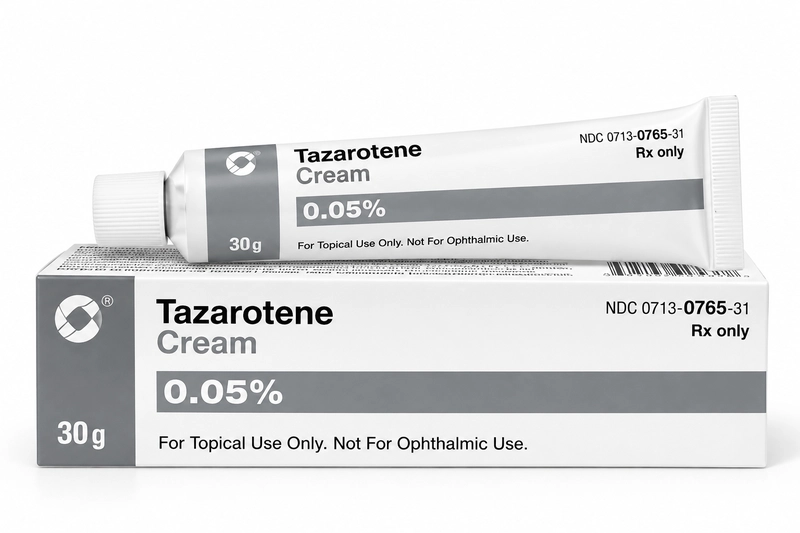
Psoriasis is another established medical use. In psoriasis, skin cells reproduce very rapidly, creating thick, scaly patches. Tazarotene helps regulate this accelerated cell growth while addressing inflammation.
We may find its use in photoaging particularly interesting. Certain tazarotene formulations are prescribed for concerns associated with long-term sun exposure, including fine facial lines, rough texture, and uneven pigmentation. The treatment works gradually, so visible changes develop through consistent use over weeks or months.
Retinol is widely used in cosmetic products. Brands formulate it into serums and creams designed for home skincare routines, often at relatively gentle concentrations.
Tazarotene is a regulated medication supplied in specific pharmaceutical strengths and vehicles such as creams, gels, foams, and lotions. Common concentrations include 0.045%, 0.05%, and 0.1%, depending on the product and treatment indication.
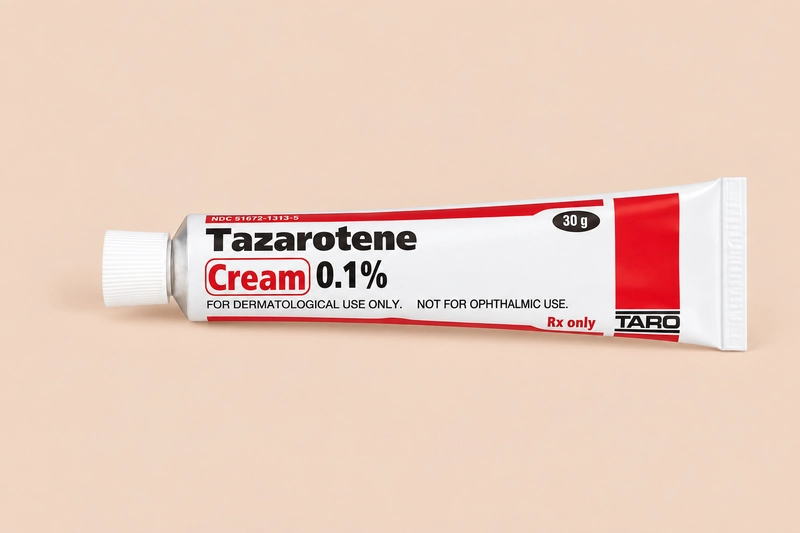
Its stronger biological activity also explains why dermatologists pay close attention to tolerability. Dryness, redness, flaking, tightness, burning, and stinging can appear during treatment, particularly while the skin adjusts.
A typical evening routine is surprisingly simple. Cleanse, allow the skin to dry, apply tazarotene in a thin layer, then use moisturizer. The exact instructions depend on the formulation and prescription.
A small amount is usually sufficient for facial treatment. Applying extra product increases exposure and can lead to greater irritation, while treatment benefits develop through consistent use over time.
Strong exfoliating acids, abrasive scrubs, highly drying acne products, and other potent actives can increase cumulative irritation when layered carelessly around a prescription retinoid.
Benzoyl peroxide may still have a place in an acne routine, although a clinician may recommend using it at a separate time of day depending on the treatment plan.
Waxing also deserves attention. Retinoid-treated facial skin can become more delicate, so hot waxing on treated areas can create a greater risk of superficial skin injury.
Daytime sun protection is equally important. Broad-spectrum sunscreen helps protect skin undergoing retinoid treatment and supports treatment goals involving pigmentation and photoaging.
The rise of retinoids in beauty has trained consumers to think in increasingly sophisticated terms. Retinol led to retinal. Ingredient percentages became part of ordinary skincare vocabulary. Prescription names such as tretinoin and tazarotene now circulate far beyond dermatology offices.
For skincare consumers, its value lies beyond the idea of finding the “strongest” vitamin A product. Tazarotene shows how an ingredient can move from cosmetic interest into genuine medical treatment, where precision, consistency, and professional guidance become part of the formula itself.
Advertisement