MENU
Close





Before the Bride of Frankenstein could utter a scream, her hair had already stolen the scene. Behind that electric silhouette lay an astonishing beauty history.

Before the Bride of Frankenstein could utter a scream, her hair had already stolen the scene. Behind that electric silhouette lay an astonishing beauty history.
October 14, 2026
Advertisement

Advertisement



In James Whale’s 1935 film Bride of Frankenstein, the creation of a woman requires an entire laboratory, a collection of body parts, and the extraordinary electrical power of a violent storm. Yet when Elsa Lanchester finally awakens, her appearance suggests another remarkable achievement.
The hairstyle occupies only a few minutes of screen time, yet its silhouette has endured for nearly a century. Behind its theatrical appearance lies an unexpected history involving Egyptian archaeology, nineteenth-century Parisian salons, and the technical ingenuity of Hollywood's earliest monster makers.
In December 1912, archaeologists working at Tell el-Amarna in Egypt uncovered a painted limestone bust of Queen Nefertiti. Created during the fourteenth century BCE, the sculpture presented an elegant face, elongated neck, and towering blue crown. Its remarkably preserved pigments offered a vivid encounter with ancient Egyptian royal beauty.

When the bust went on public display in Berlin in 1924, Nefertiti became a twentieth-century cultural phenomenon. Her profile circulated through reproductions, illustrations, advertisements, and fashionable costume parties. An Egyptian queen who had lived approximately 3,300 years earlier was suddenly influencing the modern imagination.
Egyptian-inspired aesthetics were already fashionable following the discovery of Tutankhamun's tomb in 1922, fueling the fascination with ancient Egyptian motifs within the emerging Art Deco movement. Geometric jewelry, dramatic eye makeup, and architectural silhouettes entered European and American fashion, as archaeological discoveries influenced the stylized ornamentation, symmetry, and exotic glamour that defined the era.
Nefertiti's crown was especially memorable. Its extraordinary vertical proportions created an impression of authority, while the queen's painted features appeared remarkably compatible with contemporary ideals of feminine beauty.

This celebrated silhouette became a reported inspiration for the hairstyle developed by director James Whale and Universal makeup artist Jack Pierce for Bride of Frankenstein. The resemblance lies particularly in the crown's architectural proportions, translated into an arrangement of rising hair.
The Bride was conceived as a laboratory creation, yet her appearance borrowed the majestic outline of ancient royalty. Her towering coiffure lent ceremonial grandeur to a creature whose existence depended upon distinctly modern experiments.
In her autobiography, Elsa Lanchester Herself, the actress described the elaborate construction supporting her famous appearance. Four small, tightly secured braids were arranged on her head to anchor a wired framework of horsehair approximately five inches tall. Her natural hair was then brushed upward over the structure, while separate white hairpieces created the distinctive lightning-like streaks.
The procedure transformed hair into an architectural material. Its apparent volume depended upon an internal foundation, demonstrating a principle familiar to theatrical wigmakers and fashionable hairdressers who had long relied upon padding, supports, and supplementary hair to produce extravagant silhouettes.


Developed by French hairdresser Marcel Grateau during the Victorian era, around the 1870s, the technique used heated metal tongs to shape hair into regular, undulating curves. The irons required careful temperature control, and hairdressers traditionally tested their heat against paper before applying them to the hair.
Marcel waves became associated with sophisticated professional styling during the early twentieth century. Their precise ridges appeared in fashionable portraits and Hollywood photography, demonstrating the period's fascination with glossy, controlled surfaces.
For the Bride, carefully shaped waves gave an elaborate construction the appearance of a coherent hairstyle. The flowing ridges softened its architectural height, while the white streaks introduced dramatic visual interruptions.
Lanchester's account reveals another intriguing detail: the streaks occupied slightly different positions. One began near the right temple, while another descended toward the left cheekbone. Their irregular arrangement strengthened the impression of energy moving through the hair.

Pierce approached his cinematic transformations with considerable seriousness. Responsible for the famous appearance of Boris Karloff's Frankenstein Monster, he worked during an era when elaborate screen transformations depended upon painstaking manual techniques, specialized materials, and the physical endurance of performers.
Lanchester recalled Pierce's almost surgical manner in the makeup room, an amusing parallel with the fictional scientists responsible for creating her character.
Elsa Lanchester possessed an unusual relationship with the woman she portrayed. In Bride of Frankenstein, she appeared twice: first as the novelist Mary Shelley in the opening sequence, then as the resurrected creature during the film's climax.
In Shelley's 1818 novel, Victor Frankenstein begins constructing a female companion for his creature, then destroys the unfinished body. The completed Bride, together with her extraordinary appearance, emerged through cinema's adaptation of the literary material.
Lanchester's sharp, birdlike movements and startled expressions suggested a creature discovering the physical world through unfamiliar sensations. The actress reportedly drew inspiration from the hissing sounds of swans she had observed in London, introducing an animal quality to the Bride's vocalizations.
The hairstyle amplified these gestures. Its elevated silhouette extended the line of her neck, while sudden movements caused the rigid structure to appear almost independently animated.
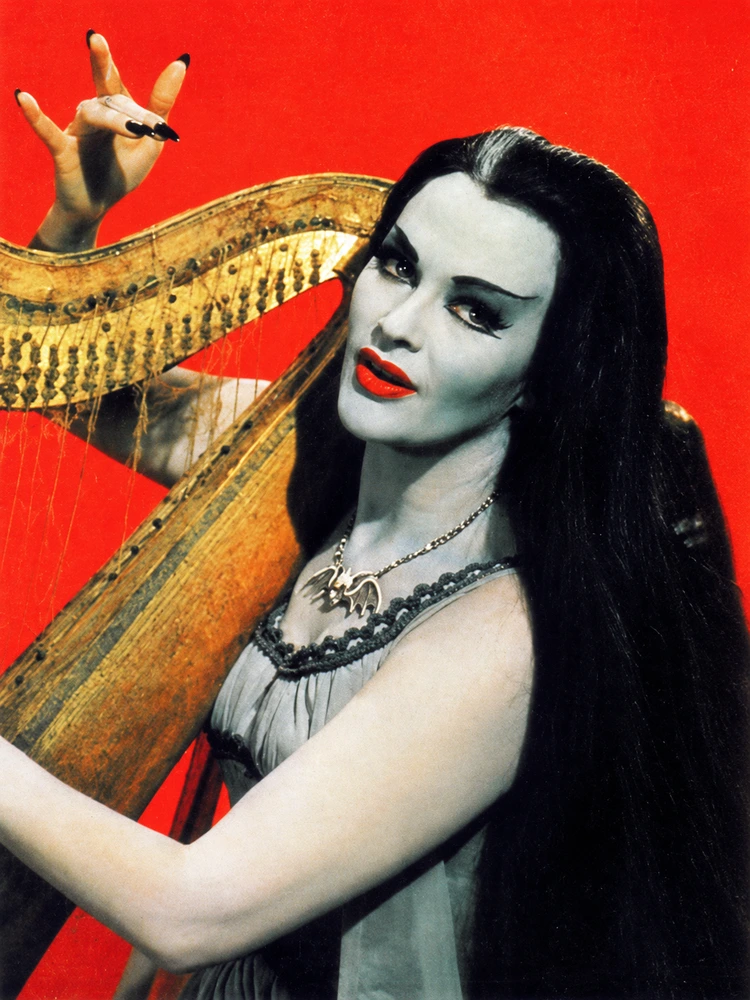
The Bride's remarkable coiffure eventually acquired a career extending far beyond Universal's original film. By the 1960s, the familiar combination of dark hair and a striking white streak had found another home in American television. Yvonne De Carlo's Lily Munster, introduced in The Munsters in 1964, wore long black hair interrupted by a white streak, translating an established horror motif into the everyday appearance of a suburban monster mother. The towering construction had disappeared, leaving a distinctive color contrast that audiences could recognize immediately.


Decades later, the same visual reference emerged in an unexpectedly playful form. When Bride of Chucky was released in 1998, Tiffany Valentine appeared with platinum blonde hair, creating another memorable bride within horror cinema.
Yet an early promotional image revealed an intriguing abandoned possibility: Tiffany originally wore red hair with a white streak, a deliberate reference to Elsa Lanchester's Bride. Franchise creator Don Mancini shared the archival photograph in 2020, revealing how the 1935 character had influenced the design process more than sixty years later.
Maggie Gyllenhaal's The Bride! (2026) offers a particularly intriguing contemporary chapter. Jessie Buckley's bleached, distressed hair revisits the original character's relationship with dramatic color alteration, while makeup designer Nadia Stacey developed an appearance shaped by physical transformation and artistic references.
The two screen Brides also reflect changing ideas about how an extraordinary woman should appear. Across ninety-one years, the iconic white streaks of the Bride of Frankenstein have remained a recognizable visual motif, inspiring successive filmmakers to reinterpret her appearance through the beauty language of their own period.
Advertisement