Enfants Riches Déprimés SS27 enters Christie’s like a beautiful disturbance, dressing old money, damaged glamour and collector obsession in cultivated decay.

Enfants Riches Déprimés SS27: Cultured Decay
Enfants Riches Déprimés SS27 enters Christie’s like a beautiful disturbance, dressing old money, damaged glamour and collector obsession in cultivated decay.
October 29, 2026


At Enfants Riches Déprimés, elegance often arrives carrying evidence of impact: a rubbed surface, a damaged hem, an expensive object with the emotional temperature of contraband.
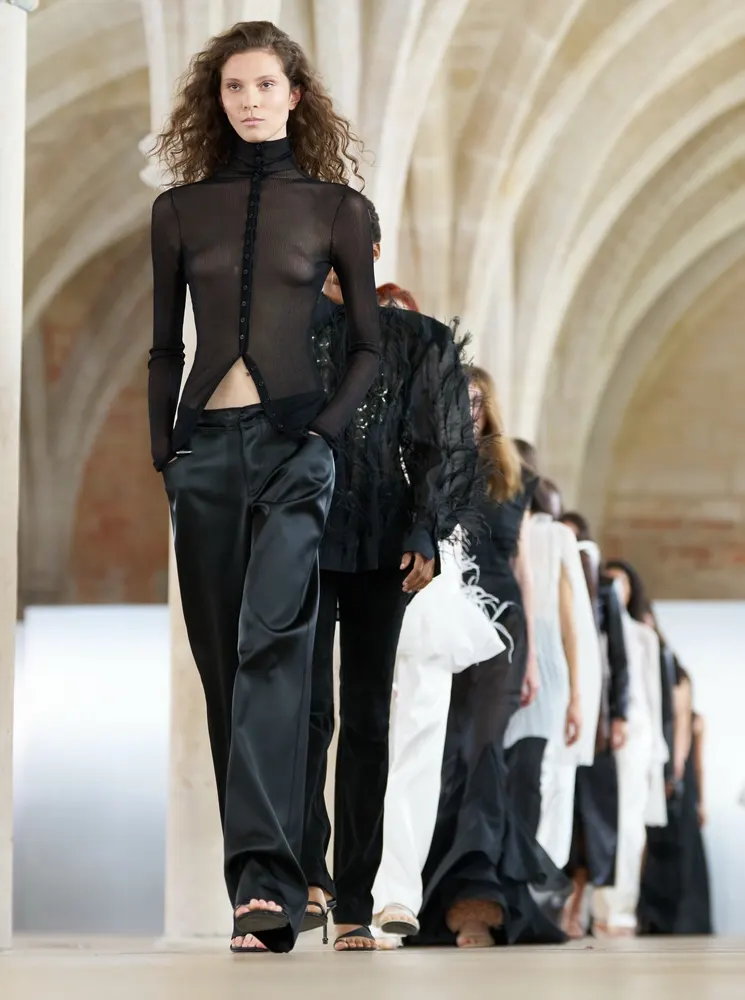
Spring/Summer 2027 sharpens that instinct inside Christie’s Paris, where Henri Alexander Levy places forty-one looks among bronzes, paintings and collectible objects, turning the auction house into a room where fashion, art and private obsession share the same air.
Antoni Tàpies sculptures surround the runway, while Willem de Kooning's drawing from Levy’s personal collection appears in a model’s hand, collapsing the distance between designer, collector and curator. The result feels cultivated and unstable, as if a bourgeois salon has been occupied by someone who understands its rules intimately and plans to disturb every one of them from within.
Pasolini Enters the Bourgeois Drawing Room
Christie’s also gives the collection an institutional polish that suits Levy’s fascination with expensive decay. The auction-house setting frames every distressed trouser, silver object and severe jacket as part of a private collection, turning the runway into a catalogue of taste shaped by obsession, privilege, damage and deliberate cultural accumulation over time.
Pasolini provides the collection’s psychological script. Levy looks to Teorema and Accattone, films built around desire, class, alienation and lives pushed toward the edge, then filters those tensions through the wardrobe of an imagined intruder moving through a wealthy household.


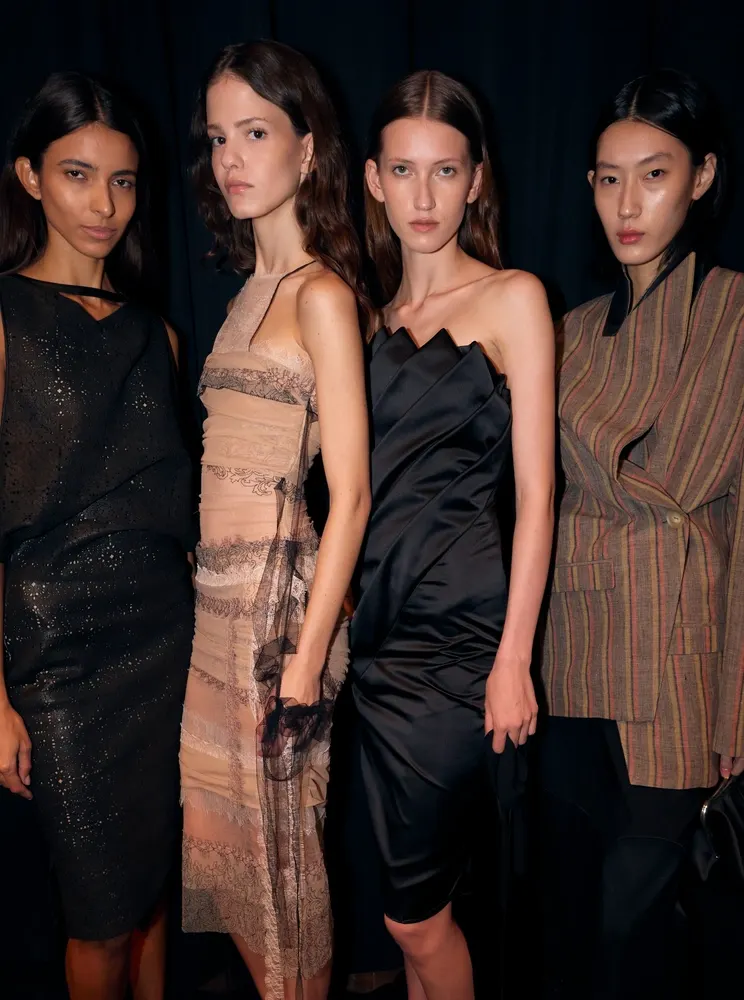
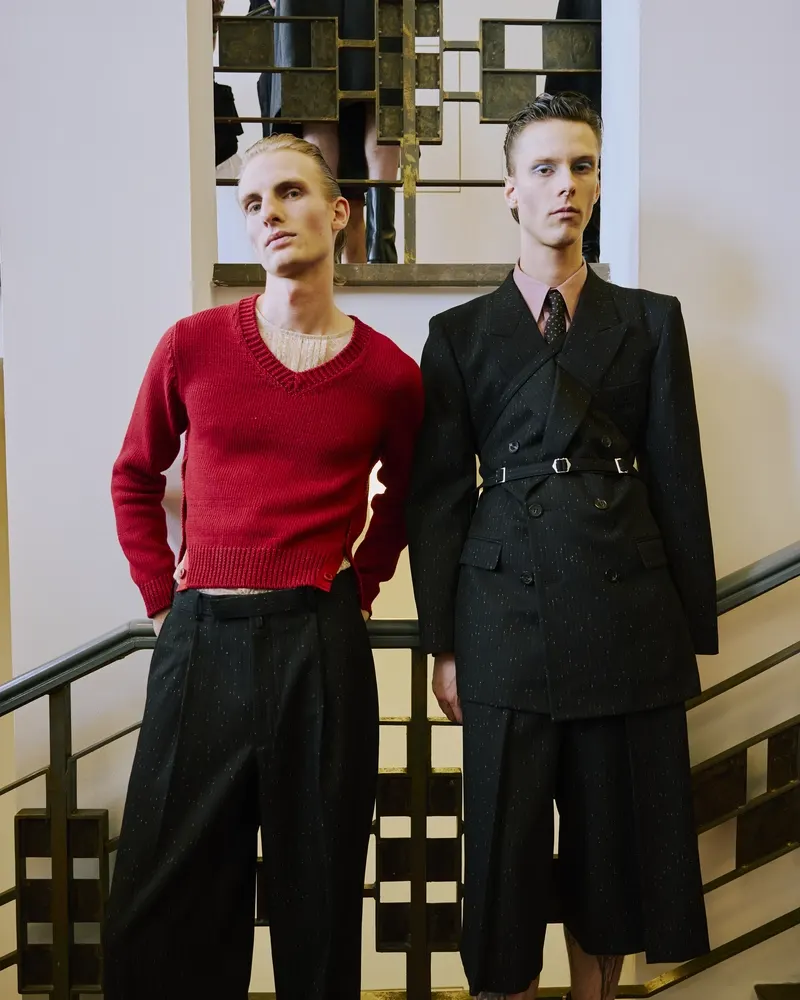
The clothes begin with discipline: lean H-line tailoring, narrow single-breasted jackets, inverse-pleated trousers, knee-length skirts and compact dresses carrying the manners of 1950s respectability. That composure gradually acquires friction through weathered surfaces, loosened proportions and styling that suggests a character staying long enough to leave a mark.
Miles Davis enters as another reference, especially the arc from sharp early tailoring toward a rougher, exhausted visual language, while John Paul Getty III appears in the background through a tan knitwear, striped shirt and leather-trouser look imagined around 1970s Rome. Enfants Riches Déprimés builds character through cultural memory, then lets fabric absorb the psychology.
Tailoring Holds While the Surface Decays
Silhouette remains controlled even as the surfaces begin to fray. Jackets hold a narrow shoulder and elongated torso, straight skirts fall with restrained severity, inverse pleats introduce movement into trousers, and black leather suiting gives the body a hard, polished frame.
Long column dresses stretch vertically with a Morticia Addams-like line, capes create broad planes around the upper body, and relaxed motoring jackets carry a decadent ease. The tension sits between order and erosion. Japanese denim, lightweight wool, linen, silk and leather provide the base, while washed checks, faded dyes, paint spatters and distressed finishes make each piece appear to have passed through a private history before reaching the runway.


One of the season’s clearest examples is the washed checked trouser known in the studio as the “divorced artist pant,” a name that captures Levy’s instinct for assigning entire biographies to garments. Textile artists helped develop faux-worn surfaces that suggest paint, tobacco, dust and studio debris while preserving precise tailoring underneath.
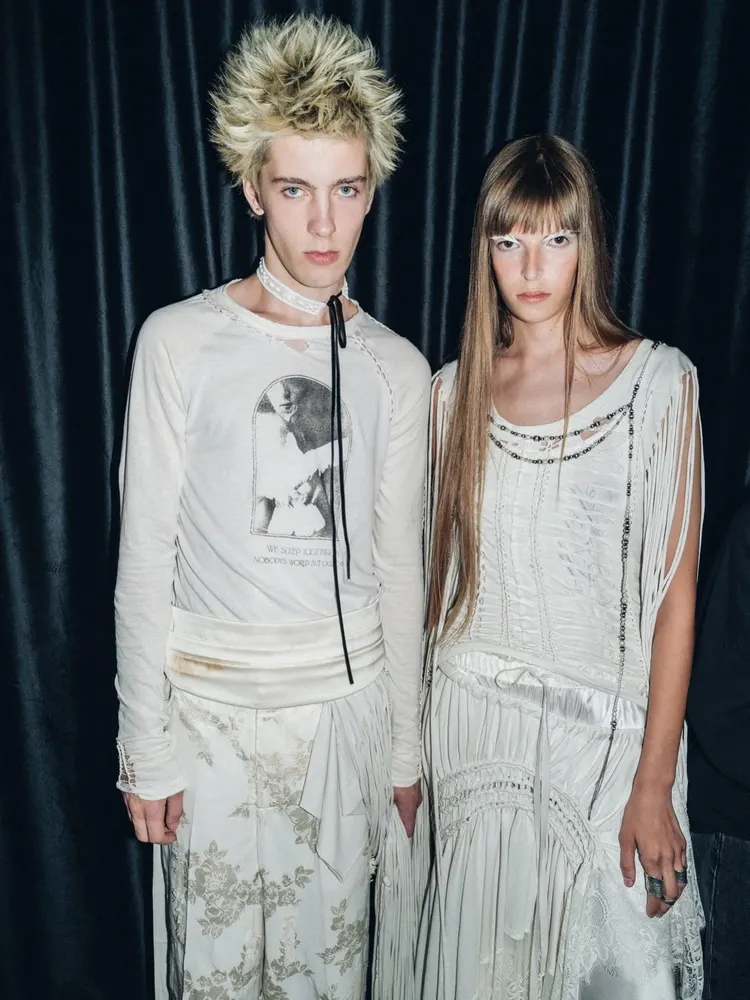
Leather outerwear uses unlined construction, asymmetric lapels and contrast stitching, giving heavy material an exposed interior logic. Enfants Riches Déprimés treats damage as authorship: wear becomes a visual signature, and the garment gains value through the suggestion of previous use, emotional residue and difficult taste.
Collectible Objects Become Part of the Wardrobe
Accessories carry the collection into Levy’s collector world. Ascot scarves replace conventional neckwear, coin belts sit low across the body, and metal hardware punctuates tailoring with the bluntness of found objects. Then the objects become stranger.
Cast-silver baby dolls, pigs, scissors, books and knives appear beside a bronze cage-like bag and a one-off bag assembled with rare pocket watches. These pieces operate like portable sculpture, sitting between accessory, artwork and private fetish object. Their value comes from scarcity, provenance and material specificity, principles that have shaped Enfants Riches Déprimés since its earliest years.


The pocket-watch bag is especially revealing. Watches associated with timekeeping are detached from their original function and reassembled into a luxury object whose purpose lies in possession, display and narrative. A leather jacket printed with the Déclaration de Genève extends that method into historical document, using the League of Nations’ 1924 declaration on children’s rights as surface language.
Levy repeatedly treats clothing as a carrier for fragments of cultural evidence, drawing from film, music, legal texts, art history and subcultural memory with the instincts of an obsessive archivist.
Styling keeps the collection poised inside that cultivated unease. David Friend uses ascots, compact tailoring, narrow belts and polished leather to establish bourgeois codes, then introduces disruption through worn fabric, unusual hardware and objects that carry a faint sense of threat.
The palette stays dense and adult: buttercream, tobacco brown, washed pink, grey, olive, royal blue, midnight, peach, burgundy and near-black brown. Each color feels slightly aged, as if pulled from interiors, old cars, cigarette-stained photographs and private clubs where the curtains have absorbed decades of smoke.


Enfants Riches Déprimés Builds a Collector Business
SS27 also arrives at a meaningful operational moment for Enfants Riches Déprimés. Founded in 2012 and built between Los Angeles and Paris, the brand has spent years cultivating scarcity, high prices and tightly controlled distribution, creating a customer base that treats garments as collectible objects.
Its next major step is a 5,900-square-foot flagship at 155 Franklin Street in Tribeca, joining stores in Paris and Seoul and giving the label its first American flagship. The New York space is planned around ready-to-wear, tailoring, couture, jewelry, furniture, vinyl, printed matter and art, extending Levy’s practice into a physical environment where fashion sits beside the objects and references that feed it.
That expansion makes the Christie’s show feel especially precise. Enfants Riches Déprimés is building a retail model around the same collector mentality that defines the collection. SS27 captures the brand at a point where rebellion has learned the manners of the auction room and discovered that decadence can be curated, catalogued and sold with immaculate control. Henri Alexander Levy’s world remains abrasive, expensive and culturally saturated, yet its sharpest gesture now lies in refinement.