A sweater with a mind of its own, a word that means crying, and a designer who welcomes uncertainty: enter the quietly extraordinary world of pillings.

Ryota Murakami on the Unspoken Beauty of pillings
A sweater with a mind of its own, a word that means crying, and a designer who welcomes uncertainty: enter the quietly extraordinary world of pillings.
October 27, 2026


A difficult request circulates through the making of a pillings sweater: Ryota Murakami sometimes wants his knitters to make something imperfect. Their hands, trained through years of exacting work, instinctively produce the precision he hopes to disturb. Even a misplaced stitch becomes complicated when the person holding the needles knows precisely where every stitch belongs. “I’ve tried many times to get people to knit in an intentionally imperfect way,” Murakami tells Jessica Van De Camp, fashion editor of PAVE Magazine. “I’m still searching for a way to express a kind of perfect incompleteness.”
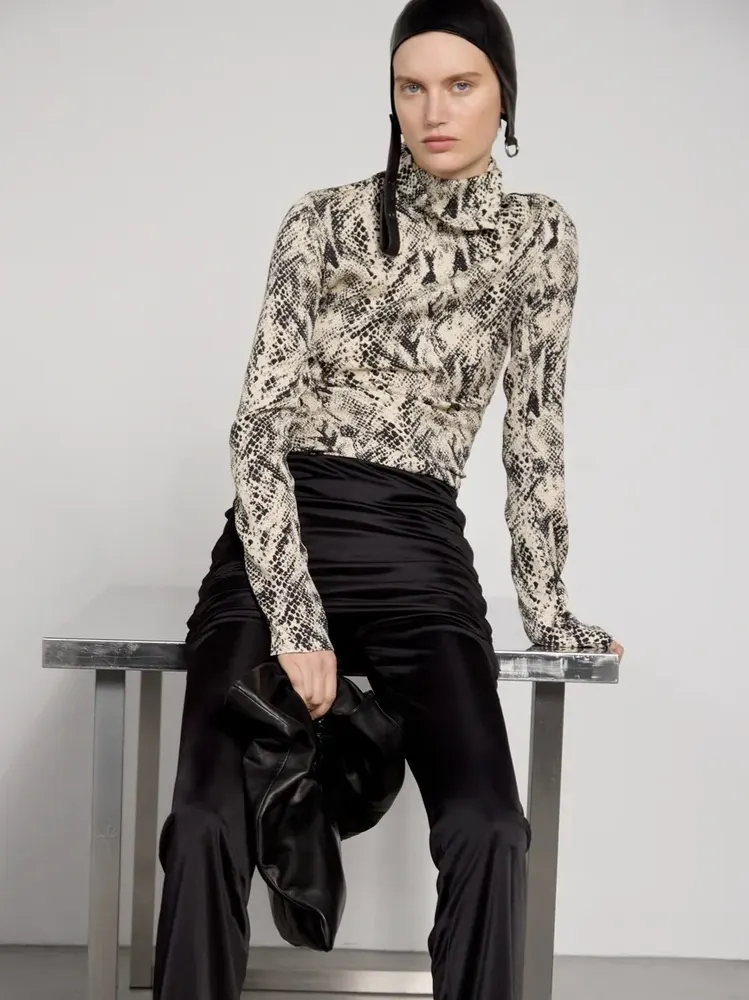
The phrase captures the peculiar discipline behind pillings, the Tokyo label whose garments possess an awkward anatomy: cardigans with wandering fastenings, sleeves gathered into uneasy folds, knitwear that seems to remember the body differently. The brand takes its name from the little fiber balls that emerge through wear and friction. An ordinary sign of use becomes a proposition about value. For Murakami, imperfection demands attention, judgment, and extraordinary skill.
The Boy Who Wanted to Fit In
Long before those distorted sweaters reached runways, Murakami was a child wearing the ones his mother knitted. Other children teased him about his homemade clothes. His early fascination with fashion grew partly from wanting to belong, an irony that now sits tenderly inside a label celebrated for its individuality. He later discovered designer clothing, worked multiple part-time jobs, and spent much of his earnings on clothes he scarcely had time to wear.
When Jessica asks whether he has kept anything from those years, his answer travels back to his parents’ house. Fashion school required money for projects, prompting him to sell almost everything. Somewhere at home, he suspects, his first Comme des Garçons shoes survive. The detail feels appropriately Murakami: an early purchase held in memory, its precise whereabouts pleasantly uncertain.

At coconogacco, the experimental fashion school founded by Yoshikazu Yamagata, questions about originality challenged him. The turning point arrived through his mother, whose homemade knitwear caught his teacher’s attention. Murakami could spend an entire day developing a sketch; his mother, approaching design through instinct and lived experience, could produce one within minutes. Their collaboration became the foundation of RYOTAMURAKAMI, established in 2014, which evolved into pillings in 2020.
Asked whether he would define originality differently today, he emphasizes allowing people to evolve alongside their surroundings. His mother's example reveals something fundamental about his creative development. Originality can emerge through encounters with people whose understanding of beauty operates outside professional conventions. Years later, a childhood sweater featuring the television character Jajamaru inspired a pillings collaboration. The clothing that once made him self-conscious had become part of his creative inheritance.

The Peculiar Humor and Quiet Emotions of pillings
Murakami once imagined another profession altogether: comedy writing. He listened to late-night radio and admired the strange friction between an individual and the surrounding world. That fascination offers an intriguing route into his clothes. Their humor is quiet, occasionally uncomfortable, and frequently rooted in ordinary objects whose peculiarities escape casual attention.
For Fall/Winter 2023, moths gathering around streetlights became a source of sympathy and visual invention. The insects, familiar enemies of treasured knitwear, suggested the vulnerability of creatures drawn toward brightness. Spring/Summer 2026 turned to My Basket, an everyday Japanese supermarket, finding interest in worn textures and the anonymous clothing of neighborhood life. A creased cardigan or lopsided shoulder becomes evidence of how carefully Murakami observes the ordinary.
His creative process, however, resists a simple psychological interpretation. “I think the things I feel in everyday life naturally find their way into my work,” he explains to Jessica. These clothes emerge through sensation, observation, and experimentation. Their emotional identity remains open to interpretation.
During the 2025 LVMH Prize experience, an industry comment stayed with him:
“The image of an introverted person works as an artistic expression, but it’s hard to imagine an introverted person actually wearing the clothes.”
The observation deserves attention because it identifies a difficult problem in fashion design. A designer can communicate introversion through exaggerated proportions, guarded silhouettes, and visual signs of discomfort. Yet someone who recognizes themselves in that description may seek entirely different qualities from their wardrobe: reassurance, discretion, ease, or the confidence to occupy public space.


An artistic representation of a personality and the practical wardrobe of that person are two distinct design questions. Murakami's willingness to reflect on the criticism suggests an awareness that clothing acquires another life through its wearer.
That relationship becomes especially interesting internationally. When Jessica asks how foreign buyers interpret pillings, Murakami observes:
“I feel that people outside Japan tend to be more attuned to the symbolism in clothing and to interpreting the meanings behind it.”
His experience points toward the fluidity of fashion's cultural meanings. An irregular sweater may suggest vulnerability to one observer, humor to another, or remarkable technical control to someone familiar with knitting. Garments travel with their designer's intentions while accumulating associations from the people who encounter them.
For pillings, international expansion therefore introduces a compelling creative challenge: the label must possess a recognizable identity while allowing its audience room to discover meanings of their own.
The Art of Making a Thread Cry
On September 2, 2026, pillings presented Spring/Summer 2027 inside the headquarters of the Asahi Shimbun newspaper. Murakami reads its Voices section, where people across generations contribute reflections on their lives. Through strangers' experiences, he encounters a society wider than his daily journey between home and work. The choice of venue was revealing: his runway occupied a building devoted to collecting human observation.
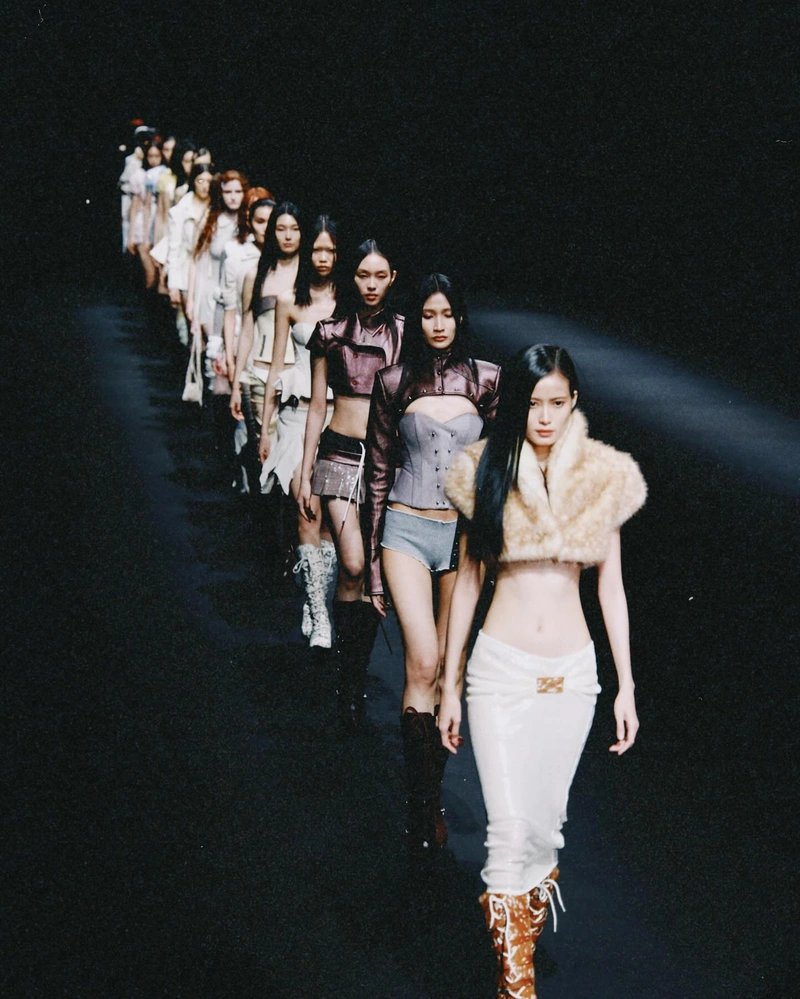
The collection, Landscapes 2, explored the shifting territory between recollection, fantasy, and physical experience. Soft tailoring twisted around the body; shirting developed unexpected folds; knitwear carried petals and drifting shades of lilac, pink, and gray. White hats referenced the Japanese children's story The White Hat, whose everyday world opens toward the fantastic. Familiar clothes acquired the peculiar edges of remembered objects.


One experiment began with a word. Japanese textile workers use naku, meaning “to cry,” when discussing bleeding color. Murakami became fascinated by naki-ito, yarn associated with dye migration.
“This whole experiment actually began because I liked the term ‘naki-ito’ (泣き糸), which refers to yarn that bleeds color.”
His team developed yarn with low colorfastness, then washed completed garments to encourage pigment to move across their surfaces. The process required substantial adjustment because conventional textile production generally seeks stable coloration.
Elsewhere, artificial-flower specialists contributed hand-coloring and heat-shaping techniques to sculptural garments inspired by morning glories observed along city streets. Intimate encounters became engineering problems, then propositions in silhouette.
These experiments signal an expanding vocabulary. Woven fabrics, linen jackets, asymmetrical shirting, and sculptural dresses have gradually widened the technical territory of pillings.


When Jessica asks which clothing category he remains eager to explore, Murakami answers simply:
“I’ve always been interested in menswear.”
The remark opens an intriguing possibility. Traditional menswear carries established expectations about structure, fit, and social presentation. Tailored jackets, shirts, and trousers offer Murakami a rich set of conventions to investigate through his fascination with displacement and irregularity.
The deeper challenge concerns the adaptability of his creative language. Hand-knitting places natural limits on production, while additional construction techniques create opportunities for growth. As pillings develops, its identity increasingly depends on an underlying sensibility capable of moving between materials, silhouettes, and garment categories.
The Hands and Hearts Behind pillings
There is an affectionate exchange when Jessica asks whether Murakami can identify individual knitters by touching their sweaters. His answer arrives with characteristic understatement:
“Honestly, I can’t tell the difference. That’s how skilled the knitters are.”
The remark contains humor, humility, and a remarkable compliment. Behind the eccentric silhouettes stands a community of practitioners capable of translating unusual instructions into carefully constructed, wearable garments.
Their consistency also reveals an operational achievement. A distinctive aesthetic must be communicated among multiple makers, interpreted through individual techniques, and developed into pieces that retain their intended character. The apparent spontaneity of a pillings sweater depends on a sophisticated relationship between creative direction and execution.

Murakami's commitment extends to AMIt, the knitting school he directs, which develops technical skills and encourages experimentation. Students can progress toward contributing to professional production. Specialized knowledge becomes something cultivated, taught, and shared.
His curiosity about historic couture workshops feels particularly meaningful within this context. Asked whose atelier he would visit, he chooses Dior during John Galliano's era or Chanel under Karl Lagerfeld, eager to observe the artisans and their working environments. The answer comes from a designer who understands that extraordinary creative freedom depends on the people capable of realizing it.
Such ambition also demands financial stability. Around Fall/Winter 2023, production difficulties and limited resources made Murakami contemplate the future of his label. A significant business development followed in 2024, when pillings was acquired by Little League, part of The Sazaby League. The partnership strengthened operational support and international commercial relationships.
By 2025, Murakami had become an LVMH Prize semifinalist. International distribution subsequently expanded to retailers including Dover Street Market and Andreas Murkudis. The label now possesses an increasingly substantial platform for its artistic ambitions.
Yet when Jessica asks whether he remembers the exact moment he realized the brand could continue, Murakami answers:
“I haven’t really felt it yet.”
Few remarks reveal the inner complexity of running an independent fashion label so efficiently.
From the outside, progress follows a clear chronology: industry recognition, investment, international retailers, expanding collections. For the designer responsible for sustaining production, supporting collaborators, and developing the next season, security may remain an evolving sensation.
There is a larger contradiction here. Murakami seeks uncertainty within the garments themselves, yet their existence requires meticulous planning, experienced craftspeople, commercial partnerships, and dependable execution. Artistic freedom and organizational responsibility have become intimately connected. The beauty of pillings is inseparable from the practical intelligence required to sustain it.
Some Things Can Remain Unexplained
Paris has become a serious possibility. Murakami respects the history built by Japanese designers who transformed international fashion, while hoping to develop an expression specific to his own team. After expanding the label's international wholesale relationships, a Paris runway represents another potential stage in its development.
Yet his response to Jessica's question about that prospect is wonderfully grounded.
“I get nervous at fashion shows no matter where they take place.”
He anticipates learning from the experience once it is over. His answer suggests a designer who approaches ambition through curiosity about what new circumstances might teach him.


A Paris presentation would carry cultural visibility and commercial opportunity. It would also introduce new demands involving production, audiences, and the communication of his work. The significance of such a move will ultimately reside in what Murakami discovers through it.
Throughout our conversation, a particular pattern emerges. His teachers challenged him to articulate originality. His mother's intuition expanded his understanding of creativity. Artisans taught him about the difficulty of constructing imperfection. International audiences introduced unfamiliar interpretations, while professional recognition brought questions that continue to occupy his thoughts.
Near the end, Jessica asks whether he is beginning to appreciate something about himself that previously escaped his attention. Murakami responds:
“Compared to the past, I think I’ve stopped trying so hard to understand things or to make myself understood by others. I’ve come to feel that it’s okay to leave things unexplained when they’re beyond my understanding.”
The thought returns us to the sweater whose imperfection requires such exacting skill. Across pillings, Murakami continues discovering how clothing can hold experience, humor, memory, and uncertainty within its construction. His artistic world allows these qualities to coexist, supported by people whose expertise gives his experiments physical form. Perhaps the most remarkable quality of Murakami's work is his willingness to leave room for discovery, even within the things he has spent years learning to make.