MENU
Close





Sagittarius stretches toward the Milky Way, Capricorn compresses myth into angular form, Aquarius turns the human body into flowing geometry, and Pisces closes the zodiac through a pair held in visual tension. The final quartet of Vacheron Constantin’s Métiers d’Art Tribute to The Celestial makes the masterclass of celestial jewelry watches.
Sagittarius stretches toward the Milky Way, Capricorn compresses myth into angular form, Aquarius turns the human body into flowing geometry, and Pisces closes the zodiac through a pair held in visual tension. The final quartet of Vacheron Constantin’s Métiers d’Art Tribute to The Celestial makes the masterclass of celestial jewelry watches.
September 22, 2026


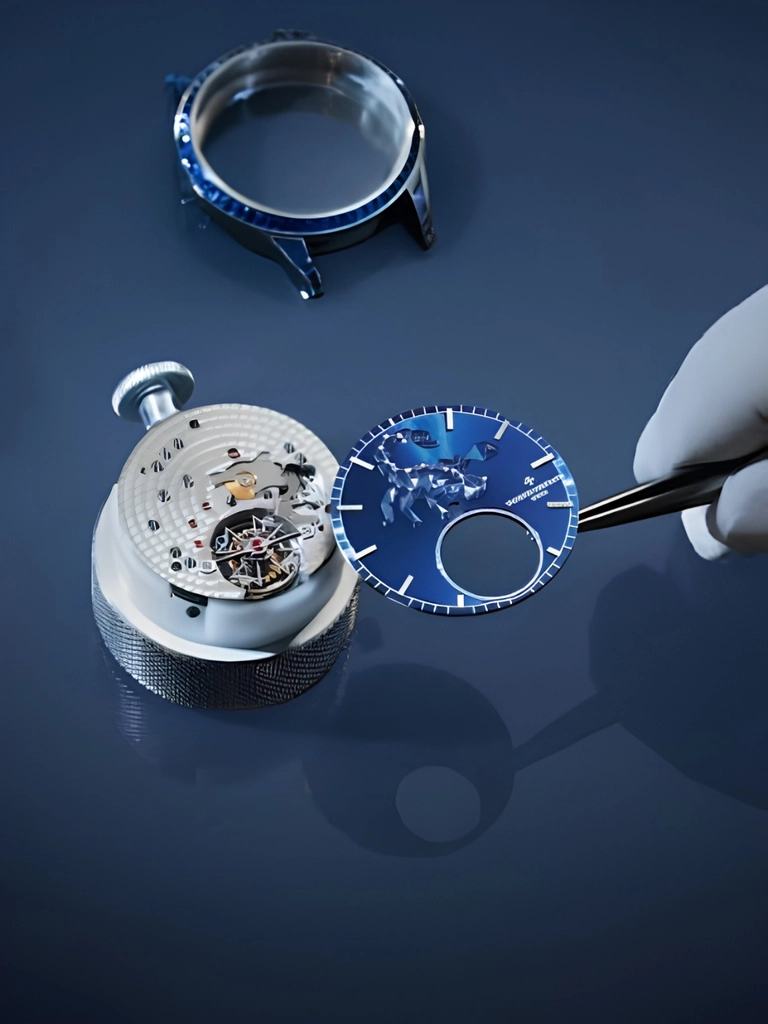
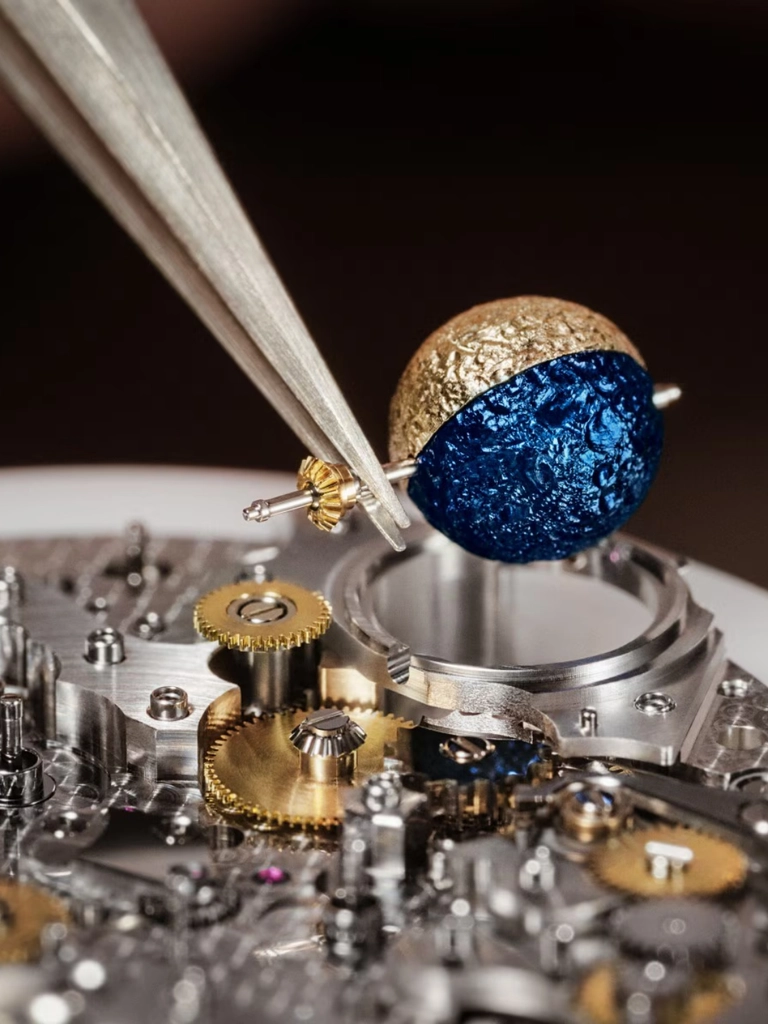
By the time Vacheron Constantin reaches the final four watches of Métiers d’Art Tribute to The Celestial, the technical vocabulary is familiar. A 39mm white-gold case surrounds a blue gold dial. The zodiac figure emerges through figurative hand guilloché, its associated constellation is articulated with brilliant-cut diamonds, and baguette-cut blue sapphires carry the colour of the dial across the bezel, crown, lugs and buckle. Below, the Calibre 2160 tourbillon turns continuously at six o’clock.
Sagittarius looks toward the crowded heart of the Milky Way. Capricorn condenses a mythological hybrid into engraved geometry. Aquarius converts water into reflected light. Pisces binds two separate figures through a celestial idea of connection.
That progression makes the final quartet especially useful for understanding the celestial jewelry watch as more than a set of twelve zodiac illustrations. Vacheron Constantin has constructed a visual grammar and then allowed each sign to disrupt it.
At the centre of the collection is a form of guillochage developed specifically for figurative imagery. Innumerable triangular areas are hand-guilloché with tightly grouped straight lines, while neighbouring sections are engraved at different angles. A single zodiac motif takes around 16 hours to complete.
Those changing angles effectively turn reflection into shading.
One section of the figure catches light while the one beside it recedes, allowing bodies to gain apparent volume without heavy sculptural relief. Seen closely, every creature breaks apart into geometric fragments. From farther away, those fragments reorganise themselves into an archer, sea-goat, water-bearer or pair of fish.
For Sagittarius and Aquarius, Vacheron Constantin adds opaline treatment to parts of the human figures, expanding the dial vocabulary beyond guilloché alone. The collection therefore maintains a shared technique while allowing specific signs to demand additional forms of articulation.
The final four references test that flexibility in particularly different ways.
Sagittarius carries one of the richest astronomical associations of the twelve zodiac constellations.
Its brightest stars form the familiar Teapot asterism, a useful naked-eye pattern whose spout points toward the region of the Milky Way’s galactic centre. In dark skies, the dense band of the Milky Way can appear to rise above the Teapot almost like steam.
Vacheron Constantin interprets Sagittarius through the traditional archer, introducing human anatomy and directional gesture into the dial.
This creates a useful compositional tension. The archer implies extension: torso, arm and weapon push the gaze outward, while the tourbillon at six o’clock anchors the lower half of the watch with circular motion. The human figure therefore occupies the dial through direction, while the movement operates through rotation.
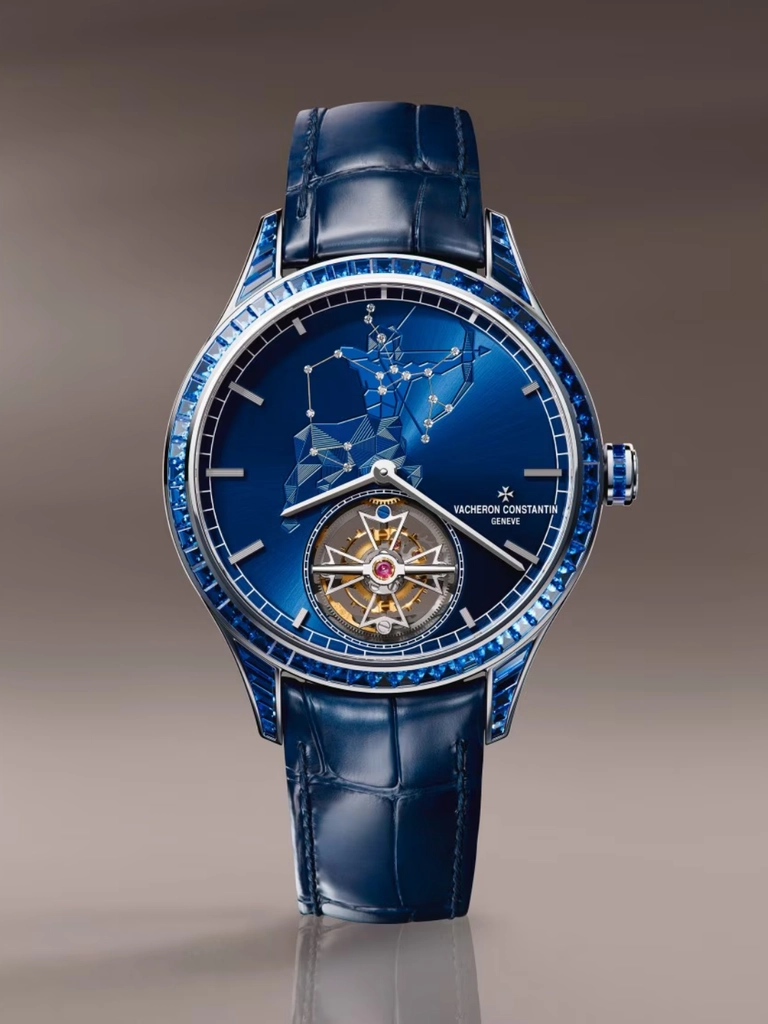
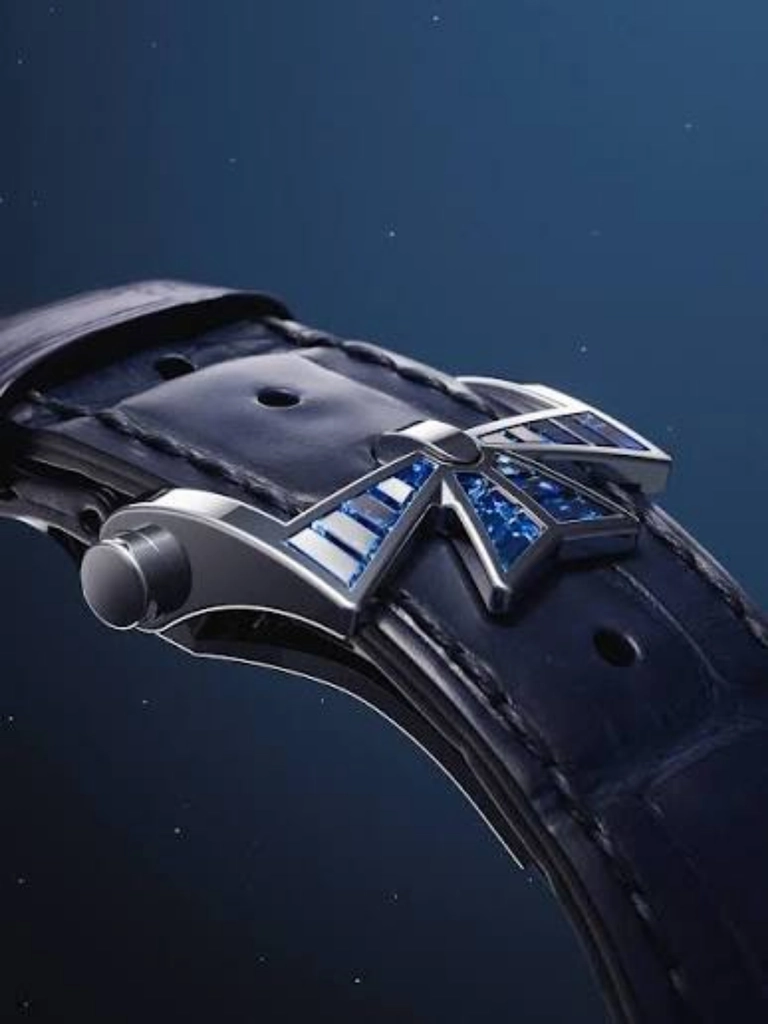
Sagittarius also belongs to the group of references in which opaline finishing supplements the figurative guilloché. That additional surface treatment gives the human components greater clarity against the saturated blue ground.
Above and around the figure, brilliant-cut diamonds identify the constellation as luminous coordinates. Their restraint matters particularly here. Sagittarius occupies a region of the real sky associated with extraordinarily rich Milky Way star fields, yet the watch translates that astronomical density through selected points rather than attempting a literal simulation of the galactic core.
The celestial jewelry watch retains clarity because each material has one function: engraved gold defines the symbolic figure; diamonds establish the celestial map.
Capricorn presents a different challenge because the traditional figure is already an act of visual invention: the sea-goat, combining the forequarters of a goat with an aquatic tail.
Its astronomical constellation, Capricornus, is comparatively faint and commonly recognised through a broad triangular or arrowhead-like arrangement. Stars including Dabih and Deneb Algedi help define that angular structure.
Where Sagittarius depends upon human gesture, Capricorn can be understood through the transition between two forms. The guillocheur must establish enough information for the viewer to read the goat while allowing the lower body to flow into its mythological marine extension.
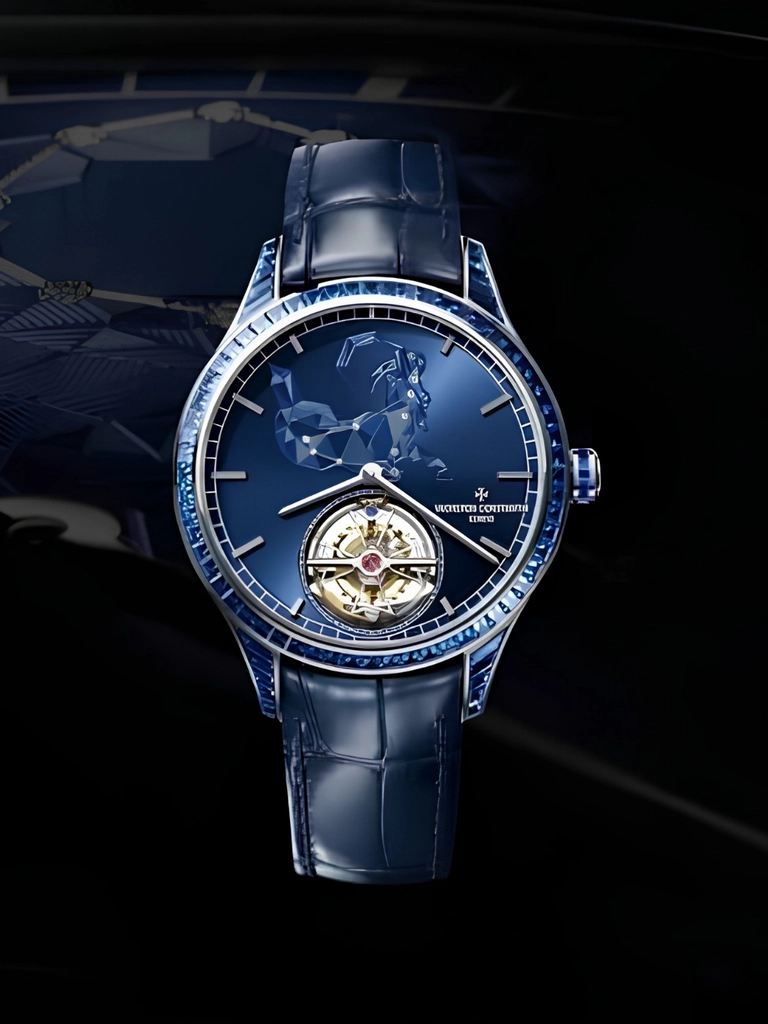
The triangular construction of the guilloché fields becomes particularly useful. Small shifts in line direction can distinguish the harder planes associated with the upper anatomy from the more fluid curve of the tail.
Its figure can occupy a concentrated region of the dial while leaving blue surface around it, allowing the constellation and the sunburst ground to participate more actively in the composition. This creates a watch whose complexity reveals itself through material precision instead of visual density.
That distinction matters across a twelve-watch sequence. Vacheron Constantin has no need to make every zodiac equally crowded. Open dial space becomes another component of the system.
Aquarius introduces an intriguing visual problem: how does a metal dial describe flow?
The constellation contains a recognisable Water Jar asterism, a small Y-shaped grouping from which traditional representations imagine a stream of water descending toward Piscis Austrinus.
The watch interprets the broader symbol through the water-bearer, making Aquarius another reference in which the human figure receives both figurative guilloché and opaline treatment. Its conceptual interest lies in the contrast between material and subject.
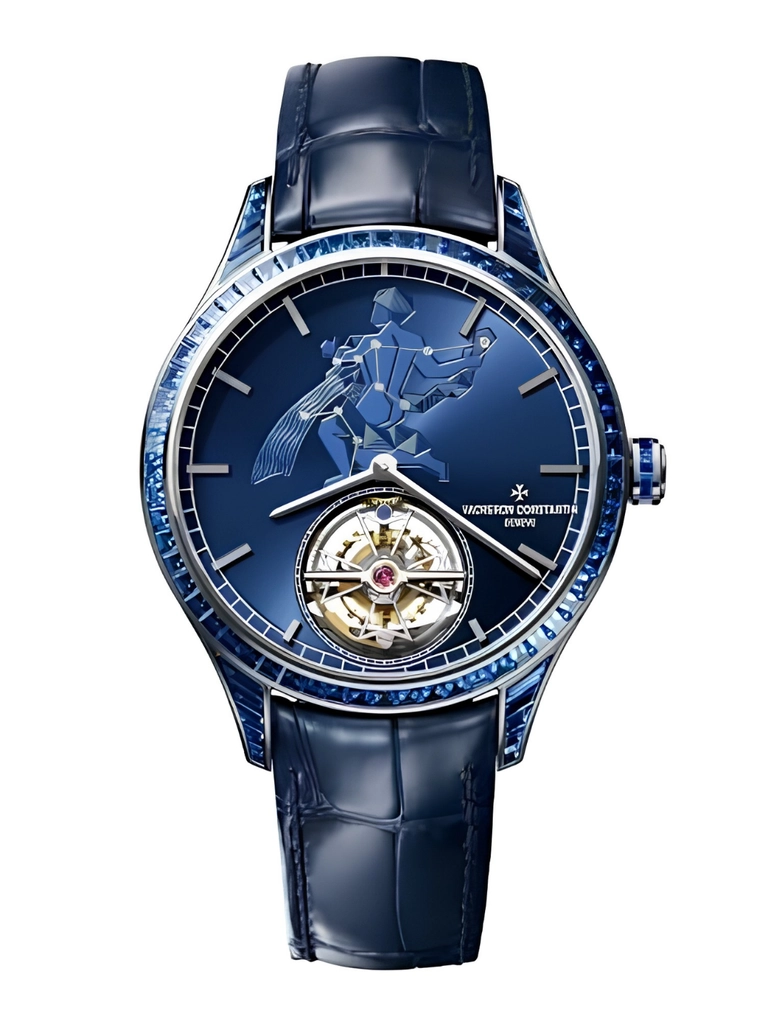
Gold is solid. Guilloché is produced through controlled cutting. Water is fluid and continuously changing. The craft must therefore create the impression of movement using fixed lines. Directional engraving provides the solution. When the wrist shifts, different triangular fields illuminate in sequence, allowing the figure to change optically even though every engraved mark remains stationary.
This quality becomes especially effective for Aquarius because movement is already embedded in its iconography. The water-bearer carries or pours. The associated constellation suggests a stream. Below, the tourbillon performs an actual sixty-second rotation. Across the dial, three distinct forms of movement coexist: symbolic, optical and mechanical.
Pisces closes the zodiac with another problem of multiplicity.
Traditional representations show two fish connected by a cord, with Alrescha, Alpha Piscium, associated with the knot joining them. The long stellar chains create a broad V-like structure across the sky, while the Circlet forms one of the constellation’s most recognisable smaller patterns.
On a watch dial, two figures immediately change the role of negative space. A single lion, bull or scorpion can create one central mass. Pisces asks the eye to move between separate bodies while still understanding them as one sign. Their relationship becomes the subject.
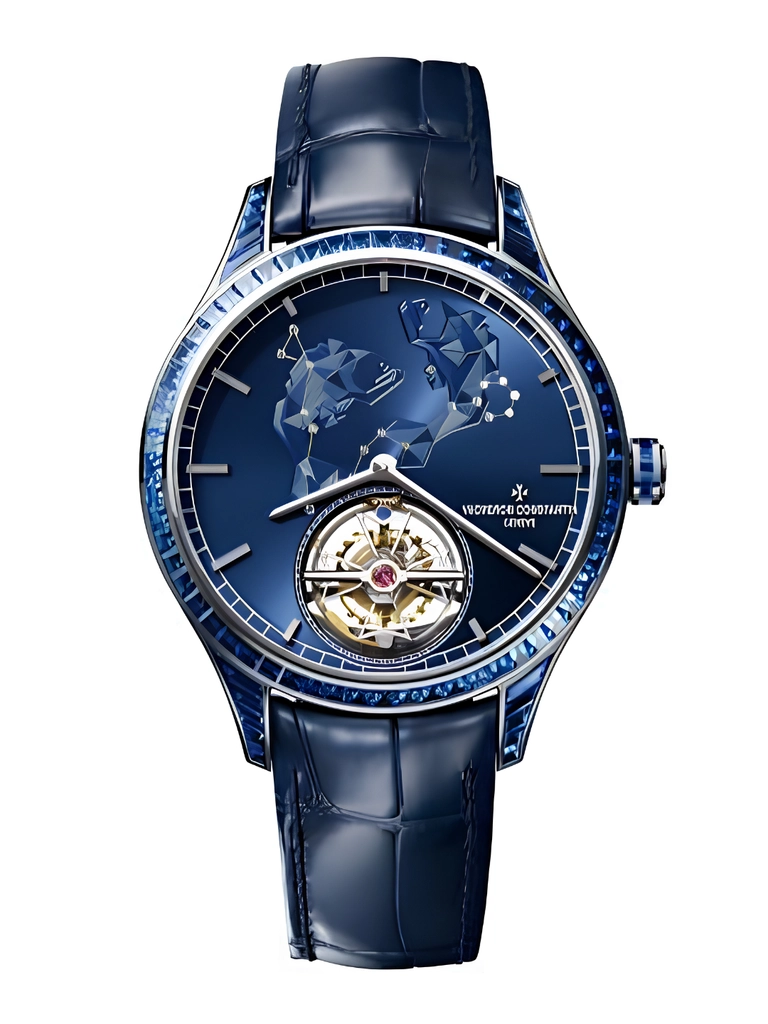
The guilloché technique is particularly effective here because the orientation of engraved fields can differentiate each fish while maintaining the same visual language. Curved bodies can turn in separate directions, with the surrounding blue acting as the space through which they appear to move.
The constellation provides a second structure above this figurative pairing. Diamond points map the celestial identity, while the symbolic fish offer the human interpretation of those distant stars. Pisces therefore closes the collection by returning to one of its central ideas: the zodiac exists simultaneously as astronomy and image.
Across all four references, diamonds and sapphires occupy deliberately different visual scales. The constellation stars use brilliant-cut diamonds, allowing individual stones to read as concentrated points of light. The surrounding blue sapphires use baguette cuts, creating elongated facets and repeated architectural flashes around the case.
Vacheron Constantin states that 96 baguette-cut blue sapphires, totalling approximately 4.41 carats, are used across the bezel, crown, lugs and buckle at collection level, with the gem-setting process requiring approximately 27 hours.
Diamonds act as coordinates. Sapphires establish atmosphere. White gold supplies the frame, while the deep blue dial binds those materials together. Jewellery becomes part of the astronomical language instead of a separate layer of ornament.
Every reference is powered by Vacheron Constantin’s automatic Calibre 2160, a 188-component tourbillon movement measuring only 5.65mm thick. It operates at 2.5Hz, or 18,000 vibrations per hour, provides approximately 80 hours of power reserve, and uses a peripheral rotor that leaves much of the movement visible through the sapphire caseback.
The tourbillon carriage also indicates small seconds, turning once per minute beneath each zodiac composition. Consistency in mechanics therefore makes variation in craft more visible.
Taken together, Sagittarius, Capricorn, Aquarius and Pisces complete the experiment established across the previous eight watches. Sagittarius uses the human figure to establish direction and reach. Capricorn tests the transition between angular and fluid anatomy. Aquarius turns changing reflection into an analogue for flowing water. Pisces explores pairing, separation and connection.
Each solution emerges from the same basic materials. This is where Tribute to The Celestial becomes more interesting than a sequence of twelve astrological emblems. The collection functions as an extended study of what figurative guilloché can describe when its subject keeps changing.
The final four also reveal a progression from physical gesture toward increasingly fluid forms. The archer draws outward. The sea-goat joins land and water. The water-bearer introduces imagined flow. The fishes finally inhabit that fluid world entirely.
For a celestial jewelry watch, the sky remains the conceptual source, yet the dial continually moves between astronomy, mythology, jewellery and mechanics.