At Dubai Fashion Week SS27, crystals caught the light and mythical birds took flight. What happens when couture turns its appetite for spectacle into art?

Dubai Fashion Week SS27: Opening Night in Full Bloom
At Dubai Fashion Week SS27, crystals caught the light and mythical birds took flight. What happens when couture turns its appetite for spectacle into art?
November 7, 2026


On October 22, 2026, the runway at Dubai Design District shimmered beneath a procession of crystal-studded gowns, sculptural silhouettes and extravagant embellishments. Opening the Spring/Summer 2027 season, Dubai Fashion Week welcomed four collections from Yousef AlJasmi, Sara Pedram, Pallavi Puri and Krésha Bajaj in collaboration with Alok Lodha Jewels. Each designer approached occasion dressing with a distinct visual language, from Persian mythology and Indian artisanal traditions to the theatrical possibilities of contemporary couture.
Yousef AlJasmi: Glamour Under Construction
Kuwaiti designer Yousef AlJasmi opened Dubai Fashion Week with a debut presentation centred on body-conscious silhouettes and elaborate embellishments. Working within a controlled palette of black, cream, nude and silver, AlJasmi explored the relationship between sculptural tailoring and fluid ornamentation.


Column and sheath gowns dominated the collection, featuring narrow skirts and closely fitted bodices. Crystal-encrusted mesh created the impression of a luminous second skin, while transparent panels revealed the garments' underlying construction. One high-neck gown featured floor-length cape sleeves adorned with crystals and pearls, allowing decorative strands to cascade freely from the arms. Elsewhere, a halter-neck dress introduced draped crystal chains across its skirt, giving the streamlined silhouette a fluid, jewelry-like quality.


AlJasmi also experimented with volume through a strapless black gown featuring an extravagant ruffled skirt. Its structured bodice established an hourglass proportion before expanding into dimensional layers, introducing variation among the predominantly narrow silhouettes.
Pearls, sequins and crystals remained central to the craftsmanship. Applied across sheer mesh, these embellishments created varying degrees of transparency and reflection. Cascading strands extended from shoulders towards the floor, responding to movement with a gentle, pendulum-like motion.
The collection demonstrated AlJasmi's understanding of contemporary eveningwear, particularly where embellishment reinforced the contours of the body. His strongest designs allowed the construction to remain visible beneath the decorative surfaces, maintaining precision within their theatrical presentation.


Sara Pedram: The Mythology Of Transformation
Persian mythology entered Dubai Fashion Week SS27 through Sara Pedram's The Simorgh Collection, inspired by the legendary bird associated with wisdom, strength and transformation. Drawing from The Conference of the Birds, the 12th-century poem by Attar of Nishapur, Pedram translated spiritual symbolism into sculptural couture.


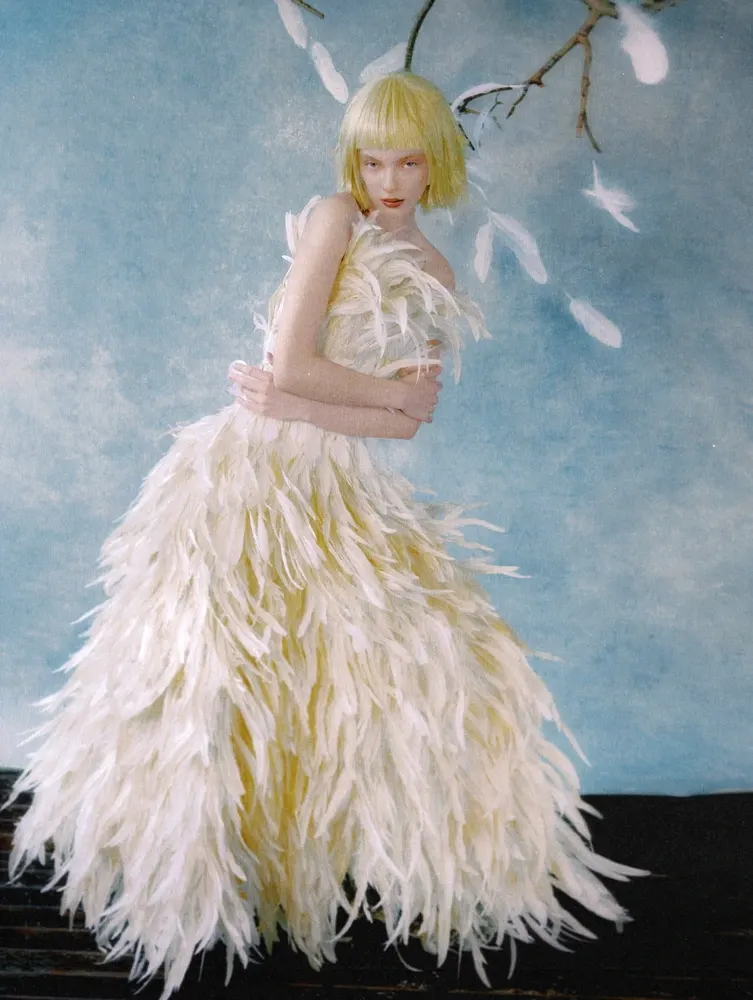
The collection explored exaggerated shoulders, wing-like extensions and dramatic volumes. Sheer gowns featured protruding shoulder constructions resembling outstretched wings, while transparent fabrics softened their architectural outlines. A richly embellished burnt-amber column gown maintained an elongated silhouette, its textured surface introducing depth through intricate decoration.
Material contrasts became particularly significant. A Prussian-blue velvet gown featured a Swarovski crystal Tree of Life embroidered across its sweeping train. The dense velvet absorbed light, allowing the reflective motif to emerge prominently against its surface.


Another striking design featured a voluminous A-line skirt constructed from rough hessian, embellished with a hand-painted scene inspired by Persian poet Hafez. The coarse textile introduced an earthy quality, while the expansive skirt provided a canvas for the illustrated composition.
Through these techniques, embroidery and textile manipulation acquired narrative significance. Winged shoulders communicated transformation through silhouette, while painted fabrics connected the garments to Persian literary heritage. Pedram's strongest creations emerged when cultural symbolism informed the physical structure, allowing mythology to become a tangible element of design.


Pallavi Puri: The Spectacle Of Indian Craftsmanship
Indian designer Pallavi Puri presented Beyond Borders at Dubai Fashion Week, an expansive 50-look collection divided into three chapters. Featuring 30 haute couture pieces, an equestrian-inspired selection and a floral edit, the presentation explored traditional Indian craftsmanship through contemporary occasion dressing.


The collection moved between elongated column gowns, strapless dresses and flowing embroidered ensembles. A white strapless gown featured a hand-painted blue horse's head across its bodice, accompanied by cascading blue fringe. Another one-shoulder dress incorporated a stained-glass-inspired horse motif, with delicate fringe softening its asymmetric silhouette.
Equestrian imagery reflected Puri's longstanding fascination with horses and Dubai's equestrian culture. These references appeared through pictorial embroidery, transforming decorative surfaces into expressive compositions.


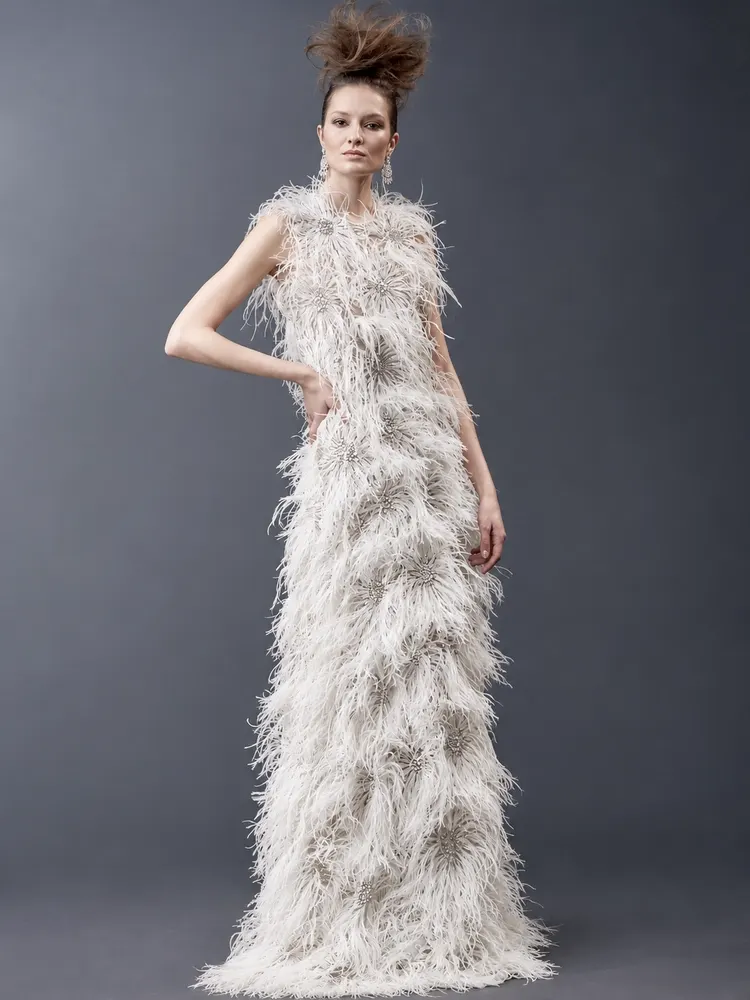
Elsewhere, a pink column gown embroidered with chain-link motifs was accompanied by a feather stole, introducing theatrical volume around its narrow silhouette. Metallic beadwork and teardrop-shaped crystals appeared throughout, producing elaborate textures across both fitted and flowing garments.
The technical scale was considerable. More than 150 artisans employed over 21 traditional craft techniques, with individual pieces reportedly requiring between 500 and 2,000 hours of handwork. Intricate embroidery and hand-applied embellishments highlighted the labour-intensive processes sustaining Indian couture.
Supermodel Lisa Haydon opened the presentation, while Lebanese actress Cyrine Abdelnour closed it in an embellished bridal design. Puri's strongest looks established a direct relationship between intricate craftsmanship and recognisable silhouettes. Across the extensive collection, equestrian symbolism provided a distinctive creative thread, demonstrating how traditional techniques could support contemporary visual storytelling.


Krésha Bajaj x Alok Lodha Jewels: A Garden Of Ornament
The opening night of Dubai Fashion Week SS27 concluded with Krésha Bajaj's The Garden of Borrowed Light, presented in collaboration with Alok Lodha Jewels. Inspired by movement, light and memory, the collection explored botanical imagery through intricate beadwork, fluid textiles and colourful gemstones.


Bajaj introduced an extensive selection of silhouettes, including crocheted crop tops with matching skirts, fitted tank tops, tailored suits and capri pants. A lilac top accompanied leopard-print capris and a beaded hand fan, bringing a playful attitude to summer dressing.
Animal motifs offered another distinctive element. A corset and coordinated skirt featured zebra stripes rendered in blue sequins, transforming a graphic pattern into an intricately embroidered surface.
Eveningwear introduced softer fabrications. Chiffon gowns in lilac and butter yellow featured crocheted corset bodices, combining lightweight movement with structured openwork. Lace, pearls and beaded tassels created additional textures, while decorative fringe formed lattice-like arrangements across the torso and hips.


The palette travelled through camel, lilac, sky blue and red before embracing metallic tones. Jewellery from Alok Lodha Jewels introduced colourful gemstones that complemented the embroidery, extending the collection's fascination with light and ornament.
Bajaj's strongest proposition emerged through her integration of elaborate craftsmanship into recognisable wardrobe pieces, allowing traditional decorative techniques to participate in contemporary summer dressing.


The opening night of Dubai Fashion Week revealed an industry invested in the expressive possibilities of craftsmanship. Yet the distinction between technical accomplishment and creative authorship remained particularly compelling. Crystals, embroidery and gemstones establish immediate visual impact, while their artistic significance depends on the ideas they communicate. The enduring challenge for contemporary couture lies in transforming extraordinary workmanship into an equally recognisable point of view.