




A pattern built on perfect order has led a remarkably disorderly life. On tartan fabric, every line knows exactly where it belongs, even as the people wearing it have spent centuries arguing over what those lines mean.

Tartan Fabric: The Order of Rebellion (Part 1)
A pattern built on perfect order has led a remarkably disorderly life. On tartan fabric, every line knows exactly where it belongs, even as the people wearing it have spent centuries arguing over what those lines mean.
November 5, 2026


A length of wool unfolds across a cutting table, revealing a network of intersecting colours. Deep green meets navy blue, interrupted by a narrow line of red. Each stripe follows a precise sequence, creating squares within squares and subtle variations of colour wherever the threads overlap. The arrangement appears straightforward, yet the smallest alteration can produce an entirely different design.
The pattern operates through repetition, proportion and colour relationships that can be preserved across generations. Its familiar geometry has travelled through Highland dress, ceremonial clothing and contemporary fashion, adapting to different garments while retaining a recognisable structure.
What Is Tartan Fabric?
Tartan fabric is a textile distinguished by a repeated pattern of intersecting horizontal and vertical stripes, traditionally created through the interlacing of differently coloured yarns. The arrangement produces a network of squares and rectangles, with additional tones emerging where contrasting colours cross.
The word tartan technically refers to the design itself. According to the Scottish Register of Tartans, its defining structure consists of two or more alternating coloured stripes arranged vertically and horizontally to form a repeated checked pattern. The sequence of stripes, known as the sett, determines the visual identity of each tartan.

Traditionally, tartan fabric is woven from wool using a 2/2 twill construction. This method produces a subtle diagonal texture across the surface, particularly visible where different coloured yarns intersect. Wool contributes warmth, resilience and an ability to form structured pleats, making the material particularly suitable for kilts, tailoring and outerwear.
Contemporary tartan textiles can also be produced from cotton, silk, synthetic fibres and blended yarns. The underlying design remains recognisable, while the behaviour of the finished fabric changes according to fibre composition, yarn thickness, weave density and finishing treatments.


The distinction between tartan and plaid deserves attention. In North American English, plaid commonly refers to a broad range of checked patterns. Historically, the Scottish term plaid described a length of cloth worn as a wrap or garment. Tartan, meanwhile, refers specifically to a repeated arrangement of intersecting coloured stripes. The terms frequently overlap in contemporary fashion, although their historical meanings differ.
Tartan also carries associations with Scottish families, districts, institutions and military regiments. These connections form an important part of its cultural identity, although the relationship between a particular design and a specific clan develops over time.
Main Characteristics of Tartan Fabric
The most immediately recognisable feature of tartan fabric is its carefully organised grid. Horizontal and vertical stripes intersect according to a predetermined sequence, establishing a pattern that repeats consistently across the textile.
The individual pattern repeat is called a sett. Its appearance depends on the number of colours, the width of each stripe and the order in which those stripes appear. A design with broad dark bands and narrow contrasting lines creates an effect of visual depth, while closely spaced stripes can produce a denser, more intricate surface.


Colour interaction contributes another distinctive characteristic. In a woven tartan, the intersection of two differently coloured yarns produces an optical mixture. The diagonal arrangement of the twill weave makes this effect particularly visible, creating intermediate tones between the dominant blocks of colour.
Many traditional tartans use symmetrical setts, in which the stripe sequence reverses around a central pivot. Asymmetrical arrangements are also possible, allowing designers to establish different patterns of repetition.
The physical qualities of tartan fabric depend largely on its textile composition. Wool tartan commonly offers warmth, moderate elasticity and the ability to retain pressed shapes. These properties are particularly valuable in tailoring, where folds, pleats and garment structure contribute to the finished silhouette.

Fabric weight introduces further variation. Lightweight wool tartan can accommodate softer draping and garments intended for movement, while heavier constructions provide the body required for structured kilts, jackets and coats.
Cotton tartan generally offers a lighter, more casual alternative, depending on the weave and yarn specifications. Silk variations introduce a smoother surface and fluid draping, making them suitable for scarves, dresses and refined accessories.
Surface texture also changes with finishing. Brushed wool develops a softer, slightly raised surface, while smoother worsted constructions retain sharper pattern definition and a more polished appearance.
The precision of the grid can become an important design consideration during garment construction. Matching the lines across seams, pockets and closures requires careful pattern placement. When successful, the repeated geometry continues across the garment with remarkable visual consistency.
Common Types and Variations of Tartan Fabric
Tartan designs can be classified according to their historical associations, intended uses and colour interpretations. These categories describe different aspects of the design rather than entirely separate methods of textile construction.


Closely associated with Scottish families and ancestral lineages, clan tartans are distinguished by specific arrangements of coloured stripes that serve as recognisable symbols of heritage. Designs such as Bruce of Kinnaird and Royal Stewart illustrate how individual setts acquire identities through their historical associations, with variations in colour and stripe proportions distinguishing one pattern from another.


Developed or adopted for military identification, regimental tartans carry associations with particular Scottish military units. Black Watch, recognised for its deep navy, green, and black checks, remains among the most familiar examples. Its subdued palette and established military heritage give it a distinctive character within traditional tartan design.


A single tartan design may appear in several colour interpretations while retaining its underlying sett. Modern versions generally feature stronger, more saturated shades, whereas ancient versions employ softer tones intended to evoke historical dye colours. Muted and weathered palettes introduce subdued or earthy hues, while hunting and dress variations have their own historical conventions, often associated with darker colours and greater use of white, respectively.
How Is Tartan Fabric Used in Fashion?
The kilt remains one of tartan fabric’s most recognisable applications, with carefully arranged pleats allowing the geometric pattern to interact with movement and volume. Traditionally constructed from wool, its distinctive structure has also inspired contemporary interpretations of pleated skirts and tailored garments.
Beyond traditional Highland dress, tartan appears in structured jackets, trousers, waistcoats, and coordinated suits, where the alignment of checks becomes an important part of garment construction. Wool coats and oversized scarves allow larger sections of the pattern to remain visible, while lightweight variations lend themselves to dresses, shirts, and fluid separates. Cutting tartan on the bias or combining contrasting panels can further transform its familiar geometry.


Designers have repeatedly explored tartan's cultural associations through experimental fashion. Vivienne Westwood's Fall/Winter 1993 Anglomania collection reinterpreted Scottish heritage through unconventional tailoring, exaggerated proportions, and playful combinations of tartan patterns. Alexander McQueen approached the material with greater historical intensity, particularly in his Fall/Winter 2006 Widows of Culloden collection, where tartan became a powerful expression of Scottish identity, memory, and political history.


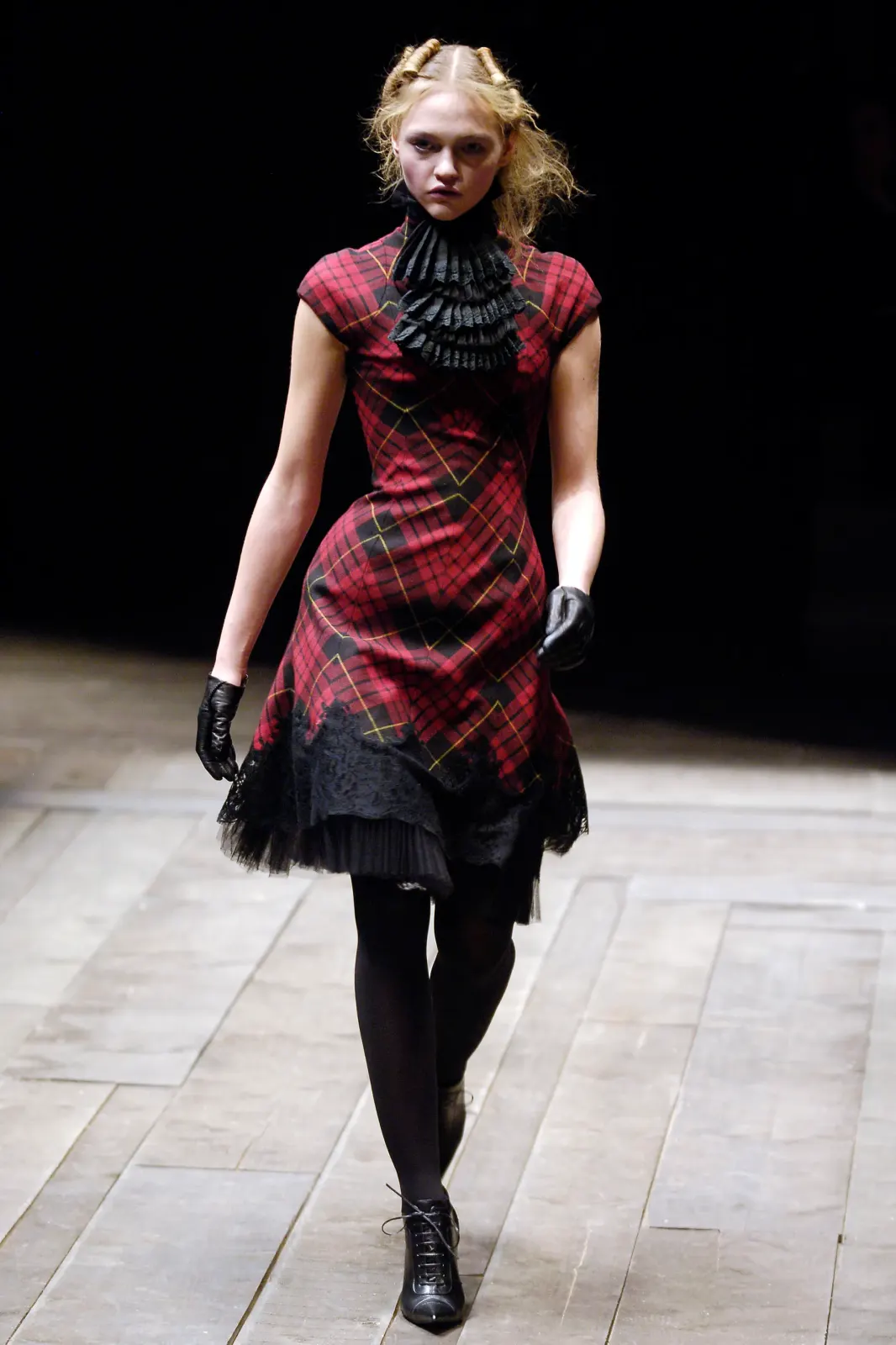
Contemporary fashion continues to expand tartan possibilities through patchwork, asymmetric construction, and unexpected colour combinations. From Chopova Lowena's hardware-accented pleated skirts to Dior's refined Scottish-inspired tailoring, the pattern moves between heritage craftsmanship and experimental design. Its presence in bags, scarves, footwear, and other accessories further demonstrates how easily its distinctive grid adapts to different scales and silhouettes.
How to Identify, Buy and Care for Tartan Fabric
Identifying tartan fabric begins with examining its repeated stripe arrangement. The colours should follow a consistent sequence across both directions, producing a recognisable sett.
On traditionally woven tartan, the coloured yarns form the pattern within the textile itself. Both sides generally reveal the intersecting stripes, although the surface texture and colour appearance may differ slightly according to the weave. Printed tartan can reproduce a similar design on other textile constructions, with the pattern applied to the surface.


Traditional wool tartan frequently displays a subtle diagonal texture associated with twill construction. Examining the surface closely can reveal this structure, particularly in areas where contrasting colours intersect.
Fabric composition should guide purchasing decisions. Wool tartan offers particular advantages for structured tailoring, kilts and cold-weather garments. Cotton versions can be suitable for lighter dresses, shirts and casual clothing, while silk and fine blended constructions provide alternative draping qualities.
When purchasing wool tartan, the intended garment should determine the appropriate fabric weight, width and finishing. Kilts generally require cloth with enough body to hold pleats, while softer constructions may be preferable for scarves and fluid garments.

Care requirements depend on fibre composition, dyeing methods and garment construction. Wool tartan often benefits from gentle handling, appropriate airing and professional cleaning when specified by the manufacturer. Excessive heat, moisture and agitation can affect the dimensions and surface texture of certain wool fabrics. Wool garments should be kept clean and protected from moth damage, while heavier pieces benefit from appropriate support to preserve their shape. Folded kilts and pleated skirts should be stored with attention to their established folds.
The value of tartan fabric lies partly in this continuity between material and design. A carefully constructed garment can retain the precision of its pattern over many years, allowing the original relationship between colour, proportion and weaving to remain visible.
Its characteristic grid may seem fixed, yet every new application introduces another interpretation of a textile whose visual identity has travelled far beyond its original setting.