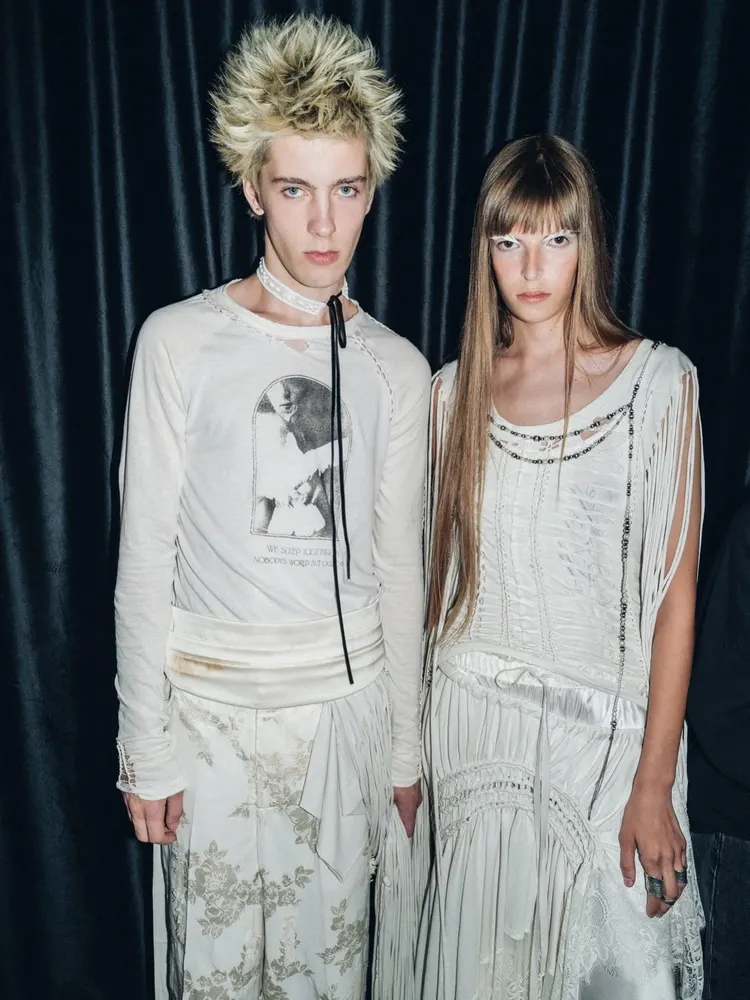
At Barcelona Fashion Week SS27, how many times can an identity be remade before it begins to lose its edges?

Barcelona Fashion Week SS27: Identity Games (Part 1)
At Barcelona Fashion Week SS27, how many times can an identity be remade before it begins to lose its edges?
November 3, 2026


The runway at Marina Vela began with clothes carrying traces of owners who would never appear on it. On October 20, the 38th edition of 080 Barcelona Fashion opened along Port Vell, with 26 shows scheduled across four days. Its opening presentation gave garments of uncertain provenance another public life, setting an intriguing precedent for an event where personal history would prove difficult to leave behind.
Barcelona has long provided space for designers whose ambitions stretch beyond conventional ready-to-wear. Here at Barcelona Fashion Week SS27, experimentation can emerge from something as familiar as a secondhand shirt or as elaborate as a fully constructed stage persona. Yet creative freedom also creates its own demands. Once a designer has permission to do almost anything, the choices made within that freedom become especially revealing.
080 REBORN
Someone else's wardrobe took possession of the runway at 2 p.m. Fermín Serret and Gilles Saint Martin returned for the fifth edition of 080 REBORN with Nòmade, a presentation built entirely around secondhand clothing. Its premise treated garments as travellers, gathering different cultural meanings as they passed between people, places and circumstances.


Prints collided across layered silhouettes, while contrasting textures and unexpected combinations unsettled the original purpose of individual pieces. Familiar clothing categories became difficult to identify beneath the accumulation of materials. Nothing requires a pristine beginning to acquire a convincing new identity.
Yet the challenge for a project like 080 REBORN lies in making the creative intervention as compelling as its environmental argument. Reuse already has an ethical justification, but a runway must still establish an aesthetic one. Nòmade found its strength in the tension between accumulated history and deliberate styling. Its exuberance raised an equally useful question about restraint: when every garment has a story, the designer must decide which stories deserve to be heard together.
Inma Linares
Fabric appeared to develop its own anatomy under the direction of Inma Linares. Her collection Morphé emerged from the Seville-based designer's continuing investigation into textile construction, with pleating, draping and manipulated surfaces shaping the relationship between clothing and the female body.


Volume became the principal instrument. Sculptural forms extended the silhouette, while transparent materials revealed how the designs occupied space around the wearer. Linares used the contrast between precise construction and fluid movement to explore femininity through the physical behaviour of cloth.
The technical ambition carried a familiar risk for sculptural fashion. Elaborate construction can become so concerned with demonstrating its own complexity that the person wearing it begins to disappear. Morphé was most persuasive as an investigation of that relationship, especially where the body's natural contours remained visible beneath the engineered volume. Its value lay in treating craftsmanship as an ongoing negotiation between material and anatomy, with neither granted absolute authority over the other.
Custo Barcelona
By Tuesday evening, Custo Barcelona had taken possession of the runway with Unexpected, a title that practically invited the audience to question how far the brand would venture beyond its established identity.
Custo Dalmau's visual language has travelled a considerable distance since the printed T-shirts that helped establish the label in the 1980s. For SS27, the focus turned towards fluid dresses, translucent layers, lace and ruffled constructions. Pastel tones and muted earth colours softened the image, while embroidery, patchwork and shimmering finishes preserved the house's appetite for surface experimentation.


The resulting femininity was elaborate, though its energy came from the material treatment itself. Wide sleeves and drifting fabrics gave the garments a sense of movement, while geometric details introduced the structural discipline necessary to control their many textures.
Unexpected consequently exposed an interesting tension within an established label. When a house has spent decades celebrating individuality, unpredictability eventually becomes part of its signature. Custo's familiar commitment to expressive dressing remained evident throughout the collection, making its quieter proportions and tactile detail meaningful developments. The surprise was subtle, and the collection's title placed a considerable burden on those refinements.
Guillermina Baeza
Wednesday morning began with a row of chairs along the runway. Models occupied them at the beginning and end of Guillermina Baeza's presentation, turning the familiar choreography of a fashion show into something resembling a dressing room temporarily exposed to public view.
Titled Vesper, the collection explores the intimate rituals surrounding women's clothing. Under the creative direction of Belén Larruy, the house brought elements of corsetry and lingerie into its established swimwear vocabulary. Tulle, satin-finished Lycra and lurex mesh accompanied floral prints drawn from the archives, while lace effects and delicate draping suggested garments caught between states of dress and undress.


The theatrical setting made the collection's central idea tangible. Swimwear already occupies a curious position in fashion, exposing the body while demanding its own forms of support, security and construction. By borrowing the visual codes of lingerie, Baeza drew attention to the complicated relationship between intimacy and public presentation.
This was an effective way to revisit an established house identity without relying entirely on nostalgia. The archive supplied the vocabulary, while the staging invited the audience to reconsider the relationship between the garment and the person preparing to inhabit it.
404 Studio
Reality became increasingly difficult to locate when 404 Studio presented Paprika. Designer Anaïs Vauxcelles turned to Satoshi Kon's 2006 animated film, whose shifting boundaries between dreams and waking life provided an imaginative framework for SS27.
Muted garments encountered hyper-saturated reds, electric blues and artificial greens. Sequinned beanies, crocheted lips and unusually positioned bags interrupted familiar silhouettes, while the label's collaboration with Melissa introduced playful interpretations of the Brazilian brand's jelly footwear.


The visual eccentricities carried a personal dimension. Vauxcelles used the film's competing worlds to examine the distance between the person who once imagined a future in fashion and the person eventually confronted with the industry's realities. Dreaming becomes a means of revisiting early creative instincts, complete with their anxieties and unrealistic expectations.
Crochet played an especially interesting role in making that psychological tension visible. Its physical texture gave improbable shapes a convincing presence, allowing fantasy to take on the substance of something handmade. The collection was entertaining at the level of individual objects, although its ambition demanded a degree of visual coherence that occasionally competed with those eccentric details.
Still, Paprika had a distinctive creative proposition. Its oddities invited the viewer to reconsider the logic of ordinary accessories and familiar clothing forms, which made the collection's surrealism relevant to the actual experience of getting dressed.
Dominnico
Madonna arrived at Barcelona Fashion Week through the imagination of Domingo Rodríguez Lázaro. Celebrating the tenth anniversary of Dominnico, the designer presented Supernova, a Spring 2027 collection inspired by the pop star's continual reinvention and her enduring command of image.
The references travelled through her early 2000s music videos, Hollywood glamour and electronic dance culture. Yet clothing also suggested an effort to establish a wardrobe capable of accompanying its wearer through ordinary life. Pinstriped tailoring, pencil skirts and reconfigured bomber jackets introduced a practical dimension to the label's familiar repertoire of provocative silhouettes.


Satin and leather supplied the sensuality, while pastel blue, lavender and soft coral interrupted the sharper contrasts of black and white. Mini jackets and fitted separates preserved Dominnico's youthful appeal. Cargo details and utilitarian accents, meanwhile, gave the garments an increasingly functional character. An ongoing collaboration with Samsung extended the brand's interest in connecting fashion with technology.
The anniversary made this evolution particularly significant. Dominnico has developed an instantly recognisable visual identity through exaggerated femininity, gender fluidity and pop-cultural spectacle. Such recognisability is valuable for an independent brand, but it can become restrictive when every season is expected to repeat the image that made the label successful.
Supernova suggested a desire to expand the possibilities of that identity. Some of the tailored pieces carried this ambition convincingly, offering silhouettes that could survive outside the carefully constructed atmosphere of a runway. Elsewhere, the familiar vocabulary remained firmly in control.
Ten years into its existence, Dominnico appears increasingly concerned with the life its clothes might lead after the spectacle ends. That consideration gives its evolution genuine significance. Growing up, for a brand built around youth and rebellion, may be the most challenging reinvention of all.
The Trouble With Reinvention Inside Barcelona Fashion Week SS27
By the time Dominnico's anniversary show came to an end, the familiar excitement of watching a designer establish a visual identity had acquired another dimension. Once that identity becomes recognisable, maintaining it can demand as much calculation as creating it. What began as an act of independence risks becoming an aesthetic obligation.
Barcelona has cultivated a fashion environment where eccentricity enjoys considerable freedom. The platform's value lies partly in its willingness to accommodate creative practices that might struggle within the demands of a major commercial fashion calendar. Yet permission to experiment should never be confused with evidence of artistic achievement. Originality deserves scrutiny precisely because it is so easily claimed.
Contemporary fashion has become remarkably skilled at producing memorable images. Social media rewards the spectacular silhouette, the outrageous accessory and the runway moment capable of circulating independently from the collection that produced it. The danger emerges when recognition becomes the final objective. Designers can spend years perfecting the appearance of individuality while gradually narrowing the possibilities of their own creative language.
Barcelona Fashion Week SS27 offers an opportunity to insist on a demanding definition of creative freedom. Independence should give designers the courage to question even the signatures their audiences have learned to love. The most meaningful act of reinvention may eventually be the willingness to abandon a successful image before it becomes impossible to escape.
And for an industry that has made identity into one of its most valuable commodities, that remains a remarkably difficult decision.