MENU
Close





Hemmerle turns high jewelry into wearable sculpture. From its 1893 origins as a Munich court jeweler to its radical use of iron, aluminum and rare gemstones, the house has built a luxury brand history defined by material contrast, architectural form and exceptional handcraft.

Hemmerle turns high jewelry into wearable sculpture. From its 1893 origins as a Munich court jeweler to its radical use of iron, aluminum and rare gemstones, the house has built a luxury brand history defined by material contrast, architectural form and exceptional handcraft.
September 19, 2026


Hemmerle began in a world where jewelry served ceremony.
Founded in Munich in 1893 by Joseph Hemmerle, the house initially became known for medals, insignia and regalia connected to the Bavarian royal court. Its early identity belonged firmly to European goldsmithing tradition: technical precision, noble commissions and the formal language expected of a court supplier.

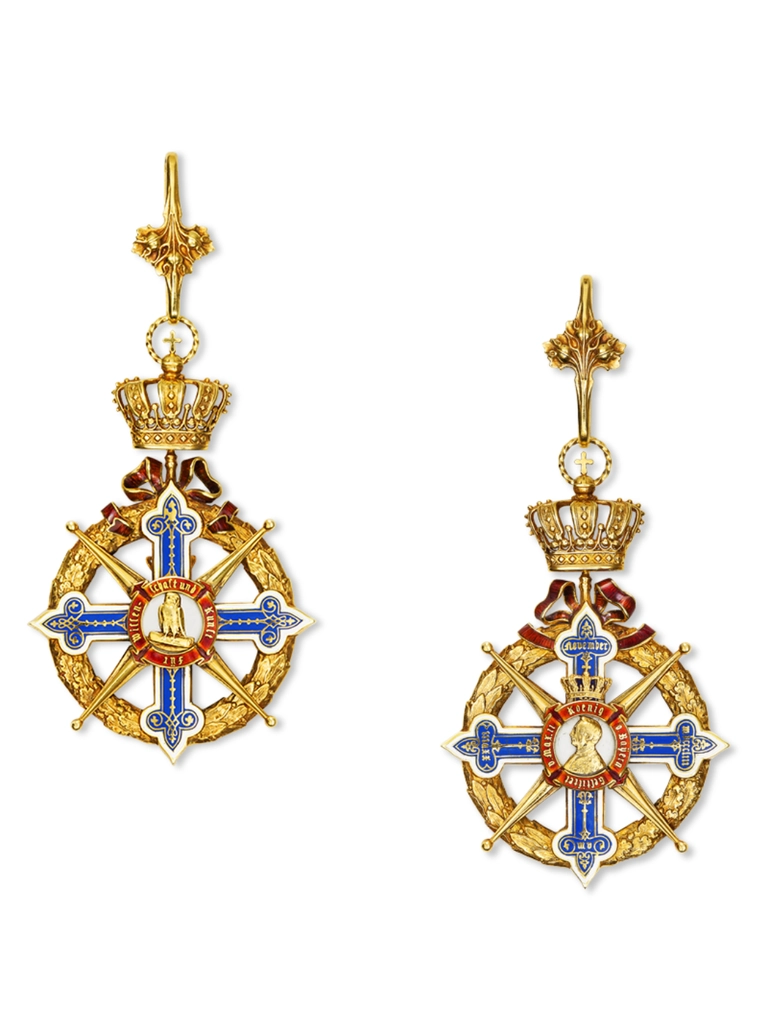
That history matters because contemporary Hemmerle could hardly look further removed from ceremonial conservatism.
Today, the atelier is associated with oxidized iron, bronze, aluminum, ebony, carved organic materials and gemstones arranged in compositions that often feel closer to modern sculpture than conventional high jewelry.


A major diamond might emerge from a dark, almost industrial surface. Emeralds may disappear into green-toned metal. Earrings can intentionally differ from one another while remaining compositionally linked. Its transformation came gradually, then suddenly. The pivotal moment arrived in the 1990s.
In 1995, Stefan Hemmerle received an unusual commission from a collector who disliked conspicuous jewelry. The solution became one of the most consequential objects in the house’s modern history: a valuable diamond set into textured iron.
Its inspiration reached back toward early nineteenth-century Berlin iron jewelry, pieces whose emotional or patriotic meaning often outweighed the intrinsic monetary value of their material. Hemmerle adapted that logic for contemporary high jewelry. Instead of allowing precious metal to amplify a gemstone’s financial status, iron created an almost austere frame around it.

The result altered the entire visual hierarchy of the jewel. Against dark iron, the diamond appeared sharper. Its brilliance felt concentrated. The setting withdrew while the stone gained intensity.

More importantly, the ring gave Hemmerle a philosophy. Luxury could be found in juxtaposition. Material worth and artistic worth could exist on different scales. A humble metal could make an extraordinary gemstone feel even more extraordinary. That principle became foundational to the house’s modern luxury brand history.

Traditional high jewelry has long relied on an established pyramid of materials. Platinum and gold form the architecture. Diamonds and important colored stones provide brilliance, rarity and value.
Hemmerle approaches that hierarchy with far more freedom.
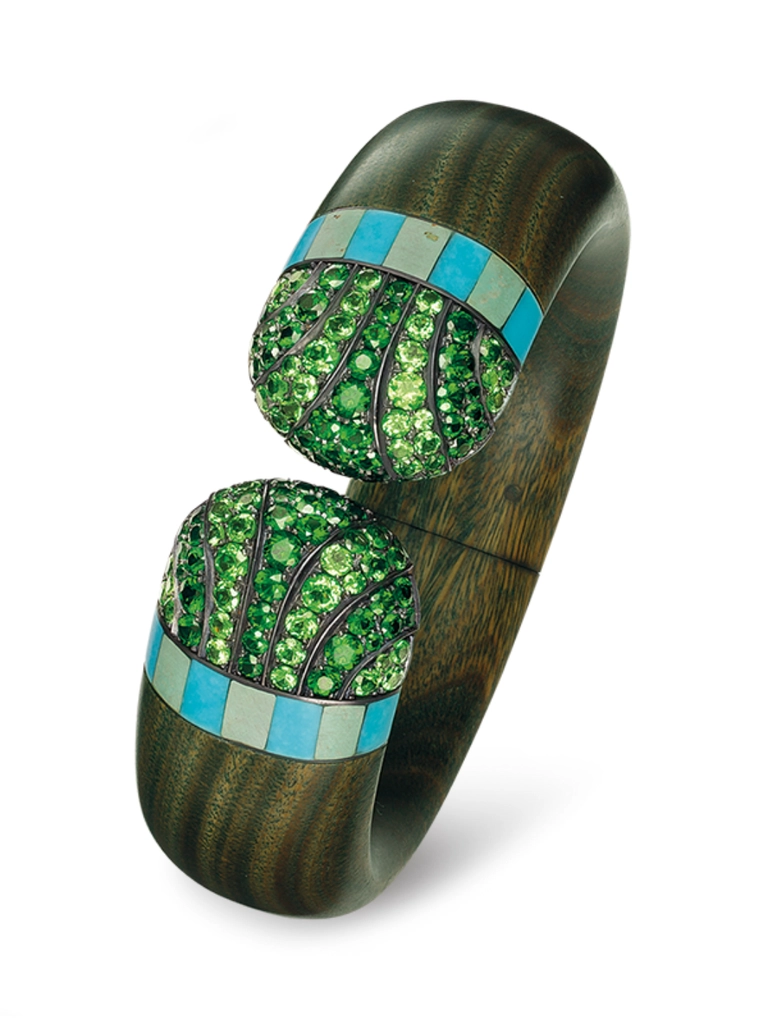
Iron, bronze, copper, aluminum and wood can sit beside stones worth exponentially more than the material holding them. The contrast feels deliberate, never ironic. These materials are selected for color, weight, texture and the way they change the optical character of a gem.
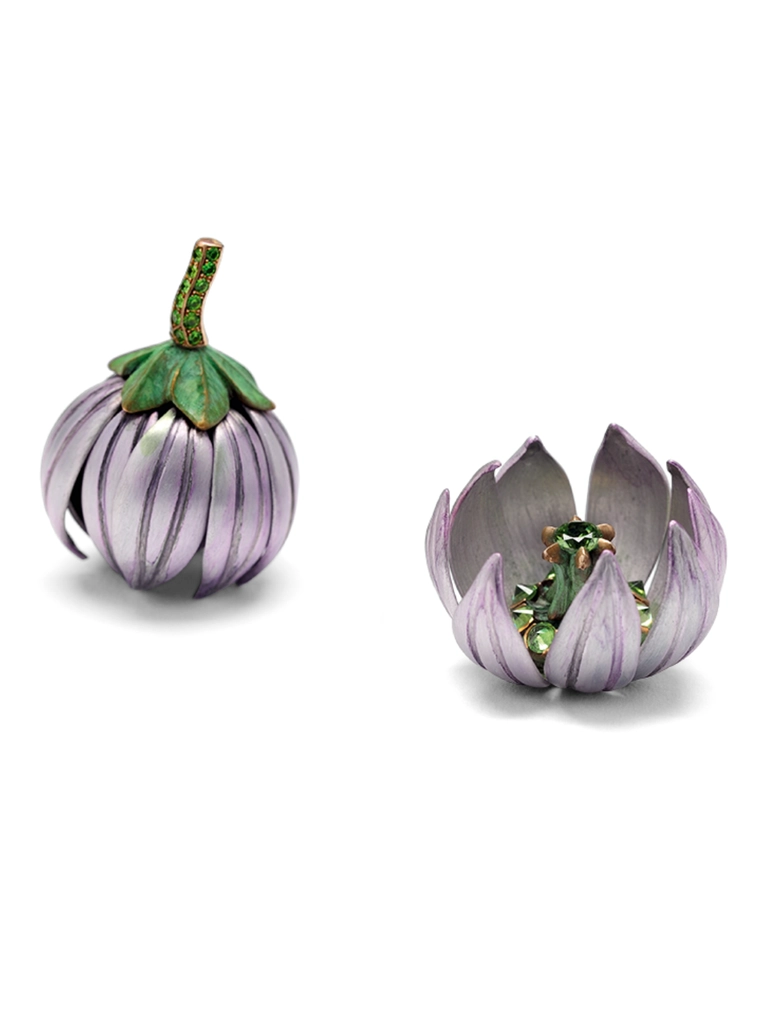

Patinated iron and bronze are particularly important.
Their darker surfaces absorb visual noise. Where polished gold reflects light around a gemstone, matte metal can create a quieter field, allowing the color of the stone to appear denser and more immediate.
A vivid sapphire gains depth against darkened bronze. A diamond set into iron looks almost electrically bright. Demantoid garnets can be surrounded by green-toned metal that dissolves into the gemstone instead of framing it conventionally.
The setting becomes atmosphere. Among Hemmerle’s most technically useful departures from traditional jewelry materials is anodized aluminum.
Its lightness allows the atelier to create substantial volume without producing equally substantial weight. Large earrings can therefore take on architectural proportions while remaining wearable. Color is equally important.
Through anodization, aluminum can acquire saturated surfaces in purple, blue, green and other tones. Hemmerle frequently uses those colors to construct a close relationship between metal and gemstone.
This tone-on-tone strategy produces an unusual effect. Instead of gold announcing itself as a separate precious material around the stone, the mounting begins to merge visually with the gem.
Another recognizable element in Hemmerle’s vocabulary is reverse setting.
Conventional jewelry typically presents the table and crown of a gemstone outward, allowing light to enter through the familiar upper facets. Hemmerle sometimes reverses that relationship, turning the pavilion outward so that pointed gemstone structures create tactile, almost armored surfaces.
Suddenly, a gem becomes texture. Rows of reverse-set stones can produce spikes, pyramids or geometric skins across a jewel. Familiar materials acquire an unfamiliar physical character.
The technique fits Hemmerle’s larger interest in disrupting expectations around precious stones. A sapphire can serve as color, architecture and surface simultaneously.
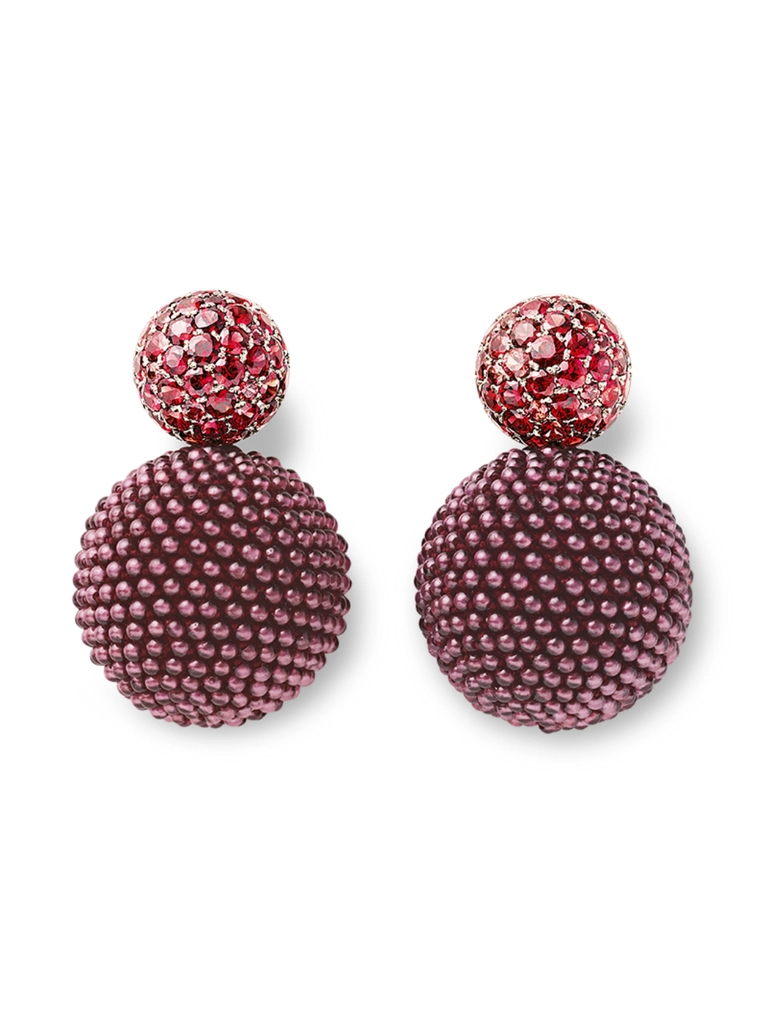
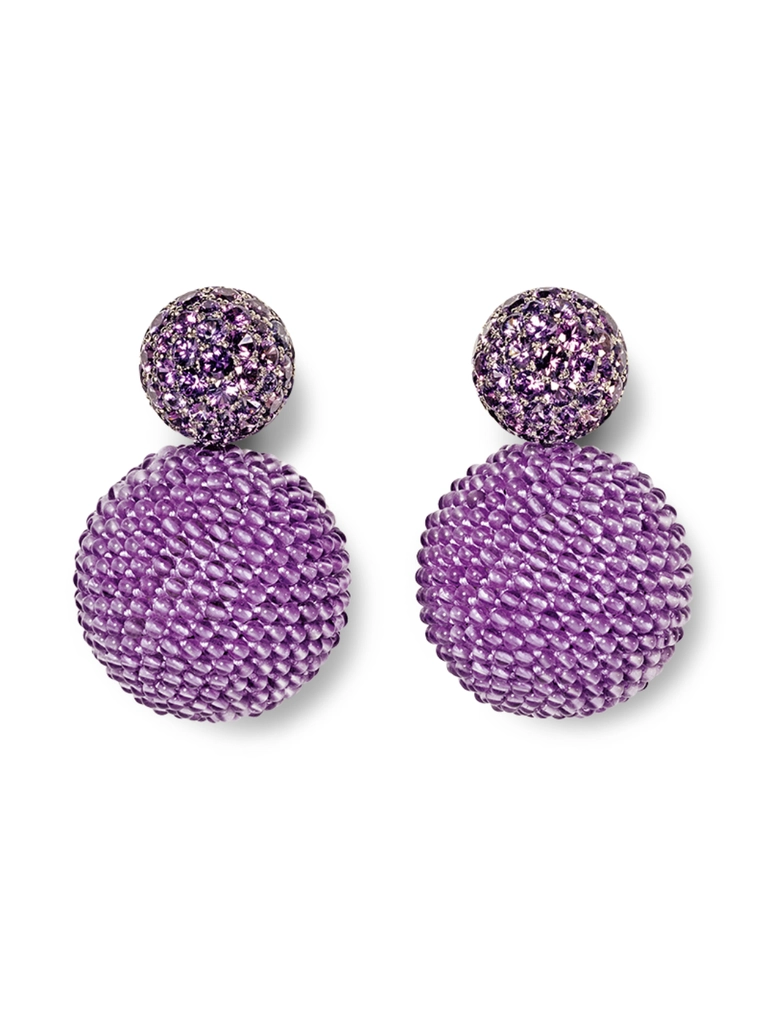
Beauty comes through construction. For all its architectural severity, Hemmerle also creates jewelry capable of extraordinary softness. Its knitted gemstone necklaces revive a nineteenth-century Austrian technique in which tiny gemstone beads are drilled and woven on silk thread. Hundreds can be incorporated into a single piece, creating a surface that falls and moves more like fabric than conventional jewelry.
Emeralds, sapphires, garnets and other stones become flexible mesh. From a distance, the effect can resemble textile. Up close, every point of the surface is mineral. The contrast is quintessentially Hemmerle: hard matter manipulated until it appears fluid.
These pieces also reveal the intensity of the atelier’s handwork. The finished object may feel visually effortless, yet construction can involve hundreds of hours of painstaking fabrication.
With fewer than 200 one-of-a-kind creations reportedly produced annually by a small team of specialist goldsmiths, scarcity emerges from labor as much as strategy.


Hemmerle occupies an unusual position in contemporary high jewelry because scale appears almost irrelevant to its identity.
There is one Munich base, a family structure spanning four generations and an annual output that remains tiny beside major international maisons. Individual creations can require more than 500 hours of fabrication.
Large-scale production would be difficult to reconcile with the techniques involved, particularly when each stone can determine the architecture of the entire jewel.
This reverses a familiar luxury model. Instead of designing a recognizable product and sourcing materials to reproduce it repeatedly, Hemmerle often begins with an exceptional material or gemstone and develops a unique construction around it.


The object exists because that particular stone exists. Within independent high jewelry, Hemmerle belongs to a small group of houses whose signatures are strong enough to be recognized before the maker’s name is revealed.
Yet those signatures differ dramatically. JAR, founded by Joel Arthur Rosenthal in Paris, is celebrated for intense pavé, painterly gradations of color and highly naturalistic forms.
Mumbai-based Viren Bhagat approaches jewelry through another vocabulary, filtering Indian and Mughal references through remarkably light contemporary structures and carefully engineered stone arrangements.
Wallace Chan pushes toward high technical spectacle through titanium, carving and large-scale sculptural forms.
Hemmerle occupies another territory entirely. Its language depends on mass and restraint, old craftsmanship and modern material science, precious gemstones and metals traditionally considered too ordinary for high jewelry.

Iron beside diamond remains the clearest shorthand. Yet the philosophy extends far beyond one material pairing. Hemmerle’s rarity also shapes its secondary-market presence.
Pieces appear far less frequently at major auctions than jewels from larger historic houses. Primary sales are closely controlled, with collectors encountering the work through the Munich house, appointments and important art fairs such as TEFAF.
This selective circulation influences the way Hemmerle is collected. For many buyers, the object sits somewhere between jewelry and contemporary art.
Museum interest reinforces that perception. Institutions including the Victoria and Albert Museum and Cooper Hewitt have engaged with Hemmerle’s work, placing it within broader conversations about design, craftsmanship and material innovation.
Such recognition shifts the discussion away from carat arithmetic alone. A Hemmerle jewel can contain an extraordinary gemstone, yet its identity depends equally on the ingenuity of the mount, the relationship between colors, the physical behavior of materials and the precision of its construction. The value of the gemstone remains visible. It simply stops being the only story.
There is a satisfying tension at the center of Hemmerle. The house began with court jewelry and became famous for iron. It works with some of the world’s rarest gemstones while repeatedly introducing materials associated with architecture, engineering or everyday objects. Its jewelry can feel monumental in form yet remarkably restrained in surface.
Even its most experimental work retains the discipline of traditional goldsmithing. This makes Hemmerle’s luxury brand history less a rejection of heritage than a transformation of what heritage can support.