Beyond Milan's applause, Phan Đăng Hoàng opens up about the memories he protects, the people behind his clothes, and the designer he has yet to become.

Phan Đăng Hoàng: “I Simply Want to Be a Designer”
Beyond Milan's applause, Phan Đăng Hoàng opens up about the memories he protects, the people behind his clothes, and the designer he has yet to become.
October 27, 2026


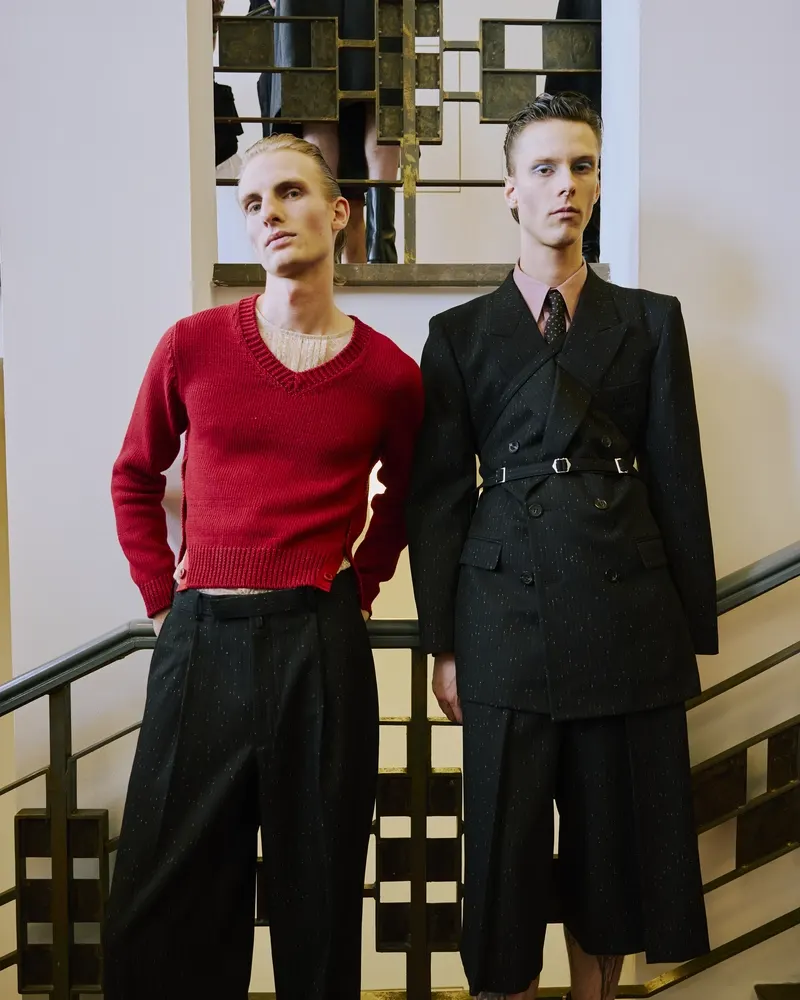
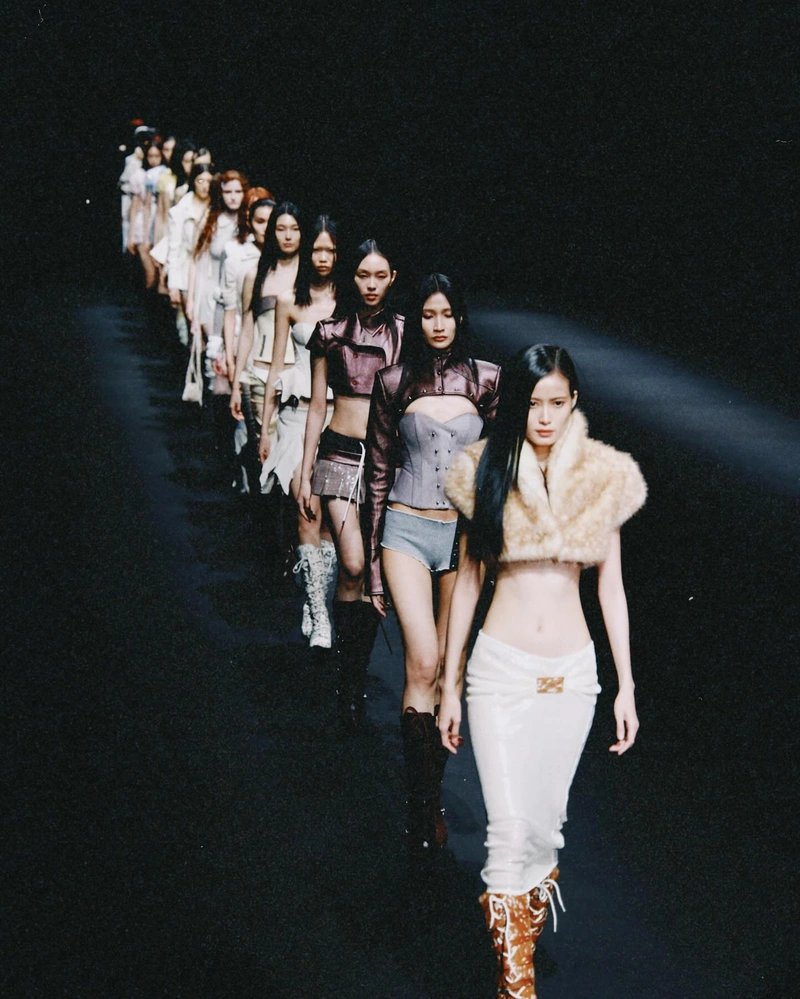
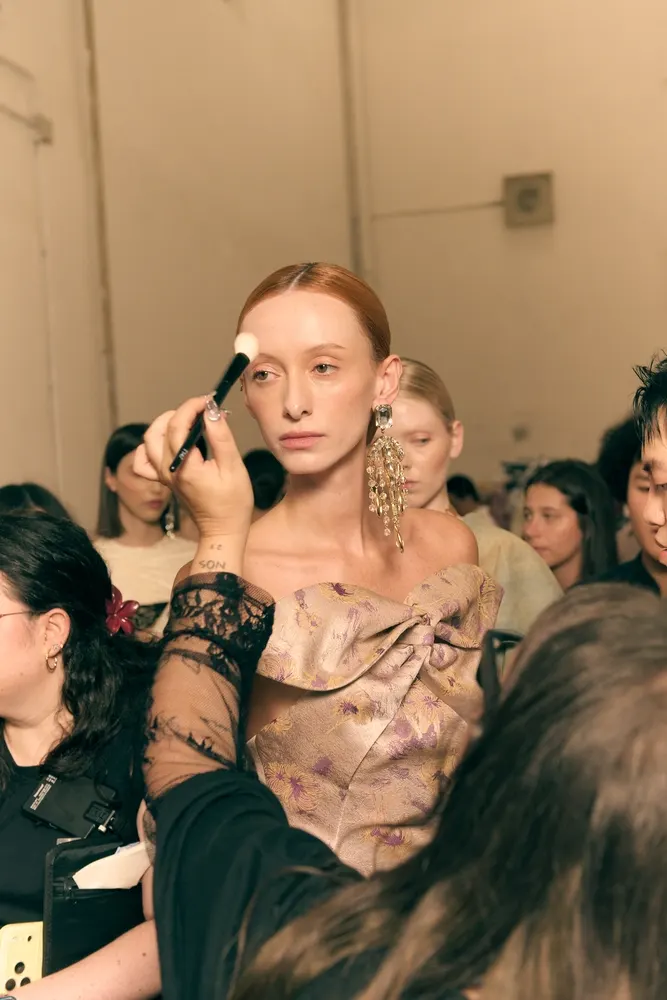
For a brief moment backstage in Milan, Phan Đăng Hoàng stopped working. Months of drawings, fittings, fabric development and complicated conversations with artisans had reached their destination: a model walking into the lights. His Spring/Summer 2027 collection, Tấm Cám, was finally moving before an audience. Then his attention returned to the second look.
“I was probably checking everything one last time,” he tells Jessica Van De Camp, fashion editor of PAVE Magazine, laughing at the memory. Hair, styling, the order of the garments, every detail demanded attention. He remembers feeling both relieved and nervous as the show began.
“You spend months thinking about every centimetre of a collection, and then suddenly it becomes movement, light, music and a person walking in front of you. It is almost impossible to control anymore.”
There is a wonderfully human absurdity to this experience. A designer can spend months creating an entire world, only to discover that its public existence begins at the precise moment he loses control of it. For Phan Đăng Hoàng, whose career has become closely associated with bringing Vietnamese cultural references to Milan, the runway marks both an artistic achievement and another stage in the demanding business of building a fashion house.
The Things We Carry From Home
Before fashion came drawing. Raised in Nghệ An in a family with artistic traditions, Phan Đăng Hoàng attracted attention as a teenager through remarkably detailed portraits. Observing faces, studying their proportions and translating expression onto paper formed an early part of his visual education. His subsequent studies at NABA in Milan introduced other possibilities: materials, three-dimensional construction and the relationship between an idea and the human body.

Vietnam remained central to his artistic imagination. Across Ceramics, ZigZag and Lacquer, he investigated different aspects of its visual culture, drawing from pottery, handmade paper, painting and traditional craftsmanship. Each collection presented a different challenge of translation. A ceramic vessel suggested volume; lacquer painting offered lessons in surface and depth; artisanal materials introduced the physical knowledge of their makers.
His decision to take Vietnamese identity seriously began during his student years. Surrounded by Europe's established artistic traditions, Hoàng recognized the creative value of experiences that belonged specifically to him. His cultural background gradually developed into a recognizable design language.
Yet recognition has brought expectations of its own. When Jessica asks whether constantly explaining Vietnam to international audiences ever becomes exhausting, his response is unusually candid.
“Sometimes I don't want to be the person who has to explain Vietnam. I simply want to be a designer.”
The admission reveals an important complication in the way culturally distinctive designers are celebrated. Heritage can provide the foundation for an original artistic vocabulary, while public expectations can gradually narrow the subjects that its creator feels permitted to explore.

Phan Đăng Hoàng believes his identity will remain present through the materials, silhouettes, techniques and emotional instincts he brings to his work. A recognizably Vietnamese symbol is only one possible expression of that identity.
Some memories, he explains, feel too intimate to transform directly into fashion. Turning them into attractive objects might diminish their personal significance. He is increasingly interested in preserving the emotions surrounding a memory while allowing its original imagery to remain private.
This understanding lends Tấm Cám particular significance. The collection revisits a story almost every Vietnamese child knows, yet its designer has begun questioning the way he understood its characters.
The Other Side of the Fairy Tale
As a child, Phan Đăng Hoàng naturally sympathized with Tấm. The familiar heroine endures cruelty, survives repeated attempts to destroy her and ultimately reclaims her happiness. Cám occupies the uncomfortable position of antagonist, shaped by jealousy and her mother's ambitions.
Adulthood, however, complicated his sympathies.
“But as I grew older, Cám became much more interesting to me.”
He began considering the conditions that shaped her behavior: insecurity, family influence and the desire to receive love or recognition. He remains aware of the character's cruelty, yet sees possibilities beyond the familiar moral distinction between heroine and villain.
That changing perspective introduces an unexpected dimension to Tấm Cám, presented at Milan Fashion Week on September 24, 2026. Publicly, the collection emphasizes Tấm's transformations, her resilience and her ability to rebuild herself through adversity. Hoàng's private reflections reveal an additional interest in emotional contradiction and the circumstances that shape human behavior.
A collection can celebrate the strength of its heroine while its creator remains fascinated by the vulnerabilities of the antagonist. The real challenge lies in translating those complicated psychological ideas into clothing.
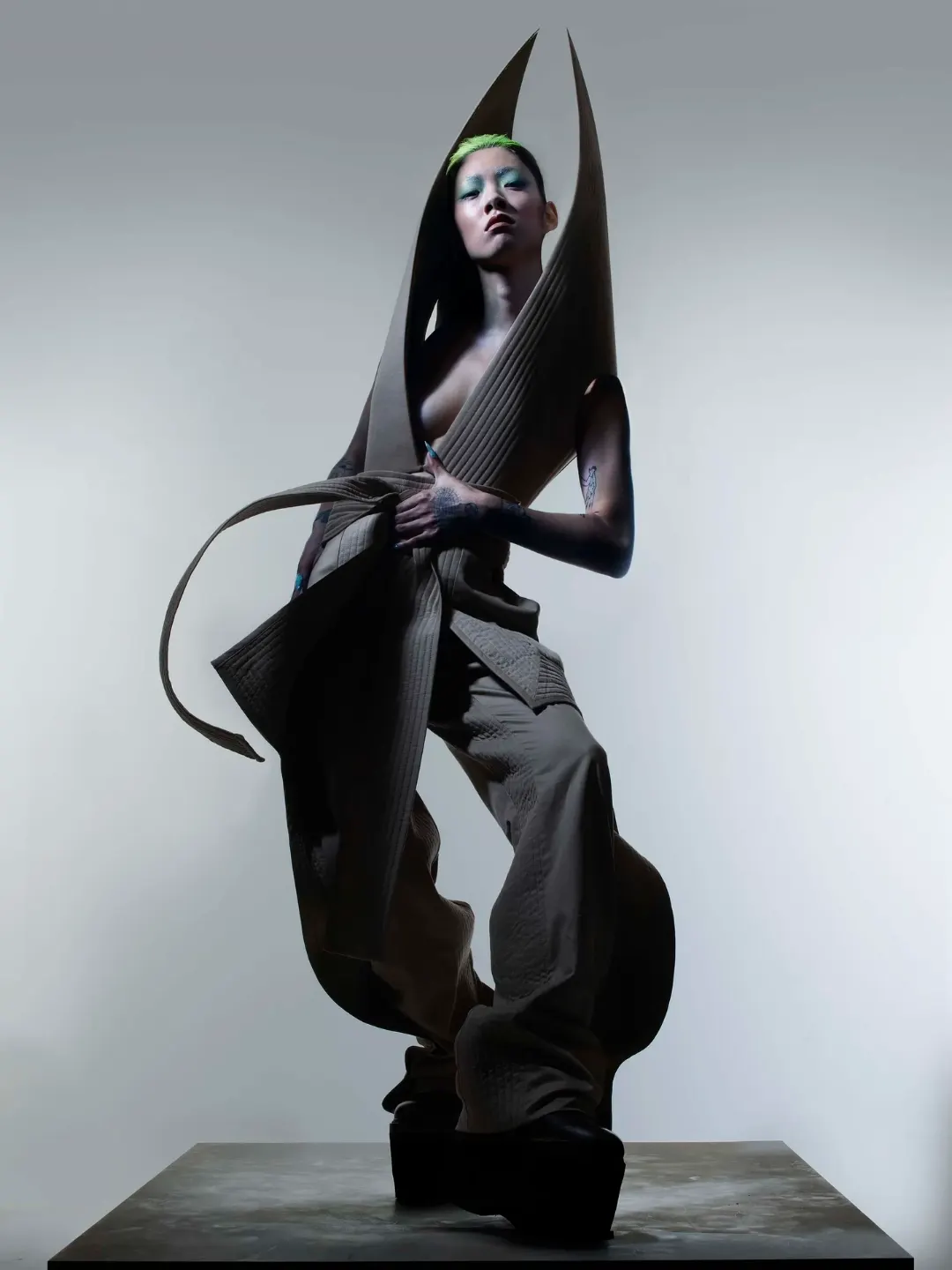
Within SS27, Hoàng approaches transformation through shifting structures, contrasting materials and silhouettes that move between softness and architectural volume. The collection draws upon the visual traditions of Kinh Bắc, including áo yếm, khăn mỏ quạ and ceremonial accessories.
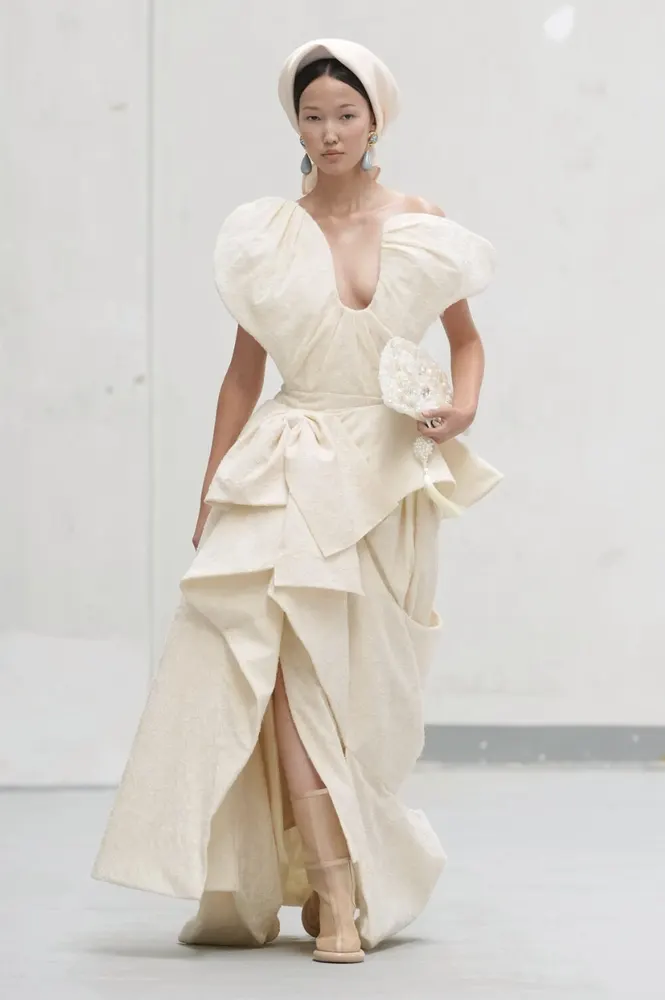
Look 40 offers one of its grandest propositions. An ivory gown expands into extraordinary upper-body volume, transforming the familiar shape of khăn mỏ quạ into an elaborate sculptural frame. An embellished fan intensifies its ceremonial presence. Here, cultural memory operates through construction and scale, pushing a recognizable reference into unfamiliar architectural territory.


Elsewhere, the vocabulary becomes quieter. An embroidered beige trench introduces craft into everyday outerwear, while a white tank paired with a dramatically constructed black skirt demonstrates how an otherwise restrained outfit can accommodate considerable formal experimentation. A fitted blue top and asymmetric cotton skirt explore movement through cutting and layered flounces.
These different approaches reveal both the ambition and the difficulty of Hoàng's developing aesthetic. His strongest designs allow material, silhouette and cultural reference to support one coherent gesture. Some of SS27's heavily embellished looks invite further editing, as large volumes, ornate surfaces and elaborate accessories occasionally compete for attention. The collection's artistic ambition remains evident; greater restraint could make certain ideas even more persuasive.
Material development provides another revealing dimension. Working with HANGSILK, Hoàng explored Vietnamese brocade alongside denim, washed cotton, satin, velvet and transparent fabrics. These combinations place established textile traditions within the practical vocabulary of contemporary dressing. Brocade can acquire an entirely different character when worn beside denim; embroidery can feel ceremonial or surprisingly casual depending on the garment carrying it.
The collection's guiding phrase, “Nothing truly disappears. It transforms,” therefore extends beyond the fairy tale. Familiar materials encounter unfamiliar forms, inherited images become contemporary silhouettes, and characters acquire emotional complexities that childhood once obscured.
The People Who Make the Impossible
One of the most demanding pieces in Tấm Cám began with a drawing that made experienced embroidery artisans from Northern Vietnam hesitate. The design contained details whose technical execution appeared extremely difficult.
Hoàng remembers their initial concerns and the decision that followed.
“Instead of simplifying the idea, we decided to work through it together.”
For almost two months, the designer and artisans tested techniques, adjusted details and searched for workable solutions. The garment's eventual completion represented an achievement of collective persistence.
This episode offers a valuable understanding of craftsmanship. Traditional techniques are often celebrated as beautiful inheritances, yet their continuing relevance also depends on the ability of skilled makers to adapt their knowledge to unfamiliar problems. The artisans contributed practical intelligence to the creative process, transforming technical uncertainty into new possibilities. Their relationship with Phan Đăng Hoàng also explains whose judgment he values most.

Jessica deliberately asks him to look beyond the much-publicized story of his early encounter with Anna Wintour. Whose opinion counts today, away from the headlines?
His answer begins with the people working beside him. Especially the atelier. They encounter his designs before the photographs, applause and polished runway presentation. They recognize excessive complications and understand when his ambition exceeds what a particular material can achieve.
His family offers another valuable perspective, grounded in personal familiarity and instincts untouched by fashion-industry expectations.
The people closest to his work are therefore also the people capable of challenging it. Their opinions give creative ambition a necessary form of accountability.
As the label expands, however, maintaining that intimacy becomes increasingly difficult. The same designer who once knew the reason behind every seam now has to develop a company capable of carrying his vision across larger teams and more complicated operations.
Phan Đăng Hoàng: Building a House Without Losing Its Heart
Ask Phan Đăng Hoàng what currently occupies his mind beyond designing, and he answers immediately: production.
Late fabrics, remade samples, customs, shipping, invoices, measurements and supplier schedules have become familiar concerns. A single logistical problem can consume an entire day, drawing his attention away from drawing or research.
For anyone observing only his Milan presentations, these realities may seem distant from fashion's glamorous public image. Yet they determine whether an ambitious collection can exist beyond a sketchbook.
“I am learning that building a fashion house is very different from simply designing a collection.”
The distinction becomes increasingly significant as PHAN DANG HOANG develops. A designer makes creative decisions about garments; a founder also establishes the relationships, resources and organizational practices that allow those garments to reach customers consistently.

Hoàng's early working environment included a modest Hanoi studio, where proximity allowed him to remain personally connected to almost every aspect of production. International presentations now demand extensive coordination among artisans, suppliers, manufacturers and collaborators.
The HANGSILK partnership illustrates how his creative interests can expand into commercial development. Research into brocade for Tấm Cám also contributed to plans for a dedicated material line serving the Vietnamese market, suggesting possibilities for sustaining textile innovation beyond individual runway collections.
Growth, however, introduces a deeply personal concern. Jessica asks what he hopes will survive if his company becomes ten times larger.
“The intimacy.”
Phan Đăng Hoàng remembers knowing the makers, understanding why fabrics were chosen and feeling personally connected to the decisions behind each garment. Increasing organizational complexity threatens to create distance between the designer and those details.

Preserving intimacy within a growing company requires more than affection for its early years. It demands clear communication, trust in collaborators and a creative culture where the purpose behind each design remains understood.
For Phan Đăng Hoàng, those relationships also sustain his imagination. When uncertainty arrives, he returns to drawing, books, photographs, museums and research. Equally meaningful is the support of customers who continue anticipating his next collection.
Their loyalty carries responsibility, but it also gives him confidence to explore unfamiliar directions. Building a successful fashion house requires systems, consistency and commercial discipline. The designer running that company increasingly dreams of a creative space where those demands can momentarily loosen their grip.
The Person Phan Đăng Hoàng Has Yet to Become
When Jessica asks where Phan Đăng Hoàng would stage a runway show in Vietnam without practical limitations, Hoàng imagines Huế.
He sees a model moving slowly through the city's historical architecture, almost as though entering a memory. The surroundings would provide their own visual grandeur, allowing contemporary clothing to encounter the accumulated history of a real place.
His other dream is considerably more extravagant: haute couture. He wants the freedom to experiment with unusual, excessive and potentially bewildering ideas, even those that might make his team question his judgment.
“I think every designer needs a space where they don't have to be practical, commercial, or even understandable.”
The statement carries particular weight after his account of the operational responsibilities surrounding an independent fashion business. He understands the discipline required to sustain a company and increasingly recognizes the creative pleasure of exploring beyond familiar expectations.

Yet when Jessica asks him to name his next unexpected inspiration, Hoàng turns toward something extraordinarily intimate. His mother spent part of her youth working as a tailor. As a child, he watched her handle fabrics, patterns and garments, observing the quiet process through which ordinary materials became clothes. Those memories established his earliest emotional relationship with fashion.
He now wonders whether her working life might someday inspire a collection. He imagines exploring the techniques, feelings and personal history he inherited through his own developing design language. After exploring celebrated Vietnamese artists, traditional crafts and national stories, Phan Đăng Hoàng may find another artistic world within the everyday work of the woman who helped shape his imagination.
For a designer whose career has become associated with interpreting cultural memory, this would be a particularly personal exploration. It also reflects his growing desire to understand himself through the people and experiences that formed him.


He remains curious about the identities of future customers and how technology, including artificial intelligence, may transform the ways people communicate and express themselves. Their changing lives could introduce unfamiliar possibilities into his practice.
For now, he appears increasingly comfortable with creative uncertainty.
“I don't think I have found the final version of PHAN DANG HOANG yet. And I actually like that.”
Perhaps this is the most compelling discovery in the conversation. The designer who has spent years communicating his heritage through fashion has begun granting himself permission to remain unwritten. The memories, techniques and relationships that brought him here continue to develop, offering possibilities beyond the expectations attached to his achievements.
And somewhere among those possibilities stands his mother, working quietly with fabric and patterns, long before anyone imagined that her son would one day present collections in Milan. The next chapter of Phan Đăng Hoàng may begin with the simplest of those childhood observations: watching someone he loves make clothes.