MENU
Close





From several metres away, a human body can shrink into little more than a vertical mark. Alberto Giacometti became obsessed with that visual instability.
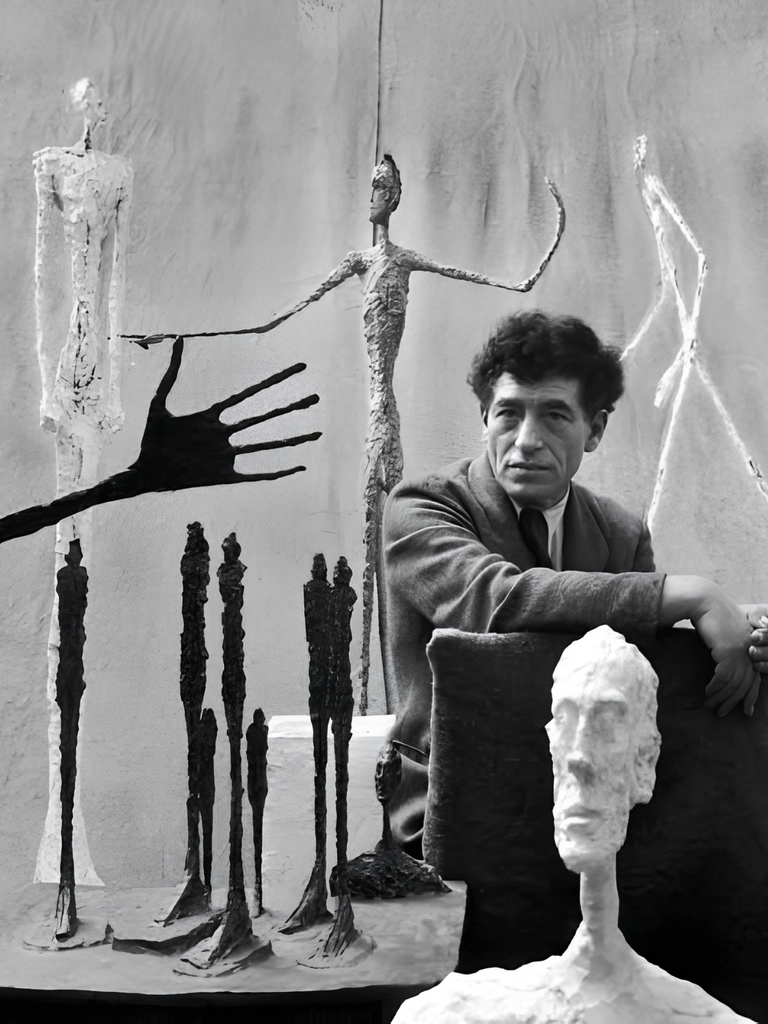
From several metres away, a human body can shrink into little more than a vertical mark. Alberto Giacometti became obsessed with that visual instability.
August 7, 2026


Alberto Giacometti reshaped modern sculpture through elongated figures, rough bronze surfaces, spatial isolation and an obsessive study of human perception.
Alberto Giacometti entered the world in 1901 surrounded by mountains large enough to make people look temporary.
He was born in Borgonovo in Switzerland’s Val Bregaglia, close to the Italian border. His father, Giovanni Giacometti, was a painter, so drawing and modelling belonged to the rhythms of childhood. Alberto made portraits of family members early, including his younger brother Diego, who would eventually become his most persistent model, studio assistant and collaborator.
Paris changed the scale of his ambitions.
Giacometti moved there in 1922 and studied sculpture under Antoine Bourdelle. Cubism, African sculpture and the experimental energy of the European avant-garde entered his work quickly. By the late 1920s, his sculptures had abandoned conventional anatomy for strange structures that resembled machines, rituals, cages and fragments extracted from dreams.
Surrealism briefly gave him the intellectual territory he needed.
Few works capture that phase better than The Palace at 4 a.m. from 1932. Thin wooden beams form an open architectural skeleton populated by fragile objects. Walls barely exist. Figures seem contained by structures that could collapse at any moment.
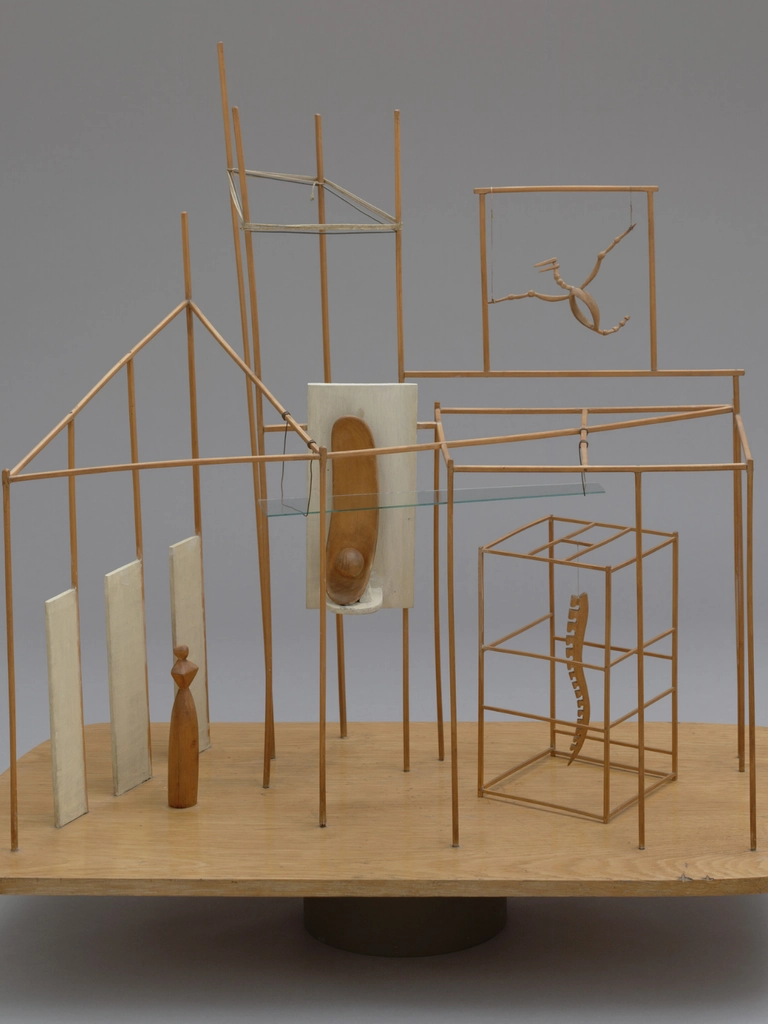
The sculpture grew partly from Giacometti’s memories of an intense relationship during which imaginary palaces were repeatedly discussed and constructed. Desire became architecture.
Yet the cage would survive long after his Surrealist period ended.
Around 1935, Giacometti returned insistently to working from living models. The decision contributed to his rupture with the Surrealist group, whose interests had moved far beyond conventional observation.
Giacometti had discovered a problem far stranger than fantasy.
He could look directly at another person and still struggle to determine what he actually saw.
Knowledge told him a face contained eyes, cheeks, lips and bone. Vision delivered something unstable. Distance compressed those features. Perspective distorted proportion. Movement altered everything again.
The conflict consumed him.
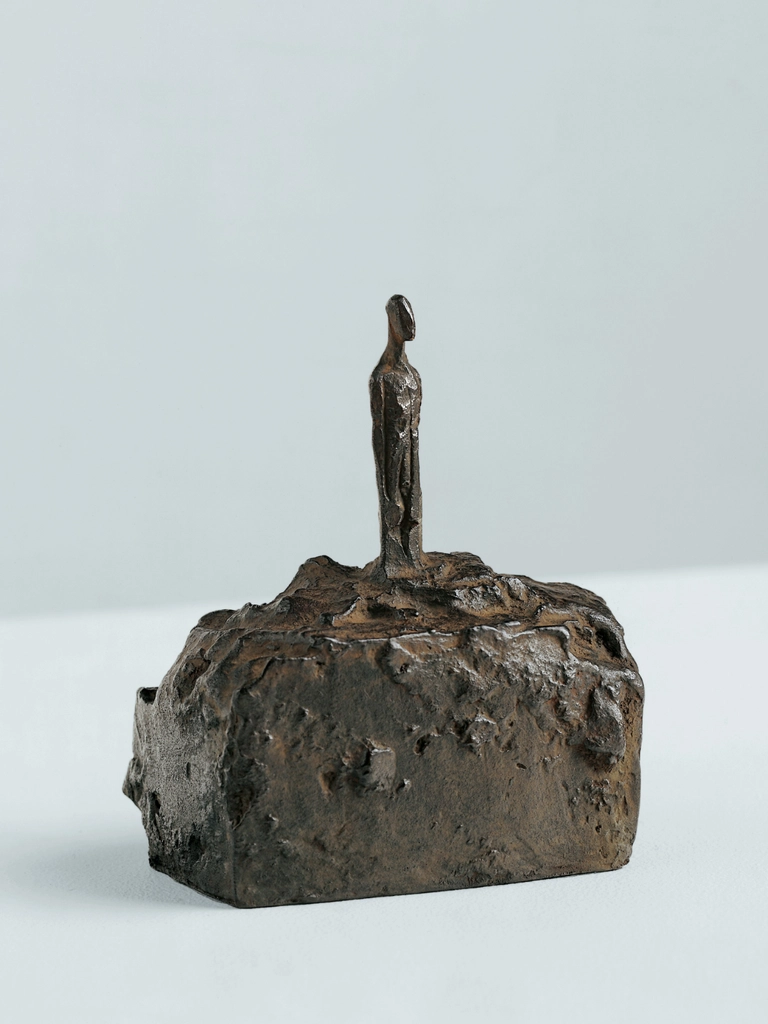
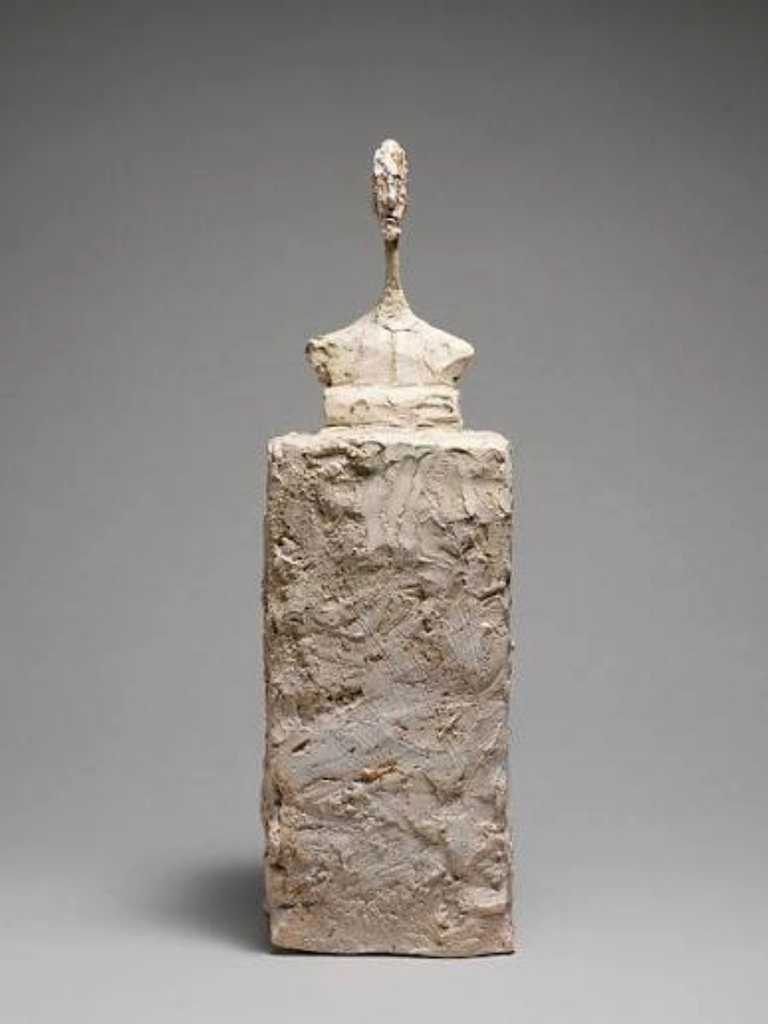
During the Second World War, while living mainly in Geneva, his sculptures became extraordinarily small. Some figures shrank almost to matchstick scale because Giacometti believed that reducing them brought sculpture closer to the visual experience of seeing somebody from far away.
He was already pushing modern sculpture toward one of its central questions.
How much material does a human presence actually require?
When Giacometti returned to Paris after the war, his figures grew taller.
Their bodies remained impossibly thin.
Arms adhered closely to torsos. Heads contracted into rough knots. Legs lengthened until they resembled narrow supports. Feet often expanded across heavy bases, anchoring bodies that otherwise looked capable of dissolving into the surrounding air.
This became the Giacometti everyone recognizes.
The historical timing gave these bodies extraordinary psychological force. Europe had emerged from war carrying mass destruction, displacement and the Holocaust. Giacometti’s exhausted figures seemed to embody the fragility of surviving human beings even when he resisted reducing them to direct symbols of postwar trauma.
Jean-Paul Sartre became fascinated by them.
The philosopher wrote about Giacometti in 1948 and interpreted his sculpture through questions of distance, isolation and human existence. Their friendship helped attach Giacometti permanently to Existentialism, although the sculptor’s own obsession remained deeply perceptual.
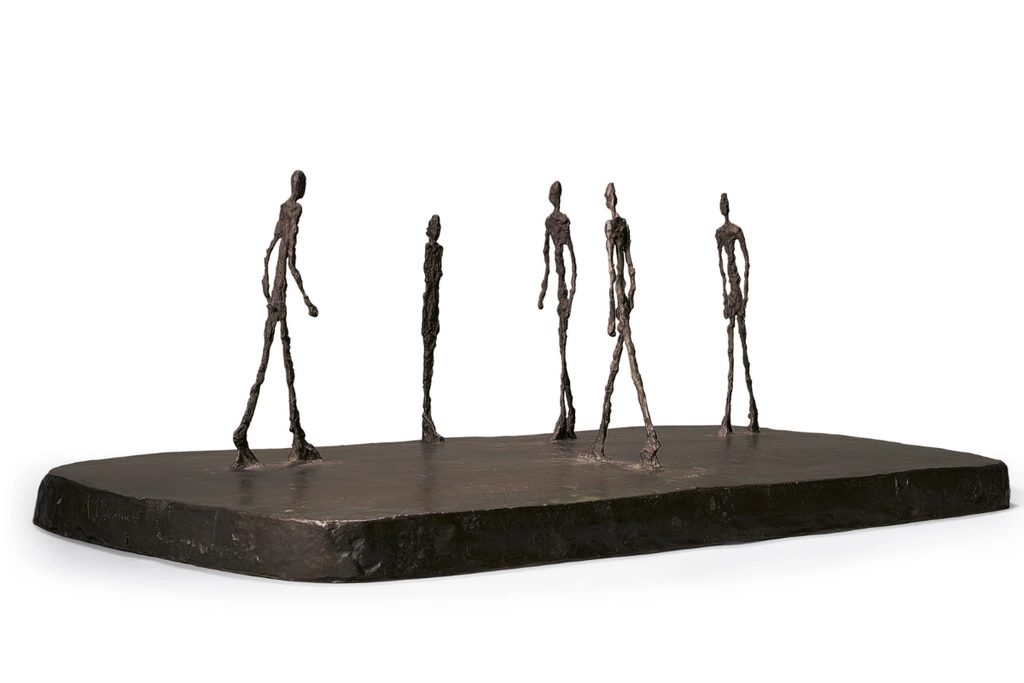
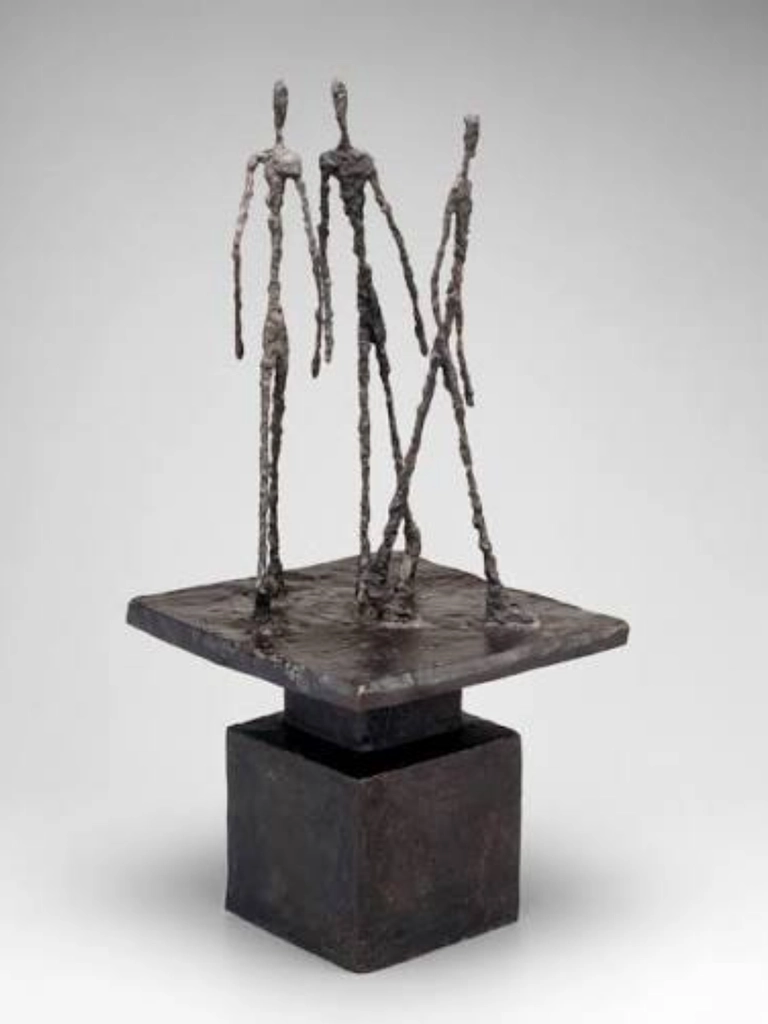
In La Place, or City Square, from 1948, five narrow people cross the same broad platform. They appear close enough to meet, yet each follows an independent trajectory. Nobody establishes meaningful contact.
The city becomes a psychological condition.
Giacometti had observed pedestrians walking through Parisian streets, watching people grow, shrink and momentarily align as distance changed. Sculpture allowed him to freeze those unstable relationships.
His rough surfaces intensified the effect.
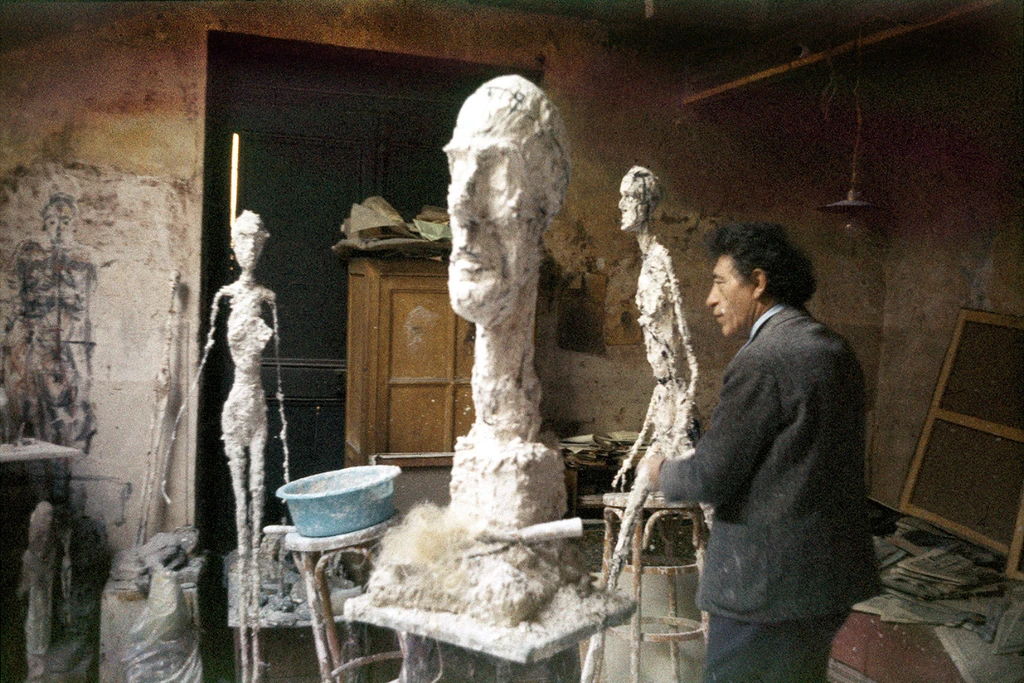
Giacometti repeatedly added and removed clay or plaster. He pressed, pinched, scraped and gouged until faces looked excavated from matter. Even bronze casts retained that nervous topography. Light catches differently across every irregular ridge, making the figure change as the viewer moves.
Smoothness would have stabilized the body.
Giacometti wanted instability.
The surrounding void became equally physical. A tiny head on a long neck makes the air beside it suddenly enormous. A narrow torso increases awareness of everything that does not belong to the body.
His earlier cage sculptures had physically enclosed figures.
The later figures carried invisible cages around themselves.
That spatial alienation became one of Giacometti’s most influential contributions to modern sculpture.
Somewhere between midnight and morning in 1947, Giacometti made art-market history without knowing it.
He was preparing for a major New York exhibition when a foundry deadline closed in. During a single overnight session, roughly from midnight until nine in the morning, he reworked L’Homme au doigt, or Pointing Man.
The plaster was reportedly still wet when workers arrived to collect it.
Its body stretches upward while both arms cut through the surrounding emptiness. One points outward. The other extends behind. The gesture gives the thin body an enormous spatial reach, as though Giacometti had constructed the sculpture from air with only enough bronze left to indicate where the person stands.
Very few casts exist.
One hand-painted bronze cast sold in 2015 for $141.285 million, establishing an auction record for sculpture at the time.
A figure almost stripped of physical mass had acquired extraordinary financial weight.
Giacometti achieved the same paradox repeatedly.
Chariot, created in 1950, places a narrow female figure on a platform between two large wheels. The structure suggests movement, although the woman appears strangely suspended. The idea partly developed from Giacometti’s memories of hospital carts after a traffic accident years earlier.
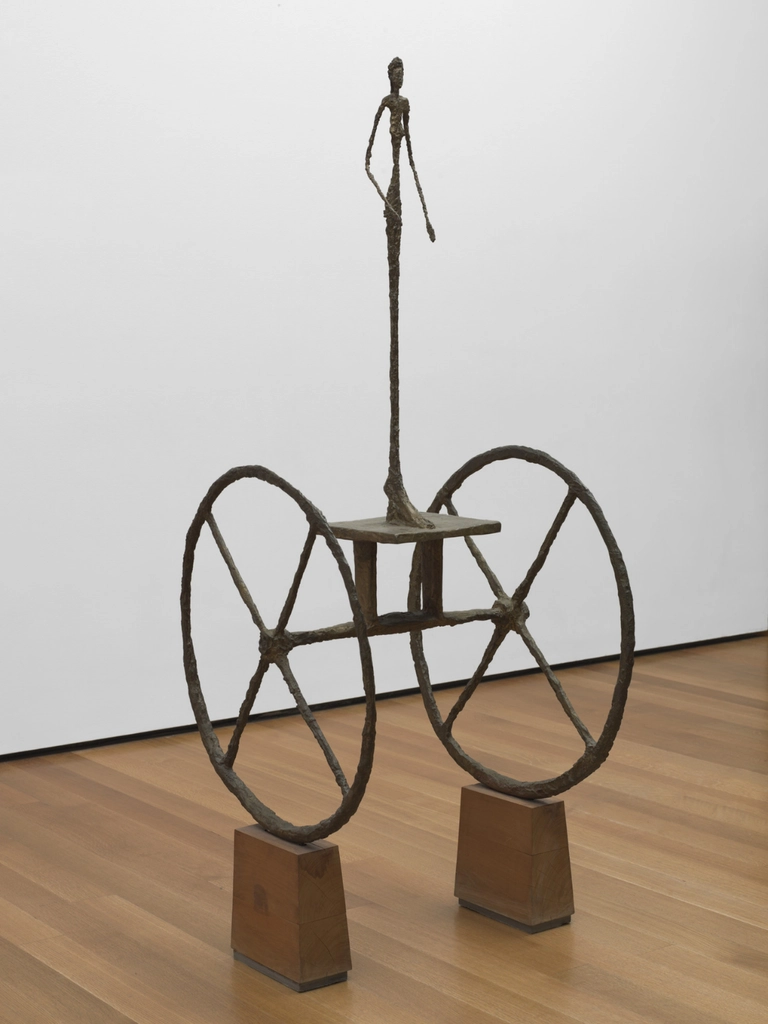
In 2014, a cast of Chariot sold for approximately $101 million.
Four years earlier, L’Homme qui marche I, or Walking Man I, had sold for about $104.3 million.
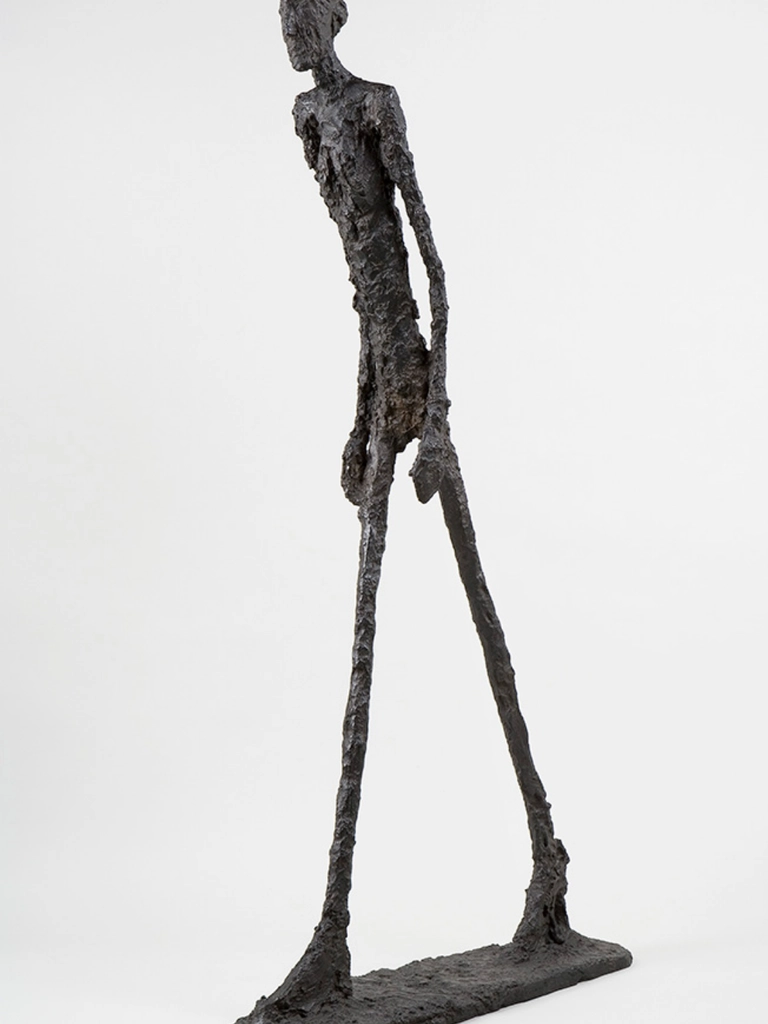
Giacometti therefore became the rare sculptor with multiple works crossing the $100 million threshold at auction.
Yet those prices remain almost absurd when placed beside his working conditions.
In 1926, Giacometti moved into a tiny studio at 46 rue Hippolyte-Maindron in Montparnasse. The room measured roughly 23 square metres.
He remained there for around four decades.
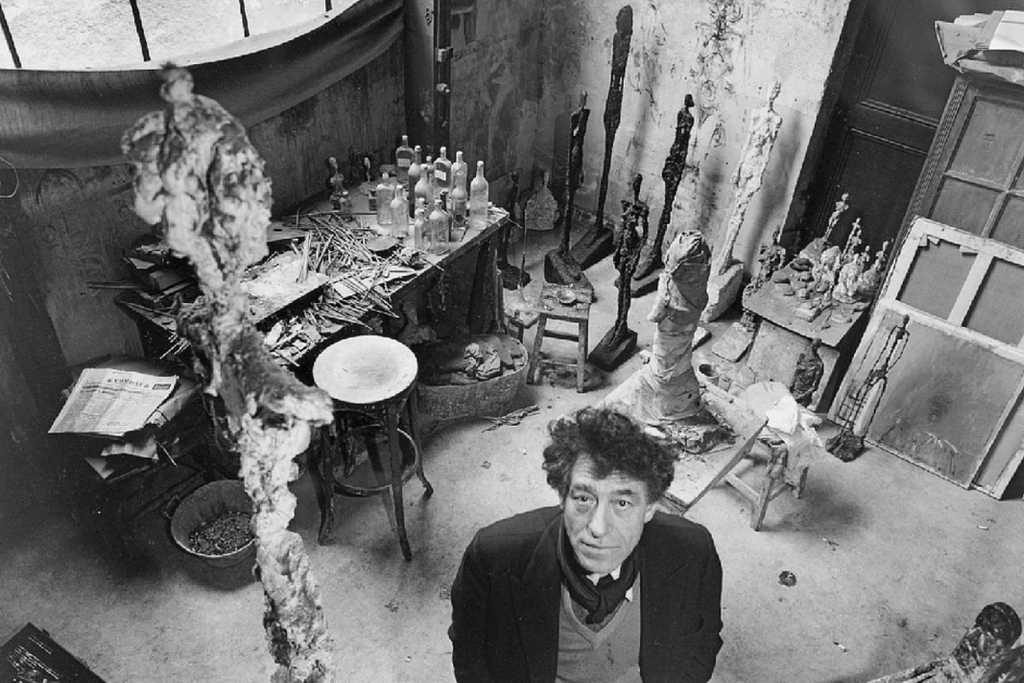
Success brought collectors, museum exhibitions and international recognition. Giacometti kept returning to the cramped studio.
Walls became covered with marks, drawings and practical notes. Plaster dust accumulated. Sculptures crowded one another. Diego worked beside him, helping with moulds, casts and the endless physical demands of production.
The limitations appear strangely appropriate.
Giacometti could have moved into an expansive studio.
His imagination seemed to require pressure.
Even Diego never became visually easy simply because he was familiar. Alberto sculpted and drew his brother repeatedly across decades, discovering fresh uncertainty every time he looked.
To know someone intimately did not mean knowing what they looked like.
By 1960, Giacometti had distilled walking into one of the simplest images possible.
L’Homme qui marche I shows a man mid-stride.
One leg extends forward. The other remains behind. Arms hang heavily beside an attenuated torso. His enormous feet grip the ground while his body seems barely substantial enough to survive the next step.
The figure possesses no identifiable destination.
That ambiguity turned it into an icon.
Postwar audiences could read survival into the stride. Philosophers could see existential persistence. Others could recognize the ordinary urban experience of moving alone through a crowd.
Giacometti had reduced walking until only movement and human presence remained.
Switzerland eventually turned that image into something people could carry in their pockets.
From 1998, the eighth series of the Swiss 100-franc banknote featured Giacometti’s portrait alongside imagery connected to his work, including Walking Man. For more than two decades, one of modern sculpture’s most fragile figures circulated through supermarkets, banks, railway stations and wallets.
The transformation contains a strange irony.
Giacometti had spent his career questioning how securely a person could exist within visual space.
His image eventually became currency.
He died in 1966 at the age of 64, leaving behind sculpture, painting and drawing produced through almost relentless revision.
The market continued expanding long after him.
Museums elevated his elongated figures into defining images of twentieth-century art. Auction houses transformed rare lifetime casts into trophies. His narrow bodies became instantly recognizable enough that a Giacometti can now be identified from across a gallery almost exactly as he once observed strangers from across a street.
Perhaps that distance is the proper place to meet them.
Step close and bronze appears scarred, granular and almost brutal.
Move backward and detail disappears.
The roughness condenses.
The figure becomes smaller.
Soon, a human body is little more than a dark vertical line surrounded by a tremendous amount of air.
That was the problem Alberto Giacometti spent decades chasing. And modern sculpture has looked at human loneliness differently ever since.