MENU
Close





Once fashion discovered that an artist could do more than provide a pretty print, the relationship between art and fashion became wonderfully complicated.

Once fashion discovered that an artist could do more than provide a pretty print, the relationship between art and fashion became wonderfully complicated.
September 29, 2026


For much of fashion history, art was something designers quoted. A painting supplied a palette, an artistic movement suggested a silhouette, a famous motif migrated onto fabric. The relationship could be sophisticated, but the hierarchy remained relatively tidy: fashion designed, art inspired.
In the 2000s, the mood darkened. Skulls replaced cherries, bleach attacked tailoring, punk drawings entered couture ateliers, and the artist moved from guest illustrator to genuine co-author. Fashion had found art. More dangerously, it had learned how useful art could be.
Luxury had entered an era of enormous global expansion, contemporary art had acquired celebrity status, and fashion houses were becoming cultural institutions with enough financial muscle to commission artists on a spectacular scale. The artist’s name could now sit beside the designer’s, while a handbag might simultaneously function as merchandise, collectible, status symbol and miniature canvas.
The distinction between art and fashion, gallery and boutique was about to become inconvenient.
If one object explains the new relationship, it may be the Louis Vuitton monogram. Its familiarity made it almost impossible to improve and irresistible to vandalise.
Under Marc Jacobs, Louis Vuitton repeatedly handed this sacred piece of brand property to contemporary artists. Takashi Murakami’s 2003 intervention remains the great candy-coloured coup. His Monogram Multicolore scattered Vuitton’s initials and flowers across white or black canvas in 33 colours, importing the visual exuberance associated with his Superflat universe into one of luxury’s most recognisable commercial surfaces. Louis Vuitton still identifies 2003 as the beginning of the partnership and the 33-colour Monogram Multicolore as its defining motif.

The joke was delicious. A monogram created to communicate heritage suddenly behaved like Pop art.
Murakami understood the contradictions perfectly. His practice already collapsed boundaries between anime, fine art, commercial imagery and consumer culture. Vuitton supplied another boundary worth collapsing: the one separating museum-approved contemporary art from something carried to lunch. And customers enthusiastically volunteered their arms.
What followed was bigger than putting an artwork on a product. Murakami’s characters and graphics spread across products and retail environments, creating a recognisable universe around the collaboration. Two decades later, the imagery remained culturally potent enough for Louis Vuitton to revive the partnership, evidence of how thoroughly those objects had graduated from seasonal novelty into fashion memory.
Richard Prince complicated the formula further for Louis Vuitton’s Spring 2008 collection. His Nurse Paintings informed a runway populated by models dressed as nurses in translucent coats, while his Joke works and painterly language migrated onto bags.
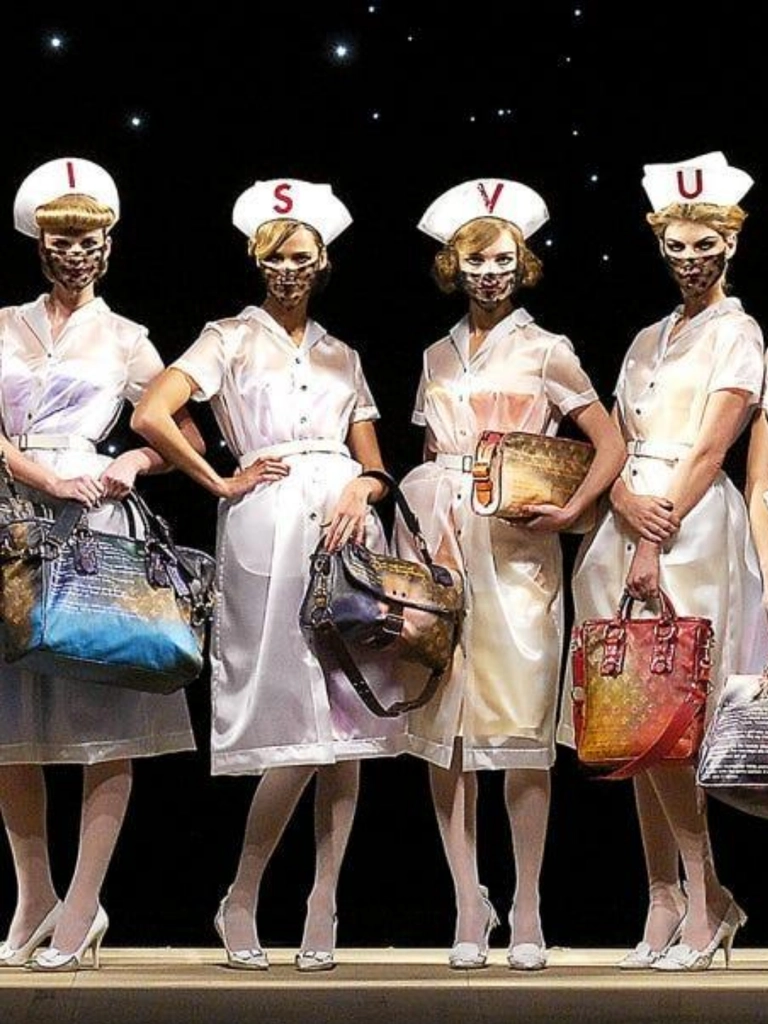
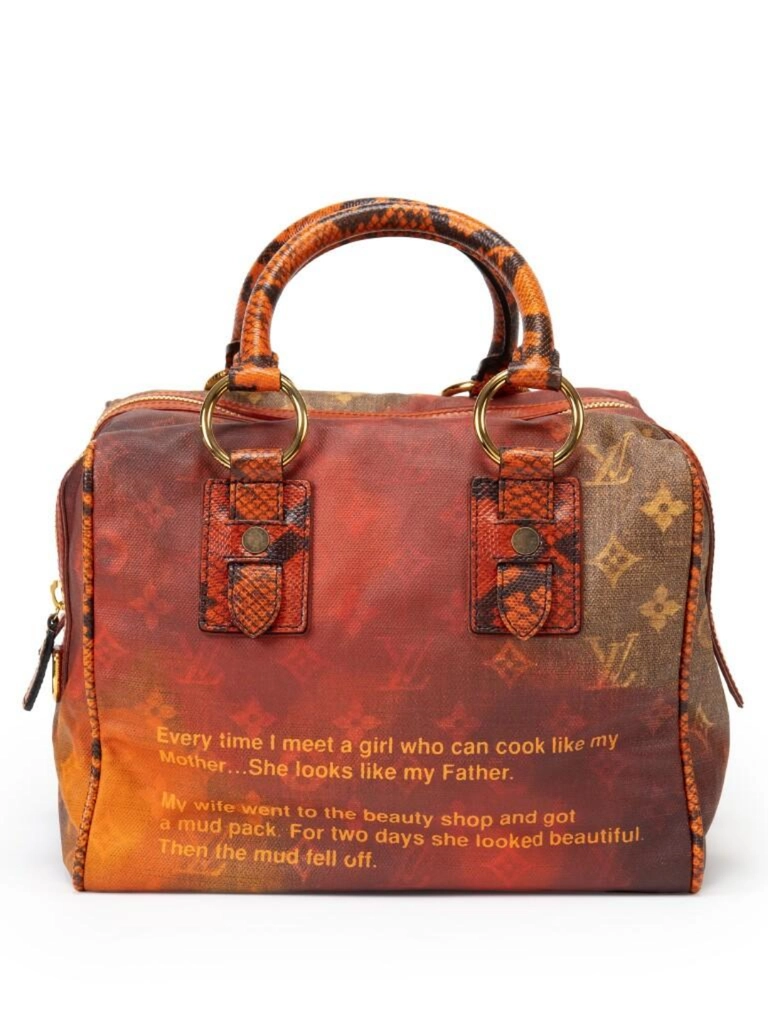
The handbag was starting to acquire conceptual baggage along with the literal kind.
Prince was particularly suited to this experiment because appropriation already sat at the centre of his practice. Advertising, pulp imagery and mass-media photographs became raw material in his art. Putting that sensibility into luxury goods created a peculiar loop: consumer imagery became art, which returned to consumer culture as a very expensive handbag.
Then came the dots. Marc Jacobs had met Yayoi Kusama in Tokyo in 2006, years before their Louis Vuitton collaboration arrived commercially in 2012. The resulting project covered dresses, bags, shoes, accessories and retail spaces in her obsessive polka-dot vocabulary.
Here, the collaboration expanded beyond garment and object. The shop itself could participate.
Kusama’s visual language proved exceptionally compatible with luxury retail because it could swallow architecture whole. A handbag could carry the dots, but so could a window, wall or building façade. Suddenly, the customer was entering an environment whose visual identity belonged simultaneously to artist and fashion house.
When Louis Vuitton revisited the collaboration in 2023, new techniques pushed that illusion further, including Painted Dots rendered to evoke the irregular physicality of Kusama’s painted marks. The collaboration extended across products and digital objects, with Vuitton also using Kusama motifs such as Painted Dots, Pumpkins and Faces.
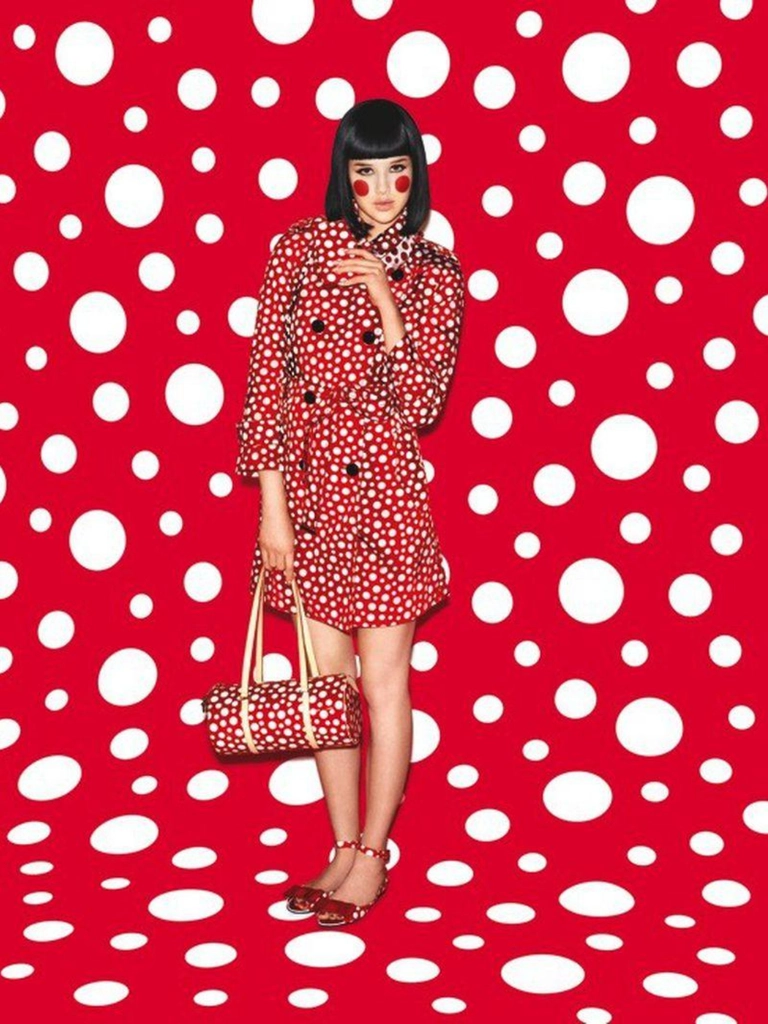

This was no longer the polite old equation of “artist inspires designer.” Luxury had discovered world-building. More importantly, the Murakami, Prince and Kusama projects helped establish commercial grammar still visible throughout the art and fashion scene: recognizable artist + recognizable house code + limited product + spectacular environment + enormous image circulation.
Pop exuberance could hardly monopolise the relationship forever. By the 2010s, some of the most memorable art and fashion collaborations were pushing toward darker territory: mortality, bodily unease, destruction, subculture and the physical violence of making.
Alexander McQueen and Damien Hirst required almost no introduction to each other aesthetically. One built a fashion mythology filled with skulls, predation and romantic death,, the other famously turned mortality into one of contemporary art’s most lucrative subjects.
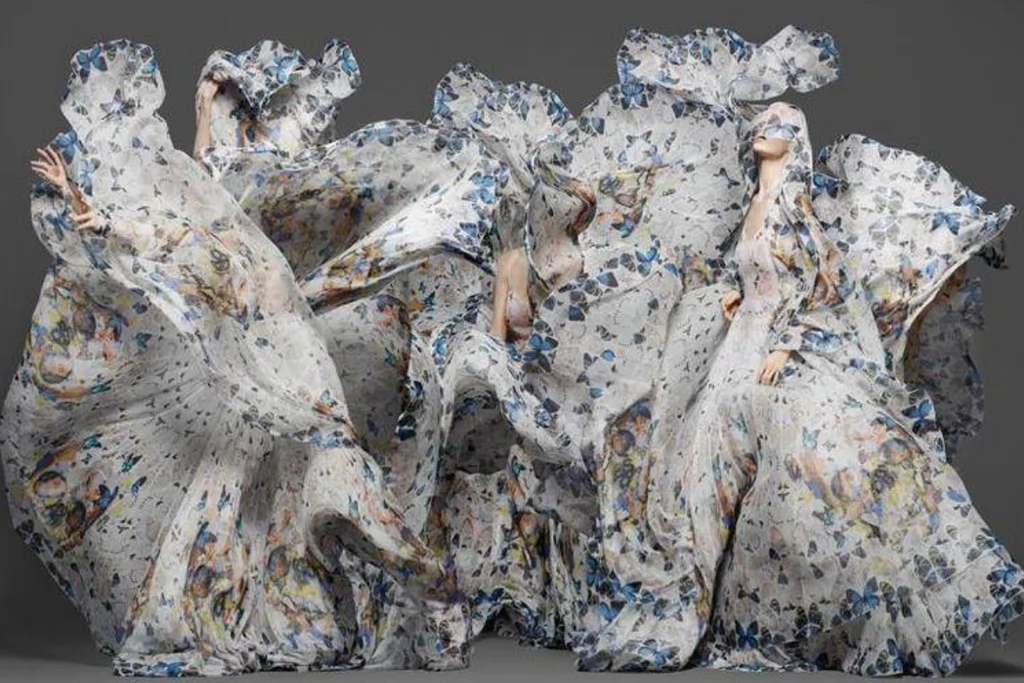
Their 2013 collaboration commemorated the tenth anniversary of McQueen’s skull scarf through 30 limited-edition designs adapted from Hirst’s Entomology works. Butterflies, spiders and other insects were arranged into kaleidoscopic formations that evolved into the McQueen skull.
It was merchandising with a mortality problem.

Yet the collaboration demonstrated something significant about what an accessory could carry. The skull was already a highly commercial McQueen signature. Hirst effectively dissected and reconstructed it through another system of death and preservation: the insect specimen.
The result made memento mori portable. A scarf could still be beautiful, naturally. It could also remind its owner that every owner eventually becomes the former owner.
Luxury!
Raf Simons and Sterling Ruby pushed authorship somewhere more radical. Their relationship had developed over years. Ruby designed Simons’s Tokyo store interior in 2008, Simons subsequently used denim bleached by Ruby and in January 2014 the pair presented an entire Autumn/Winter menswear collection under the joint label Raf Simons/Sterling Ruby. It replaced Simons’s usual eponymous collection for that season.
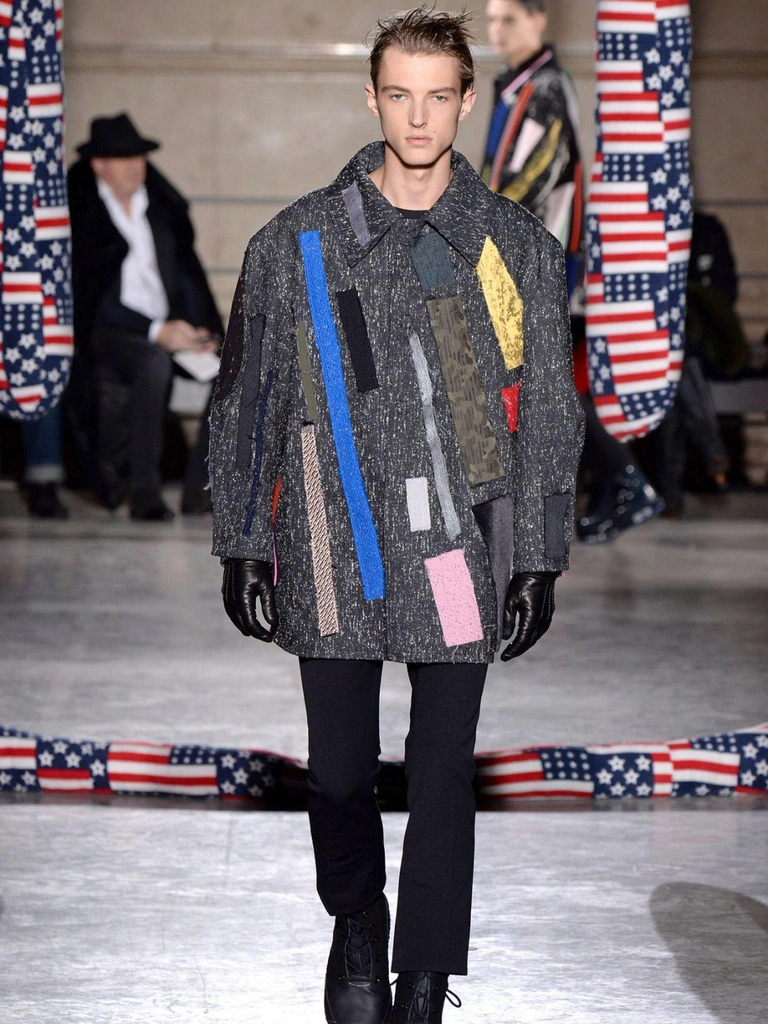
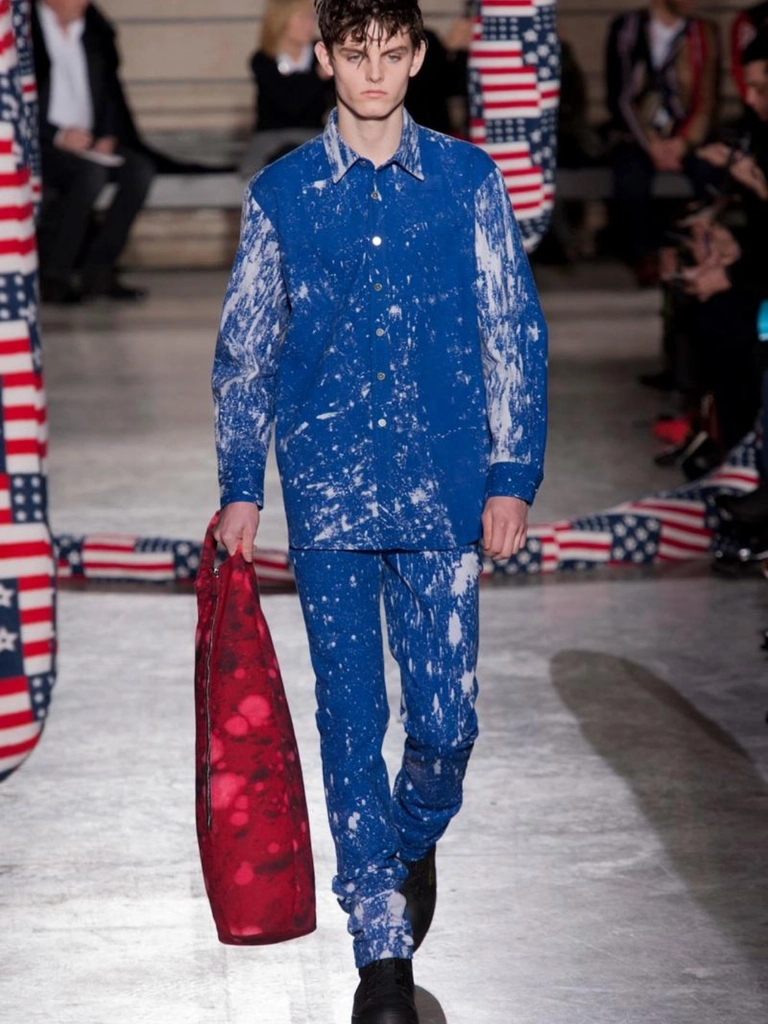

That slash mattered. Artist collaborations often preserved a reassuring division of labour. Designer makes clothes. Artist supplies image. Marketing department adds an “×”. Simons and Ruby disturbed the arrangement by constructing a complete wardrobe together.
Ruby’s industrial, abrasive vocabulary entered garments through bleaching, paint effects, patches, collage and manipulated surfaces. The clothes carried evidence of process. Instead of reproducing pristine artwork faithfully across fabric, the collection brought something closer to studio behaviour into fashion.
Tailoring encountered contamination. Coats appeared splashed and scarred. Materials collided. Familiar menswear forms became carriers for the visual debris of Ruby’s practice. The Design Museum subsequently described the project as a fusion of high art and fashion, while contemporary coverage emphasised that Ruby and Simons had created a complete collection together.
Here the conceptual shift becomes clear: the artist no longer had to decorate the garment. The artist could participate in deciding what the garment was.
This is the deeper legacy of the shift.
Murakami demonstrated how completely contemporary art could rewrite a heritage logo. Kusama showed that an artist could consume the entire retail environment. Hirst turned a commercial signature back toward mortality. Ruby challenged the distinction between artist and designer. Jones built a fashion system in which contemporary artists could influence garments, embroidery, accessories, scenography and the cultural story surrounding a collection.
The progression from Pop Modernism toward darker and more conceptual collaborations therefore tells us something larger than the history of fashionable prints.
Fashion stopped merely borrowing art’s appearance and began borrowing its methods: appropriation, repetition, authorship, installation, disruption, irony, subculture, material experimentation. And art, supposedly the intellectually serious party in this marriage, discovered that it looked remarkably good on a handbag. The old question was whether fashion could qualify as art. The twenty-first century produced a much more entertaining problem. What happens when art and fashion stop asking permission?