MENU
Close





Ancient Greek style begins where cloth meets the body, and every fold seems to awaken a goddess, carrying myth into the present.

Ancient Greek style begins where cloth meets the body, and every fold seems to awaken a goddess, carrying myth into the present.
August 4, 2026
Advertisement

Advertisement



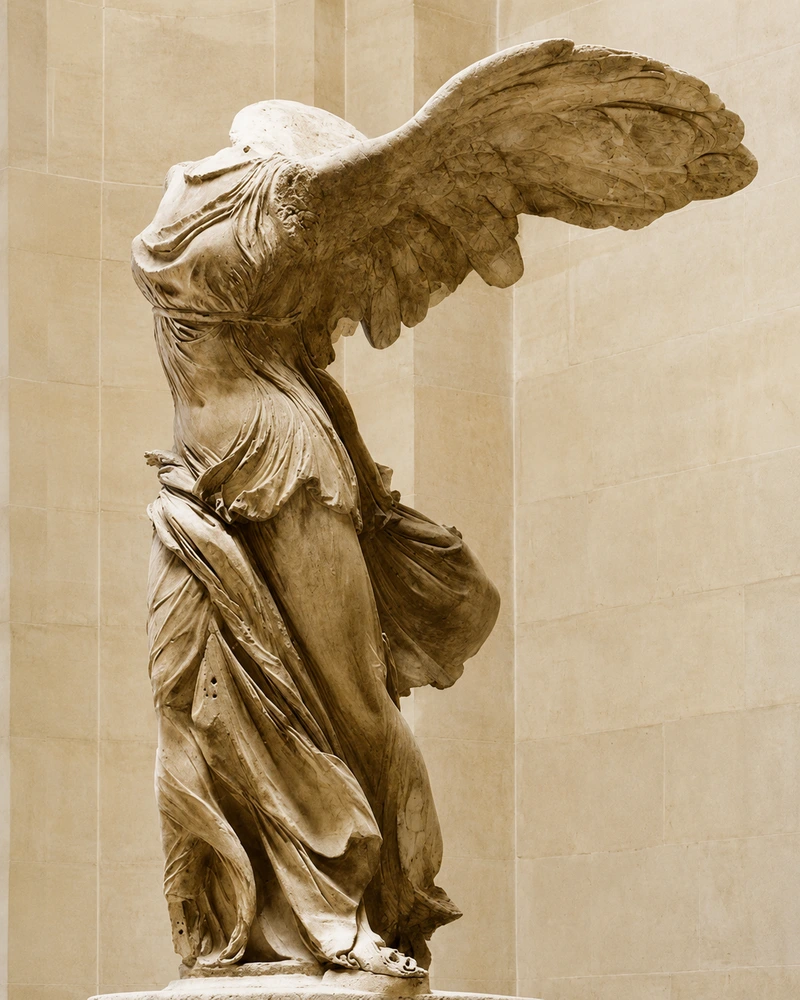
A marble woman stands on the prow of a ship, her wings spread behind her, her clothing driven violently against her body by an invisible wind. The stone around her torso appears thin enough to breathe. Fabric gathers over her hips, presses against one leg, and explodes into deep folds behind her. She has remained in this position for more than two thousand years, yet the air still seems to move around her.
Centuries later, the same illusion enters a couture salon. A woman steps forward in silk jersey twisted over one shoulder. Fine pleats descend toward the floor. The fabric opens with her stride and closes behind her. The dress contains no archaeological accuracy, no literal toga, no theatrical costume. Yet Greece is unmistakably present.
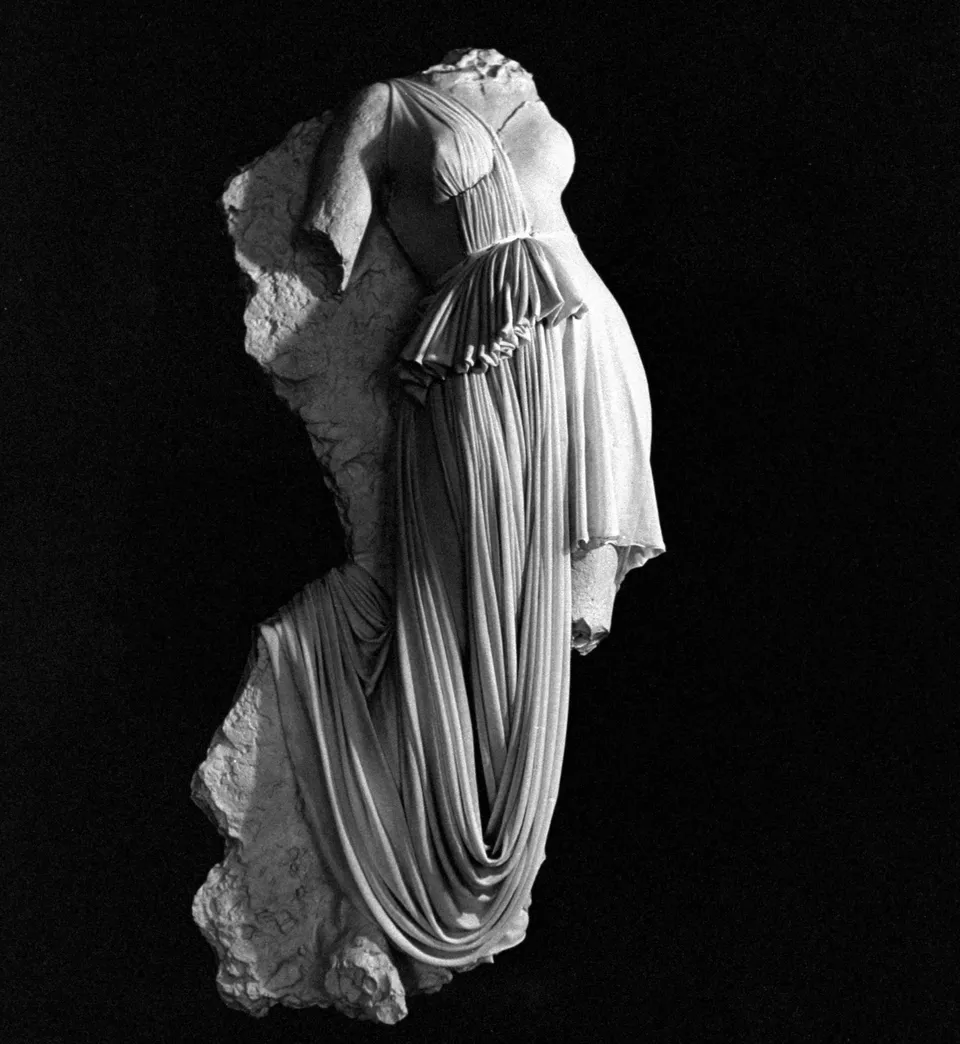
This is the deeper life of Ancient Greek style. It survives through the act of arranging cloth around the body. Draping, pleating, twisting, gathering, wrapping, fastening, girdling, and folding became a design language capable of crossing empires, revolutions, couture houses, cinema screens, and modern technology. Ancient Greece left fashion fewer complete garments than images of garments, and that absence gave later designers enormous freedom. Every generation encountered the classical fold and imagined a different world inside it.
Ancient Greek style begins with fabric before it becomes clothing. A rectangle of wool or linen is lifted, folded, fastened, and belted. Its structure develops directly upon the body. There is no requirement for a garment to be divided into sleeves, bodices, lapels, or shaped panels. Cloth follows the shoulder, circles the torso, drops from the waist, and gathers wherever the wearer decides to control it.

The apparent simplicity conceals remarkable complexity. A change in belt position alters the proportions of the entire silhouette. A fastening placed closer to the neck produces a narrow shoulder line; moved outward, it creates breadth and ceremony. Fabric pulled through a girdle produces a bloused fold above the waist. A mantle shifted across the chest changes dignity into drama, concealment into display, repose into movement.
Ancient Greek dress, therefore, resists the modern assumption that technical sophistication depends upon extensive cutting. Its intelligence belongs to placement. The body becomes the framework, while gravity completes the construction.


The peplos embodied this principle with monumental clarity. Usually associated with a heavier woollen cloth, it was folded along the upper edge to form an overfold known as the apoptygma, wrapped around the body, fastened at the shoulders, and secured with a belt. Its vertical fall could resemble a column, yet the garment changed constantly as the wearer walked, sat, lifted an arm, or adjusted the girdle.
The chiton offered a lighter and more fluid possibility. Formed from rectangular panels and often associated with linen, it could be fastened along the shoulders or upper arms, creating a rhythm of small openings and gathered fabric. It could fall to the feet, rise above the knees, cling in fine folds, or expand into generous volume. The same basic structure served different genders, ages, social roles, and occasions.
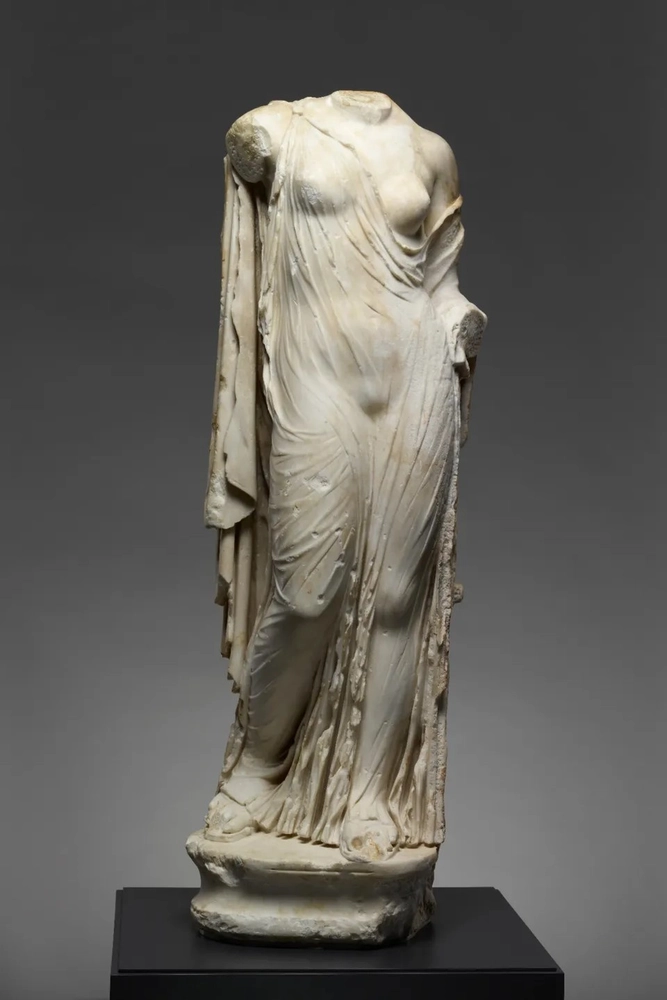
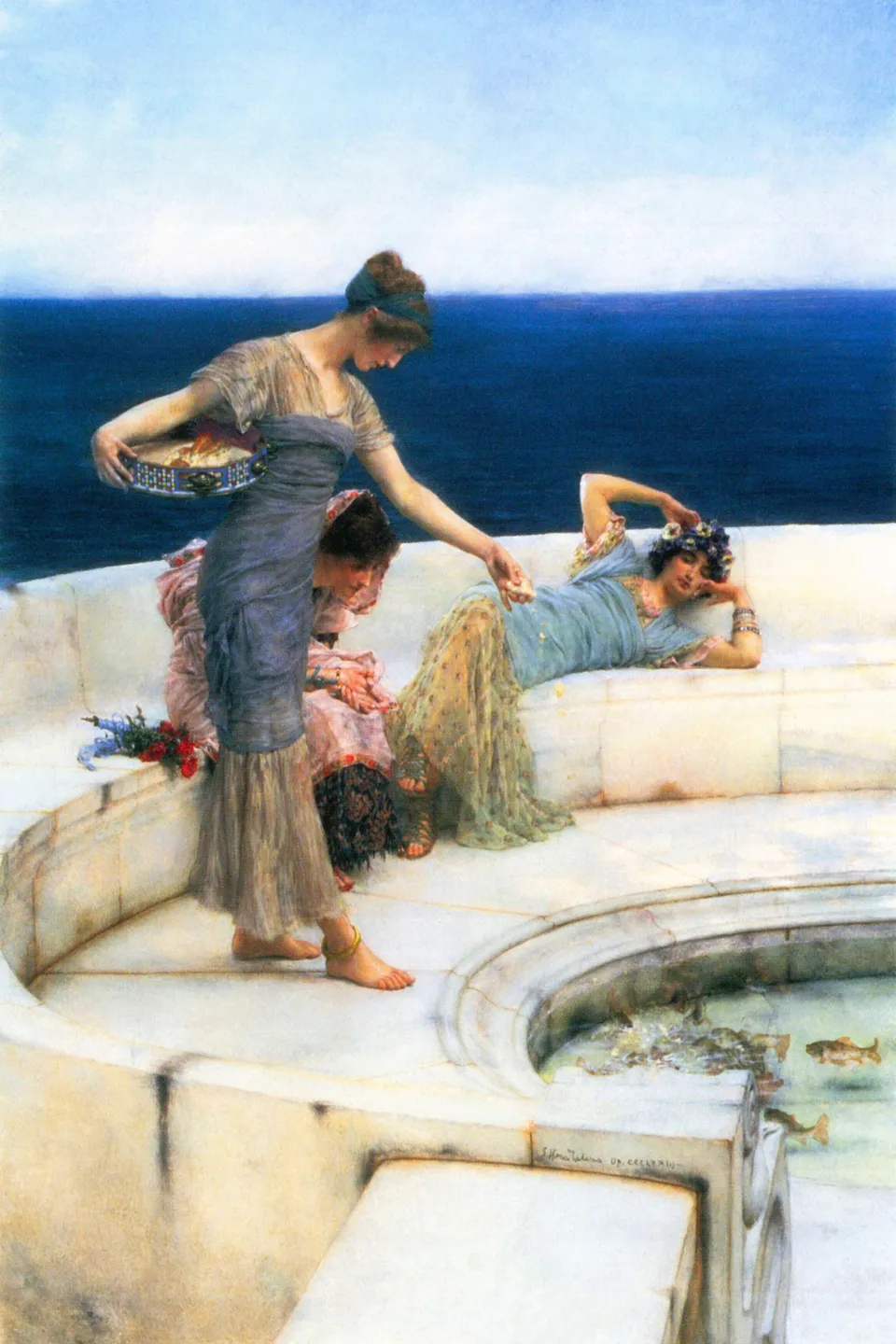
The himation entered as a larger outer cloth, carried around the body like portable architecture. It could cover the head, enfold the shoulders, cross the torso, or gather around the waist. Its visual authority came from arrangement. One person could appear philosophical, ceremonial, private, or commanding through the handling of a single mantle.
The shorter chlamys carried another temperament. Associated with travellers, soldiers, hunters, and active young men, it could be fastened at one shoulder and thrown back from the body. The asymmetry that modern fashion frequently reads as goddess-like also belonged to mobility, masculinity, and speed.
Popular culture often compresses Ancient Greek style into a white one-shouldered evening gown worn with gold sandals. The historical reality contained heavier wool, fine linen, vivid dyes, patterned borders, embroidered surfaces, layered mantles, practical tunics, and ceremonial cloth. Ancient clothing participated in labour, citizenship, warfare, religion, domestic life, sexuality, grief, and spectacle.

The whiteness associated with Greece emerged partly through the afterlife of sculpture. Marble survived while pigment faded. Later viewers encountered pale statues and transformed material loss into an aesthetic ideal. Purity, reason, restraint, and whiteness became fused within a European fantasy of classical civilisation.
Yet the ancient world was chromatic. Garments carried colour. Sculptures and temples displayed painted detail. Borders could announce wealth, status, ritual importance, or regional taste. The clean white Grecian gown tells a powerful story, though it frequently tells more about Neoclassical Europe than ancient Athens.
The signature of Ancient Greek style lies in the relationship between surface and form. Cloth appears free, yet every fold directs the eye. It may descend in disciplined vertical lines, spiral around the torso, collect beneath the breast, or sweep from shoulder to hip. The body remains present through the garment, sometimes gently suggested, sometimes dramatically revealed.

Draping is the foundation of this language. Fabric is shaped in response to a three-dimensional figure, allowing weight and tension to influence the final silhouette. Draping gives the impression that clothing has discovered the body in real time. The garment seems personal, almost temporary, as though it could be released with a single pin and returned to its original rectangular form.
Pleating introduces order. Repeated folds multiply light and shadow, lengthening the figure while preserving movement. In sculpture, pleats gave stone the visual delicacy of fabric. In fashion, they allow cloth to expand and contract around the wearer. A pleated dress can remain narrow in stillness and become voluminous during movement, carrying architecture inside softness.
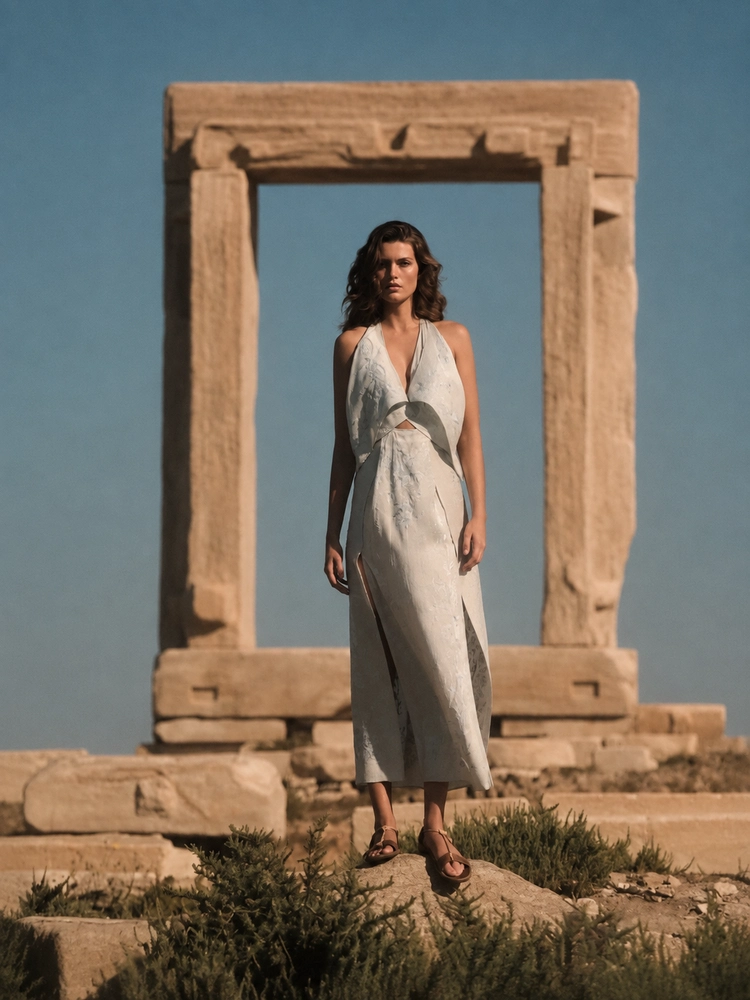

Twisting adds directional force. A twisted shoulder, neckline, or waist pulls fabric toward a focal point, creating tension across the surface. The technique gives a dress an origin, as though every fold were being drawn toward a clasp, knot, or invisible hand.
Wrapping creates intimacy. Cloth circles the body and records its volume. It can protect, expose, restrain, or release depending upon its tightness. A wrapped garment often appears closely authored by its wearer because the silhouette depends upon how the material has been handled.
Gathering concentrates fullness. Several feet of fabric can be controlled at a single shoulder or waist, producing a cascade that moves outward from one charged point. Knotting and pinning transform practical fastening into ornament. The fibula, clasp, cord, belt, or brooch becomes part of the composition, showing exactly where loose cloth becomes clothing.


Girdling shapes proportion. When fabric is drawn over a belt, it creates the kolpos, a soft pouching fold that changes the relationship between torso and skirt. The waist can sit at the natural line, lower across the hips, or higher toward the ribs. Later fashion exaggerated this possibility into the Empire silhouette, with a seam or belt placed directly beneath the bust.
The Empire waist belongs to fashion’s interpretation of antiquity. It draws upon the high girdling visible in some classical images, yet its most recognisable form emerged during the late eighteenth and early nineteenth centuries. It transformed the torso into a brief upper section and allowed the skirt to fall in a long uninterrupted column.
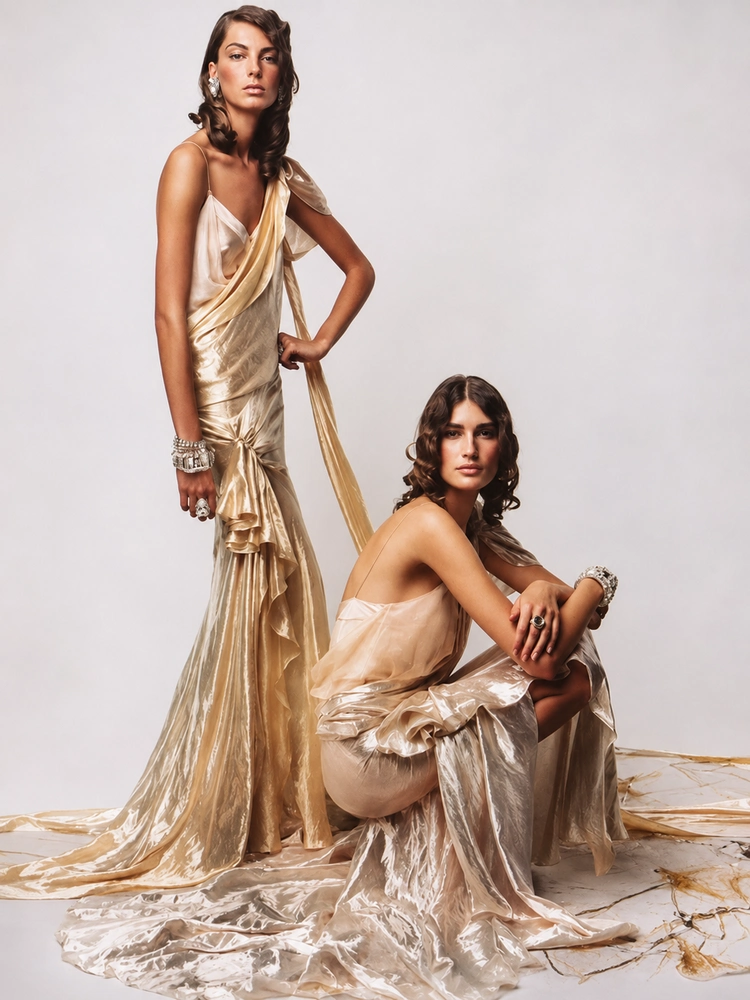
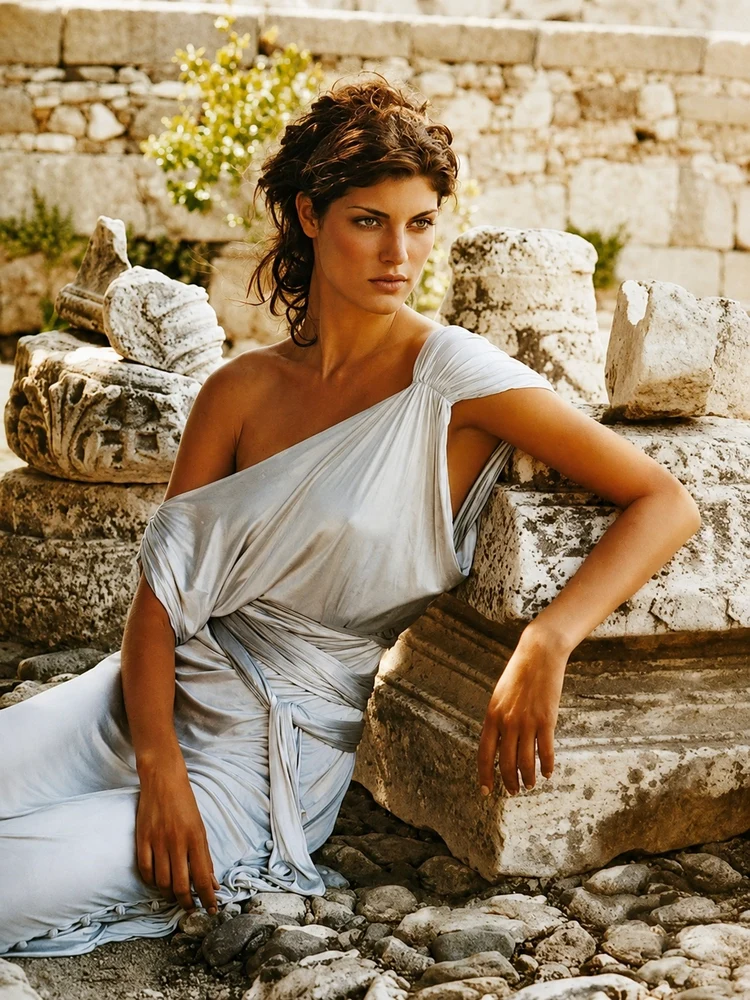
Asymmetric silhouette gives Ancient Greek style much of its drama. One exposed shoulder creates a diagonal line across the torso. A mantle gathered at one side sends the eye across the body. A skirt opening over one leg turns walking into revelation. Symmetry suggests temple order; asymmetry introduces wind, action, and human presence.
Across these techniques, the body remains central. Ancient Greek style rarely treats clothing as a hard shell. It frames the wearer through rhythm, gravity, and motion. Its true signature is the sense that fabric possesses memory: it remembers the shoulder that carries it, the waist that gathers it, and the step that opens it.
The history of this style begins long before fashion adopted the word “Grecian.” During the Geometric period, approximately 900–700 BCE, Greek communities were developing new civic, religious, and artistic structures. Textile production already formed a vital part of domestic and economic life. Spinning and weaving demanded skill, time, material knowledge, and disciplined repetition. Cloth was valuable because it contained labour within every thread.

By the Archaic period, approximately 700–480 BCE, clothed female statues known as korai appeared in sanctuaries and public spaces. Their garments were carved with patterned borders, layered folds, and carefully organised surfaces. The clothing did more than cover the figure. It communicated offering, status, beauty, youth, and sacred presence.

The Charioteer of Delphi, created around 474 BCE, brought another emotional register. His long garment descends in strict vertical folds. The upper body remains composed, the expression restrained, the silhouette controlled. The figure embodies victory through discipline. There is little theatrical excess, yet the entire surface is charged with contained energy.

This bronze would later inspire Mariano Fortuny’s Delphos gown, but its original power belonged to a culture in which dress, ritual, athletics, religion, and civic identity met within the same body.
Athena presided over this meeting. She was goddess of wisdom, strategy, warfare, skilled craft, and the city of Athens. Weaving belonged to her domain because textile work represented organised intelligence. Threads crossed according to structure. Patterns required foresight. Cloth emerged through patience, calculation, and hand knowledge.
During the Panathenaic festival, a woven peplos was presented to Athena. This sacred garment carried myth into civic ritual. The production of the cloth connected female labour with the identity of the city, while its ceremonial presentation transformed textile into political theatre.
The story of Arachne exposed the darker tension within divine craft. Arachne, a mortal weaver, challenged Athena through technical brilliance. Her tapestry revealed the abuses and disguises of the gods, turning weaving into criticism. Athena answered with violence, and Arachne became a spider, condemned or blessed to weave forever depending upon how the myth is read.

The story recognises textile as a medium capable of speaking dangerously. A woven image could praise authority or expose it. Skill offered prestige, yet it could also threaten hierarchy.
Penelope in the Odyssey used weaving as temporal strategy. Pressured to choose a new husband while Odysseus remained absent, she promised to decide after completing a burial shroud. Each night, she unravelled the work produced during the day. The loom became an instrument of delay and autonomy. Her cloth controlled time inside a household where others attempted to control her future.

These stories complicate the softness later attached to Grecian dress. The classical textile carries intelligence, deception, endurance, memory, civic obligation, and resistance.
During the Classical period, approximately 480–323 BCE, sculptors developed an increasingly complex conversation between cloth and anatomy. Drapery revealed the body through covering it. Thin carved folds followed breasts, thighs, knees, and torsos, while heavier sections accumulated beside the figure. The contrast created the impression of fabric responding to flesh.
The sculptural programmes of the Parthenon, built during the fifth century BCE under the political leadership of Perikles, placed draped bodies at the centre of Athenian self-image. The folds carried movement through processions, divine assemblies, and mythological conflict. Clothing became part of an ideal in which the human form, civic order, and divine presence appeared harmoniously connected.
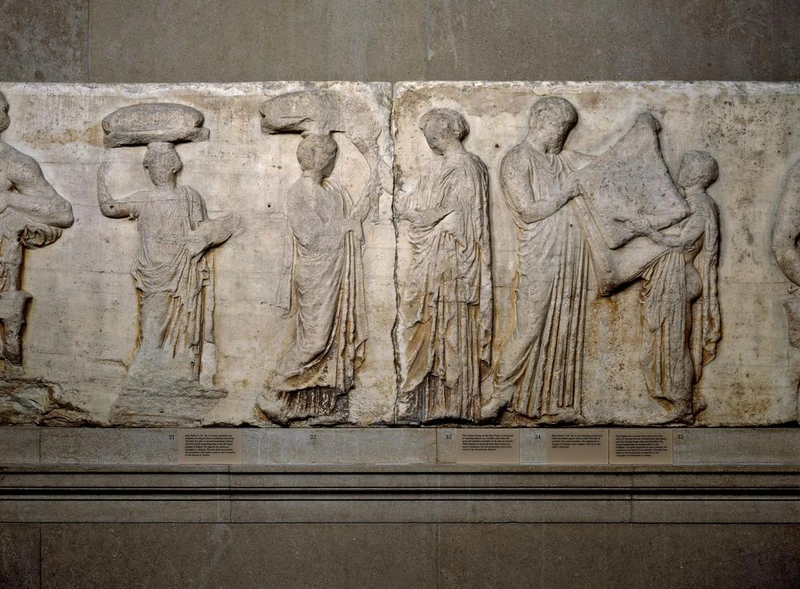
The so-called wet-drapery effect emerged as one of classical art’s most seductive devices. Fabric appears pressed against the body as though damp, revealing anatomy while preserving the symbolic dignity of dress. Later fashion repeatedly returned to this balance of exposure and concealment. Chiffon, silk jersey, fine knit, and bias-cut satin could create the sensation that cloth had merged with skin.
After the death of Alexander the Great in 323 BCE, the Hellenistic world developed a more dramatic visual language. Figures twisted, struggled, reached, fell, and occupied space with heightened emotion. Drapery joined this theatrical expansion.
The Winged Victory of Samothrace stands at the climax of that transformation. Her garment records a violent atmosphere. Thin fabric presses against the abdomen and legs, while deeper folds billow behind her. The body advances through wind without losing command. Victory is embodied as balance inside turbulence.
Centuries passed, and Europe repeatedly rediscovered antiquity according to its own anxieties. During the late eighteenth century, archaeological discoveries, Grand Tour culture, classical scholarship, and political revolution gave Greece and Rome renewed symbolic force.
After the French Revolution of 1789, fashionable women abandoned much of the heavy court structure associated with the ancien régime. High-waisted gowns in light muslin created long vertical silhouettes. Bodies appeared less armoured, more mobile, and closer to the imagined naturalism of ancient sculpture.
The Directoire, Consulate, and Empire periods turned classical dress into a modern political aesthetic. The new silhouette could suggest republican virtue, imperial ambition, erotic freedom, archaeological sophistication, or social privilege. Fine white muslin looked simple, yet imported cloth, delicate construction, laundering, and sheer layering often made that simplicity expensive.

Around 1920, Mariano Fortuny and Henriette Nigrin developed the Delphos gown. Finely pleated silk formed a narrow column inspired by the Charioteer of Delphi. Small glass beads weighted the edges, helping the garment fall close to the body. Each dress could stretch, contract, and adapt to its wearer. The Delphos looked ancient and futuristic at once.

Madeleine Vionnet carried classical drapery into mathematical modernism. Working most influentially during the 1910s, 1920s, and 1930s, she explored the bias cut and constructed garments that spiralled, twisted, and fell around the body with extraordinary precision. Her dresses appeared effortless because their engineering was concealed inside movement. Vionnet understood Greece as a system of proportion.

Madame Grès transformed drapery into a form of sculptural concentration. From the 1930s onward, she worked silk jersey into narrow hand-formed pleats, often building asymmetrical bodices and long column skirts directly around the body. Her garments have frequently been compared to Greek statues, yet their power lies in touch.
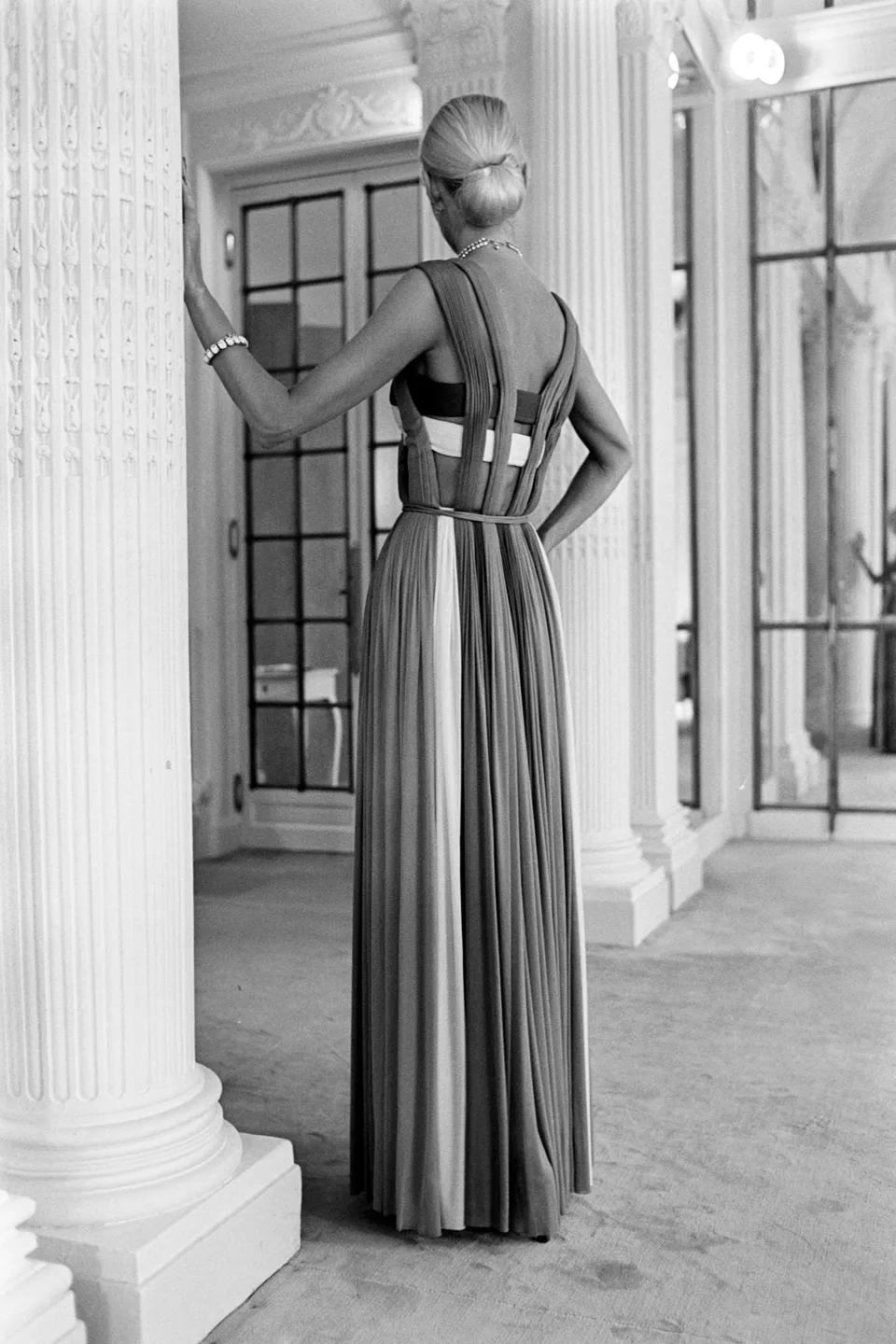

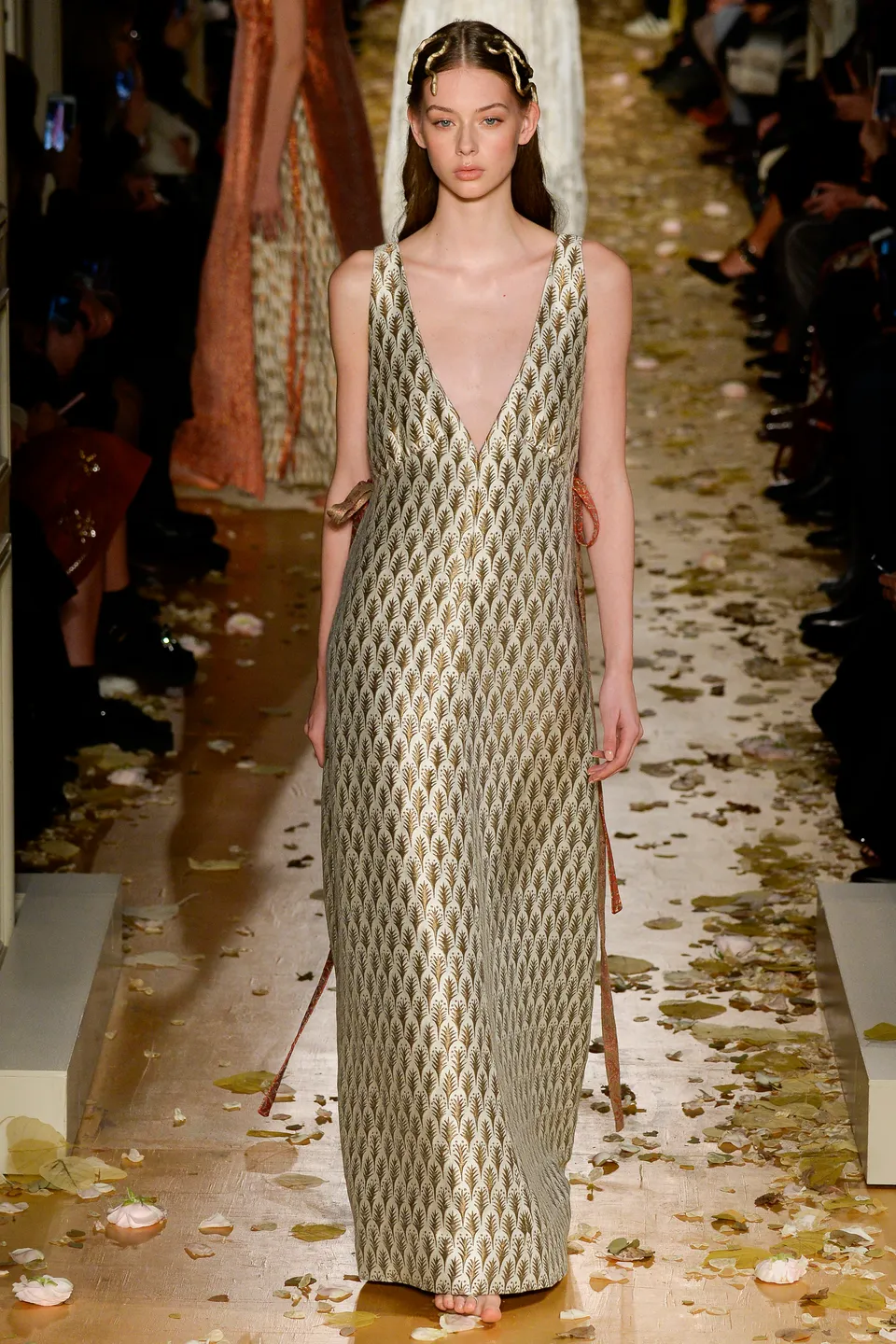
Valentino approaches Ancient Greek style as romantic mythology, filling its draped silhouettes with softness, ritual, and the presence of women who seem to have stepped out of an epic.


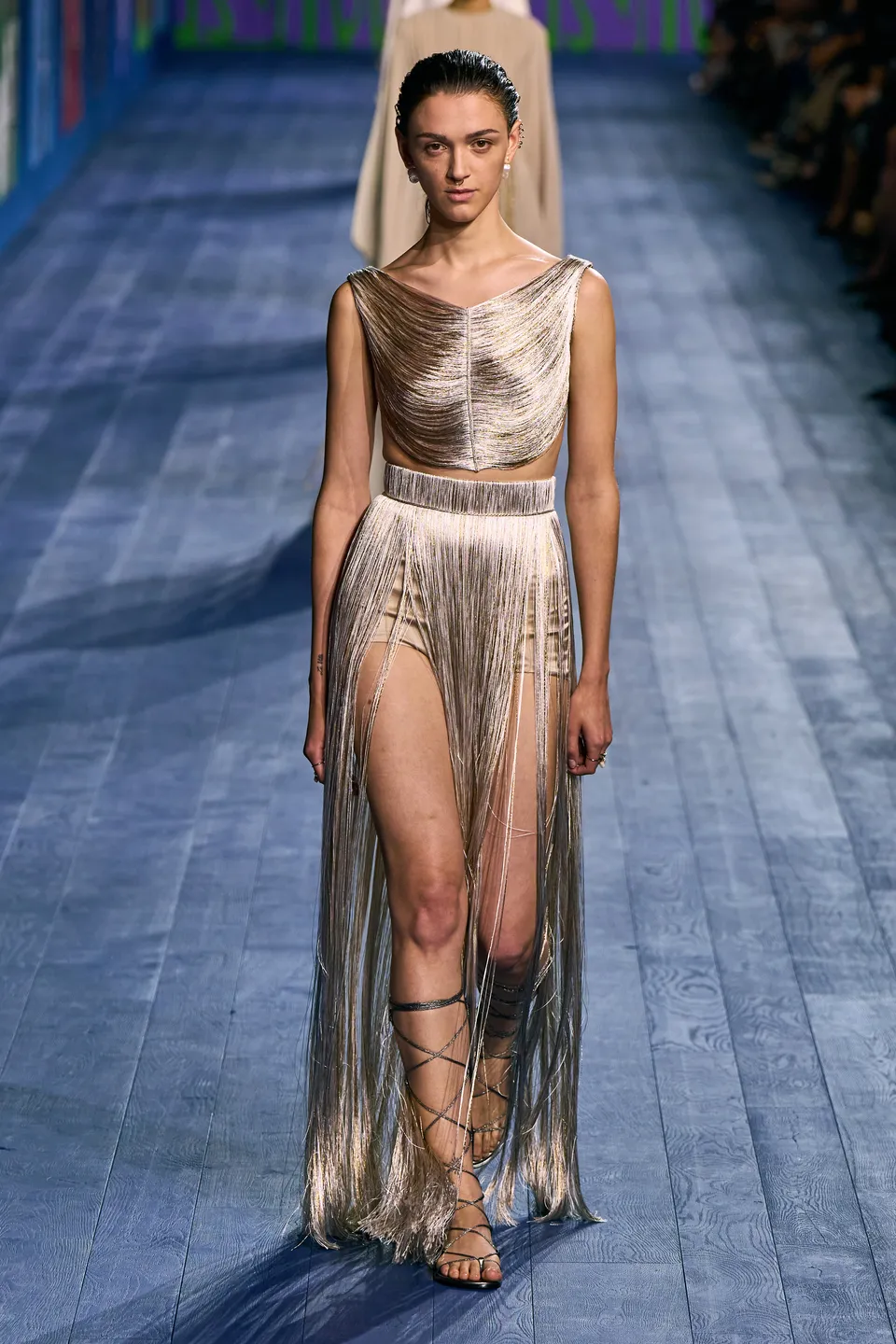
Dior gives the style a quieter authority, reducing the body to long columns, pale fabrics, and controlled folds that recall the solemn dignity of classical sculpture.
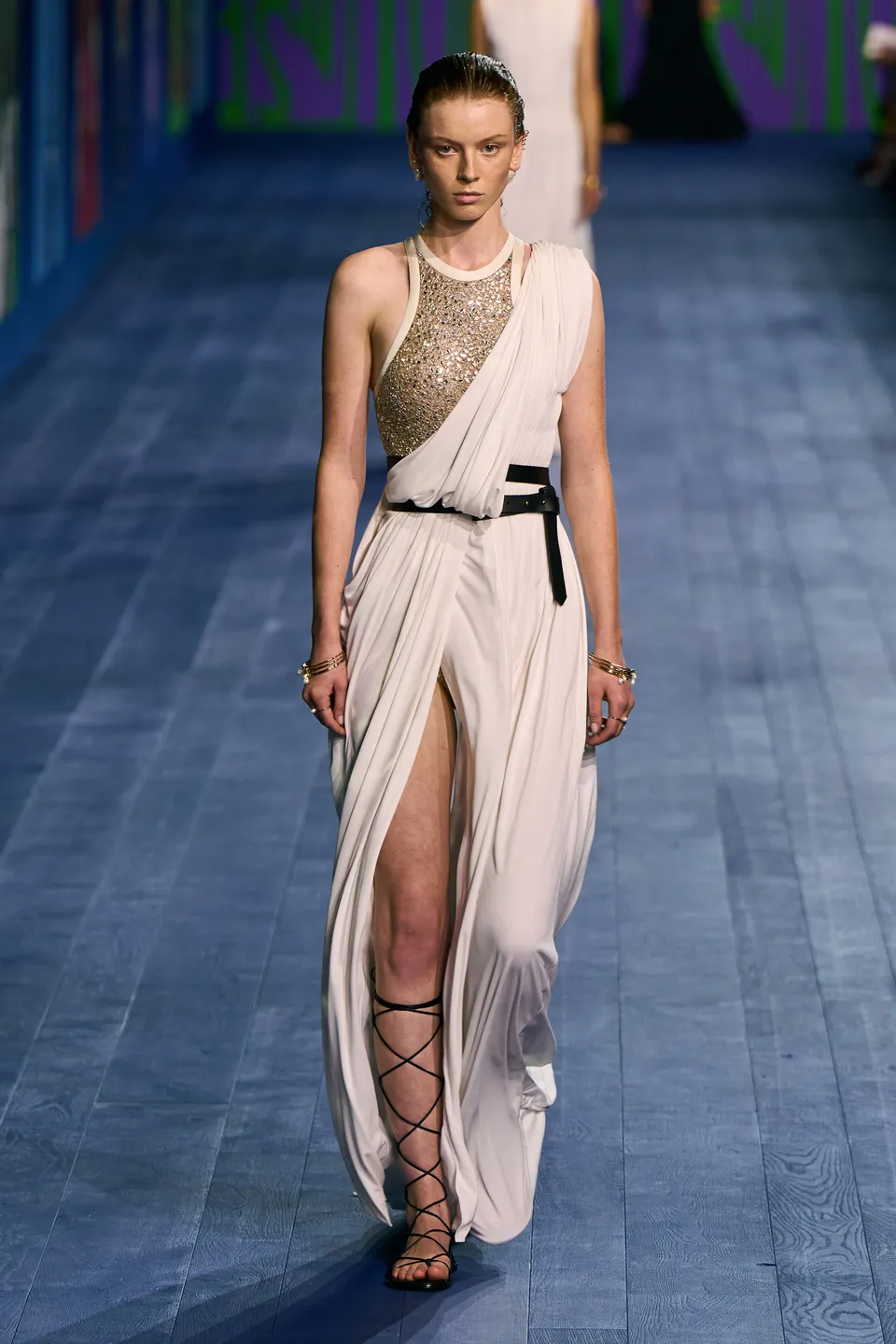
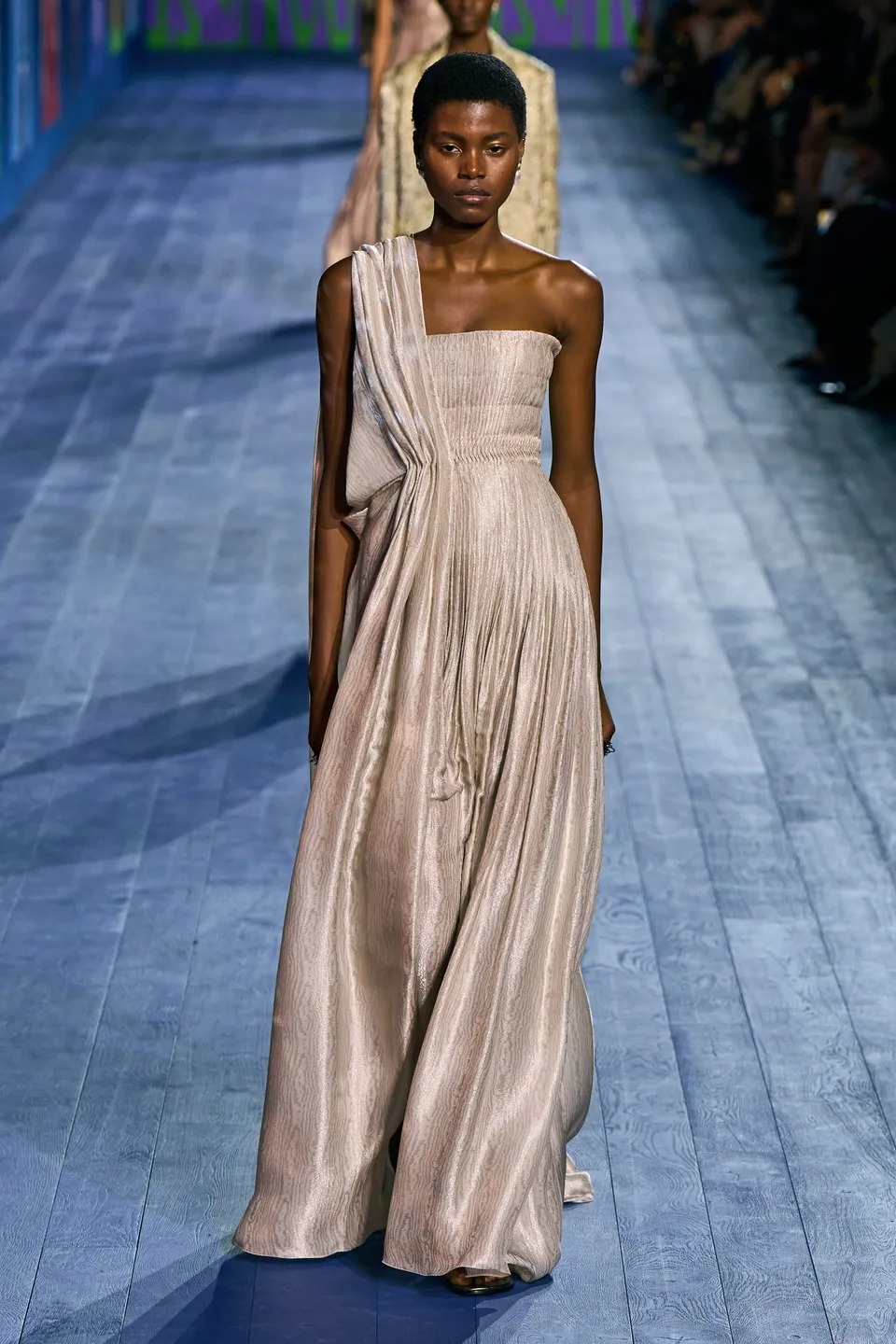
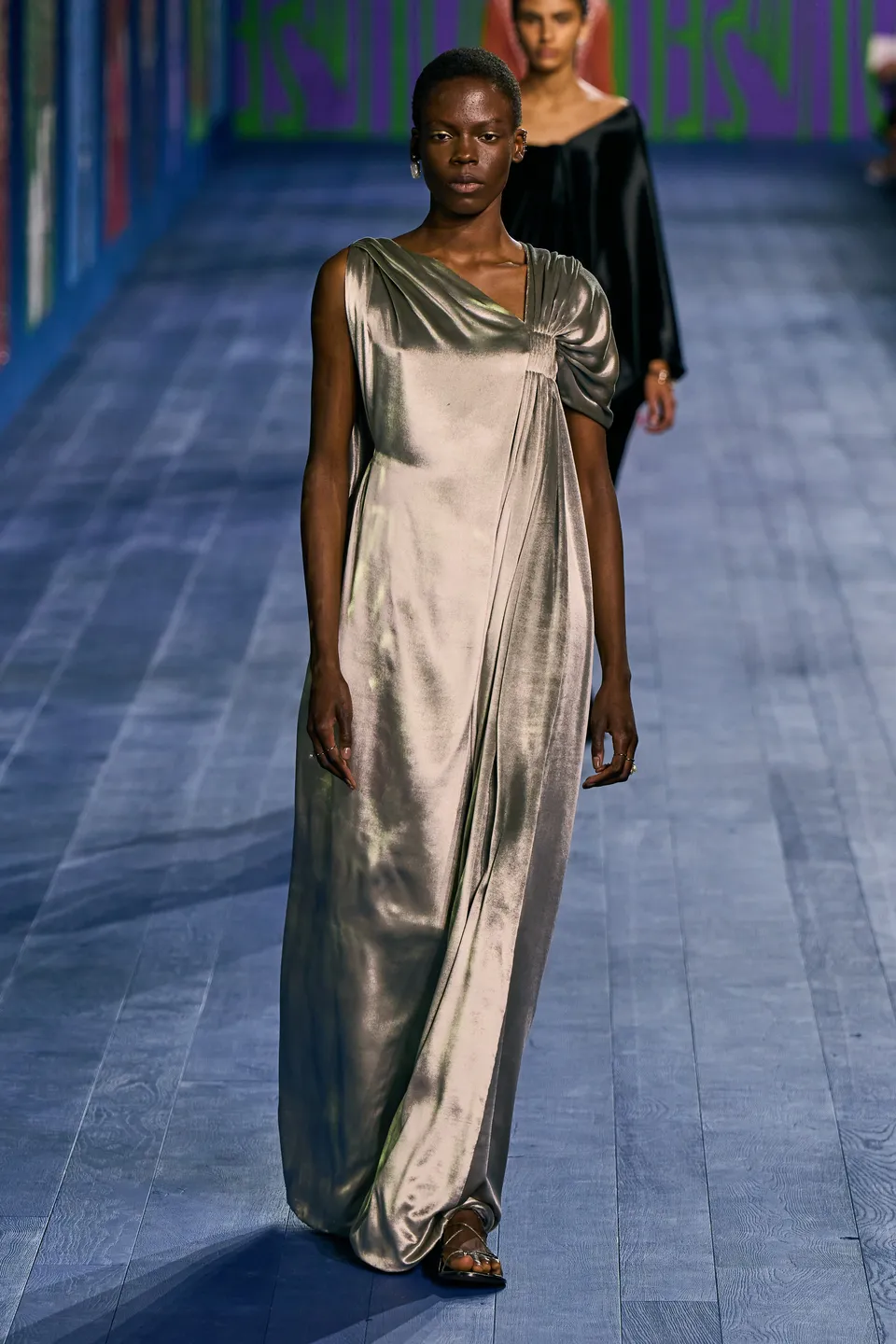
Chanel transforms the Grecian spirit into spectacle, combining pleating, gilded ornament, architectural lines, and decorative excess with the grandeur of an imagined ancient world.

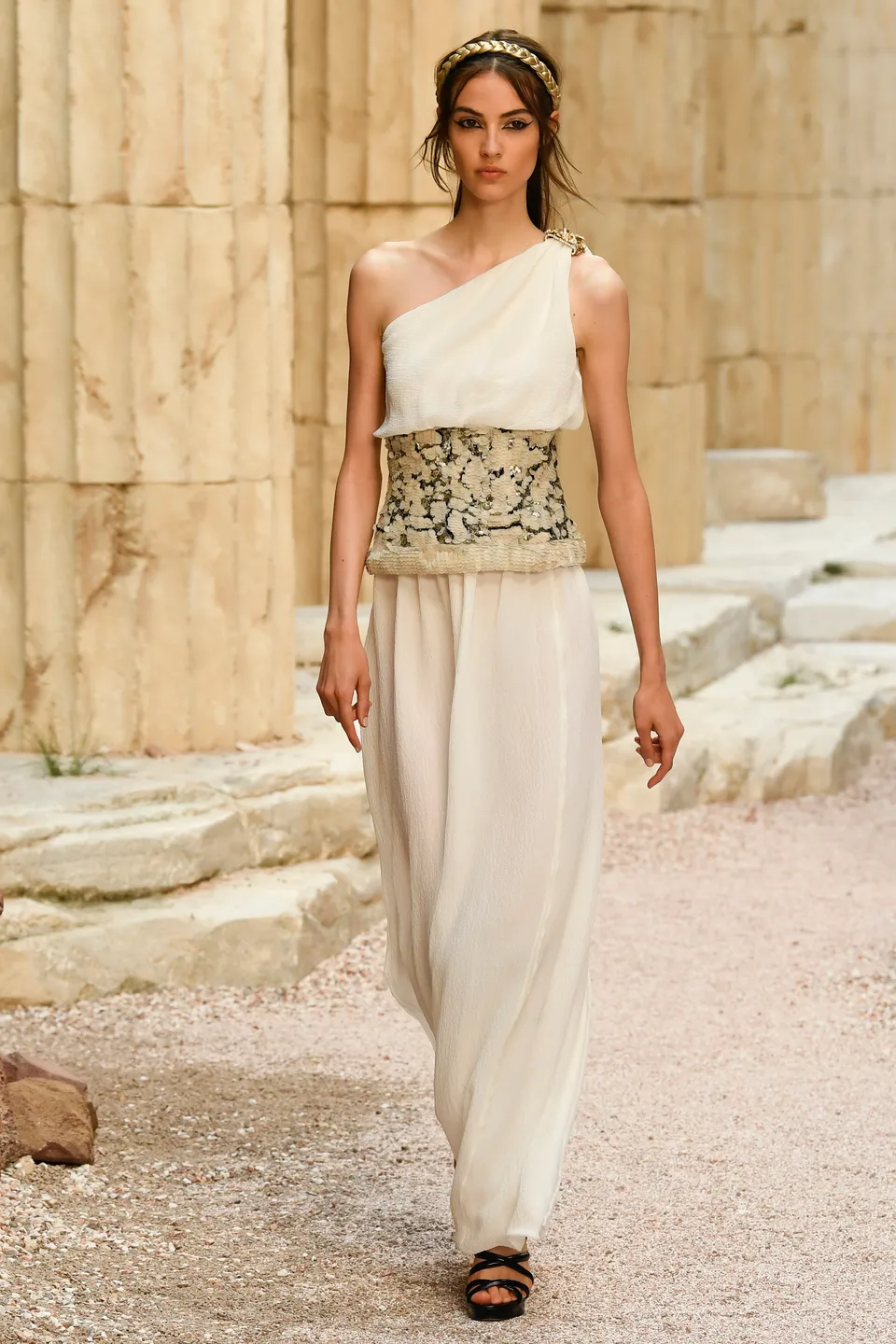
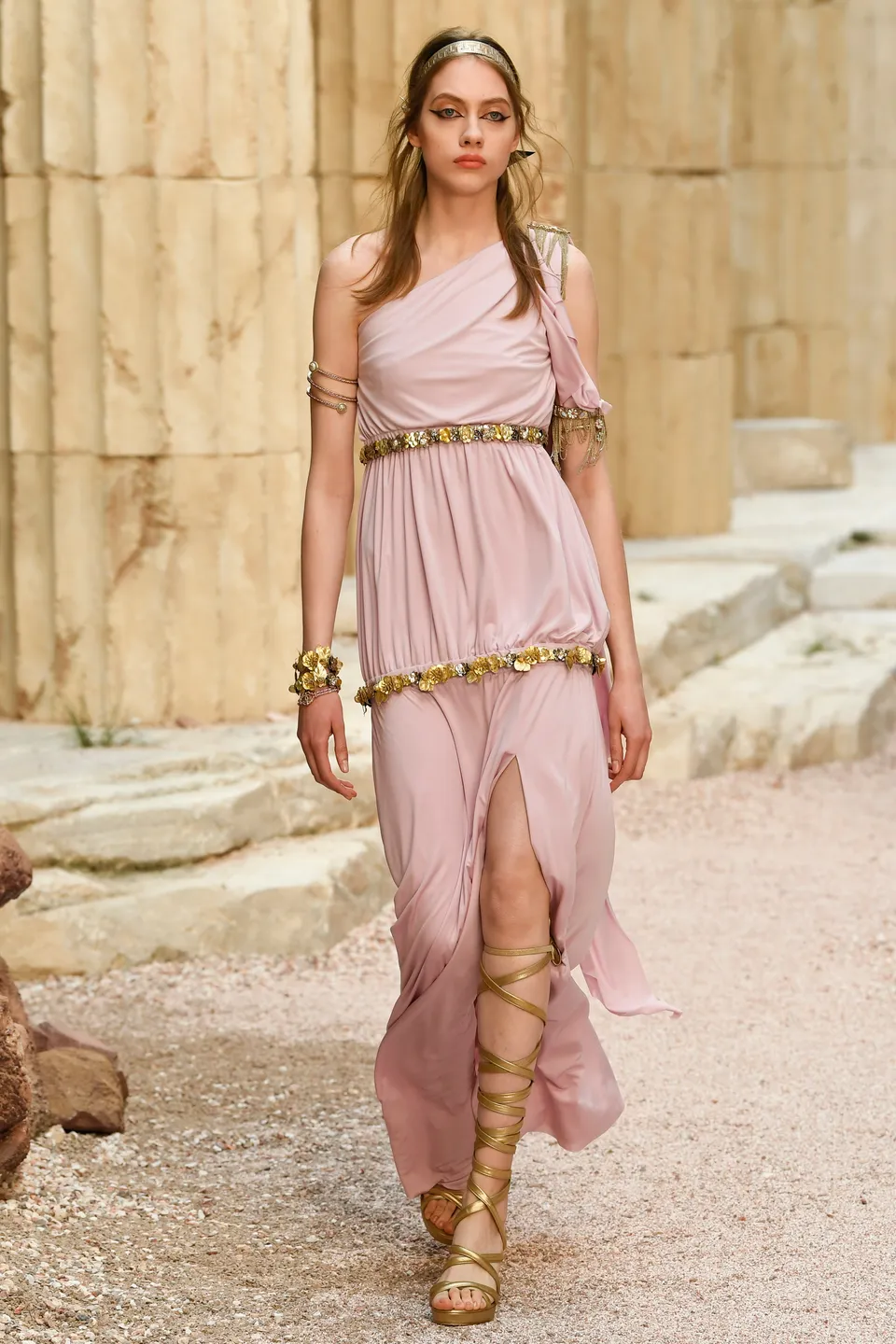
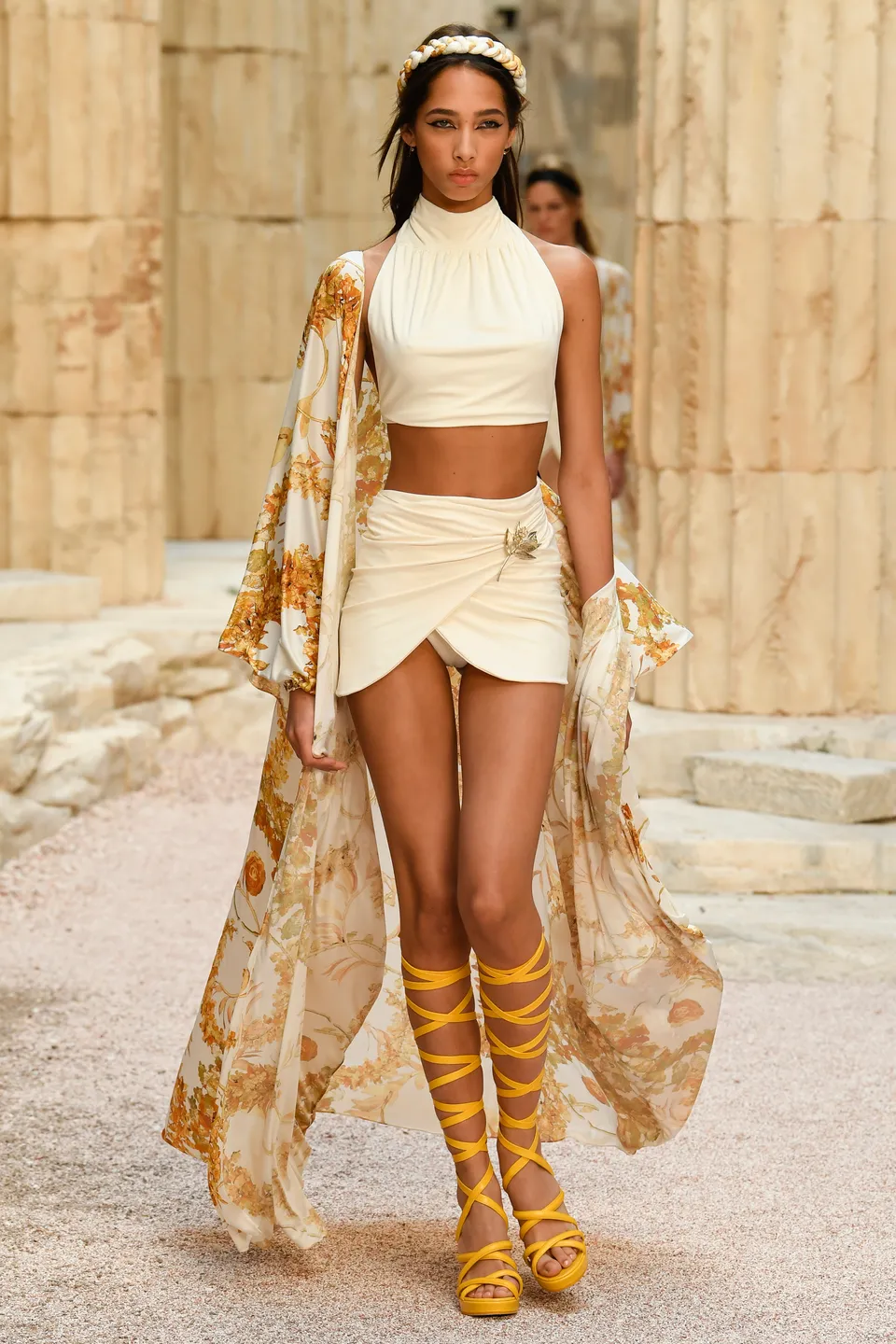
Givenchy pushes Ancient Greek style toward the warrior figure, sharpening drapery through corsetry, armour-like construction, and a darker vision of divine femininity.
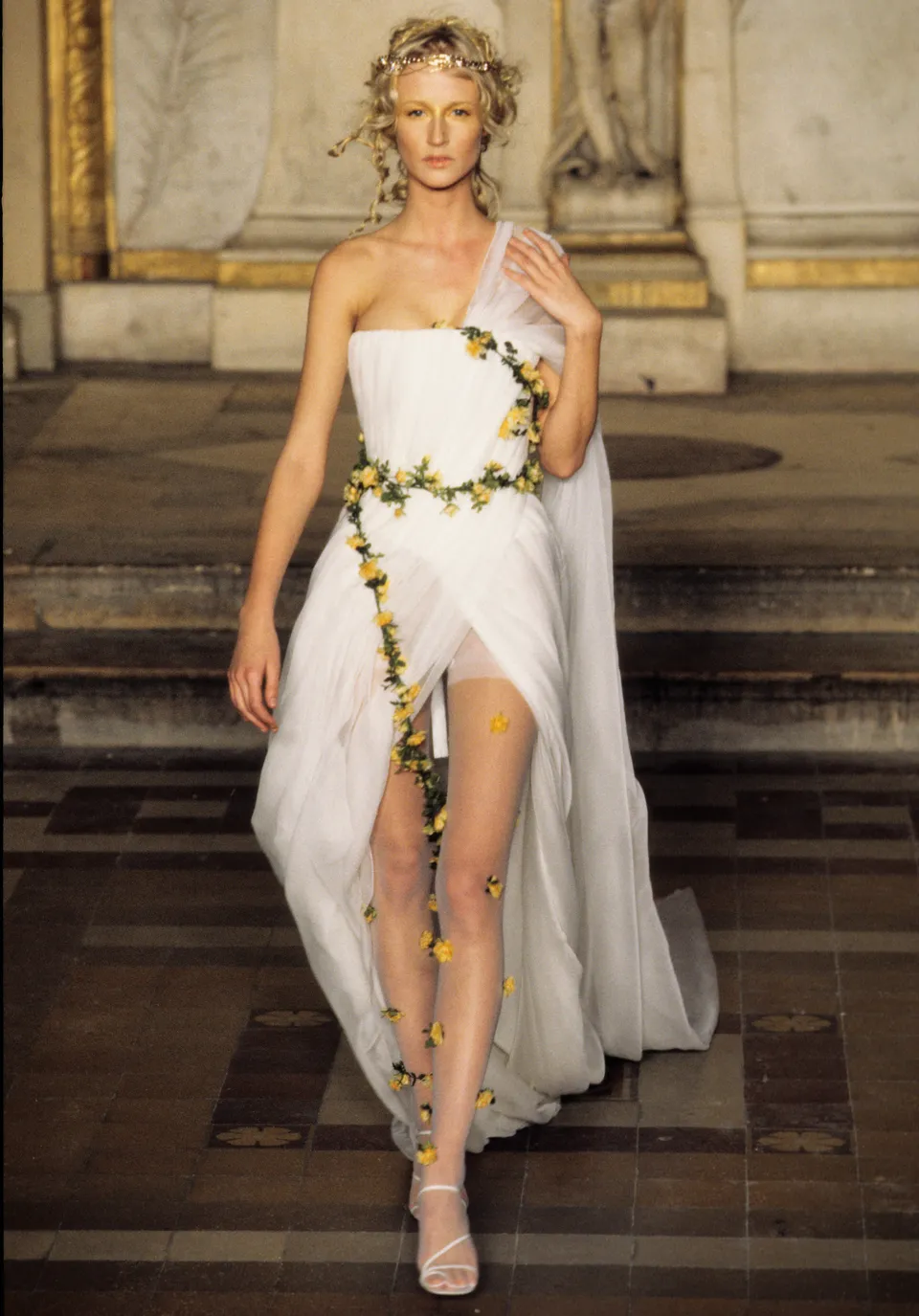
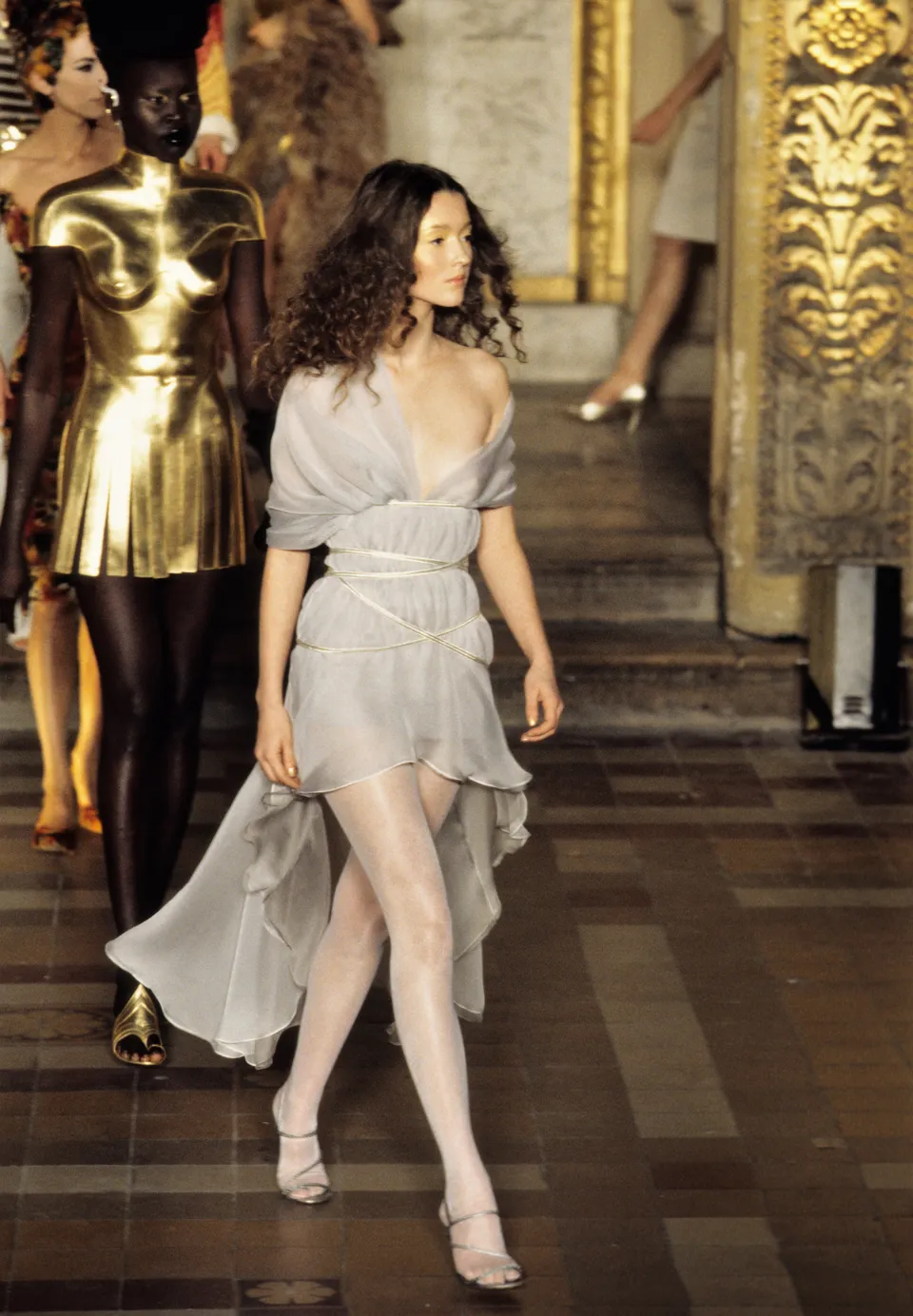
Alberta Ferretti treats the style as pure movement, allowing chiffon, jersey, and fine pleats to float around the body with the softness of air and water.
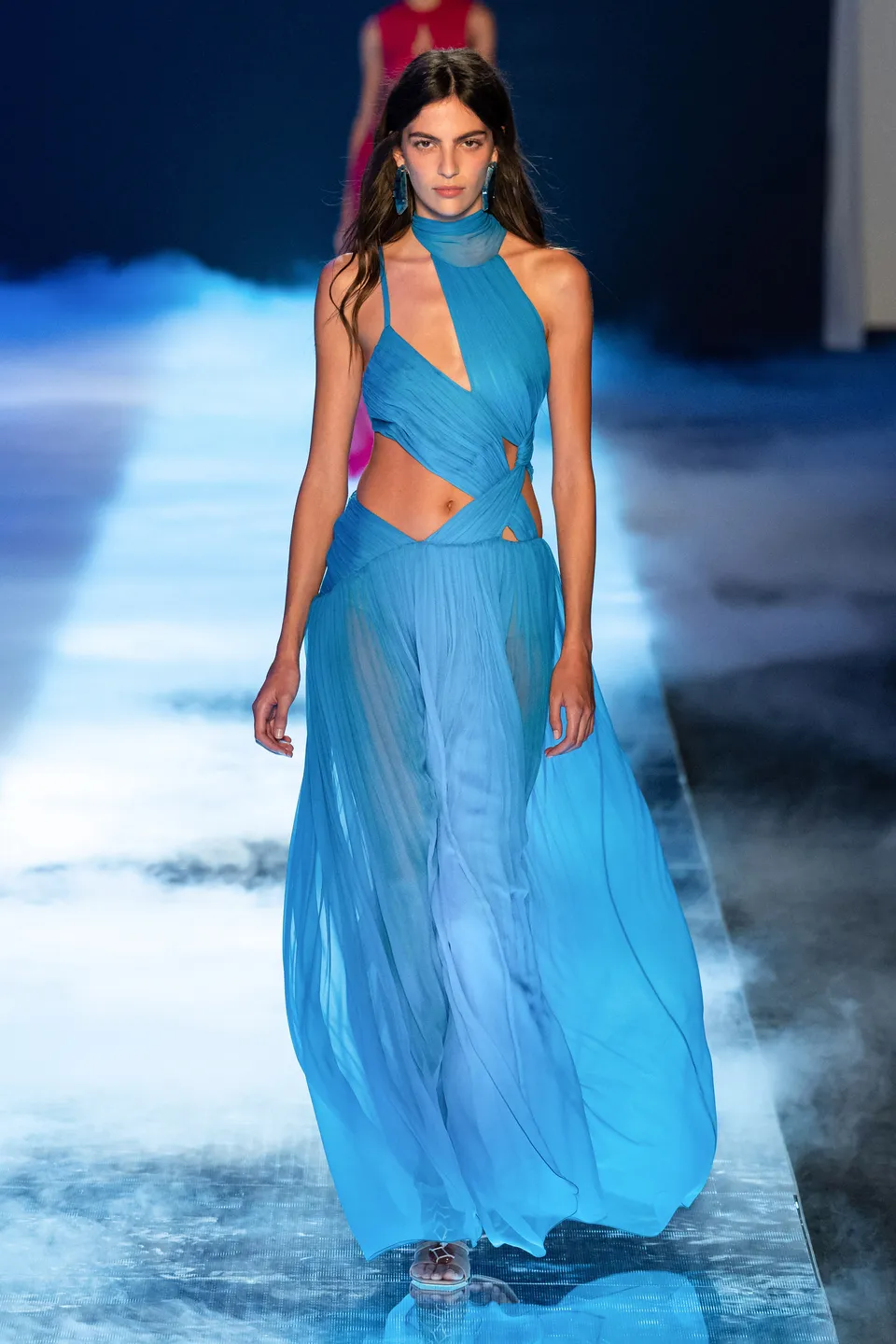
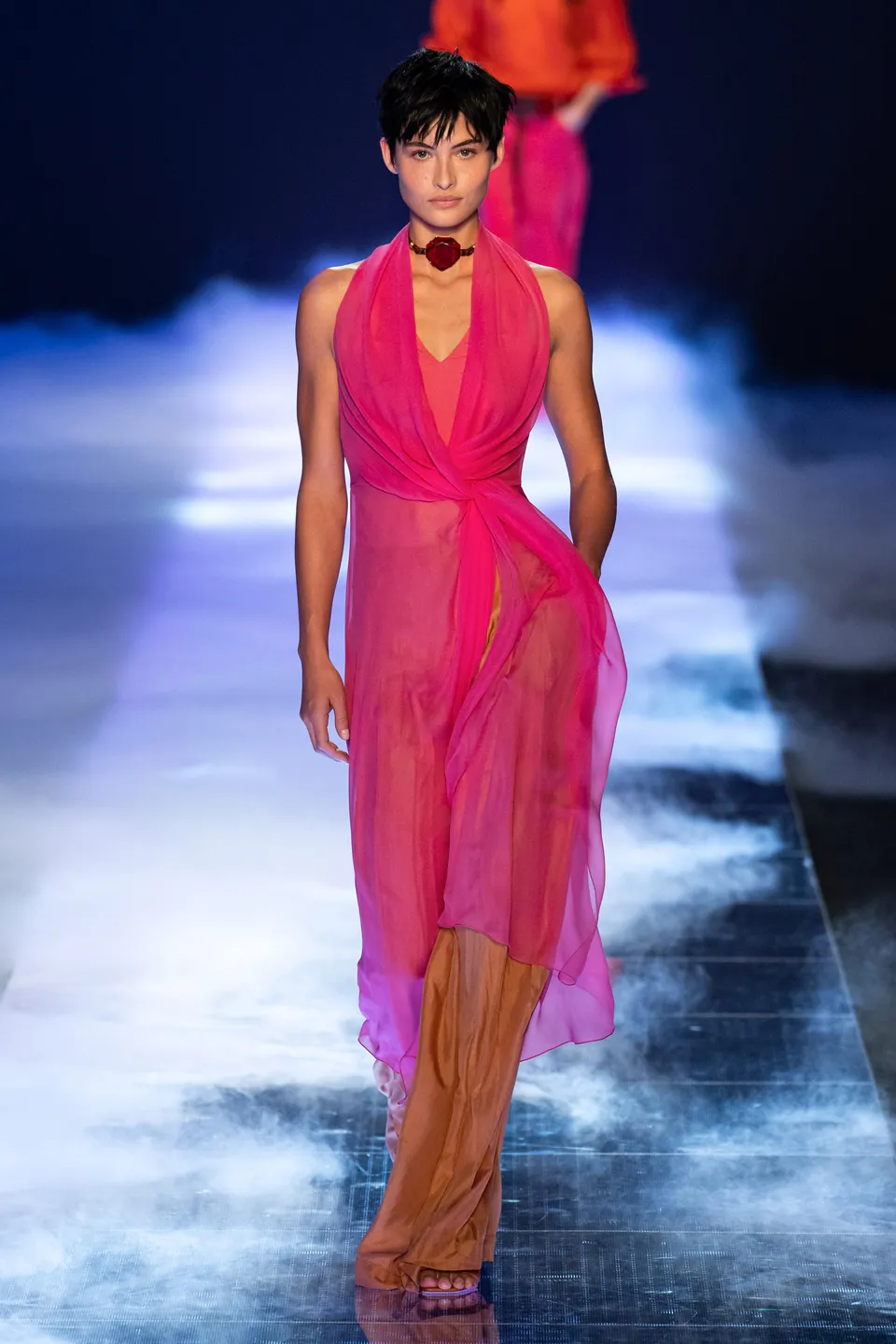
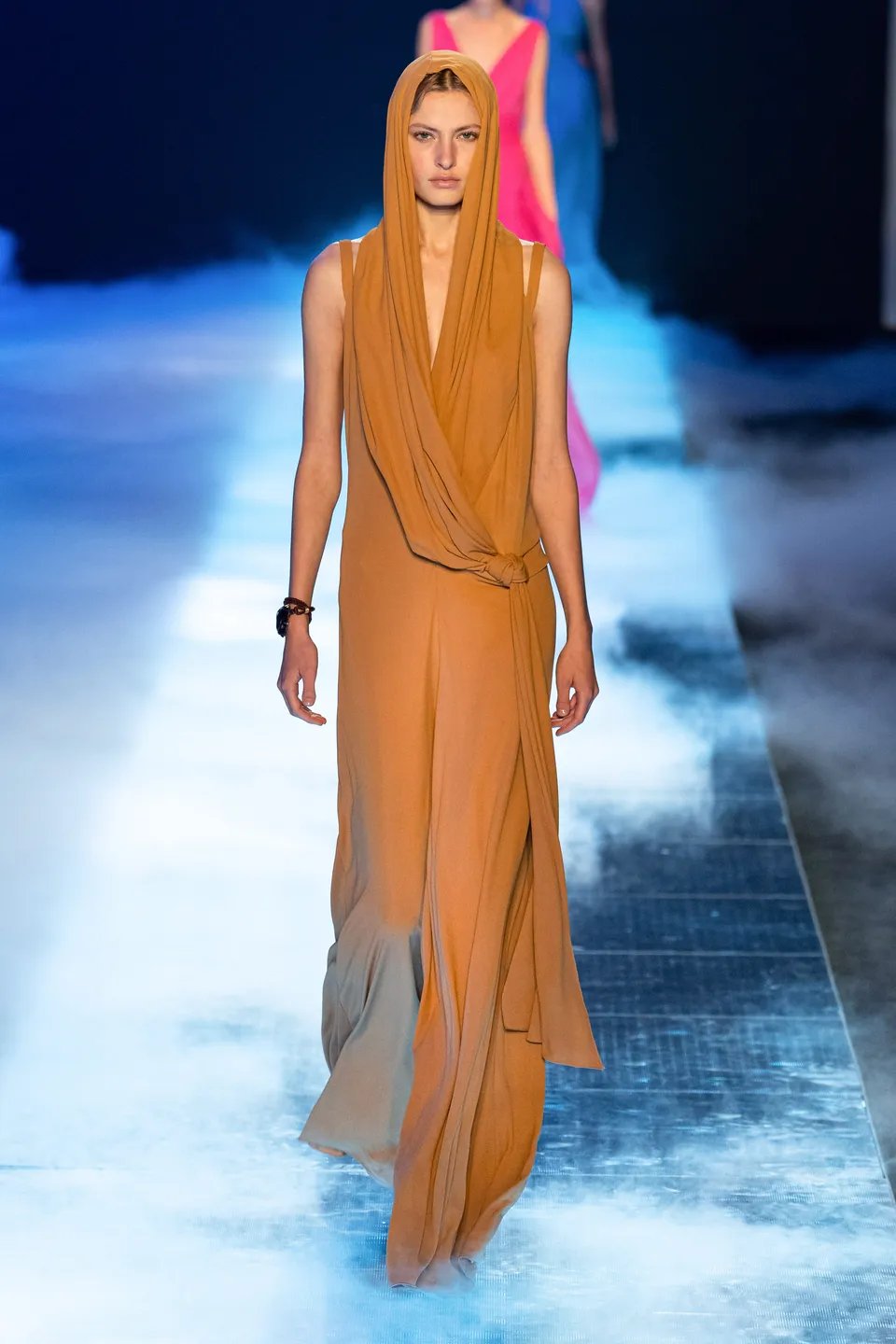
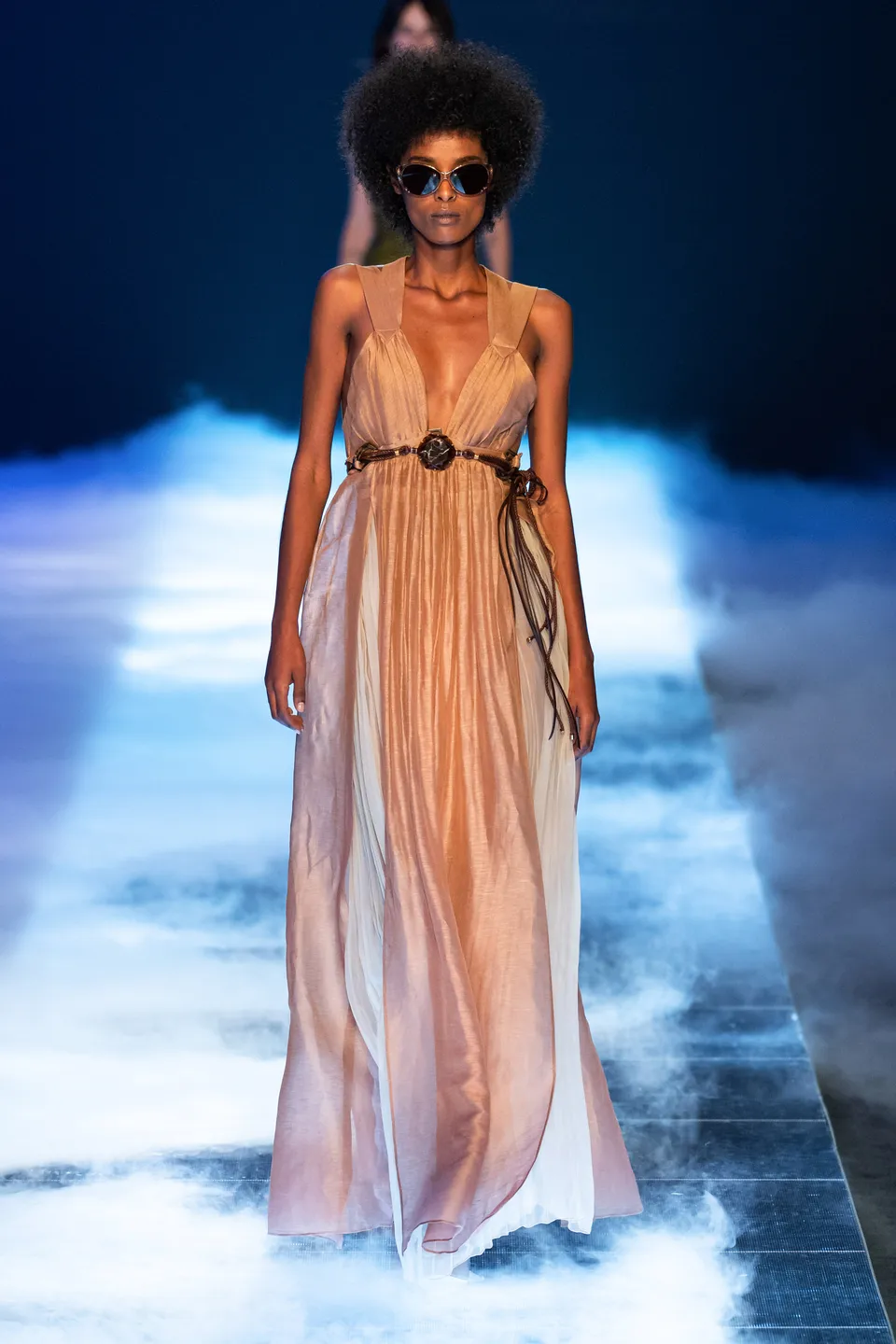
Alaïa brings the language back to anatomy, twisting and gathering fabric so closely around the figure that every fold seems shaped by muscle, breath, and motion.

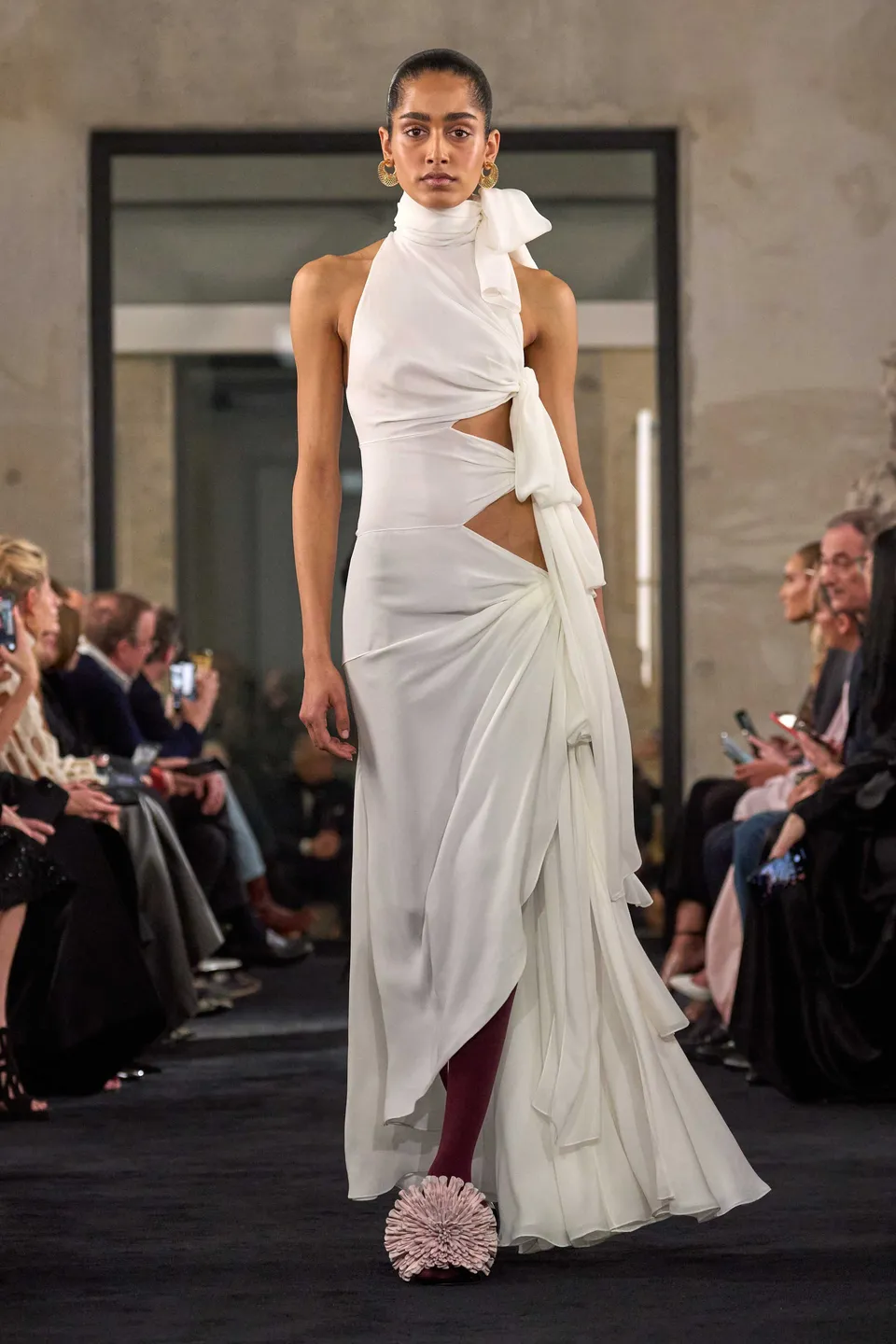
Philosophy di Lorenzo Serafini gives the classical silhouette a younger sensuality, loosening pleats and wrapped panels into clothes that feel instinctive, light, and slightly undone.
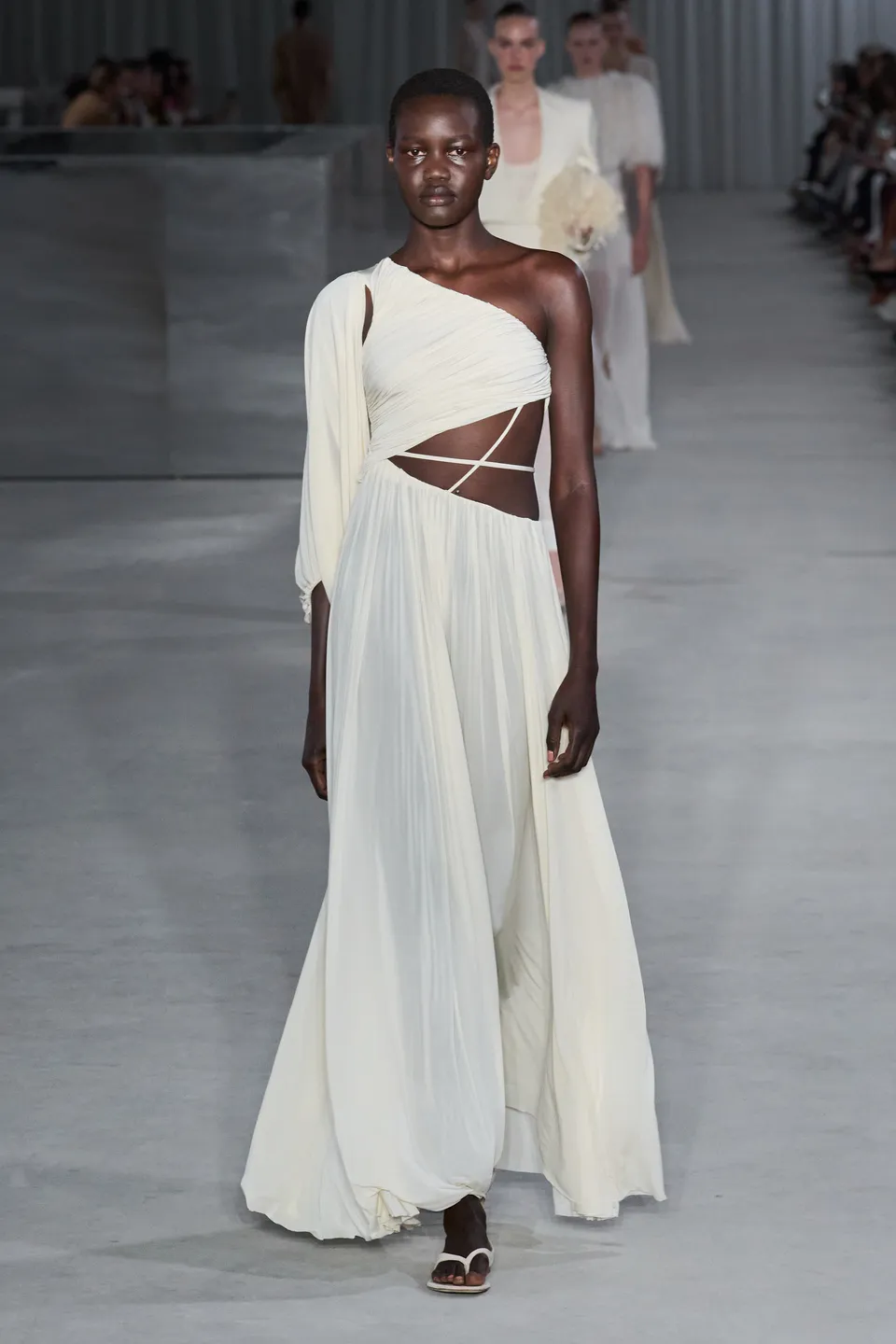
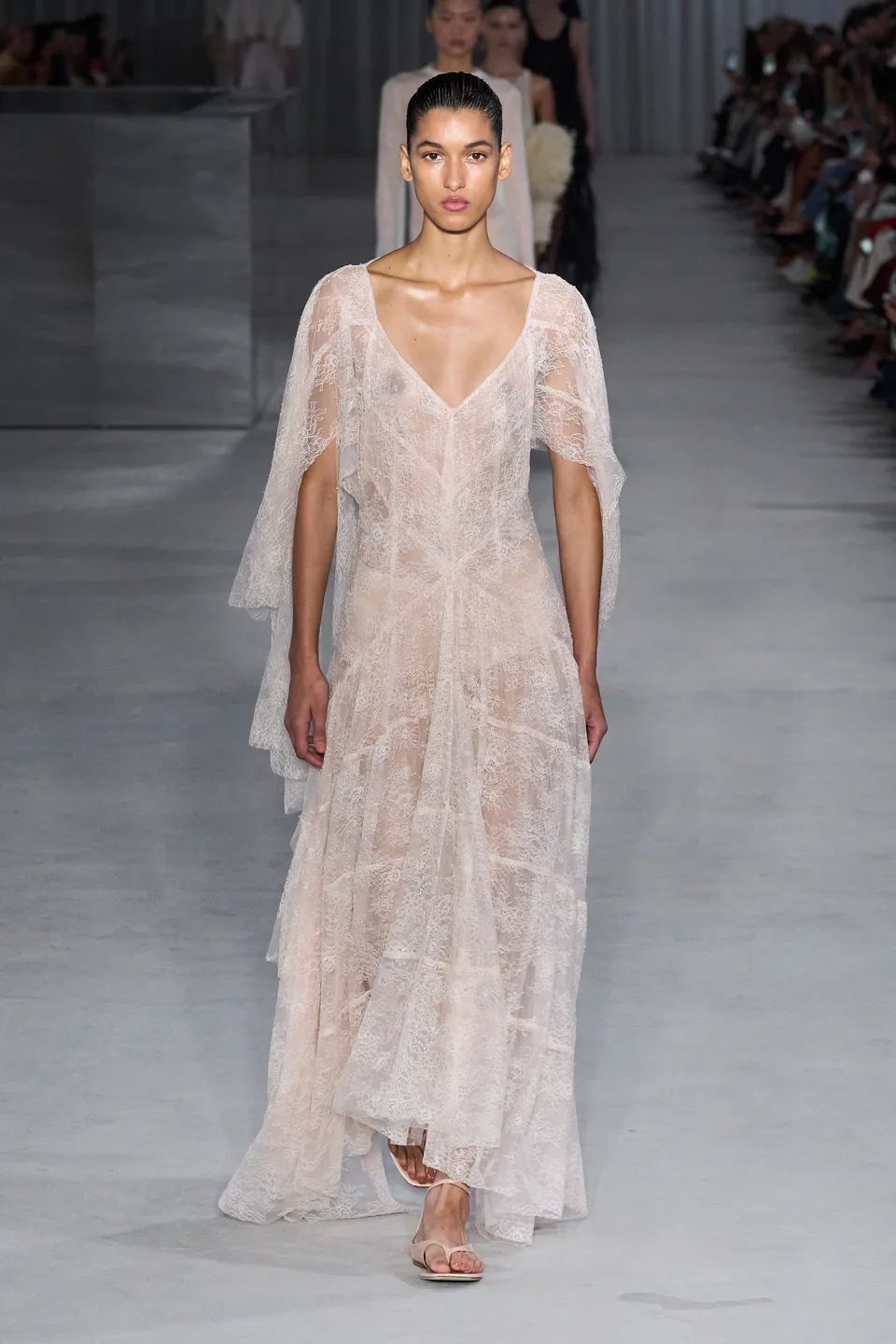
Victoria Beckham translates the style into modern restraint, using precise draping, bias cutting, and fabric tension to make the body appear both protected and exposed.


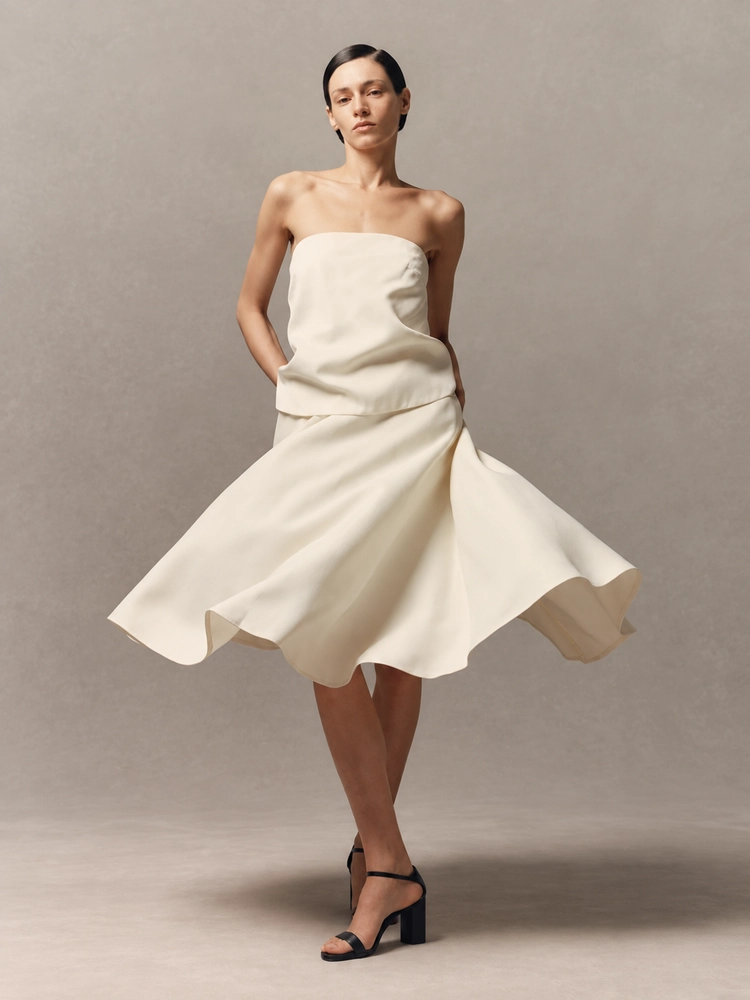
To wear Ancient Greek style is to become conscious of movement. A tailored jacket can preserve its shape while the body acts inside it. A draped dress changes with every gesture. The wearer lifts an arm, and folds travel toward the shoulder. She turns, and the fabric circles the waist. She walks, and the hem expands into air.
The garment appears unfinished without her.
This dependence produces the sensation of living sculpture. The body creates the final composition through time. A photograph captures one arrangement, while the next step produces another. Cloth reveals its intelligence through transition.
Vertical pleats lengthen the body and lend the wearer ceremonial stature. A high girdle lifts the visual centre upward. A one-shoulder construction exposes the collarbone while creating a line of authority across the torso. A mantle can enlarge the figure until it occupies architectural space.

The emotional power of Ancient Greek style grows from contradiction. It can appear soft and commanding, sensual and severe, exposed and protected. The fabric may cling to the body while surrounding it with volume. The silhouette may seem spontaneous while depending upon exact control.
Its most familiar embodiment is the goddess, though even this figure contains many identities.
Athena brings strategic intelligence. Her drapery belongs to command, civic presence, and craft. Nike carries momentum. Cloth streams behind her as evidence of arrival. Aphrodite connects drapery with desire, allowing fabric to frame the body at the threshold between concealment and revelation. Artemis brings mobility, independence, and the shortened garment of the hunt. Penelope carries textile inward, toward patience, memory, and authorship.
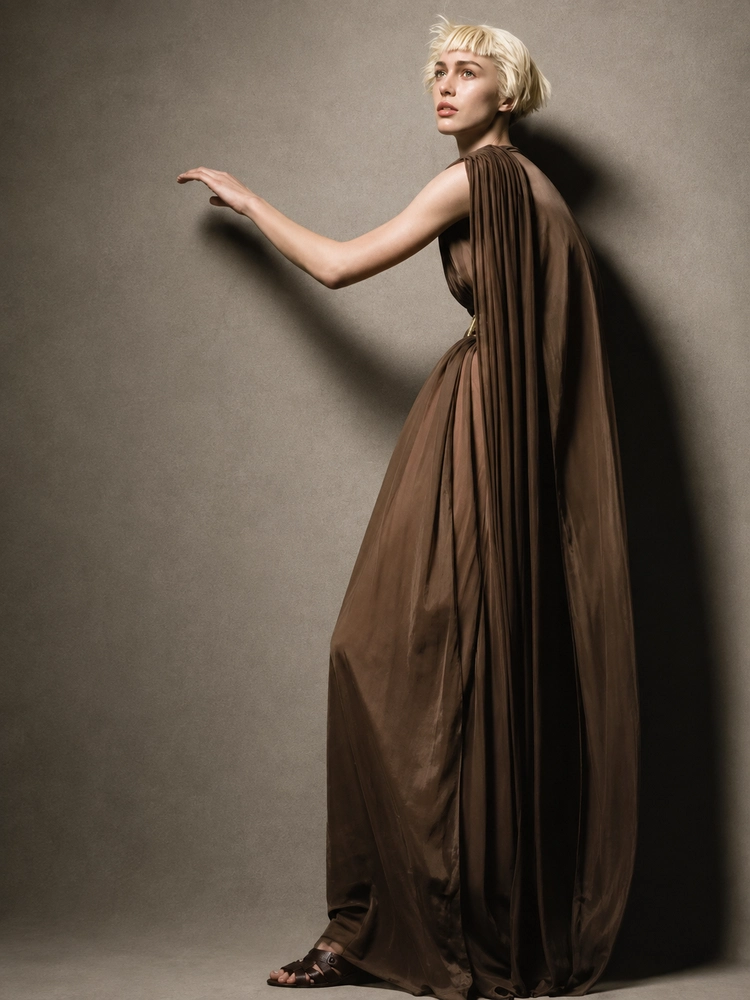
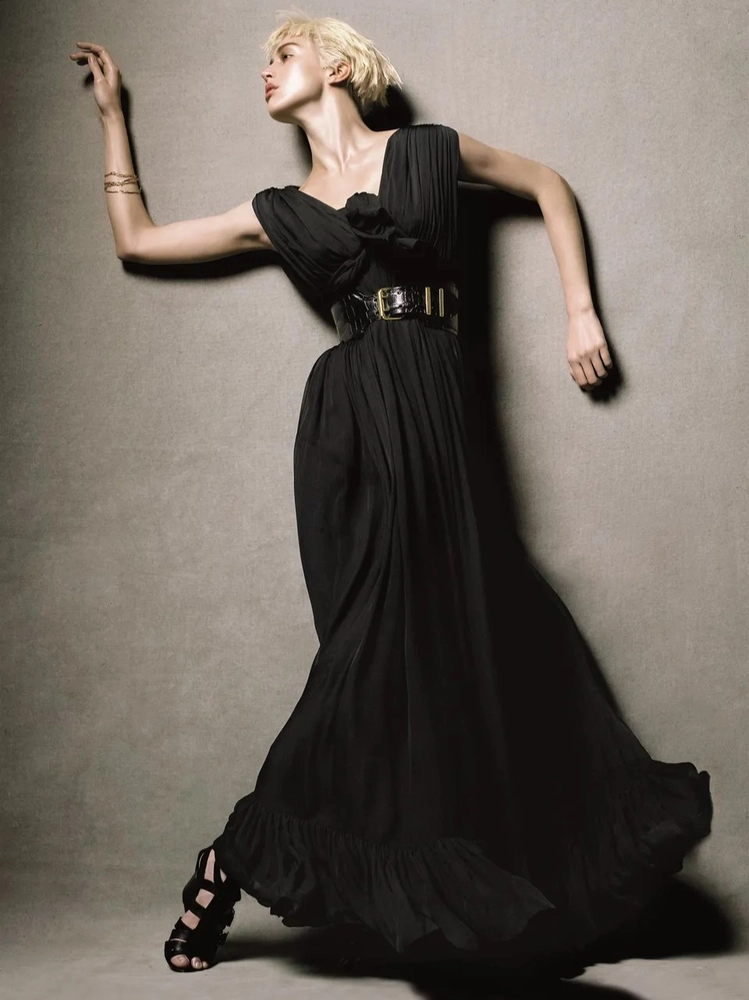
The mortal wearer inherits traces of all of them. A draped gown can make her appear ceremonially calm while fabric moves around her. She becomes the fixed centre of a changing surface.
This is why the style continues to dominate moments that demand symbolic presence: weddings, red carpets, performances, state occasions, and couture presentations. The Grecian silhouette gives the wearer a myth before she speaks. It enlarges her beyond ordinary time.
Yet the strongest versions preserve the human body inside the symbol. The wearer should still breathe, walk, twist, and alter the garment. When drapery becomes rigid decoration, the style loses its ancient intelligence. Its power lives in response.
The endurance of Ancient Greek style comes from the simplicity of its central question: what can fabric become when it meets a body?
The style absorbs every new material because it belongs to a method of thinking. Draping allows gravity to become a collaborator. Wrapping allows one surface to perform several functions. Pleating stores volume inside repetition. Twisting transforms tension into ornament. Girdling changes proportion without cutting the cloth apart.
Its apparent timelessness also deserves scrutiny. Every historical revival created its own selective Greece.


Eighteenth-century Europe saw republican virtue and archaeological purity. The nineteenth century cultivated imperial grandeur and pale marble idealism. Early modern designers found bodily liberation and artistic modernity. Hollywood discovered the goddess as spectacle. Couture transformed the classical fold into exclusivity. Contemporary designers use it to explore gender, fluidity, technology, sustainability, and the politics of the body.
These revivals reveal the desires of the present more clearly than the realities of the ancient past.
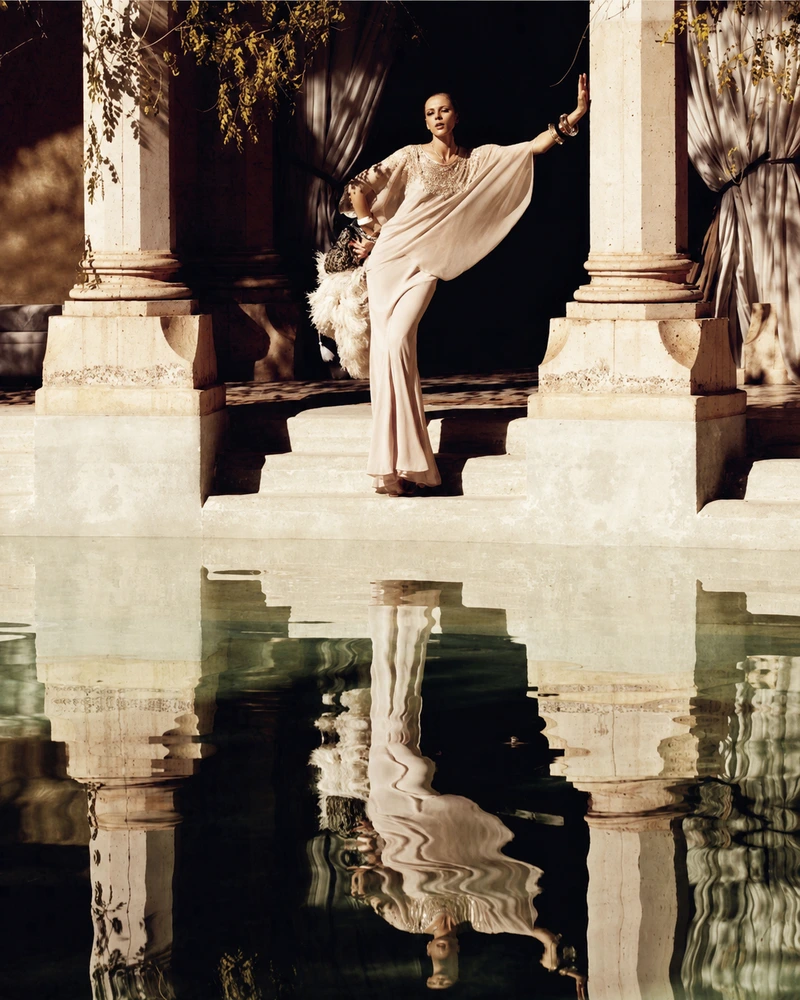
The white Grecian gown can suggest innocence, yet ancient clothing carried colour. The goddess dress can suggest universal femininity, yet Greek dress belonged to men, workers, soldiers, citizens, worshippers, performers, and enslaved people as well. The free-flowing silhouette can signify liberation, though its modern versions may demand hidden corsetry, internal support, complex cutting, and hours of couture labour.
Ancient Greek style survives through these tensions. It offers simplicity while containing immense technique. It appears natural while carrying centuries of cultural construction. It evokes freedom while repeatedly serving systems of status and spectacle. Its immortal root lies in transformation. And the marble figure begins to breathe again.
Advertisement