Above Tokyo, YOSHIROTTEN transforms cosmic observations into art, revealing how imagination, instruments, and memory shape our experience of the unseen.

YOSHIROTTEN and the Language of the Unknown
Above Tokyo, YOSHIROTTEN transforms cosmic observations into art, revealing how imagination, instruments, and memory shape our experience of the unseen.
October 27, 2026


From the forty-fifth floor of Toranomon Hills, Tokyo appears as an immense arrangement of buildings, traffic, and artificial light. Visiting the empty gallery where his latest exhibition would take shape, YOSHIROTTEN looked across the city and then toward the sky. The universe suddenly seemed close. He later told Pen Online that an underground venue might have inspired an entirely different project. His observation reveals a creative instinct: for him, a place can generate the very premise of an artwork.
Opening at TOKYO NODE on October 30, 2026, Transmissions with the Beyond brings that instinct to an unprecedented scale. Developed with the cooperation of the Japan Aerospace Exploration Agency, or JAXA, the exhibition draws astronomical observations into painting, sculpture, moving images, and spatial installations. Beneath its cosmic imagery runs a persistent question in YOSHIROTTEN’s practice: what exists beyond the limits of human sight, and how might an artist give it form?
The World Beyond the Eye of YOSHIROTTEN
Born in Kagoshima in 1983, YOSHIROTTEN grew up surrounded by volcanic landscapes and the cultural presence of scientific exploration. Nature and science fiction fascinated him, while music, fashion, and skate culture shaped his early visual vocabulary. He eventually moved between independent artwork and commercial art direction, establishing the creative studio YAR in 2015.
Projects for Hermès and Nike, alongside graphic work for Arashi Yanagawa’s JOHN LAWRENCE SULLIVAN, illustrate his fluency across cultural languages. Typography and collage taught him how images can transmit an atmosphere before their meanings become explicit. Yet his enduring fascination concerns the world outside ordinary perception.

In a 2020 TOKION interview discussing his 2018 exhibition FUTURE NATURE, YOSHIROTTEN considered how familiar landscapes might appear under different forms of light. Human eyes register only a narrow range of electromagnetic radiation. Instruments detect wavelengths that remain invisible to us. A landscape, therefore, contains realities its familiar appearance can never fully describe.
FUTURE NATURE translated this curiosity into environments where organic forms met digital textures. They suggested speculative versions of nature, shaped by both observation and invention. The interest in inaccessible wavelengths was already a question about mediation: which parts of reality become visible, and who decides how they look? At TOKYO NODE, that inquiry acquires a new source of material. With JAXA, observations gathered through space science enter the artist’s visual vocabulary, making the technologies of perception integral to the new work itself.
A Sun Beneath the Surface
During the pandemic, YOSHIROTTEN began making daily images for SUN. Across 365 compositions, gradients surrounded a peculiar celestial figure: a silver sun imagined inside the Earth. Inspired partly by research into the planet’s interior, this invented body reflected minerals, circumstances, and emotions around it. In a 2026 HIDDEN CHAMPION interview, he described the project as an inward exploration approaching a spiritual world.
His sun receives and reflects, accumulating traces of daily attention. The project later expanded into installations, including a large-scale presentation at Japan’s National Stadium in 2023. Its evolution from image to environment anticipated the physical ambition of his latest exhibition.
Menhir, presented at Harajuku Quest in 2026, approached the invisible through measurement. A rooftop spectrometer captured variations in environmental light, including wavelengths beyond ordinary vision. Its observations interacted with the artist’s graphics to generate shifting fields of colour on LED displays. Selected states were then preserved in Tranthrow, printed onto aluminium honeycomb panels associated with spacecraft construction.
These projects reveal a progression without suggesting that one simply replaces another. SUN invents an interior landscape through introspection; Menhir incorporates measurable conditions into a changing image. Transmissions with the Beyond moves farther outward, drawing upon observations of black holes and distant astronomical phenomena. Across all three, colour becomes the point where information, interpretation, and imagination encounter each other. The exhibition’s cosmic setting may be new, but its deeper inquiry has been developing for years.
Reading a Black Hole
At the centre of Transmissions with the Beyond is a dialogue between YOSHIROTTEN and Professor Hiroya Yamaguchi of JAXA’s Institute of Space and Astronautical Science. Their exchange helped generate works informed by research and observation, extending the artist’s established curiosity about invisible phenomena into the realm of astrophysics.

Puddle Cygnus X-1 uses observation data concerning a black hole investigated by the X-Ray Imaging and Spectroscopy Mission, XRISM, as material for painting and video. Light Pulse draws on all-sky observation data gathered through the International Space Station, translating it into light and sound. Supernova considers a stellar explosion, while Halo approaches stellar orbits through sculptural form.
A black hole offers a demanding subject. Its event horizon marks a boundary beyond which light cannot escape. Astronomers study surrounding matter and radiation, interpreting instrument readings through analytical models. Even a scientific visualisation involves choices about how complex measurements can be represented. YOSHIROTTEN adds another interpretive passage, composing sensory experiences from information gathered far beyond direct human perception.
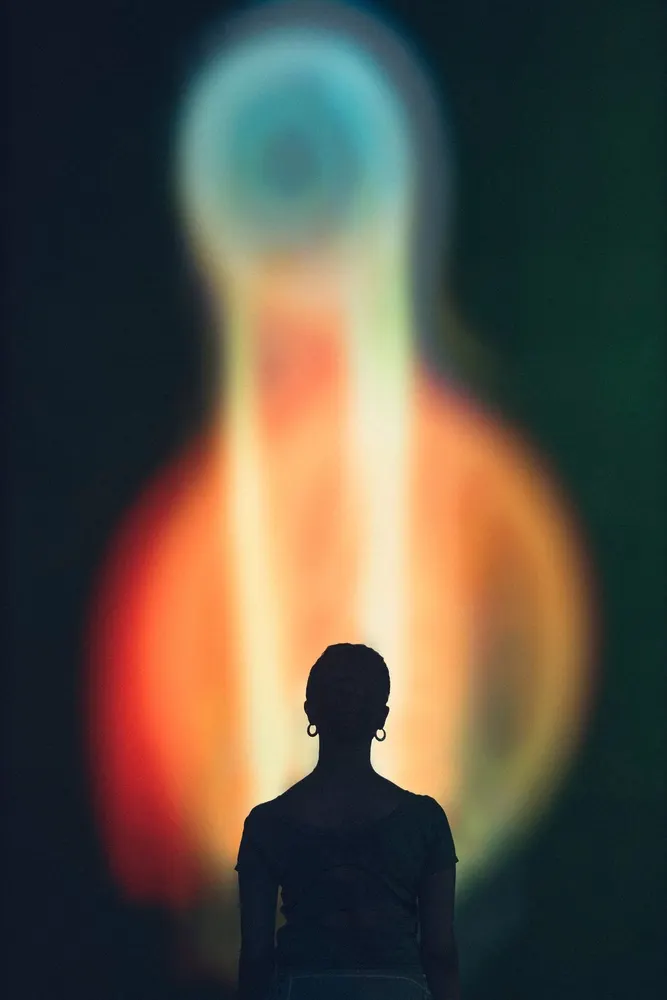
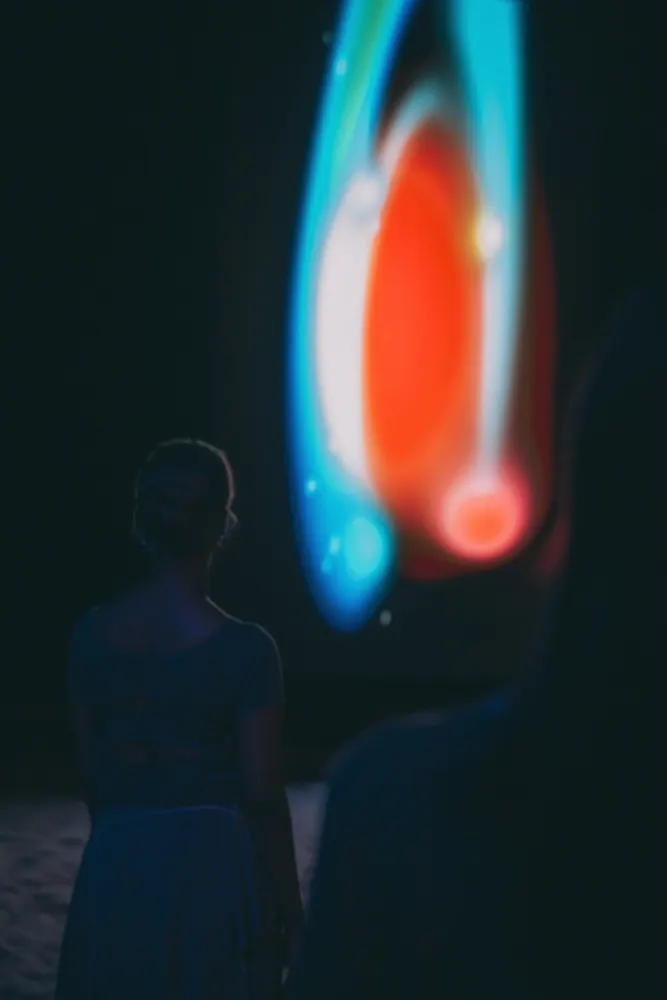
The collaboration raises a difficult question: what survives when scientific data become art? The available exhibition materials identify the observational sources, but do not explain precisely how individual measurements produce each colour, movement, or sound. These works should be approached as artistic interpretations informed by research, with their exact mechanisms requiring further documentation. Their value lies partly in making the distance between evidence and experience perceptible.

The exhibition also includes historical space hardware, among it the solar-sail spacecraft IKAROS and a control console associated with Ohsumi, Japan’s first artificial satellite, launched in 1970. These objects restore physical labour and engineering to an exhibition otherwise populated by seemingly immaterial phenomena. Humanity’s knowledge of the cosmos emerges through collaborative research, machines, and decades of experimentation.
YOSHIROTTEN has described imagining the events preceding a stellar explosion while developing Supernova. That imaginative interval is revealing. Astronomical observation establishes what available evidence can support; art introduces emotional and speculative relationships to what remains distant. His works invite curiosity without claiming that aesthetic experience can substitute for scientific explanation. Scientific authorship and artistic authorship meet here, creating forms that carry traces of both.
When an Image Becomes a Place
The exhibition’s architecture makes this exchange physical. Across approximately 1,500 square metres at TOKYO NODE, the gallery is conceived as a spacecraft above Tokyo. YOSHIROTTEN has described an RGB installation composed of 144 monitors and a SUN work approximately seven metres across, suspended within a space reaching ten metres in height. These arrangements are more than demonstrations of technological scale. They change how a person encounters an image.
The wall of monitors distributes colour across a grid large enough to engage the viewer’s peripheral vision. The suspended SUN shifts an imagined celestial body into the space shared with visitors, asking them to measure its scale through their own movement. In another planned gallery, glowing gradients wash across an architectural environment saturated with red and orange.

Elsewhere, a luminous circular image appears at the end of a darkened passage, drawing attention toward the distance between observer and object. The exhibition simulations suggest an experience structured through successive spatial relationships, not simply a succession of pictures. The viewer remains physically grounded within the city's everyday rhythms below.
Daylight and the city’s changing nighttime illumination are also intended to interact with the installations. External conditions will alter the atmosphere surrounding carefully constructed visual compositions. This returns us to Menhir, where light measured outside a building influenced the artwork inside it. At TOKYO NODE, the city becomes part of the visual field, even as the exhibition directs attention toward space.

YOSHIROTTEN has spoken of clubs as environments collectively shaped by music, architecture, and people. His interest in visitors making independent discoveries offers an important standard against which to consider this monumental project. Spectacle commands attention; meaningful participation leaves room for ambiguity. Whether the completed installation strikes that balance requires firsthand experience. Its ambition, however, is already clear: a gallery built for observing images becomes an environment in which visitors must reconsider their own position as observers.
Communicating Across Worlds
YOSHIROTTEN’s movement between fashion, music, graphic design, and fine art reflects a lasting concern with transmission. Typography gives language a visible character; collage generates fresh associations between existing motifs; spatial installation connects signals, surfaces, and bodies. The exhibition’s Pokémon collaboration and accompanying music projects extend this visual language into popular culture, though its collaboration with scientists brings the central inquiry into sharper focus.

The Japanese title of Transmissions with the Beyond invokes communication with a distant place or time. Distance here is physical, perceptual, and imaginative. Instruments collect information from worlds beyond ordinary sight; artists determine how that information might acquire a form that others can encounter. Every translation reveals particular qualities while leaving others outside the frame.
From a gallery suspended above Tokyo, YOSHIROTTEN imagines contact with a universe that can be measured yet never fully inhabited. His new installations bring that distance into the body’s immediate surroundings. They also reveal a paradox: the farther our instruments extend perception, the more urgently we confront the human decisions through which their findings become visible. The unknown remains unknown in important ways. Art gives us another means of approaching it.