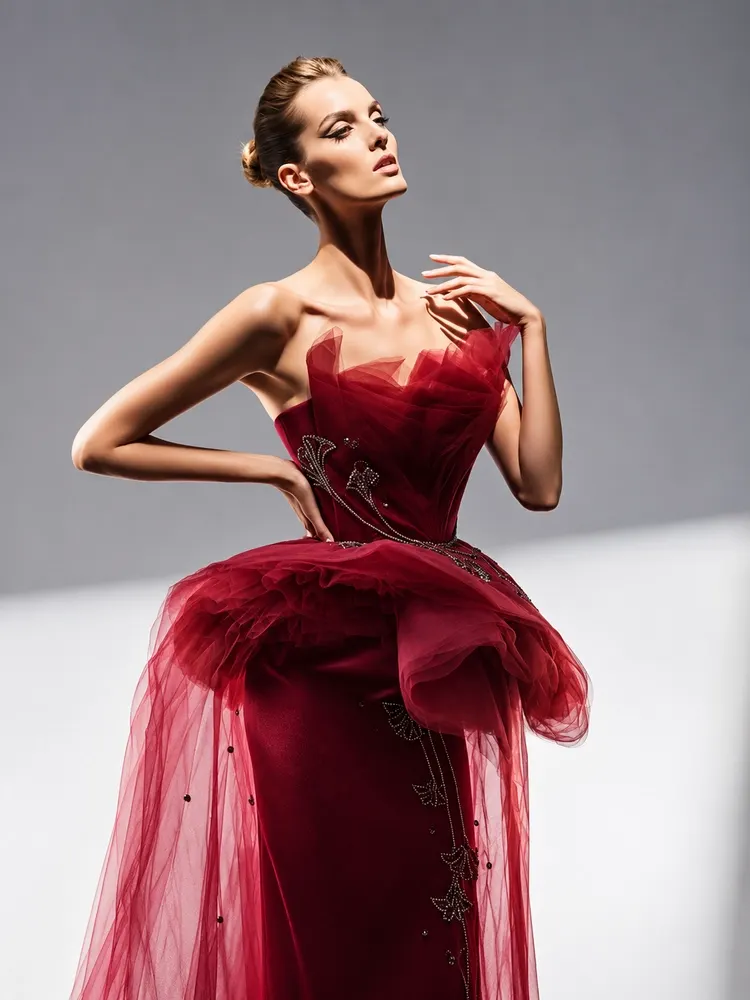





At Fall 2026 Haute Couture week, ready-to-couture asks how far the perfect cut can be pushed before it becomes invention.

Ready-to-Couture: The Return of the Perfect Cut
At Fall 2026 Haute Couture week, ready-to-couture asks how far the perfect cut can be pushed before it becomes invention.
November 24, 2026


The simplest clothes are often the least forgiving. A jacket cut too broadly across the shoulder loses its elegance, a dress suspended from the wrong point collapses, and trousers whose fabric carries insufficient weight expose every imperfection in construction. Such problems have preoccupied dressmakers for centuries, although their solutions rarely command the attention of spectacular embroidery.
Across Fall/Winter 2026 haute couture, these modest concerns acquired renewed prominence. Ready-to-couture returns attention to the original ambition of haute couture: making ordinary clothing exceptional through exacting construction.
Before the Ballgown, There Was the Day Suit
A private client visiting a Parisian couture salon once expected a complete wardrobe, including tailored suits, afternoon dresses, coats and travel clothes, each adjusted through fittings to her body. Coco Chanel understood this relationship particularly well: her cardigan-like jackets used supple fabrics, controlled ease and balanced proportions to release women from restrictive tailoring.
Cristóbal Balenciaga pursued another solution with his 1957 sack dress, releasing the waist and redistributing volume around the shoulders, back and hem. His work with silk gazar demonstrated how developing a fabric could make an unfamiliar silhouette structurally possible. Such experiments influenced clothing far beyond couture's wealthy clientele.
The renewed interest in ready-to-couture therefore returns to an era when perfecting daywear could produce revolutionary changes in dress. The difficult question is how much further those familiar shapes can evolve after decades of industrial refinement.
The Jacket Is Learning to Move Again
Tailoring negotiates constantly between movement and shape. The shoulder must accommodate the arm, the chest requires ease, and the armhole determines whether a jacket remains comfortable when its wearer reaches forward.


At Chanel Fall 2026 Couture, Matthieu Blazy explored that negotiation through softened tailoring, fluid separates and experiments between the structured tailleur and softer flou ateliers. His transparent interpretation of the Chanel suit was especially revealing: delicate embroidery maintained its recognizable outline even as the conventional substance of the garment seemed to disappear.


Silvana Armani's velvet suits at Giorgio Armani Privé relied instead on elongated jackets, controlled shoulders and unusually precise proportions. Velvet's directional pile complicates cutting, since light and pressure alter the appearance of its surface.


At Balenciaga Fall 2026 Couture, Pierpaolo Piccioli placed familiar chinos and a silk T-shirt within a couture vocabulary. Ready-to-couture thus concerns the internal architecture of recognizable clothes: where a pattern holds its structure, where it releases tension and how the result behaves in motion.
The Dress That Depends on a Millimetre
Michael Stewart's Standing Ground makes the apparently plain dress a demanding exercise in anatomy. Standing Ground Fall 2026 Couture collection presented twenty-eight predominantly slender silhouettes whose success depended on precise dressmaking and controlled proportions.


A column dress exposes every error in balance. Draping fabric directly on a stand allows a designer to establish tension and fullness around a three-dimensional body before translating those decisions into a pattern. Bias-cut, by contrast, exploits the diagonal direction of woven cloth to encourage flexibility, but also requires control over stretching and distortion.


Seam placement, internal supports and fabric weight can maintain sculptural definition without disturbing the exterior. Imane Ayissi's fluid ensembles investigate related questions through textile character and the positioning of drape. Ready-to-couture achieves its apparent ease precisely because so much effort is invested in preventing the fabric from behaving unpredictably.


At Celia Kritharioti Fall/Winter 2026 Couture, the minidress adopts the familiar proportions of a cocktail wardrobe, with clean, abbreviated silhouettes elevated through feather-trimmed edges, contrasting bows and carefully controlled surface details.
When a Fold Becomes the Architecture
At Dior, Jonathan Anderson approached Fall/Winter 2026 Couture through the sculptural practice of Lynda Benglis, exploring what folding, knotting and molding could make fabric do.
A pleat stores material inside a narrow visible surface, allowing volume to expand with movement or redirecting the direction in which cloth falls. A knot alters tension; a strategically positioned fold can create projection without conventional darts or internal scaffolding. Historical Dior shapes, including the Bar jacket, became a foundation for reconsidering the relationship between surface and structure.


Pleating itself is ancient, which makes the distinction between mastery and invention particularly important. Ready-to-couture becomes genuinely experimental when an established technique acquires a new structural function, rather than simply producing a more immaculate version of an existing garment.
The Body No Longer Needs a Waist
At Fendi, Maria Grazia Chiuri explored unwaisted A-line shapes, elongated dresses and kimono-like constructions, allowing fabric to fall more freely around the body. The apparent simplicity conceals a difficult adjustment in weight distribution.


A fitted waist supplies an obvious point of control; remove it, and balance shifts toward the shoulder, neckline, grain and hem. Excessive fullness can overwhelm the wearer, while insufficient ease restricts movement. The couturier must resolve these competing demands through cutting and material choice.
In ready-to-couture, removing corsetry does not eliminate structure: the work of shaping the garment simply migrates to less conspicuous places.
Ready-to-Couture Has Become a Cultural Obsession
The Metropolitan Museum of Art's 2027 Costume Institute exhibition, extraORDINARY: Fashion and the Poetics of the Everyday, examines how ordinary objects and familiar garments acquire artistic significance through design. Announced after the July 2026 couture presentations, it offers a cultural parallel, rather than an influence on the collections.
A commonplace jacket can be transformed through cutting, just as an unremarkable fabric can become exceptional through manipulation. Yet Balenciaga's historical innovations ultimately affected clothing outside the couture salon, raising a demanding standard for today's ready-to-couture experiments: can these technical discoveries change how ordinary wardrobes are made?
Contemporary ready-to-wear already benefits from precision cutting, computer-assisted pattern development and sophisticated manufacturing. Exceptional workmanship remains valuable, but its relationship to novelty is increasingly complicated.
The more radical opportunity lies in customization. Couture fittings can accommodate posture, asymmetry and individual proportions that standardized sizing often overlooks. An atelier capable of moving seams, redistributing tension and constructing extraordinary volumes also possesses the knowledge needed to question the standardized body around which commercial clothing is designed.
That would take ready-to-couture into more challenging territory than the perfect jacket: rather than refining a familiar ideal, couture could reconsider whose body defines that ideal, allowing the most consequential innovation to occur in the pattern itself.