MENU
Close





Balenciaga SS27 catches the house in a moment when its future no longer needs to arrive with impact. Something quieter is taking shape, and Pierpaolo Piccioli seems willing to let it reveal itself slowly.

Balenciaga SS27 catches the house in a moment when its future no longer needs to arrive with impact. Something quieter is taking shape, and Pierpaolo Piccioli seems willing to let it reveal itself slowly.
October 16, 2026
Advertisement

Advertisement



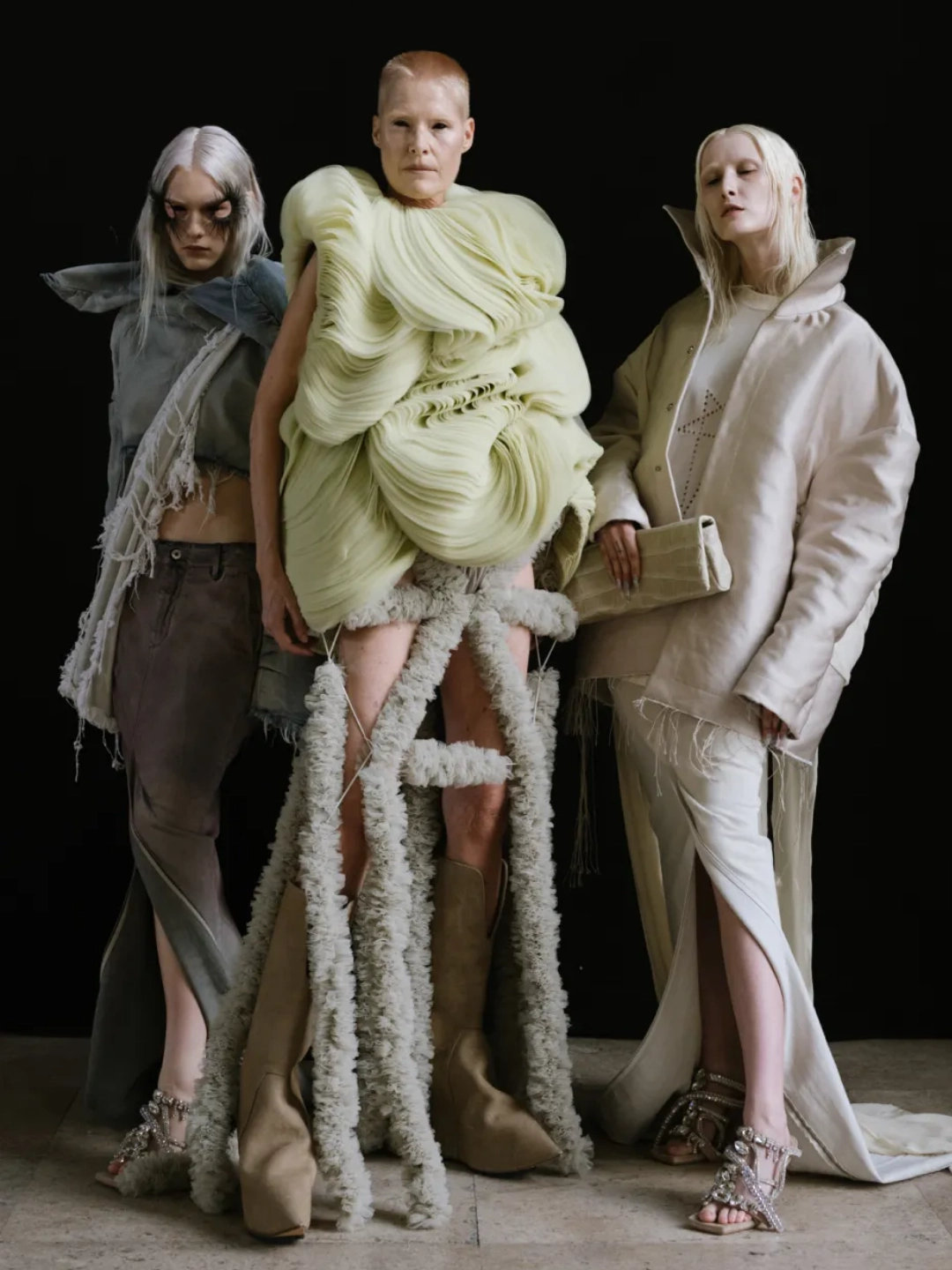
Pierpaolo Piccioli’s first Balenciaga couture collection had the concentration of a laboratory. Couture 55 placed him directly inside the house’s most intimidating inheritance, where volume, fabric and the space surrounding the body carry almost architectural authority. And Balenciaga SS27 takes those experiments out of the salon. The techniques remain sophisticated, but the wardrobe around them becomes startlingly familiar.
The house names the collection UNSIZED: A Lightness of Being, and the title is more useful as a philosophy than a technical brief. Piccioli treats freedom as something built into the garment itself, allowing form to adjust, breathe and move with the wearer instead of fixing the body inside one prescribed silhouette. Couture here begins to look less like an occasion and more like a way of thinking about everyday clothes.
A white shirt tucked into white jeans should belong to the quietest corner of a wardrobe. At Balenciaga, familiar clothing becomes interesting once construction begins interfering with familiarity.
Dense stitching pulls fabric into a Basque-like waist. Denim responds to bias cutting with ease rarely associated with its sturdy reputation. T-shirts and jackets acquire sculptural tension through techniques whose complexity remains partly concealed inside garments that still register as everyday clothes. The house itself describes Spring 27 as a complete wardrobe of Balenciaga archetypes in which quotidian pieces are given renewed significance.
The distinction between couture and casual clothing consequently becomes harder to locate. Pierpaolo Piccioli is moving couture intelligence into categories that already belong to ordinary life.


Cristóbal Balenciaga built much of his mythology through technical decisions whose radicalism could disappear inside immaculate simplicity. A silhouette might look inevitable only because enormous expertise had removed every visible sign of struggle. Pierpaolo appears drawn to the same paradox. Complexity is allowed to disappear into ease.
Jeans worn beneath an evening dress become meaningful in that context. Their presence does not function as a predictable high-low styling trick. Both garments are being asked to relinquish the behaviour traditionally assigned to them. Eveningwear can move with the informality of day clothes; denim can inherit the fluidity and precision associated with dressmaking.
Couture no longer waits for a special invitation.
Its luxury resides in the possibility that an ordinary garment has been considered extraordinary seriousness.
Cristóbal created some of fashion’s most enduring silhouettes by placing space between fabric and flesh, allowing cocoon, balloon and sculptural volumes to construct another anatomy around the wearer. Pierpaolo inherits that architecture without inheriting all of its gravity.
Balenciaga SS27 lets volume swell and recede with an unusual degree of lightness. The collection’s techno taffeta was engineered specifically for featherweight structure, while familiar Balenciaga forms are reduced until their architecture depends upon very few layers of cloth. Balloon, drape and cocoon remain part of the house vocabulary, but movement is allowed to disturb their outlines.


Couture 55 had already established the foundation. Its neo-gazar revisited Cristóbal’s material innovation through fabric capable of combining structure with remarkable lightness, sometimes functioning simultaneously as exterior surface and internal support. Spring translates that research into a wardrobe whose volumes appear increasingly comfortable with impermanence.
That quality separates Piccioli’s interpretation from archival worship. His adaptation comes from fabric that can inflate around the hips, collapse toward the legs or swing away from the shoulders. Architecture becomes something encountered in motion.
His instinct for softness uncovers another possibility of the house code that is already latent inside it. Balenciaga construction has always depended on mastery over space. Pierpaolo makes that space breathable.
Clothes can remain sculptural without turning the wearer into a pedestal for them. Their authority comes through control, then through knowing when control should loosen.
Cristóbal gives Pierpaolo architecture. Pierpaolo gives it air.
The word unsized initially sounds like a statement about measurement. Cloth is wrapped, draped and adjusted around the body through ribbons instead of forcing the body toward one immovable ideal. The collection takes a traditional couture relationship between fabric and wearer, then strips away some of the ceremony surrounding it. Fit becomes responsive.
Bias cutting deepens that proposition. Fabric cut away from the straight grain gains another relationship with gravity, allowing trousers, tailoring and denim to move with a pliability that disrupts their normal rigidity. Pieces associated with structure begin to negotiate with the person inside them.


For a house built upon silhouette, that negotiation is significant. Cristóbal liberated the body partly by creating room around it. His sack dress, cocoon and semi-fitted constructions challenged the assumption that womenswear had to reproduce the waist and curves dictated by prevailing fashion. Piccioli seems interested in extending that freedom from exterior space into the garment itself. The silhouette does not only give the body room. It can adapt as the body moves.
The house describes Spring 27 through kinetic silhouettes and minimized layers, with adjustment and function becoming decorative devices in their own right. Yet clothes avoid turning that philosophy into visible engineering for its own sake. A ribbon may change volume with one gesture. Fabric shifts against the body without advertising every technical decision responsible for the movement.


Freedom becomes tangible through ease.
Pierpaolo's vision has long trusted fabric enough to let emotion come through motion, especially once cloth is allowed to fall without excessive interruption. At Balenciaga, that instinct encounters a house obsessed with construction.
Neither side needs to disappear.
Unsized becomes compelling when size itself stops being the headline. What remains is the thought that a garment can possess a strong identity without demanding that every body inside it assume the same one.
White establishes authority early in the collection. Then colour begins loosening the atmosphere.
Saturated pinks, coral oranges and more acidic tones enter sculptural silhouettes without dissolving their discipline. Against Balenciaga’s exacting forms, colour acquires unusual emotional weight. It changes the temperature of the architecture.


Pierpaolo has always treated colour as something capable of carrying emotion before narrative arrives. At Balenciaga, that instinct encounters an environment where shape can easily dominate everything around it. Spring 27 begins finding equilibrium between the two.
Volume contains colour before colour softens volume.
The same exchange happens through texture. Organic embellishment, lace and surfaces that appear almost grown onto the garment interrupt the precision of construction without burying it. Nothing needs to become romantic in an obvious sense. The warmth appears in smaller disruptions of severity.


Creative directors entering historic houses can make authorship visible too quickly by importing wholesale signatures. The result may look recognisably theirs while leaving the house beneath it strangely absent. Piccioli’s progress at Balenciaga has been gradual because he appears increasingly willing to let his instincts pass through the maison’s structure before they emerge on the other side.
The colour looks increasingly like Pierpaolo. The body still looks unmistakably Balenciaga. For the first time, separating the two starts becomes unnecessary.
Creative transitions are eventually judged twice. Fashion judges clothes. Business judges whether people want to own them.
The second judgment is currently complicated at Balenciaga. Kering reported year-on-year growth for the house in the first quarter of 2026, supported by leather goods and continued demand for the City and Rodeo lines. By the second quarter, the group described performance as more challenging, while Balenciaga worked through its creative transition and rebalanced the business, with leather goods remaining a source of strength. Kering now reports Balenciaga within its broader Fashion & Leather Goods segment and does not disclose standalone house revenue, so the available picture is mixed instead of a clean narrative of decline.
Yet the anxiety surrounding Pierpaolo raises a more interesting question than quarterly momentum.
Demna spent a decade teaching an enormous audience how to desire Balenciaga. The house became inseparable from streetwear, exaggerated proportions, distressed objects, cultural provocation and products that could communicate their identity almost instantly. That era did not merely sell clothes. It created a consumer fluent in its codes.
Pierpaolo has inherited that consumer along with Cristóbal’s archive. Those inheritances do not always ask for the same thing. Balenciaga SS27 proposes value through subtler signals, yet none carries the instant cultural punch on which the previous Balenciaga era often thrived.
Calling that incompatibility with Balenciaga would confuse one successful interpretation of the house with the house itself.
Pierpaolo increasingly appears deeply compatible with its foundations. He understands volume without fetishising archive. He respects couture as technique instead of costume. His softness does not erase architecture, and his romantic instinct is being disciplined by one of fashion’s most demanding construction languages.
The uncertainty lies elsewhere. Can customers who spent years learning that Balenciaga should shock them learn to desire the pleasure of being quietly surprised instead?
A creative director can change clothes in a season. Changing desire takes longer.
Cristóbal once changed what people believed clothing could do to the body. Demna changed what a generation believed Balenciaga could mean. Pierpaolo’s real test may be convincing them that they can want something different from it again.
Advertisement