MENU
Close





Italy has inspired centuries of artistic masterpieces, but rarely on a canvas small enough to rest upon the wrist. In its Rare Handcrafts 2026 collection, Patek Philippe captures the country's architectural grandeur and poetic landscapes through the extraordinary precision of haute horlogerie.

Italy has inspired centuries of artistic masterpieces, but rarely on a canvas small enough to rest upon the wrist. In its Rare Handcrafts 2026 collection, Patek Philippe captures the country's architectural grandeur and poetic landscapes through the extraordinary precision of haute horlogerie.
October 14, 2026


Few watchmakers have cultivated the relationship between artistic craftsmanship and mechanical precision as extensively as Patek Philippe. Its Rare Handcrafts collection celebrates disciplines that have survived centuries of technological change, preserving techniques whose mastery depends upon patience, manual dexterity, and an extraordinary sensitivity to materials.
In 2026, the Geneva manufacture turned its attention to Italy, creating a series of exceptional timepieces for its Watch Art Grand Exhibition in Milan. Architecture, sculpture, and regional landscapes offered an expansive source of inspiration, translated into miniature compositions through traditional enamelwork, engraving, and wood marquetry.
Among the creations, three Golden Ellipse references present particularly compelling interpretations of Italian cultural heritage: Baroque Decoration, Crouching Lion, and Sunset in Tuscany. Each approaches a different artistic discipline, exploring how the visual language of monumental architecture, classical sculpture, and landscape painting can inhabit the remarkably intimate proportions of a wristwatch.
Introduced in 1968, the Golden Ellipse occupies a distinctive position in Patek Philippe's design history. Its elliptical silhouette, situated geometrically between a circle and a rectangle, draws inspiration from the golden ratio, the mathematical principle long associated with harmonious proportions in classical art and architecture.
Its restrained construction has traditionally emphasized the relationship between shape, material, and proportion. For the Rare Handcrafts editions, this simplicity offers an unusually receptive surface for artistic experimentation.
The absence of conventional hour markers creates an uninterrupted composition across the dial, disturbed only by two slender hands. Within its 34.5 × 39.5 mm case, intricate scenes unfold across a surface of astonishingly limited dimensions.
Behind these miniature artworks lies the manufacture's ultra-thin automatic caliber 240, measuring just 2.53 mm in thickness. Equipped with an off-center 22-karat gold minirotor and a minimum 48-hour power reserve, the movement allows the watches to retain an elegant 6.58 mm case profile.
This architectural discipline gives each dial its visual coherence. A miniature painting must accommodate the movement of hands, the curves of its frame, and the technical constraints of watchmaking, achieving an equilibrium between artistic complexity and functional clarity.
REF. 5738/50G-050 — GRAND FEU CLOISONNÉ ENAMEL & MINIATURE PAINTING
The architectural extravagance of the Italian Baroque finds an unexpectedly delicate expression in the Golden Ellipse Baroque Decoration. Inspired by the interiors of the Reggia di Venaria Reale, the composition captures the ornamental sophistication of one of the great residences of the House of Savoy.
The original palace celebrates the theatrical possibilities of architecture. Curving forms, elaborate ornamentation, and carefully choreographed light create interiors where structural elements participate in a continuous artistic composition.
Patek Philippe condenses this spatial richness into an enamel dial, reproducing architectural details with extraordinary precision. The curved framing of the composition evokes the experience of looking upward toward an elaborately embellished ceiling.


The technical achievement begins with approximately one meter of fine gold wire, weighing around 0.68 grams. The enameller carefully shapes this wire to establish the outlines of architectural details, creating individual compartments for the application of colored enamel.
A palette of 20 transparent, opaque, and opalescent enamel colors supplies the subtle variations necessary to reproduce the palace's ornamental surfaces. Each dial undergoes approximately twelve firings at temperatures exceeding 800°C, with miniature painting on enamel providing the finest details.


The process requires exceptional control. Enamel colors respond differently to heat, while successive firings can alter previously established tones. The artisan must anticipate these transformations throughout the creation of the image.
The white-gold case surrounds the composition with a cool metallic frame, while a glossy mauve alligator strap introduces an understated echo of the dial's soft violet tones.
Limited to six examples, the reference demonstrates a distinctive achievement of haute horlogerie: preserving the visual intelligence of a monumental architectural tradition within a surface measured in millimeters.
A different artistic sensibility governs Crouching Lion, whose monochromatic dial pays tribute to the sculptural heritage of Naples.
The central subject derives from the Crouching Lion created by Italian sculptor Pasquale Ricca in 1866, situated in Naples' Piazza dei Martiri. Patek Philippe reimagines the animal against the monumental colonnade of the Basilica of San Francesco di Paola in Piazza del Plebiscito, constructing a new visual relationship between two landmarks of the city.
The lion occupies the foreground with impressive physical presence. Its mane, powerful limbs, and carefully modeled expression evoke the tactile qualities of carved stone, while the architectural backdrop establishes depth through receding columns and graduated shadows.


To reproduce this effect, the artisans employ grisaille enamel au blanc de Limoges, an exacting technique traditionally associated with monochromatic painting on enamel.
The process starts with an opaque black enamel foundation. Using exceptionally fine brushes and needles, the enameller applies successive layers of white Limoges enamel, adjusting their thickness to create variations of light and shadow.
Through this controlled accumulation, the lion's sculptural volume gradually emerges. Thin applications produce restrained grey tones, while denser layers establish luminous highlights. The final image acquires an almost photographic sense of dimensionality, achieved entirely through the manipulation of enamel.
Each dial requires approximately 19 to 20 firings, with temperatures gradually descending from 780°C to 755°C. This meticulous sequence demands a precise understanding of how heat affects transparency, density, and surface appearance.


The finished composition recalls the tradition of chiaroscuro, where the relationship between illumination and darkness determines the emotional character of an image. Here, grisaille enamel provides a visual language particularly suited to the physical solidity of nineteenth-century sculpture.
A white-gold case and glossy black alligator strap reinforce the monochromatic aesthetic. Produced in a limited series of six, the reference captures a compelling dialogue between sculptural permanence and the delicate material processes of enamel painting.
Beyond Italy's architectural grandeur, the country's rural landscapes have long occupied the imagination of painters, poets, and travelers. The rolling hills of Tuscany, punctuated by medieval villages and cypress trees, possess a visual harmony shaped by centuries of agriculture and settlement.
In Sunset in Tuscany, Patek Philippe translates this pastoral atmosphere into an intricate composition of natural wood.
The dial portrays a Tuscan village beneath a glowing evening sky, with carefully assembled fragments suggesting the changing illumination of the surrounding countryside. Its warmth emerges directly from the tonal variations and natural grain of the wood itself.


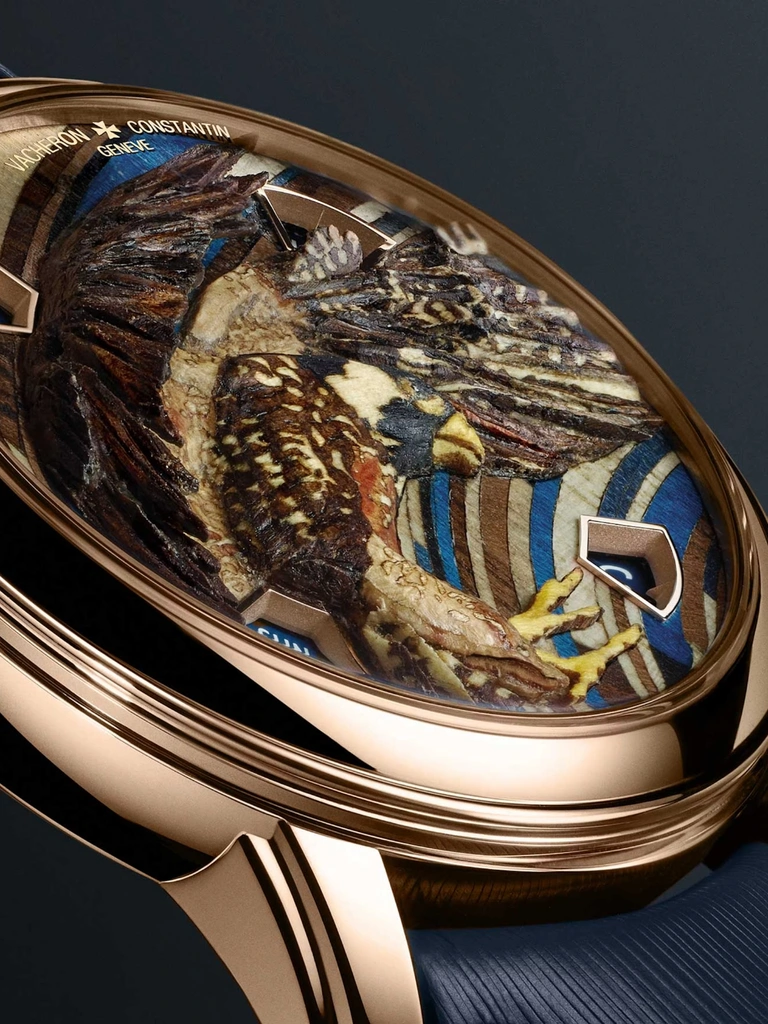
Wood marquetry demands an entirely different approach to image-making. The artisan selects individual veneers according to their color, texture, grain direction, and capacity to suggest particular visual elements. Each piece must be cut with extraordinary accuracy before being assembled into a seamless composition.
For this reference, the marquetry artist combined 203 veneer pieces and 75 miniature inlays, selected from an impressive 57 species of wood. These components create subtle transitions between illuminated buildings, darkening vegetation, and the reddish glow of the evening sky.


The technique introduces an additional expressive dimension through the character of the material. Natural wood retains variations that can enrich the composition, giving the image a visual complexity connected to its organic origins.
Its rose-gold case complements the earthy palette, while a light gold-toned calfskin strap subtly references Italy's celebrated leatherworking traditions.
Limited to ten examples, Sunset in Tuscany presents an especially intimate form of artistic craftsmanship. Its landscape possesses the quiet atmosphere of a miniature painting, yet its individual colors and textures originate in the natural characteristics of wood.
Across these three Golden Ellipse creations, the significance of rare handcrafts extends beyond technical virtuosity. Each artistic discipline requires an exceptionally specialized knowledge of materials, developed through years of practice and transmitted across generations of artisans.
Enamelwork involves the unpredictable transformations of powdered glass under extreme heat. Wood marquetry demands a highly refined ability to interpret natural colors and textures. Both techniques expose the artist to irreversible errors, where a single miscalculation can compromise weeks of painstaking labor.
Their preservation carries particular importance in a watchmaking industry increasingly defined by technological innovation and precision manufacturing.
The limited production numbers reinforce the considerable labor involved: six examples each for Baroque Decoration and Crouching Lion, and ten for Sunset in Tuscany. The collection speaks to collectors who value artistic authorship alongside mechanical excellence.
Ultimately, the cultural significance of haute horlogerie may lie in its unusual relationship with time itself. Mechanical watchmaking seeks to measure its passage with increasing precision, while traditional craftsmanship preserves knowledge accumulated across centuries. On these Golden Ellipse dials, the two pursuits coexist. Their movements continue marking the hours, but the miniature artworks above them belong to a different chronology, measured through patient gestures, accumulated skill, and the endurance of artistic tradition.