MENU
Close





The joke has changed, the street has walked onto the runway, and Moschino SS27 seems perfectly happy to meet fashion in the middle of an ordinary day.
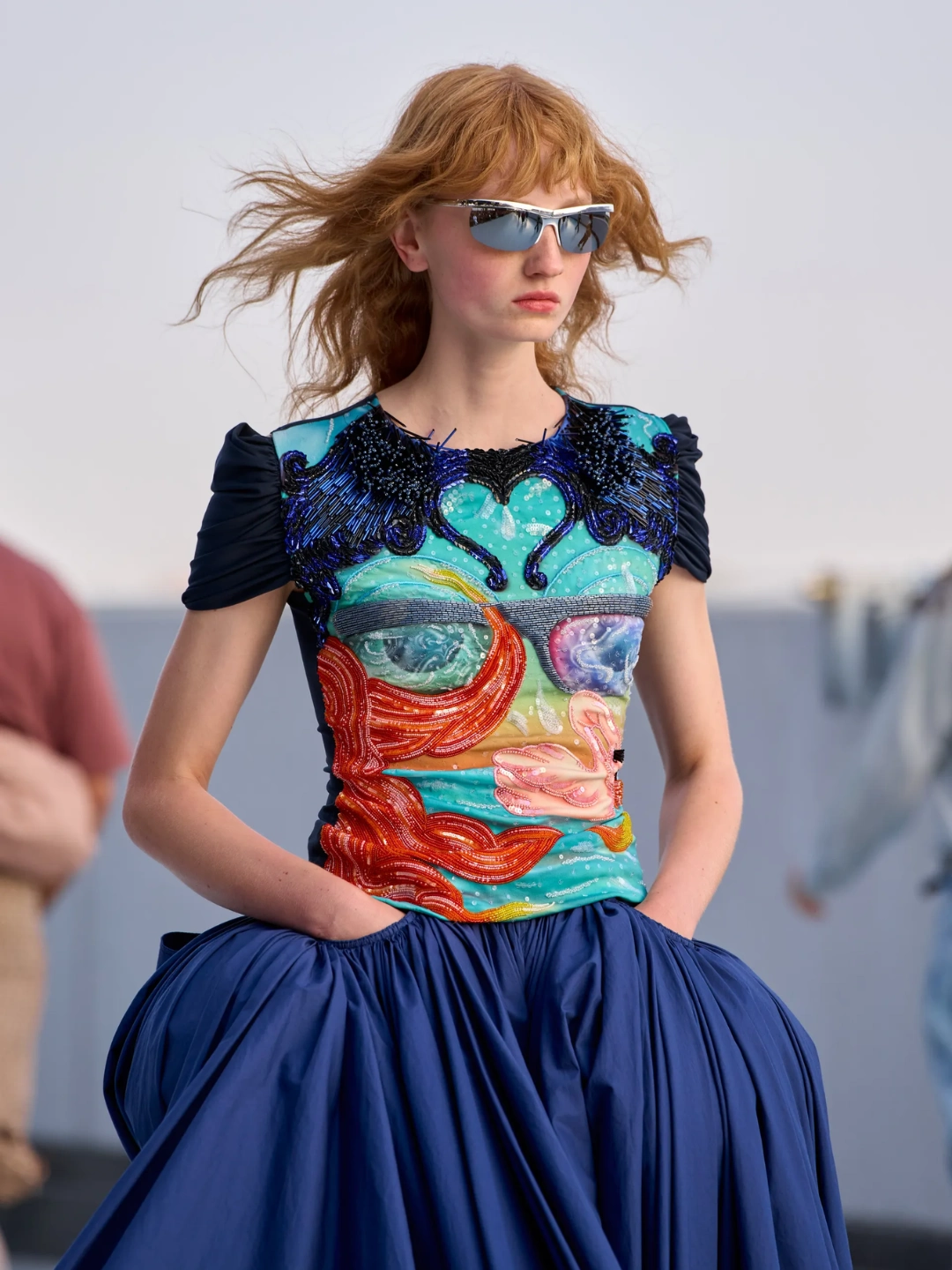
The joke has changed, the street has walked onto the runway, and Moschino SS27 seems perfectly happy to meet fashion in the middle of an ordinary day.
September 28, 2026
Advertisement
Advertisement


More than 400 people streamed across the roof of a parking garage while the models walked against them. Some carried bags, pushed through the crowd, checked phones or moved with the distracted rhythm of a commute. For a few minutes, the runway looked uncannily close to the city outside it. Simone Rizzo and Loris Messina had placed their first Moschino collection directly inside human traffic.
Franco Moschino built a house capable of laughing at fashion from inside the system itself. Rizzo and Messina inherit that joke after years of constructing their own mischievous universe at Sunnei, yet their debut avoids a greatest-hits performance. They studied the archive as a laboratory, searching for the logic behind Moschino’s irony while resisting a literal reconstruction of its familiar icons. Even the absence of a livestream belonged to the proposition: the collection was meant to be encountered physically, among bodies moving through the same space.
Rizzo described the clothes as belonging to the streets and, crucially, “to real people.” Fashion still gets to exaggerate, distort and misbehave here. It has simply been returned to the place where everybody already participates in it every morning: getting dressed and going outside.
At first glance, the office appears to be functioning normally.
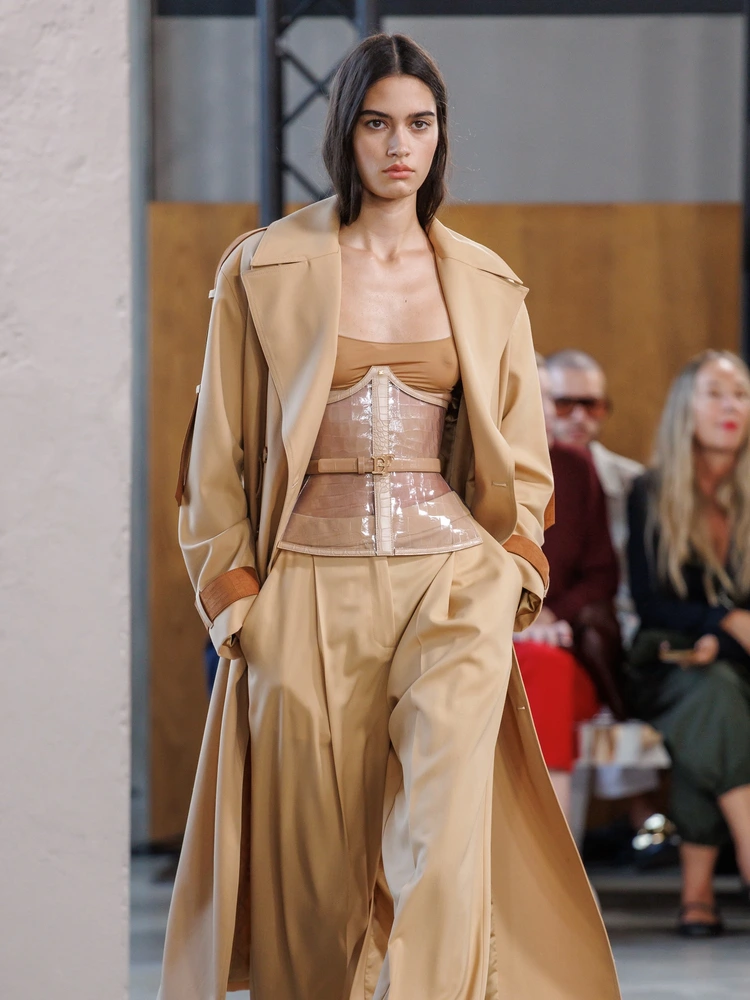
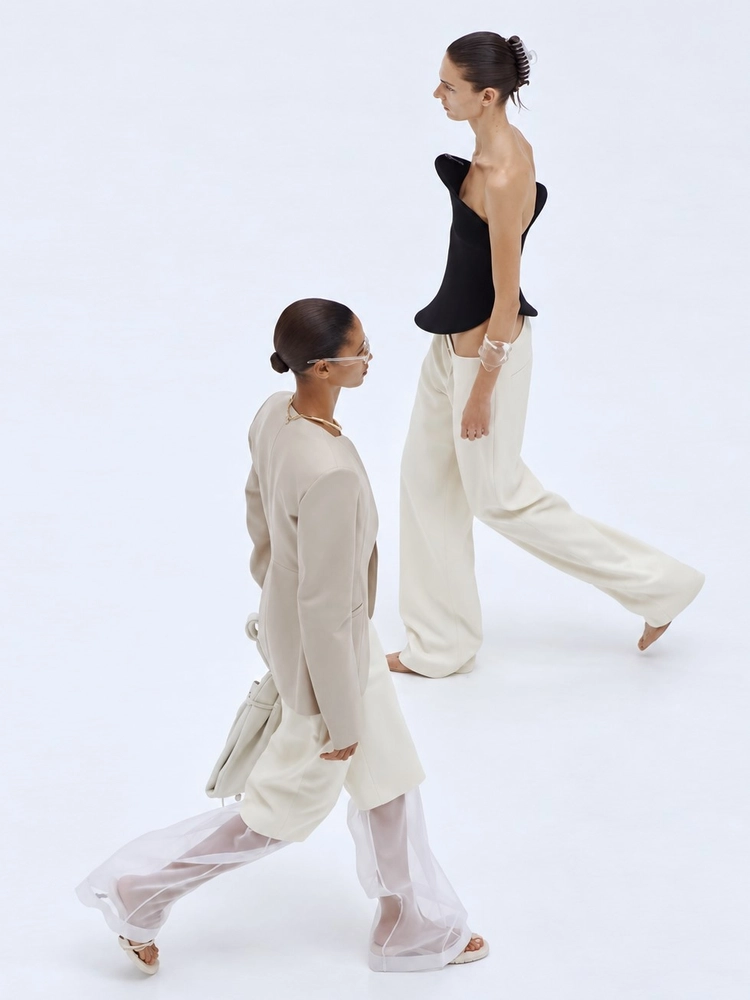
Tailoring keeps a relatively straight, elongated line, with jackets falling cleanly past the hip and trousers extending the body downward without aggressive sculpting. Trench coats stay loose enough to move with the walk, while denim takes on a similarly practical rhythm through longer, uncomplicated shapes. These silhouettes could survive a commute, a meeting and whatever happens after someone finally closes the laptop.
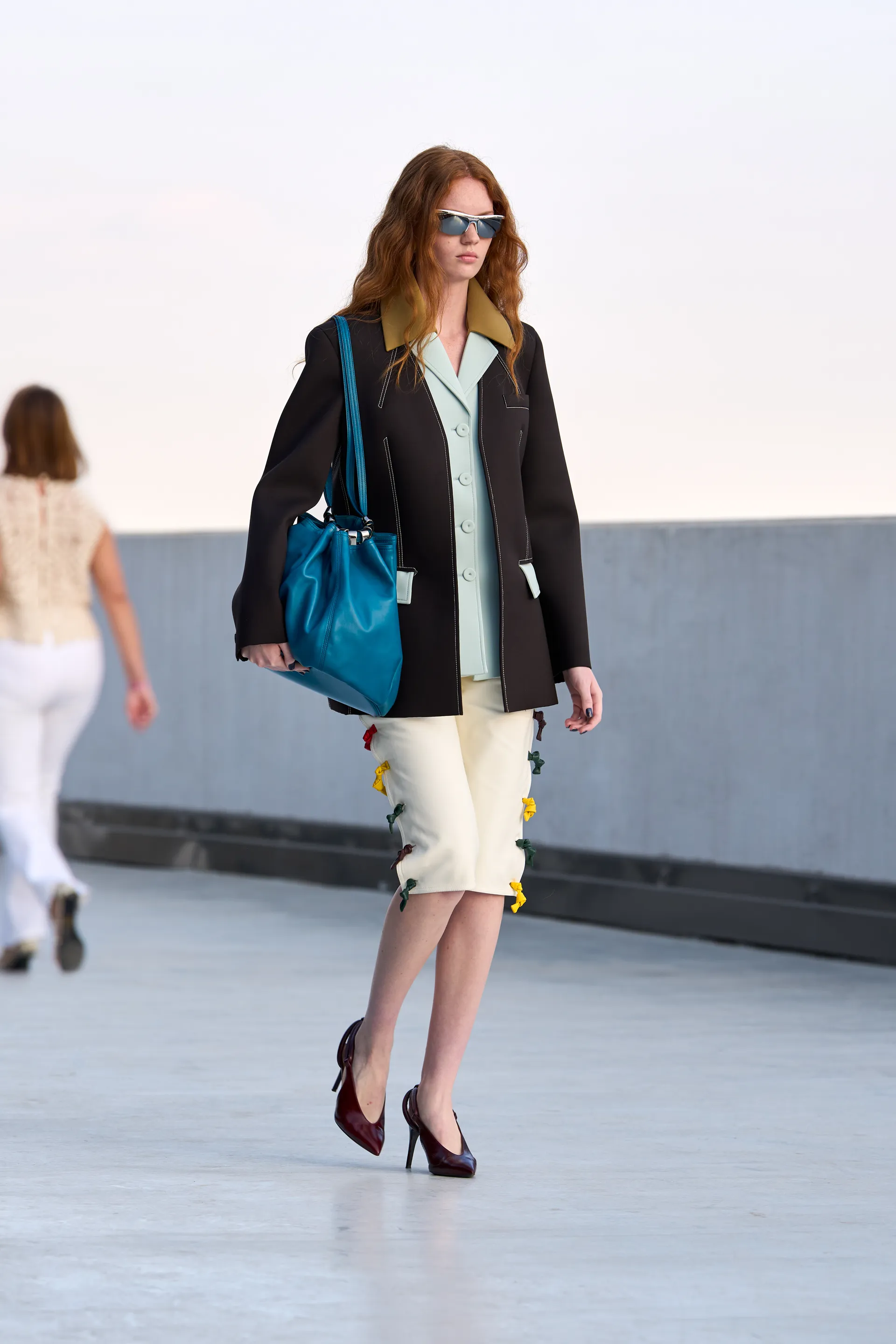
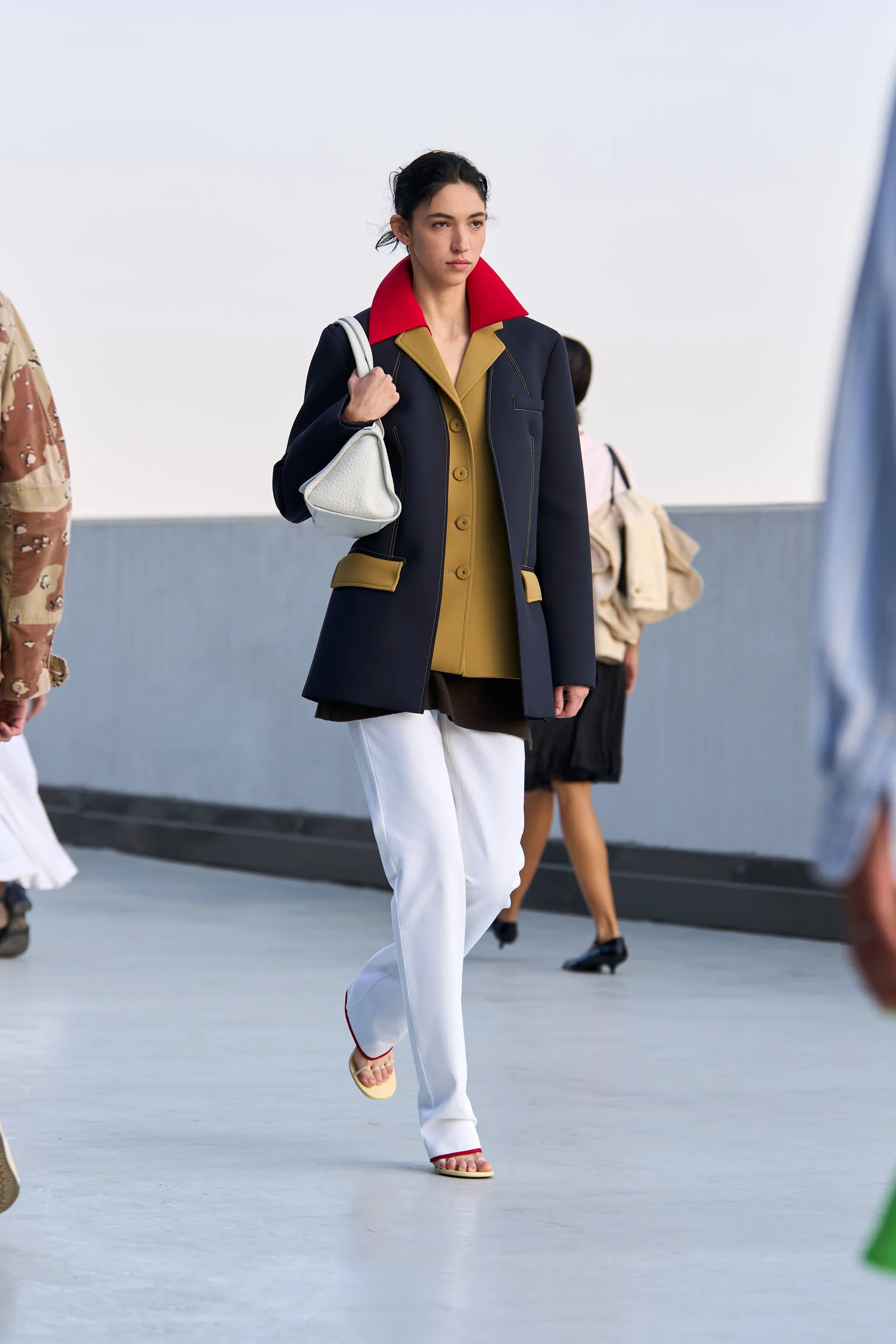
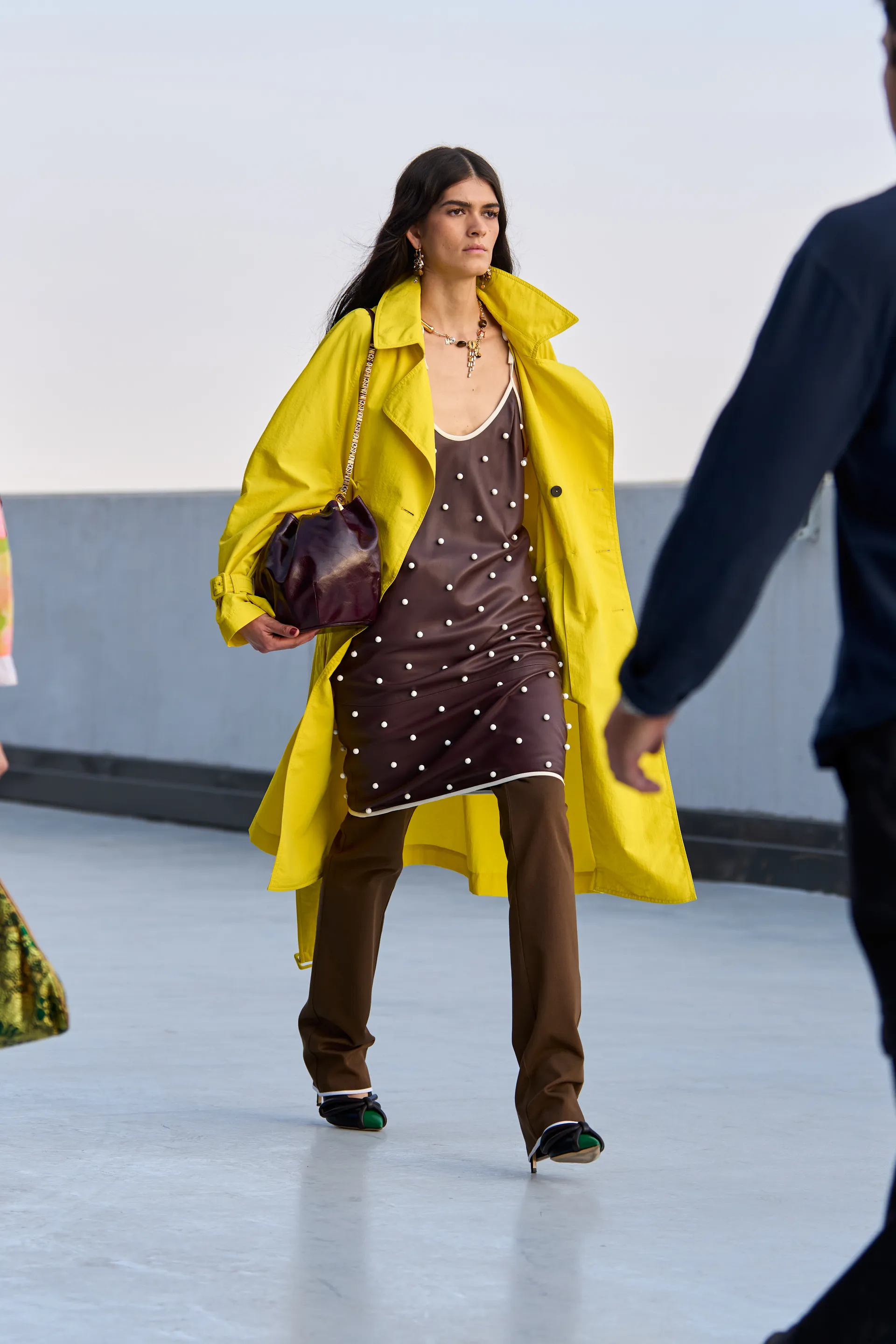
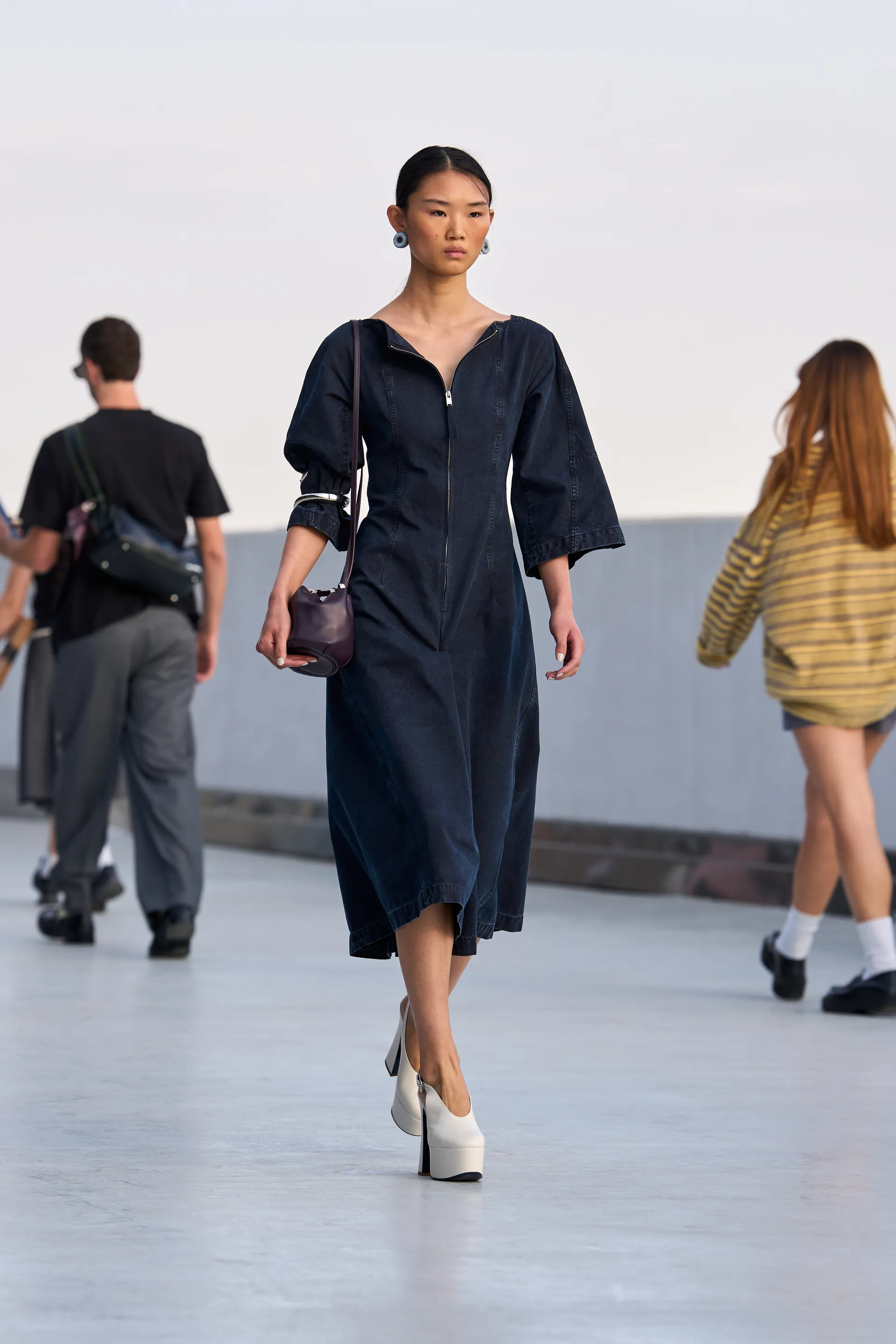
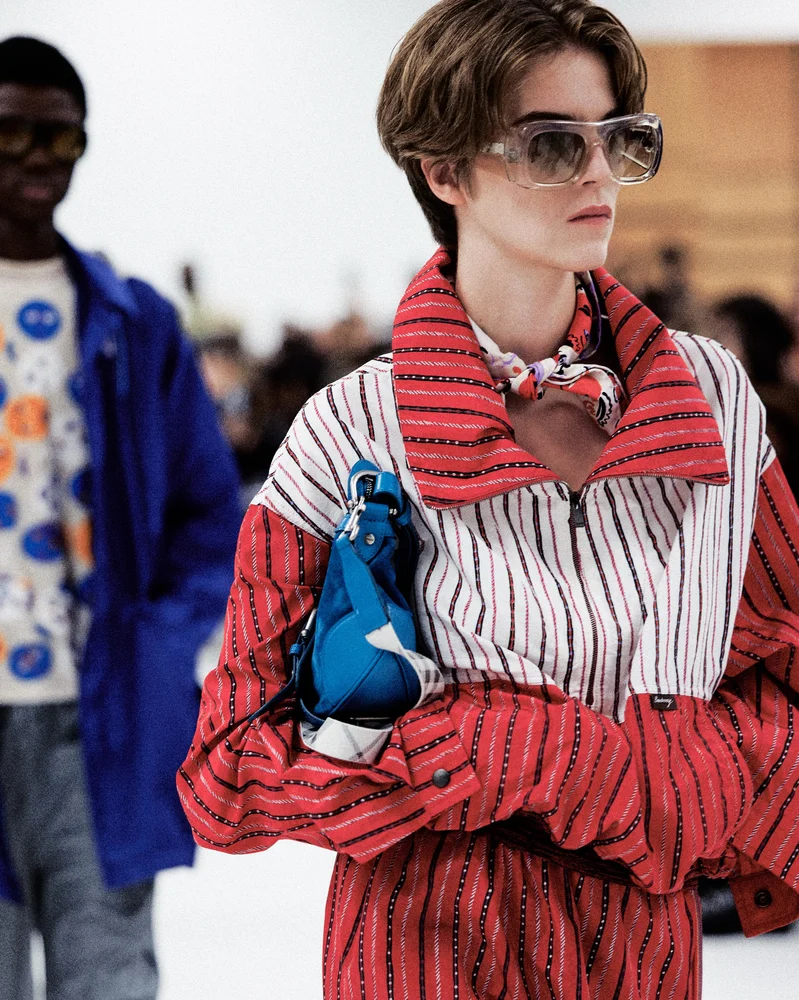
Closer inspection unsettles the uniform. Layers create doubled collars and unexpected flashes of colour beneath sober jackets, while proportions occasionally stretch beyond the tidy limits of business dress. A conventional coat can suddenly carry a sharp red collar or a pale tailored layer underneath, giving the impression that several versions of the work wardrobe have been stacked together.
Messina and Rizzo's clothes frequently sit between usefulness and disruption, allowing something ordinary to remain ordinary long enough for the second idea to register. The bags retain everyday practicality, outerwear looks built for movement, and denim grounds the collection in garments already circulating through ordinary life.
“Business casual” becomes a little casualty of its own rules. Nothing has collapsed dramatically. The commuter had merely started dressing for herself again.
Then the lower half of the body starts claiming considerably more room.
Volume moves outward from the hips, gathers around the hem and occasionally suspends itself in rounded shapes that seem to trap air inside the garment. Waists often stay relatively controlled, allowing the expansion below them to read with even greater clarity. A skirt can balloon close to the thigh, spread laterally around the hips or remain narrow until an eruption of fringe changes its entire circumference in motion.
Some shapes reference the logic of panniers, the rigid structures once used to widen skirts dramatically at the sides. Here, that old architecture appears inside a wardrobe otherwise connected to everyday dressing, collapsing centuries of fashion behaviour into the same silhouette.
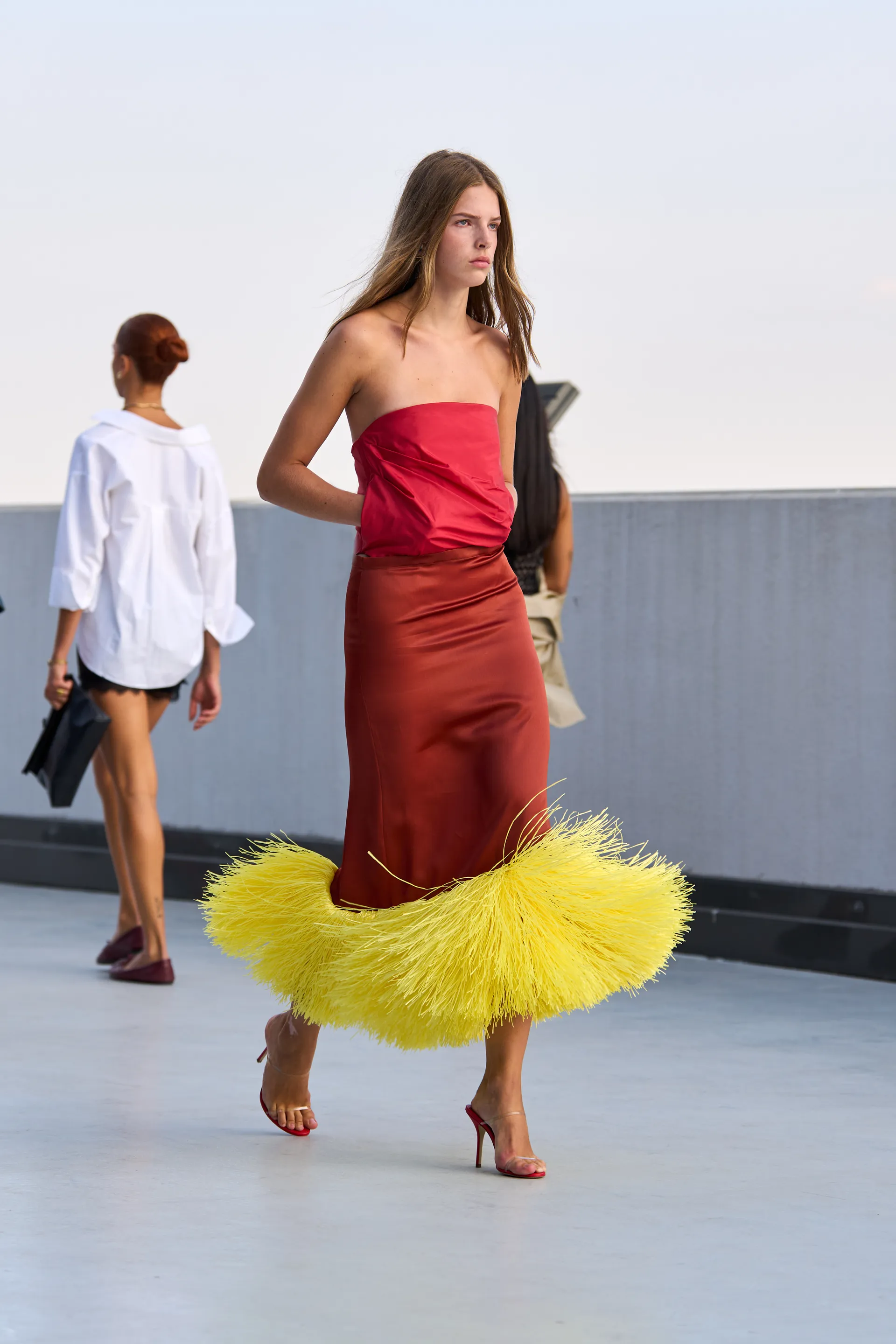
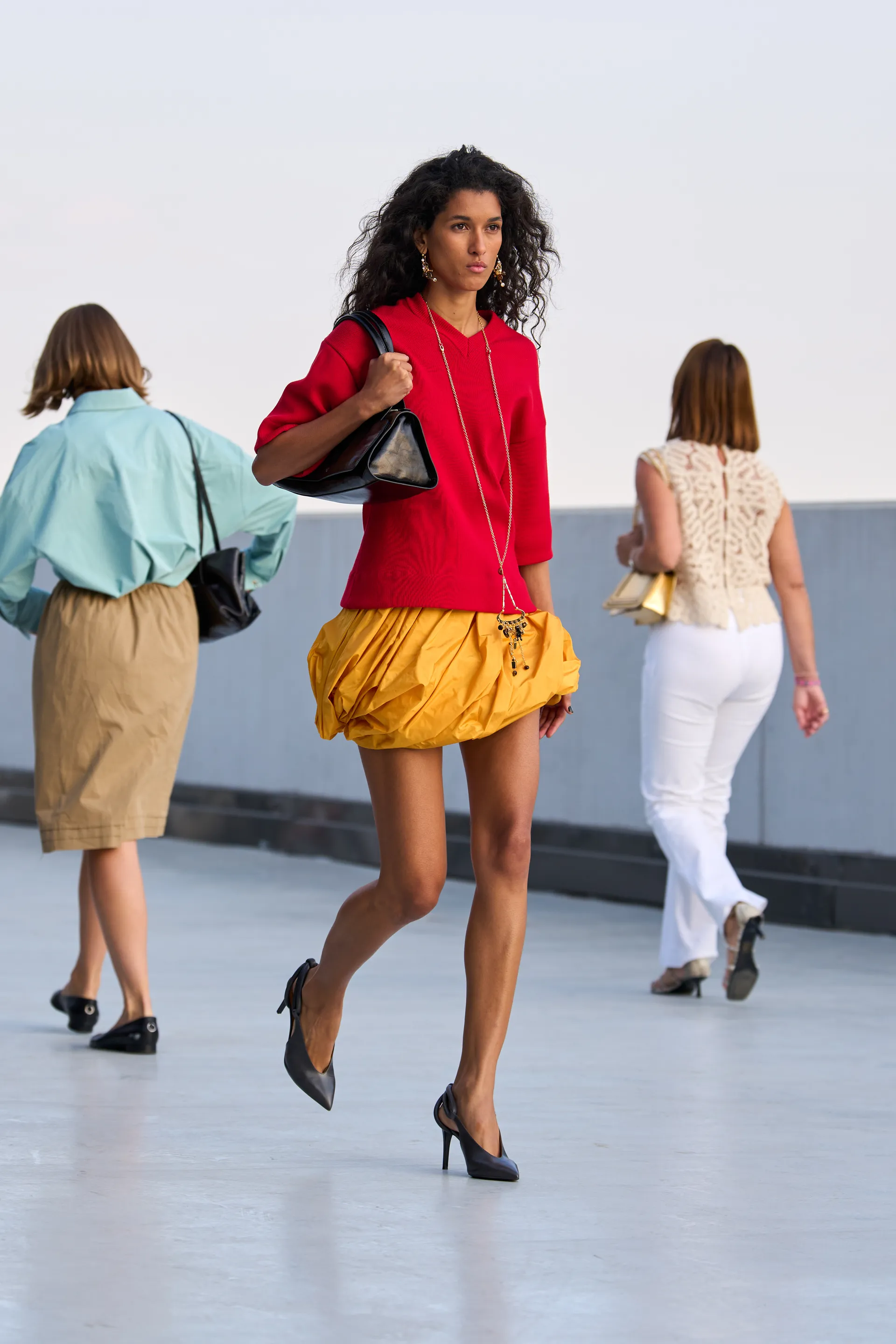
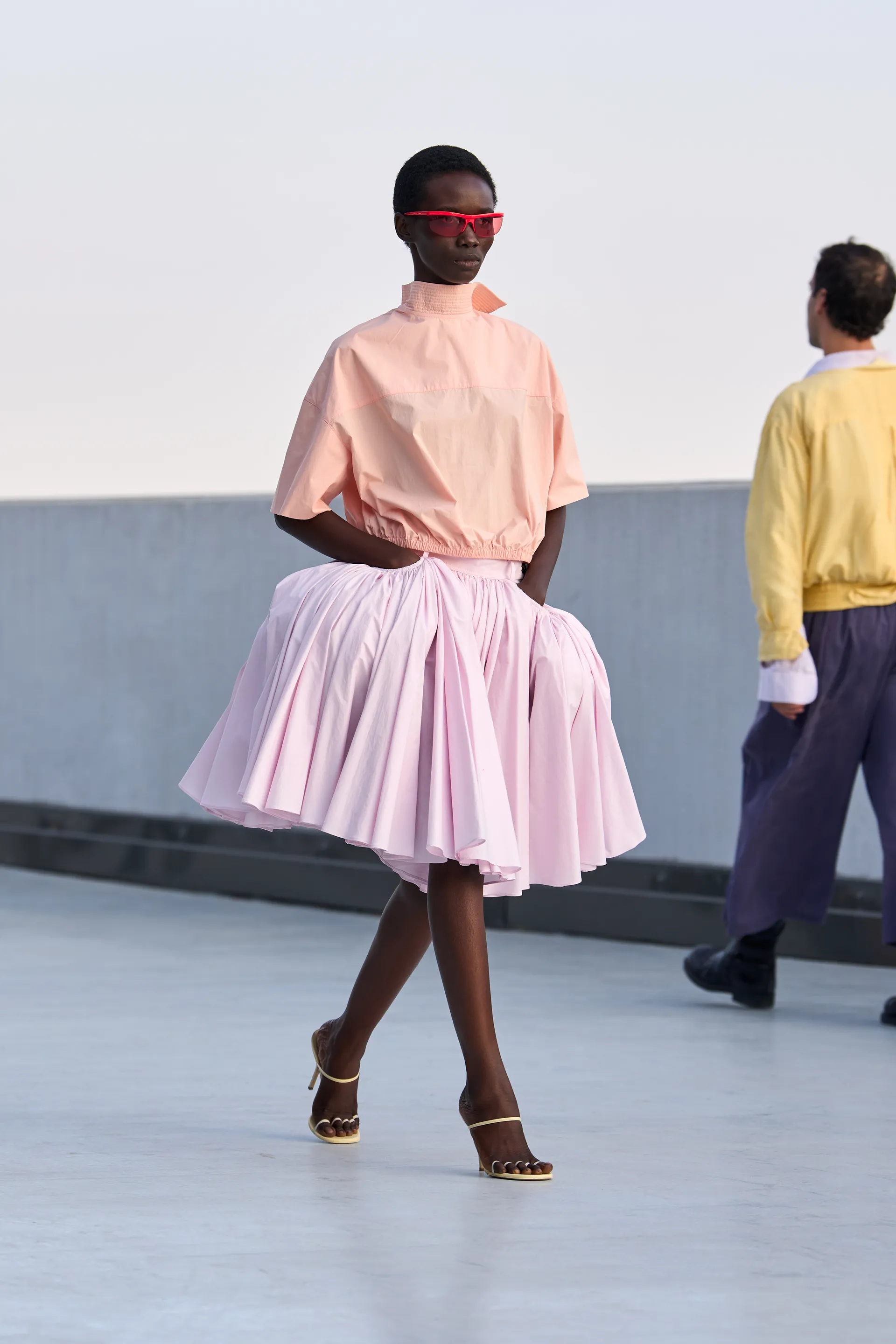
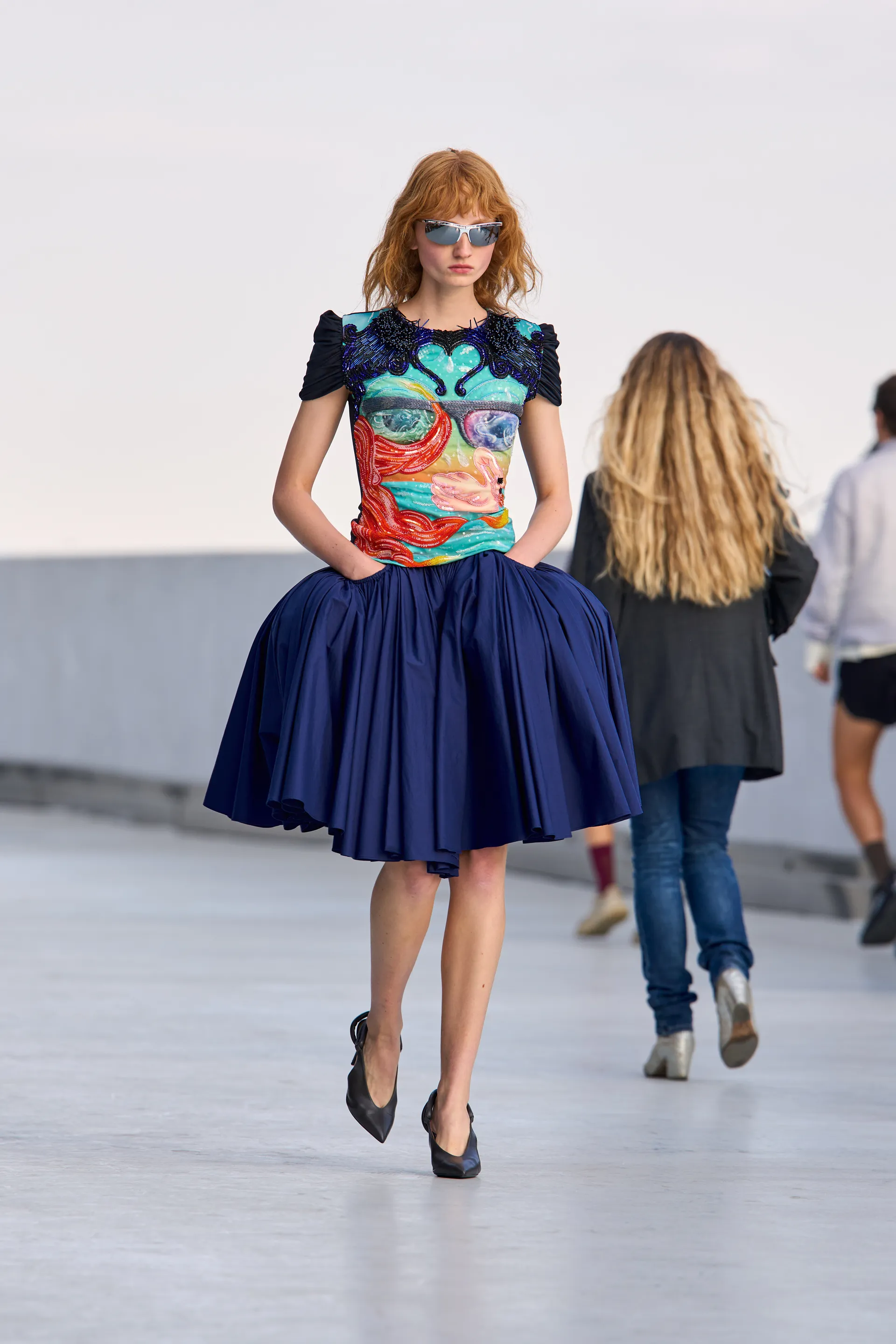
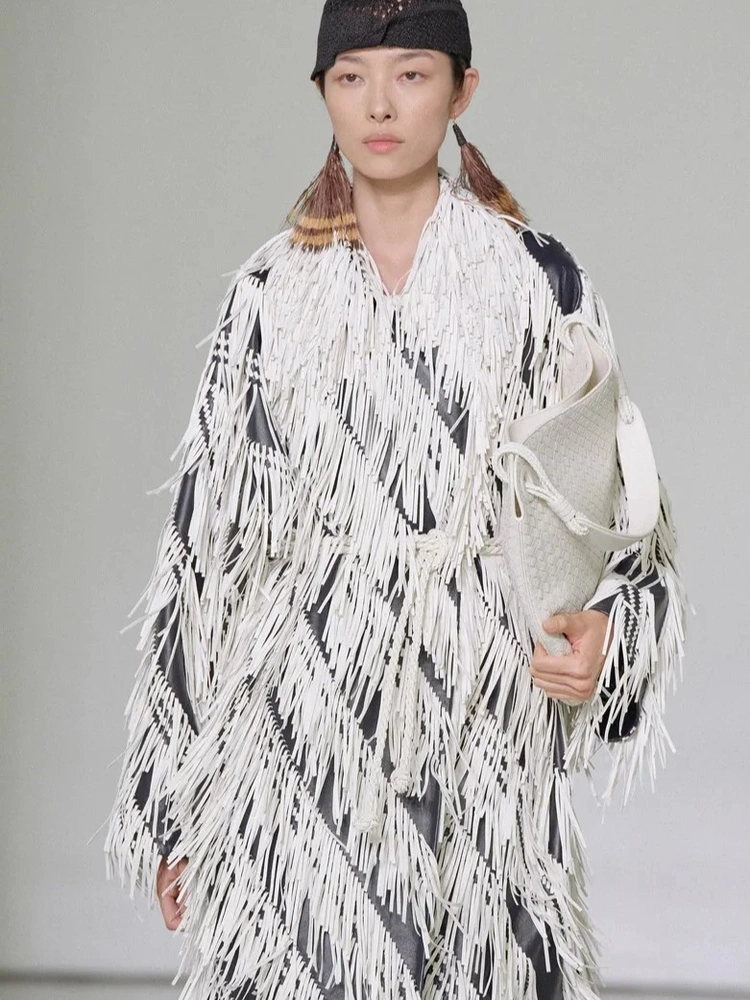
Material determines how far the exaggeration can travel. Crisp woven surfaces hold rounded shapes away from the leg, while softer draping falls in deep folds from an expanded hip. Dense raffia-like fringe behaves differently again, turning the hem into a moving perimeter that shakes and separates with every step. The body remains the fixed point while fabric keeps redrawing the area around it.
That placement of volume is where the new Moschino humour becomes clearest. Simone Rizzo and Loris Messina rarely need to attach an obvious punchline to the garment. A familiar skirt pushed several inches too far outward can already make the joke.
Eventually, proportion stops pretending to be polite.
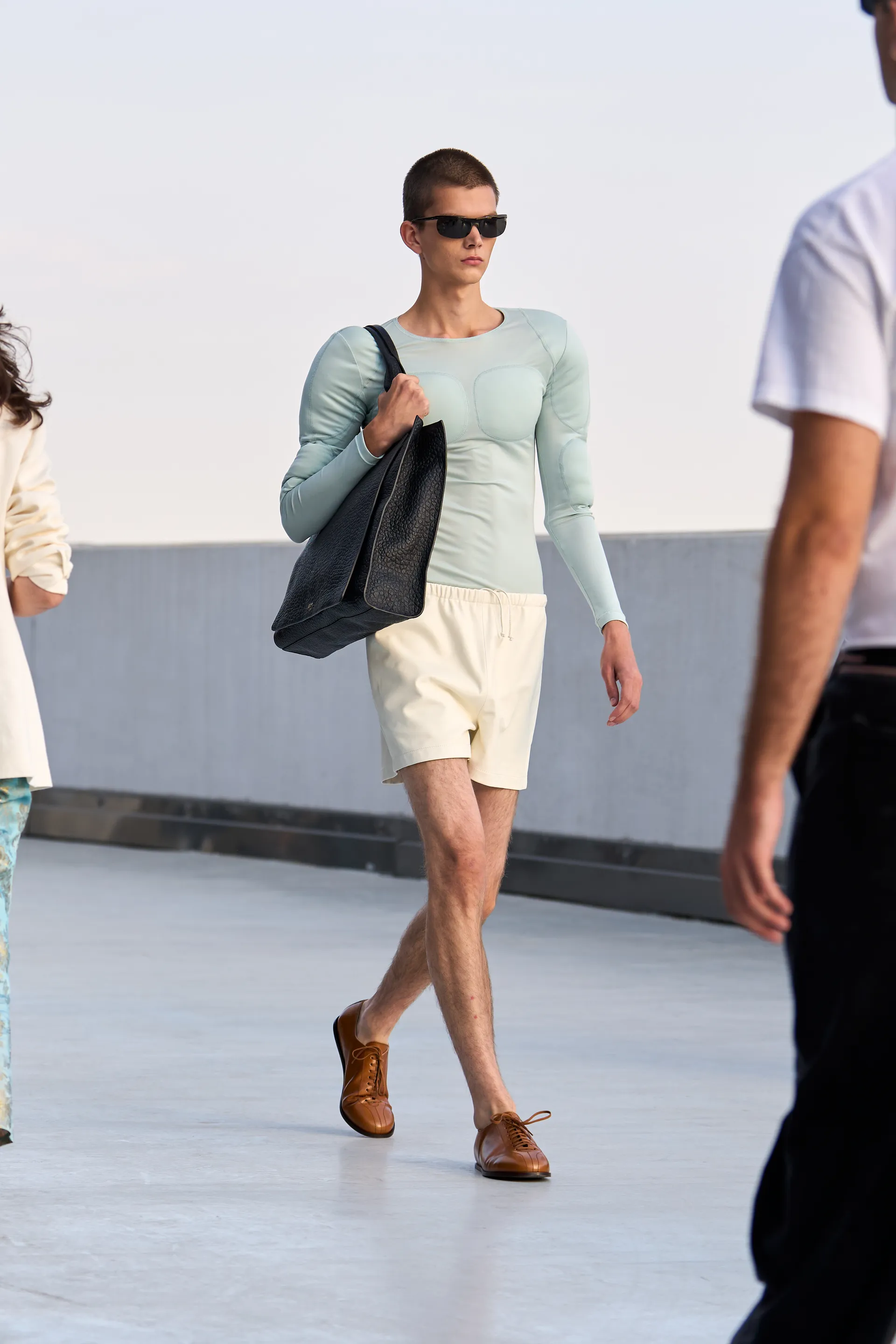
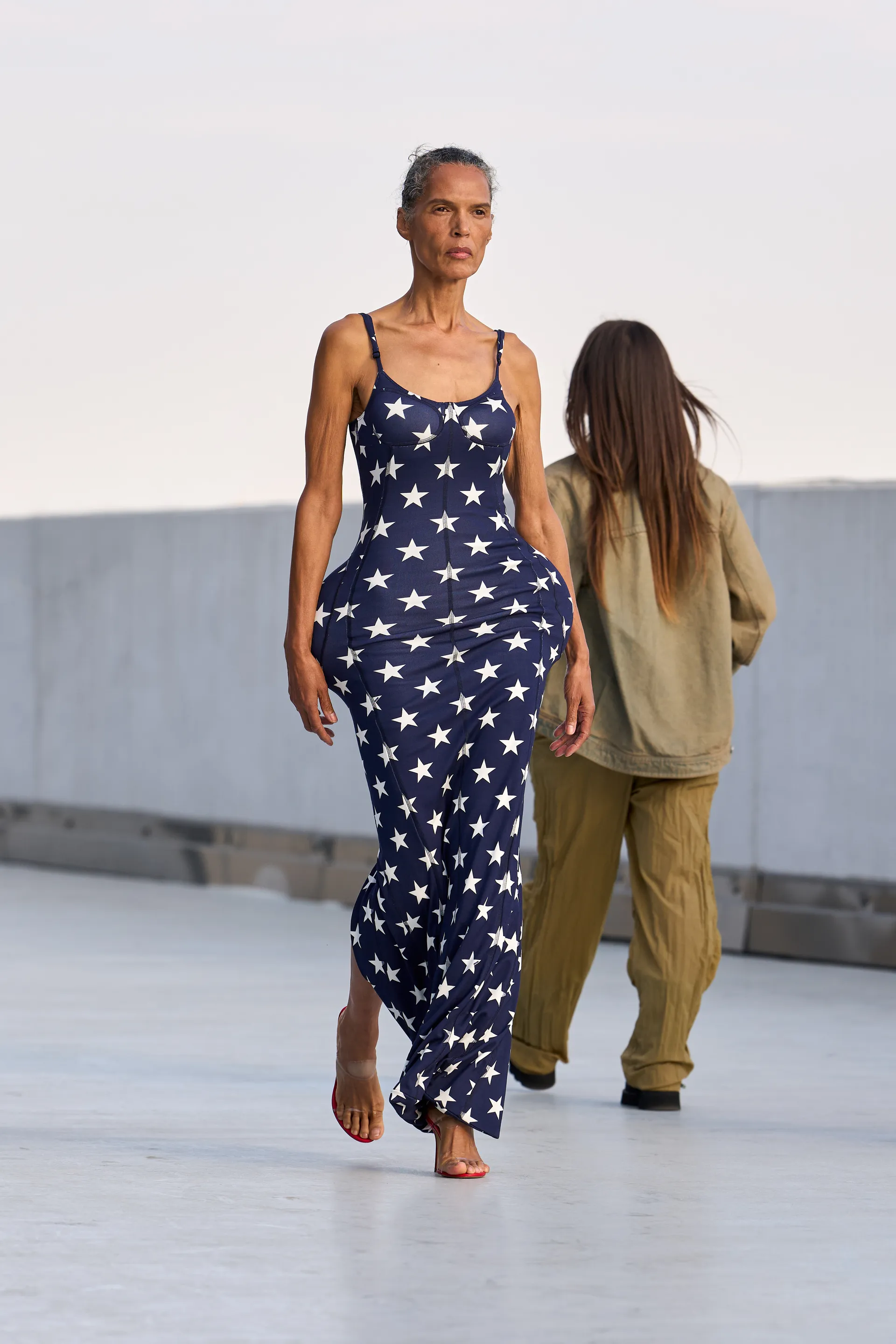
Some silhouettes exaggerate the human figure itself, using internal structure to push hips and musculature beyond their natural outline. The star-covered bodycon shape is especially direct in its manipulation of anatomy, part of a wider interest in surgically altered or artificially perfected bodies that also appear through padded menswear. The designers presented those distortions as a reflection of the present, allowing current beauty ideals to become physical architecture.
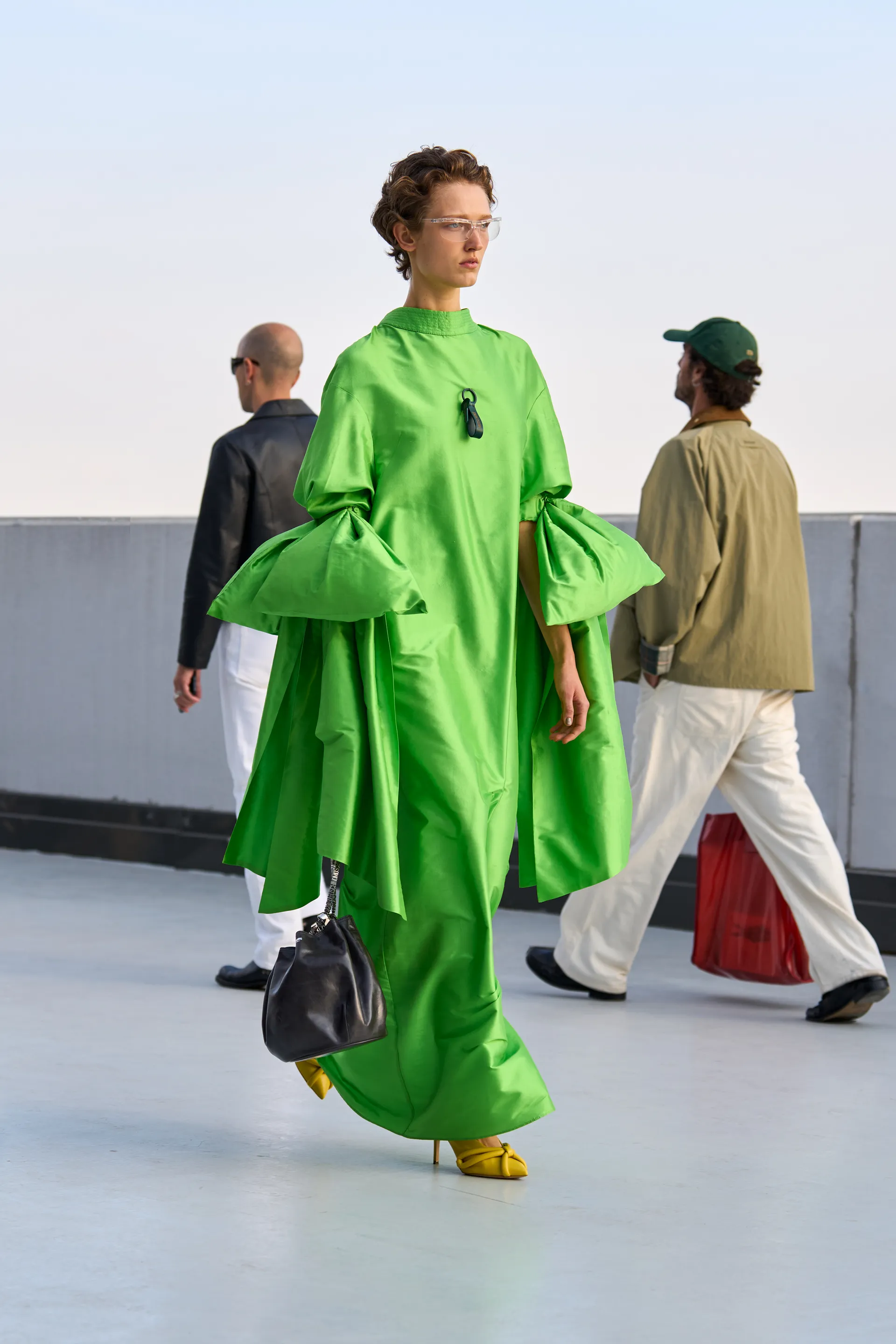
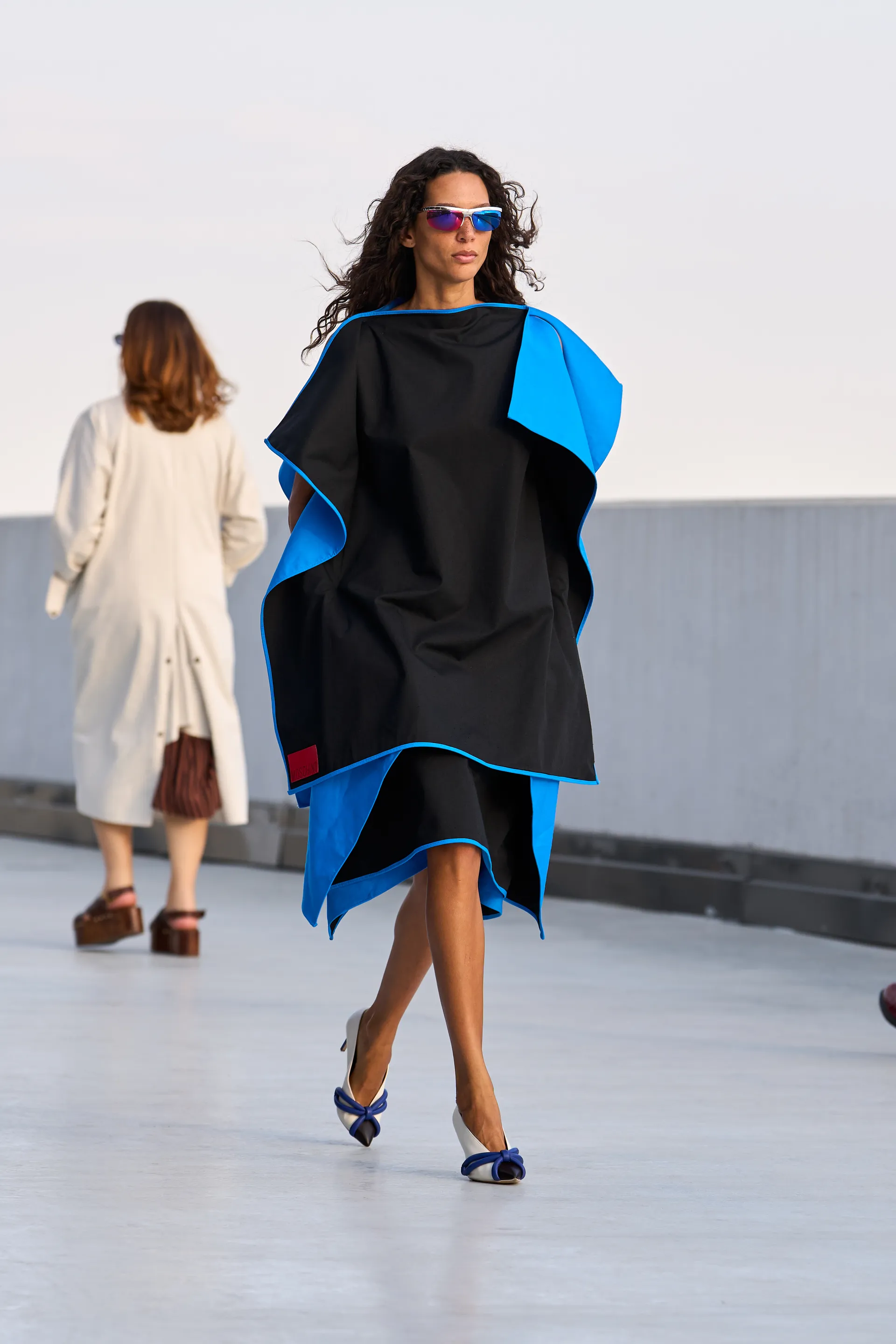
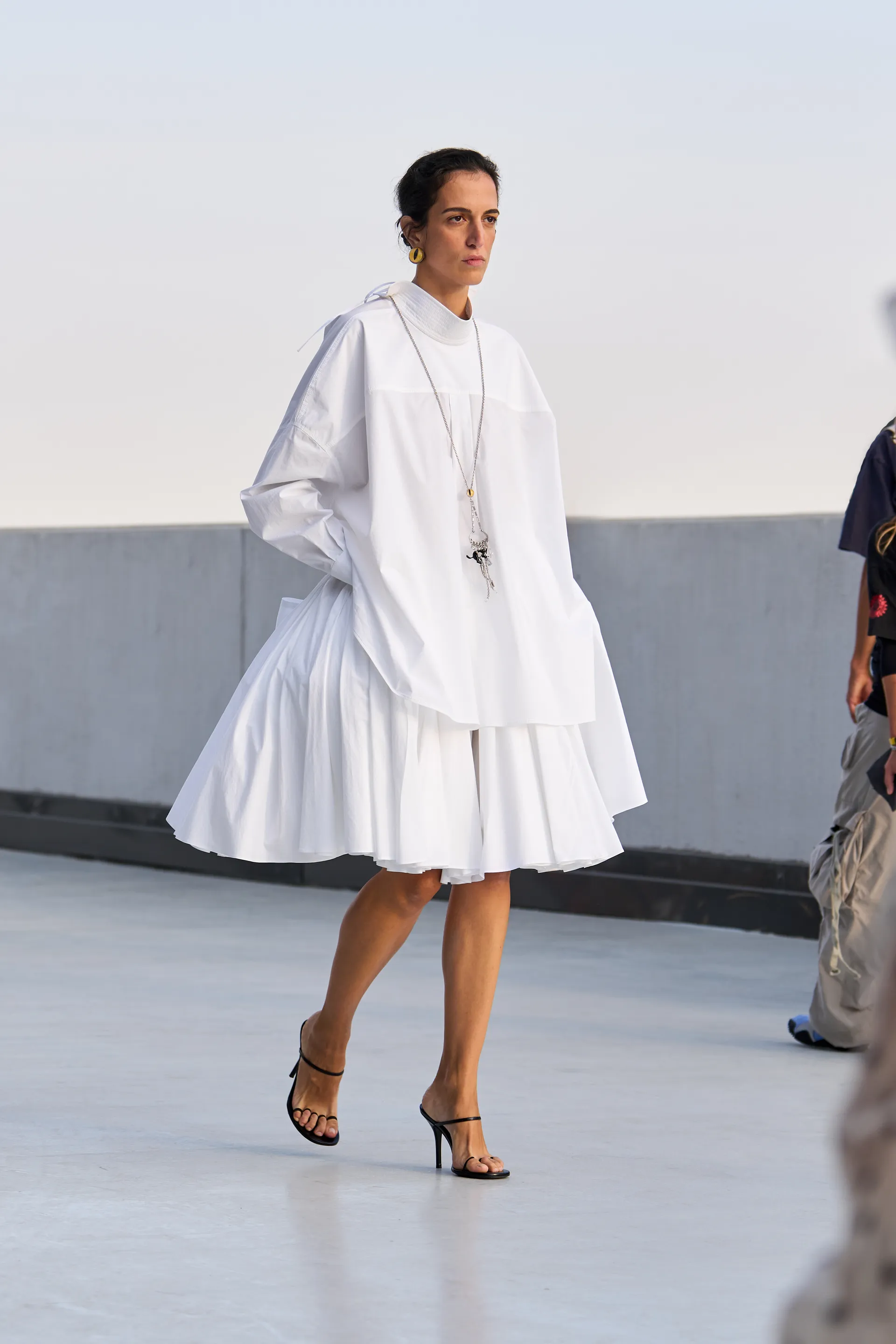
Elsewhere, the body almost disappears inside geometry. Wide sleeves swell away from the arms, fabric projects outward from the torso, and loose dresses fall from the shoulders without returning to the waist. Some silhouettes move close to a trapeze line, widening through uninterrupted planes as they descend and allowing the cloth to swing independently around the figure. Their looseness gives the collection another form of exaggeration: the body can be amplified through padding, or temporarily erased through volume.
That is a very Moschino contradiction. The joke can live in an impossible body and in a body hidden inside an impossible dress. Messina and Rizzo connect those extremes through cut, keeping the humour embedded inside silhouette instead of relying on a logo to explain it.
Then comes GOOD LUCK.
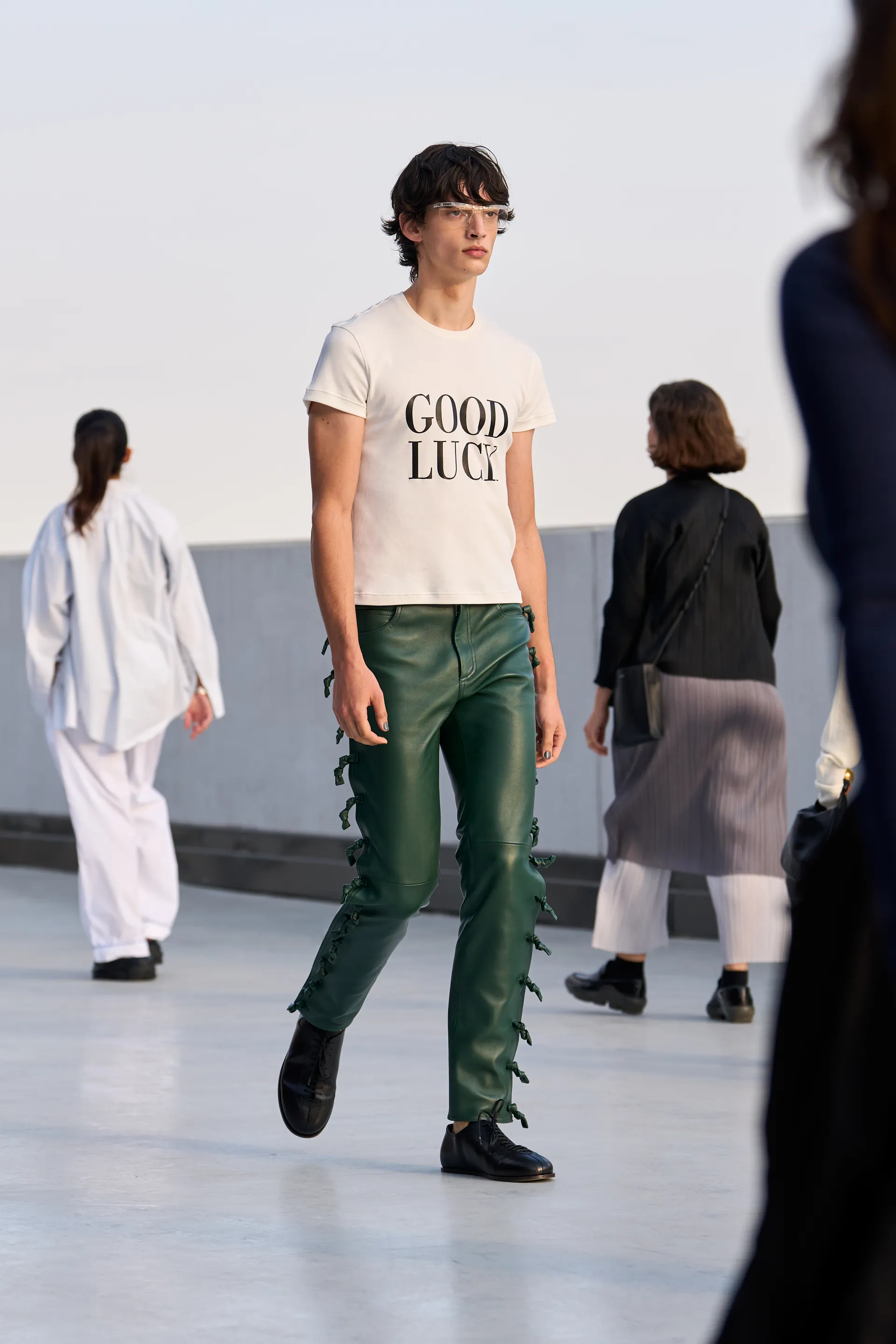
The phrase had already appeared before the show on the green bag created for the duo’s first symbolic Moschino look at Vogue World, where it was presented as an optimistic mantra. Printed across a plain white T-shirt in the collection, its optimism acquires a slightly suspicious edge. On the designers’ first season at the house, “good luck” can be read as blessing, warning, self-encouragement or a dry little message sent toward an industry currently trying to work out what comes next.
Moschino has always enjoyed language that changes depending on how seriously the wearer takes it. Two words are enough.
Anyone whose Moschino reference point is Jeremy Scott’s years of saturated pop imagery will register the change immediately. Simone Rizzo and Loris Messina offer a quieter kind of provocation, one rooted in coats, skirts, trousers and T-shirts that can return to the street after the runway ends. Calling that shift “mundane” almost misses the joke, because mundanity is exactly the terrain they have chosen to manipulate.
The timing makes that sobriety especially interesting. Spring 2027 arrives during a luxury slowdown, when conspicuous excess carries a different emotional weight and clothes that look usable, repeatable and close to real life gain another kind of persuasion. Reading through that lens, the collection can almost resemble a recession indicator: fashion tightening its language while still finding ways to distort the everyday.
Moschino never becomes visually timid in the process. Colour survives, bodies are pushed into stranger proportions, historical references slip into daywear, and familiar objects still carry the possibility of becoming absurd. The joke changed register rather than disappeared. Jeremy Scott often pushed Moschino toward spectacle; Messina and Rizzo seem more interested in discovering how far an ordinary garment can be bent before it stops looking ordinary.
Althought that new direction is not fully resolved yet. Certain inflated or anatomically warped shapes recall Duran Lantink, some sculptural volumes drift toward Comme des Garçons territory, while the elevation of everyday objects can occasionally call Loewe to mind. At points, the collection reads like a moodboard whose influences remain visible on the surface. The concept is clear, but the house language still needs time to separate itself from references the audience already associates elsewhere.
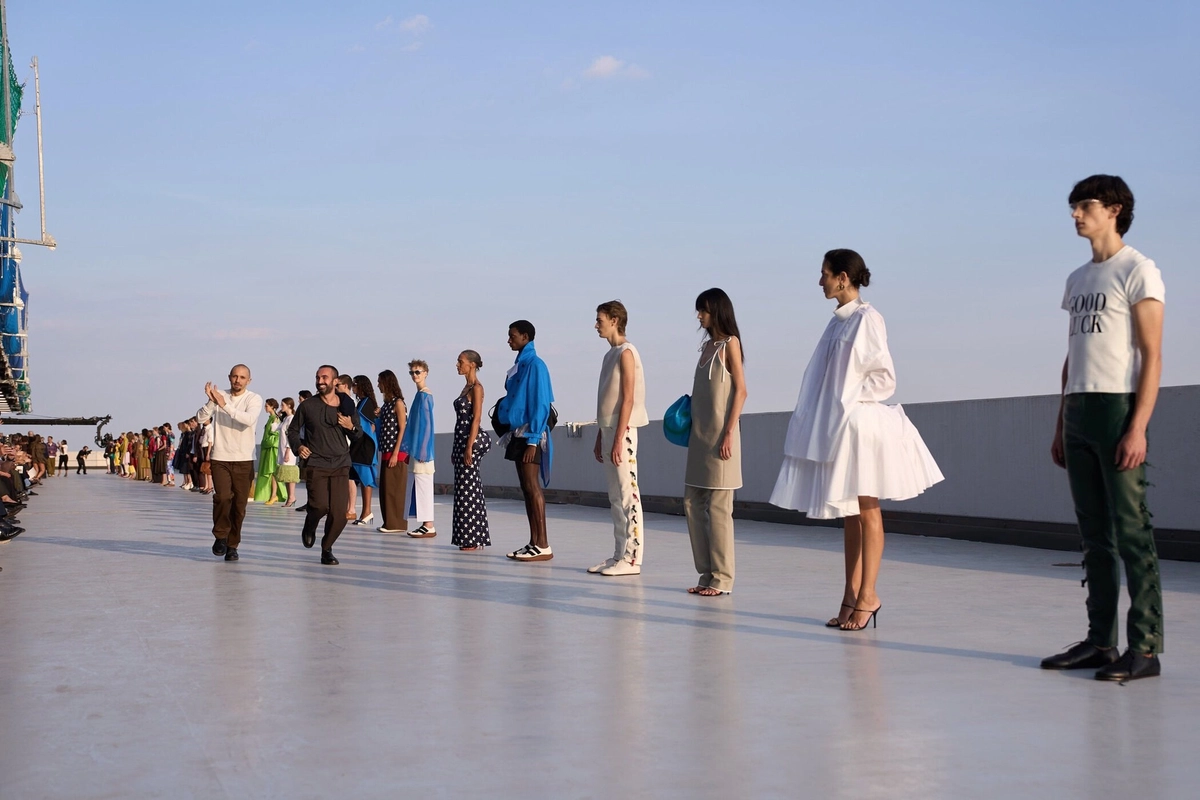
The runway itself offered the strongest clue to where that language might eventually settle. More than 400 people crossed the parking roof alongside the models, collapsing the distance between fashion spectacle and ordinary movement. Someone in a sculptural skirt shared space with someone walking a dog, someone heading to work, someone passing through. Luxury may divide people by access and price, yet clothing itself remains one of the most universal daily acts.
Franco Moschino built the house by noticing the absurdity already embedded in fashion and turning it back on the system with a smile. The new duo approaches that inheritance through participation, reality and a quieter kind of provocation.
For a debut, Moschino SS27 sets the direction more convincingly than it defines the destination. Simone Rizzo and Loris Messina have changed the temperature of the house, preserved its appetite for irony and introduced a language that could eventually become unmistakably theirs. The road is open. The identity still has some distance to travel.
Good luck? Perhaps that T-shirt knew exactly what it was saying.
Advertisement