Not every work of art hangs on a wall, and not every object in a home exists merely to serve a function. From jewellery fashioned with glass to the legendary Bacchantes vase, René Lalique devoted his life to dissolving the boundary between art and everyday objects. More than a century later, his legacy still poses a compelling question: what makes a house a place where we can truly live with beauty?

René Lalique: When Art Enters Everyday Life
Not every work of art hangs on a wall, and not every object in a home exists merely to serve a function. From jewellery fashioned with glass to the legendary Bacchantes vase, René Lalique devoted his life to dissolving the boundary between art and everyday objects. More than a century later, his legacy still poses a compelling question: what makes a house a place where we can truly live with beauty?
November 11, 2026


A vase can be nothing more than a useful object. Flowers are arranged in it, the water is changed, and once the last stems have withered, it is put away. Yet some vases, like René Lalique’s Bacchantes, invite us to leave them on the table even when they are entirely empty. Not necessarily because they are expensive, or because they bear a celebrated name, but because their form, material and relationship with light give them a presence of their own. They no longer exist simply to contain something else. They have become something worth contemplating in themselves.
There is a beautiful idea that one need not own a painting by Pierre-Auguste Renoir to live among works of art. A kitchen filled with thoughtfully chosen plates, a living room with a remarkable vase, or a dining table where the afternoon light passes through drinking glasses can each offer an aesthetic experience. In this understanding, art does not reside exclusively in museums, galleries or the collections of the wealthy. It also exists in the everyday relationship between people and the objects that surround them.
Few designers in the history of the decorative arts embodied this conviction as persuasively as René Lalique. Born in France in 1860, Lalique began his career as a jeweller, became one of the defining figures of Art Nouveau, and later turned to glass, helping to shape the visual language of Art Deco. Throughout his career, he repeatedly challenged established assumptions about materials, value and function. For Lalique, jewellery did not have to be made of diamonds to be precious, just as a vase did not have to abandon its purpose to be considered art.

The Vase That Needs No Flowers
In 1927, René Lalique designed Bacchantes, a vase inspired by the female followers of Bacchus, the Greco-Roman god of wine and revelry. Ten female figures rise in relief around its body, their arms linked in a dance that seems to have no beginning or end. The curves of their bodies merge with the glass surface, creating an impression of movement within an entirely motionless object. As light passes through it, the interplay of transparent and frosted surfaces accentuates the forms, allowing the vase to appear subtly different throughout the day.

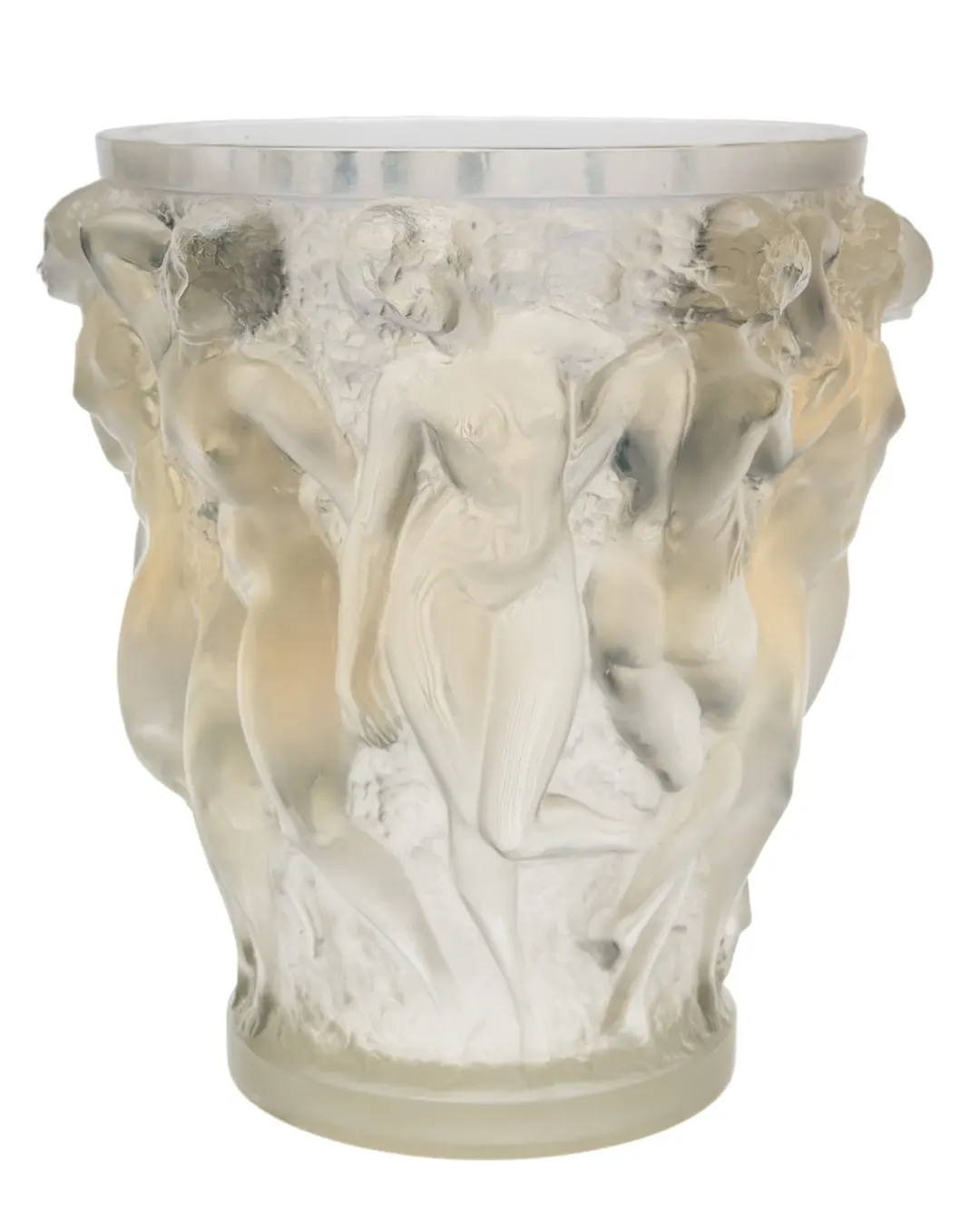
Bacchantes is not a sculpture disguised as a vase. It is genuinely a vessel, capable of holding flowers and taking its place in a domestic interior. Yet that function does not determine its entire value. Even without a single stem, the women continue their dance across the glass, while light continues to transform our perception of the object. It is a curious reversal: ordinarily a vase is chosen to complement flowers, but with Bacchantes, the flowers can become secondary to the vase itself.
Almost a century after its creation, Bacchantes remains among Lalique’s most recognisable designs. The original was made in glass; since 1947, the model has been produced in crystal. According to Lalique, making the contemporary crystal version takes approximately fifteen days, involving hot and cold working, polishing and hand-finishing. A seemingly simple vessel must pass through numerous stages of specialised craftsmanship before it can take its place on a living-room table.

Those details help explain part of its value, but not all of it. Labour and technical difficulty do not automatically transform an object into art. What carries Bacchantes beyond the category of finely made craft is its ability to sustain aesthetic interest across generations. Someone who owns the vase today may live in a modern apartment, surrounded by minimalist furniture, with habits entirely unlike those of a buyer in the 1920s. Yet the same form can still converse with a contemporary interior.

Perhaps this is one of the defining qualities of enduring design: it does not have to keep changing to prove that it remains relevant.
René Lalique: The Jeweller Who Refused to Let Diamonds Define Value
To understand how René Lalique came to create objects such as Bacchantes, we must return to his earlier life as a jewellery designer. In the late nineteenth century, European high jewellery was still strongly shaped by a hierarchy of precious metals and gemstones. Gold, diamonds, rubies and sapphires were not merely materials; they were visible signs of status and purchasing power. A jewel might be judged first by the monetary value of what it contained.
Lalique approached the problem differently. He used horn, enamel, glass, ivory and semi-precious stones, sometimes placing them alongside diamonds or gold in the same composition. Materials not conventionally associated with the highest forms of wealth became instruments for expressing colour, form and imagination. Flowers, insects, birds, serpents and female figures appeared in extraordinary jewels that often resembled miniature sculptures more than objects intended simply to display riches.
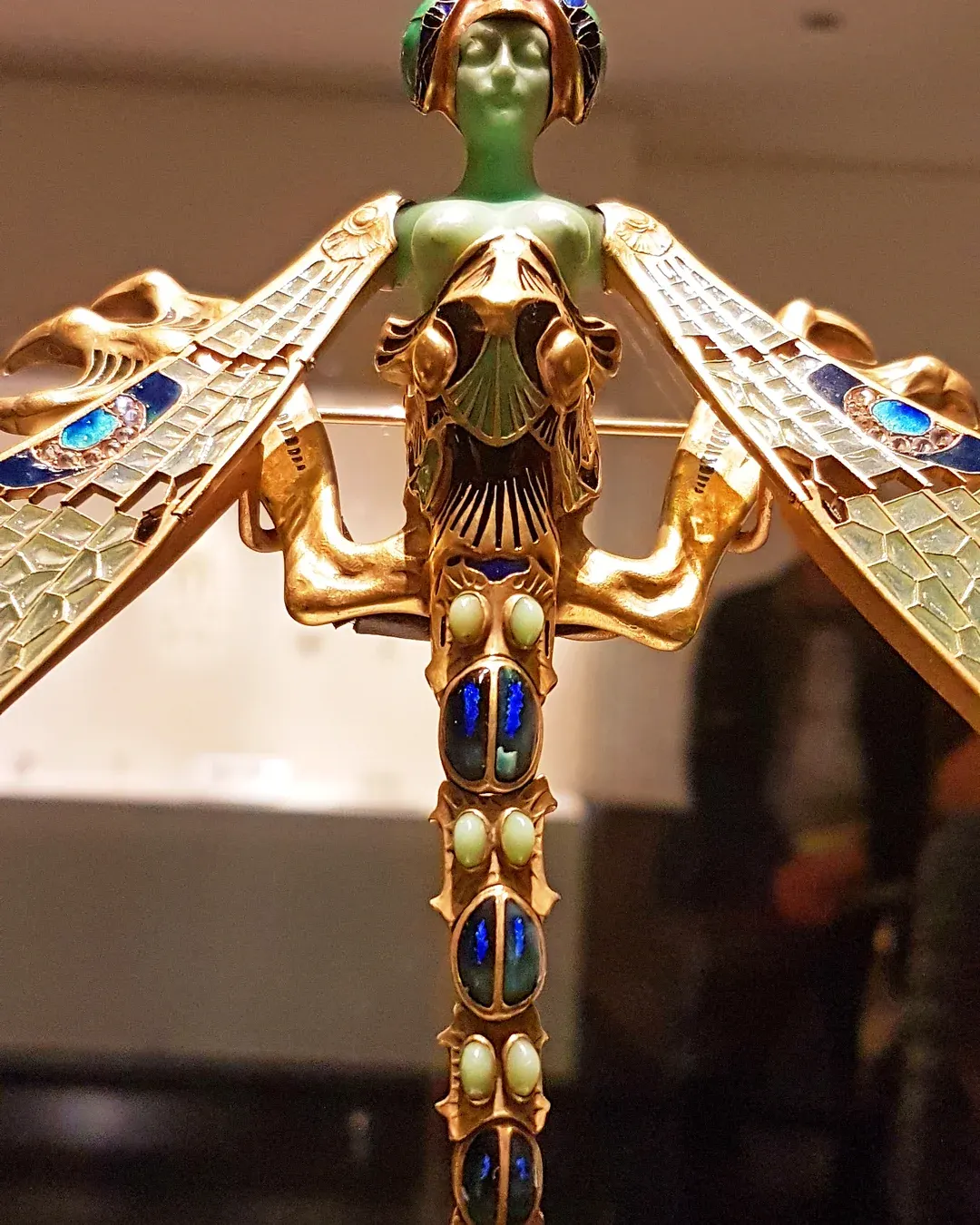

The Musée Lalique preserves a conviction associated with the designer: “To seek beauty is a more worthy aim than to display luxury.” In other words, the pursuit of beauty mattered more than the exhibition of wealth.
This did not mean that Lalique rejected wealth or refused to work for the elite. His clientele included figures such as the actress Sarah Bernhardt and the financier Calouste Gulbenkian. Lalique was also a successful businessman who understood the value of reputation and rarity. What he changed was the framework by which an object could be judged. The cost of its raw materials was no longer the only measure; design, craftsmanship and the ability to provoke an emotional response mattered just as much.

That shift carried implications far beyond jewellery. If glass could become a coveted jewel, why could it not become a work of art in a living room? If beauty could be created from comparatively ordinary materials, why should the objects of everyday life be condemned to an ordinary design language?
Within that question lay the foundations of the next chapter of René Lalique’s creative life.