Winter brands have started wandering far beyond snow, and the further they go, the stranger the definition of a winter brand becomes.
Climate Is Only Half the Story for Winter Brands
Winter brands have started wandering far beyond snow, and the further they go, the stranger the definition of a winter brand becomes.
September 9, 2026


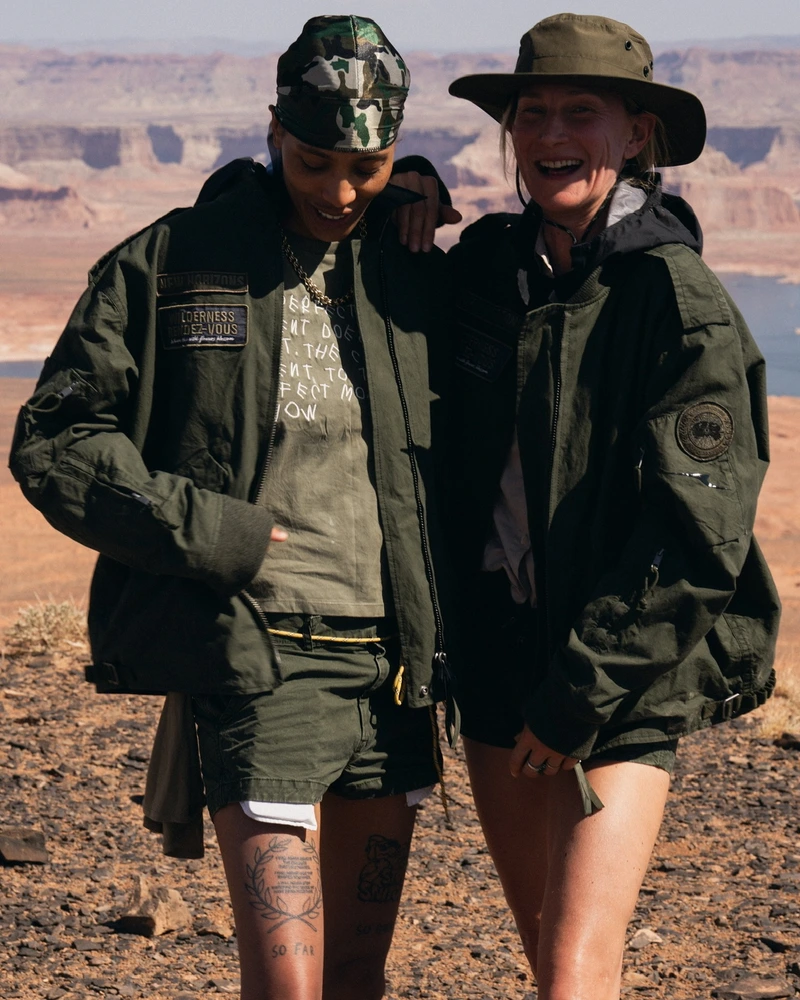
Haider Ackermann once belonged to a world of languid tailoring and immaculate evening clothes; technical puffers sat outside his personal wardrobe history. Then Canada Goose handed him the keys to one of fashion’s great cold-weather machines, and by summer 2025 he had taken 15 guests into the Utah desert for three days of helicopter rides, horses, canyon dinners and 40-degree heat, dressing them in lime-green water-resistant hot pants, lightweight parka shells and hiking boots.
A brand famous for dressing Antarctic scientists had suddenly placed its creative future somewhere between Lake Powell and a sun-baked rock formation. Ackermann explained the ambition with unusual clarity: he wanted Canada Goose to reach warm places as well as cold ones.

The stunt becomes considerably richer when placed beside one unexpected market figure: sun-protective apparel is developing into a market projected around $1.74 billion. UV exposure, humidity, wind, rain and heat are giving technical clothing companies another collection of environmental problems to solve, which raises a wonderfully inconvenient question about the entire category. Perhaps winter brands have spent decades selling something broader than winter.
Maybe Winter Brands Solved Winter First
The North Face offers one of the clearest clues because its own executives describe the performance requirements of an ice climb and summer training through the same vocabulary: freedom of movement, protection, breathability and durability. The company’s Futurelight membrane manages wind and rain while allowing heat to escape, while its Lightrange technology introduces UPF protection, moving the brand’s technical language directly from insulation toward sun management.


Canada Goose expresses the same philosophy through its Mirage jacket, whose construction takes cues from the heavier Constable jacket of the 1990s while stripping away insulation for another climate.
A parka becomes one answer to one environmental condition. A UV shirt, rain shell and breathable summer layer belong to the same intellectual family because each manages the conversation between skin, weather and movement. “Winter brands” starts sounding like a description of where these companies first became famous, while environmental competence starts sounding closer to the expertise they can actually commercialise.
Moncler 2026 Have a Puffy Summer campaign takes the physical language of its winter identity and translates it into light layers, then surrounds Jamie Dornan with enormous inflatable-looking sea creatures: an octopus, whale, lobster, seahorse, crab and flamingo, all carrying the rounded puffiness associated with Moncler.
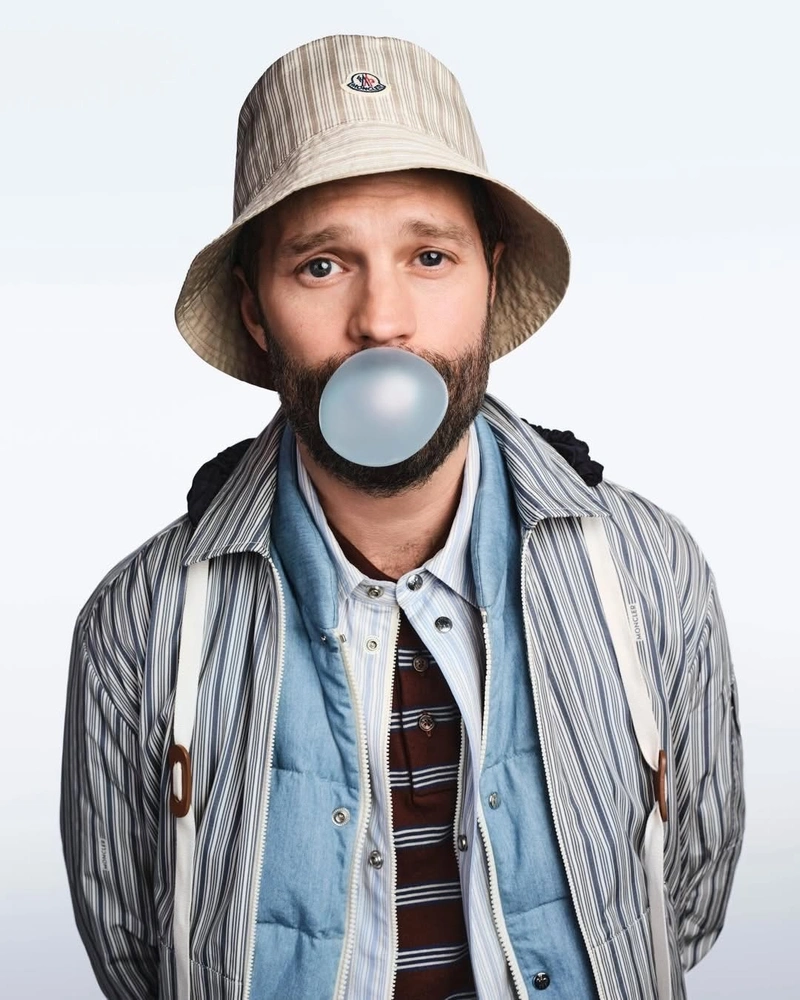

Even the beach fauna has effectively been Monclerised. The house describes the collection as its signature DNA “evolved for lighter, brighter days,” which turns a humorous campaign into a serious exercise in transferring technical and visual authority from snow toward sun.
Take Away the Puffer and See What Survives
Perfect Moment has conducted this experiment almost literally. The label’s black-and-white houndstooth became famous across skiwear and slope-ready separates; in 2026, the same graphic appears on a long-sleeved zip-front swimsuit made from Italian Carvico fabric with UPF50+ protection, chlorine resistance and compression, priced at $295 in the US. The body has moved from piste to surf, while the visual signal stays almost comically intact.
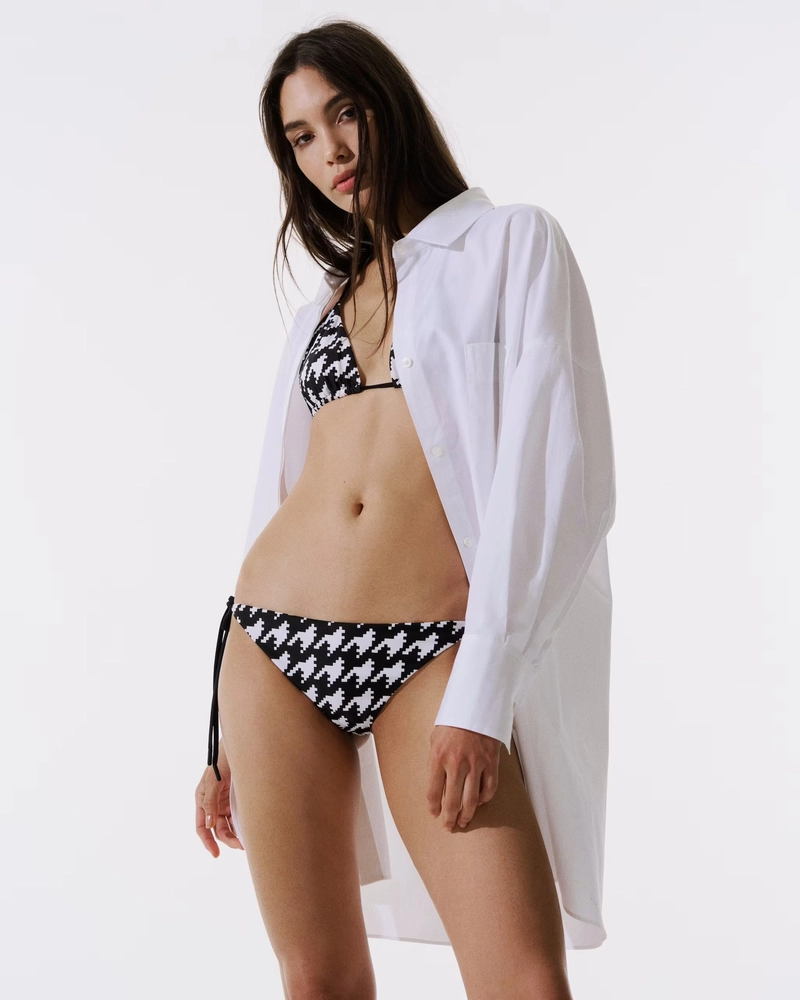
This is where summer becomes a fascinating brand-equity examination for winter brands. A puffer gives Moncler quilting, volume and instant silhouette; Perfect Moment receives its star motifs and sharp ski geometry; Canada Goose carries the physical authority of the expedition parka. Strip away those hero objects and an ordinary shirt, bikini or tennis dress has to communicate identity through fabric, proportion, hardware, print and attitude.
Consumers are becoming particularly demanding judges of that exercise. McKinsey’s 2026 study of over 2,000 luxury clients in the US and China found that emotional connection now ranks among the central drivers of desirability, while 68% of US luxury consumers said newer or disruptive brands reflect their identity. Craftsmanship and quality operate as expected foundations, while immediate desire increasingly drives full-price purchasing.
Summer therefore works like a luxury blind tasting for winter brands. Remove the famous coat and ask whether the customer can still taste the house.
Perhaps Winter Brands Are Following Wealth, Not Weather
Goldbergh SS26 Club Capri collection divides the season into RACQUET, ACTIVE and SWIM, wrapping tennis dresses, fitness pieces and bikini in Capri prints and gold accents while explicitly framing the collection around Mediterranean leisure. The choice looks particularly calculated once another figure enters the room: 65% of travellers in the top 1% played tennis regularly or occasionally in 2025, while 52% had played pickleball or padel.

The travel habits become even juicier. The top 1% of affluent US travellers surveyed by Resonance take around six leisure trips per year, spend an average $12,400 per trip, and average roughly $74,400 in annual travel expenditure. These customers effectively live through a portfolio of destinations, activities and wardrobes across the calendar.
Both skiing and racquet sports carry equipment, specialised clothing, resorts, private clubs, coaching, hospitality and the wonderful social theatre of looking appropriately dressed while performing leisure in public. Swim, golf and destination hiking occupy adjacent territory. The geography changes from alpine lodge to Mediterranean hotel; the underlying ecosystem still revolves around travel, discretionary income, specialised wardrobes and belonging.
Fashion’s Seasons Are Starting to Lose the Weather
Welter Shelter accidentally produced one of the funniest case studies of 2026. The Amsterdam outerwear company organised a summer gifting initiative in Paris during a period of heatwaves, sending lightweight jackets into a city that appeared determined to prove how unnecessary a jacket could feel. During the exact week recipients received them, the weather flipped and Paris was hit by torrential rain. The marketing gods apparently have a sense of humour.

Welter Shelter says it designs around unpredictability, which may eventually prove a useful word for the entire fashion calendar. The North Face operates across a retail geography stretching from Glasgow and Stockholm to Dubai and Cape Town, while winter daytime temperatures in the UAE average around 25°C. One global assortment therefore serves cold northern cities, desert economies, tropical humidity and Southern Hemisphere seasons simultaneously.
Actual climate data makes the traditional labels feel even shakier. At least 95% of Europe experienced above-average annual temperatures in 2025, while the continent’s temperature trend has been running around 0.56°C per decade since the mid-1990s. March 2025 snow-covered area across Europe sat around 31% below average, and July produced a 25-day heatwave across a substantial part of the continent.
This suggests a useful new phrase for winter brands and the wider industry: climatic fashion. A global brand can increasingly think through hot, wet, humid, windy, high-altitude, transitional and travel conditions, treating Spring/Summer and Fall/Winter as merchandising languages while real weather follows a far messier calendar.
Winter Brands Enter the Climate Paradox
Arc’teryx offers a glimpse of how technically difficult a serious response can become. Its new Sperro SV hardshell took four years to develop under the brand’s System 0 circularity framework, with repairable components, recycled and recyclable ECONYL nylon, a product passport and over 80 repair routines available through ReBIRD. Arc’teryx chose one of its technically demanding mountain shells as the first System 0 product, forcing circular thinking to coexist with waterproofing, durability and high-performance construction.
Four years for one jacket offers a useful reality check against fashion’s appetite for endless climate-specific categories.

Global fibre production reached 132 million tonnes in 2024, equivalent to roughly four tonnes every second, and business-as-usual projections place production around 169 million tonnes by 2030. Polyester accounts for 59% of global fibre output, with 88% of that polyester fossil-based, while fibre originating from recycled pre- and post-consumer textiles remains below 1%.
So every clever new solution for heat, UV, humidity and volatile rain sits inside an industry already producing fibres at extraordinary volume. Climate instability can inspire modular clothing designed for many conditions; it can also inspire another swimsuit, another rain shell, another summer capsule and another specialised SKU.
NYU Stern’s 2026 research across apparel supply chains found extreme heat already disrupting productivity, quality and worker health across South and Southeast Asia, while brands’ tight lead times and purchasing practices can restrict suppliers’ ability to fund cooling infrastructure.
So the most intriguing discussion around winter brands moving into summer eventually reaches far beyond puffers and swimwear. The next great technical achievement may involve far more than making a jacket work in every climate; it may involve designing a fashion system capable of adapting to climate volatility without turning every new weather problem into another excuse to manufacture four tonnes of fibre every second.