MENU
Close





The world’s most beautiful tennis courts offer more than immaculate lines and professional surfaces.
The world’s most beautiful tennis courts offer more than immaculate lines and professional surfaces.
July 9, 2026


A tennis court begins with one of design’s most unforgiving diagrams: a flat rectangle divided by exact white lines. Its dimensions allow little room for interpretation. The surrounding experience, however, can be transformed almost without limit.
At the world’s most remarkable resorts, the court has evolved beyond a sporting amenity placed somewhere behind the spa. It can become the visual climax of an entire property, a structure that interprets the geography around it or a stage upon which a hotel’s philosophy becomes immediately legible.
At Il San Pietro di Positano, the court occupies a narrow threshold between limestone and sea. Bürgenstock Resort encloses the sport beneath intricate timber geometry. Hotel du Cap-Eden-Roc preserves the social rituals of Riviera clay-court tennis, while Singita Serengeti House sets the familiar game against an almost limitless wilderness.
These four luxury tennis courts approach design differently, yet each understands the same principle. A memorable court cannot compete with its setting. It must teach the player how to experience it.
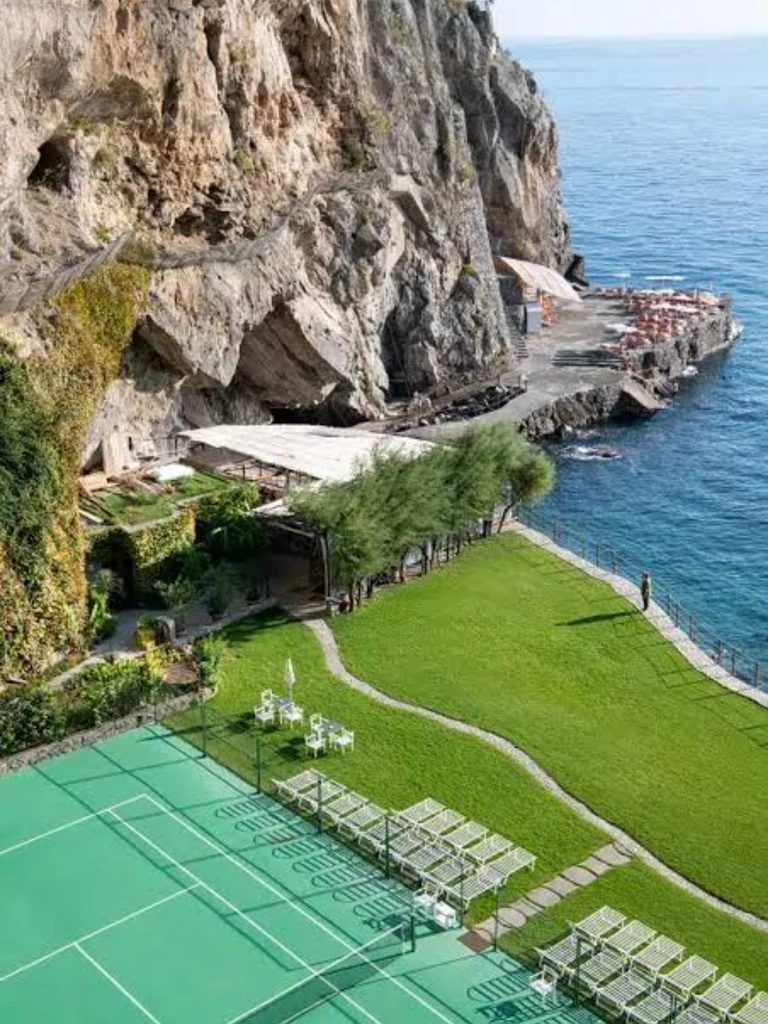
From the upper terraces of Il San Pietro di Positano, the Amalfi Coast descends in a near-vertical sequence of gardens, stone walls and fragrant planting. Far below the main hotel, a green luxury tennis court rests at sea level, held between a rugged rock face and the property’s private pebble beach. It is regulation size, yet the geological enclosure makes it appear less constructed than discovered.
Reaching it is part of the architecture. The hotel provides direct access to the shore through an elevator carved into the rock, carrying guests from the elevated property toward its beach platforms and coastal facilities. The journey feels like a controlled descent through the mountain before the doors open onto sunlight, salt air and the enclosed brilliance of the court.
Its visual power comes from compression. The cliff rises sharply behind the baseline, while the Mediterranean opens beyond the opposite edge. One side appears almost immovable; the other extends toward an unobstructed horizon. The strict geometry of the playing surface temporarily brings order to a landscape defined by irregular stone, steep gradients and water.
Il San Pietro’s wider architecture follows the same sensitivity. The property describes its relationship with nature as one in which outdoor and indoor spaces merge through light, vegetation and fragrance. Members of the Cinque family have recalled founder Carlino Cinque examining additions from the water and rebuilding anything he felt disrupted the coastline. The court embodies that attitude: conspicuous in color, yet remarkably restrained in form.
Playing here alters the usual sensory hierarchy of tennis. The ball remains the immediate focus, but waves, reflected light and the smell of coastal planting continually return the player to the setting. The experience is intimate rather than theatrical. There are no grandstands, clubhouse façades or decorative colonnades, only a rectangle of green held inside one of Europe’s most dramatic coastal formations.
The result is perhaps the purest expression of destination tennis. Il San Pietro does not attempt to create a court with a sea view. It makes the sea and cliff feel like the court’s missing walls.
Where Il San Pietro submits to natural rock, the Diamond Domes at Bürgenstock Resort reinterpret it. Located high above Lake Lucerne, the complex consists of two indoor tennis halls arranged symmetrically around a central outdoor court. The resort offers two covered courts and one open-air court, with facilities designed to meet Davis Cup standards.
The architectural distinction lies overhead. Rüssli Architekten designed the halls with freestanding timber roof structures spanning approximately 22 by 37 metres. Their intersecting members form a repeating diamond lattice inspired by the geometry of crystal rock, giving the complex its name. Seen from below, the structure appears simultaneously heavy and delicate: an Alpine shelter reduced to a precise web of wood.
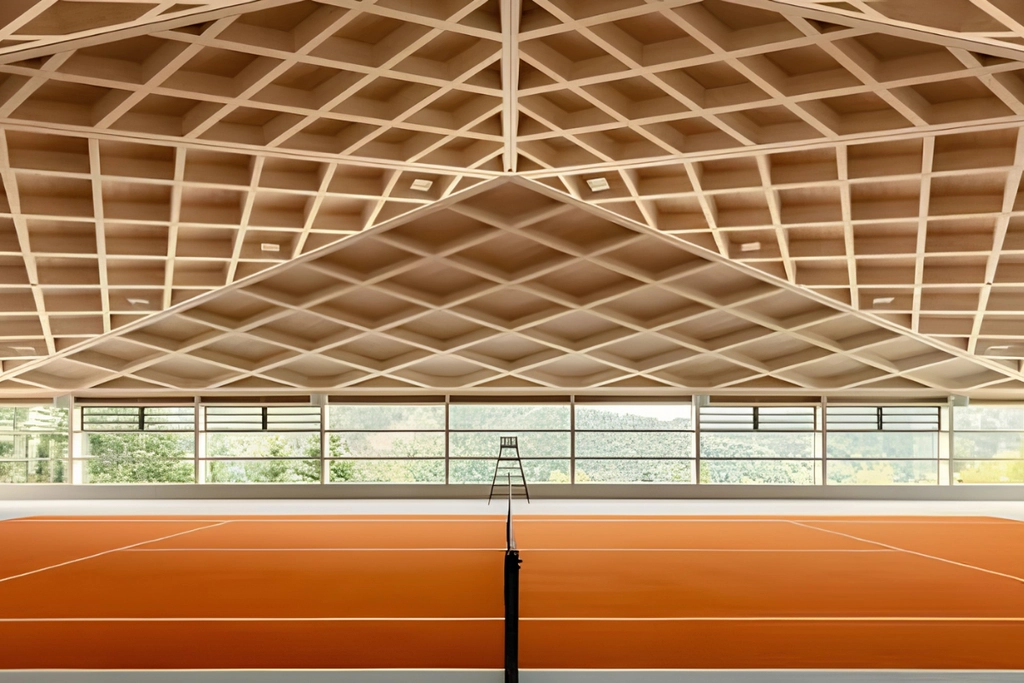
That roof does more than produce an impressive photograph. Large indoor tennis halls can feel industrial because they require uninterrupted width, significant height and strict control of lighting. The Diamond Domes turn those engineering demands into the principal decoration. Rather than concealing the span, the architects articulate every crossing member, allowing structure to become pattern.
Glass façades draw daylight and landscape into the halls, connecting the warm interior timber with views toward the surrounding valley and mountains. The vivid court surface therefore sits between two contrasting experiences of nature: the framed Alpine scenery outside and the abstracted wooden “crystal” above.
The wider complex was planned to keep service infrastructure visually recessive. Its clubhouse, bar, reception and changing areas were shifted underground, while delivery access and multi-level parking were concealed beneath the court zone so that traffic would not disturb players. Natural-stone façades help the building sit quietly within the historic resort rather than announce itself as an isolated sports centre.
Bürgenstock consequently offers the most explicitly architectural court in this group. Its beauty comes from neither coastal drama nor inherited glamour, but from the transformation of engineering into atmosphere.
Every serve activates the building visually. The ball rises toward the timber lattice, shadows move across the surface and the repeated roof geometry reinforces the rhythm of play. The court becomes a chamber for movement-part sporting facility, part contemporary Alpine pavilion.
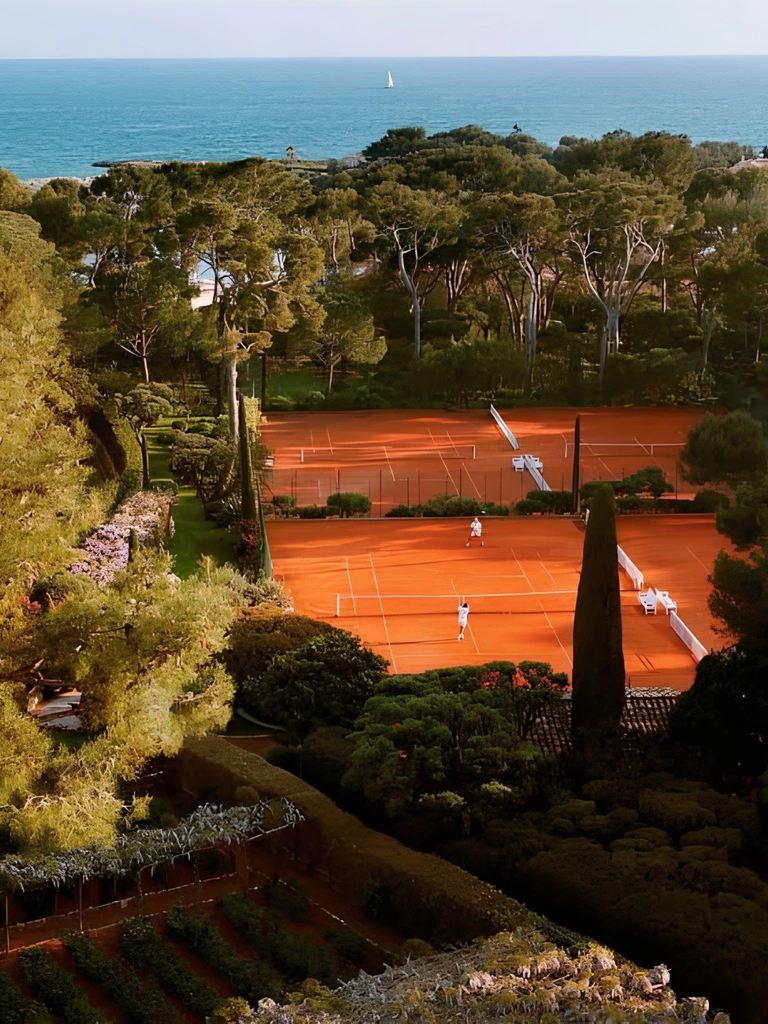
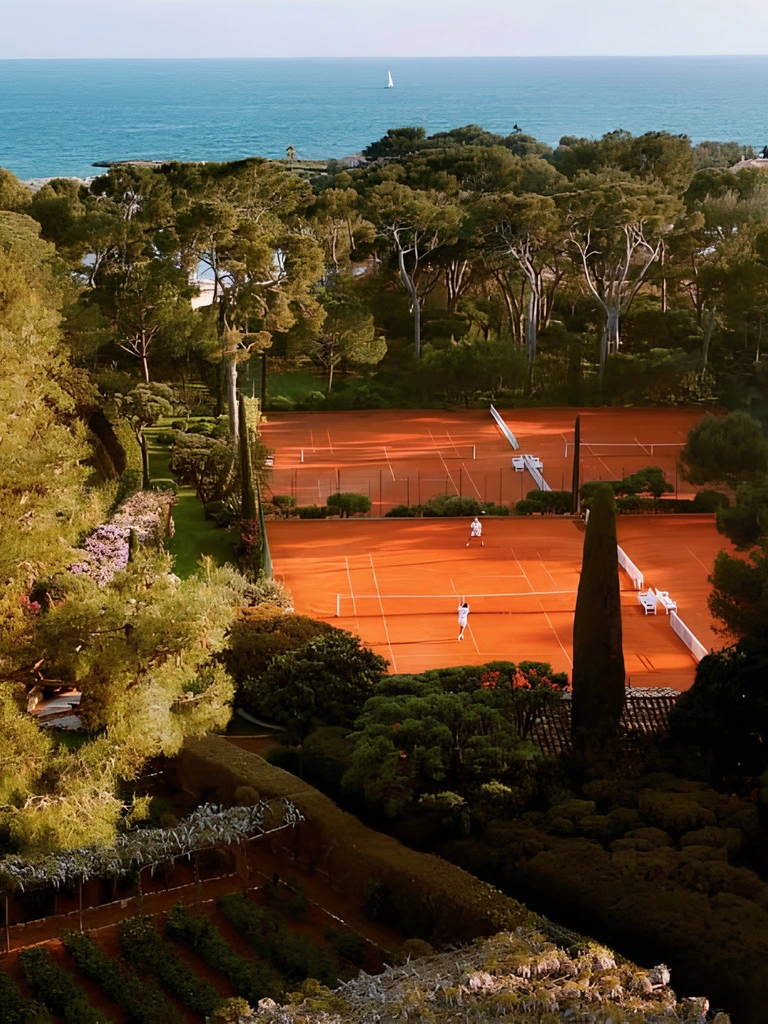
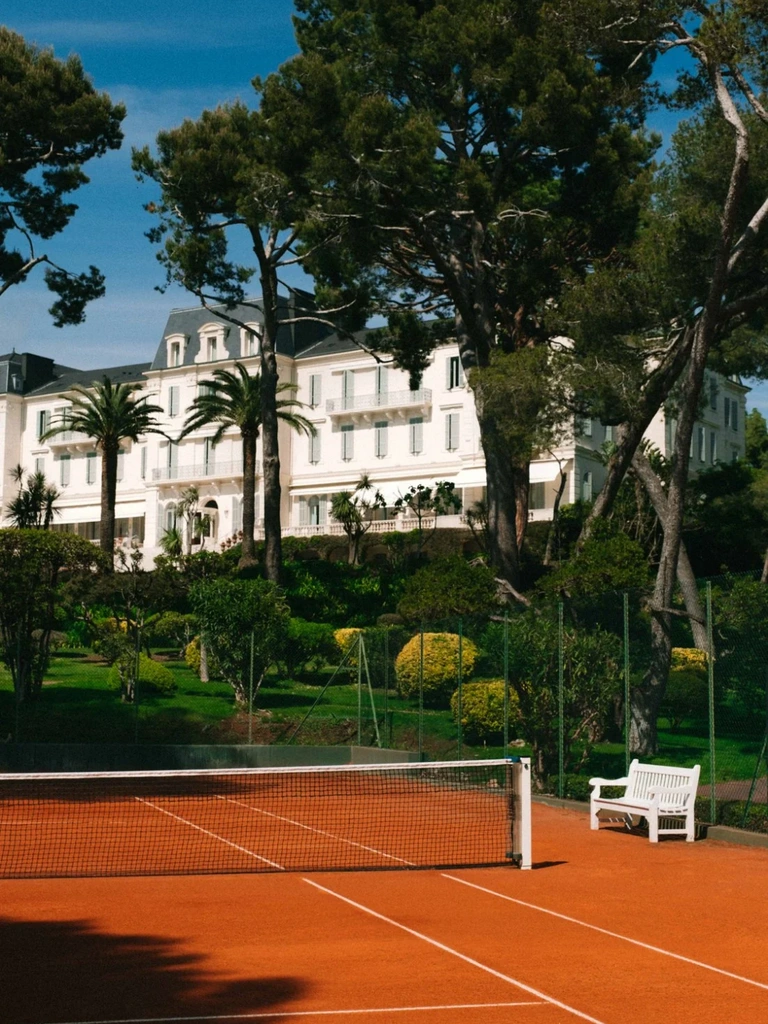
Hotel du Cap-Eden-Roc’s five clay courts are less radical as architectural objects. Their significance lies instead in how naturally they belong to a complete cultural landscape.
Set within the property’s grounds at the southern end of Cap d’Antibes, the courts are shaded by Aleppo pines, palms and olive trees. Certified coaching is available, but the setting encourages an understanding of tennis as part of a slower sequence of Riviera leisure rather than an isolated athletic appointment.
Red clay is essential to that mood. Unlike an immaculate hard court, clay records what happens upon it. Shoes leave traces, slides disturb the surface and the ball produces small marks before the court is swept and prepared again. It is a material that makes performance visible and maintenance ritualistic.
At Eden-Roc, its terracotta-red surface also belongs to the color language of the Mediterranean garden. It sits comfortably among dark pine trunks, silvery olive leaves and the saturated green of the grounds. Instead of confronting nature through bold contrast, the courts appear embedded within a cultivated landscape that has matured around them.
The hotel began as Villa Soleil in the late 19th century before developing into one of the French Riviera’s defining social addresses. Its identity was shaped by writers, artists, film figures and generations of seasonal guests, creating a form of luxury rooted in continuity and return. The luxury tennis courts participate in that history without needing to serve as monuments to it.
A morning match can flow into a swim in the property’s celebrated seawater pool, lunch beside the coast or an afternoon beneath the pines. The appeal is not efficiency but graceful transition. Sport becomes one chapter in a day whose pleasures are designed to overlap.
This distinguishes Eden-Roc from contemporary wellness resorts that treat every activity as a measurable program. Its courts preserve a more social vision of tennis: competitive enough to demand proper clay and expert coaching, yet relaxed enough to accommodate conversation, spectators and a long lunch afterwards.
Il San Pietro turns the court into a hidden coastal discovery. Eden-Roc makes it feel like something that has always belonged to summer.
The luxury tennis court associated with Singita’s Tanzanian properties is located at Serengeti House, an exclusive-use villa within Singita Grumeti, rather than at nearby Sabora Tented Camp. Singita describes the private court as being nestled among the region’s sweeping plains, creating an unusual setting for a family game or more serious competition.
Here, the court’s architectural importance comes from how little architecture it needs. There is no attempt to construct a large clubhouse, decorative canopy or visually dominant pavilion. The playing surface provides a familiar human scale inside a landscape whose dimensions are difficult to comprehend.
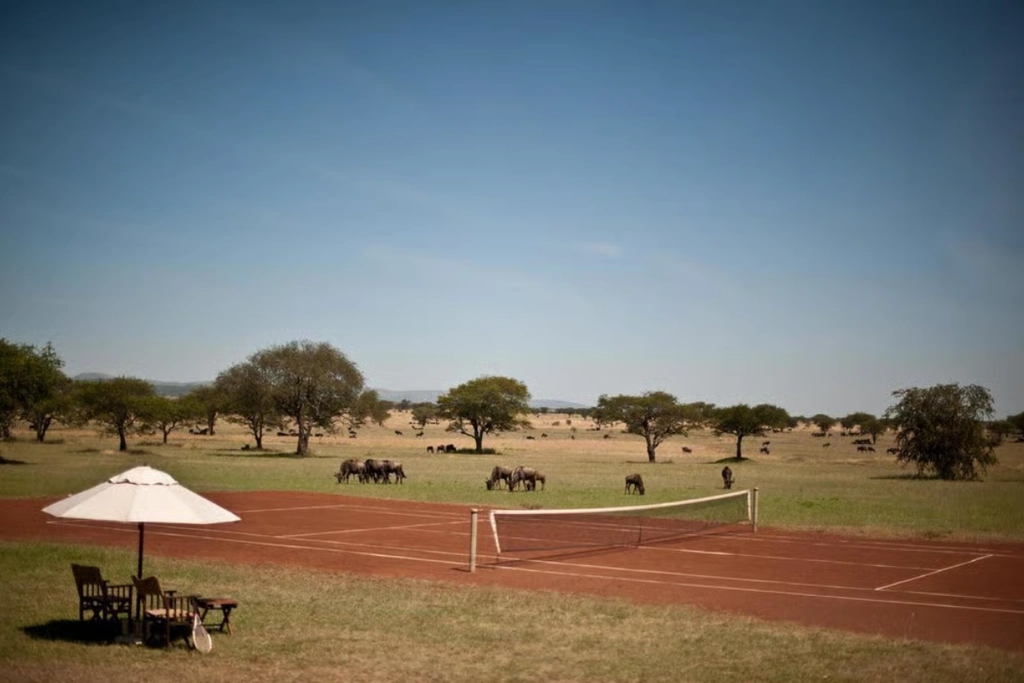
The white lines become especially striking because they represent absolute order against the organic variation of the grasslands. A court is normally large enough to dominate its immediate environment. In the Serengeti, it appears almost miniature.
Singita Grumeti lies adjacent to Serengeti National Park and forms part of the wider Serengeti-Mara ecosystem, through which the Great Migration moves. The protected landscape is defined by open plains, wildlife corridors and a hospitality model built around low guest numbers and close access to nature.
That context changes the meaning of luxury. At a traditional resort, exclusivity may be expressed through marble, elaborate service spaces or the separation of guests from their surroundings. At Serengeti House, privilege comes from exposure to the landscape and the scarcity of other people.
The court allows guests to perform one of the most familiar leisure rituals in an environment that refuses to become ordinary. Wind, shifting light and the possibility of seeing wildlife across the distant plains continuously challenge the visual boundaries of the match.
The experience should not be romanticized as entirely without control. It exists within a carefully managed private property and conservation landscape. Yet its design succeeds because that management remains visually quiet. The court appears as a temporary human diagram placed gently upon an ecosystem far larger and older than the game itself.
These four courts demonstrate that architectural significance does not require the same visual language.
Bürgenstock creates beauty through structural invention. Hotel du Cap-Eden-Roc relies on material tradition and social continuity. Il San Pietro turns a difficult coastal site into an act of intimacy, while Serengeti House makes the court almost disappear beneath the scale of its surroundings.
Their common luxury is specificity. None could be lifted from its present location and retain the same emotional force. Remove the limestone from Positano, the timber vault from Bürgenstock, the mature Riviera planting from Eden-Roc or the open plains from Serengeti House, and each becomes merely an excellent place to play tennis.
The finest luxury tennis courts therefore offer more than performance or spectacle. They translate a destination through movement. The player experiences the cliff while chasing a ball, looks toward the Alps between points, feels clay shift beneath a sliding foot or discovers how small a baseline appears beneath an enormous African sky.
In each case, the luxury tennis court remains governed by the same dimensions. Everything memorable begins where those white lines end.