Gold rescued from 1969, an Apollo inspired timer and an application resembling border control turned the Mission to the Moon 1969 into far more than another MoonSwatch.
Gold rescued from 1969, an Apollo inspired timer and an application resembling border control turned the Mission to the Moon 1969 into far more than another MoonSwatch.
July 21, 2026


With only 1,969 numbered pieces available, Swatch replaced overnight queues with a test of knowledge, patience and permission, transforming the act of buying a watch into a miniature lunar mission.
Since its 2022 debut, the MoonSwatch has thrived on the collision between two apparently incompatible ideas. Omega supplied the mythology of the Speedmaster, the first watch worn on the Moon, while Swatch translated that history into Bioceramic cases, quartz movements and relatively accessible prices.
The Mission to the Moon 1969, reference SSX01B700, alters that formula more substantially than its black case initially suggests. Announced on July 16, 2026, the chronograph commemorates Apollo 11 and the gold Speedmaster produced by Omega in 1969 to celebrate the mission’s success. Swatch restricted production to 1,969 individually numbered watches, making it the most tightly limited MoonSwatch release at the time of its introduction.
Scarcity forms only one layer of its attraction. The greater provocation sits within the case. Swatch placed a meaningful quantity of genuine precious metal inside a product line usually associated with playful affordability, then priced the watch according to the value of gold in 1969.
The result occupies an unusual position. It remains recognisably a MoonSwatch, yet its material story reaches closer to Omega’s historical world than any previous model in the collaboration.

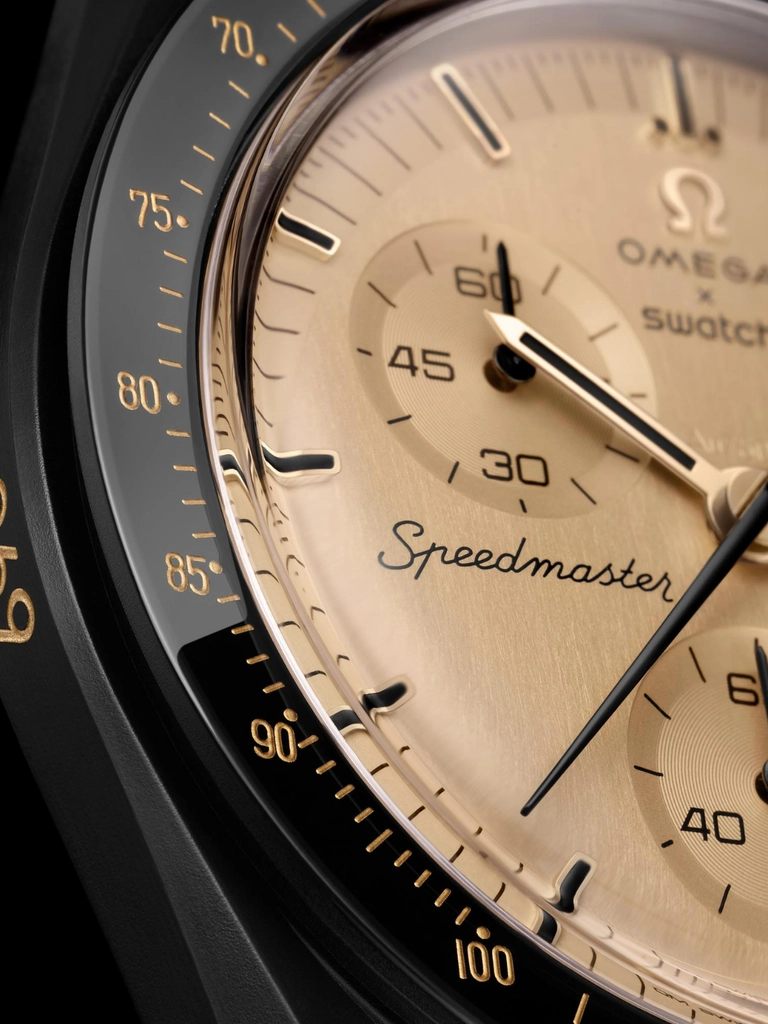
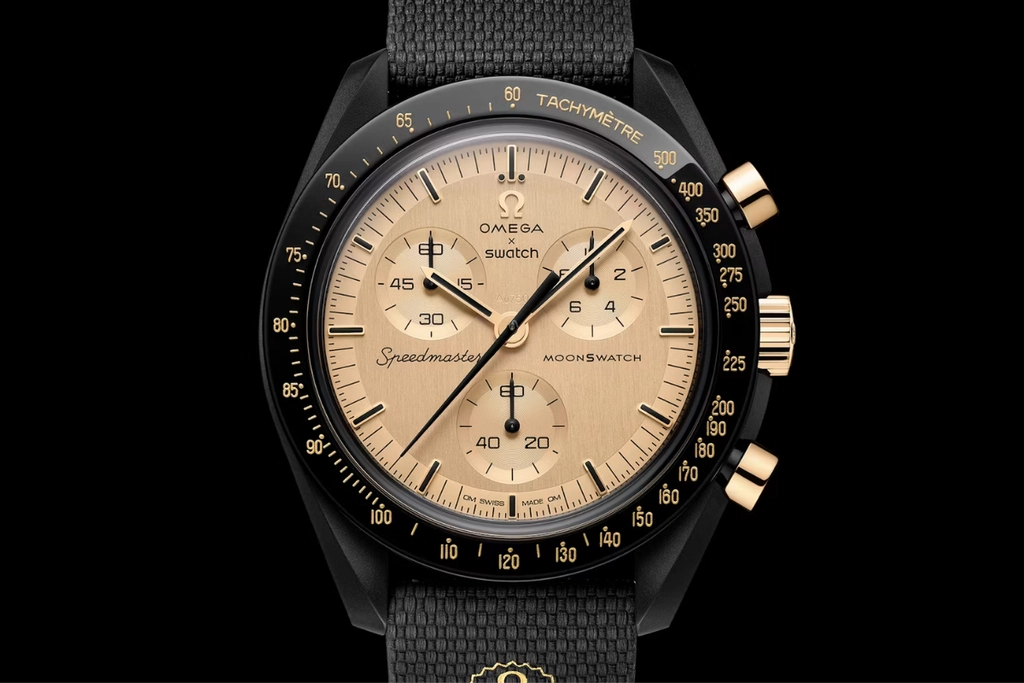
The dial, hands, crown and chronograph pushers are crafted from Omega’s proprietary 18K Moonshine Gold. Together, these components weigh exactly 11 grams, a deliberate reference to Apollo 11. This figure describes the weight of the 18K alloy rather than pure gold, but it still gives the watch a precious metal presence rarely encountered at its retail level.
The provenance makes those 11 grams more emotionally persuasive. According to Swatch, old Omega spare parts dating from the 1969 period were melted in the company’s own foundry and transformed into Moonshine Gold for this edition. The material therefore carries a physical link to the year of the Moon landing rather than functioning as a newly produced decorative accent.
Luxury watchmaking frequently speaks about heritage through design quotations, archival colours and revived reference numbers. The Mission to the Moon 1969 makes heritage materially present. Fragments from Omega’s past have been destroyed, refined and recast into a contemporary Swatch.
That act gives the watch an almost ceremonial quality. Original components lose their former identities, yet their metal survives inside a new generation of objects. History becomes something that can be melted, redistributed and worn.
The 42 mm case remains faithful to the proportions of the wider MoonSwatch family. It measures 13.25 mm thick, offers water resistance to 3 bar and houses a quartz chronograph movement. Matte black Bioceramic surrounds the gold, allowing the watch to retain the lightweight, slightly futuristic character that defines the collaboration.

Against that darkness, the Moonshine Gold dial carries a vertical satin finish inspired by Omega’s commemorative gold Speedmasters. Bevelled gold hour markers are filled with black lacquer, while vintage style Omega branding and period appropriate typography strengthen the connection to 1969. The dial also carries markings associated with its solid gold construction, including the “Au 750” designation.
The black Bioceramic bezel receives a glossy finish and a gold coloured tachymeter scale. Each limited edition number is engraved into the case at nine o’clock and filled with gold lacquer, turning the side profile into a quiet declaration of scarcity.
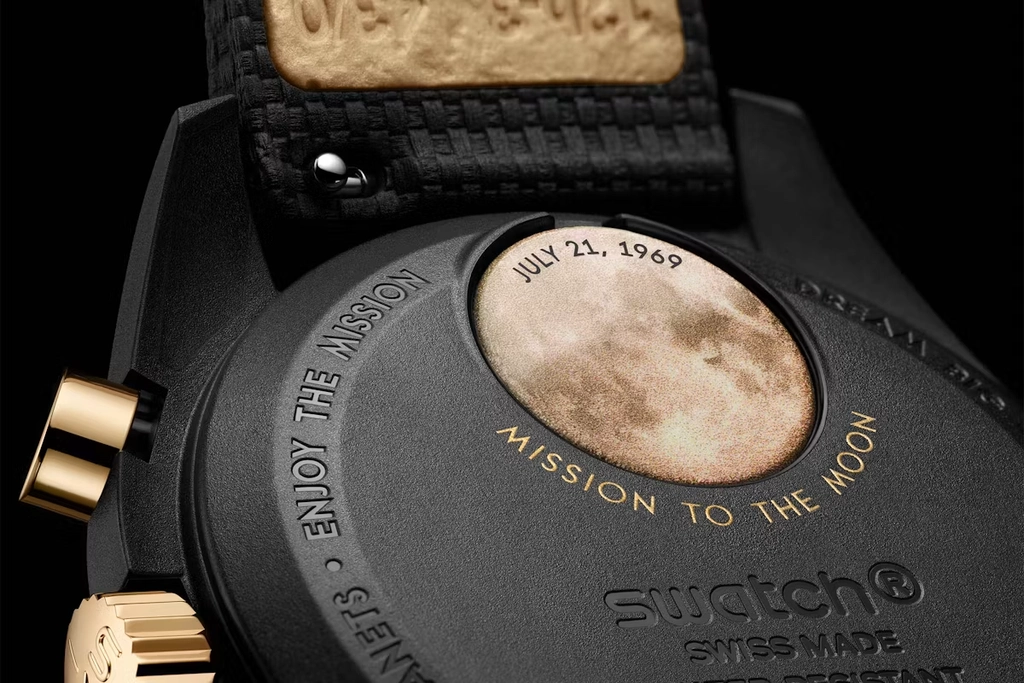
On the back, the battery cover depicts a golden Moon, a lunar footprint and the date July 21, 1969. The black rubber strap closes with Velcro and reveals a gold coloured lining textured to resemble the lunar surface. The detail remains largely hidden while worn, preserving one final piece of theatre for the owner.
Swatch priced the Mission to the Moon 1969 at CHF 500, with regional prices including US$570, £520 and €600. The figure was determined through a historical concept rather than a conventional calculation of contemporary precious metal value.
In 1969, Swatch states that 11 grams of 18K gold cost approximately US$11, or around CHF 48 using the period exchange rate. The company used the gold price from July 21, 1969 as the symbolic foundation for the new watch’s CHF 500 retail price.
At the time of the 2026 launch, watch publications estimated that the 18K gold content alone carried a melt value of slightly more than US$1,000. Melt value ignores manufacturing expenses, refining losses, taxes and the remaining components, yet the contrast remained extraordinary. A watch containing precious metal reportedly worth more than its complete retail price created an immediate sense of economic tension.
Swatch turned that tension into publicity. The price appeared generous, irrational and historically romantic at once. Collectors were encouraged to see the watch as an object temporarily protected from the present, sold under the imagined economic conditions of the Moon landing era.
Previous Swatch collaborations had become synonymous with physical drops, crowded pavements and customers waiting outside boutiques. The Mission to the Moon 1969 replaced stamina and geographical proximity with the Electronic Swatch Timepiece Application, abbreviated to ESTA in a playful reference to the travel authorisation used for entry into the United States.
The application window ran from July 16 at 3:32 pm CEST until July 21, 2026, at 11:59 pm CEST. Applicants first entered their personal details and selected the Swatch boutique where they would collect the watch if approved. They then faced 32 questions covering Apollo 11, space exploration, Omega, Swatch and horological history.
Swatch allowed exactly two hours and 15 minutes to complete the application. The duration referenced the amount of time Neil Armstrong and Buzz Aldrin spent conducting activities on the lunar surface, turning the countdown into another piece of Apollo themed storytelling.
Correct answers secured consideration rather than automatic success. An internal Swatch jury selected 1,969 participants from the pool of applicants who answered every question correctly. This distinction preserved an element of mystery after the knowledge test had been completed.
Approved applicants received a limited period to complete the transaction. Swatch gave each selected buyer 48 hours to purchase the watch online. Failure to pay within that period meant surrendering the allocation, allowing another qualified applicant to receive approval.
The system also kept one physical stage. Buyers had to collect the Mission to the Moon 1969 personally from the boutique selected during the application. A valid photograph ID or passport and the approved ESTA were required, while collection by another person was prohibited.
Swatch therefore created a hybrid release rather than a conventional online lottery. The application happened digitally, the purchase happened online and possession still required arrival at an authorised physical destination.
The structure combated automated purchasing and reduced the possibility of spontaneous boutique chaos. At the same time, it introduced a new collection of barriers. A potential buyer needed knowledge, time, correct documentation, access to a participating store and the ability to travel there.
Traditional MoonSwatch scarcity rewarded those willing to arrive early, stand in line and remain close to a boutique. ESTA transformed access into administrative friction. The body disappeared from the queue, yet effort remained central to the experience.
This represents a larger shift in luxury marketing. Many brands once created desire by withholding information and restricting supply. Digital culture has made secrecy harder to maintain, while automated purchasing has made ordinary online drops vulnerable to bots and professional resellers. The solution offered by Mission to the Moon 1969 was to make the route towards the product more complicated than the payment itself.
The questionnaire asked applicants to demonstrate literacy in the worlds supporting the watch. Apollo 11 history, Speedmaster mythology and Swatch knowledge became forms of social currency. Money remained necessary, though money alone could no longer open the door.
This model resembles permission based luxury. The customer expresses interest, completes a ritual, submits to evaluation and waits for approval. Acquisition becomes a temporary relationship with institutional authority.
The intellectual gatekeeping deserves closer attention. A collector with limited access to a physical Swatch boutique previously faced exclusion through geography. Under ESTA, a different hierarchy emerged. Familiarity with watch culture and space history increased eligibility, but the final jury process retained brand control.
The method rewards engagement, yet it also turns fandom into unpaid labour. Applicants spent time studying, answering questions and navigating a timed digital system without any guarantee of purchase. The object’s desirability grew through this investment.
That emotional mechanism is powerful. Once someone has completed 32 questions and waited for a verdict, the watch represents more than a commercial transaction. It becomes evidence of having passed through a selective process.
The Mission to the Moon 1969 therefore borrows from universities, immigration systems, private clubs and luxury waitlists. The applicant asks for admission. The brand decides who may proceed.
The watch’s greatest contradiction also defines its success. Swatch built its identity around accessibility, colour and democratic Swiss design. The Mission to the Moon 1969 turned that accessible universe into an examination available to only 1,969 winners.
Its CHF 500 price remained modest beside a solid gold Omega Speedmaster, while the application process created an exclusivity usually associated with far more expensive objects. Material generosity and administrative difficulty pulled in opposite directions, intensifying desire between them.
The watch also demonstrates how collaboration culture can mature. Another colour variation might have extended the MoonSwatch phenomenon briefly. Historical gold, numerical symbolism and the ESTA system gave this release a complete narrative structure. Every major element points towards 1969: the production number, the recycled Omega material, the 11 gram weight, the price logic, the application timer and the final lunar imagery.
With the Mission to the Moon 1969, Swatch sold more than a chronograph. It sold the experience of applying for history, waiting for clearance and earning permission to place a small piece of the Moon era on the wrist.