MENU
Close





Memory is rarely faithful, especially in fashion. Marni SS27 looks back just long enough for something familiar to surface, then shifts the proportion, cuts through the fabric and lets the recollection come back slightly wrong.
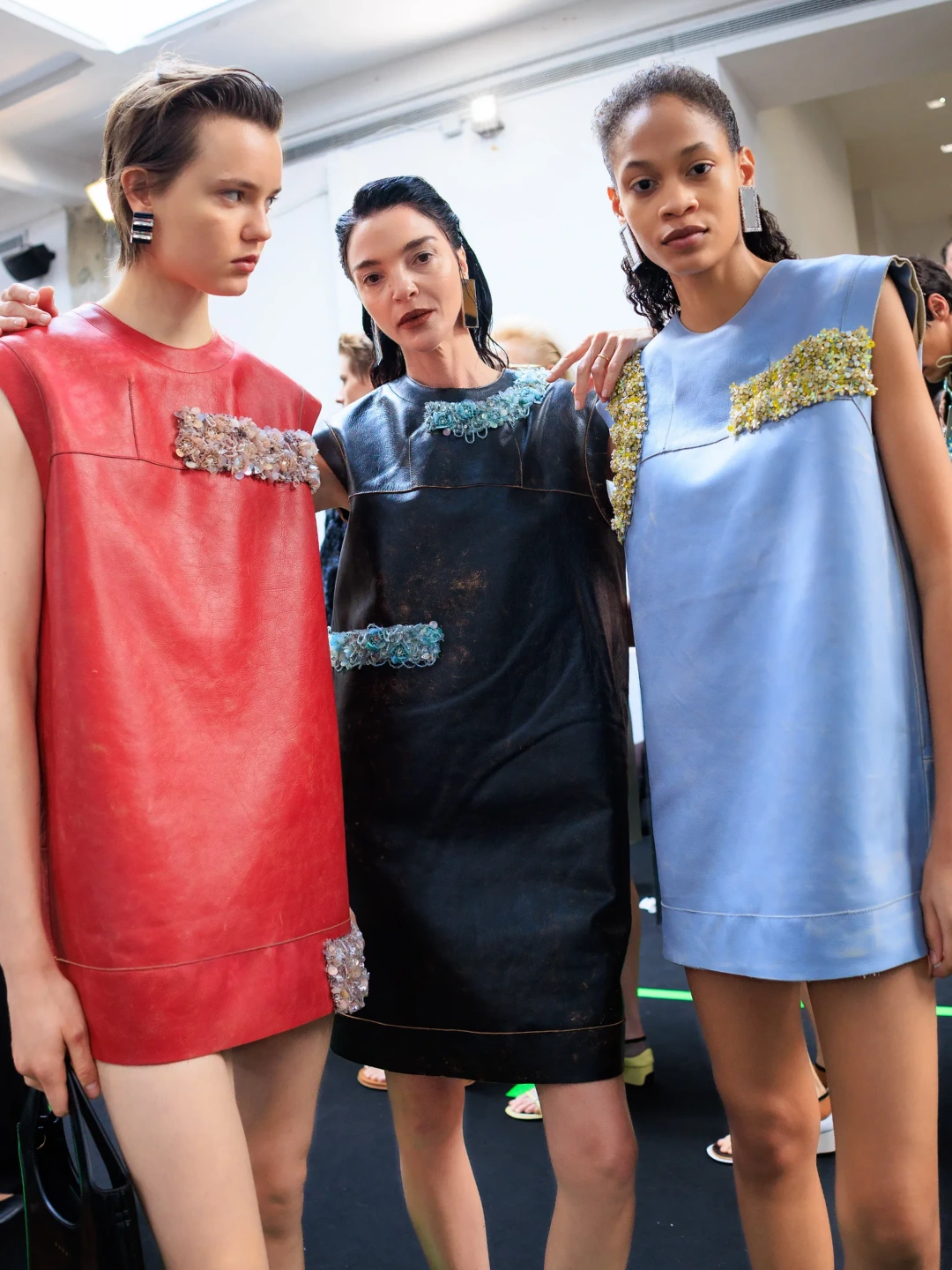
Memory is rarely faithful, especially in fashion. Marni SS27 looks back just long enough for something familiar to surface, then shifts the proportion, cuts through the fabric and lets the recollection come back slightly wrong.
September 27, 2026
Advertisement

Advertisement



Meryll Rogge entered Marni SS27 with an unusually delicate assignment. The house hardly needed another dramatic reinvention. Its appeal had always lived in something harder to manufacture on command: an instinct for colour, awkward proportion and clothes whose intelligence never announced itself too loudly. Her FW26 debut restored much of that everyday eccentricity, bringing Marni closer to the lived-in world that once made it distinctive. Spring 2027 picks up that conversation without treating continuity as obedience. It is Rogge’s second collection for the house, and the language already looks more willing to misbehave.
Something from the 1960s keeps flickering through the collection, although it never stays still long enough to become nostalgic.
Straight shift silhouettes and abbreviated hems carry the clean optimism of the decade, while graphic surfaces and oversized hardware recall an era fascinated by modernity and geometric clarity. Rogge herself acknowledged that the influence surfaced almost unconsciously, folded into a broader dialogue that also moved through the late 1990s and early 2000s.
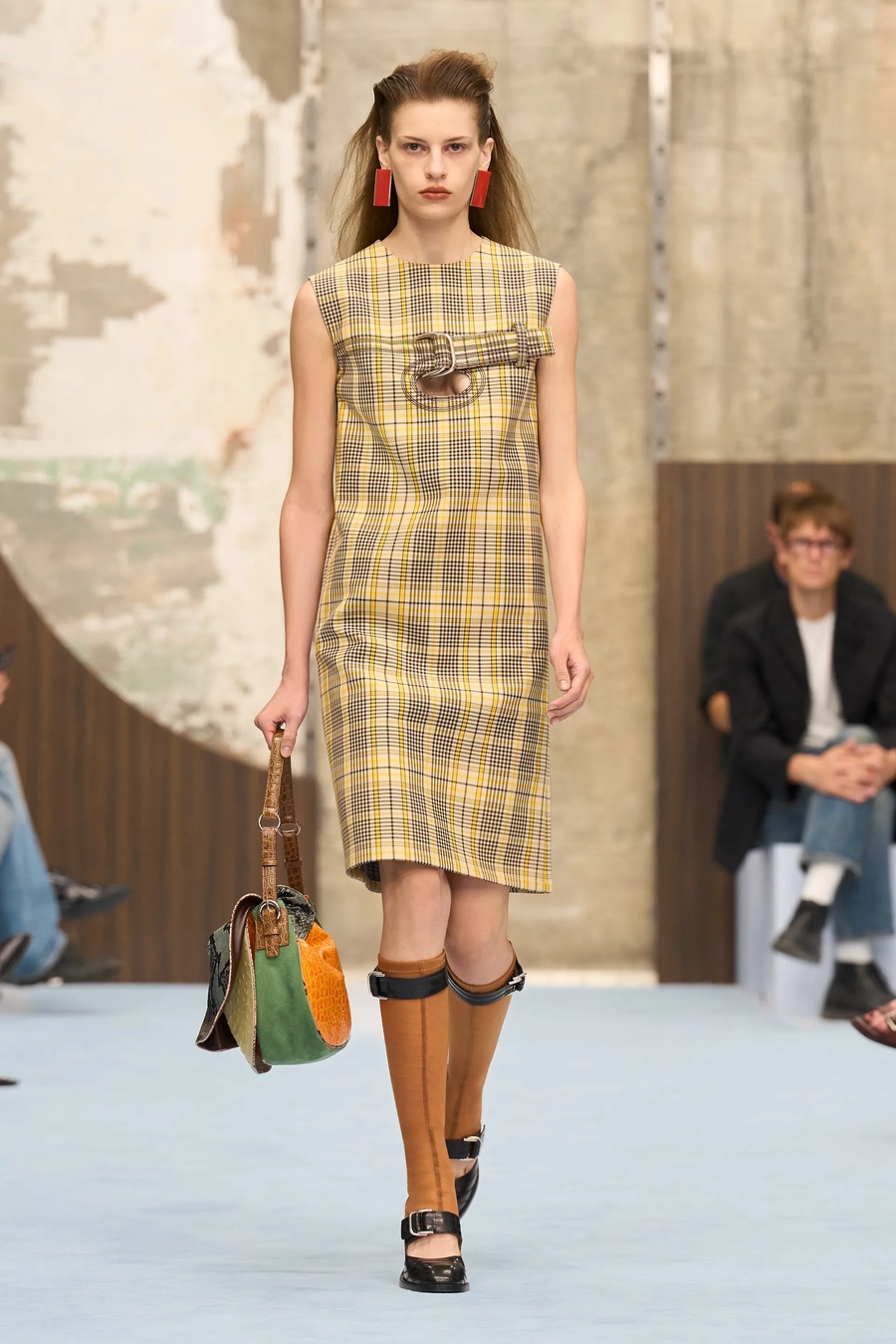



That lack of historical precision works in Marni’s favour. Clothes resemble memories rather than reproductions. Proportions drift away from period correctness; a buckle grows comically large, a familiar print becomes enlarged until its origin begins to blur, an otherwise prim silhouette is interrupted before it can settle into retro sweetness.


Fashion tends to remember decades through a handful of convenient images. The 1960s becomes the mini, the shift, the graphic print, the promise of a newly modern woman. Rogge takes those shorthand forms and subjects them to the unreliable logic of recollection. Something survives, something disappears, another detail returns on the wrong scale.
Marni SS27 does not need the decade intact. Distortion is more useful.
A perfectly reconstructed sixties dress would belong to history. Meryll Rogge leaves enough error inside the memory for it to belong to Marni.
Fabric begins disappearing in places where structure would normally remain concealed. Openings interrupt surfaces, linings appear outside their expected territory, and underwear construction migrates toward the exterior of the garment. Marni describes the collection itself through cutting away and looking beneath the surface, treating absence as a way of uncovering what was already present.
Skin naturally appears in the process, though seduction never takes full control of the image.
Cutouts in contemporary fashion often operate through an immediate economy of exposure: remove fabric, reveal body, produce sex appeal. Rogge uses absence with another curiosity. An opening might frame anatomy, but it also draws attention to the architecture surrounding it. The eye starts noticing where cloth has been joined, where an underlayer might have remained hidden, or how a familiar garment can change once one section is removed.

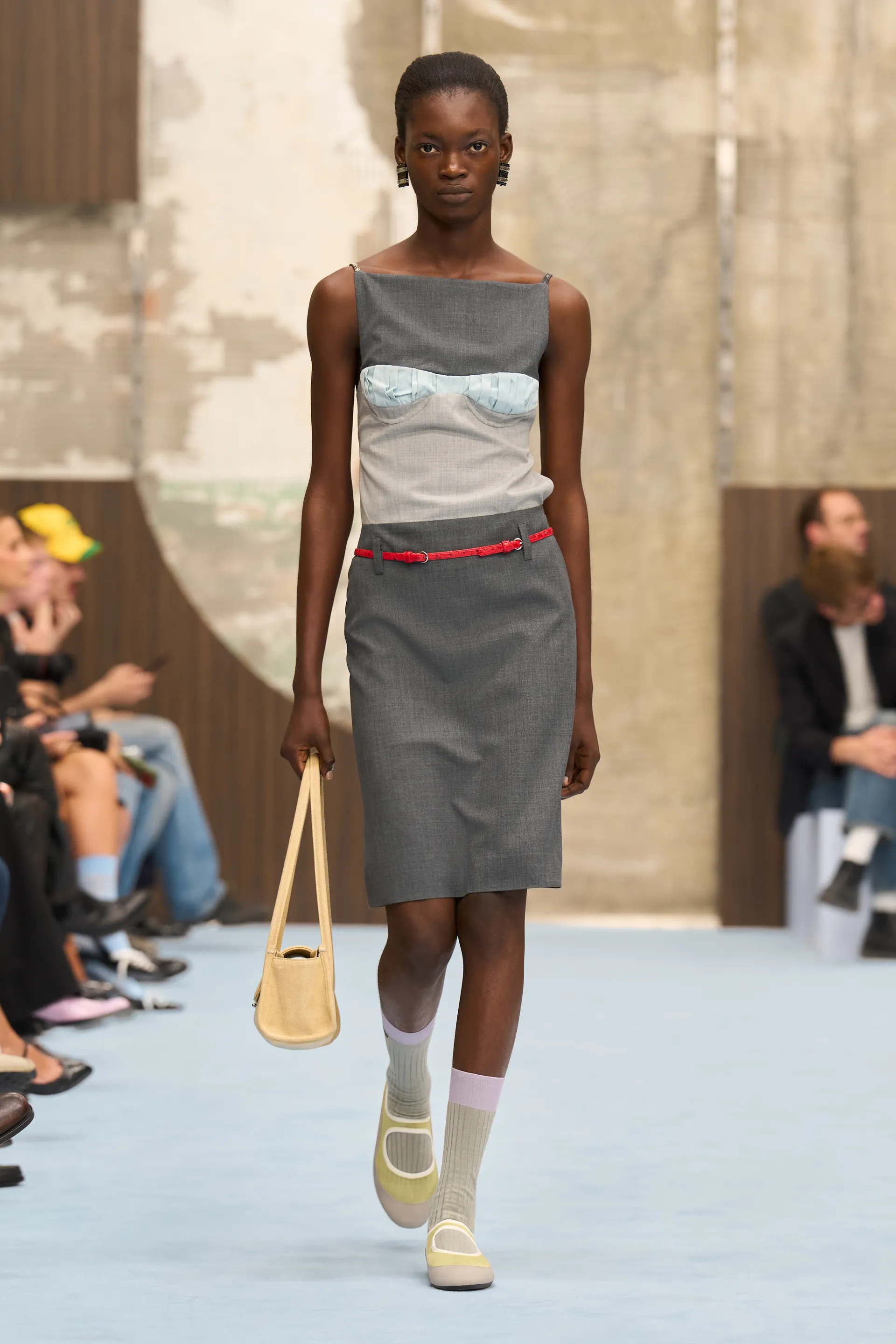
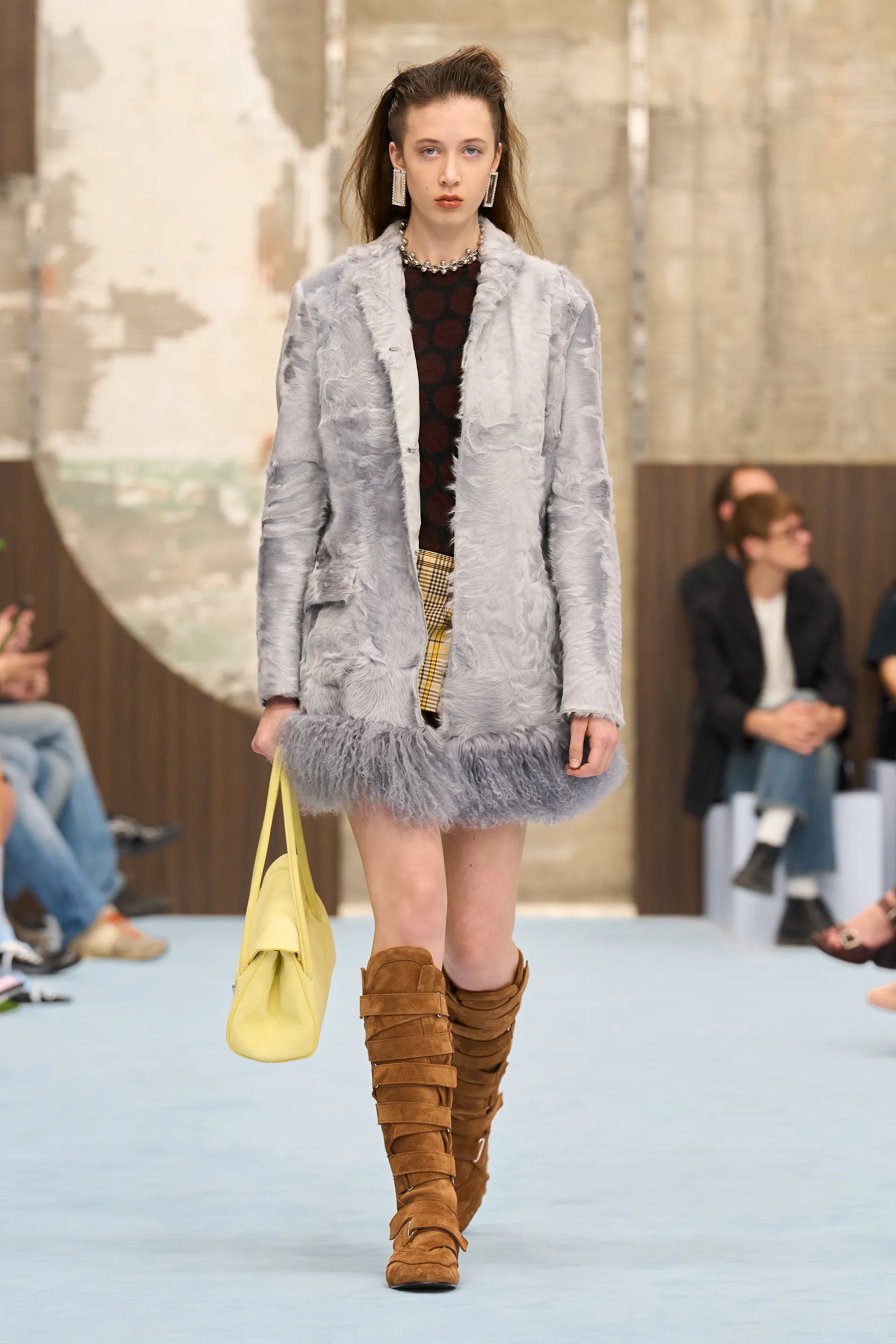

A brassière outline incorporated directly into clothing pushes the idea further. Something designed as support underneath becomes a visible line of construction. Interiors begin behaving like surfaces. Triple stitching and hardware perform similar work, allowing techniques usually treated as functional to participate in the image itself.
Rogge is effectively opening Marni without letting it fall apart.
Nothing appears to be collapsing dramatically at the seams. The garments remain controlled, often almost proper, while small acts of removal expose their logic. Meryll Rogge is exposing the garment so we can watch Marni think.
Marni has always known the charm of a silhouette that refuses to behave elegantly in the conventional sense. Volume can slump, widen or hang with an almost childlike directness, giving the body room rather than disciplining it into polish.
Rogge keeps that softness in the outline, then lets material argue with it.
Raw calfskin gives familiar sack-like shapes a harder physical presence. Surfaces that might have floated now hold themselves away from the body, while industrial stitching introduces visual firmness into forms that would otherwise read as gentle. The collection repeatedly lets softness and resistance occupy the same garment.
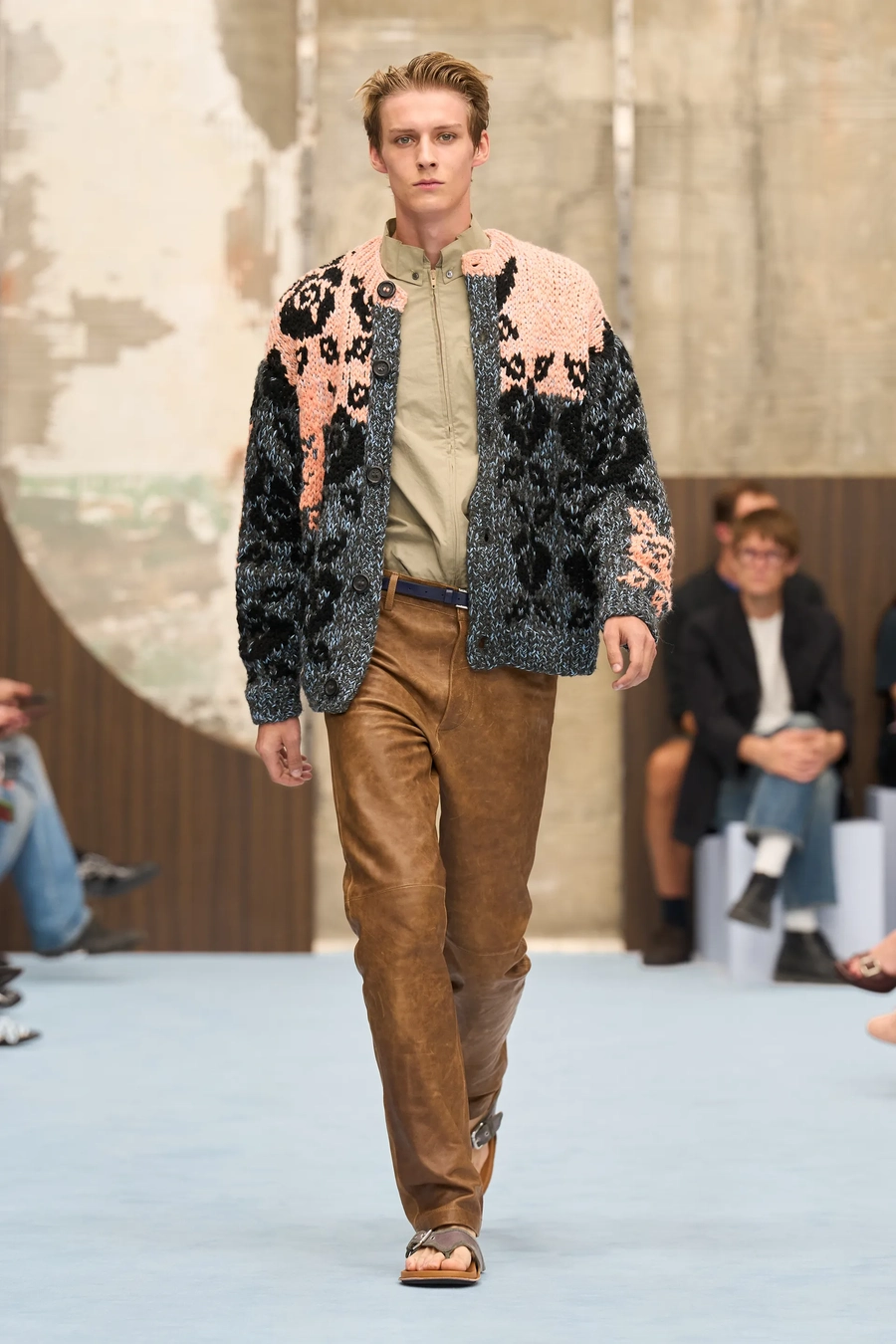

Meryll Rogge has little interest in turning Marni into severe minimalism, yet neither does she leave its eccentricity cushioned inside familiar tactility. Hardness appears as a corrective force. It gives the silhouette another backbone. The shift is subtle enough to avoid rewriting Marni as something colder than it is. Curves remain. Volume survives. Sensuality occasionally appears through an opening or a glimpse of skin. But surfaces interrupt any slide into prettiness.

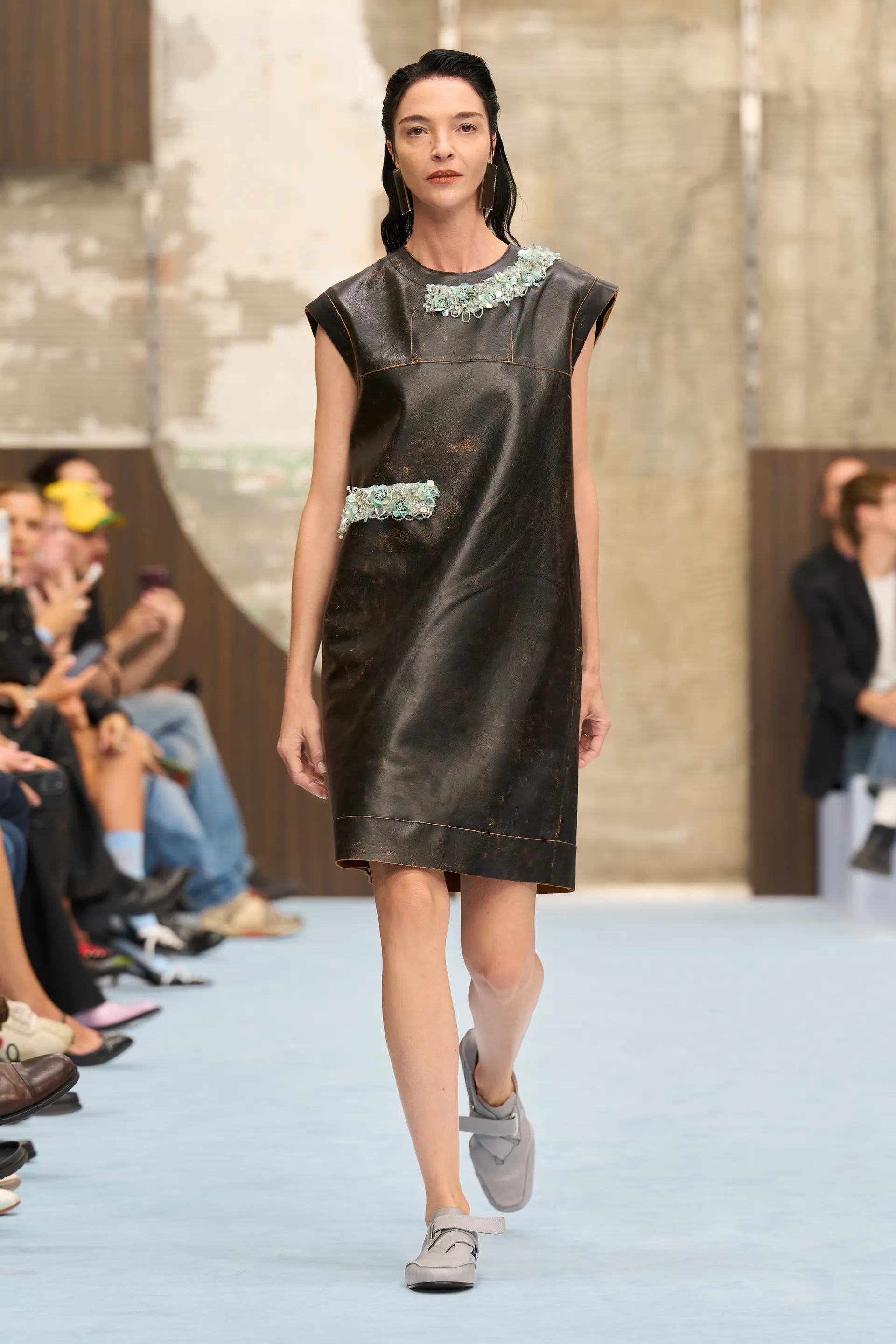
Marni has historically been generous with texture, colour and unusual combinations, so toughness here carries more interest when it arrives through material behaviour rather than visual aggression. Leather does not need to resemble armour. A dense surface can alter the emotional weight of a soft dress by itself.
Rogge keeps the silhouette tender, then refuses to let the material agree.
Taste becomes most interesting at Marni when it misses perfection by a few deliberate centimetres.
A trouser ends somewhere slightly unexpected. Sportswear pushes into tailoring without asking permission. Hardware expands beyond sensible scale. Preppy references lose their neatness once another proportion interrupts them. Sequins acquire eyelets, jewelry receives additional embellishment, and details migrate away from the places convention expects to find them.


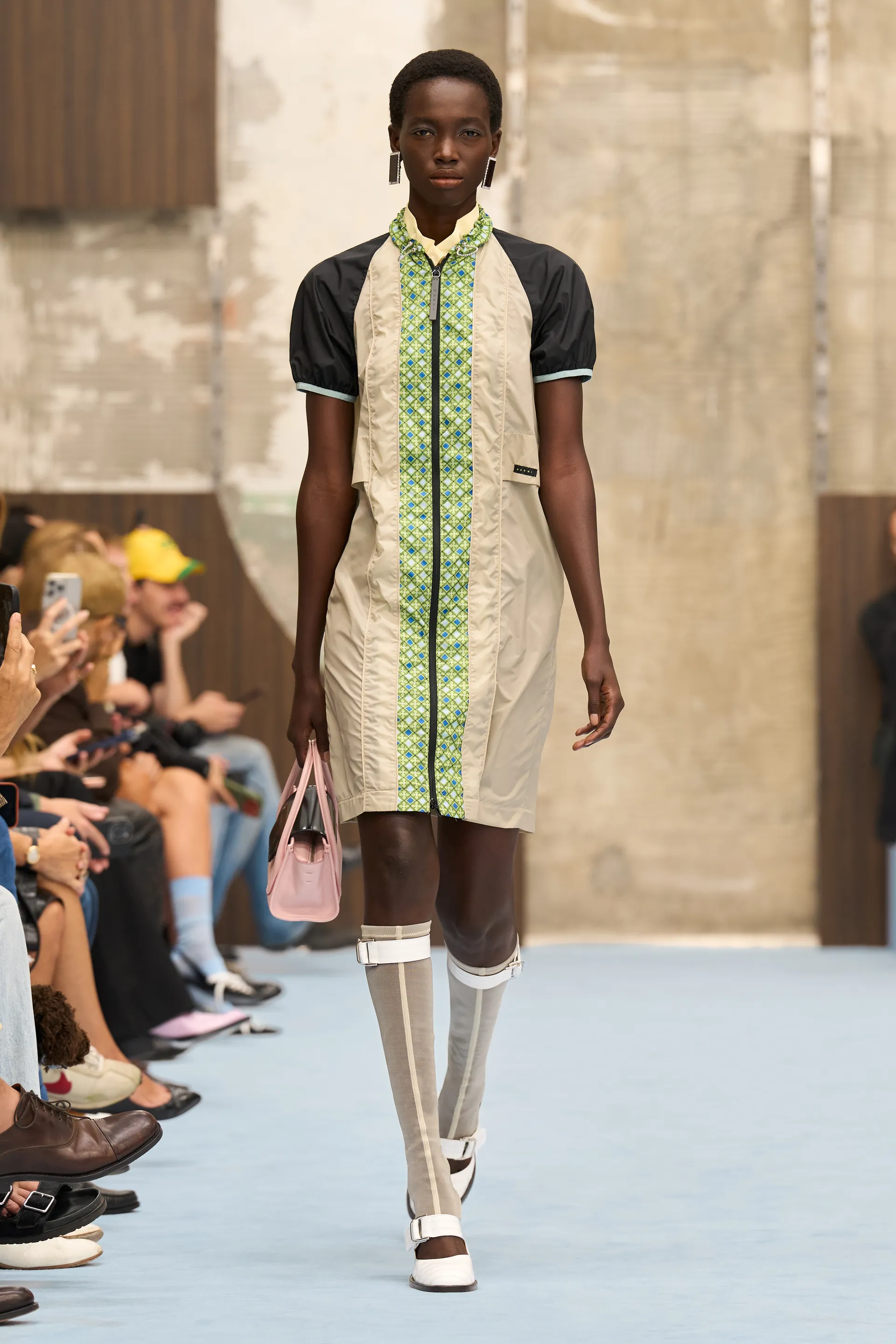

None of these gestures needs to become grotesque. Marni’s awkwardness has rarely depended on ugliness itself. Its seduction comes from the fraction of doubt introduced into good taste. Rogge seems particularly attuned to that threshold.
Distort every element and eccentricity becomes a performance. SS27 often stops just before either extreme, leaving one element in an outfit slightly uncooperative. The mismatch gives the eye somewhere to linger.


This quality also keeps the collection from becoming overly intellectual despite the amount of thought invested in construction. Clothes can be analysed through subtraction, scale or historical memory, yet many of their strongest decisions retain the immediacy of instinct. Something looks better because the buckle is absurdly large. A print becomes more Marni once it drifts away from being tasteful.
That instinct is enormously important for a house whose charm has always resisted perfect explanation. Too much theory around Marni would flatten the very strangeness that makes it pleasurable.
Good taste could make these clothes easier.
Marni has never needed it easy.
Two collections are enough to reveal instinct, but hardly enough to declare a definitive era.
Meryll Rogge has already solved one problem convincingly. Marni looks like Marni again without reading as an exercise in historical restoration. Its eccentricity has returned with sharper edges, and clothes carry enough friction to avoid the polished neutrality that so often follows a creative-director transition.
The next problem will be harder.
A designer can spend an early tenure proving respect for a house, especially one whose identity was shaped so distinctly before her arrival. Rogge has shown an impressive ability to select, edit and disturb those codes without making them unrecognisable. That sensitivity is currently one of her greatest strengths. Eventually, the same sensitivity could become protective.
Fashion usually grants new creative directors only a brief period in which fidelity is praised before authorship becomes the next demand.
Marni SS27 contains glimpses of a tougher, drier and slightly more industrial Marni that belong increasingly to her own hand. The temptation now should be to follow those disturbances further, even when they begin moving beyond what history already confirms as recognisably Marni.
Her first season proved she could hear the house clearly. Her second shows that she knows where to interrupt the sentence.
The real fascination will begin when Marni starts speaking with an accent we recognise as hers.
Advertisement