




At Shanghai Fashion Week SS27, a gangster's dinner table waited beneath red lights. The guests had arrived with some unfinished business.

Shanghai Fashion Week SS27: Ghosts in the Wardrobe
At Shanghai Fashion Week SS27, a gangster's dinner table waited beneath red lights. The guests had arrived with some unfinished business.
November 24, 2026


At Taiping Lake on October 12, a round restaurant table occupied the centre of the runway. The surrounding carpet glowed crimson, suggesting a scene borrowed from a Hong Kong gangster film. Nobody needed to explain the atmosphere. Even before the first model appeared, the room had acquired the uneasy intimacy of a private gathering where everyone knew something the audience did not.
The third instalment of Shanghai Fashion Week SS27 moved between Xintiandi and the experimental venues of Yongyuan Road on October 12 and 13. Following the previous days' examinations of creative storytelling and feminine identity, designers began reaching into cinema, literature and their own personal histories. Familiar cultural images acquired new physical forms, while the passage of time left increasingly visible traces of clothing.
SHAO Let the Gangsters Show Their Softer Side
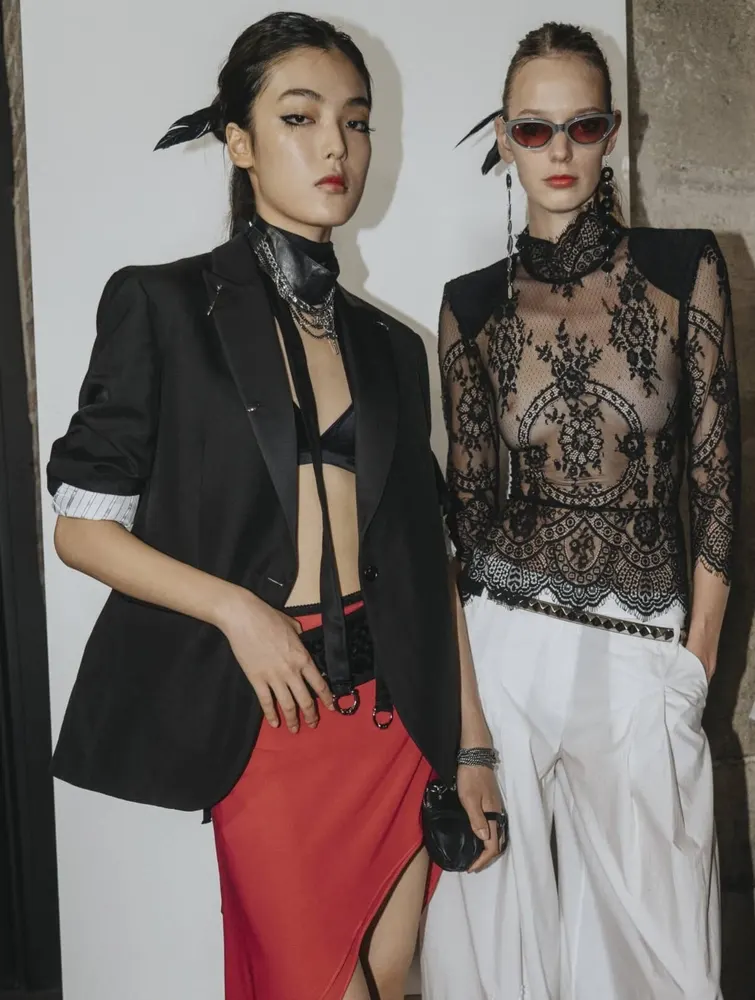
Shao Yang had already introduced Underworld Royale through an intimate performance at New York's Chinese Tuxedo restaurant. For its second chapter, Softness in the Shadows, she brought the atmosphere of 1990s Hong Kong gangster cinema to Shanghai, translating its familiar codes of masculine authority into a wardrobe charged with sensuality.
Pinstriped waistcoats exposed bare backs, while cropped blazers revealed lingerie beneath their tailoring. Prince of Wales checks appeared across asymmetric three-piece suits, joined by wrapped shirts, satin skirts and softened leather. Coated denim jumpsuits preserved the harder edges of the criminal underworld, although their construction encouraged unexpected fluidity.


Yang's background in made-to-measure tailoring gave the collection a valuable foundation. She could disturb conventional menswear proportions while preserving the technical discipline that made those references recognisable. The exposed backs were particularly effective, introducing vulnerability into garments traditionally associated with authority and protection.
The gangster references were deliberately cinematic, yet the designer's upbringing between Taipei and Brooklyn gave the collection a personal dimension. Hong Kong films became part of a visual memory connecting different cities and cultural experiences.
The collection's strongest proposition emerged through its treatment of masculine confidence. Yang allowed those familiar codes to accommodate sensuality without losing their structural presence. The result suggested an underworld where vulnerability might be an equally convincing form of power.
OUDE WAAG Found Beauty in What Remains
Jingwei Yin approached the runway with an unusually intimate subject. Following a difficult period in his personal life, the designer developed OUDE WAAG's Spring/Summer 2027 collection around the experience of living with loss and the gradual changes that accompany emotional recovery.
The garments carried this tension through their construction. Sharp tailoring encountered liquid draping, while washed surfaces suggested materials altered by time. Chiffon floated around controlled silhouettes, with knots and twisted fabric introducing irregularity into otherwise disciplined compositions.
Yin's interest in Chinese ink painting also appeared through prints inspired by the pomo technique, allowing spontaneous marks to interrupt the precision of the clothing. Browns and muted greys established a subdued palette before flashes of crimson introduced an unexpected intensity.


His experience working with Haider Ackermann remained evident in the attention given to the relationship between tailoring and drape. Yet OUDE WAAG's approach possessed a distinct emotional restraint. The garments acknowledged the conflicting impulses of concealment and exposure, allowing their construction to communicate in a complicated psychological state.
Particularly convincing were the pieces where fabric appeared caught between holding its shape and surrendering to gravity. Those contradictions provided a visual language for experiences that resist tidy resolution.
Yin's collection was a thoughtful reminder that fashion's relationship with memory can extend beyond historical references and cultural nostalgia. Sometimes the past remains present because the body has yet to discover how to carry it.
GIOIA PAN Took Gotham Into the Atelier
Gotham City has rarely been associated with the delicacy of knitwear. Yet Taiwanese designer Pan Yi-Liang found an intriguing relationship between the DC universe and her expertise in textile construction for Nocturnal Textures, developed in collaboration with Warner Bros. and DC.
Batman and the Joker provided familiar visual references, while the collection explored the psychological contradictions associated with the fictional city. Knitted fabrics encountered structured woven materials, with asymmetrical arrangements and contrasting surfaces introducing tension into the silhouettes.
Pan's technical expertise remained essential to the collection. The elasticity of knitwear allowed garments to follow the body, while firmer materials established controlled architectural shapes. The contrast created an opportunity to translate comic-book imagery through construction rather than relying entirely on recognisable graphics.


The collaboration also raised questions about how effectively established intellectual properties can contribute to an independent designer's creative development. Batman already possesses a powerful visual identity, making his symbolism immediately accessible to audiences. The risk emerges when that recognition becomes the primary source of a collection's appeal.
GIOIA PAN's strongest proposition lay in the relationship between softness and protection. Her familiar knitwear techniques offered a physical interpretation of the superhero's armour, suggesting that vulnerability and strength could inhabit the same garment. The results were convincing wherever that tension emerged through material and silhouette.
SHETELLS Let the Phantom Return
Forty years after The Phantom of the Opera premiered in London's West End, its theatrical universe found another stage at Shanghai Fashion Week. SHETELLS collaborated with the celebrated musical for Opera Legacy, exploring the relationship between performance, identity and the emotional significance of clothing.
The runway drew inspiration from the Phantom's subterranean lake. Blue lighting illuminated weathered architectural surfaces and classical columns, establishing an atmosphere suspended between the theatrical and the real.
Within that setting, SHETELLS developed garments around architectural tailoring and flowing fabric. Defined silhouettes softened through movement, while subtle variations in texture and surface reflected the shifting illumination. The designer's established interest in creating space between clothing and the body remained central to the construction.


The collection approached theatrical costume through a contemporary wardrobe vocabulary, allowing suggestions of drama to emerge from proportion and material. Its most effective gestures were also its most restrained, particularly where the movement of fabric conveyed something of the musical's emotional intensity.
Yet an association with such a recognisable theatrical production creates demanding expectations. The Phantom's imagery already exists within a remarkably complete aesthetic universe, from its elaborate costumes to the familiar atmosphere of its stage design.
SHETELLS found an interesting direction in treating those references as an emotional foundation. The challenge was to establish a visual identity capable of retaining its significance once the theatrical surroundings disappeared.
Short Sentence Had Somewhere Else to Be
On October 13, the atmosphere shifted towards the ordinary rhythms of urban life. Short Sentence approached its Spring/Summer 2027 collection through the experience of moving between cities, considering how familiar clothing accompanies people into unfamiliar environments.
Designer Guan Lin developed the collection around the accumulated memories of contemporary travellers. Previous homes, relationships and everyday experiences continued to influence the individual, even as their surroundings changed.
Relaxed shoulders and generous proportions established an unforced silhouette, while checks and stripes introduced familiar wardrobe references. Bright colour combinations interrupted otherwise practical arrangements, and layered separates suggested clothes assembled through the natural decisions of daily life.

The styling conveyed a sense of movement, as though the garments had been selected from a wardrobe gradually accumulated across different circumstances. That impression aligned with Short Sentence's established focus on everyday dressing.
The collection's appeal rested on its treatment of familiarity. Shirts, jackets and relaxed separates offered recognisable starting points, while their proportions and combinations introduced a personal character.
Such an approach requires particular precision. Without the immediate impact of dramatic construction or elaborate embellishment, seemingly ordinary garments must establish their distinction through cut, fabrication and styling.
Short Sentence's exploration of urban migration offered an appealing perspective on contemporary dressing. Clothes become companions through repetition, gathering personal significance as their owners move through different stages of life.
花木深 Followed the Wind Through Ancient China
An invisible current travelled through the garden-inspired presentation of 花木深, whose collection Following the Wind drew upon the Tang dynasty poet Li Qiao's Wind. The poem's observations of nature provided the starting point for garments designed to capture movement through intricate textile decoration.
The designer translated changing landscapes into embroidered surfaces, incorporating references to rustling leaves, rippling water and shifting vegetation. Traditional Su embroidery appeared alongside elaborate beadwork informed by techniques associated with Lesage, giving the garments a richly textured appearance.
Historical decorative motifs extended the collection's cultural vocabulary. References to ancient pottery and bronze mirrors entered the designs, connecting botanical imagery with artefacts from different periods of Chinese history.


The presentation employed a pavilion-inspired installation, introducing an architectural environment associated with traditional encounters between landscape and poetry.
The collection's ambitious craftsmanship demonstrated the continuing appeal of historical textile techniques. Its most compelling possibilities emerged when decoration responded to the garment's movement, allowing the fabrics to suggest the changing forms of the natural world.
Yet the elaborate visual language also revealed a familiar challenge for contemporary interpretations of Chinese heritage. Historical references can lend a collection immediate cultural authority, while their decorative richness sometimes overshadows the designer's individual perspective.
For 花木深, the next creative opportunity may lie in allowing the invisible qualities of its inspiration to become increasingly important. Wind is experienced through its effects, and the relationship between fabric and movement offers possibilities extending well beyond ornament.
The Cost of Looking Back at Shanghai Fashion Week SS27
A familiar character arrives with an audience already waiting. Batman needs little introduction, while the Phantom's theatrical world has accumulated decades of cultural recognition. Even a centuries-old literary masterpiece carries an established emotional vocabulary, inviting audiences to approach its reinterpretation through memories formed long before the runway presentation begins.
For independent designers, such familiarity offers an undeniable advantage. Building recognition requires substantial financial and creative investment, while established cultural references can provide immediate access to an audience's imagination. Nostalgia has become an increasingly valuable resource within contemporary fashion, capable of connecting commercial interests with the appearance of artistic depth.
Yet memory also possesses a commercial dimension that deserves scrutiny. When designers repeatedly return to beloved films, iconic characters and historical aesthetics, the creative process risks becoming dependent upon their existing cultural authority. The audience arrives already prepared to recognise the reference, leaving the clothes themselves with the comparatively modest task of confirming its appeal.
The distinction becomes especially apparent when personal experience enters the conversation. OUDE WAAG's exploration of grief and Short Sentence's reflections on migration demonstrated how memories can shape clothing through lived experience. Their designs drew upon emotions that resisted immediate recognition, asking the garments to establish meaning through construction and wear.
Perhaps that is where Shanghai's independent designers possess their greatest opportunity. Their cultural inheritance is extensive, but its most valuable contribution to contemporary fashion need not be the preservation of familiar imagery. History becomes creatively significant when designers are willing to disturb it, challenge its authority and expose the contradictions that nostalgia tends to conceal.
The past can offer an extraordinary wardrobe. The danger begins when fashion becomes so comfortable wearing yesterday that it loses the courage to imagine tomorrow.