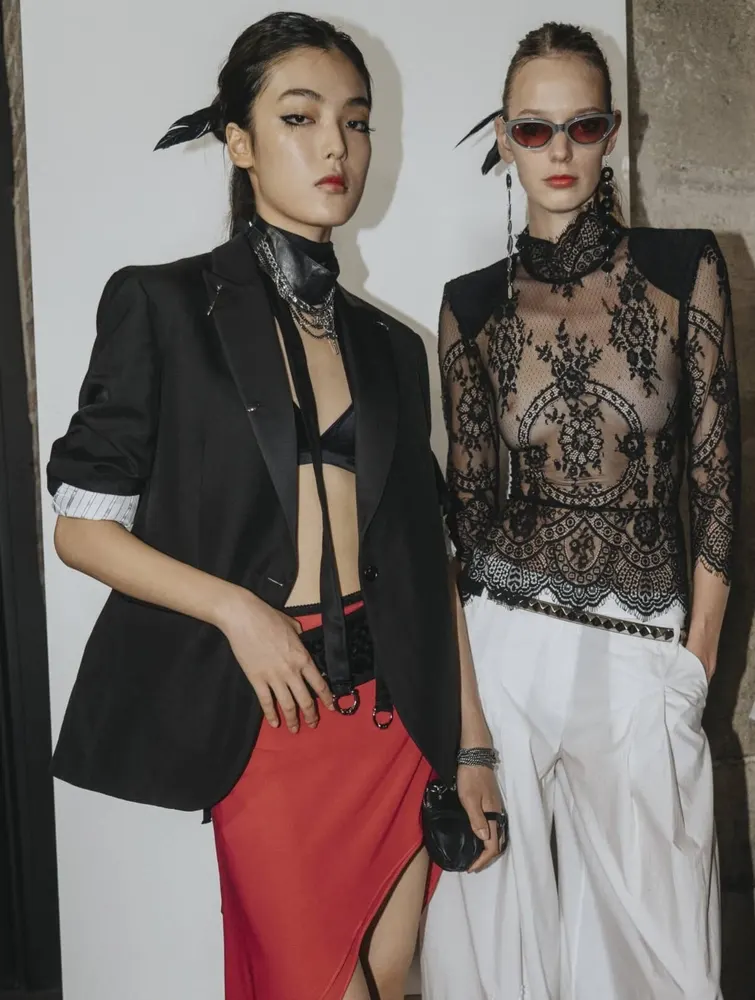





From financing collections to opening doors overseas, Musinsa has transformed a sneaker community into one of Korean fashion's most unusual businesses.

How Musinsa Built a Kingdom of Korean Labels
From financing collections to opening doors overseas, Musinsa has transformed a sneaker community into one of Korean fashion's most unusual businesses.
November 23, 2026


A beautiful collection can disappear long before anyone discovers it. Somewhere between the last fitting and the first delivery, a factory demands payment, fabric suppliers send their invoices, and a young designer discovers that having good clothes is an entirely separate accomplishment from having the money to manufacture them. The industry has traditionally left this rather unpleasant chapter out of its romantic accounts of emerging talent.
Musinsa made a business out of reading precisely that chapter.
Founded in 2001 as an online sneaker community by Cho Man-ho, Musinsa developed into a commercial institution that reported approximately ₩5 trillion in gross merchandise value in 2025, with consolidated revenue of ₩1.47 trillion and operating profit of ₩140.5 billion. Those figures describe different measures of activity: the marketplace's transaction value is substantially larger than the revenue Musinsa recognizes itself.
The Musinsa Retailer That Became a Bank
The factory has little interest in whether a collection will become popular next month. Wages, equipment, materials and production schedules require payment today. For a small fashion company, financing that interval between manufacturing and eventual sales can determine whether an otherwise promising business survives.
In 2015, Musinsa introduced its Partner Fund Program, offering interest-free production financing to eligible labels operating within its ecosystem. Initial annual funding amounted to ₩3.2 billion. By September 2025, cumulative support had reached ₩409.5 billion, with an annual average of roughly ₩84 billion distributed during 2022–2024.

The program subsequently developed separate incubation, growth and core funding categories, addressing businesses at different stages of commercial development. Its underlying attraction is easy to understand: a designer with insufficient working capital can obtain assistance producing the merchandise that Musinsa hopes to sell. The cumulative funding figure represents support provided over time, rather than grants or an ownership investment of the same amount.
Consider COOR, the Korean contemporary label recognized for its restrained tailoring and relaxed outerwear. The company has received Musinsa production funding since 2021, while Musinsa Partners separately invested in the business and provided professional assistance with its financial and accounting systems.

Production financing helps garments reach the factory floor; venture investment can provide longer-term capital and involve equity ownership. Musinsa operates through both arrangements, with its investment arm reporting approximately ₩100 billion invested across more than 80 brands by October 2026.
The retailer has begun participating in the economics of a collection before the first customer can purchase it. Musinsa's interest in a designer's commercial success therefore extends beyond the familiar act of placing an order or collecting a marketplace commission.
Musinsa Has Discovered the Value of Small Designers
Years before the investment funds and sophisticated commercial operations, Musinsa possessed something Korean independent labels desperately needed: an audience interested in clothes beyond the established department store assortment.
Its early community assembled enthusiasts who photographed their outfits, discussed sneakers and followed emerging streetwear labels. Covernat and thisisneverthat were among the brands associated with Musinsa from the marketplace's early years. Both subsequently appeared within Musinsa Partners' investment portfolio, although their independent creative histories cannot simply be credited to the retailer.


The relationship has developed into an unusually close connection between consumer attention and commercial decision-making. Shopping activity generates information about demand, purchasing patterns and customer reactions. Musinsa can use its understanding of the market when deciding which businesses to support and how to present their merchandise.
In an interview published in The State of Fashion 2024, Musinsa discussed an approach resembling digital content platforms that support creators while providing access to audiences. It is a compelling analogy, with one rather inconvenient physical complication: a sweatshirt requires fabric, labor, storage and shipping before it can generate revenue.
Musinsa has also developed creator-marketing services to connect participating brands with fashion content creators, adding another commercial function to its relationship with designers. Instead of leaving a small label to finance every campaign and independently assemble its audience, the platform can connect product discovery with shopping activity.

For Covernat or thisisneverthat, a recognizable design identity remains essential. Musinsa supplies access to a distribution environment where that identity can reach customers at scale. Its influence resides partly in the allocation of commercial attention, a resource that becomes more consequential as thousands of competing labels enter the same marketplace.
From Internet Favorite to Department Store Tenant
COOR's commercial history contains an instructive complication for anyone tempted to dismiss online fashion as temporary popularity. The label developed a strong digital following and subsequently expanded into Korean department stores, taking the practical demands of inventory planning, merchandising and established retail partnerships into another setting.
Musinsa's published account of COOR describes both investment support and professional management assistance. The company also developed a reputation for maintaining its positioning without relying heavily on indiscriminate discounting, even when participating in important shopping promotions.

The process reveals how a fashion business matures beyond the initial excitement of discovery. Customers begin expecting consistent sizing, dependable product quality and enough inventory to satisfy demand. A brand's identity must survive repeated commercial encounters, including the less glamorous possibility of a customer returning an expensive coat.
Matin Kim provides another revealing case. The contemporary Korean label began selling through Musinsa in 2020, while also building its business through other commercial relationships, including Hago House. Musinsa later became its official distribution partner in Japan.
When Matin Kim opened its Shibuya store in 2025, Musinsa reported sales of approximately US$235,000 during its first four days, following earlier online activity and Japanese pop-up events. By October 2026, the brand had opened its fifth Japanese store through that distribution relationship.

A Korean independent label had moved from domestic digital sales to a substantial physical presence in Japan, with Musinsa participating in the logistics, marketing and retail execution.
For the designer, this expansion introduces new demands involving local stock, store personnel, merchandise selection and customer expectations. For Musinsa, it creates a commercial opportunity extending beyond the original marketplace transaction. The company that once helped a label find an audience can eventually become the organization responsible for helping it reach an entirely different country.
The Cost of Growing Together
The spreadsheet eventually arrives at a less romantic question: how much does a designer actually keep?
A fashion label selling through Musinsa must account for production costs, marketplace commissions, promotional spending, packaging, fulfillment and returns. Revenue may climb spectacularly while the margin left after these expenses remains surprisingly narrow.
In September 2026, a survey by the Korea Federation of SMEs reported an average fee burden of 24.3% among its surveyed Musinsa sellers. That figure reflects the survey's participating businesses and its definition of transaction costs, rather than a universal commission charged to every Musinsa partner. The company has emphasized that its fees also support services such as marketing and platform operations.
The difficulty is that those services are genuinely valuable, making their price considerably harder to judge. A young designer may find an expensive marketplace commission preferable to independently financing customer acquisition, advertising and digital retail operations. A more established label may eventually discover that its growing volume of sales has altered the economics of the same arrangement.


Mardi Mercredi, recognizable for its flower-emblazoned sweatshirts and knitwear, belongs to Musinsa Partners' investment portfolio alongside Covernat and thisisneverthat. Such relationships introduce an additional financial dimension: Musinsa can participate in some brands' development as an investor while also earning revenue through its broader commercial operations.
The company's own financial accounts illustrate the sophistication of that structure. In 2025, commission revenue represented approximately 38.8% of Musinsa's total revenue, with the remainder substantially generated through product and merchandise sales.
Its profitability, however, reveals little about the individual margins of the independent designers selling through the platform.
For a small label, the delicate question concerns bargaining power. A retailer supplying customers, capital and marketing services becomes a valuable business partner. When those services also account for a substantial portion of the label's sales, negotiating their cost becomes an unusually consequential exercise.
Musinsa Is Selling the Infrastructure of Independence
In Japan, Musinsa has begun taking responsibility for a part of international fashion commerce that usually requires considerable organizational expense. Korean labels can place merchandise within its domestic logistics network while Musinsa coordinates international shipping, customs clearance and local delivery.
The arrangement addresses an expensive practical problem. Exporting clothing requires appropriate documentation, inventory management, freight coordination and the ability to respond when merchandise arrives late or customers request returns. Those responsibilities can discourage smaller labels from pursuing international demand even when consumers have demonstrated interest.

By November 2026, approximately 4,000 Korean brands were available through Musinsa Global, which served 13 strategic international markets outside China. The company's Japanese operations combined online commerce, temporary stores and local distribution, with transaction volume during the first seven months of 2026 already exceeding the full-year total for 2025.
Musinsa can therefore participate in overseas retail growth without acquiring the trademarks of every designer involved. Many businesses remain separately owned, while financing, distribution and customer access increasingly pass through shared commercial infrastructure.
Its investment arm adds another layer, taking stakes in selected businesses while the wider marketplace continues serving thousands of brands that Musinsa does not own. There is something wonderfully peculiar about an industry so devoted to the mythology of individual creativity developing an economic system in which a designer's independence can be supported by an increasingly elaborate corporate organization.
Musinsa has made that relationship commercially productive. Its independent partners can gain access to resources once difficult for smaller fashion businesses to assemble, while Musinsa earns an increasingly influential position within the industry those businesses collectively sustain. The designer still signs the collection.