MENU
Close





In the second quartet of Vacheron Constantin’s Métiers d’Art Tribute to The Celestial, four radically different signs reveal how a celestial jewelry watch can turn guilloché, diamonds, sapphire and mechanical motion into distinct ways of reading the sky

In the second quartet of Vacheron Constantin’s Métiers d’Art Tribute to The Celestial, four radically different signs reveal how a celestial jewelry watch can turn guilloché, diamonds, sapphire and mechanical motion into distinct ways of reading the sky
September 22, 2026


The first four signs of Vacheron Constantin’s Métiers d’Art Tribute to The Celestial demonstrate how one decorative vocabulary can describe a ram, bull, twins and crab. The next four push that experiment somewhere else entirely.
Leo, Virgo, Libra and Scorpio introduce four increasingly different visual problems: an animal defined by muscular presence, an expansive human figure, an abstract instrument of balance and an articulated creature whose body naturally bends across the dial.
All four remain confined to the same architecture.
Each celestial jewelry watch measures 39mm in white gold and combines a blue sunburst dial, a hand-guilloché zodiac figure, a corresponding constellation picked out in brilliant-cut diamonds, baguette-cut blue sapphires and Vacheron Constantin’s ultra-thin Calibre 2160 tourbillon. Across the full twelve-reference collection, the figurative guilloché alone requires approximately 16 hours for each zodiac sign.
That consistency makes the differences more revealing.
The Maison is not changing materials every time the zodiac changes. It is asking the same techniques to behave differently.
At the centre of every Tribute to The Celestial dial is an unusual development of traditional guillochage. Instead of using the technique primarily to generate repeating rosettes, waves or linear textures, Vacheron Constantin divides the zodiac figure into countless small triangular fields. Each triangle contains densely engraved straight lines set at a different angle from the sections beside it.
Those directional changes control light. One patch brightens while another recedes. A curved back can appear rounded. A limb separates from a torso. A claw or tail acquires definition even though the underlying surface remains almost flat.
Figuration is therefore produced optically.
The technique becomes particularly interesting across Leo, Virgo, Libra and Scorpio because their forms share little anatomical logic. What works for the mass of a lion has to be reorganised for a human body, abandoned almost entirely for Libra’s symbolic geometry, then adapted once again to the segmented curve of a scorpion.
Four zodiac signs become four tests of the same tool.
Leo presents one of the collection’s most physically imposing subjects. The lion has accumulated associations with strength, authority and solar imagery for centuries, and the constellation itself contains Regulus, one of its most recognisable stars. Its familiar stellar pattern includes the curved formation commonly called the Sickle, which suggests the head and mane of a lion.
Yet Vacheron Constantin’s challenge is less about repeating that astronomical diagram literally than about giving the symbolic animal sufficient presence on a compact watch dial.
A lion depends upon volume. Its mane, shoulders and body need to feel substantial even when rendered through lines cut into a relatively shallow surface. Figurative guilloché solves that problem through changing planes of reflection. The eye reads contrasting triangular areas almost as facets, gradually assembling them into an animal with apparent mass.


The effect becomes especially strong when the wrist moves. Under one angle of light, the figure appears clearly articulated. Under another, individual sections dissolve into the surrounding blue, leaving the diamond constellation more visually prominent.
Leo therefore alternates between animal and sky. This relationship echoes the concept behind the wider collection. Mythology produces the lion; astronomy reduces it back to stellar coordinates.
The tourbillon at six o’clock adds another point of force beneath the composition. Its continuously rotating Maltese Cross-shaped carriage gives the lower dial movement while the lion occupies the space above. For a celestial jewelry watch, Leo feels appropriately commanding without requiring literal sculptural excess.
Virgo introduces a fundamentally different difficulty.
It is one of four signs in the collection, alongside Gemini, Sagittarius and Aquarius, in which Vacheron Constantin supplements hand guilloché with an opaline finish to articulate the human figure. The Maison’s current specifications for the Virgo reference specifically identify both treatments on the dial.
The additional surface language matters because a human silhouette asks more of the eye than an animal emblem.
Proportion becomes immediately recognisable. The relationship between head, torso and limbs needs clarity, while folds, gestures and surrounding negative space can easily make the composition visually dense.
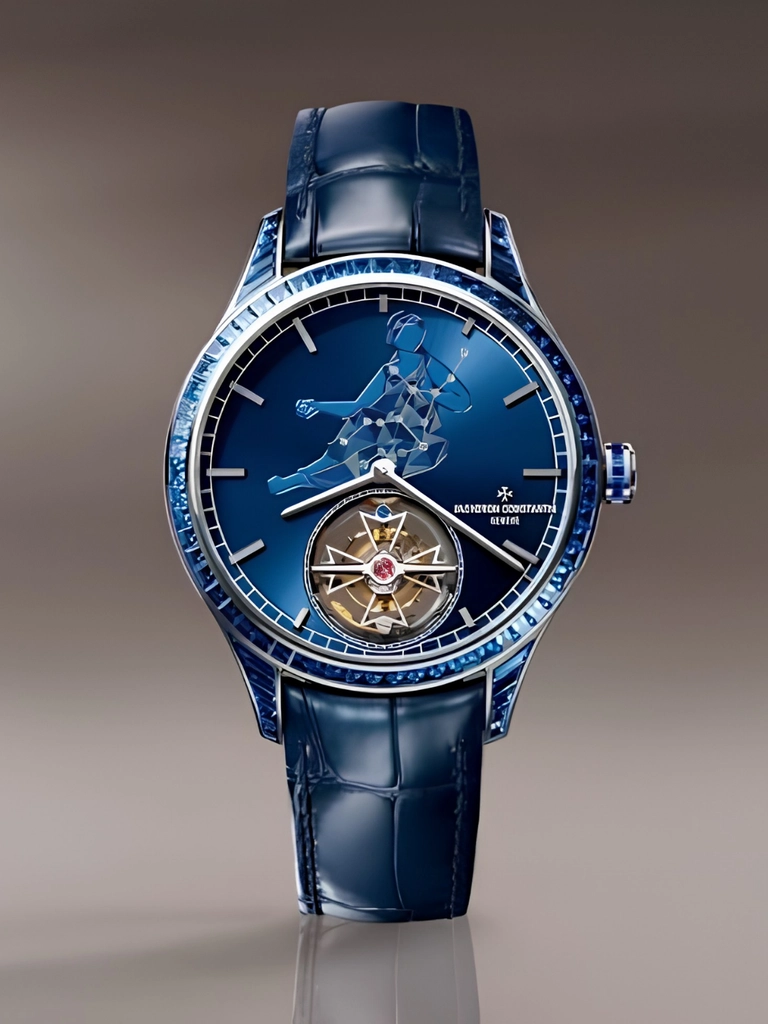
Virgo also corresponds to a large constellation, with Spica as its brightest star. That astronomical spread gives the diamond constellation a wider visual territory to inhabit around the figurative image.
Guilloché and opaline surfaces allow different parts of the figure to respond to light separately, while the stellar network extends the composition outward. The zodiac figure and constellation share the dial without collapsing into one visual layer.
This is where Vacheron Constantin’s treatment of gemstones becomes especially disciplined. Diamonds do not outline the human body. They retain their role as stars.
Libra changes the rules because its central symbol is an object.
There is no anatomy to model, no mane to articulate and no limbs to organise. The scales depend upon balance, suspension and bilateral structure.
That makes Libra one of the most architectural references in the series.
The visual language of guilloché can now work closer to its geometric roots. Symmetry becomes useful instead of restrictive, while the central image naturally establishes axes across the dial.
Libra’s constellation is associated with prominent stars including Zubenelgenubi and Zubeneschamali, names whose histories preserve the constellation’s older relationship with the neighbouring Scorpius. On the watch, however, the constellation is distilled into fine connections and diamond points above the blue dial.
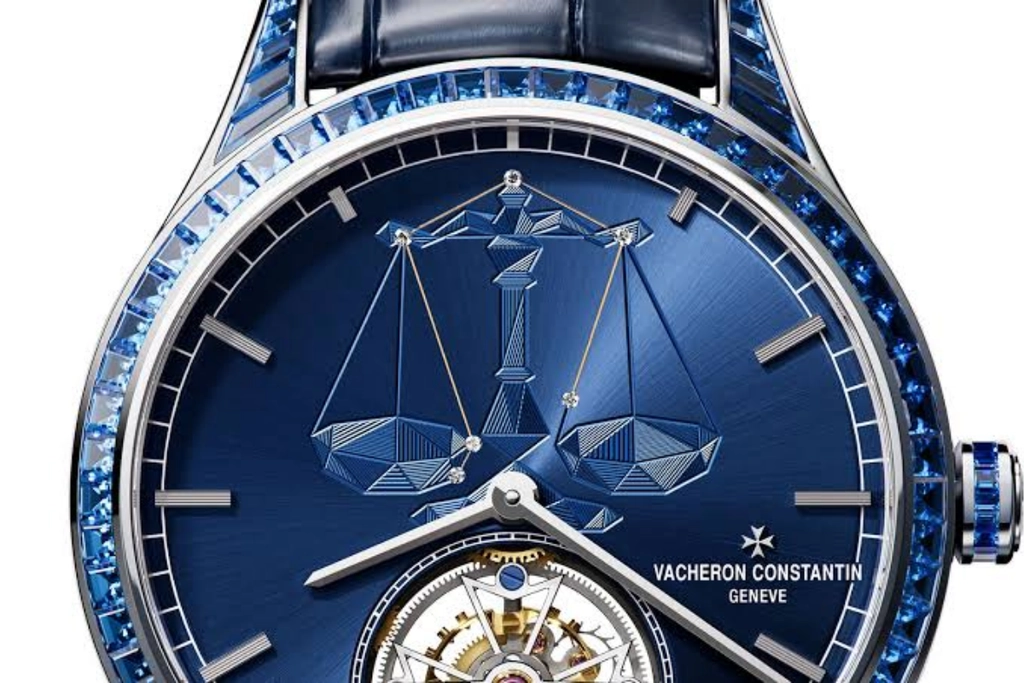
The scales and constellation operate almost like two diagrams layered together. This geometry also creates an interesting relationship with the baguette-cut sapphires around the exterior.
Across Tribute to The Celestial, Vacheron Constantin’s collection documentation specifies 96 baguette-cut blue sapphires totalling approximately 4.41 carats across the bezel, crown, lugs and buckle, with approximately 27 hours required for gem-setting.
Their rectangular cuts establish repeating segments around the circumference. On Libra, that regularity feels especially sympathetic to the central subject. The dial deals in equilibrium while the case surrounding it is organised through disciplined sequences of sapphire.
If Libra feels constructed, Scorpio feels kinetic.
The scorpion is one of the zodiac animals most naturally suited to the vocabulary Vacheron Constantin developed for this collection. Its anatomy is already segmented. Its legs radiate outward. Its tail curves away from the body before returning through a dramatic hook.
The geometric language of tiny guilloché triangles can follow these changes in direction without forcing the animal into a smooth silhouette.
Each section of the scorpion becomes its own field.
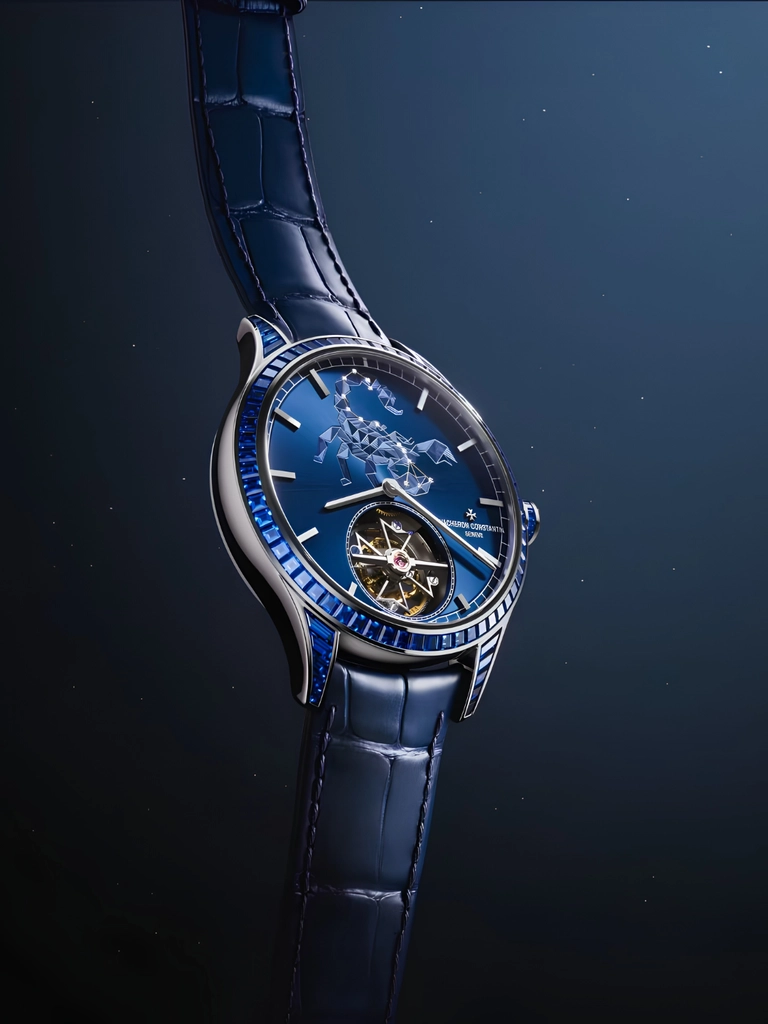

A claw catches light differently from an adjacent limb. The abdomen can read as a sequence of articulated planes. The curved tail encourages the eye to travel across the dial instead of remaining concentrated around its centre.
Vacheron Constantin itself uses a close-up of the Scorpio guilloché to demonstrate the collection’s figurative engraving technique, making the reference particularly useful for understanding how these minute fields of straight lines are assembled into a recognisable creature.
Then the constellation introduces a second curve.
Scorpius is among the night sky’s most recognisable zodiac constellations, with Antares forming its celebrated reddish heart. On the watch, brilliant-cut diamonds mark the constellation against the deep blue surface; Vacheron Constantin lists approximately 0.04 carat of diamonds for the Scorpio reference.
The physical scorpion and celestial Scorpius therefore occupy the dial simultaneously.
Across Leo, Virgo, Libra and Scorpio, Vacheron Constantin treats diamonds, sapphires, mechanics and guilloché as parts of the same celestial system. Brilliant-cut diamonds are used selectively to mark the stars of each astronomical constellation, so their placement changes from one reference to another according to the actual stellar structure of the sign, effectively giving jewellery a cartographic function.
Around these concentrated points of white light, baguette-cut blue sapphires extend across the bezel, crown, lugs and buckle, requiring approximately 27 hours of setting and creating broader, architectural flashes that carry the blue of the dial outward into the case. The two gemstones therefore operate at different visual scales: diamonds act as stars, while sapphires establish the surrounding atmosphere.
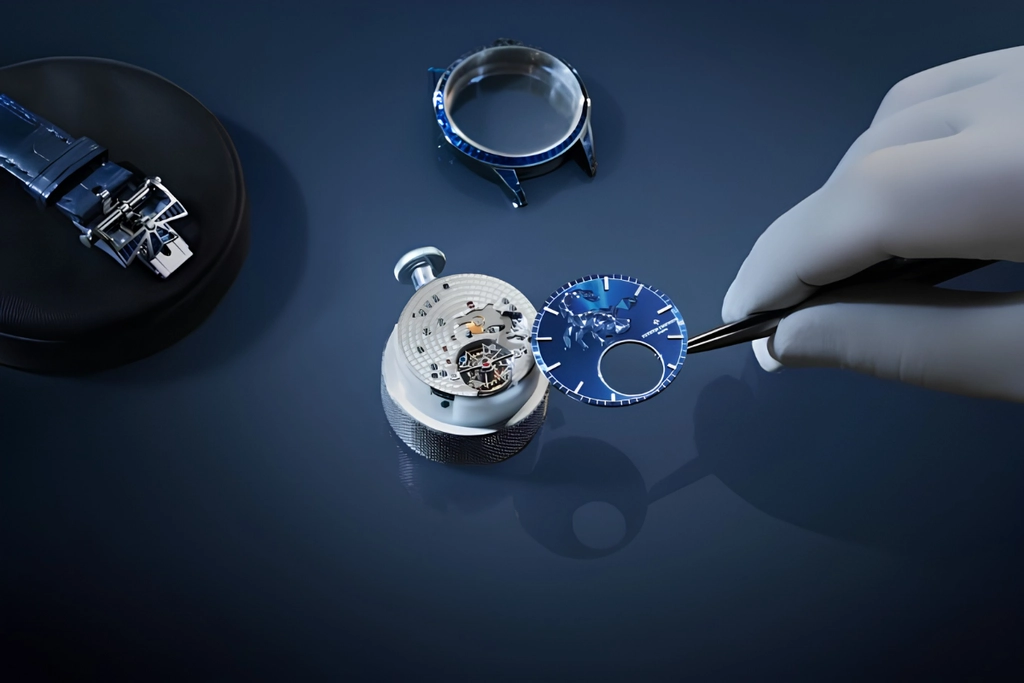
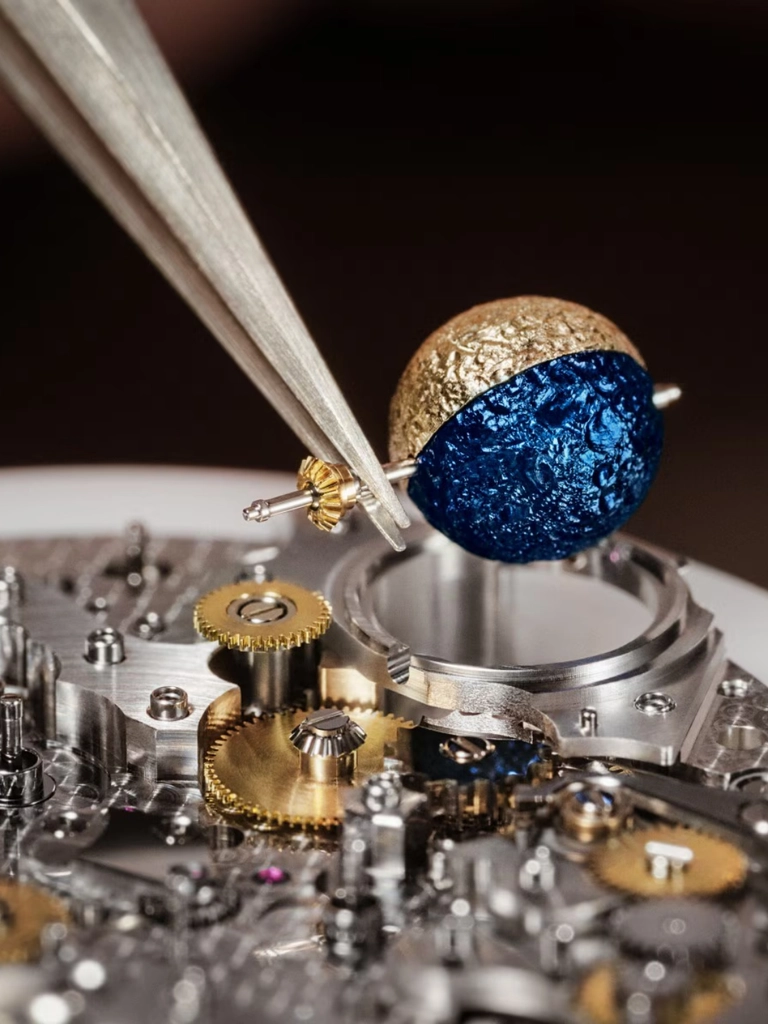
At six o’clock, the Calibre 2160 introduces the only continuous physical movement within this otherwise fixed celestial composition. Its 188-component automatic tourbillon movement measures only 5.65mm thick, operates at 2.5Hz and delivers approximately 80 hours of power reserve, while its peripheral winding architecture helps keep the finished watch at just 10.7mm thick despite the complication and extensive gem-setting.
The tourbillon’s rotation gives the dial a temporal rhythm that the static constellations cannot provide, linking astronomical space with mechanical time. Against this shared architecture, each zodiac figure asks figurative guilloché to solve a different visual problem.
The four references also clarify why Tribute to The Celestial works beyond conventional zodiac jewellery. The astrological symbol supplies a starting point. Craft determines its final character.
Leo becomes substantial because engraved lines can construct apparent volume. Virgo gains complexity through the interaction of guilloché and opaline surfaces. Libra turns precious materials into an exercise in balance. Scorpio exploits the relationship between geometry and articulated anatomy.
Meanwhile, diamonds return every image to its celestial origin, sapphires carry the blue field beyond the dial, and the tourbillon continues its sixty-second rotation below.
The same sky produces four different watches. For Vacheron Constantin, that may be the most interesting proposition behind the celestial jewelry watch: a constellation remains fixed for centuries, yet the human interpretation of it can continue to change. Click here for the last four watches from the Tribute to The Celestial collection.