Yayoi Kusama: Becoming the Polka Dot
Yayoi Kusama: Becoming the Polka Dot
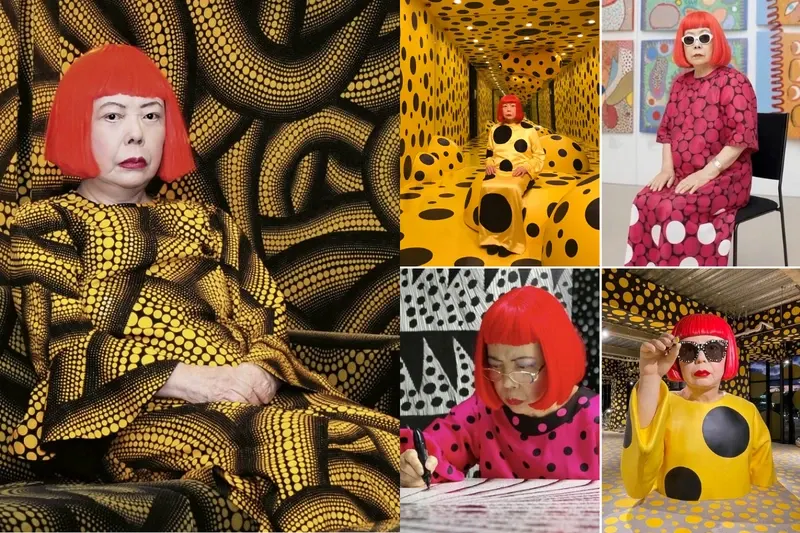
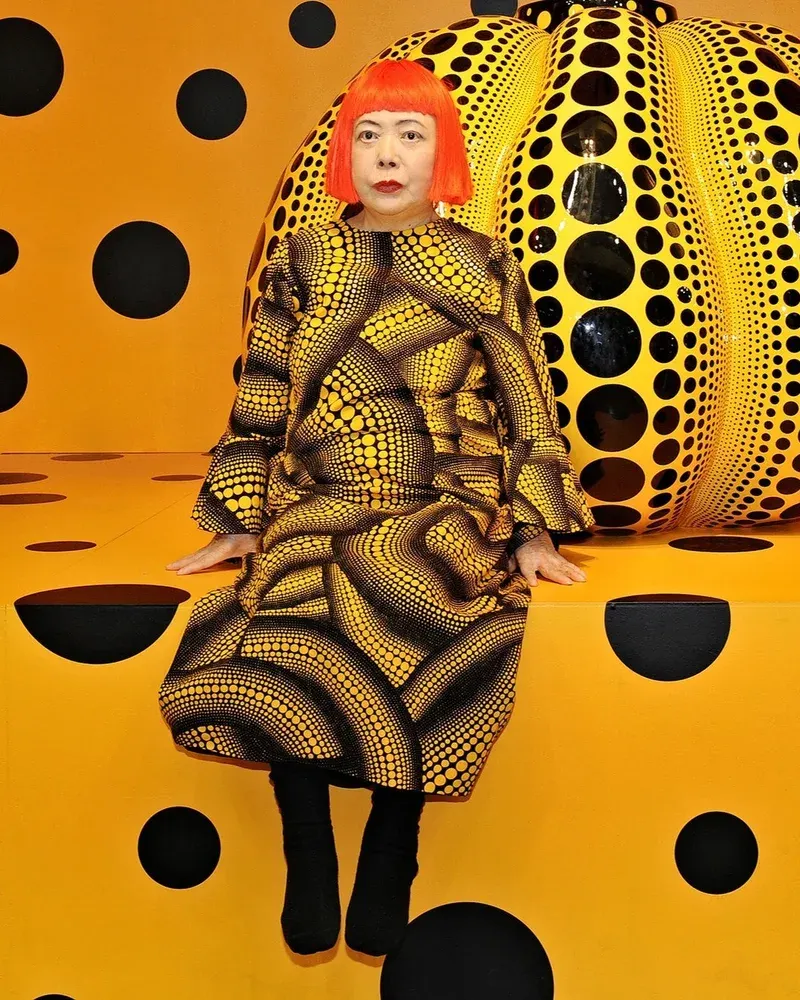
There is something unusually efficient about Yayoi Kusama’s face in a photograph. Start with the hair: a sharply cut bob sitting just below the ears, a heavy horizontal fringe and a red so saturated that it behaves almost like paint. Kusama has worn brightly colored wigs as part of her public image for decades, yet the scarlet version became the defining one. Its artificiality is precisely what gives it power. There is little attempt to imitate natural hair color or texture; instead, the wig creates a clean geometric block around her face, instantly visible even in a crowded exhibition photograph.
Yayoi Kusama continued designing her own clothes in later life, printing patterns from her paintings onto bespoke fabric and completing the distinctive “Kusama look” with brightly colored wigs.
Deep red lipstick frequently picks up the hair color, while makeup rarely competes with the larger composition. Even when oversized sunglasses enter the picture, their graphic shape strengthens the character. Remove the dots entirely and the bob alone is already enough to make the silhouette feel hers. Few artists have managed to turn a haircut into such a reliable visual signature.

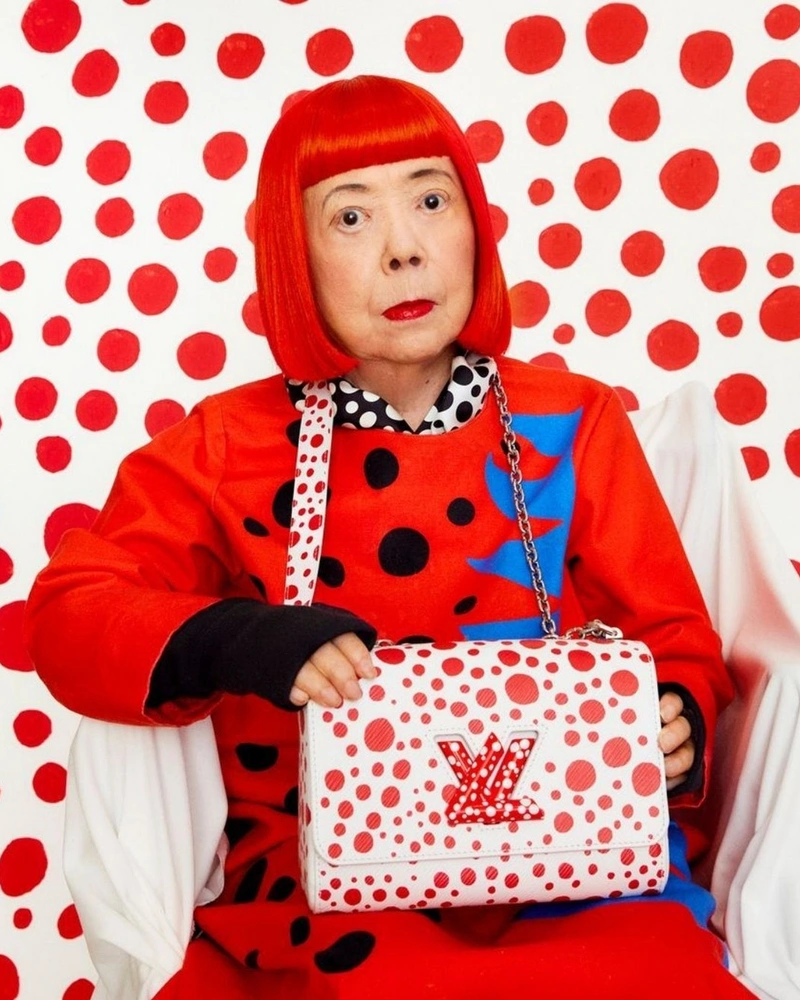
Then come the dots, and this is where an ordinary piece of clothing becomes unmistakably Yayoi Kusama. Her dresses often use relatively simple shapes: long straight gowns, loose tunics, modest necklines and generous surfaces of fabric. The silhouette gives the pattern room to dominate. A complicated cut would compete with what Kusama actually wants the eye to process first: circles, color and repetition. Red with white dots became one of the most familiar combinations, although yellow, black, pink, green and other intense shades circulate throughout her wardrobe.
The dots themselves can grow almost absurdly large, expanding far beyond the scale of a conventional polka-dot print until the dress looks like a fragment cut directly from one of her installations. That relationship has existed for far longer than her later celebrity image suggests. Christie’s records that Yayoi Kusama decorated her clothes with dots as a child, and by the 1960s she had even created her own fashion company. What makes the later wardrobe so memorable, however, is discipline. A child could reproduce those ingredients with a handful of crayons and the drawing would still read as Yayoi Kusama.
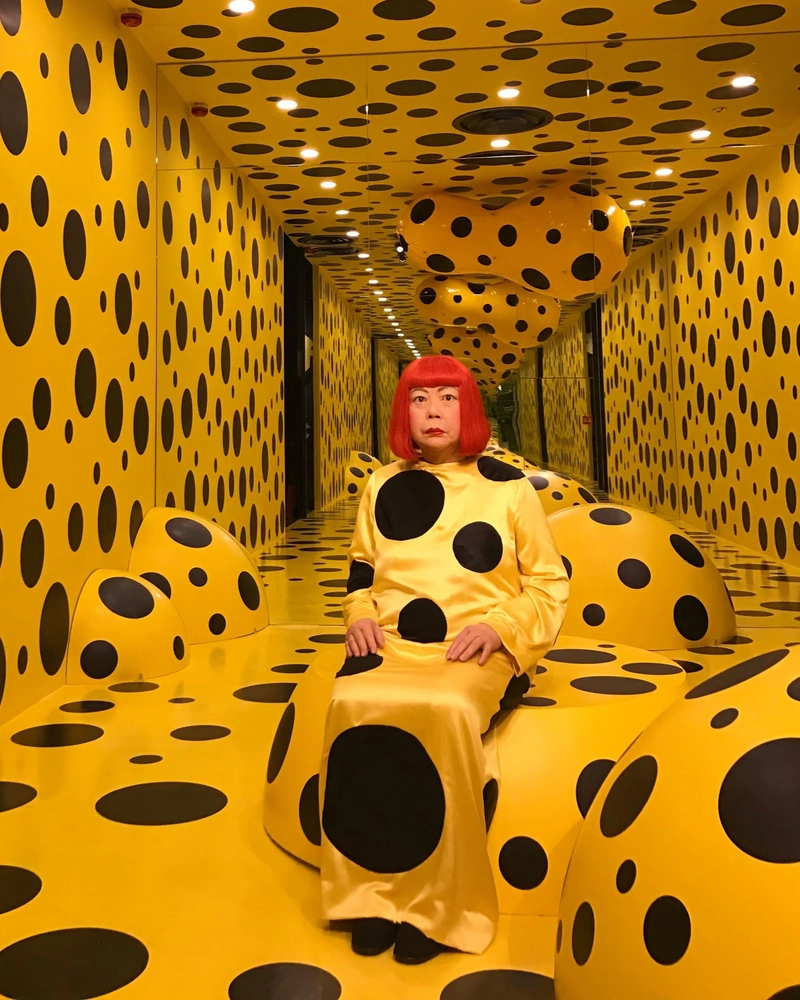
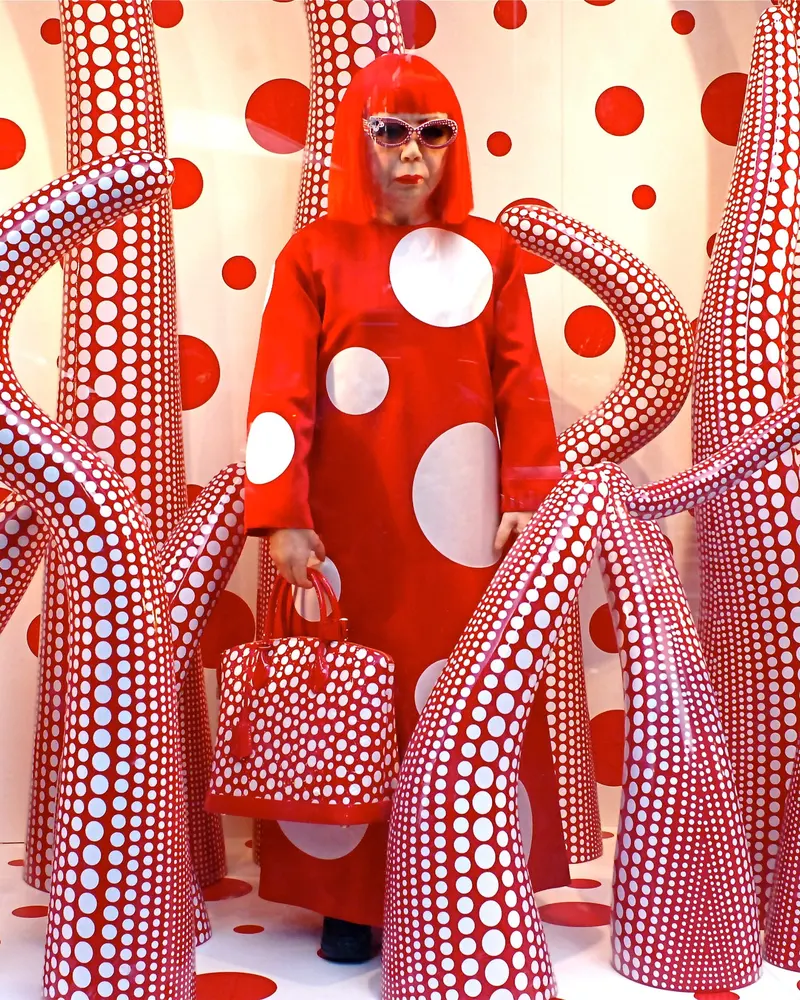
Sunglasses, handbags, shoes and scarves can enter the same chromatic and patterned system, turning accessories into extensions of the outfit instead of independent statements. Her personal style is a carefully curated self-image and traces that instinct back to her New York years, when she sometimes appeared at openings in elaborate kimonos and used clothing as part of her public presentation. Her 1966 Walking Piece offers a striking earlier version of this instinct: Yayoi Kusama moved through Manhattan in a floral kimono carrying an ornate parasol, making the dressed body itself part of the image.
Decades later, the strategy became even tighter. Oversized glasses could repeat the color of a dress. A dotted handbag could echo the circles covering her body. Footwear could stay within the same palette. Most importantly, the clothing could match the artwork surrounding her. Place Yayoi Kusama in a red-and-white dotted dress inside a red-and-white dotted installation and the usual distinction between portrait subject and background starts collapsing. This speaks directly to her idea of self-obliteration, in which repeated patterns spread across bodies, objects and environments until individual boundaries appear to dissolve.

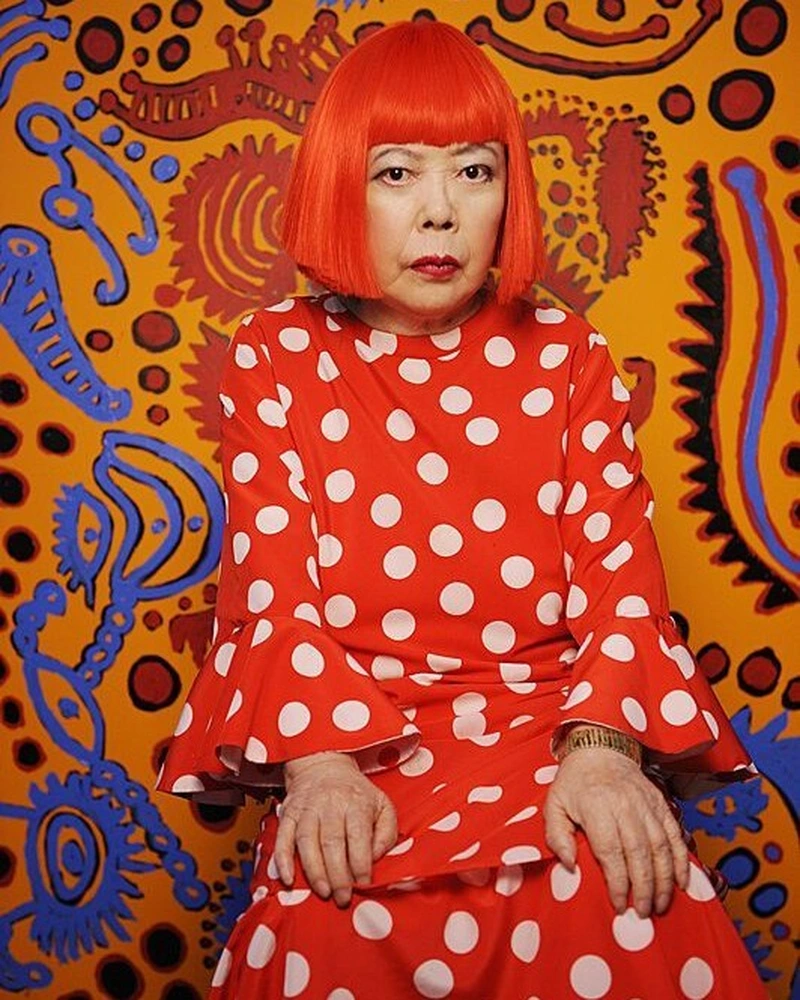
Yayoi Kusama treated dressing almost as another artistic medium, allowing the patterns from her canvases and installations to travel across fabric and onto her own body. The artist consequently became difficult to separate from the artwork she produced. Stand her beside a pumpkin, inside a dotted room or simply against a blank wall and the same character survives. Fashion gave Yayoi Kusama something even fame alone cannot guarantee: a visual identity readable in seconds.