MENU
Close





Twelve zodiac signs, hand-guilloché figures, diamond constellations and a blue sapphire frame turn Vacheron Constantin’s Métiers d’Art Tribute to The Celestial into a study of the night sky through jewellery and mechanics. What's your sign?
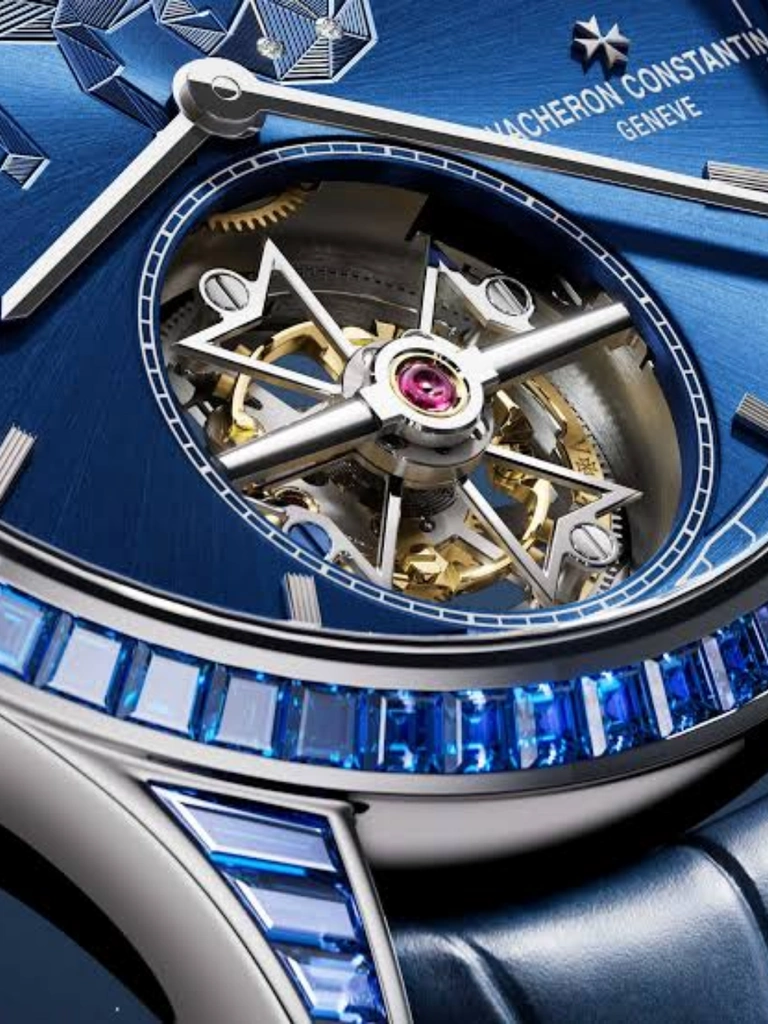
Twelve zodiac signs, hand-guilloché figures, diamond constellations and a blue sapphire frame turn Vacheron Constantin’s Métiers d’Art Tribute to The Celestial into a study of the night sky through jewellery and mechanics. What's your sign?
September 22, 2026


Humans have spent millennia turning disconnected stars into recognisable figures. Rams, bulls, twins and crabs were imagined across the sky long before mechanical watchmaking existed, gradually entering the cultural system now known as the zodiac.
Vacheron Constantin reverses that ancient process. Instead of looking upward and creating images from points of light, Métiers d’Art Tribute to The Celestial takes those established celestial figures and reconstructs them in gold, diamonds, sapphire and mechanical movement.
Introduced in 2025, the collection comprises twelve references corresponding to the twelve Western zodiac signs. Every model shares the same fundamental architecture: a 39mm white-gold case, a blue hand-guilloché dial, a diamond constellation, baguette-cut blue sapphires and the ultra-thin automatic Calibre 2160 tourbillon.
Yet uniform architecture does not produce uniform watches.
The differences are clearest across the first four signs — Aries, Taurus, Gemini and Cancer, where four radically different bodies are translated through the same decorative technique. A horned animal, a massive bull, two human figures and a crustacean force the guillocheur to solve entirely different problems of volume, symmetry and movement.
This is where the collection’s idea of the celestial jewelry watch becomes most compelling.
The figures on Tribute to The Celestial are created through a form of figurative hand guilloché developed to move the technique beyond its familiar geometric vocabulary.
Traditional guillochage is associated with waves, rosettes, radiating fields and repeating mathematical patterns. Vacheron Constantin instead divides each zodiac figure into numerous tiny triangular areas. Straight lines are engraved densely inside each section, with their orientation changing from one triangle to the next.
The direction of those lines controls reflection.
When light hits the dial, adjacent surfaces brighten and darken differently. Those small shifts construct shoulders, limbs, horns, claws and curves without relying on conventional painted modelling.
Each zodiac figure requires approximately 16 hours of hand-guilloché work.
The image therefore exists through geometry first and figuration second. From a normal viewing distance, one sees an animal or human form. Under closer inspection, that body fragments into minute networks of engraved lines.
The four opening zodiac signs show just how flexible that system can become.
Aries introduces the series through one of the zodiac’s most immediately recognisable animal forms: the ram.
Its visual identity depends heavily on the relationship between head, body and curved horn. Figurative guilloché allows the dial to translate those forms through directional changes rather than heavy sculptural relief.
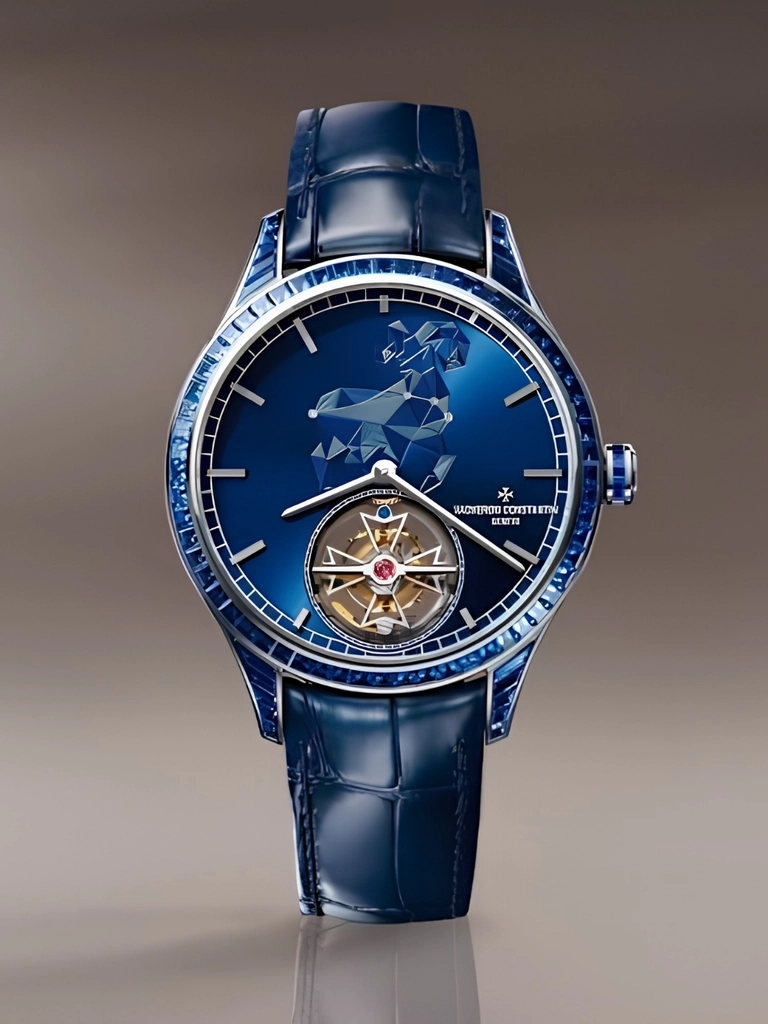
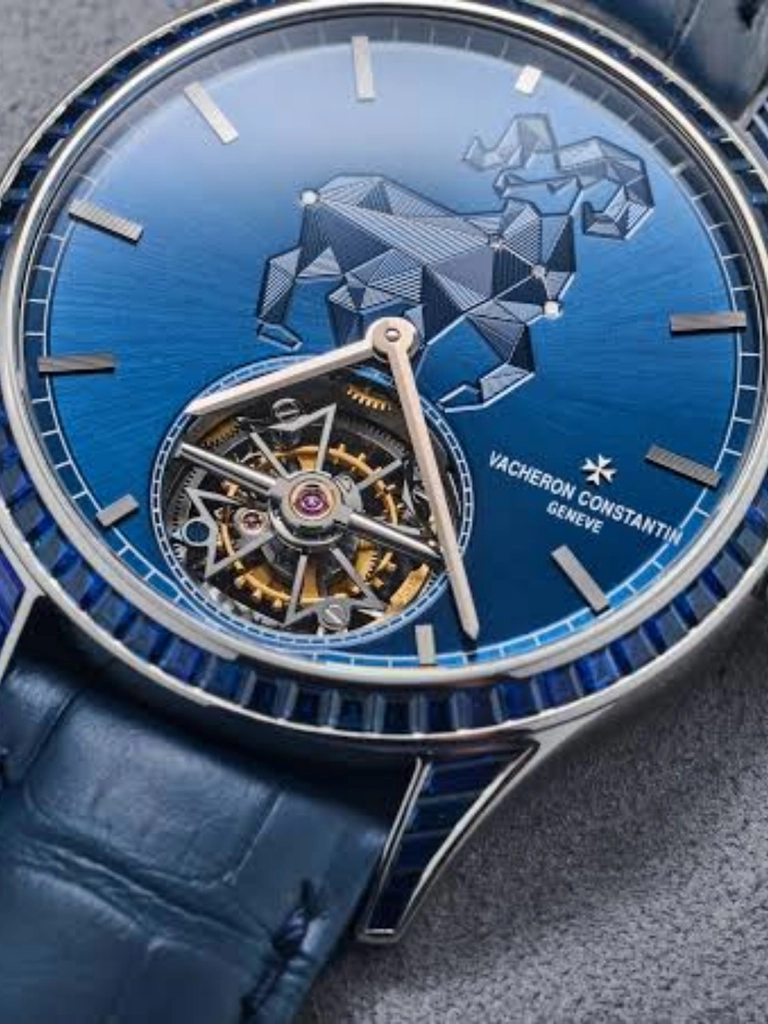
The engraved fields around the body shift their reflection as the watch moves, making the ram appear more defined from certain angles before allowing parts of its silhouette to merge back into the surrounding blue. This optical instability feels particularly appropriate for the collection.
The zodiac image never behaves like a static printed illustration. Its visibility depends on light, movement and the viewer’s position. Above the figurative ram, the corresponding Aries constellation is reduced to a far more economical visual language: fine connecting lines punctuated by brilliant-cut diamonds.
Aries therefore appears twice. One version belongs to mythology and human imagination. The second belongs to astronomical mapping.
Taurus presents almost the opposite challenge. Where Aries can be understood through curve and compact movement, the bull requires a convincing sense of physical weight.
Its shoulders, head and horns need visual mass, even though the surface from which they emerge remains essentially flat. Here, the changing density and direction of the guilloché fields become critical. Different engraved areas react separately to light, creating the impression of muscular planes passing across the body.

The bull’s broad structure also changes the balance of the dial. The tourbillon remains permanently positioned at six o’clock, so the zodiac composition has to negotiate with a large circular mechanical opening beneath it. Taurus uses the upper dial decisively, establishing a substantial visual counterweight to the moving tourbillon below.
Diamonds once again mark the constellation across the blue surface. The contrast becomes particularly effective here: the bull is dense and materially present, while its constellation is reduced to luminous points.
Gemini creates a completely different compositional problem because its zodiac representation depends on two human figures. The technique now has to articulate relationships between bodies.
Spacing becomes as important as modelling. Two silhouettes have to remain individually legible while still forming one zodiac composition, and the negative space between them becomes part of the design.
Gemini is also one of four references — along with Virgo, Sagittarius and Aquarius, in which Vacheron Constantin introduces opaline-treated details into the figurative composition. The additional finish helps separate human forms from the surrounding engraved field.
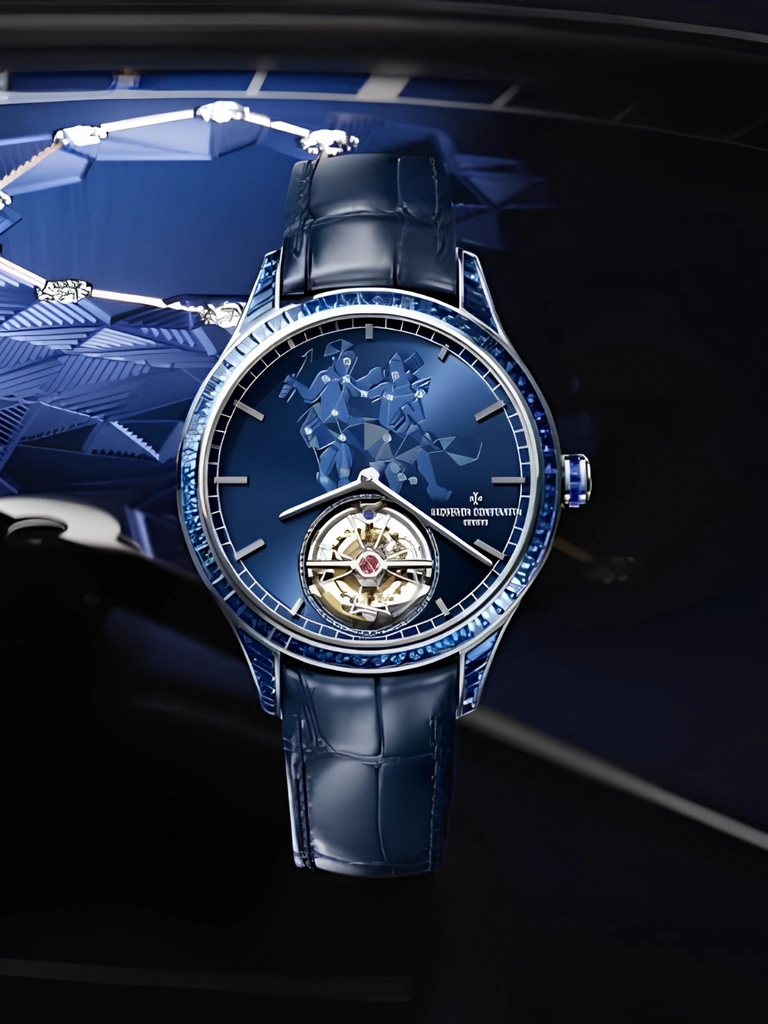
Tribute to The Celestial does not simply change one central icon twelve times. Techniques can be adjusted according to the visual demands of the sign. The constellation introduces another form of duality. Its stellar structure accompanies a symbolic image already based on pairing, giving Gemini one of the collection’s most naturally layered compositions: two figures, multiple stars and the tourbillon turning independently beneath them.
The watch becomes an exercise in controlled multiplicity.
Cancer may offer the strongest demonstration of how far the visual language can move away from conventional jewellery motifs. A crab is an awkward subject for elegance.
Its body is low and broad. Multiple legs extend laterally. Claws create competing directional lines. Its anatomy is defined through symmetry, but also through almost mechanical segmentation.
Those qualities become strengths under guilloché. The triangular engraved fields can follow the crab’s shell, legs and claws while changing their angles to separate individual anatomical regions. The form develops through accumulation instead of smooth modelling.
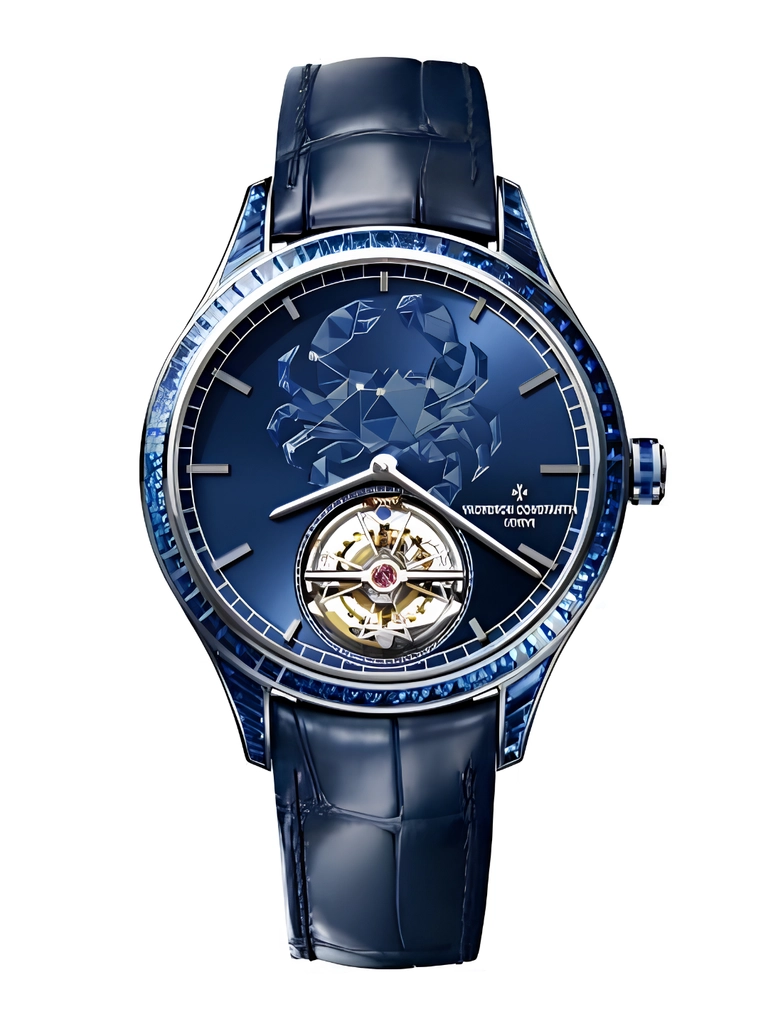
Cancer consequently feels graphic. Its articulated body relates naturally to the geometric system used to create it, producing a zodiac figure in which subject and technique appear especially well matched.
The surrounding diamonds provide the opposite visual experience. Tiny points of light extract the Cancer constellation from the physical creature and return it to the night sky. Once again, the dial moves between two scales: the intimacy of microscopic hand engraving and the near-incomprehensible distances represented by a constellation.
Each reference contains a second visual system layered over the zodiac figure. Brilliant-cut diamonds represent stars within the relevant constellation, connected through fine lines across the blue dial.
A conventional high-jewellery approach could have filled the entire surface with stones. Vacheron Constantin instead treats each diamond as a point carrying information. The gemstone becomes a coordinate. This is one reason celestial jewelry watch describes the collection so effectively. Jewellery and astronomy perform the same task.
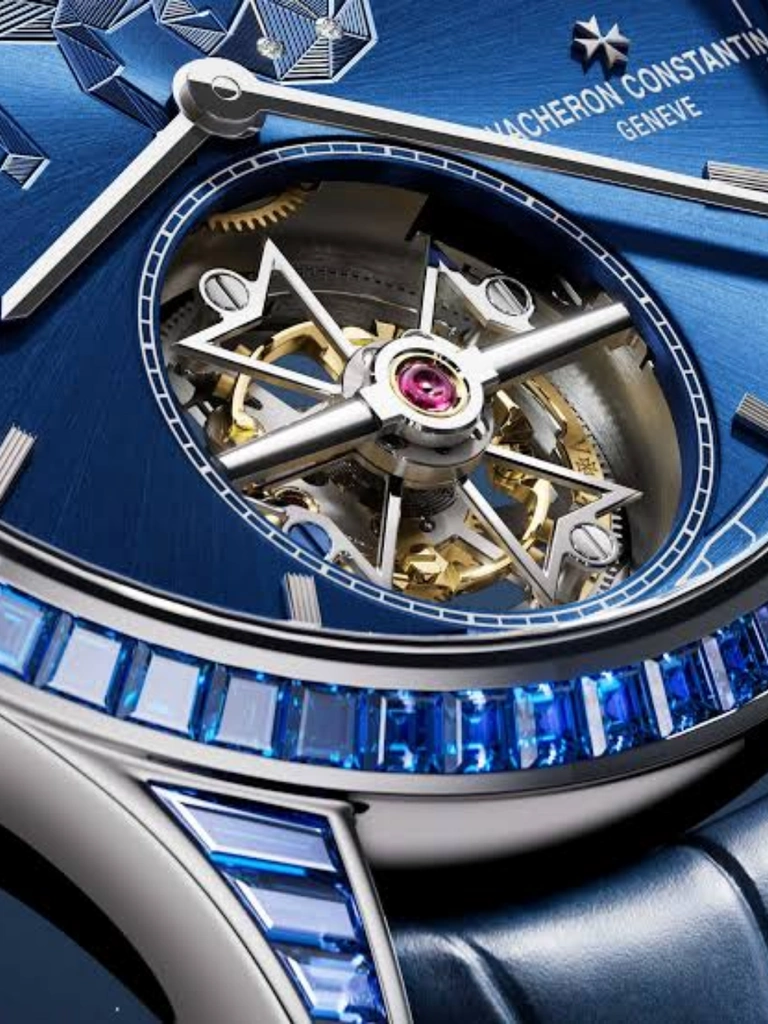
A diamond possesses exceptional brightness under concentrated light, making it an intuitive material with which to represent a star. Its value exists alongside its function within the composition. The watch becomes richer because the stones mean something. Baguette-cut blue sapphires carry that logic outward from the dial. They appear across the case architecture, establishing a continuous blue environment around the zodiac scene. Gem-setting requires approximately 27 hours for each watch, while the gemstone weight sits at around 4.41 carats according to Vacheron Constantin’s collection specifications. The baguette cut contributes an architectural quality.
Its rectangular shape produces elongated flashes and disciplined repetition around the circular watch. This creates a useful distinction from the brilliant-cut diamonds scattered across the dial. Diamonds behave like points. Sapphires behave like planes. Together, they establish two different scales of celestial light.
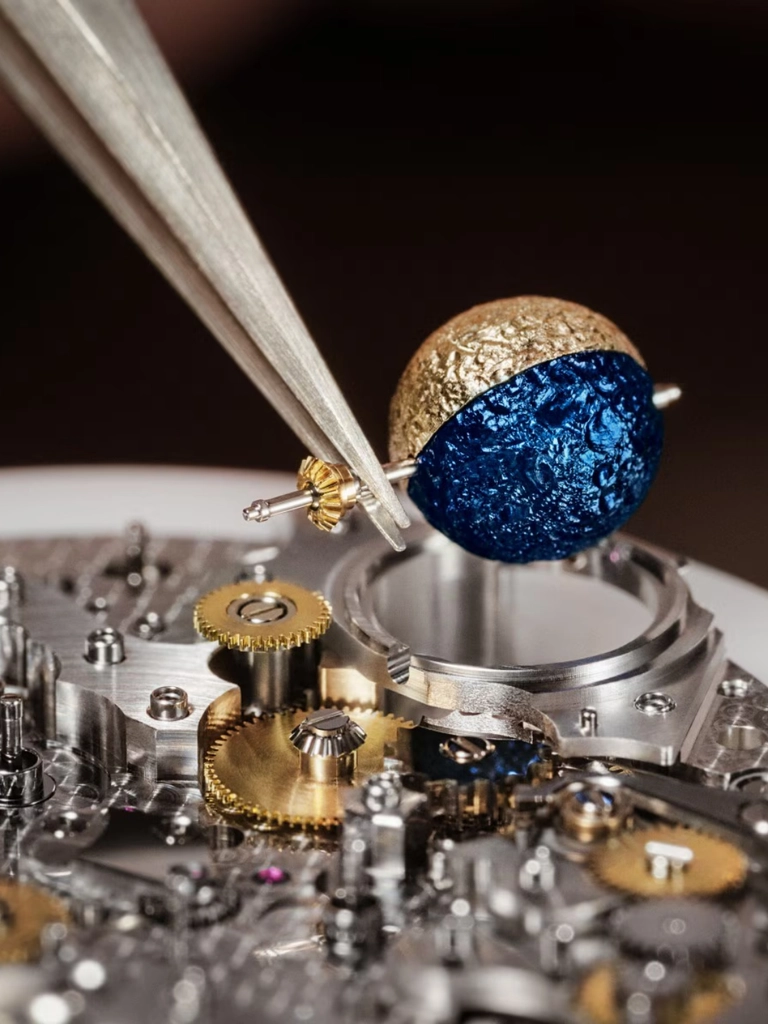
At six o’clock, imagery gives way to mechanics. The Calibre 2160 places its tourbillon directly inside the visual composition. The carriage completes one revolution every sixty seconds and carries the small-seconds indication, producing continuous physical motion beneath the zodiac figure. Its cage evokes Vacheron Constantin’s Maltese Cross emblem.
The movement measures just 5.65mm thick, contains 188 components, runs at 2.5Hz and delivers approximately 80 hours of power reserve. Its automatic winding system uses a peripheral rotor positioned around the circumference of the movement. This architecture helps preserve the calibre’s thin profile while leaving much of the movement visible through the sapphire caseback.
The tourbillon also gives the celestial concept something the diamond constellation cannot provide. The stars are fixed. The zodiac figure changes only through reflected light. The tourbillon actually moves. Within a watch inspired by the sky, it becomes the closest thing to an orbit.
What makes Tribute to The Celestial compelling is the way every material is given a different astronomical role. Diamonds become fixed points of light. Sapphires build the surrounding atmosphere. Guilloché gives mythology a body, while the tourbillon introduces the only true motion within the composition.
Across Aries, Taurus, Gemini and Cancer, the same technical vocabulary produces four distinct ways of reading the sky. One depends on curve, another on mass, another on duality, another on segmentation. The zodiac is therefore less a decorative theme than a framework through which Vacheron Constantin tests how far line, light and mechanics can reshape a familiar image.
A celestial jewelry watch like this ultimately sits between two systems of time. One is mechanical, measured through the rotation of the tourbillon and the movement of the hands. The other is far older, built from the human habit of looking at the night sky and turning distant stars into stories. Tribute to The Celestial brings both onto the same dial, where mythology remains fixed in diamonds while time continues to move beneath it. Read about the next four zodiac-inspired watches in the same collection here.