MENU
Close





Are you sure your leg veins deserve a needle just because you can see them? We have reached the point where a perfectly ordinary sign of circulation can qualify for injection, laser and disappearance.

Are you sure your leg veins deserve a needle just because you can see them? We have reached the point where a perfectly ordinary sign of circulation can qualify for injection, laser and disappearance.
August 29, 2026


Beauty culture has developed an unusually confident vocabulary around leg veins. They “vanish.” They are “cleared.” They become “vein-free.” They disappear beneath body foundation, stockings, injections and vascular lasers. Each word quietly establishes visibility as the offense.
Marie Claire made that language particularly explicit in July 2026 with Everything You Need to Know About Leg Veins—and How to Make Them Vanish. Its opening places summer hemlines beside the private scrutiny women direct toward their legs, then moves through lasers, sclerotherapy, radiofrequency ablation and camouflage.
Yet a visible vessel can represent several biological realities. Superficial veins can show through thin skin. Spider veins, medically called telangiectasias, create delicate red, blue or purple networks near the surface. Varicose veins involve enlarged vessels and can accompany aching, swelling, heaviness or venous dysfunction.
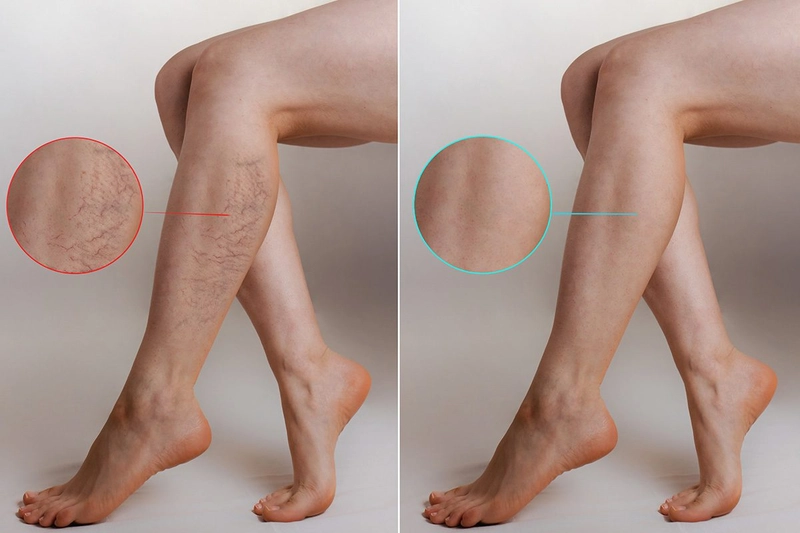
The U.S. Office on Women’s Health says spider veins may affect over half of women. In the San Diego Population Study, researchers inspected 4,422 legs and found spider veins in 54.6 percent. Function testing classified 79.5 percent of those legs as normal, and researchers found that the majority of legs carrying spider veins also functioned normally.
Beauty has therefore created a problem whose visual presence frequently exists inside a functioning system.
A British advertisement from 1938 promised movement “From Varicose Veins To Beautiful Legs.” By the late 1940s, elastic stockings were marketed through promises of “sheer leg beauty.” Over subsequent decades, exposed legs became increasingly scrutinized territory across fashion, hosiery, advertising and beauty media.
The ideal that emerged carried an almost eerie visual silence.
A beautiful leg presented smooth colour, uninterrupted surface and very little information about what happened underneath. Hair disappeared. Bruises disappeared. Tonal variation disappeared. Veins joined the list.
Cosmetics eventually transformed concealment into a routine beauty technique. In 2019, L’Oréal Paris grouped visible veins among the “imperfections” someone might wish to conceal, then offered a four-step method involving primer, colour correction, waterproof concealer and setting powder.
The language exposes the standard particularly clearly. Human circulation entered the same cosmetic editing system as pigmentation and blemishes.
Even the beauty press made the desired endpoint startlingly literal. A 2012 Allure story carried the title “Vein-Free Legs.” A vein had moved from anatomy into aesthetics.
Veins collectively hold around 70 percent of an adult’s blood volume, approximately 3.5 litres in a typical adult physiological model. Their capacity allows the venous system to serve as an enormous blood reservoir while continuously returning blood toward the heart.
The legs face a particularly dramatic assignment because blood travelling upward must climb against gravity.
That job depends heavily on the muscles beneath the calf. When we walk, calf muscles squeeze the deep veins and drive blood upward while one-way valves help direct its journey toward the heart. Around 90 percent of venous return from the lower extremities travels through the deep veins, and the calf-muscle pump has an estimated ejection fraction of roughly 65 percent.
That figure makes the obsession with visible superficial vessels particularly fascinating. A fine spider vein appearing beneath the skin represents a tiny visible fragment of an enormous hydraulic system operating underneath.
For years, the correction happened on top of the skin. Stockings covered leg veins. Tanning products softened tonal differences. Body foundation created an uninterrupted field of colour.
Cosmetic medicine eventually travelled beneath the surface.
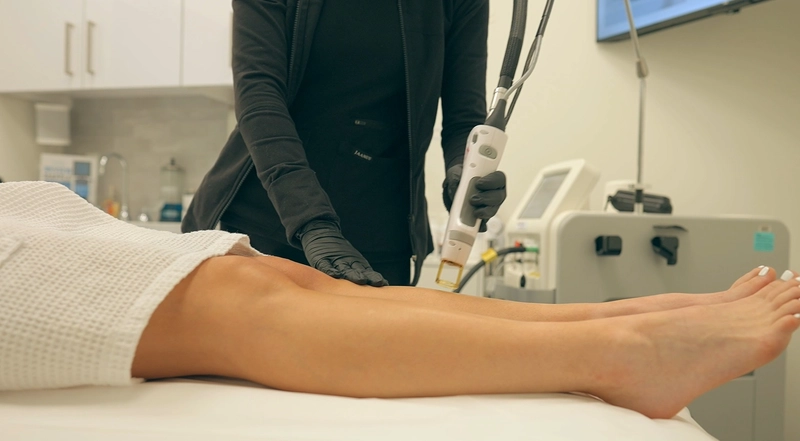
Sclerotherapy sounds almost surreal when described mechanically. A clinician places a fine needle into a selected vein and injects a chemical solution. The solution irritates the vessel lining, causing the vein to swell shut and scar. Blood then travels through healthier veins, while the treated vessel gradually fades. Mayo Clinic says small spider veins can become visibly reduced within three to six weeks.
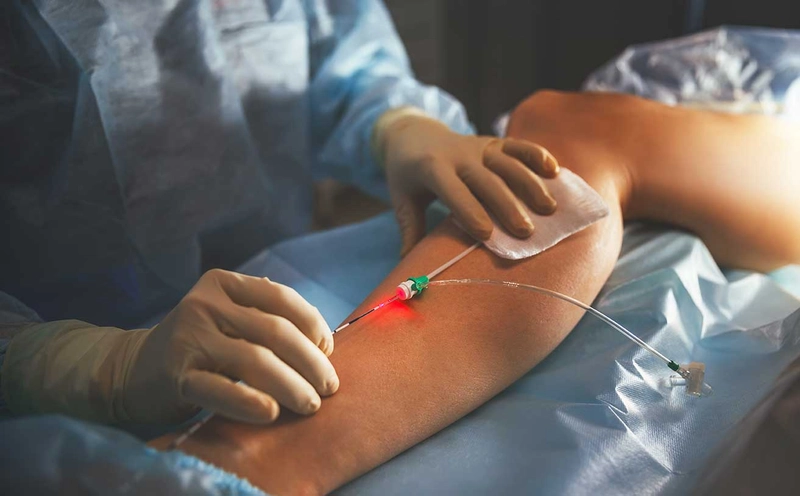
Closing one cosmetic vein therefore leaves the circulation with alternate pathways. The body's transport system quietly reorganizes itself.
The treatment has become remarkably routine. The American Society of Plastic Surgeons estimated 516,883 sclerotherapy procedures in the United States in 2024. Spread across the calendar year, that works out to roughly one procedure every minute.
One every minute.
That figure shifts spider-vein treatment from a tiny cosmetic curiosity into a substantial aesthetic economy.
ASPS currently puts the average surgeon cost of sclerotherapy at about $500, before associated expenses. At that scale, circulation has acquired a measurable commercial value simply through its visibility.
The procedure itself can be effective. Cleveland Clinic reports that one sclerotherapy session may eliminate roughly 50 to 80 percent of injected veins, with treatment usually taking around 30 to 45 minutes.
A vessel can carry blood for years, become aesthetically unwanted, receive a needle, scar shut and disappear from view within weeks.
That sequence says something extraordinary about how far beauty has travelled beneath the skin.
Leg veins push this instinct into unusually intimate territory because the perceived imperfection sits beneath the skin itself. The cosmetic gaze has travelled through the surface and reached the body's plumbing.
How much anatomy can human skin reveal before beauty decides the body has shown too much?
Gender sharpens that question. Visible leg veins can carry associations with muscularity, exertion and athletic identity. Fine vessels crossing a woman’s thigh, ankle or knee regularly enter another vocabulary: concealment, age, treatment, embarrassment. The vessel continues performing a circulatory role while culture assigns the visible line an entirely separate meaning. The ideal body therefore begins to resemble a strangely edited biological object: alive, warm and energetic, with its machinery hidden from view.