MENU
Close





Faces sharpen into masks, streets tilt beneath nervous feet, skies bleed above silent figures, and colour abandons nature as Expressionism enters the canvas to reveal everything polite reality tries to conceal.
Faces sharpen into masks, streets tilt beneath nervous feet, skies bleed above silent figures, and colour abandons nature as Expressionism enters the canvas to reveal everything polite reality tries to conceal.
July 9, 2026


Expressionism begins with a rejection of visual obedience. The external world remains recognisable, though its proportions, colours, surfaces, and perspectives are reorganised according to psychological pressure. A face may turn green, a street may collapse into a steep corridor, and a human body may become angular enough to resemble an exposed nerve. The distortion carries the meaning.
This principle separates Expressionism from Impressionism more clearly than chronology alone. Impressionist painters studied the instability of visible light, atmospheric colour, and immediate perception. Expressionist artists pushed beyond the eye toward fear, desire, loneliness, spiritual longing, and social agitation. The Guggenheim defines the movement through its emphasis on the expressive force of pictorial form and its pursuit of subjective experience, while MoMA identifies simplified or distorted forms and exaggerated, frequently clashing colours among its central devices.
Such art could appear rough because refinement carried little value when refinement weakened emotional force. Brushwork remained visible, outlines became aggressive, and colour detached itself from physical description. A yellow face could communicate sickness or estrangement more efficiently than carefully modelled flesh. The canvas ceased to operate as a window and became a surface under pressure.
The movement flourished most visibly between 1905 and 1920, particularly in Germany and Austria, as industrial growth, mass urbanisation, political instability, and modern city life transformed European society. Its artists encountered crowded streets and profound isolation within the same environment. Extreme angles, compressed spaces, and acidic palettes translated that contradiction into form.
Before Expressionism acquired a name or a collective programme, Vincent van Gogh, Edvard Munch, and James Ensor had already discovered that reality could be altered to communicate a deeper emotional condition.
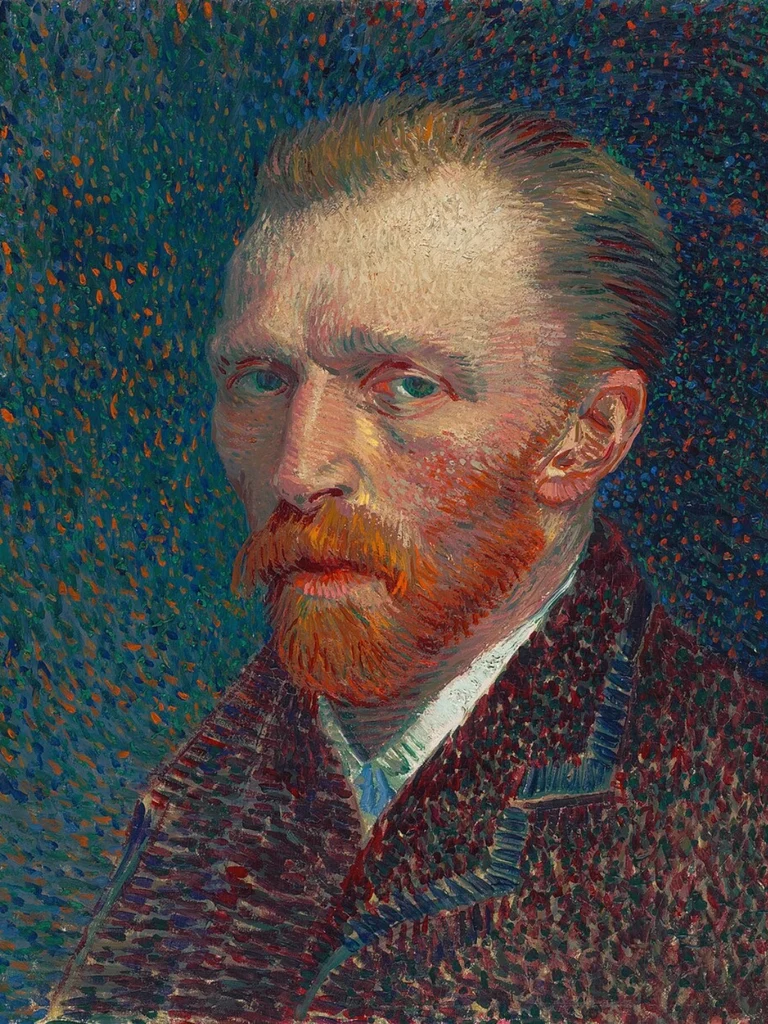
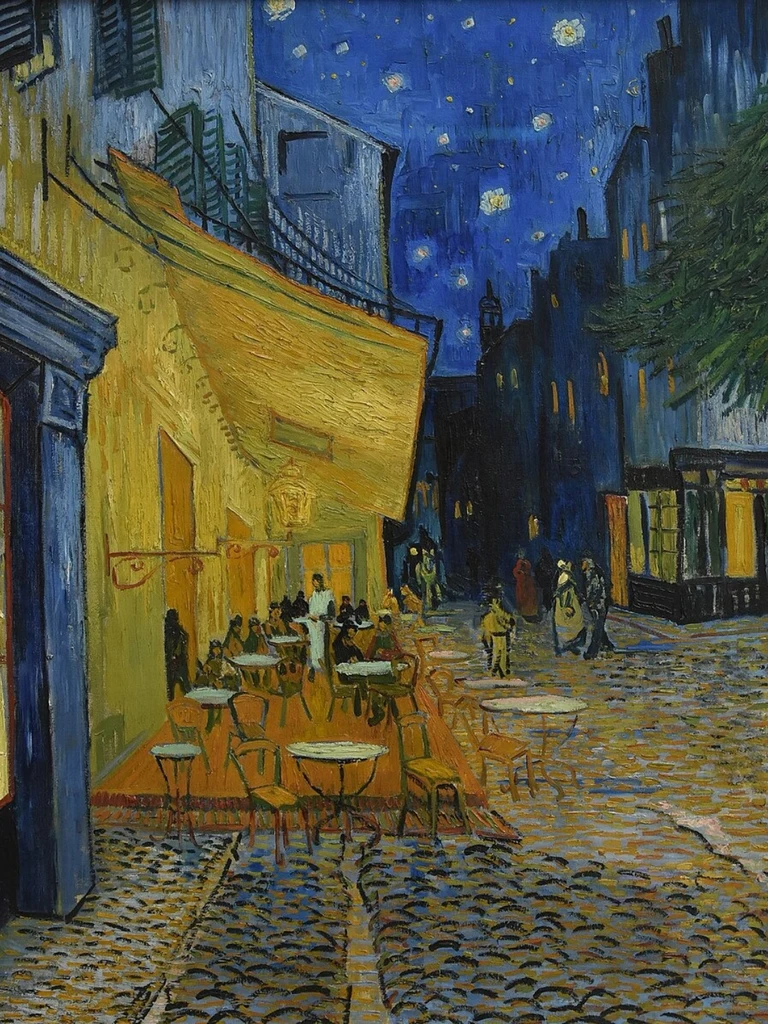
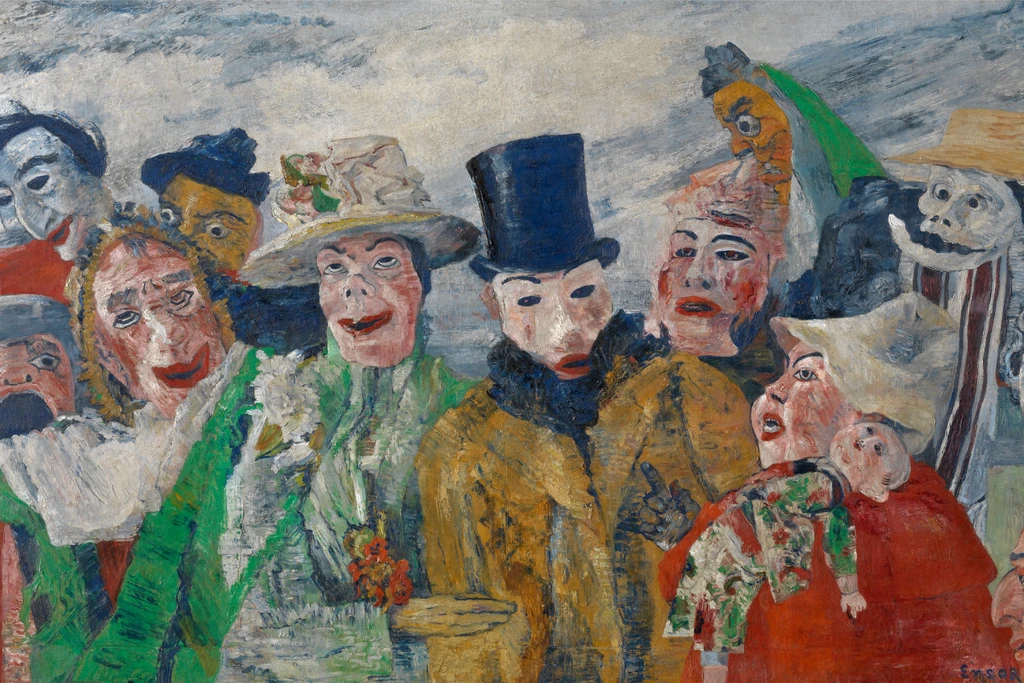
Van Gogh made colour rhythmic and emotionally charged. His skies, trees, rooms, and human figures appear animated by an internal current. Munch turned personal memory, illness, grief, erotic unease, and mortality into recurring psychological symbols. Ensor filled rooms and streets with masks, skeletons, grotesque crowds, and theatrical faces, treating respectable society as a carnival of concealed aggression.
Munch’s The Scream, first realised in 1893, became the movement’s most recognisable premonition. The central figure possesses few individual characteristics, allowing the body to function as a universal instrument of panic. The road, fjord, sky, and human face participate in the same wavering rhythm. Landscape stops serving as background and begins experiencing the crisis alongside the figure.
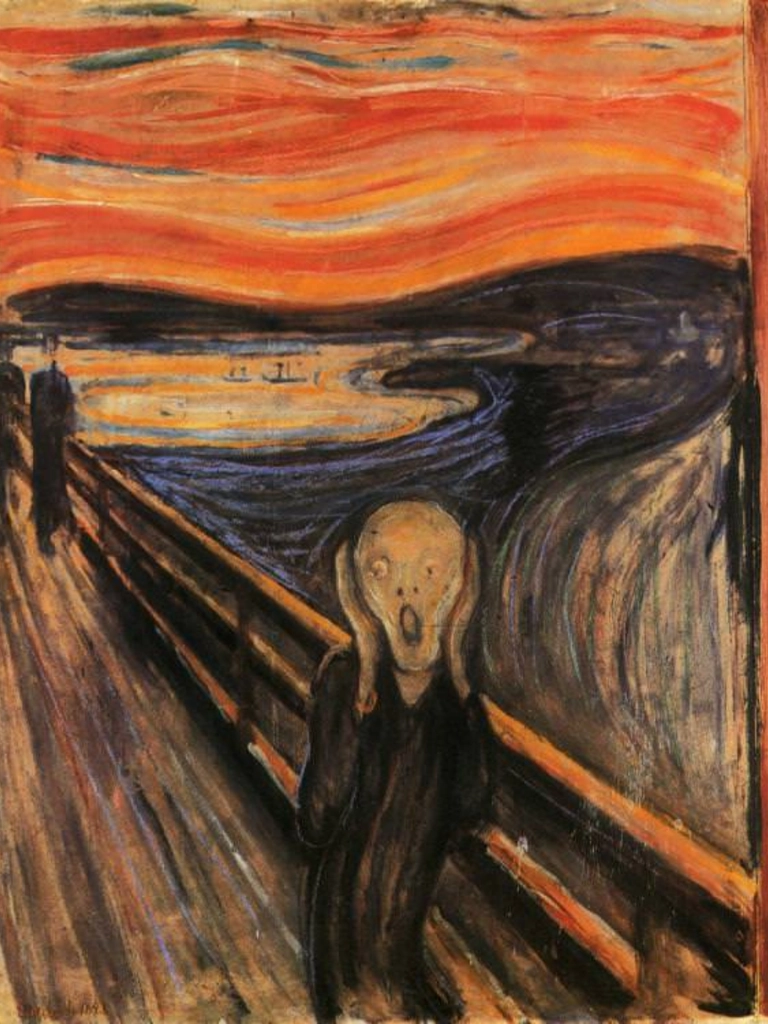
Munch described sensing an immense scream passing through nature, a concept that clarifies the painting’s construction. The figure may appear to be screaming, yet the surrounding environment is equally unstable. The red sky presses downward while blue-black water bends around the scene. Emotion has escaped the body and infected the world. Norway’s National Museum now describes the work as a universal symbol of anxiety and fear.
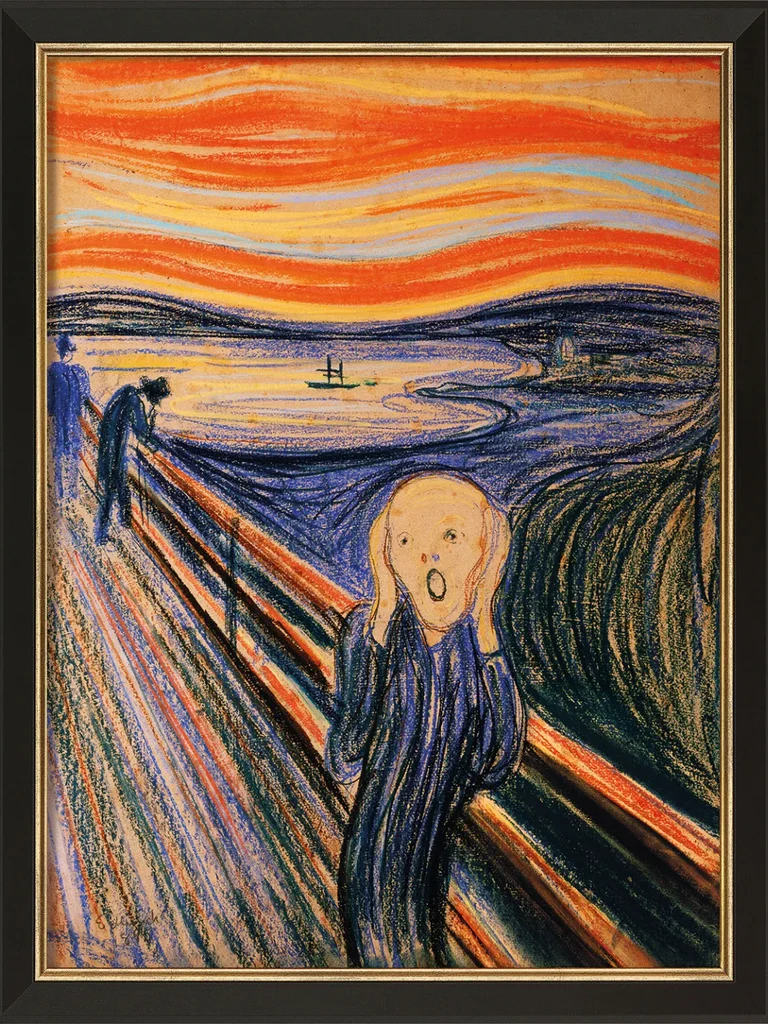
The image also developed a cultural life almost as turbulent as its surface. Munch produced four principal versions. The National Gallery’s 1893 painting was stolen in February 1994 and returned to the museum later that year. The 1895 pastel, the only version then remaining in private hands, sold at Sotheby’s in 2012 for $119.9 million.
The institutional beginning of German Expressionism is commonly placed on June 7, 1905, when four architecture students founded Die Brücke in Dresden. Ernst Ludwig Kirchner, Erich Heckel, Fritz Bleyl, and Karl Schmidt-Rottluff selected a name meaning “The Bridge,” presenting themselves as a passage toward an art still being invented. Max Pechstein and other artists later joined the group.
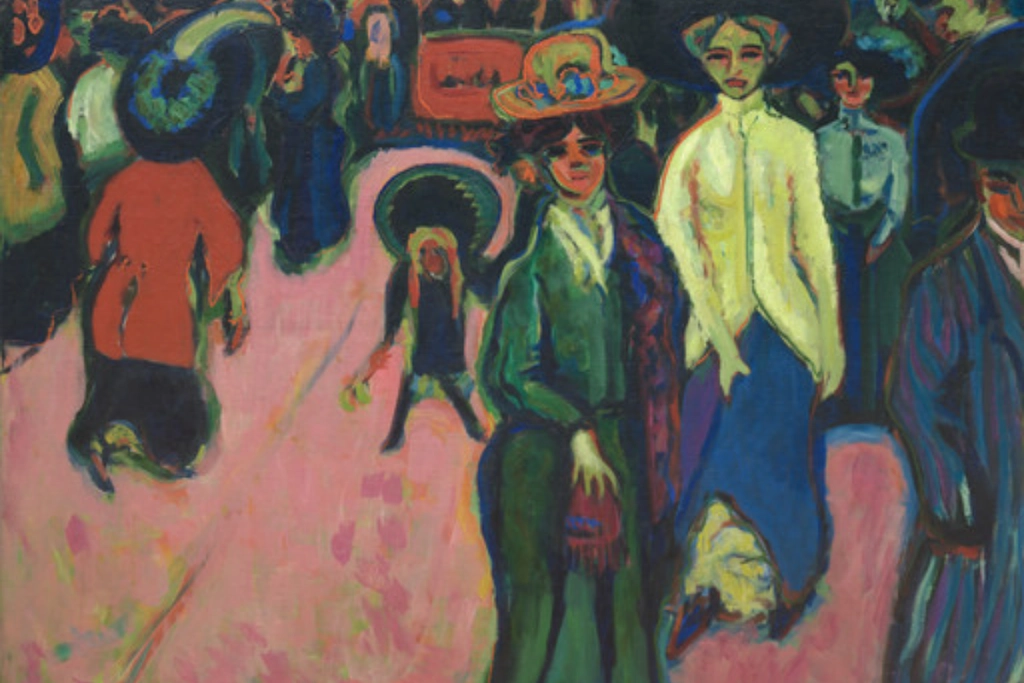
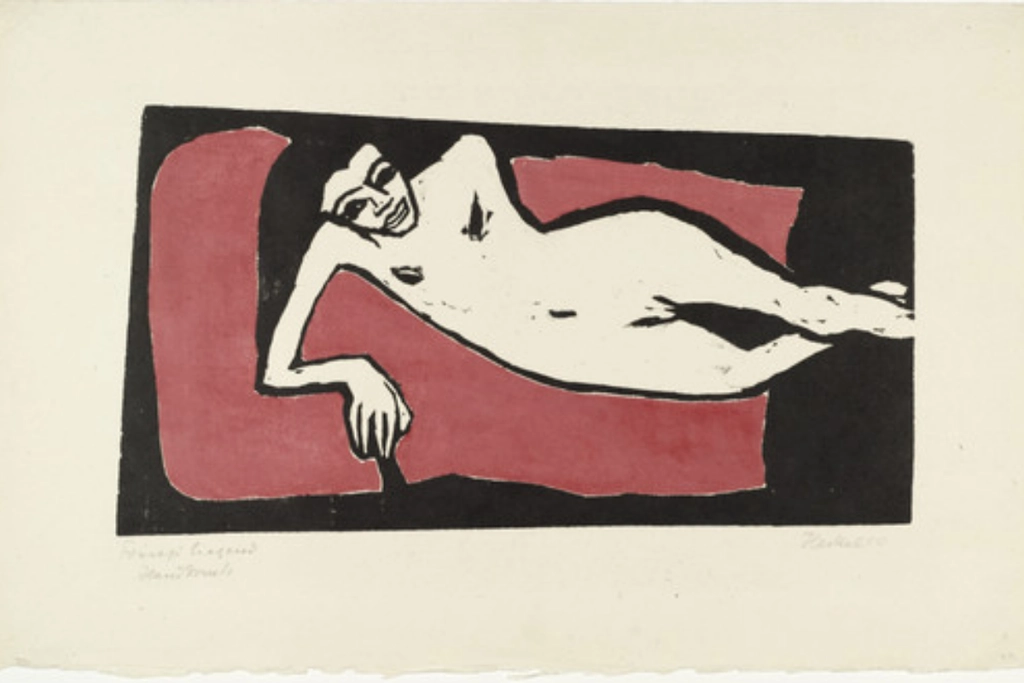
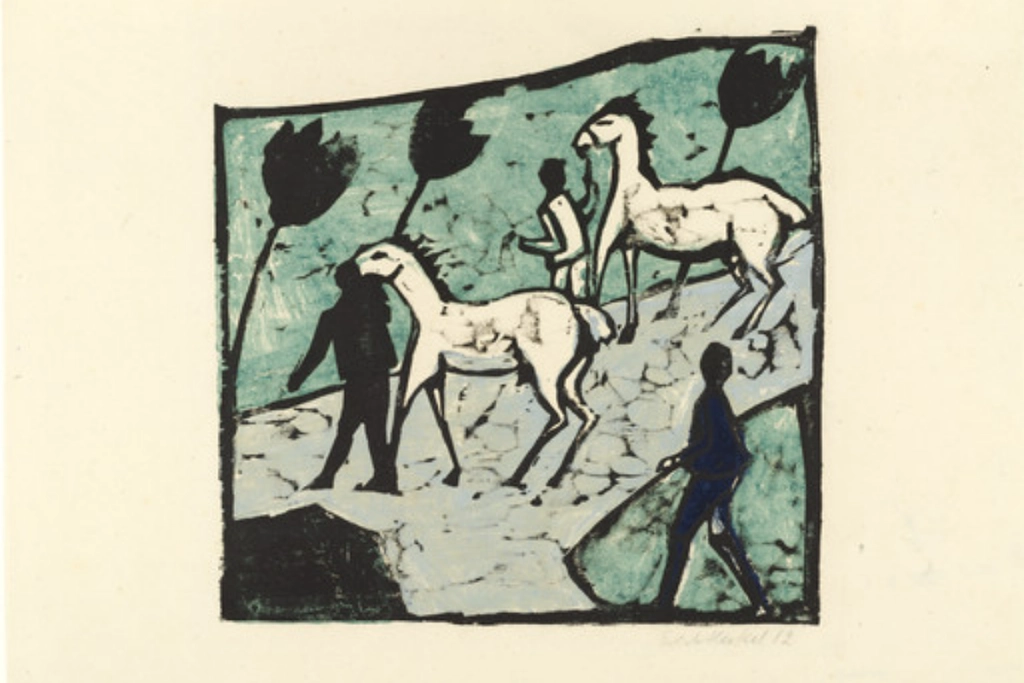
Their paintings and prints carry the energy of people trying to tear culture away from academic supervision. Jagged contours, flattened bodies, rough woodcuts, and clashing palettes opposed the polished surfaces of official art. They admired medieval German printmaking and studied art from Africa and Oceania, though their appropriation of cultures classified by European institutions as “primitive” also reveals the colonial hierarchies embedded inside modernism.
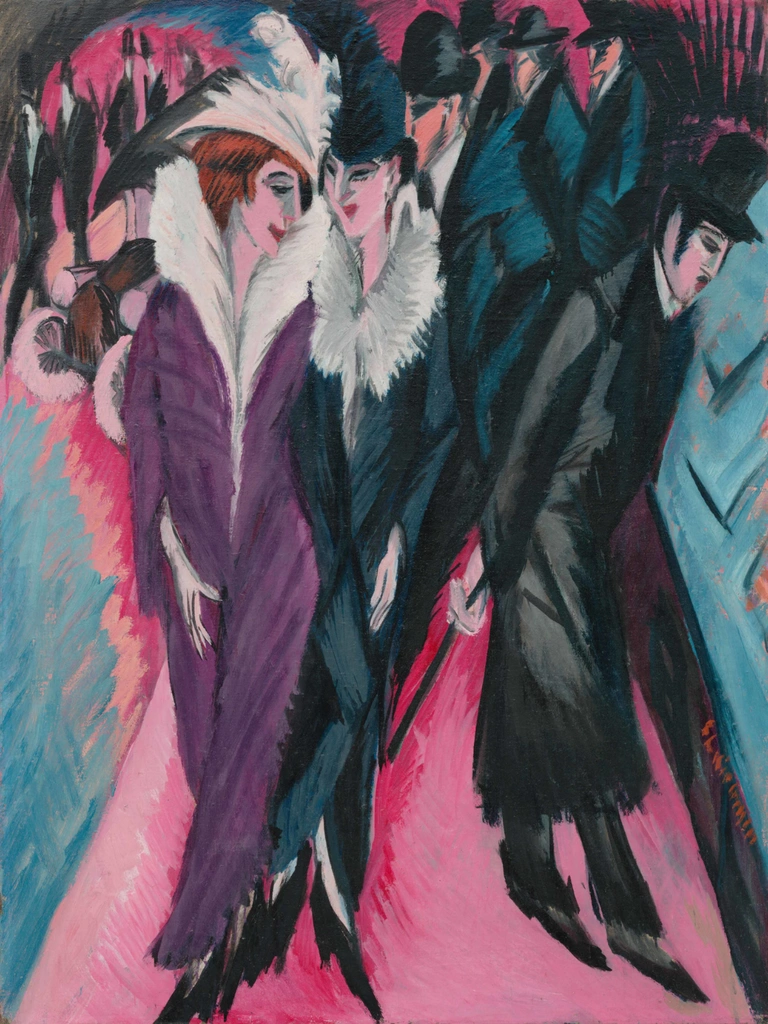
Kirchner’s Street, Berlin from 1913 captures the group’s urban vision at its most severe. Fashionable figures crowd a city street, yet physical proximity creates no intimacy. Needle-like bodies, tilted space, caustic pink, and compressed perspective turn metropolitan elegance into social threat. The women’s elaborate hats and clothing identify the spectacle of modern consumption, while their masklike faces make individuality appear fragile. MoMA describes Kirchner’s wider street series through acute perspectives, jagged strokes, angular forms, and charged colour.
Die Brücke dissolved in 1913, but its members had already established a language capable of representing Berlin’s speed, sexual commerce, alienation, and nervous glamour. The city became a psychological machine. Its pavements offered movement without freedom, crowds without community, and fashion without stable identity.
Der Blaue Reiter emerged in Munich in 1911 under the leadership of Kandinsky and Franz Marc. It functioned as a looser intellectual alliance than Die Brücke. Its members shared an interest in abstracted form, prismatic colour, music, folk art, spirituality, and the possibility that painting could communicate without depending on recognisable subject matter.
Where Die Brücke drove distortion through the modern street and human body, Der Blaue Reiter often directed it toward metaphysics. Kandinsky believed colour and form could operate with the emotional immediacy of music. His titles increasingly borrowed musical structures, including Improvisations and Compositions, because music could generate meaning without illustrating a visible object.
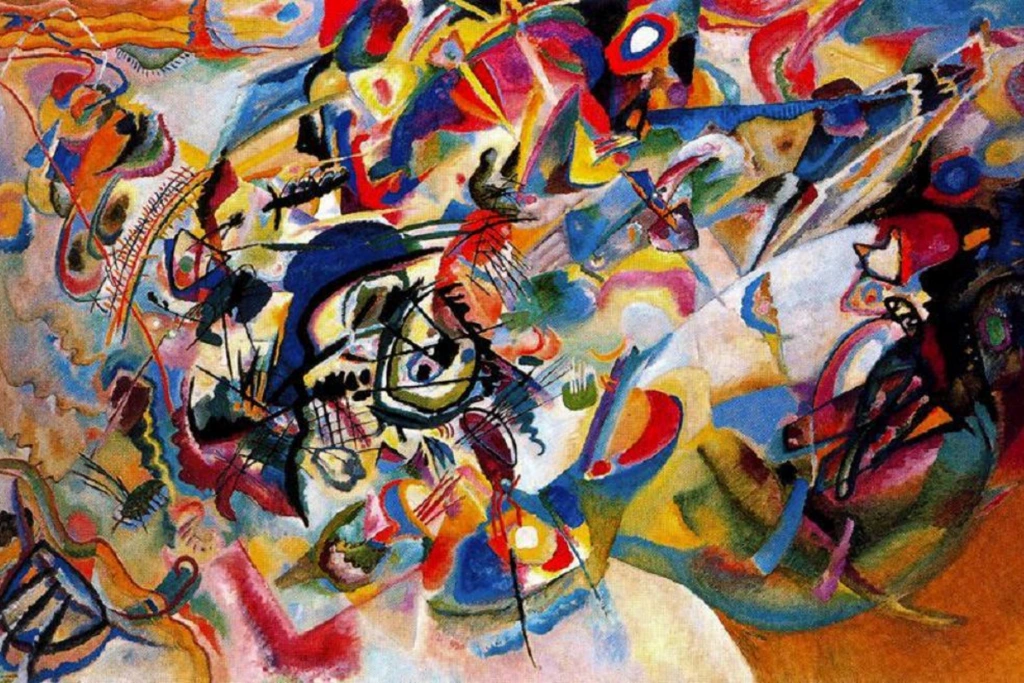
Composition VII, painted in 1913, represents the scale of this ambition. Curves, diagonals, coloured zones, and colliding forms create a turbulent visual field in which conventional depth has almost disappeared. The work has frequently been described as pure abstraction, although traces of recurring Kandinsky themes such as flood, resurrection, and spiritual transformation remain buried within its structure.
Franz Marc approached colour through animals, assigning symbolic and emotional qualities to blue, yellow, and red. In The Large Blue Horses of 1911, the animals form a rhythmic unit of curved backs and lowered heads. Their blue bodies detach them from zoological description and place them inside an imagined spiritual order. The painting proposes nature as a realm of coherence unavailable to modern human society.
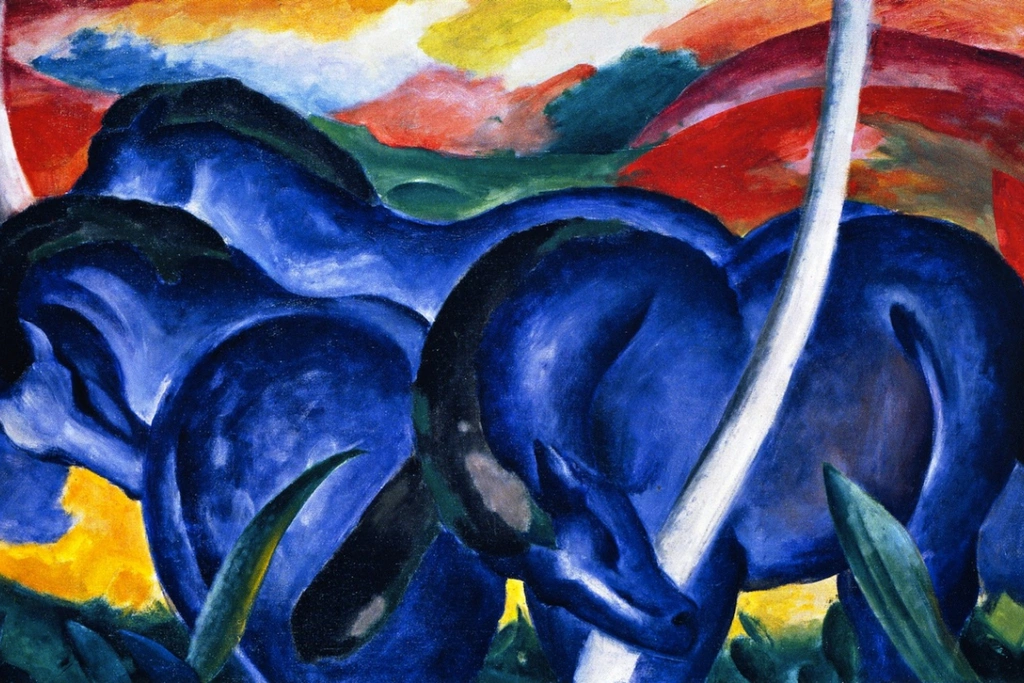
The contrast between the two collectives therefore exceeds style. Die Brücke exposed the friction of modern existence through bodies, streets, sexuality, and social rebellion. Der Blaue Reiter pursued a spiritual language capable of moving beyond materialism. Both treated naturalistic representation as an inadequate instrument for modern experience.
Austrian Expressionism developed through a different cultural atmosphere. Vienna presented itself as an imperial centre of elegance, scholarship, music, and psychoanalysis, while its artists revealed a society preoccupied with sexuality, illness, repression, and the instability of the self.
Egon Schiele made the human body carry this conflict. His figures bend into strained poses, their limbs lengthened, joints sharpened, and skin interrupted by bruised greens, oranges, reds, and exposed paper. The body becomes evidence of consciousness under examination.
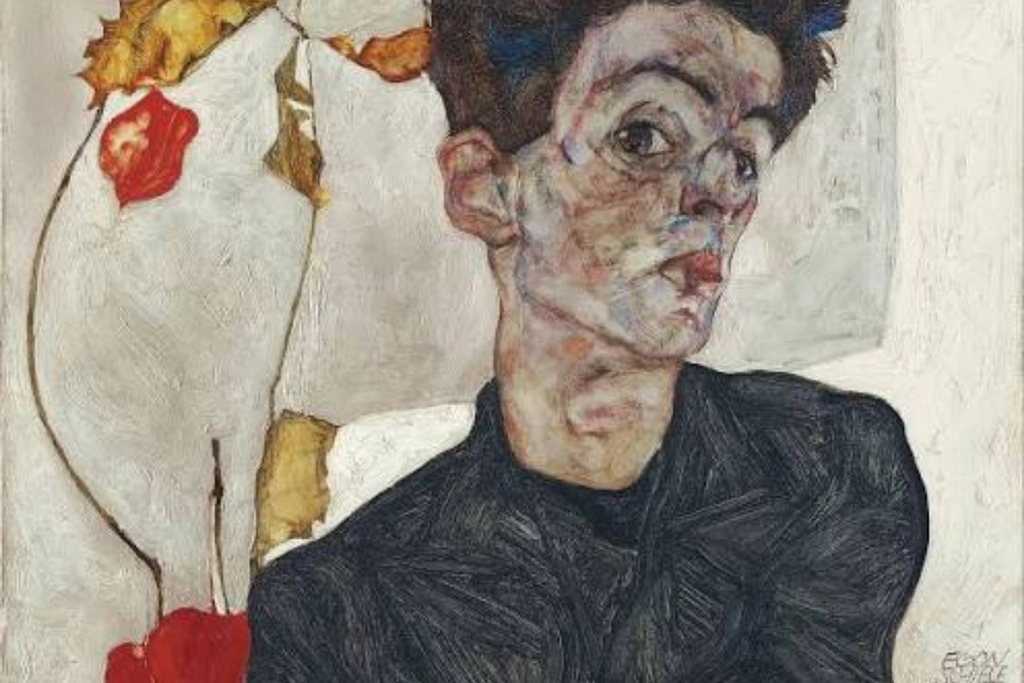
In Self-Portrait with Chinese Lantern Plant from 1912, Schiele turns his head away while fixing the viewer with a direct gaze. The cropped body, dark hair, sharp contour, and red lantern fruit form an exact composition whose control complicates the image of Schiele as a purely spontaneous provocateur. The Leopold Museum describes the portrait as simultaneously fragile and self-confident, with every line carefully balanced by another.
His art strips portraiture of social reassurance. Clothing, posture, and expression cease to stabilise identity. Faces look unfinished, bodies appear vulnerable, and the artist’s repeated self-images offer no final or authoritative version of the self. This intensity helped make Schiele one of Expressionism’s most commercially valuable figures, even though his landscapes remain rarer on the market than his works on paper and figurative studies.
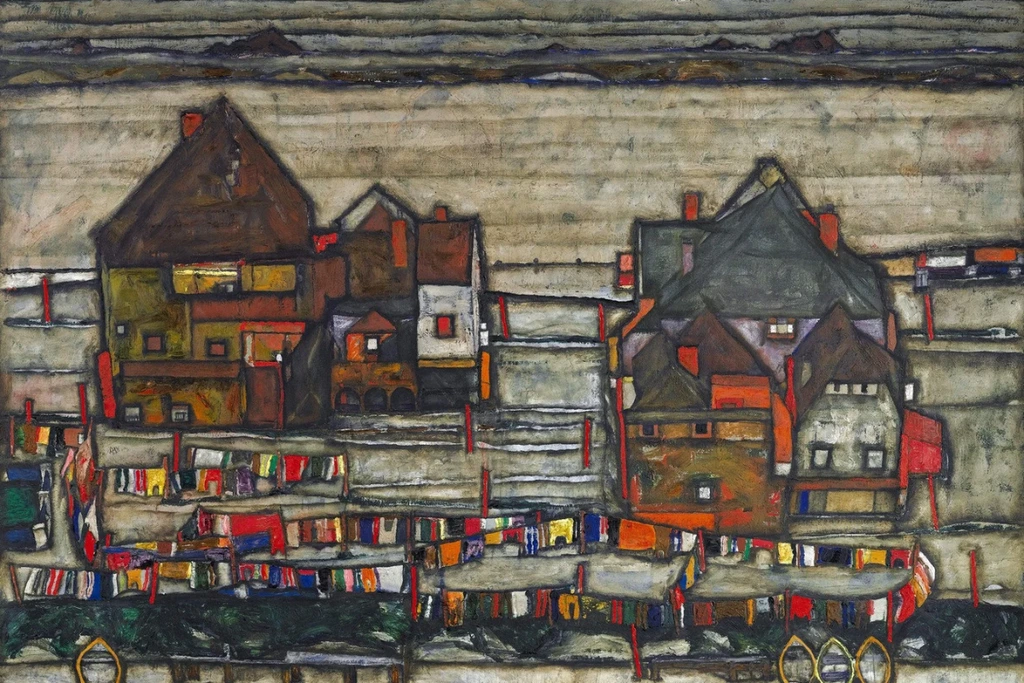
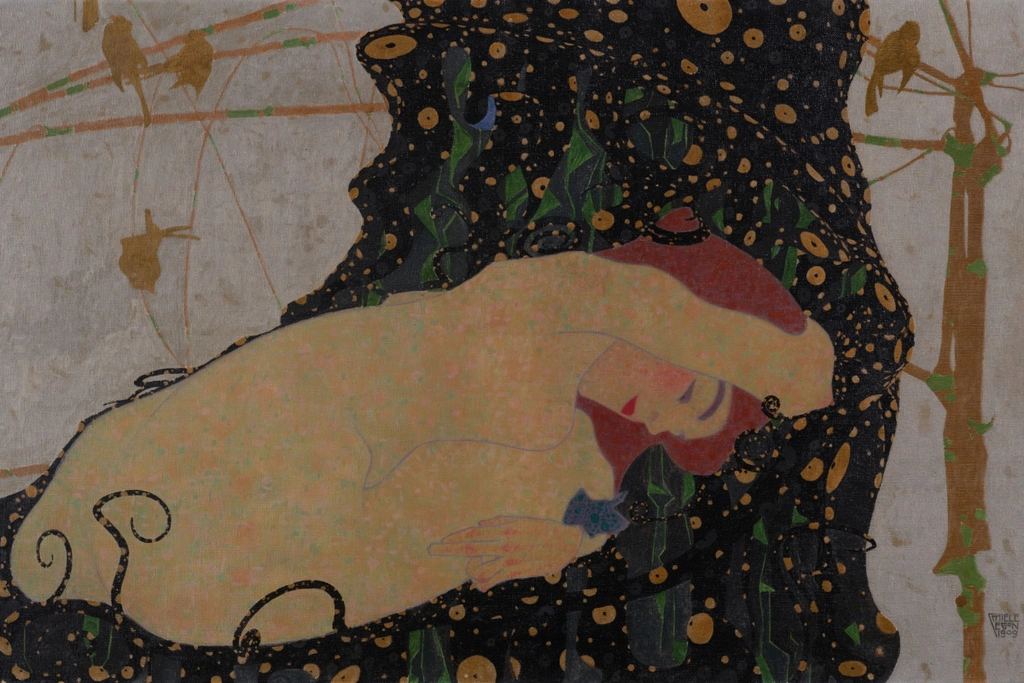
His 1914 townscape Häuser mit bunter Wäsche (Vorstadt II) sold for £24.68 million in 2011, establishing an auction record for Schiele that remained above the £18.4 million achieved by Danaë in June 2026. The price reveals how the market rewards scarcity, provenance, and museum-level scale as heavily as recognisable subject matter.
The political power of Expressionism became brutally clear under National Socialism. Nazi cultural policy treated modernist distortion, abstraction, social criticism, and emotional ambiguity as evidence of racial, moral, and political decay. Expressionist art was especially vulnerable because its fractured bodies and unstable spaces contradicted the regime’s demand for idealised strength, obedience, and legibility.
In 1937, the Nazi government opened the defamatory Degenerate Art exhibition in Munich. Around 740 works were displayed in deliberately humiliating conditions, while more than 20,000 modern artworks were eventually removed from German state-owned museums. Paintings by Kirchner, Kandinsky, Paul Klee, Max Beckmann, and many others were mocked, sold abroad, stored, or destroyed.
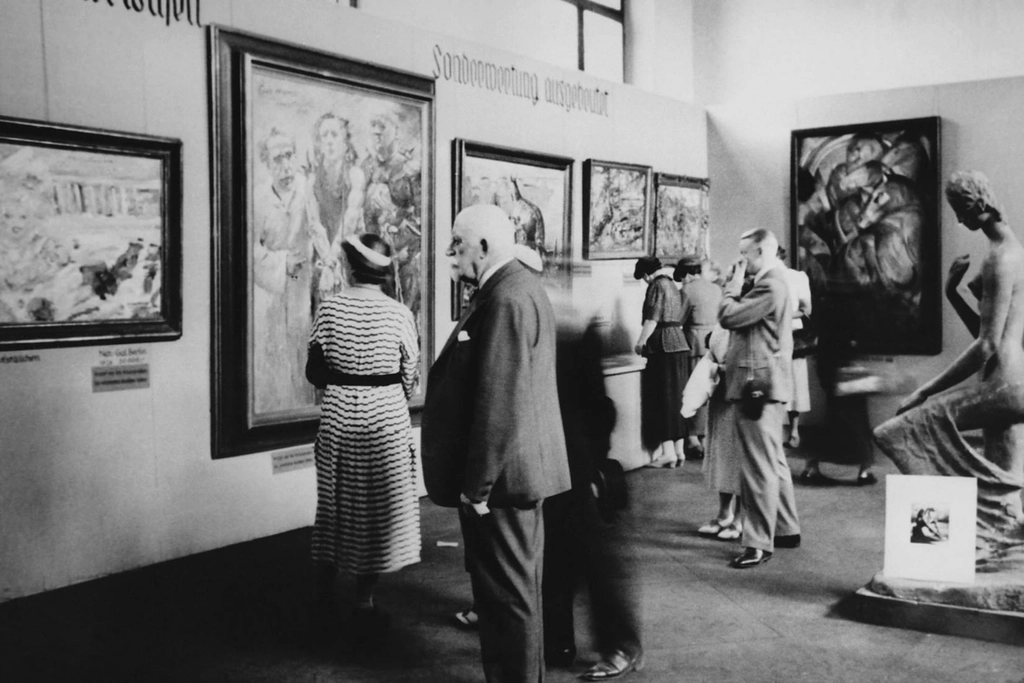
The exhibition exposed the regime’s fear of interpretation. Expressionism refused to provide the disciplined bodies, heroic workers, wholesome families, and clean national myths demanded by authoritarian imagery. Its nervous streets, sexually ambiguous figures, spiritual abstractions, and wounded faces left meaning open. Such openness represented a political danger because it allowed viewers to experience conflict instead of receiving a completed doctrine.
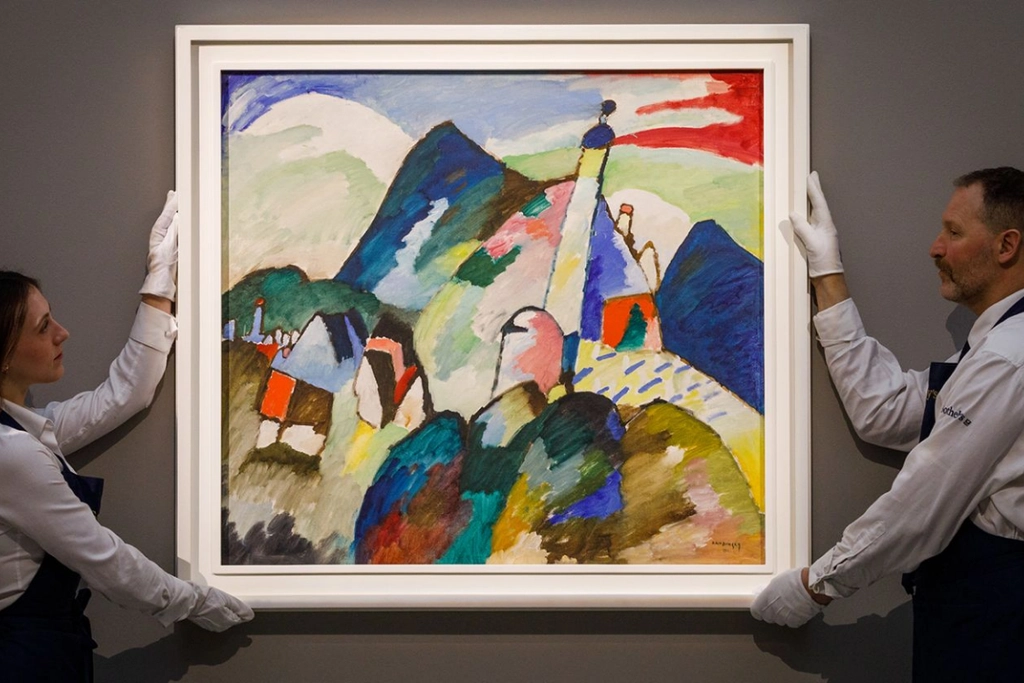
The market now treats many of these once-condemned works as near-sacred commodities. Kandinsky’s 1913 Bild mit weissen Linien sold for £33 million in 2017, before his 1910 painting Murnau mit Kirche II raised his auction record to £45 million in 2023. Munch’s privately held Scream remains a $119.9 million benchmark, while major Kirchner, Marc, and Schiele works are increasingly difficult to obtain outside museums and restituted collections.
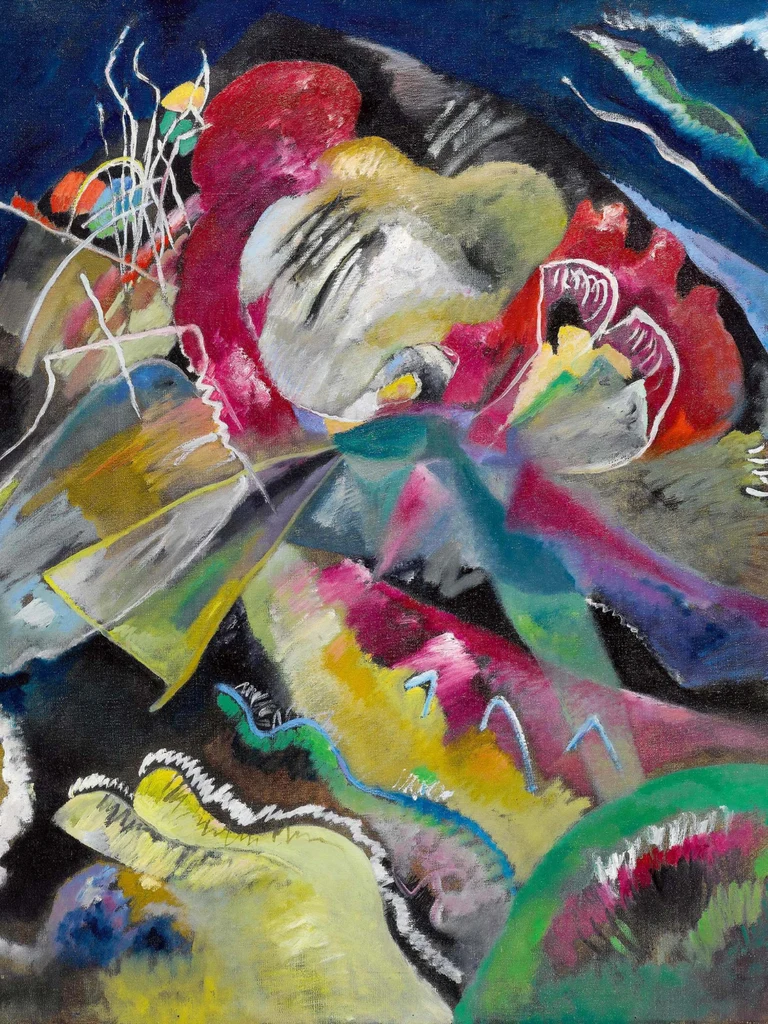
The financial transformation carries a sharp historical irony. Art once condemned as malformed, diseased, and culturally dangerous now commands prices reserved for the most protected objects in the global market. Its radicalism survives beyond those figures. Expressionism changed painting by proving that distortion could possess precision, ugliness could carry intelligence, and emotional truth could demand a reality entirely of its own.