Where does painting end and music begin? Wassily Kadinsky.
Wassily Kandinsky's Musical Abstraction
Where does painting end and music begin? Wassily Kadinsky.
June 4, 2026


Wassily Kandinsky did not enter modern art quietly. He arrived as a man who had already abandoned one life for another. A promising academic career in law went for the dangerous freedom of painting.
For Kandinsky, painting was not simply an image. That is why his legacy feels both intellectual and feverish. Kandinsky was not the mystic hiding from theory, nor the theorist allergic to emotion. He was both. He wanted art to be systematic, almost scientific in its effects, yet also ecstatic. He wanted painting to leave the visible world behind and still feel more real than reality.
The Blue Rider
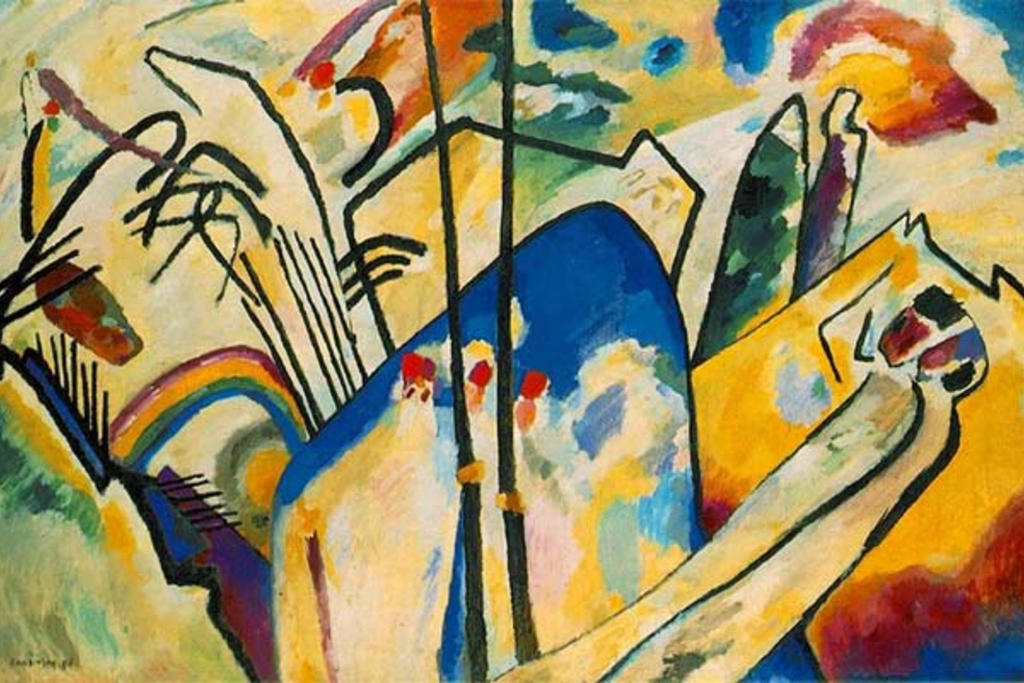
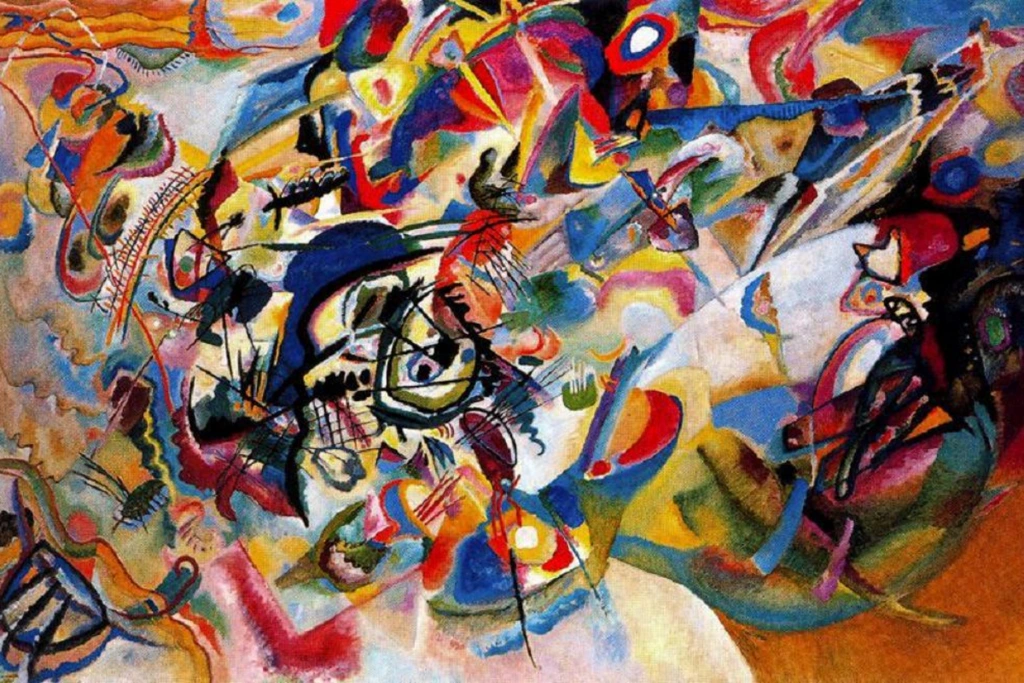
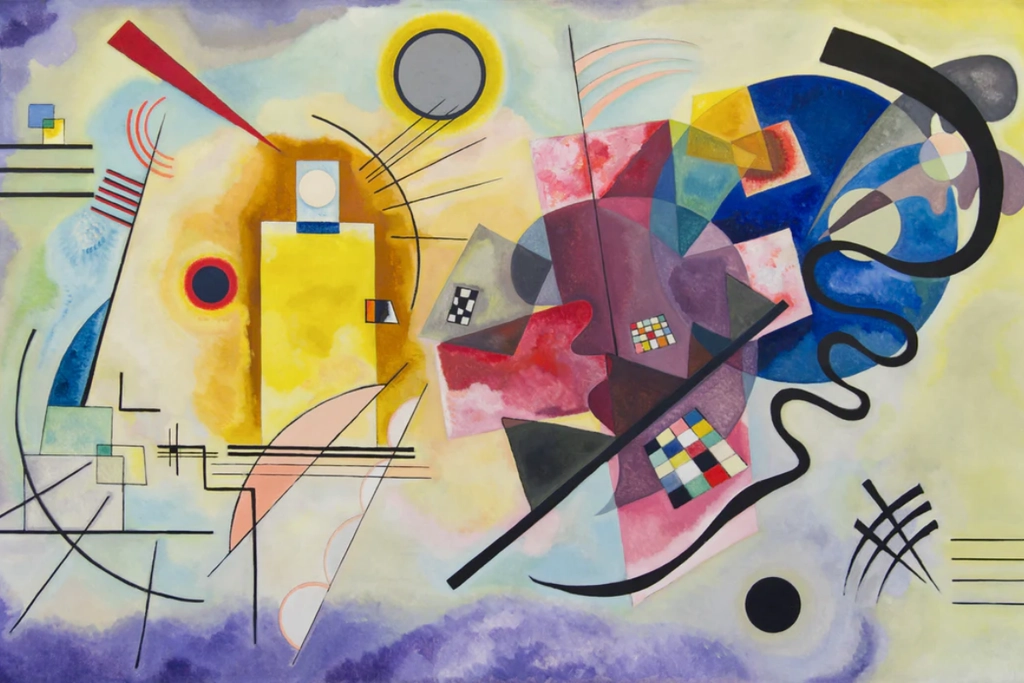
Kandinsky’s road to abstraction unfolded through several lives, and the first great rupture came in Munich. As co-founder of Der Blaue Reiter, or The Blue Rider, he moved away from conventional landscape painting toward something more volatile. Russian folklore, Fauvist colour and spiritual intensity began to loosen the grip of the object. The landscape remained, but it started to dissolve. Horses, hills and figures became less important than motion, colour and inner pressure.
His categories reveal the ambition clearly. Impressions still held traces of the external world. Improvisations moved closer to spontaneous emotional release. Compositions became the grandest form, vast orchestrations where colour and shape could gather into something almost apocalyptic. This was painting with weather inside it.
What made Kandinsky radical was not simply that he removed recognizable objects. It was that he treated their disappearance as liberation. The object, for him, could become a trap. It pinned meaning down too quickly. Once the viewer recognized a tree, a horse or a town, imagination narrowed. Abstraction opened the field again.
The Upside-Down Epiphany
The most cinematic story in Kandinsky’s mythology takes place in his Munich studio at dusk. He entered the room and saw a painting glowing with extraordinary force, beautiful precisely because it seemed to contain no recognizable subject. Only later did he realize it was one of his own landscapes turned upside down. The accident became a revelation. The painting had become more powerful when the object disappeared.
Whether read as myth or memory, the episode captures the central drama of his art. Kandinsky did not hate the visible world. He distrusted its authority. He believed objects could reduce painting into description, while colour and form could open a more dangerous territory: feeling without narrative, force without illustration, music without sound.
This was the beginning of his great modernist seduction. Kandinsky gave abstraction a spiritual alibi. The blankness was not empty. The missing object was not absence. It was an invitation to experience painting as vibration.
Painting Sound, Hearing Colour
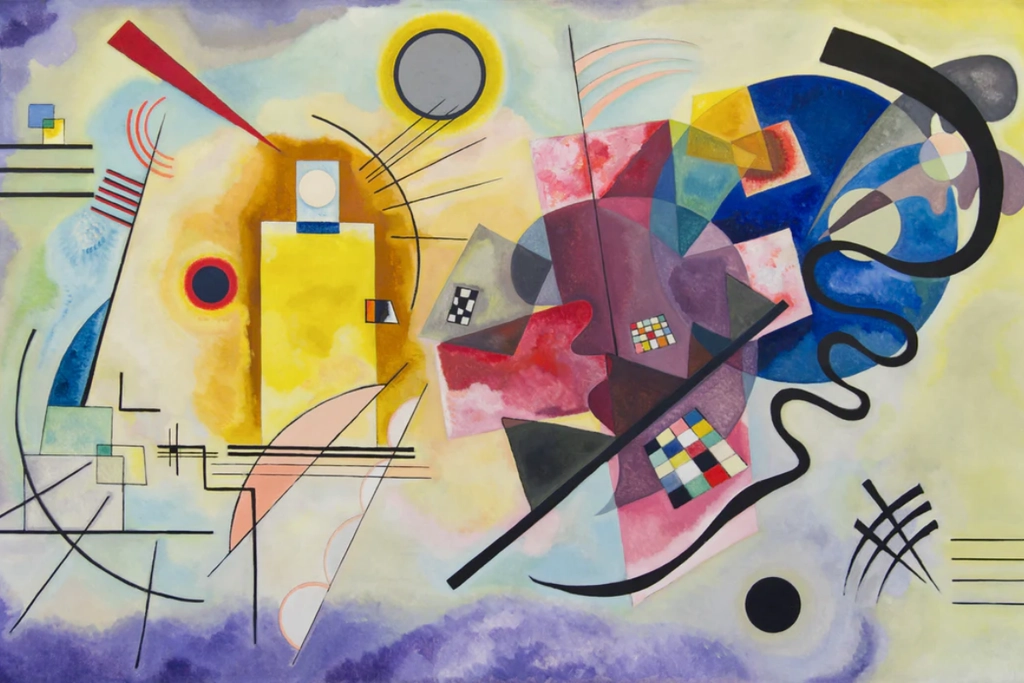
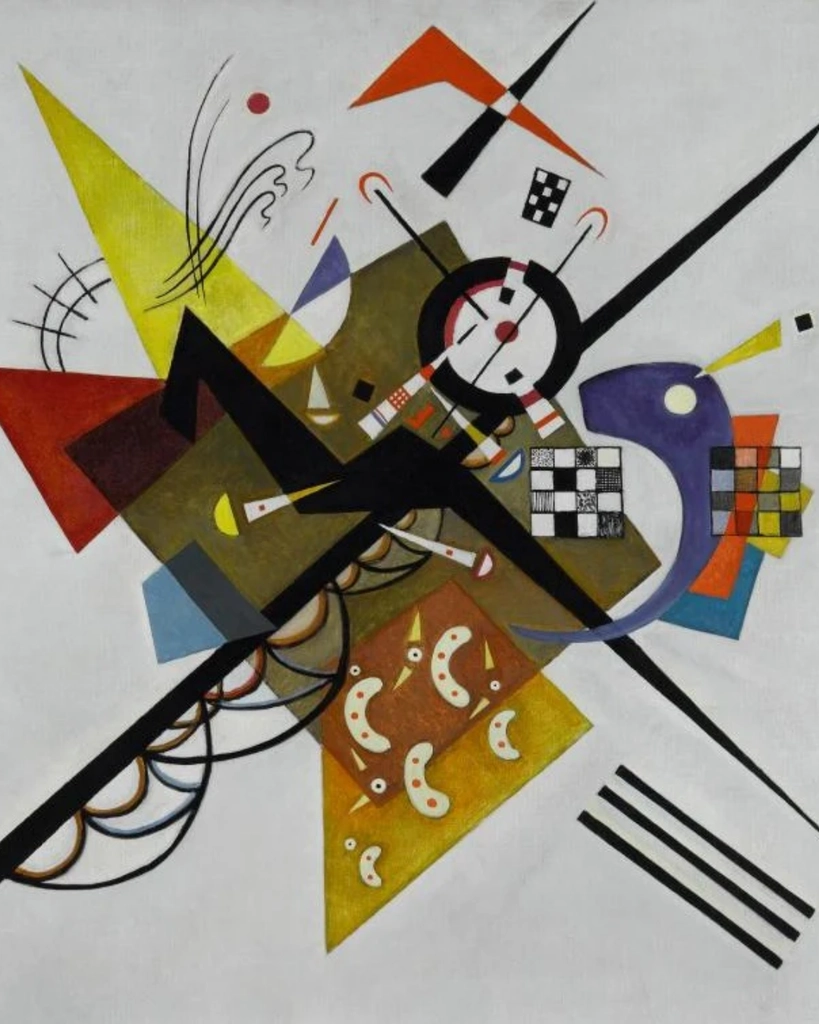
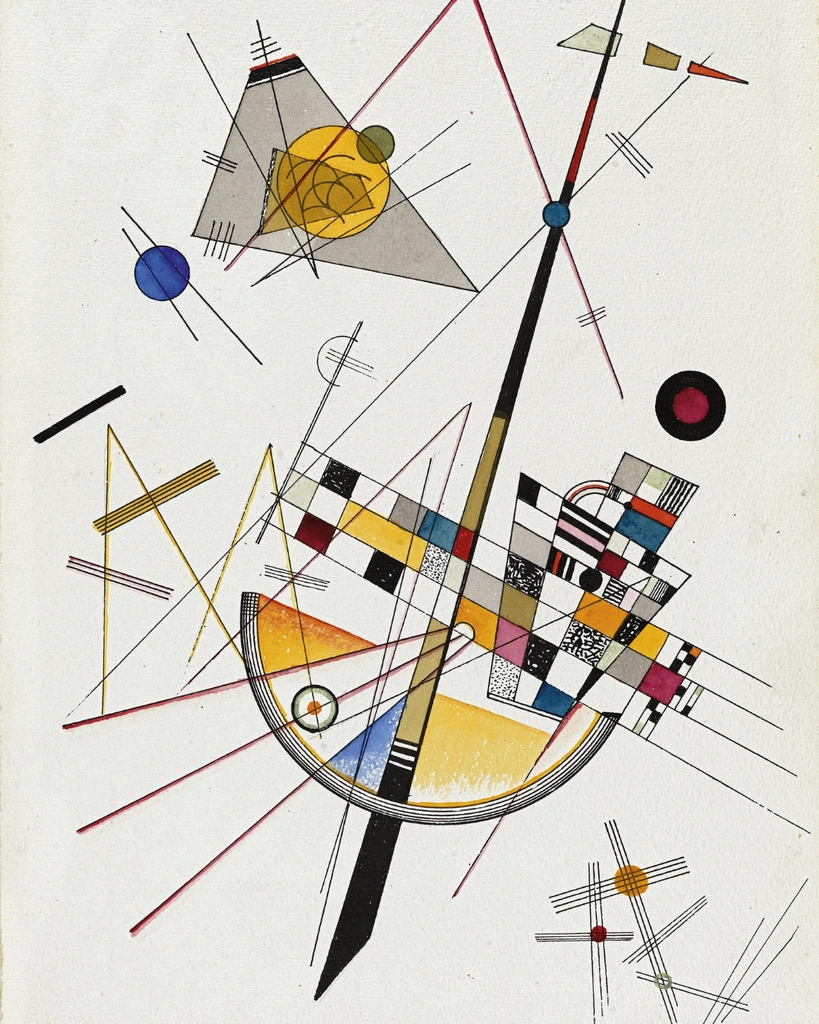
To read Kandinsky properly, one has to enter his strange sensory theatre. He wrote about colour with the language of music, chords, resonance, vibration, inner sound. In his landmark 1911 treatise Concerning the Spiritual in Art, colour was never merely visual. Light blue could suggest the flute, dark blue the cello or double bass, yellow the sharp blare of a trumpet, red the force of drums or tuba.
This is where Kandinsky becomes more than a painter of abstraction. He becomes its composer. His theory of Internal Necessity imagined the artist arranging visual elements not for resemblance, but for psychic impact. A successful painting did not need to show a mountain, a body or a room. It needed to strike the correct inner note.
There is something almost luxurious in that idea, but also severe. Kandinsky was asking the viewer to give up the comfort of recognition and enter a more unstable form of looking. The painting would no longer tell you what it was. It would act upon you.
Bauhaus Geometry And The Discipline Of Ecstasy
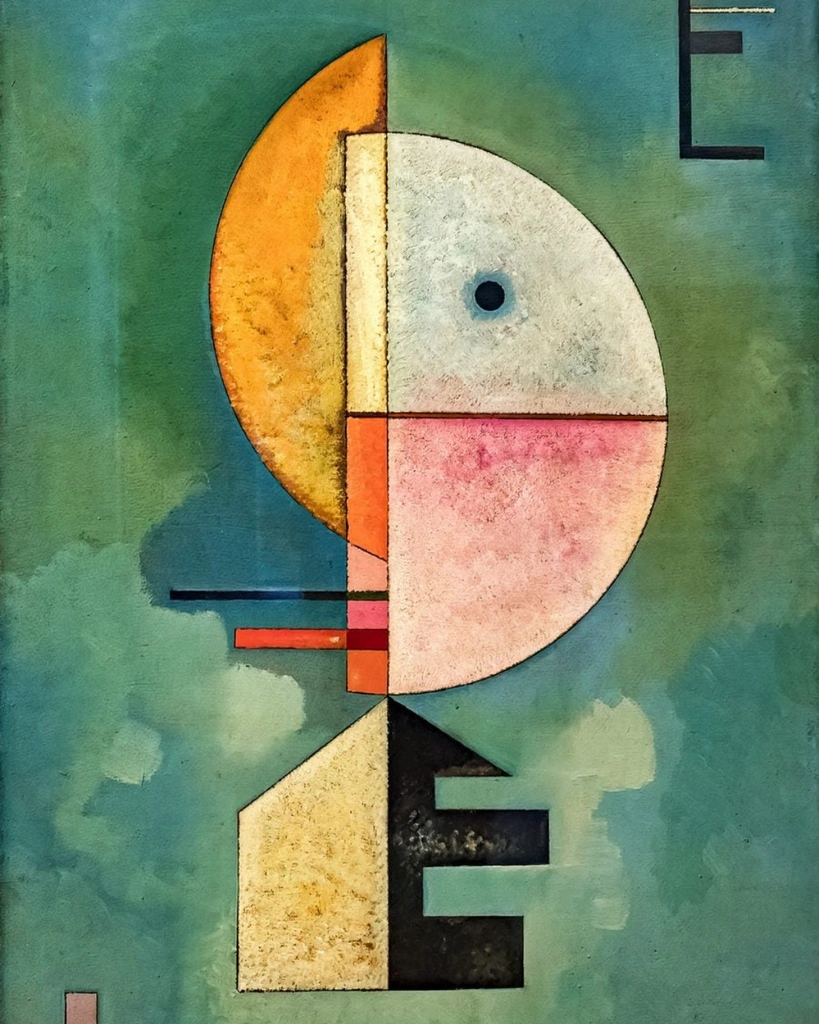
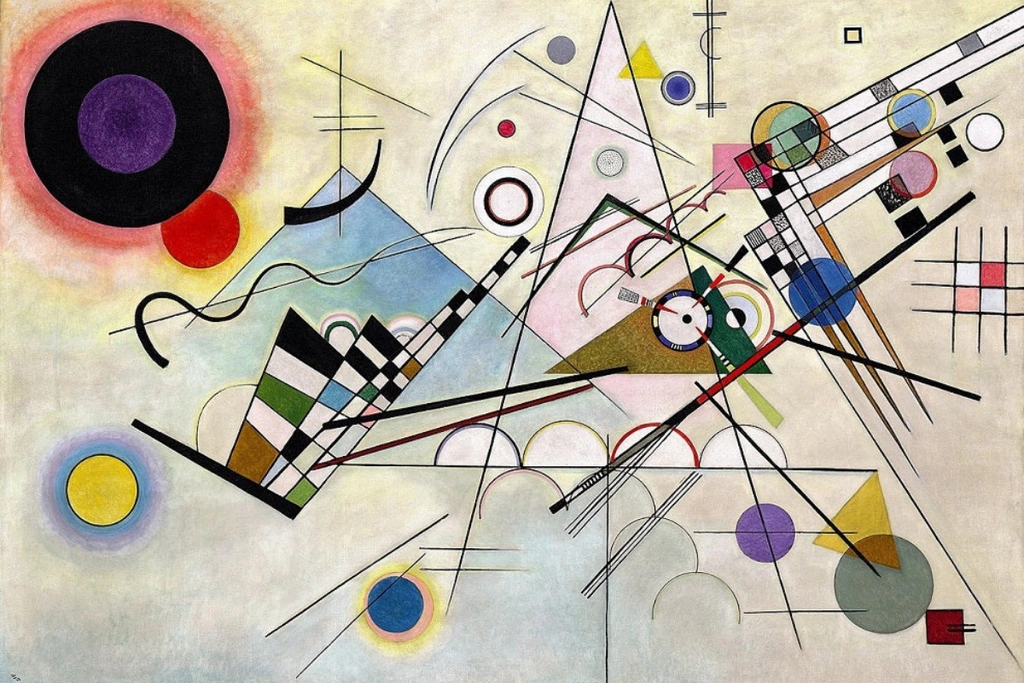
Then came the Bauhaus, and Wassily Kandinsky’s wild emotional weather found a harder architecture. In Germany, between 1922 and 1933, his work shifted toward structure. The brushstroke became cleaner. The composition became sharper. Triangles, circles, grids and intersecting lines replaced earlier turbulence. The spiritual did not disappear; it became engineered.
This phase is sometimes treated as a cooling of Kandinsky’s art, but that misses the tension. The Bauhaus works feel like emotion forced into mathematics. They are not colder. They are more controlled. If the Blue Rider years sounded like an orchestra in a storm, the Bauhaus period sounds like a score drawn by a ruler.
Here, Kandinsky’s abstraction became modern in a new way. It no longer depended on explosion. It could operate through balance, pressure, collision and precision. The circle, the triangle and the line became actors. Geometry became drama.
Paris, Exile And The Return Of The Living Form
In 1933, Kandinsky left Nazi Germany for Paris, after the Bauhaus was forced to close and avant-garde art came under attack. His work had been condemned by the Nazi regime as “Degenerate Art,” a label meant to humiliate modernism and strip it of legitimacy. Yet exile did not freeze his vision. In Paris, his paintings softened again.
The rigid geometry of the Bauhaus years gave way to biomorphic forms. Floating shapes that resemble amoebas, embryos, microscopic organisms, marine life and private planets. These late works feel lighter, stranger, almost playful, but their playfulness has depth. Kandinsky was no longer painting the explosion of abstraction or its architecture. He was painting its afterlife.
The Parisian canvases suggest that abstraction could breathe. It could become cellular, aquatic, humorous, intimate. The spiritual system became less monumental and more microscopic, as if Kandinsky had turned from the cosmos to the organism and found the same mystery scaled down.
The Guggenheim Spiral And Kandinsky’s Afterlife
Kandinsky’s influence did not remain inside the canvas. His spiritual theories deeply affected Solomon R. Guggenheim, whose collection of more than 150 Kandinsky works helped form the foundation of the Museum of Non-Objective Painting in New York, the institution that later became the Solomon R. Guggenheim Museum.
That architectural afterlife feels fitting. Kandinsky spent his career arguing that painting could move beyond the object and become an experience of ascent, vibration and inner transformation. The Guggenheim’s spiral gave that idea a physical body. Visitors did not simply stand before abstraction; they moved through a modern temple partly built from its promise.
The irony is that Kandinsky wanted to free painting from the material world, yet his legacy became embedded in one of the most recognizable museum structures of the twentieth century. His art escaped the object, then helped build an icon.
The Essence of Wassily Kadinsky's Abstraction
Wassily Kandinsky remains powerful because he made abstraction feel urgent. He did not treat non-representational painting as a style, but as a spiritual technology. Colour could pierce. Form could vibrate. Geometry could discipline emotion. A painting could become a sound the body hears before the mind explains it.
His work asks the viewer to surrender one habit: the need to recognize before feeling. In Kandinsky’s world, blue deepens into gravity, yellow cuts outward like noise, red glows with force, and the canvas becomes a chamber where vision turns musical.
Modern art did not simply inherit Kandinsky’s abstraction. It inherited his risk: the belief that painting could abandon the visible world and still tell the truth.