Ai Weiwei (艾未未) has broken ancient vessels, filled museums with millions of porcelain seeds and transformed his own surveillance into art. Yet provocation is never his final destination.

Ai Weiwei, Art That Refuses Silence
Ai Weiwei (艾未未) has broken ancient vessels, filled museums with millions of porcelain seeds and transformed his own surveillance into art. Yet provocation is never his final destination.
July 22, 2026


Born in Beijing in 1957, Ai Weiwei has become one of the most prominent conceptual artists and cultural dissidents of the 21st century. His practice moves restlessly between sculpture, photography, architecture, filmmaking, performance, social media and public installation. Traditional Chinese carpentry may appear beside industrial steel. An ancient ceramic vessel may be coated in synthetic paint. Children’s toy bricks may be reorganised into portraits of political prisoners.
These contradictions are central to Ai Weiwei’s work. He does not treat history as something safely preserved behind museum glass. He treats it as unstable material—something repeatedly destroyed, rewritten, commercialised and claimed by those with enough authority to define its meaning.
The Personal History Behind the Provocation
Ai Weiwei’s defiance began long before he became internationally famous. His father, Ai Qing, was an influential modern Chinese poet who was denounced as a “rightist” under Mao Zedong. The family was sent first to Heilongjiang and later into exile in Xinjiang, where they endured years of political humiliation and harsh living conditions. Ai has recalled watching his father perform degrading forms of labour, including cleaning public toilets, after being stripped of his cultural position.
The experience gave Ai an intimate understanding of how quickly a celebrated intellectual could be transformed into an enemy of the state. Political power did not merely punish the body; it attempted to rewrite identity, erase dignity and determine which memories could survive.
After returning to Beijing, Ai studied at the Beijing Film Academy and became involved with the Stars, an influential avant-garde group that challenged the restrictions imposed on artistic production in post-Mao China. He later lived in New York from 1981 to 1993, absorbing the work of Marcel Duchamp, Andy Warhol, Jasper Johns and other figures who had radically expanded the definition of art.
Destruction as a Form of Creation
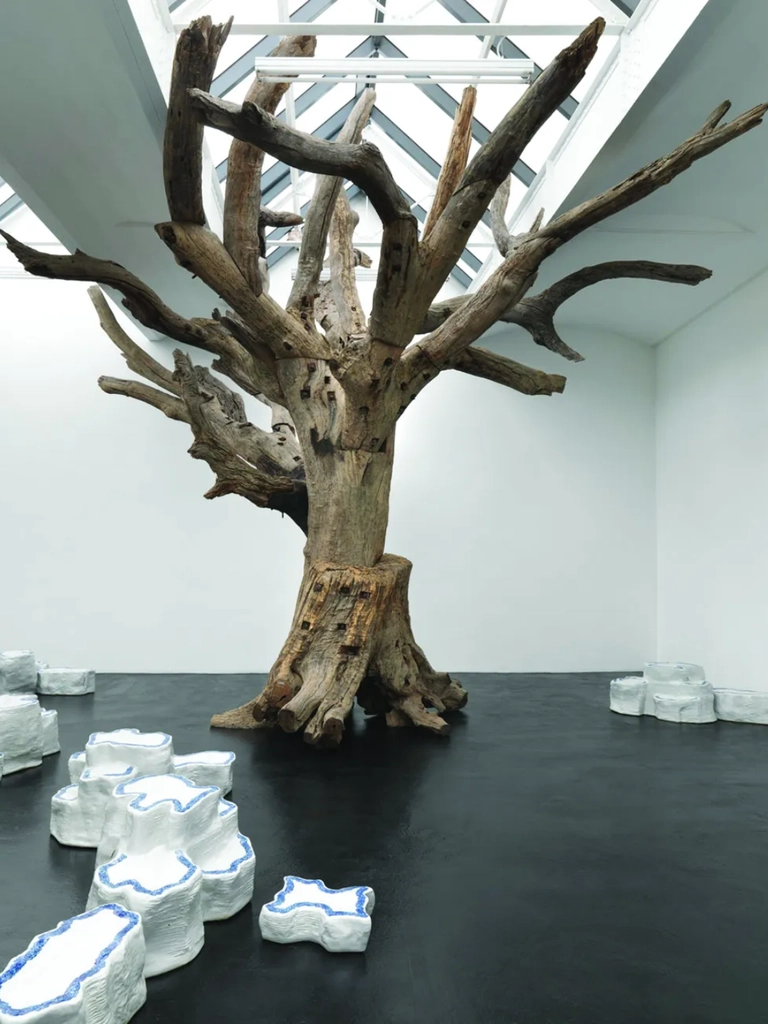
Ai Weiwei frequently uses existing objects rather than creating pristine forms from nothing. Antique furniture, timber from dismantled temples, historic vessels, bicycles, life jackets and mass-produced toys enter his work carrying histories that he then interrupts.
In Colored Vases, ancient ceramic vessels are submerged beneath layers of bright industrial paint. In other works, Han Dynasty urns are marked with the Coca-Cola logo, forcing an encounter between cultural antiquity and global consumer branding. The gestures can initially appear destructive or even disrespectful. Yet their discomfort is precisely the point.
Who determines that an object is sacred? Does age automatically create value? Can cultural heritage remain authentic once it has entered an international market? And how different is one artist painting an ancient vessel from a government demolishing historic neighbourhoods in the name of modernisation?
Ai’s interventions expose destruction as an ongoing political and commercial process rather than a single shocking act. He damages the surface so that viewers are forced to reconsider the systems that assigned the object its value in the first place.
The Individual Against the Monument
This strategy reaches its most concentrated form in Dropping a Han Dynasty Urn. Created in 1995, the photographic triptych shows Ai holding, releasing and watching a roughly 2,000-year-old ceremonial vessel break against the ground. His expression remains almost impassive as an object associated with cultural continuity becomes fragments.
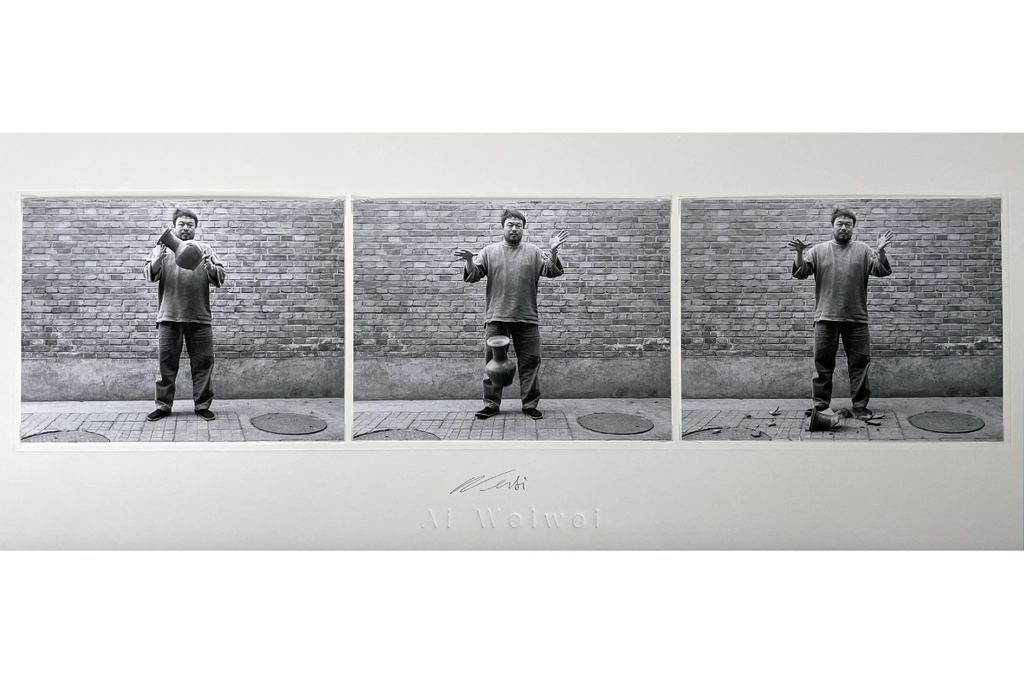
The work is often interpreted as an attack on cultural preservation, but it is equally a confrontation with manufactured reverence. Ai turns destruction into evidence. The photographs ensure that the lost object becomes more visible after its destruction than it may ever have been before.
Study of Perspective, produced across several years beginning in 1995, uses a far simpler gesture. Ai extends his middle finger towards institutions and landmarks including Tiananmen Square, the White House, the Reichstag and the Eiffel Tower. The body appears small against these symbols of national, cultural and political authority, yet the gesture disrupts their grandeur.
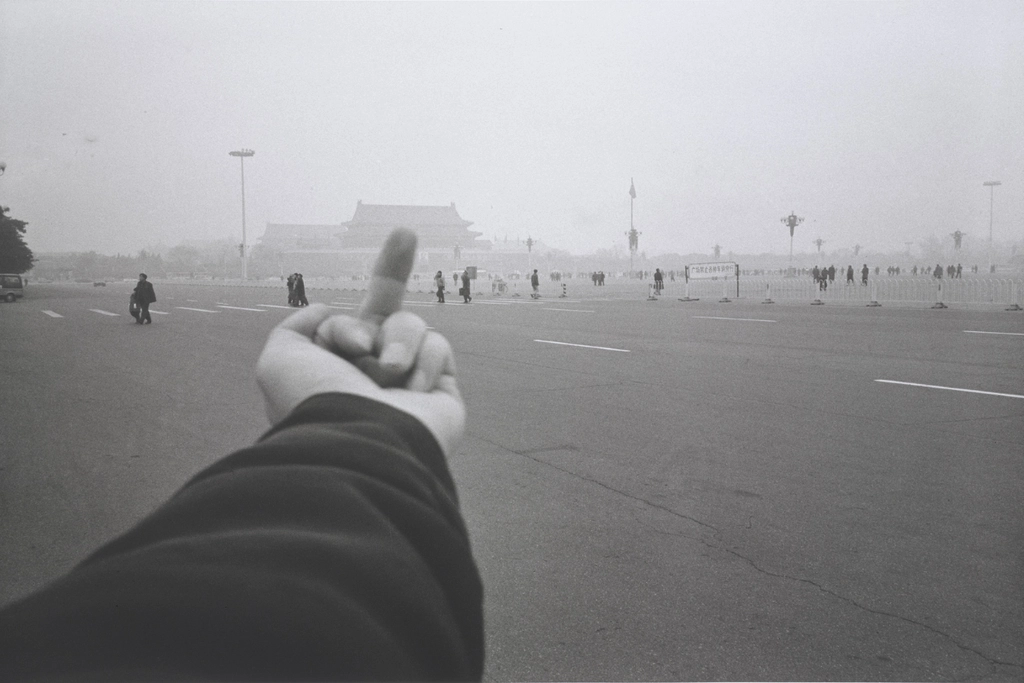
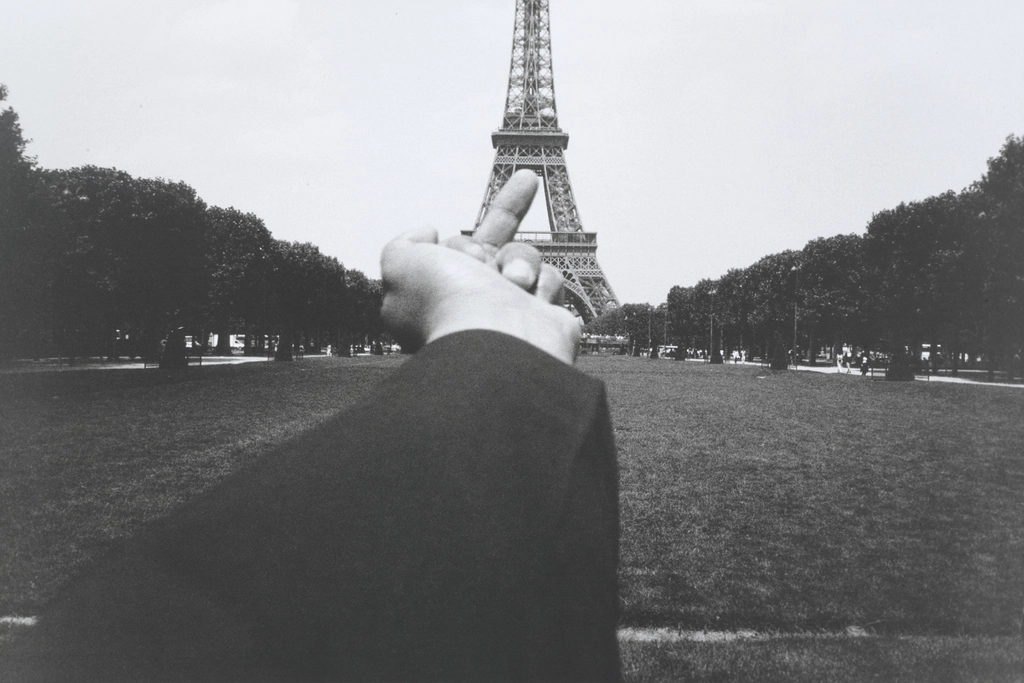
It is a deliberately crude form of measurement. Instead of allowing the monument to dictate perspective, Ai places the individual hand in the foreground. Authority is pushed into the distance.

One Hundred Million Individuals
For Sunflower Seeds, installed in Tate Modern’s Turbine Hall in 2010, Ai covered the vast floor with more than 100 million porcelain seed husks. Each was moulded and hand-painted by specialists in Jingdezhen, the historic centre of Chinese porcelain production. Approximately 1,600 artisans worked on the project for around two years.

From a distance, the seeds resemble a uniform grey field. Up close, small differences emerge. Each mark has been applied by a human hand.
The installation complicates familiar ideas about China as the world’s factory. An apparently mass-produced landscape is revealed to be the result of painstaking individual labour. At the same time, each unique object nearly disappears within the crowd.
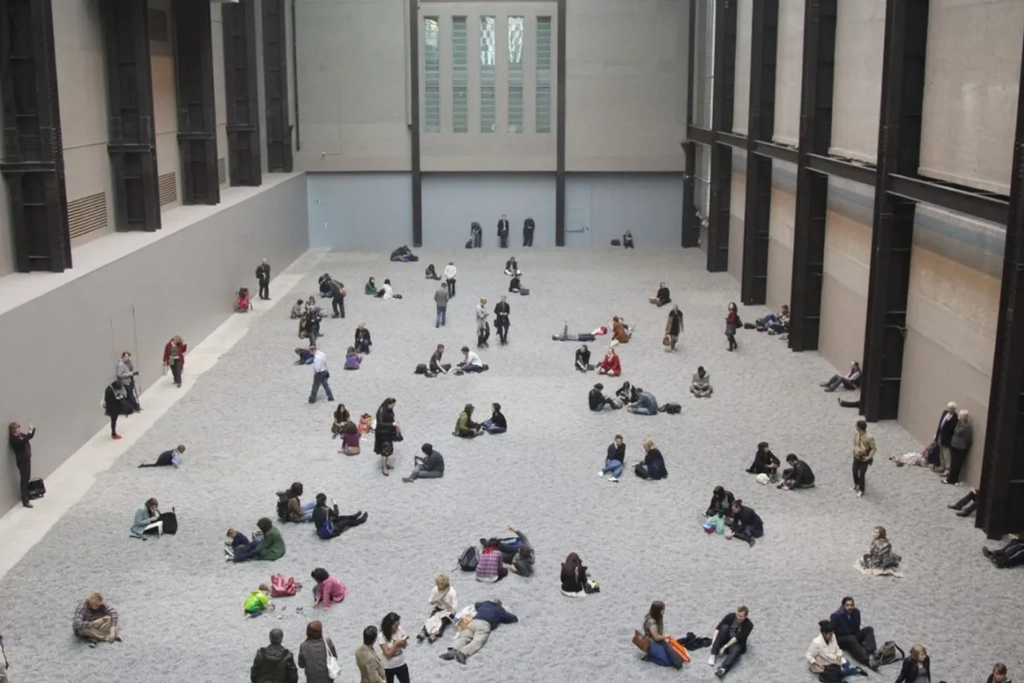
Sunflowers also carried political associations in Mao-era imagery, where the people were frequently represented as flowers turning towards Mao as though he were the sun. Ai reverses the arrangement. The seeds no longer face a central authority. They lie together, numerous but leaderless, inviting viewers to consider whether collectivity must always require conformity.
Reconstructing Stolen History
Circle of Animals / Zodiac Heads recreates the twelve animal heads once installed around a fountain-clock at Yuanming Yuan, Beijing’s Old Summer Palace. The original bronzes were removed after Anglo-French forces looted and destroyed the complex in 1860.

Ai’s versions resist a simple reading as patriotic restoration. They are enlarged, newly fabricated and openly inauthentic. By reproducing objects already surrounded by disputes over looting and repatriation, he asks whether a copy can acquire the symbolic authority of an original—and whether national identity itself is partly constructed through objects selected to represent collective loss.
The work therefore speaks simultaneously about colonial violence, cultural ownership and the art market’s appetite for scarcity. History becomes something that can be stolen, copied, auctioned and reclaimed several times over.
Activism as Artistic Material
For Ai Weiwei, activism is not an activity separate from the studio. Investigations, documentary footage, online posts and encounters with censorship become part of the work itself.
In April 2011, Chinese authorities detained him for 81 days at a secret location. After his release, Ai translated the experience into S.A.C.R.E.D., six iron boxes containing near-life-sized dioramas of his confinement. Through small viewing openings, audiences see the artist eating, sleeping, washing and using the toilet while guards remain constantly present.

The 2026 Sewing a Button installation denies viewers the comfort of abstraction. Surveillance becomes architectural. Privacy disappears not through dramatic violence but through the relentless occupation of ordinary space.
Ai later expanded his attention beyond China to migration, borders and the global refugee crisis. Boats, discarded life jackets and documentary filmmaking became means of confronting the way displaced people are transformed into statistics. The scale of these works is often monumental, but their emotional force depends on recovering the individual life hidden inside a mass political event.
Understanding the Ai Weiwei Art Market
Ai Weiwei’s market reflects the unusual breadth of his production. At one end are monumental installations, architectural sculptures, historic wood constructions and complete sculptural groups suited to museums or major collections. At the other are screenprints, porcelain objects, skateboards, jewellery and editioned multiples that allow private collectors to enter the market at a considerably lower level.
His strongest publicly documented auction result remains the bronze edition of Circle of Animals / Zodiac Heads, sold by Phillips in London in June 2015 for £3,442,500, then approximately $5.4 million. The result continues to be cited as his auction record.
The lower market may begin in the low thousands. Phillips records examples of the editioned Artist’s Hand selling for approximately £2,300 to £4,500, while larger ceramic groups, wooden constructions and historically important works can command tens or hundreds of thousands. Current asking prices and auction estimates also vary significantly according to material, scale, edition size, provenance and exhibition history.
Collectors are therefore not purchasing a single recognisable visual style. They are buying entry into a conceptual system in which the object acts as evidence of a larger question.
The Unexpected Life Beyond the Gallery
Ai also served as an artistic adviser to Herzog & de Meuron during the creation of one of the most iconic sport centers, the Beijing’s National Stadium, widely known as the Bird’s Nest. Despite contributing to one of the defining architectural symbols of the 2008 Olympics, he later distanced himself from the Games and criticised their use as political propaganda.

In 2015, LEGO refused to fulfil a bulk order intended for an exhibition containing politically themed works. Supporters responded by donating bricks through collection points around the world. LEGO later changed its bulk-order policy, and a senior company figure acknowledged that the refusal had been an internal mistake.
Ai has even moved his political language into music. In 2013, he released The Divine Comedy, a six-track rock project created with musician Zuoxiao Zuzhou. Its songs revisit detention, censorship and surveillance, turning personal trauma into deliberately abrasive sound.
These episodes reveal an artist unwilling to remain inside the respectable boundaries of contemporary art. Architecture, social media, music, legal conflict and public controversy are not distractions from his practice. They are its expanding territory.
Ai Weiwei’s work does not promise that art can defeat power. It offers something more difficult: a method for refusing power’s preferred version of reality.