MENU
Close





David Hockney found California sunshine suspiciously good, Renaissance perspective suspiciously limited, photography suspiciously static and the iPad suspiciously useful. But after nearly seven decades...
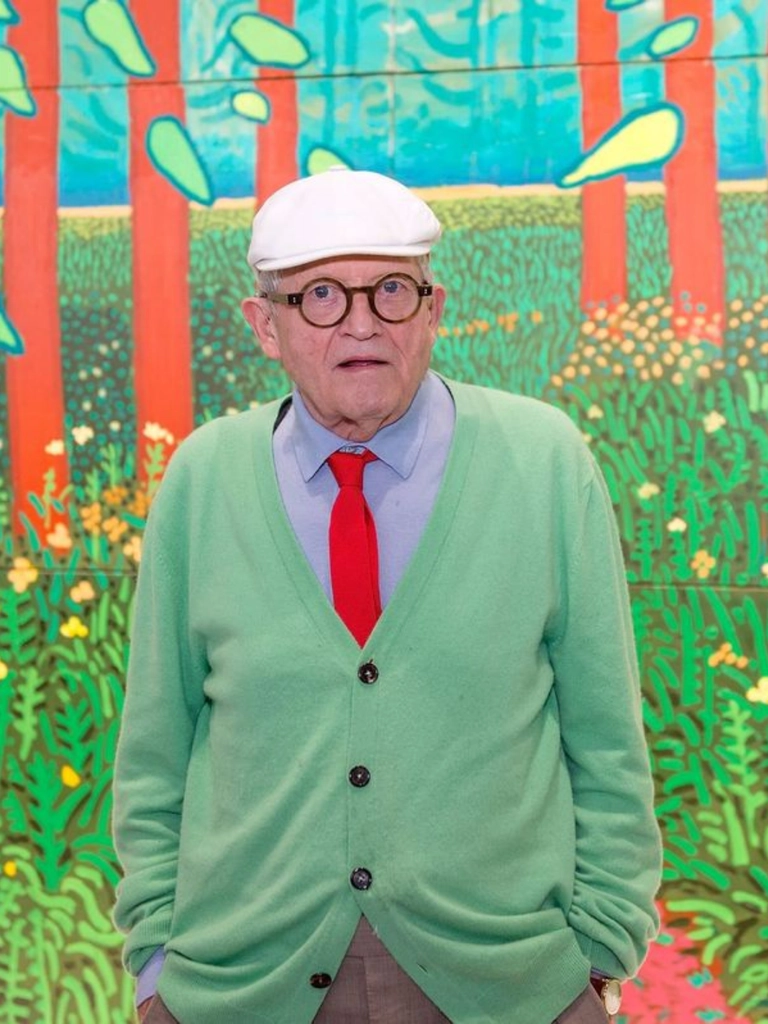
David Hockney found California sunshine suspiciously good, Renaissance perspective suspiciously limited, photography suspiciously static and the iPad suspiciously useful. But after nearly seven decades...
August 7, 2026


Bradford in 1937 hardly sounds like the birthplace of California blue. Born into the industrial north of England, David Hockney was a natural rebel who spent his career defying institutional norms.
After studying at the Bradford School of Art, he entered London’s Royal College of Art, emerging as a disruptor who reshaped British painting in the early 1960s. His defiant streak peaked during final exams: when required to write an essay to graduate, Hockney refused, arguing he should be judged solely on his artwork. Threatened with failure, he fired back with a satirical sketch of a diploma — prompting the college to cave, rewrite its degree rules, and grant his diploma anyway.
That unyielding spirit defined his entire life; by his death in London on 11 June 2026 at age 88, his restless vision had redefined painting, photography, stage design, and digital media.
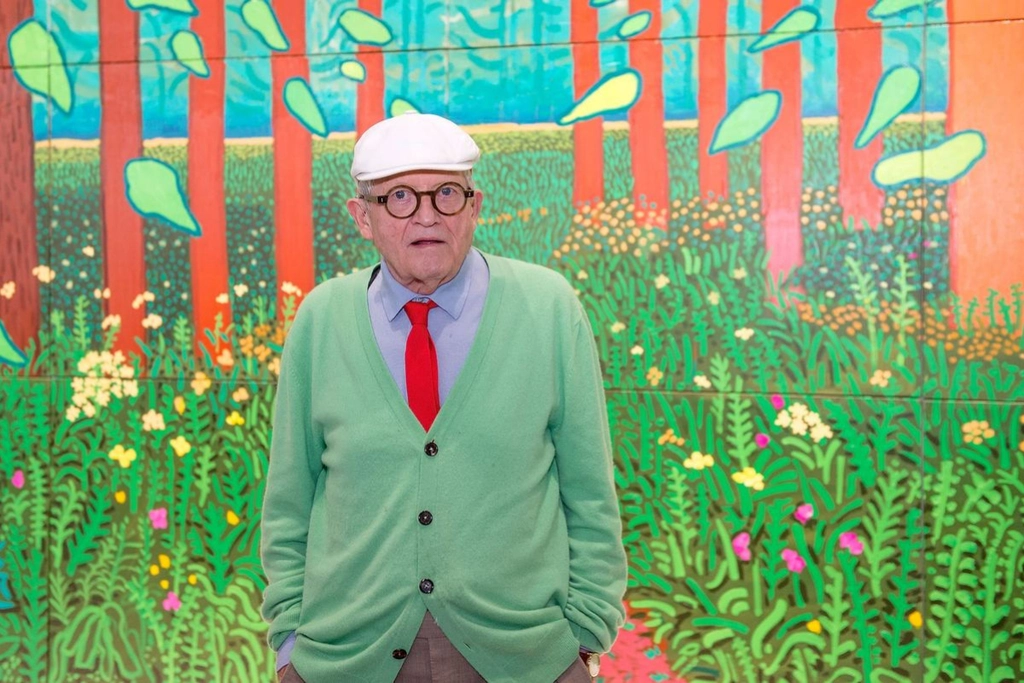
Calling Hockney simply a Pop artist captures one doorway into a much larger building. Pop gave his early career an atmosphere of graphic directness, contemporary imagery and irreverence, yet his deeper obsession concerned vision itself. How does a person experience a room? How does memory alter a landscape? Why should a painting obey a fixed camera-like viewpoint when our eyes constantly wander?
That curiosity allowed Hockney to occupy an unusual position between modern art and contemporary art. He could look toward Picasso, Matisse and Cubism while simultaneously embracing fax machines, Polaroids, photocopiers, video cameras, iPhones and iPads. Technology entered his studio as another way of drawing.
Turquoise pools, hard shadows and immaculate modernist houses gave Hockney a visual vocabulary that London could scarcely supply. He first visited Los Angeles in 1964 and became fascinated by a city where sunlight sharpened architecture into flat blocks of color. Acrylic paint proved ideal for the task. Its rapid drying time supported crisp surfaces, controlled edges and bright color relationships suited to water, glass and Southern California architecture.
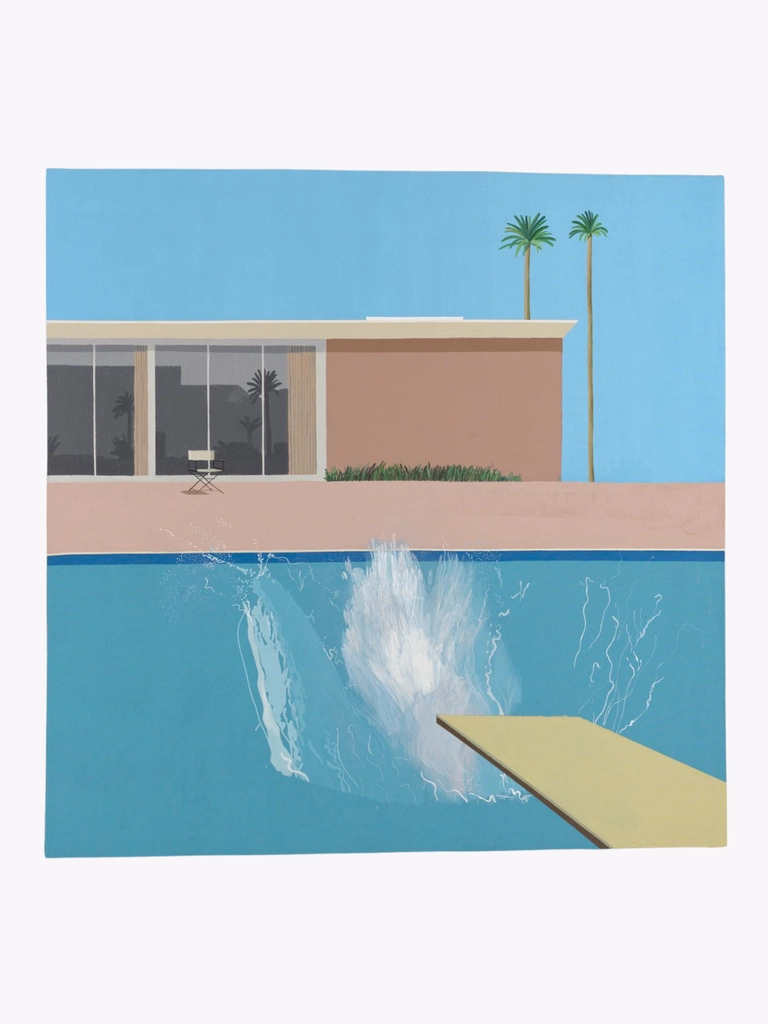
A Bigger Splash from 1967 condensed this fascination into one of the defining images of twentieth-century painting. The swimmer has vanished beneath the surface. Only the explosion of water remains, suspended against a pool whose geometry looks almost aggressively calm. A fleeting event becomes strangely permanent.
That contradiction demanded labor. Hockney spent around two weeks carefully painting the splash, working from photographic material and using small brushes to construct an event that lasted only moments. The image looks spontaneous because enormous control sits beneath it.
Pools also carry cultural meaning. In Hockney’s California, they represented leisure, architectural fantasy, bodily freedom and the private world behind suburban walls. The familiar blue rectangle became a stage where desire, observation and distance could coexist.
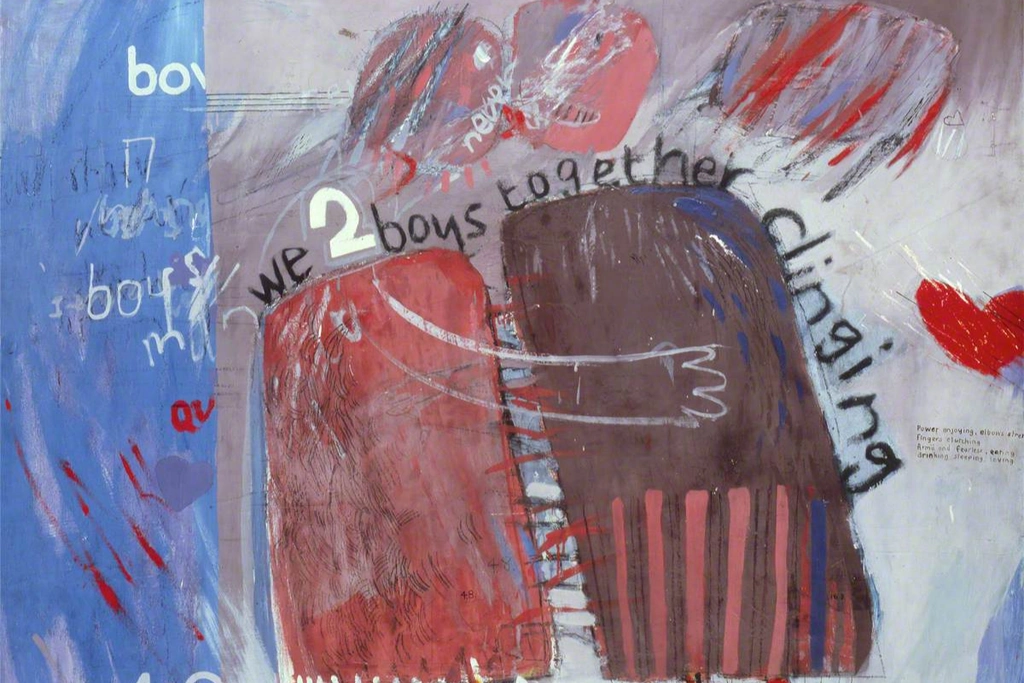
Two male figures cling together beneath handwritten fragments and graffiti-like marks in We Two Boys Together Clinging from 1961. Its title came from Walt Whitman, and its celebration of gay desire appeared while homosexual acts between men remained criminalized in Britain. Hockney’s early paintings therefore entered queer visual history years before the partial decriminalization of homosexuality in England and Wales in 1967.
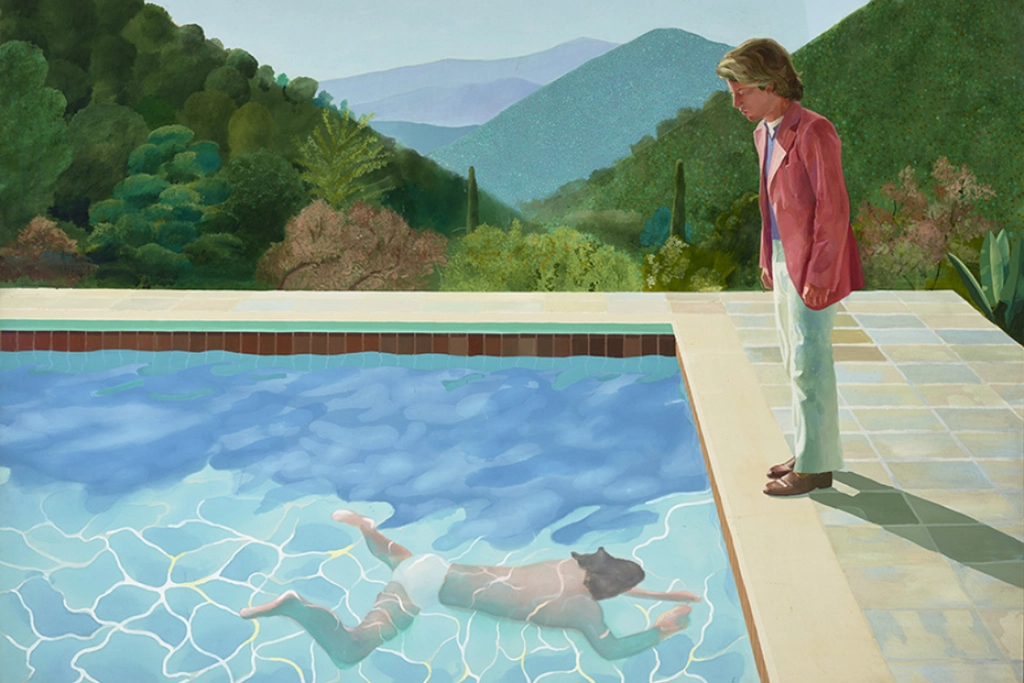
His sexuality functioned as lived material within the work. Friends, lovers, domestic interiors and relationships gave his paintings emotional architecture. Peter Schlesinger became both partner and recurring subject during Hockney’s California years, eventually appearing in one of his most famous compositions, Portrait of an Artist (Pool with Two Figures) from 1972.
This gives Hockney an essential position in contemporary art beyond his instantly recognizable palette. Private queer experience gained the scale traditionally reserved for aristocrats, religious narratives and public history. Domestic life became worthy of monumental painting.
A cat sits comfortably in Mr and Mrs Clark and Percy, yet the human relationship around it looks far more complicated. Fashion designer Ossie Clark occupies a chair while textile designer Celia Birtwell stands near the open window. Light pours through the room, but psychological clarity remains elusive.
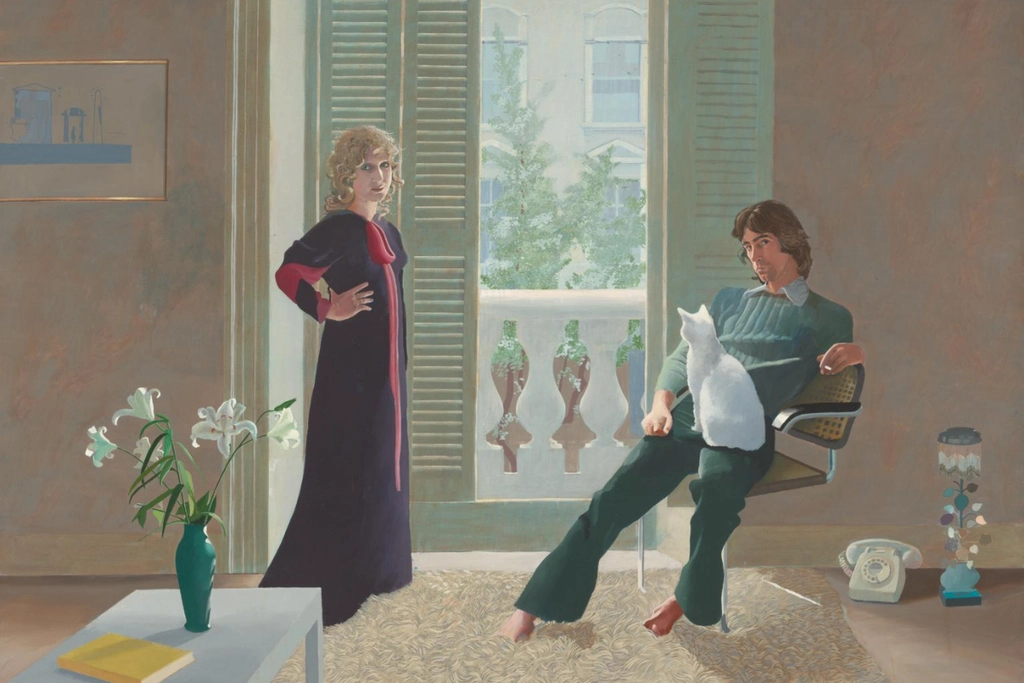
Between 1968 and the mid-1970s, Hockney developed monumental double portraits featuring friends, couples and cultural figures. Henry Geldzahler and Christopher Scott, Christopher Isherwood and Don Bachardy and Mr and Mrs Clark and Percy use architecture, furniture, posture, windows and distance to suggest relationships without converting them into straightforward narratives.
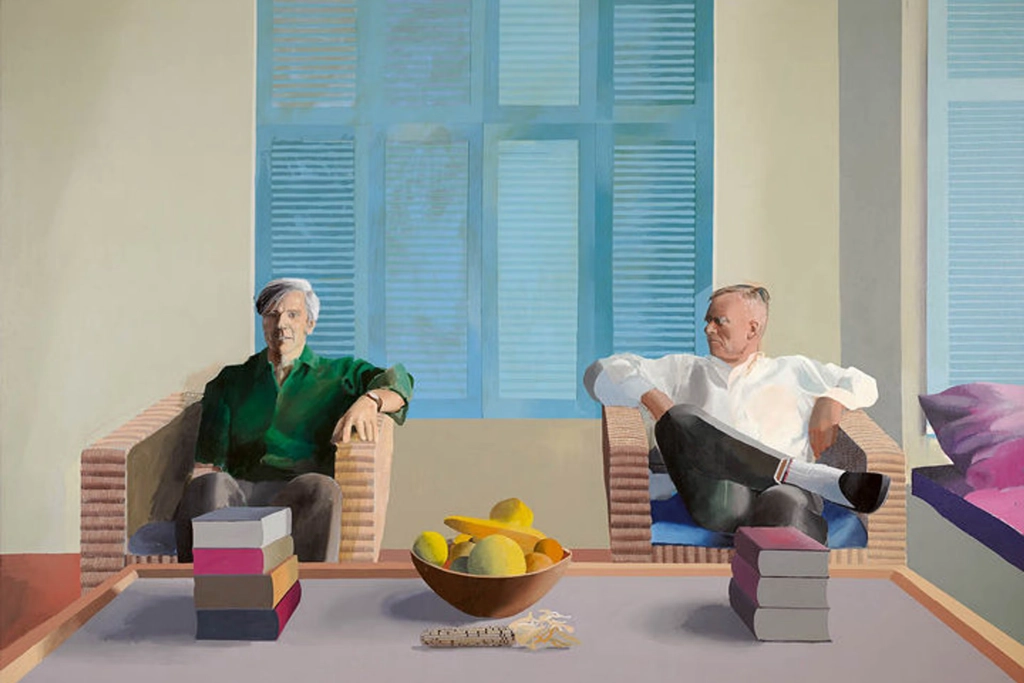
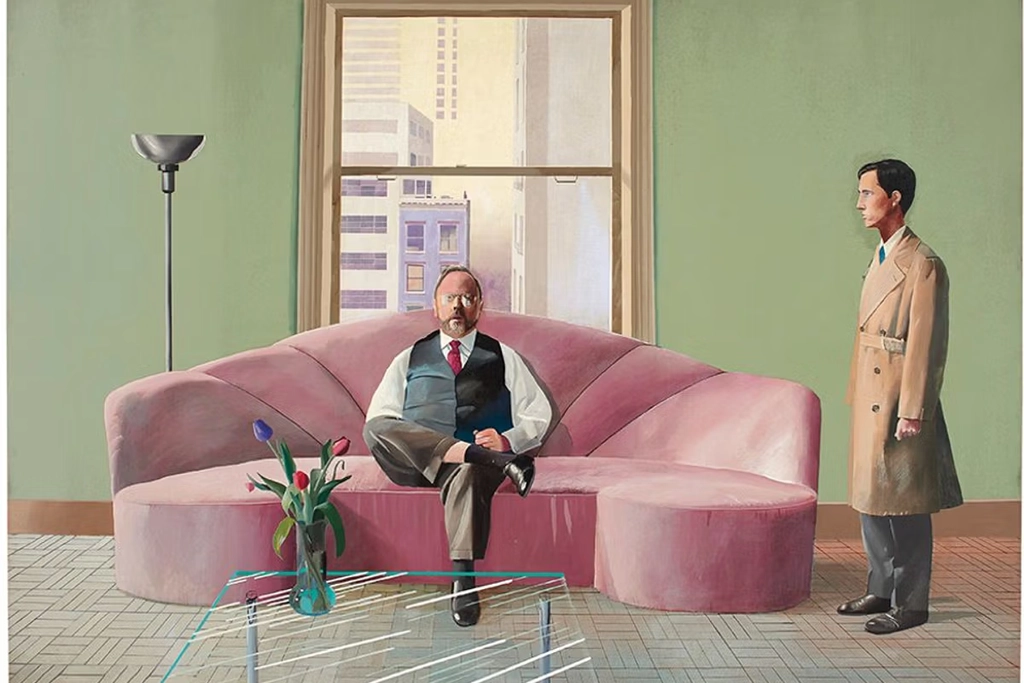
Human positioning carries as much information as facial expression. One person sits while another stands. A gap opens between bodies. Glass reflects light. A window pushes the eye toward another world. Hockney could turn an apparently polite portrait into a quiet study of attachment, power and emotional distance.
That tension reaches a remarkable intensity in Portrait of an Artist (Pool with Two Figures). Peter Schlesinger stands fully clothed beside a pool, looking toward a swimmer underwater. Hockney joined two photographic ideas to produce the composition after his relationship with Schlesinger had ended. Romantic biography and formal construction merge into an image that still resists a single emotional reading.
A road appears several times. A face shifts slightly. Objects change scale as your attention crosses the surface. Hockney grew increasingly dissatisfied with the authority granted to single-point perspective and photography’s frozen viewpoint.
His photographic collages, widely known as “joiners,” pushed that argument into physical form. During the 1980s he assembled numerous Polaroids or conventional photographs of the same subject, captured from shifting positions and moments. Works such as Pearblossom Hwy., 11-18th April 1986, #2 turn photography into an accumulation of looking. The Getty notes that the latter involved almost 800 photographs.
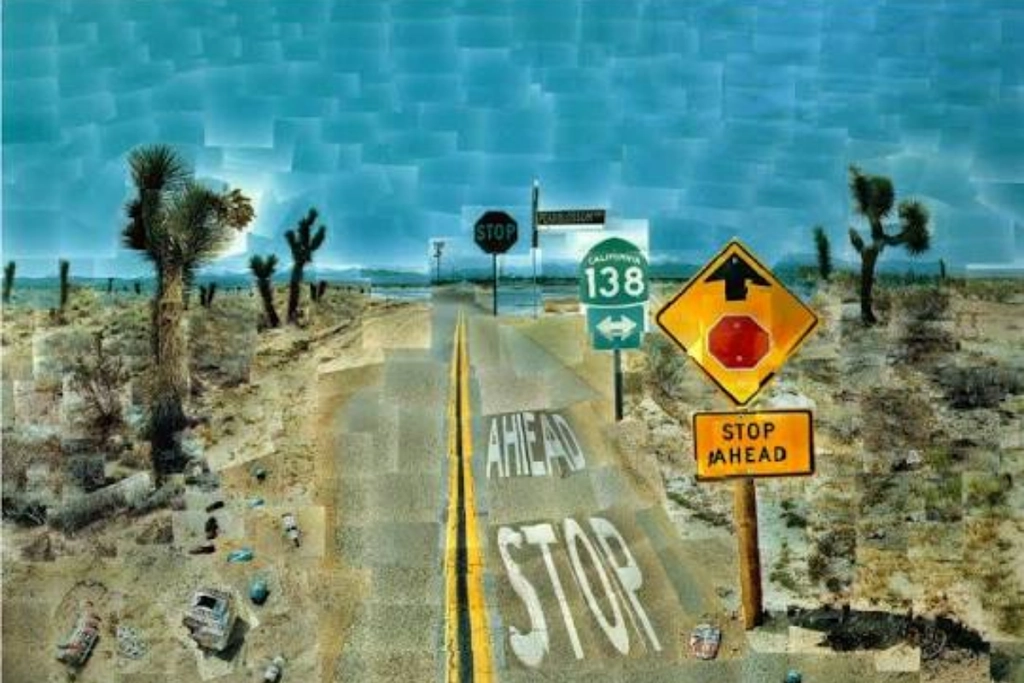
Time enters the picture because each fragment records a slightly different instant. Movement enters because the camera changes position. Perspective becomes psychological because viewers must assemble the scene through their own looking.
Here Hockney’s connection with Cubism becomes especially productive. Picasso and Braque fractured objects to expose several viewpoints within one image. Hockney carried a related question into photography and late twentieth-century modern art, exposing the difference between a mechanical lens and human attention.
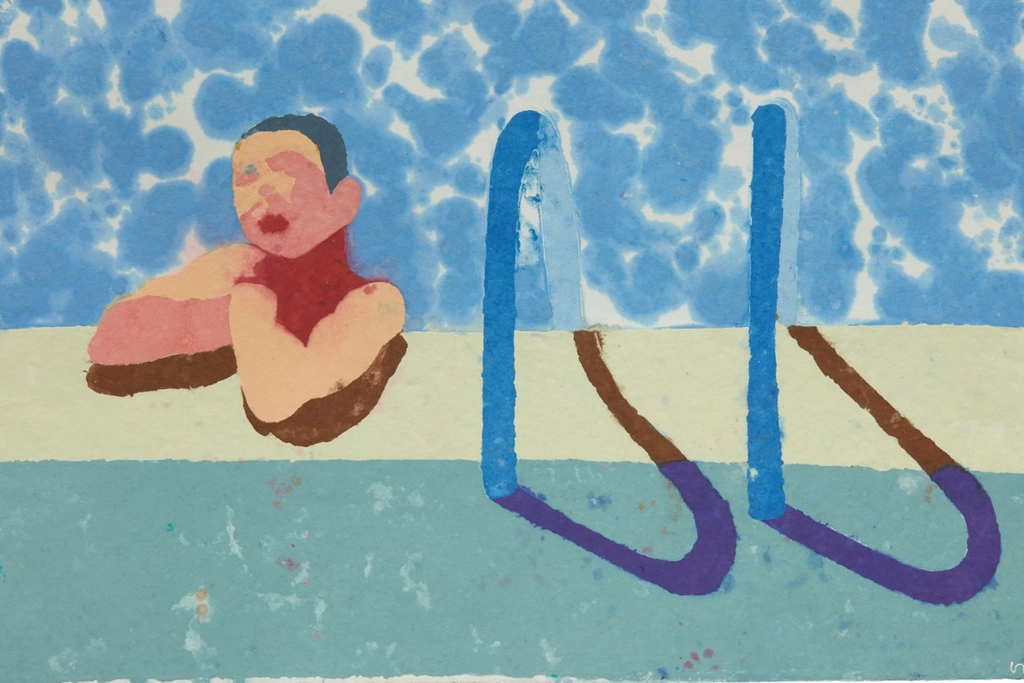
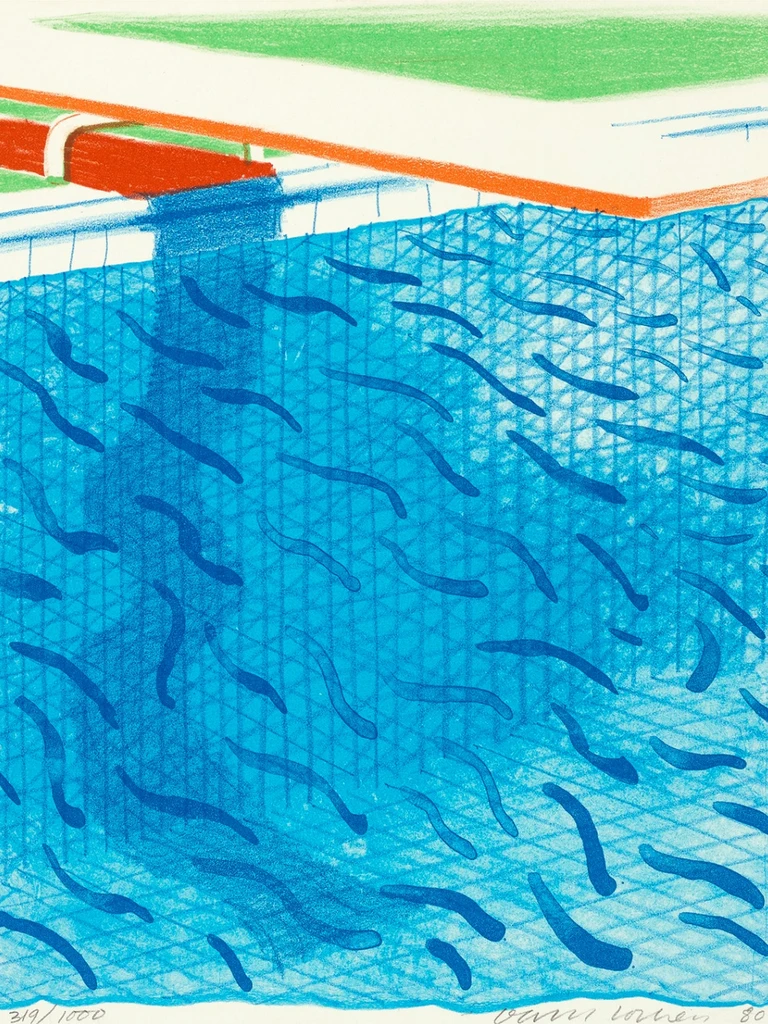
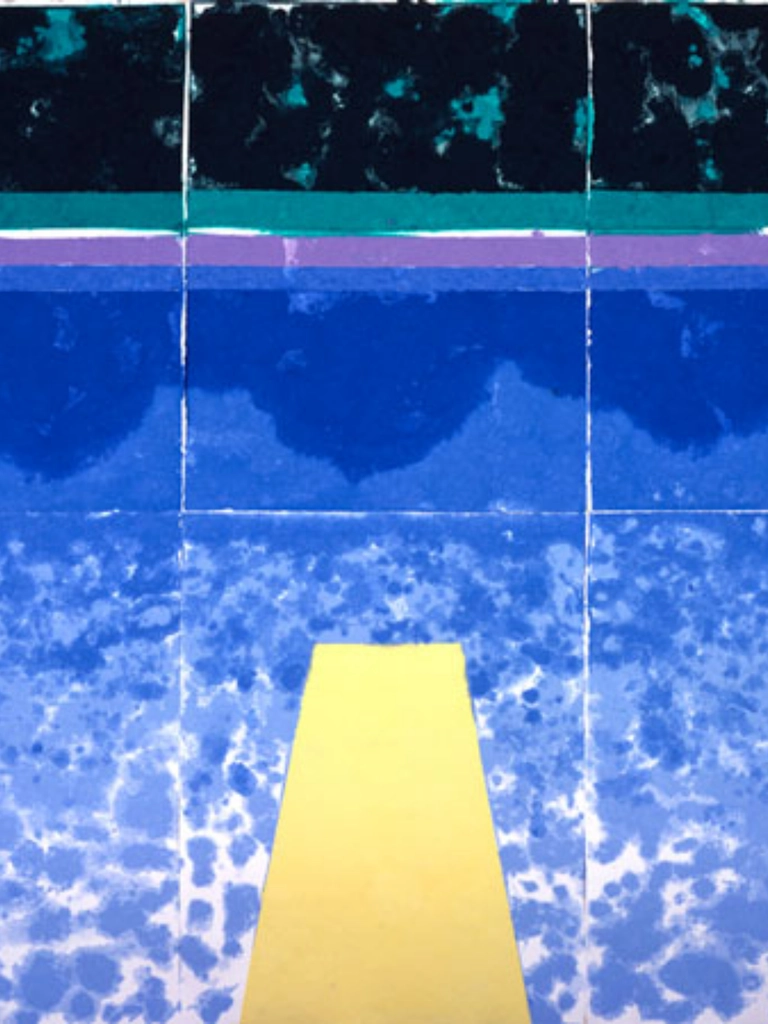
Wet colored pulp became paint in 1978 when Hockney worked with master printer Kenneth Tyler on the Paper Pools series. Pigmented cotton pulp allowed color to become part of the paper itself, producing images whose watery subject seemed embedded in their physical material.
Decades later, another surface captured his attention. Hockney was producing iPhone drawings by 2009, and iPad works soon became central to his practice. The screen offered luminous color, portability and extraordinary speed. Flowers could be drawn shortly after waking. Weather could be captured while changing. A sequence could even preserve the stages through which an image developed.
For an artist associated with traditional painting, the adoption of digital tools carried an important message about contemporary art. Medium mattered less than the act of looking. Hockney approached an iPad with the curiosity he brought to acrylic, photography or paper pulp.
During the 2020 lockdown in Normandy, that portability became particularly valuable. He produced an extensive sequence of iPad landscapes observing spring, blossoms, rain, moonlight and seasonal transformation. His late digital work carried forward a fascination that had existed since Yorkshire and California: the world changes continuously, so the artist must keep looking.
A Bigger Splash (1967) turns two seconds of disturbed water into a carefully constructed icon of California.
Mr and Mrs Clark and Percy (1970-71) transforms a fashionable London interior into a psychologically charged portrait of marriage, friendship and space.
Portrait of an Artist (Pool with Two Figures) (1972) fuses the pool painting with relationship portraiture and eventually became Hockney’s auction masterpiece.
Nichols Canyon (1980) bends a Los Angeles road into an electric ribbon of color, pushing landscape toward Fauvist intensity.
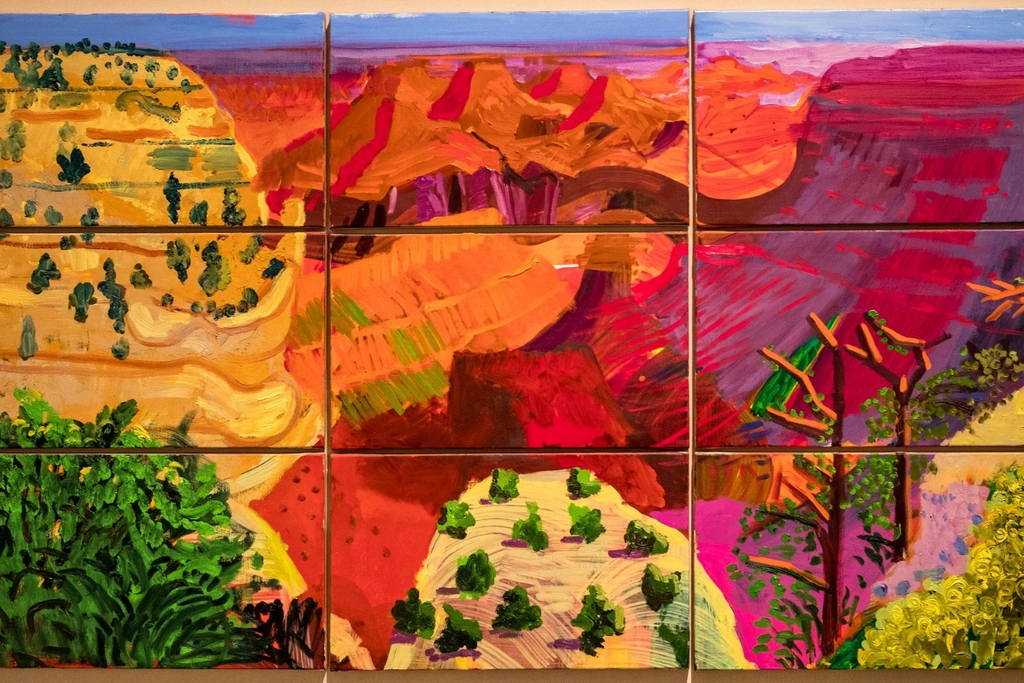
A Bigger Grand Canyon (1998) spreads the landscape across 60 canvases, giving the eye multiple surfaces to navigate.
The Arrival of Spring in Woldgate, East Yorkshire in 2011-4 May carries his investigation of landscape into digital drawing, recording seasonal change through the iPad.
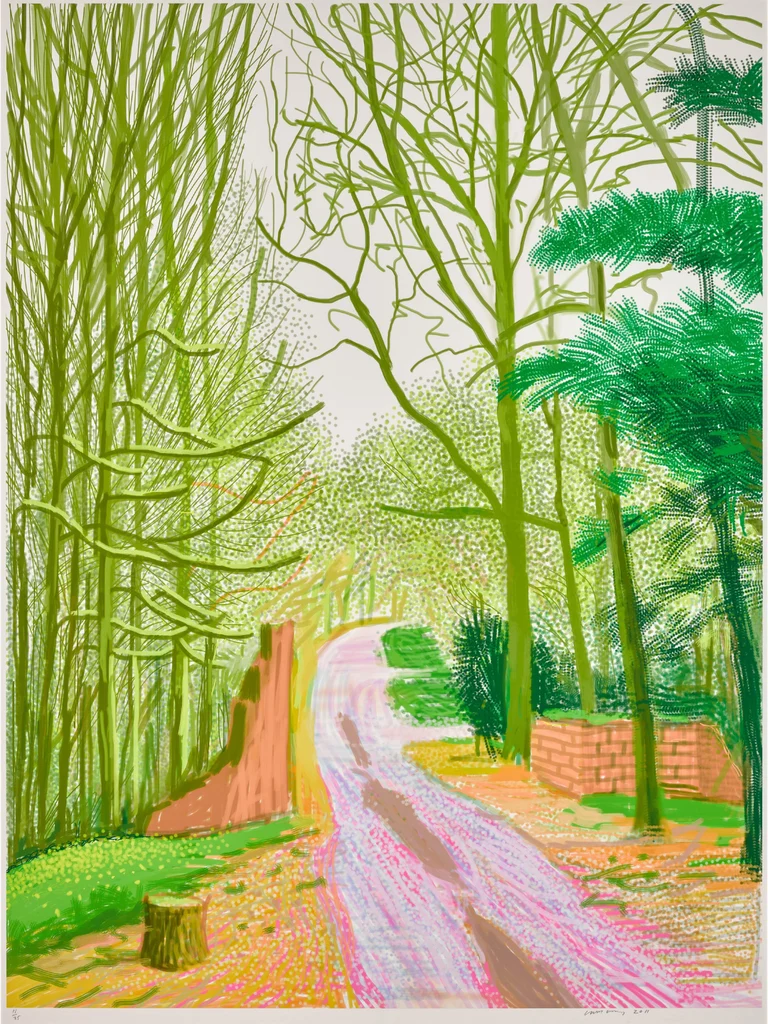
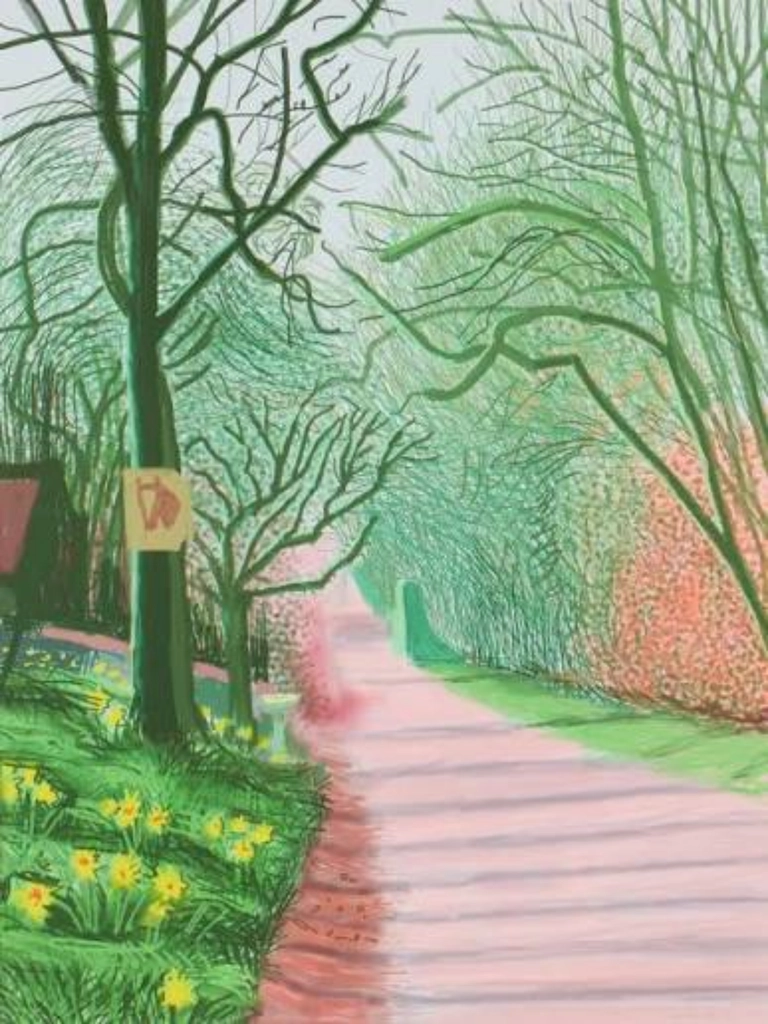
Together they show why Hockney resists a single signature style. Pools may have made him famous, yet perspective became the larger lifelong problem.
Nine minutes of bidding in November 2018 transformed Portrait of an Artist (Pool with Two Figures) into a market phenomenon. The painting sold for $90.3 million, then the highest auction price ever achieved for a work by a living artist. Jeff Koons surpassed that living-artist benchmark the following year. Hockney’s $90.3 million result remains his auction record.
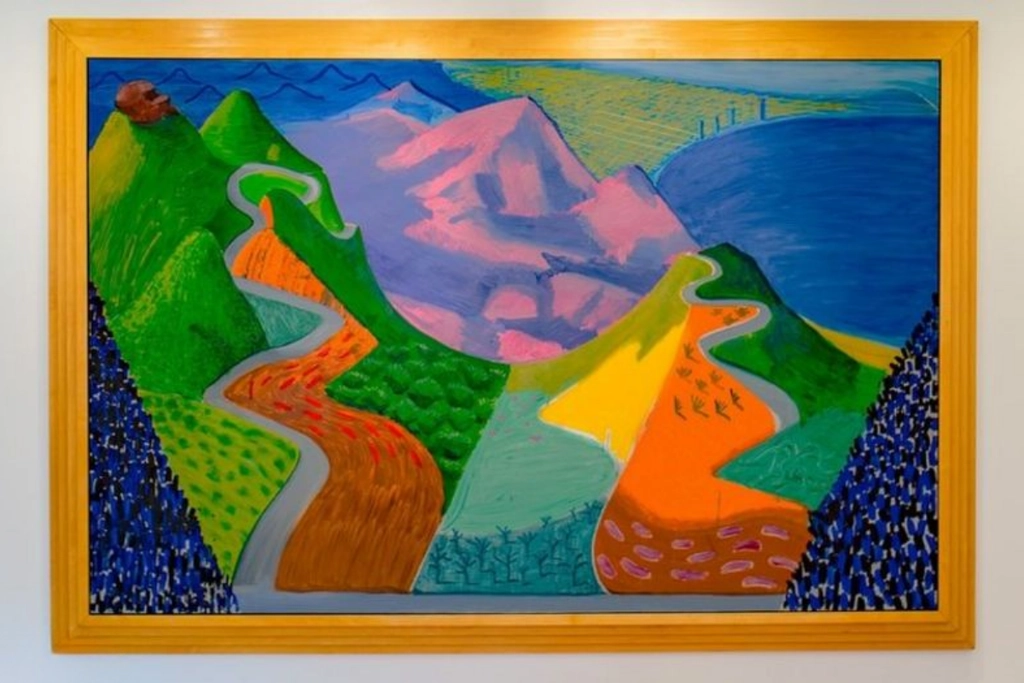
Other prices reveal how broadly collectors valued his strongest periods. Pacific Coast Highway and Santa Monica sold for $28.453 million in May 2018. During the same sale, Piscine de Medianoche (Paper Pool 30) reached $11.744 million, establishing a record at that time for a Hockney work on paper. Henry Geldzahler and Christopher Scott later sold for £37.7 million, approximately $49.5 million, in London in 2019.
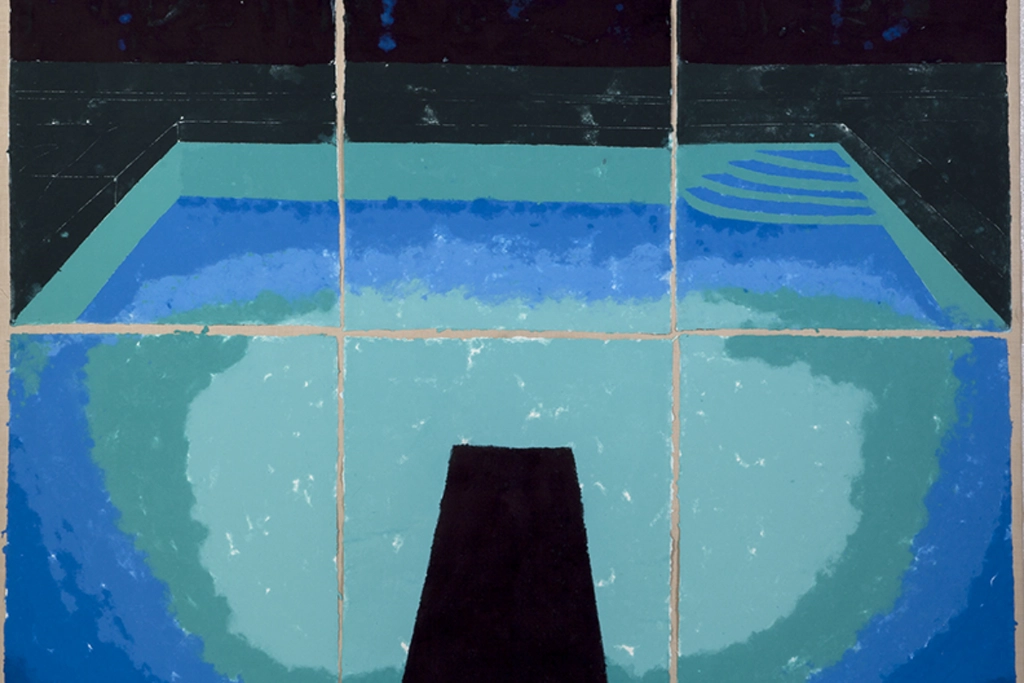
The figures tell only part of Hockney’s cultural value. His images travel unusually well between museum scholarship and popular memory. A pool, a blond head, round glasses, a Yorkshire road or two people standing awkwardly inside a room can register as “Hockney” almost immediately.
A screen glowing in an elderly painter’s hand might appear far removed from a swimming pool painted in 1967. The same problem connects them: how can an image contain the experience of seeing?
Hockney spent nearly seven decades testing possible answers. Acrylic flattened sunlight. Double portraits converted relationships into spatial tension. Joiners fractured photography’s authority. Vast landscapes forced the viewer’s eye to travel. Digital drawing shortened the distance between observation and mark.
His death in 2026 closed one of the longest experimental careers in British art, yet the questions remain unusually current. Cameras now sit inside every phone, algorithms generate pictures in seconds, and screens mediate enormous portions of visual culture. Hockney had already spent decades questioning whether a technically accurate image could ever equal human sight.
That may be David Hockney's sharpest contribution to both modern art and contemporary art. Technology kept changing around him. His subject stayed stubbornly human: two eyes, a memory, a moving body and a world that refuses to hold still long enough for a single picture.