MENU
Close





Stella McCartney SS27 turns ocean conservation into a collection of marine-inspired forms and experimental materials, revealing a house whose textile innovation is moving faster than its silhouettes.

Stella McCartney SS27 turns ocean conservation into a collection of marine-inspired forms and experimental materials, revealing a house whose textile innovation is moving faster than its silhouettes.
October 1, 2026
Advertisement

Advertisement



At the British Ambassador’s residence in Paris, wet grass turned the runway into its own small environmental problem. Heels sank into the garden, rain hung over the setting, and oceanographer Sylvia Earle introduced a collection built around marine life, overfishing and the climate crisis. Stella McCartney framed the season with a blunt question: sea life or sea food?
That combination makes SS27 especially revealing. The environmental research is aggressively forward-looking. The wardrobe often looks much more familiar.
Marine imagery can easily become decorative shorthand, but Stella McCartney pushes the theme further into activism.
The show addresses industrial fishing, marine pollution and endangered sea life, while the latest Stella Times extends the argument through an imagined interview with a grieving whale that has lost a calf to fishing gear. The device is strange, sentimental and deliberately confrontational. McCartney has rarely been interested in separating fashion from environmental messaging, and SS27 makes that position unusually explicit.




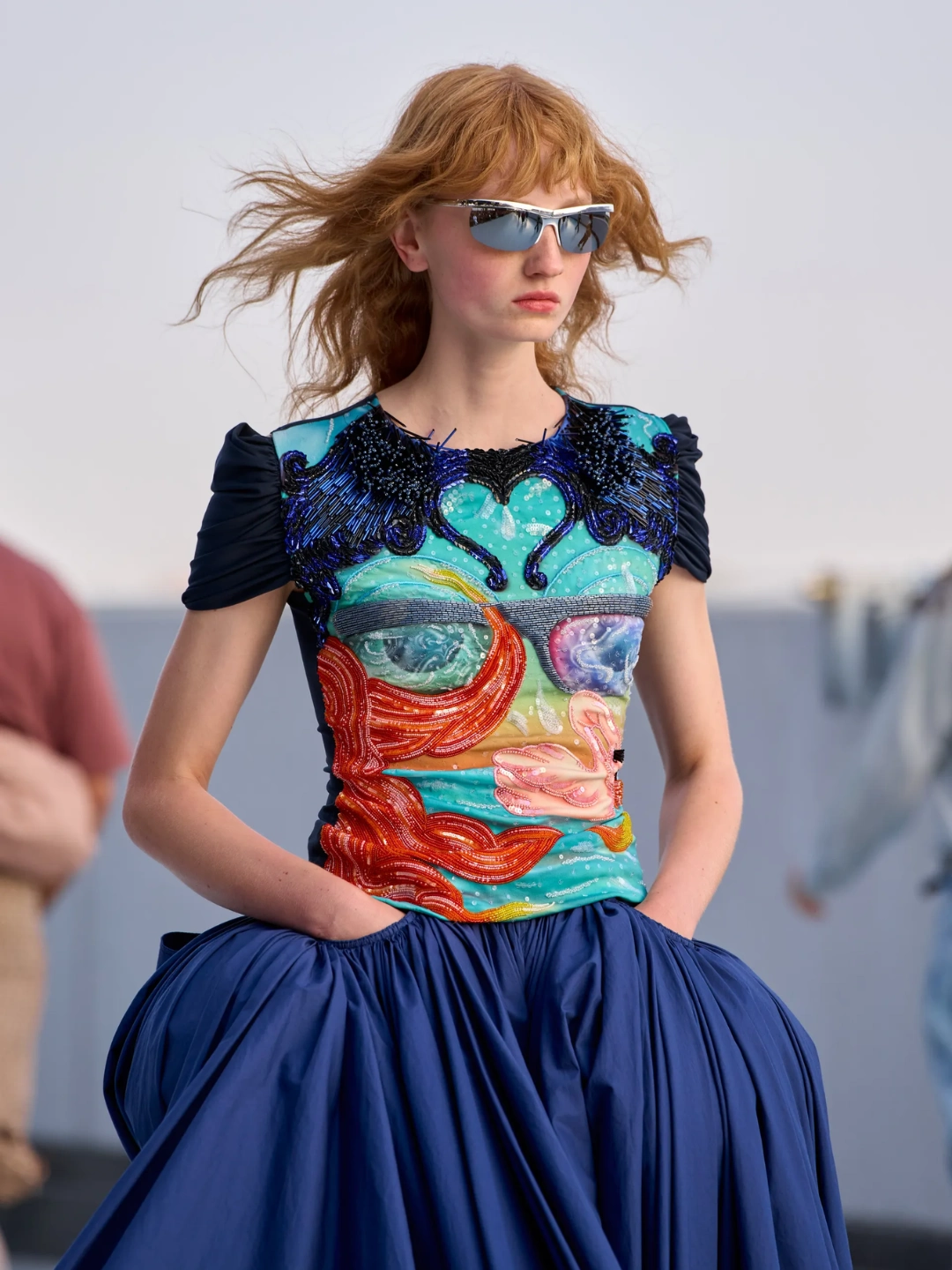
The runway translates the ocean through sharks, dolphins, orcas, starfish, coral, waves and oyster-like forms.
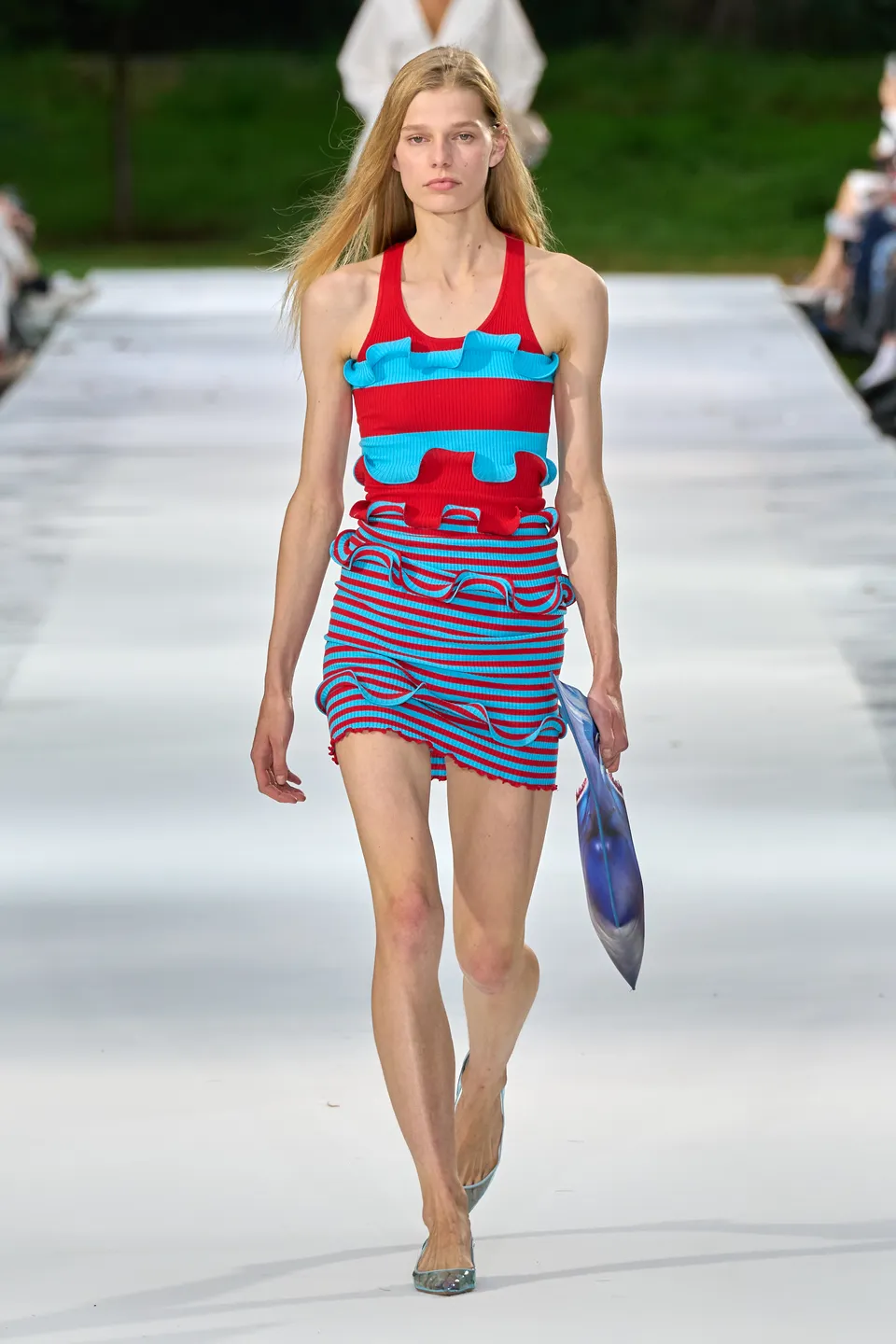
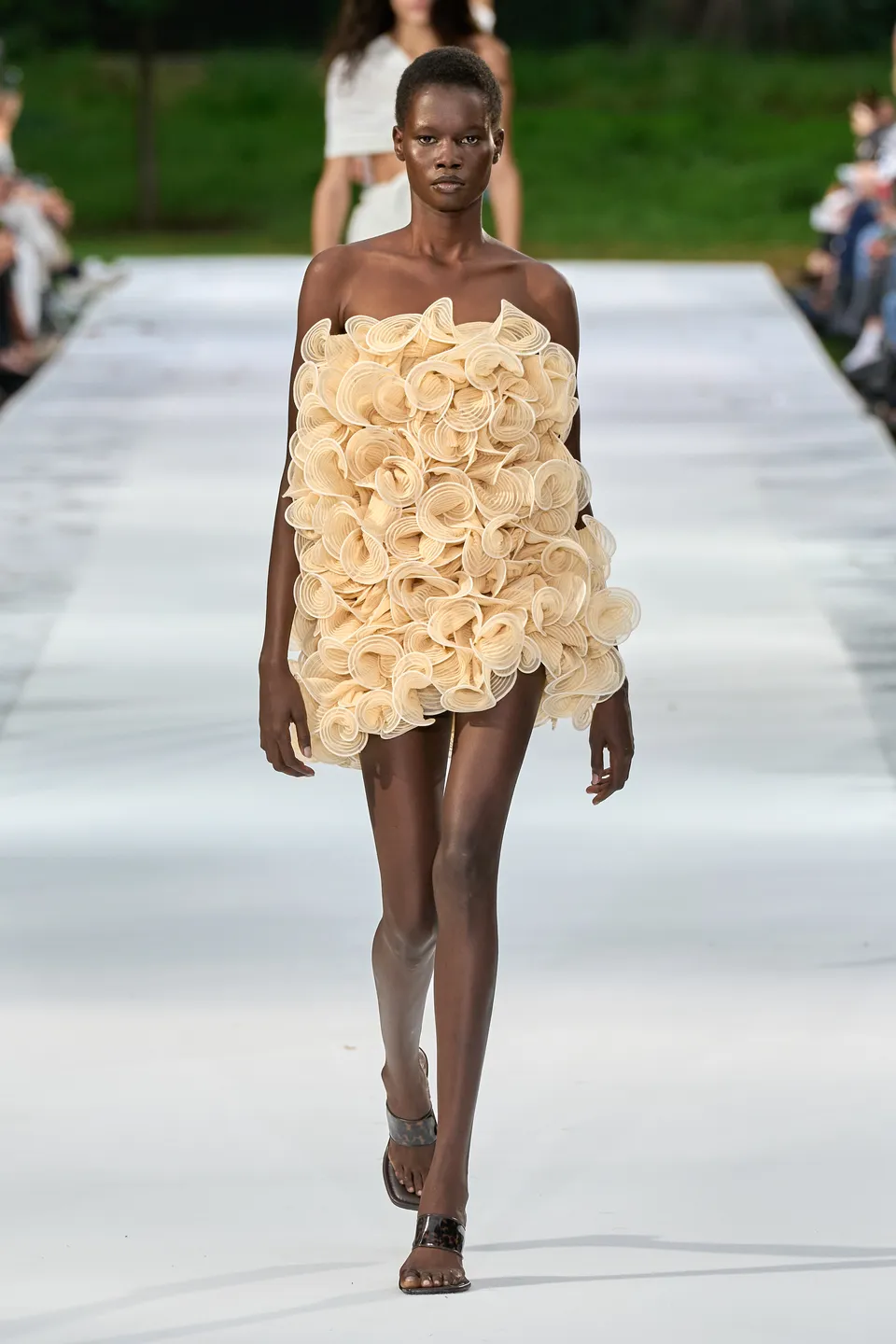
Knitted surfaces push outward like coral growth. Transparent constructions suggest fishing line or marine debris while creating unusual tension around the body. Shell-like volumes distort the torso and hips, moving the collection toward something more biomorphic.
Around 25 years after launching her own house, Stella McCartney revisits many of the codes that built her identity: oversized tailoring, menswear-derived proportions, relaxed trousers, denim, sporty separates, peplums, liquid jersey and evening dresses that depend more on movement than rigid structure.




The casting strengthens that sense of memory. Miranda Kerr and Karlie Kloss return to the runway, bringing with them another layer of fashion history.
Loose blazers sit over fluid trousers. Tailoring contracts at the waist with drawstrings. Low-rise denim shares the runway with basketball shorts and chunky skate shoes. A sculpted peplum can appear only a few looks away from something that resembles elevated sportswear.
Menswear has always been one of Stella McCartney’s most reliable starting points, and SS27 returns to it with less stiffness than ceremony.
Oversized jackets are cinched with cords. Formal shapes loosen around the waist. Jacket-bodysuit hybrids pull tailoring closer to the skin. Wide trousers keep the lower half fluid even when the upper body appears more controlled.
It introduces the logic of sportswear into tailoring without forcing either category to disappear. A blazer can remain recognizably formal while behaving more like something adjustable and lived in.



Even Stella’s more structured silhouettes rarely fight the body. Mobility remains part of the design language, whether through dropped proportions, stretch, fluid fabric or softened construction.
The coral-like knits are among the collection’s clearest successes. Their surfaces push outward, fold, cluster and gather into forms that resemble organic growth. Instead of illustrating coral, Stella McCartney lets the garment behave more like it.
Transparent fishing-wire constructions are even more direct. They create a strange contradiction between delicacy and danger. Fishing line can appear nearly invisible in water while remaining one of the most destructive materials in marine environments. On the runway, that same visual quality produces fragile, almost suspended architecture around the body.




Shell and oyster-like shapes extend the experiment into volume, giving the collection a slightly alien quality that works well against the more familiar tailoring.
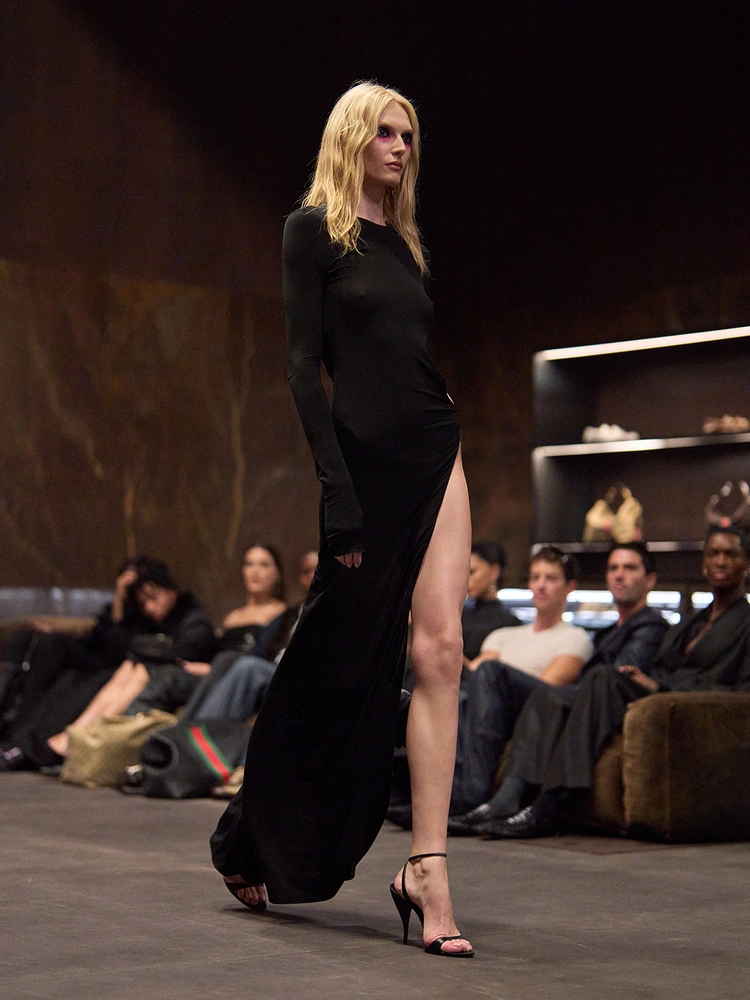
Then come the fluid evening pieces. These are recognizably Stella: elongated, Grecian, soft and controlled by gravity more than corsetry. Their familiarity is part of their appeal, even if they offer less surprise than the marine structures.
Stella McCartney continues to invest in materials that remain experimental across much of luxury fashion. The collection includes Living Ink’s algae-derived black pigment, Spiber’s Brewed Protein, recycled polyester, recycled denim, forest-friendly viscose, organic organza and other lower-impact or bio-based alternatives.
Stella has spent years arguing that sustainable material innovation cannot remain a niche luxury experiment. The biggest fashion groups need to adopt these technologies at scale so production costs can fall and smaller brands can eventually access them too.
Stella McCartney increasingly operates as both fashion house and research platform. A relatively independent label is helping develop, test and publicize material systems that could eventually become useful far beyond its own collections.



That work is expensive, operationally difficult and much less glamorous than a runway show. It may also be the most important thing the company is doing.
Oversized tailoring, peplums, fluid jersey, denim, sporty separates and relaxed eveningwear all belong comfortably inside the existing Stella McCartney vocabulary. The house knows how to make these clothes. Its customer knows how to wear them.
That coherence can also become a form of safety. The ocean is new. Much of the wardrobe is not. That imbalance is especially noticeable because the material research is so ambitious. When a garment uses algae-derived pigment, protein-based fibers or sophisticated recycled systems, familiar styling can suddenly look more conservative than it might under conventional production.
This is an unusual problem to have. Stella McCartney has pushed the technical side of fashion so far forward that “nice clothes” can begin to feel modest beside the technology underneath them.
The interesting question is whether the fashion language can evolve at the same speed as the materials.
Stella McCartney has returned to full ownership of her company following the end of LVMH’s minority stake, while maintaining a sustainability advisory relationship with the group.
The house is celebrating roughly 25 years while carrying the financial and operational pressure of sustainable innovation more directly on its own shoulders.
The company needs commercially reliable products while continuing to fund research that may benefit the wider industry. Familiar tailoring, denim, eveningwear and sportswear help provide the retail stability required to keep experimentation alive.
Seen that way, some of SS27’s design conservatism becomes easier to understand. The safer wardrobe helps finance the riskier laboratory. But that logic also raises the creative challenge. If the brand’s future is being built through radical materials, the visible design language eventually has to make that future feel just as radical.
After 25 years, Stella McCartney’s influence is difficult to reduce to a single silhouette. Her larger contribution lies in making environmental responsibility part of the mechanics of luxury fashion. SS27 shows how far that work has travelled.
Advertisement