A last-minute withdrawal at Christie’s has reignited questions surrounding a Frida Kahlo’s painting, Mexico’s cultural patrimony laws and the importance of provenance. The 1952 painting Congress of the Peoples for Peace, estimated at up to $3.5 million, was pulled from auction following a request from Mexican authorities to investigate its ownership and export history.

A Frida Kahlo's Painting Windrawn Amid Provenance Dispute
A last-minute withdrawal at Christie’s has reignited questions surrounding a Frida Kahlo’s painting, Mexico’s cultural patrimony laws and the importance of provenance. The 1952 painting Congress of the Peoples for Peace, estimated at up to $3.5 million, was pulled from auction following a request from Mexican authorities to investigate its ownership and export history.
November 17, 2026


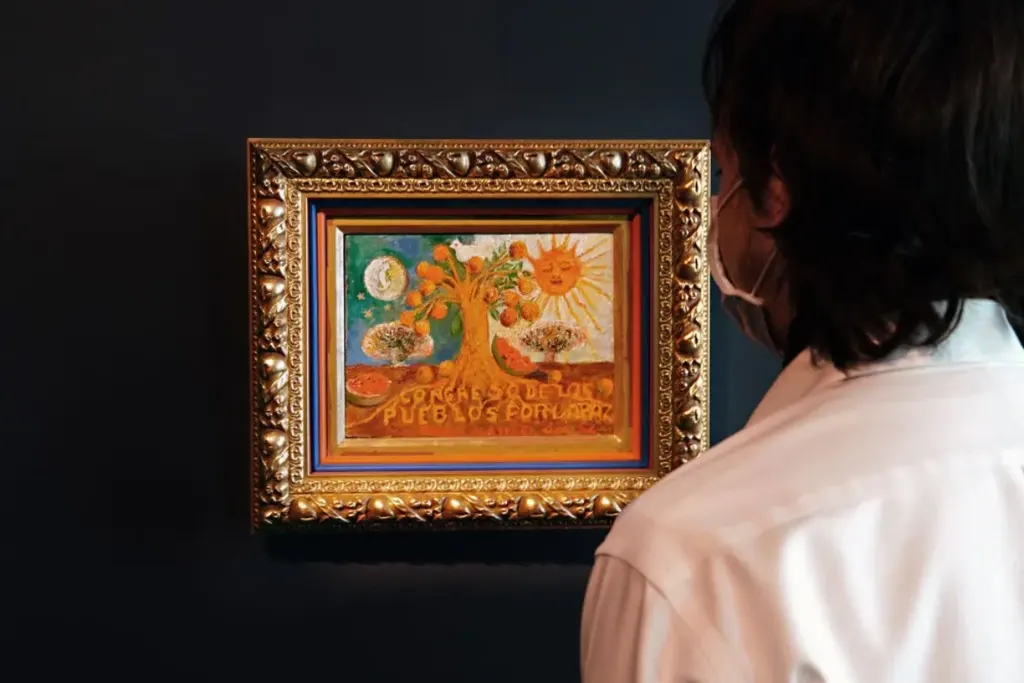
On November 17, 2026, Christie’s withdrew Frida Kahlo’s painting Congreso de los pueblos por la paz (Congress of the Peoples for Peace) from its 20th Century Evening Sale in New York, just hours before the auction. Estimated at $2 million–$3.5 million, the 1952 painting was expected to measure up to removed following a formal request from Mexico’s cultural authorities to postpone the sale and examine its ownership and export history.
Signed and dated October 1952, the painting depicts a white dove perched atop a monumental tree suspended between day and night, with its title inscribed among the roots. Kahlo created and donated the work for the Soviet-backed Congress of the Peoples for Peace, held in Vienna in December 1952. The gathering brought together hundreds of artists, writers and intellectuals, reflecting the political and cultural concerns of the postwar period.
The Provenance Dispute and Mexico’s Cultural Heritage
At the centre of the controversy is Mexico’s 1984 decree declaring Frida Kahlo’s paintings located in the country national artistic monuments. Under the relevant cultural patrimony laws, their permanent export requires state authorisation. Initially, the National Institute of Fine Arts and Literature (INBAL) maintained that Kahlo had donated the painting during her lifetime and that it had left Mexico before the decree took effect. However, the institute subsequently requested documentation establishing its ownership and provenance.
The dispute intensified when cultural advocates argued that Congress of the Peoples for Peace appeared in the inventory associated with the Casa Azul Trust, established by Diego Rivera in 1957 to preserve Frida Kahlo’s painting legacy. Researchers questioned how the painting moved from the artist’s estate into private ownership, particularly given gaps in its publicly documented history. Christie’s published provenance identified Galería Ramis Barquet as an early owner, followed by a private collector and a Sotheby’s auction in 2020, where the present consignor reportedly acquired it for $2.6 million.

An Uncertain Future for Frida Kahlo’s Painting
Following mounting scrutiny, Christie’s confirmed that it had agreed with the consignor to withdraw the painting for further research, expressing hopes of offering it at a later date. The decision highlights the importance of provenance research in the international art market, where questions of ownership, historical transfers and cultural heritage can significantly affect an artwork's eligibility for sale.
As Frida Kahlo's painting, Congress of the Peoples for Peace remains not only a sought-after work of modern art but also a reminder that an auction's most important question is sometimes not how much a masterpiece might fetch, but whether its journey to the auction block can be fully accounted for.