MENU
Close





A problem gets a fix. The fix creates another problem. That problem gets another fix. GLP-1 skin may be beauty’s clearest new example of a market built on fixing the problems created by yesterday’s fixes.
A problem gets a fix. The fix creates another problem. That problem gets another fix. GLP-1 skin may be beauty’s clearest new example of a market built on fixing the problems created by yesterday’s fixes.
August 12, 2026
Advertisement

Advertisement



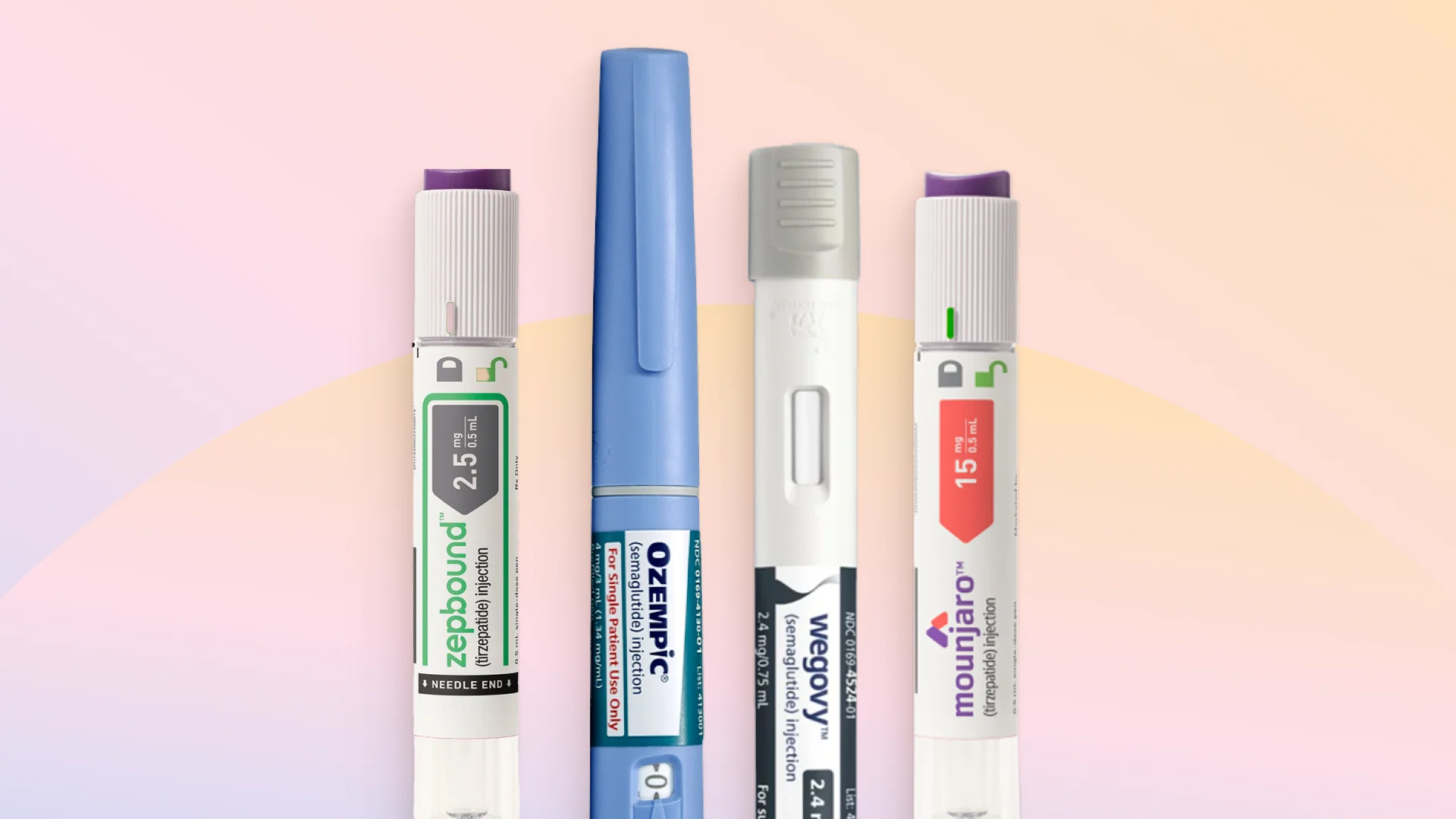
GLP-1 medications now sit at the center of one of the largest shifts in weight management and metabolic medicine. Bodies change. Faces change with them. Cheeks can lose volume, skin can loosen, folds can deepen and texture can appear thinner or crepier. The internet found a name quickly: “Ozempic face.”
Plastic surgeons are developing serums around GLP-1 users. IMAGE Skincare prints the term directly onto packaging. Kiehl’s is testing cheek sagging specifically in consumers prescribed GLP-1 medication for weight management.
A pharmaceutical solution has created an aesthetic aftermath, and skincare has started selling answers to the aftermath.
The phrase GLP-1 skin belongs primarily to beauty and aesthetics vocabulary. Medical research describes the underlying changes through facial volume loss, skin laxity, altered tissue support and signs associated with accelerated facial ageing.
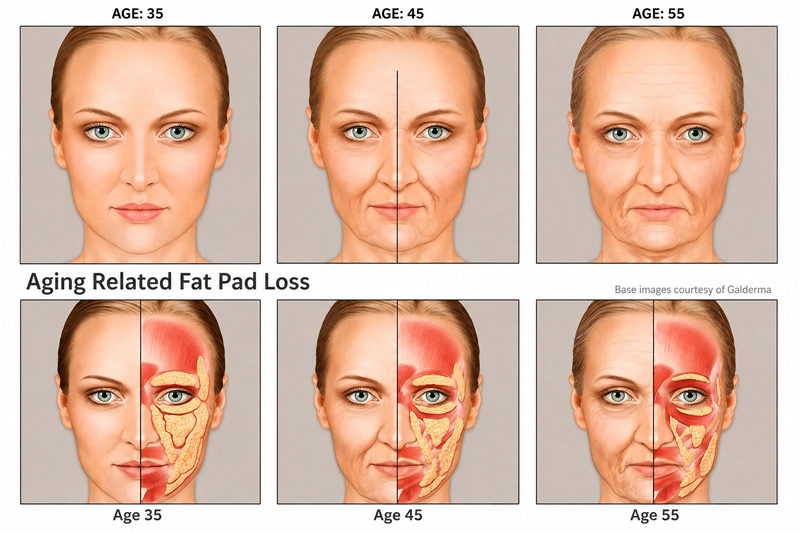
A 2026 review of facial and neck aesthetics in GLP-1 patients describes changes occurring across multiple anatomical planes. Facial fat compartments can shrink, with visible effects around the cheeks, temples, jaw and eye area. As that underlying architecture changes, skin can appear looser and existing lines can become increasingly visible.
Weight-loss speed plays a major role in this story. Rapid reduction in body mass can leave skin adjusting to a dramatically altered volume beneath it. Research on GLP-1 receptor agonists has therefore linked rapid weight reduction with aesthetic concerns including facial volume loss, laxity and body-contour changes.
Scientists are also investigating deeper biological possibilities. Keratinocytes carry GLP-1 receptors, and emerging research has explored relationships between GLP-1 signalling, epidermal activity, fibroblasts, collagen, inflammation and barrier function. Those mechanisms remain an active field of study, which gives the beauty industry a fascinating commercial window: consumers can see changes before science has finished explaining every pathway behind them.
That gap between visible concern and evolving evidence is exactly where new product categories tend to grow.
Beauty only needs a problem consumers can recognize in the mirror.
Scale changes everything.
Gallup reported in July 2026 that 11% of U.S. adults currently use GLP-1 medication for weight loss, climbing from 3% in 2024. Another 15% said they had used one for weight management at some point. Awareness reached 91% of American adults.
The future commercial projection gets even larger.
Morgan Stanley Research estimates the global market for diabetes and obesity treatments built around this category could reach $190 billion by 2035, up from approximately $79 billion in sales during 2025.
Those numbers rewrite the business potential of a loose jawline.
When millions of consumers undergo a similar physiological transformation, every visible consequence becomes a possible brief for skincare, aesthetics, haircare, wellness and body care.
The commercial logic is brutally efficient.
GLP-1 addresses metabolic health and weight management. Weight loss changes the appearance of tissue. Beauty identifies those changes, names them, packages them into concerns and sells a routine around them.
One solution creates the conditions for another market.
Plastic surgeon Julius Few approached the issue from inside aesthetic medicine.
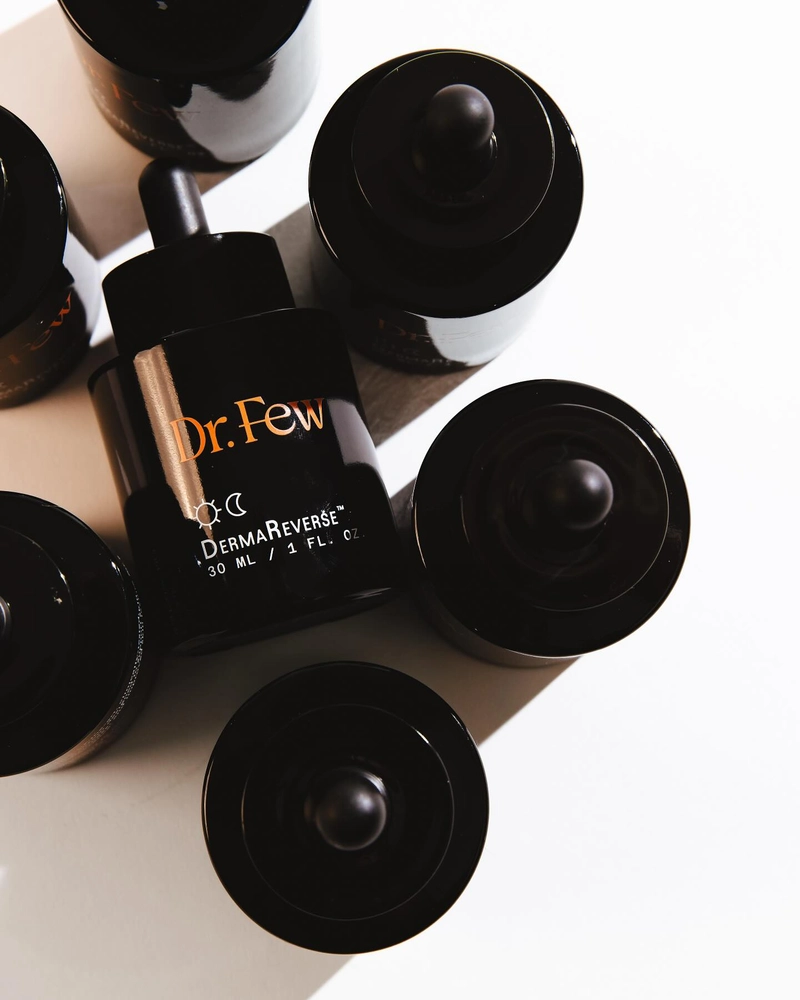
His Dr. Few Skincare DermaReverse™ grew from observations of skin-quality changes among patients receiving GLP-1 therapies. The formula uses a proprietary retinoic-acid system, peptides, sodium hyaluronate and botanical ingredients with the goal of supporting texture, hydration, firmness and visible repair.
Its scientific story deserves attention because the supporting research reached a peer-reviewed journal.
The six-week pilot used a split-face, double-blind, placebo-controlled design. Participants applied the investigational serum to one side of the face and placebo to the other twice daily. Researchers reported statistically significant improvements across measured skin-quality categories including hydration, surface roughness, pigmentation, visible pores and static wrinkles.
Then comes the number that keeps the hype in perspective:
seven women.
The median age was 55, and participants were receiving stable GLP-1 receptor agonist and/or SGLT-2 therapy. The researchers themselves call for larger cohorts and additional histological assessment.
Seven faces can open a research door.
They can hardly close the scientific debate.
DermaReverse therefore captures the entire tension around GLP-1 skin beautifully: a real clinical observation, an early intervention, a sophisticated study design and an evidence base still young enough to leave plenty of unanswered questions.
Beauty has entered the laboratory while the laboratory is still writing the story.
IMAGE Skincare makes the category feel fully commercial.
Its VOL.U.LIFT™ GLP-1 4D Skin Rebound Complex places GLP-1 directly in the product name and organizes the concern around four Ds:
Deflation. Deep wrinkles. Dehydration. Density.
That vocabulary does more than explain a formula. It teaches consumers how to read their own faces.
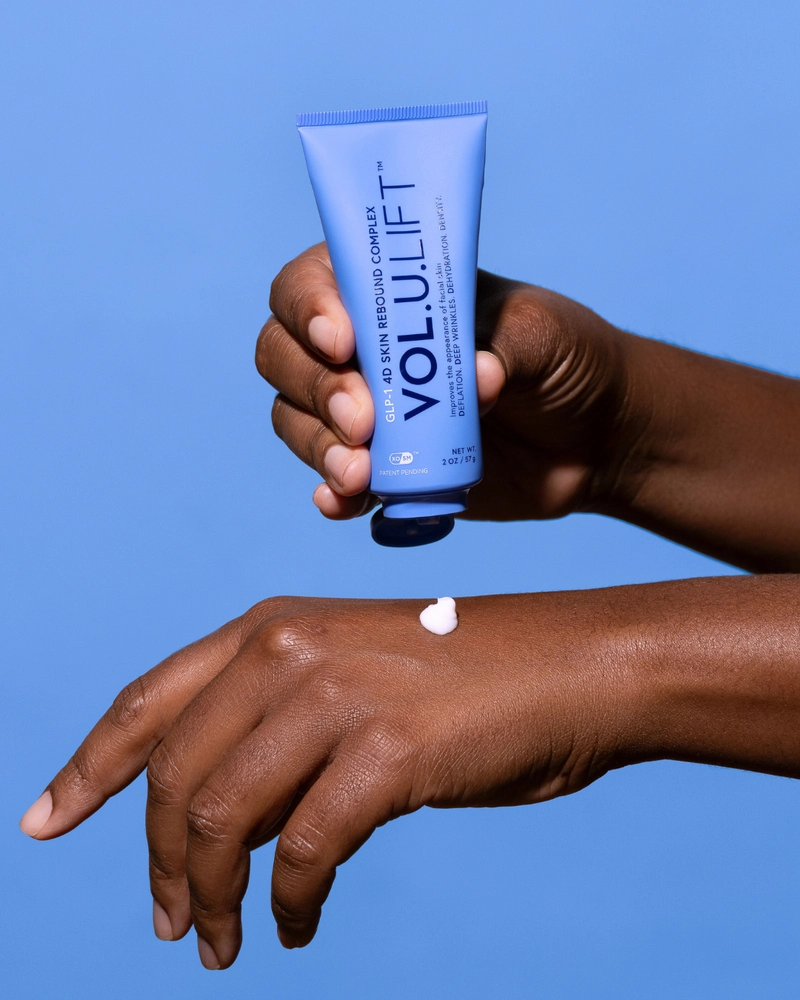
The $134 treatment uses the brand’s patent-pending XOSM encapsulation technology alongside ingredients including bakuchiol, hyaluronic-acid systems, peptides and antioxidant complexes. IMAGE positions the formula specifically around visible volume loss following rapid weight reduction.
Its 12-week study involved 29 participants aged 35 to 65 and reported:
20.1% increase in facial volume
23.2% increase in elasticity
22.5% increase in firmness
21.8% increase in hydration
20.7% reduction in wrinkles.
The footnote makes the story considerably richer.
Those 29 participants included people who had experienced weight loss through GLP-1 agonists, GIP drugs, other weight-loss medications or gastric bypass surgery. The study data remain on file with IMAGE International Manufacturing.
The packaging speaks with extraordinary specificity.
The test population contains a broader weight-loss story.
That gap shows how quickly marketing categories can become sharply defined while the clinical boundaries remain fluid.
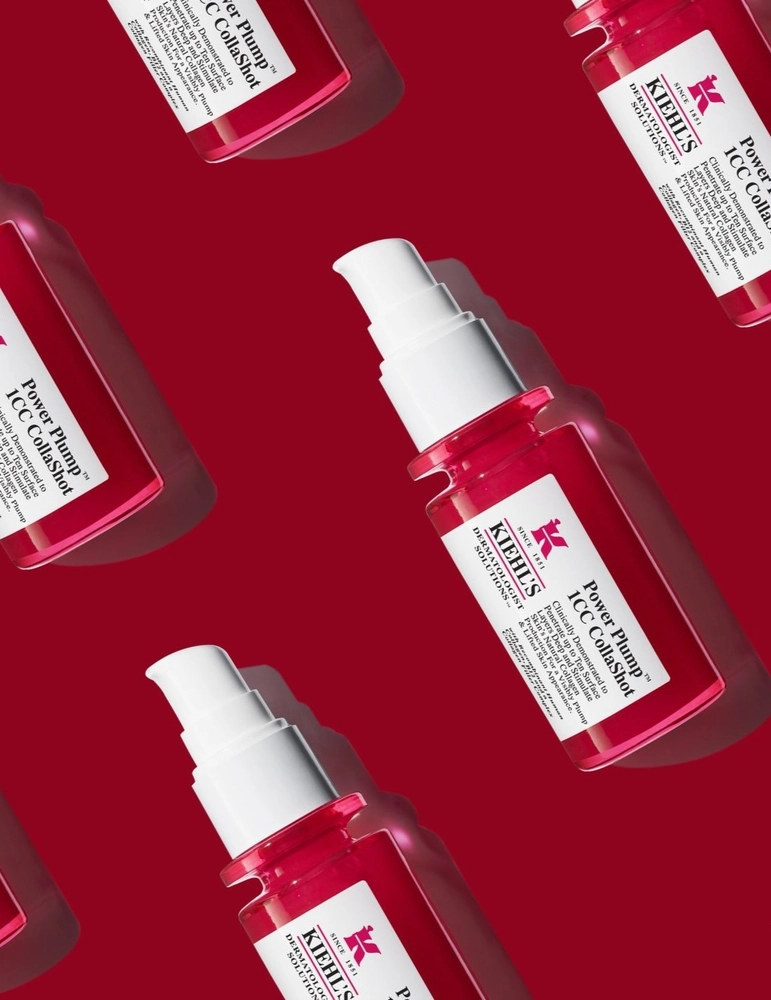
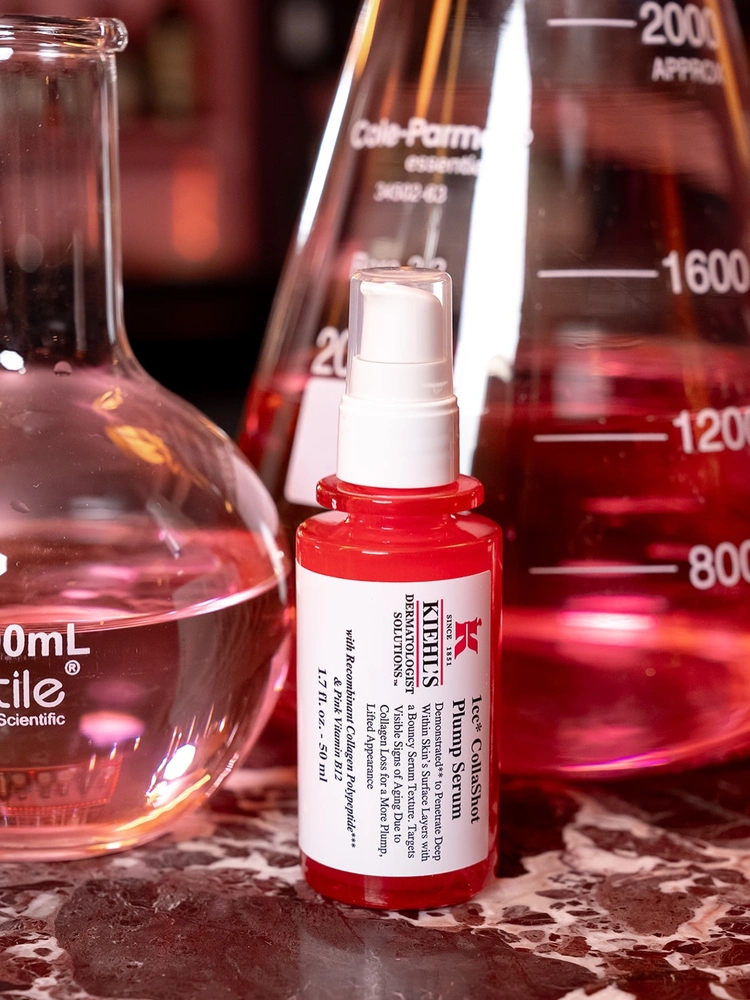
On July 29, 2026, Kiehl’s 1CC CollaShot Plump Serum pushed the conversation into mainstream prestige beauty.
Its patent-pending formula uses supra-liposomal recombinant collagen polypeptides, vitamin B12 and rhamnose. The vitamin B12 gives the serum its naturally pink colour, while the recombinant collagen polypeptides form the scientific centerpiece of its plumping story. The “1CC” name refers to a daily application amount of approximately one cubic centimetre, two pumps twice a day.
Then Kiehl’s drops the line that makes this product crucial to the GLP-1 story.
The brand reports 22% improvement in cheek sagging among consumers prescribed GLP-1 medication for weight management after eight weeks of twice-daily use. It also reports three-times improvement in facial plumpness through clinical grading after eight weeks.
Prices range from $55 to $78 depending on size.
That price point and Kiehl’s global retail presence change the cultural meaning of the category.
The issue has travelled from a plastic surgeon’s treatment room, through specialist clinical skincare, into a mainstream prestige serum sold as part of an ordinary twice-daily routine.
GLP-1 skin has become shelf space.
There is something almost perfectly commercial about the circle.
GLP-1 medications answer serious medical needs and have transformed the conversation around diabetes, obesity and metabolic health. Their rapid adoption is also producing visible changes that increasingly send consumers toward dermatologists, aesthetic clinics and beauty counters.
Then another industry appears carrying another promise.
Serums can support hydration, texture, elasticity and visible firmness. Major changes in facial volume involve deeper tissue architecture and can lead consumers toward aesthetic procedures. Yet skincare has already found a way into that gap, selling itself as part of the recovery ritual after a much larger physiological transformation has taken place.
The body changes. The mirror notices. The market names the concern. Then someone puts the answer in a bottle. And the ecosystem keeps widening.
Current research and real-world monitoring are already examining hair shedding, body composition, muscle loss and additional dermatological changes associated with rapid weight loss and GLP-1 use. Large-scale online analysis has also surfaced user-reported effects that researchers are still investigating.
That creates an uncomfortable commercial possibility. Every newly recognized consequence generates another question. Every question becomes a concern. Every concern can become a serum, supplement, treatment, device, service or entire category.
At some point, the cycle starts looking less like innovation and more like an economy built around the unfinished consequences of its previous solutions.
Perhaps that is the most revealing story of the GLP-1 era. We started with a product designed to solve one enormous problem. Now beauty is building products for what happens after that solution. Haircare may follow. Body care already has. Aesthetic medicine is already there. And the most provocative question may be the one the market has little incentive to answer too quickly: How many future products will be sold to fix problems created by products we once bought as the fix? Because the real business opportunity may sit far beyond the original prescription. It may live in everything consumers are persuaded they need afterward.
Advertisement