Elizabeth Holmes: Dressing the Part of a Visionary
Elizabeth Holmes: Dressing the Part of a Visionary

Before the black turtleneck became shorthand for Theranos, it carried someone else’s mythology. Steve Jobs had already taught Silicon Valley that repeating the same clothes could be sold as efficiency, focus and indifference to trivial decisions. Holmes adopted the language almost wholesale. By 2014, The New Yorker was already describing a daily uniform of black suit and cotton turtleneck reminiscent of Jobs, worn with her hair twisted into an unruly bun.
Repetition did the rest. The more often Holmes appeared in roughly the same silhouette, the less it registered as an outfit and the more it became branding. She did not need a logo across her chest. The neckline was enough.

Black can make almost anything look more intentional than it really is.
Holmes’ turtleneck sat tightly against the neck and disappeared beneath an equally dark blazer, removing most of the visual information that conventional corporate dressing usually provides. No print, barely any contrast, nothing seasonal enough to date the image quickly. In photographs, clothes almost withdraw so that the face and voice can take over.
The blazer matters more than the Jobs comparison sometimes suggests. Without it, the turtleneck belongs to tech-founder minimalism. Add structured shoulders and narrow lapels and the same garment begins speaking corporate authority. Elizabeth Holmes was not simply dressing like somebody too busy to care about fashion. She was dressing for a room in which credibility had its own silhouette.
Even repetition became part of the pitch. At a 2015 Vanity Fair summit, Maria Shriver explicitly referred to Holmes wearing the same black turtleneck-and-pants combination as a uniform intended to simplify daily dressing. Holmes herself acknowledged the “uniform” framing onstage.
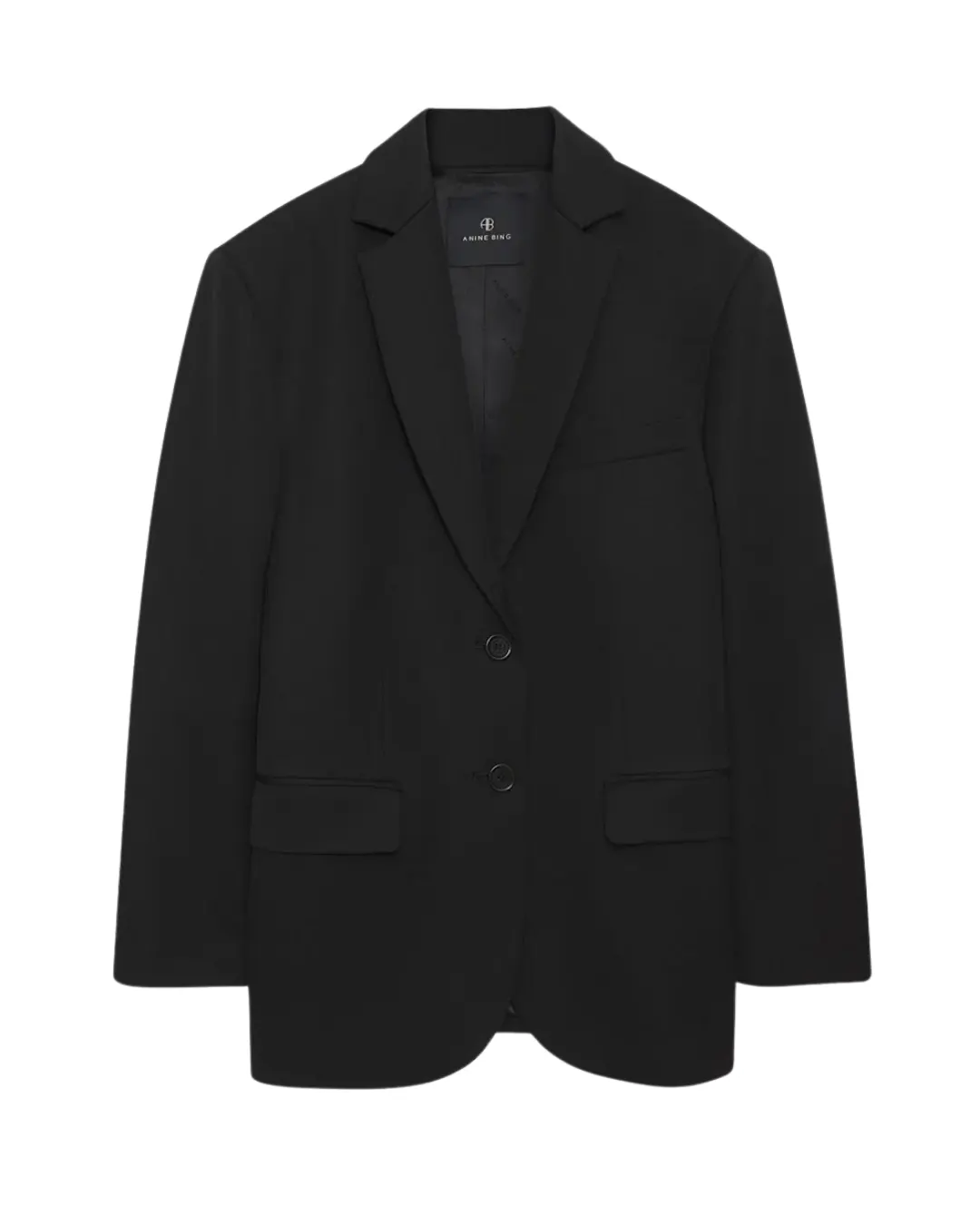
Recreating the visual effect now does not require chasing the exact label. Marcella makes the sort of fine, close-fitting turtleneck that disappears neatly beneath tailoring, while brands such as Anine Bing or COS offer black blazers with enough structure to preserve the severe upper line. Keep both pieces almost aggressively plain. The whole point is that nothing below the chin should appear to be trying particularly hard.

Then the camera pulls back and mythology becomes considerably more ordinary.
Straight black trousers continue the vertical line without adding another idea. They are neither dramatically wide nor sharply cropped, and that relative blandness is useful. Holmes’ uniform was never built around fashion-forward proportion. It borrowed authority from sameness, allowing the clothes to look permanent while the story around them kept growing.
The flats make that pragmatism even clearer. Put a pointed pump beneath this outfit and suddenly it enters familiar executive womenswear. A low black flat keeps it closer to Silicon Valley’s cultivated indifference toward traditional business polish. Practicality becomes part of the performance.
That distinction is easy to preserve with contemporary pieces. A straight or gently tapered trouser from Theory, H&M or Banana Republic keeps the line clean, while Vagabond or Steve Madden can supply a black leather flat with little visible ornament. No dramatic buckle, no contrast toe, no attempt to turn the shoe into the memorable part.
Holmes’ wardrobe depended on refusing precisely that kind of competition. Every piece knew it was supporting the cast.


The clothes may have been disciplined, but the face never followed quite the same rules.
Bright red lipstick, heavily worked eyes and bleached blonde hair introduced a strange instability above all that controlled black. The lipstick could sit slightly outside its cleanest line. Mascara appeared dense and occasionally clumped. Hair often escaped the careful smoothness expected from the polished founder archetype, falling somewhere between hurried and deliberately undone.
That imperfection became so identifiable that The Dropout’s makeup department studied photographs of Holmes closely to reproduce it. Head makeup artist Jorjee Douglass described working with deliberately smudged eyeliner, clumpy mascara and an uneven red lip rather than polishing Amanda Seyfried into a conventional corporate beauty look.
Red lipstick also did something the black wardrobe could not. Against an almost colorless outfit, it concentrated attention directly on the mouth. Every photograph suddenly had a focal point. The messier hair worked in a similar way, disturbing the severity of the clothes just enough to suggest that getting dressed had been secondary to whatever allegedly more important problem awaited at the office.
A deep neutral red from MAC or NARS can recreate that contrast, but perfection would miss the image entirely. The Holmes look was never old-Hollywood red lip plus immaculate waves. Its power came from the collision between a uniform attempting total control and beauty details that looked as though somebody had applied them while already late for a meeting.
Elizabeth Holmes made repetition do what fashion normally asks novelty to accomplish. The black turtleneck became so inseparable from the public persona that even after she abandoned it, the image refused to disappear. A 2026 Wall Street Journal piece noted how firmly the look remains lodged in popular memory, while Vanity Fair contrasted that founder-era uniform with beige knits and softer presentation seen in the newer documentary You Can See Everything.
Clothes can help construct a character. The more interesting problem begins when the character survives the wardrobe.