MENU
Close





Julie Kegels arrived at Paris Fashion Week carrying the expectation of an LVMH Prize winner and answered it with a collection obsessed with gravity, pressure and garments losing their proper place.
Julie Kegels arrived at Paris Fashion Week carrying the expectation of an LVMH Prize winner and answered it with a collection obsessed with gravity, pressure and garments losing their proper place.
October 1, 2026
Advertisement
Advertisement


Opening the official Paris Fashion Week runway schedule on September 28 placed Julie Kegels in an unusually exposed position. Her label is barely two years old, yet the Belgian designer entered Spring/Summer 2027 with the 2026 LVMH Prize behind her, international stockists already carrying the collection and an industry suddenly paying much closer attention to every decision.
Kegels responded to that pressure literally. Apple of the Day examines gravity as physical force, psychological burden and the strange weight that accompanies success. Her personal habit of eating an apple before bed provided the initial connection to Newton, while the collection expanded the idea toward falling under pressure, falling into place and the instability that comes when something begins to slip from its expected position.
The most immediate change happens through proportion.
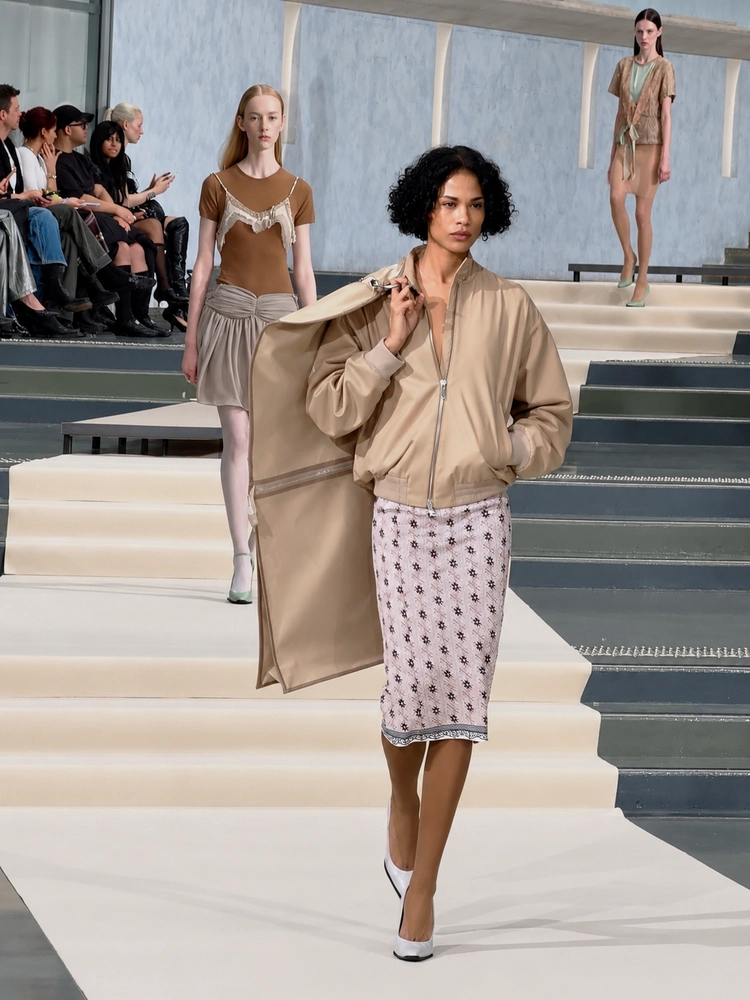
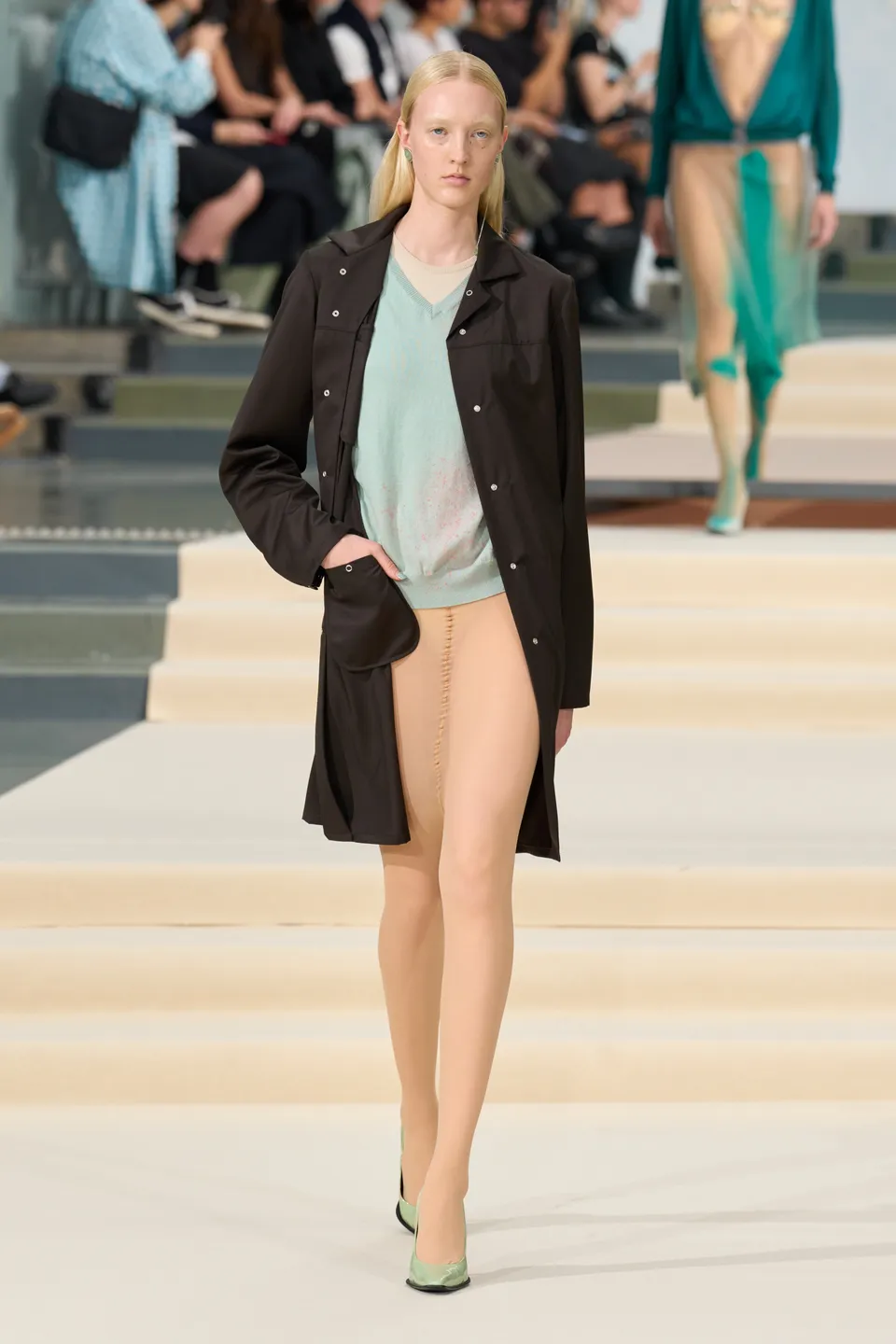
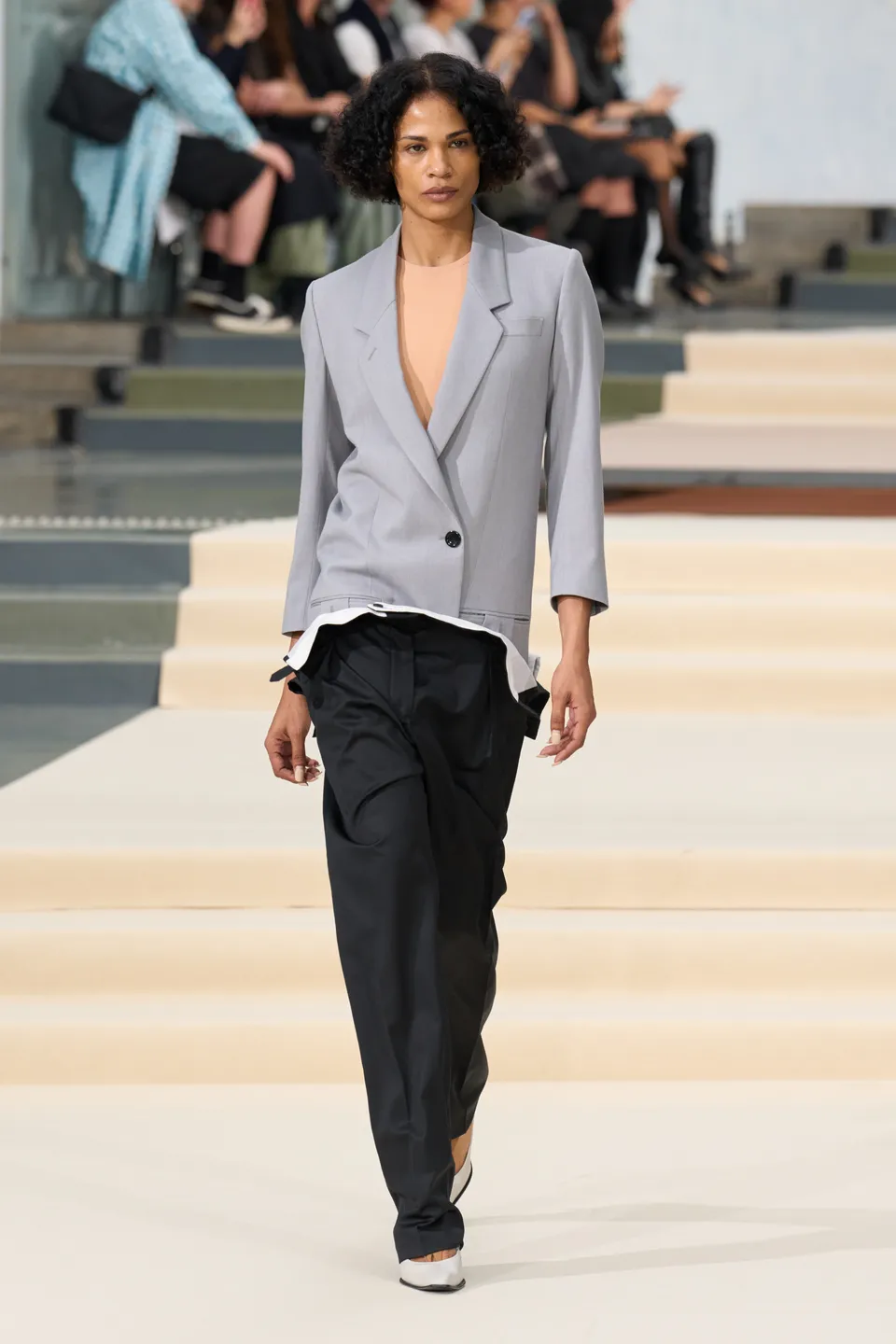
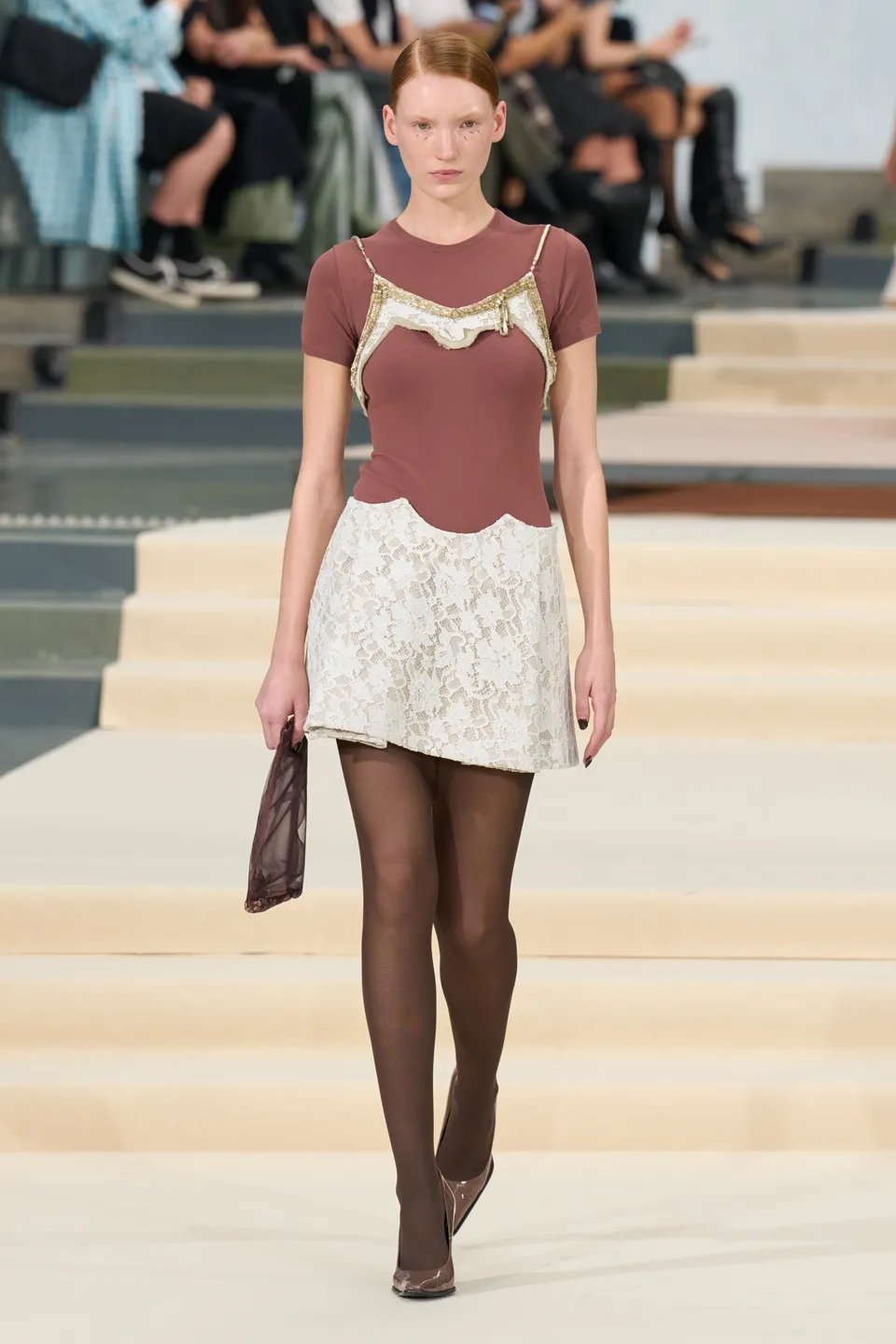
Trouser crotches drop dramatically toward the knee, waistlines descend around the hips and armholes appear dragged away from their conventional position. Pleated skirts sit unusually low, while knits slide from the shoulder as though the wearer has moved faster than the garment can follow.
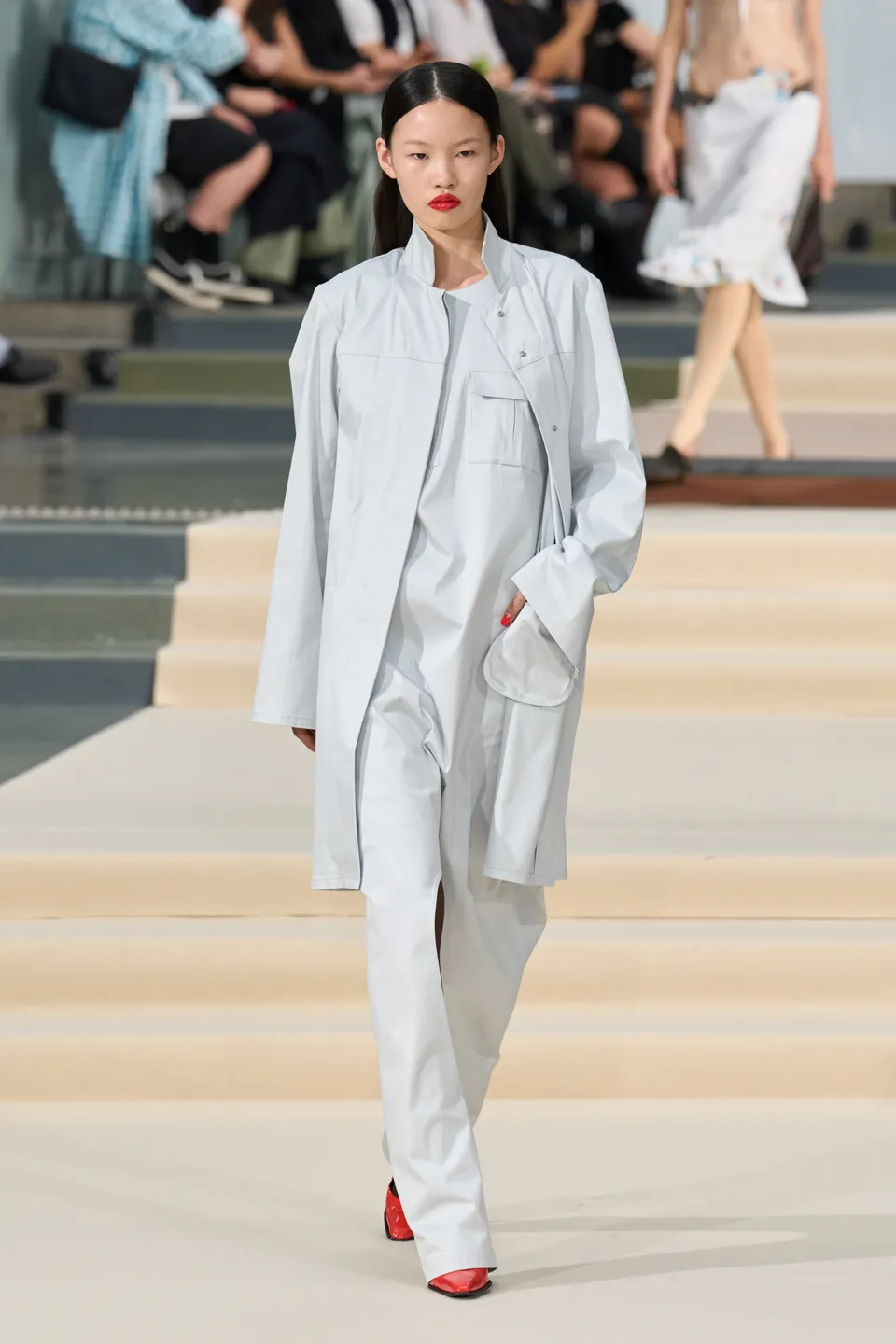
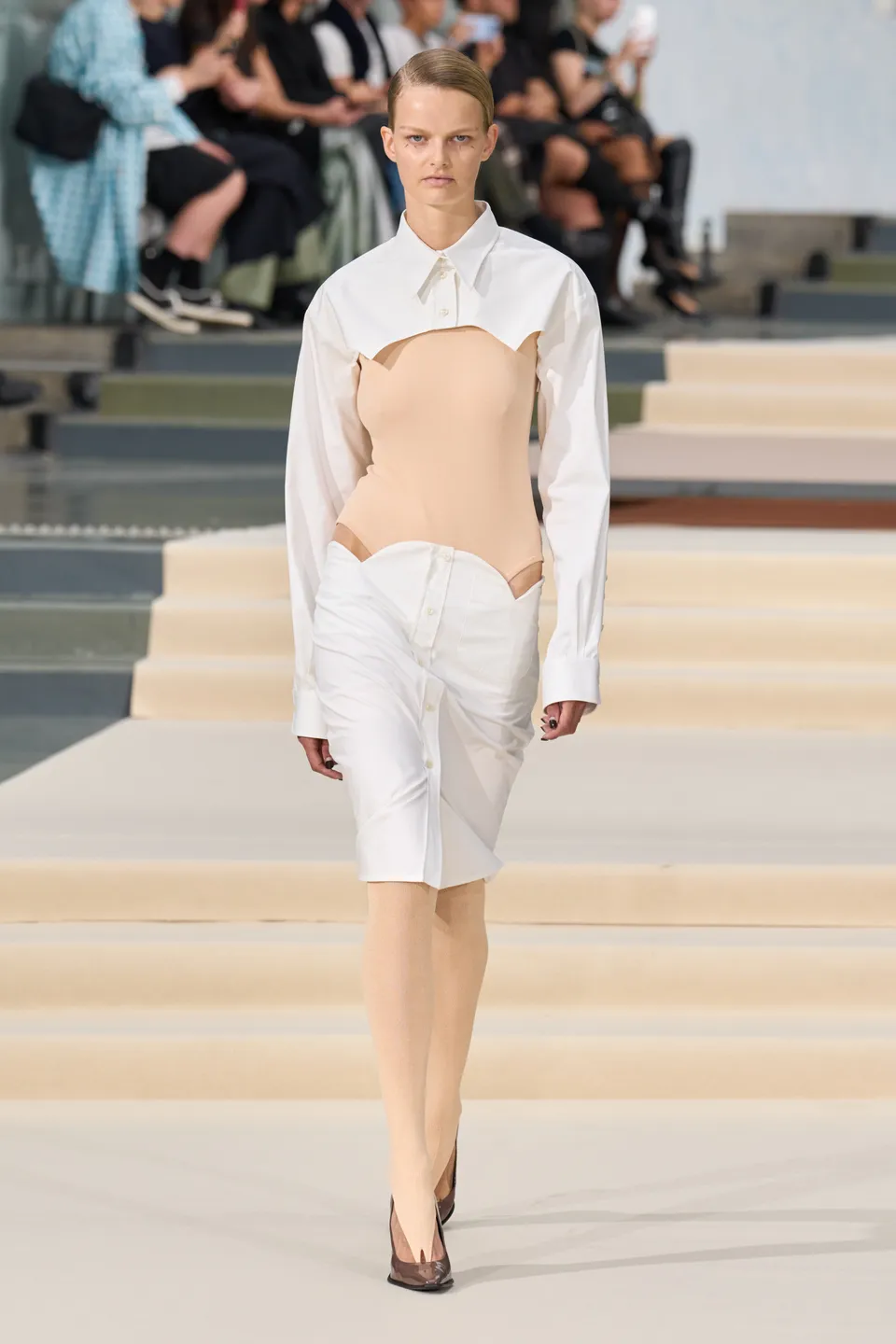
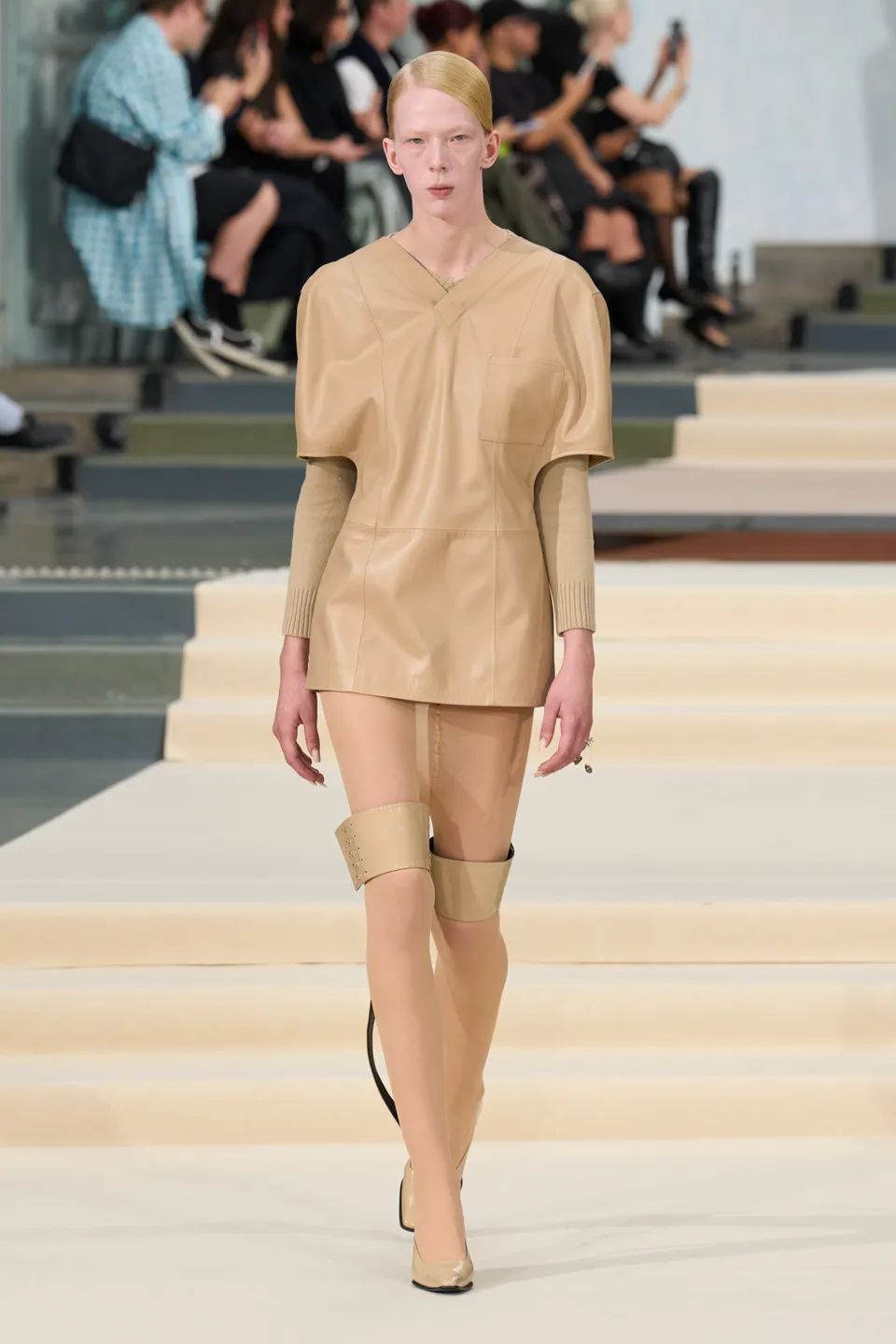
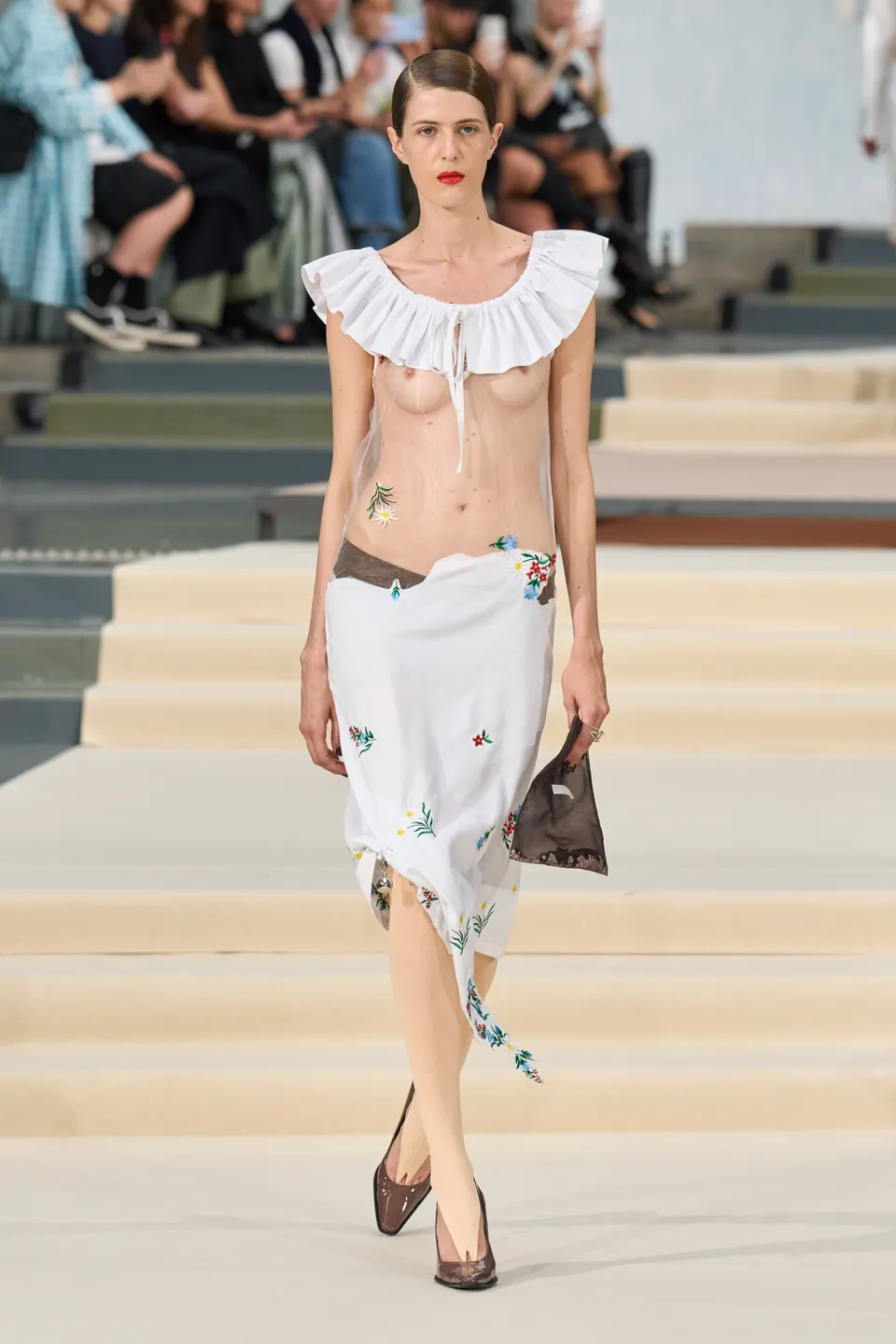
These interventions extend an idea Kegels has been developing across previous seasons. Her Spring 2026 work played with clothing caught in transition, while Fall 2026 explored perception through shadows and distorted visual impressions. SS27 brings the instability directly into construction, making displacement part of the garment itself.
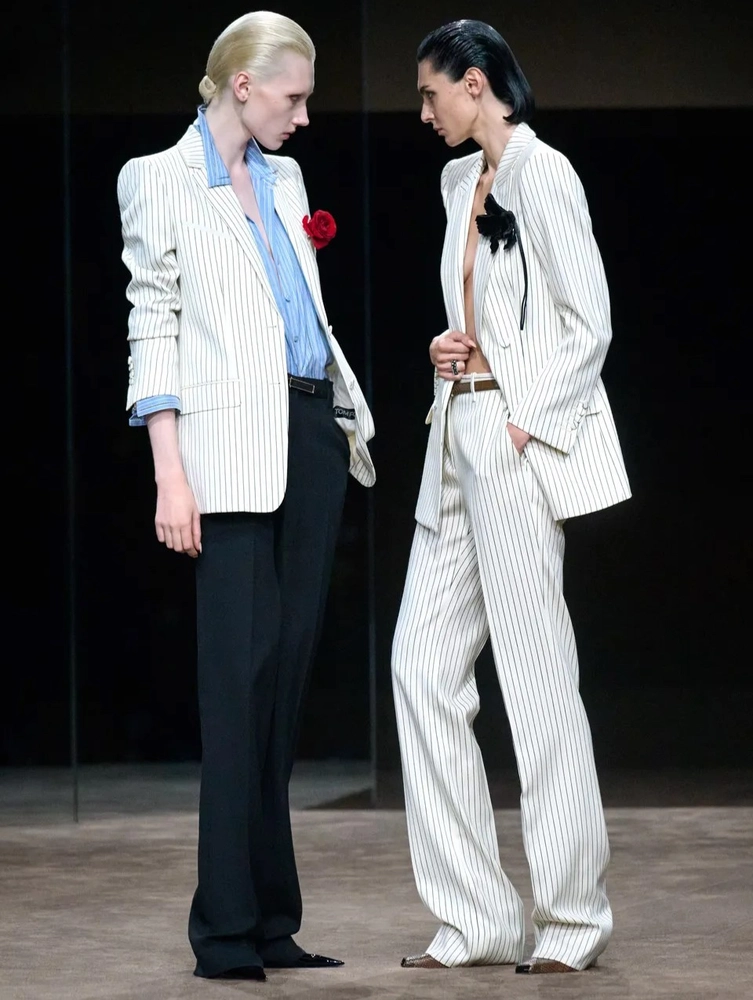
This method works particularly well when a familiar object remains visible underneath the disruption. The opening gray trousers still register immediately as tailoring, yet their extended rise changes the relationship between pelvis, leg and jacket above. A slipped knit retains the familiarity of everyday dressing while its altered position turns an ordinary mistake into a silhouette.
Kegels appears increasingly interested in the exact moment elegance begins to lose composure, and that tension is becoming one of her strongest recurring signatures.
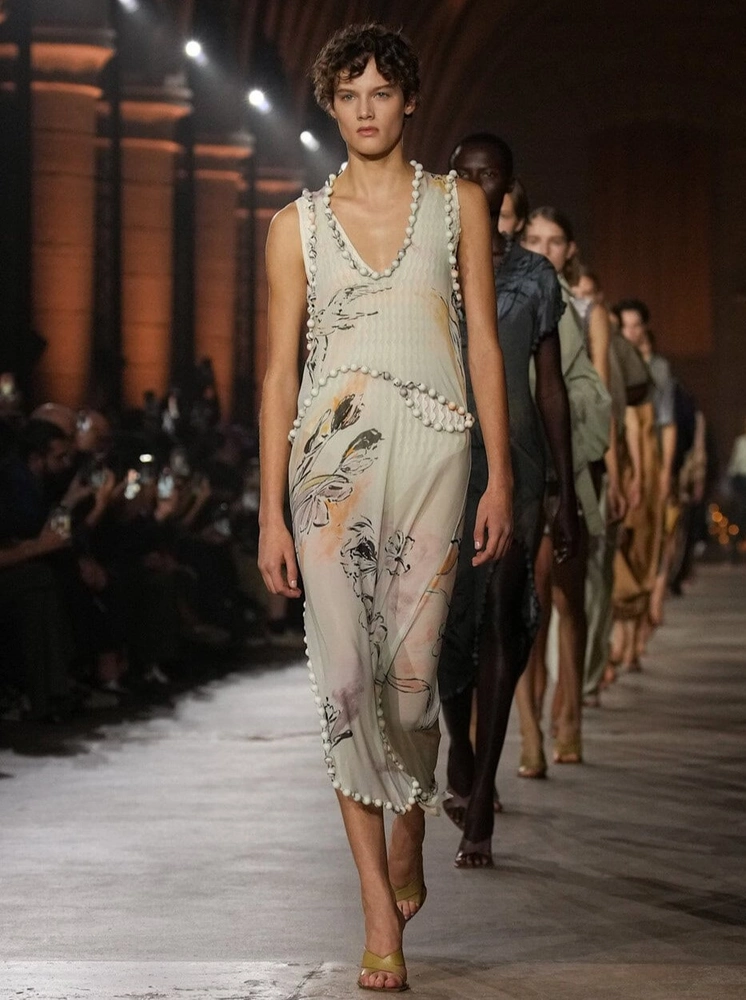
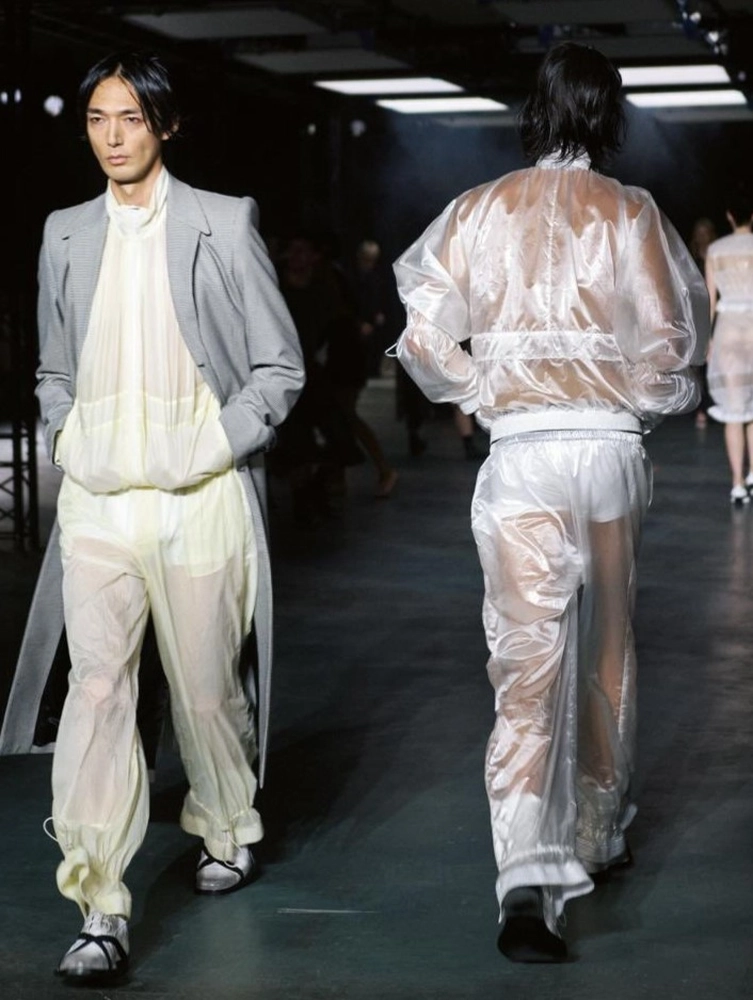
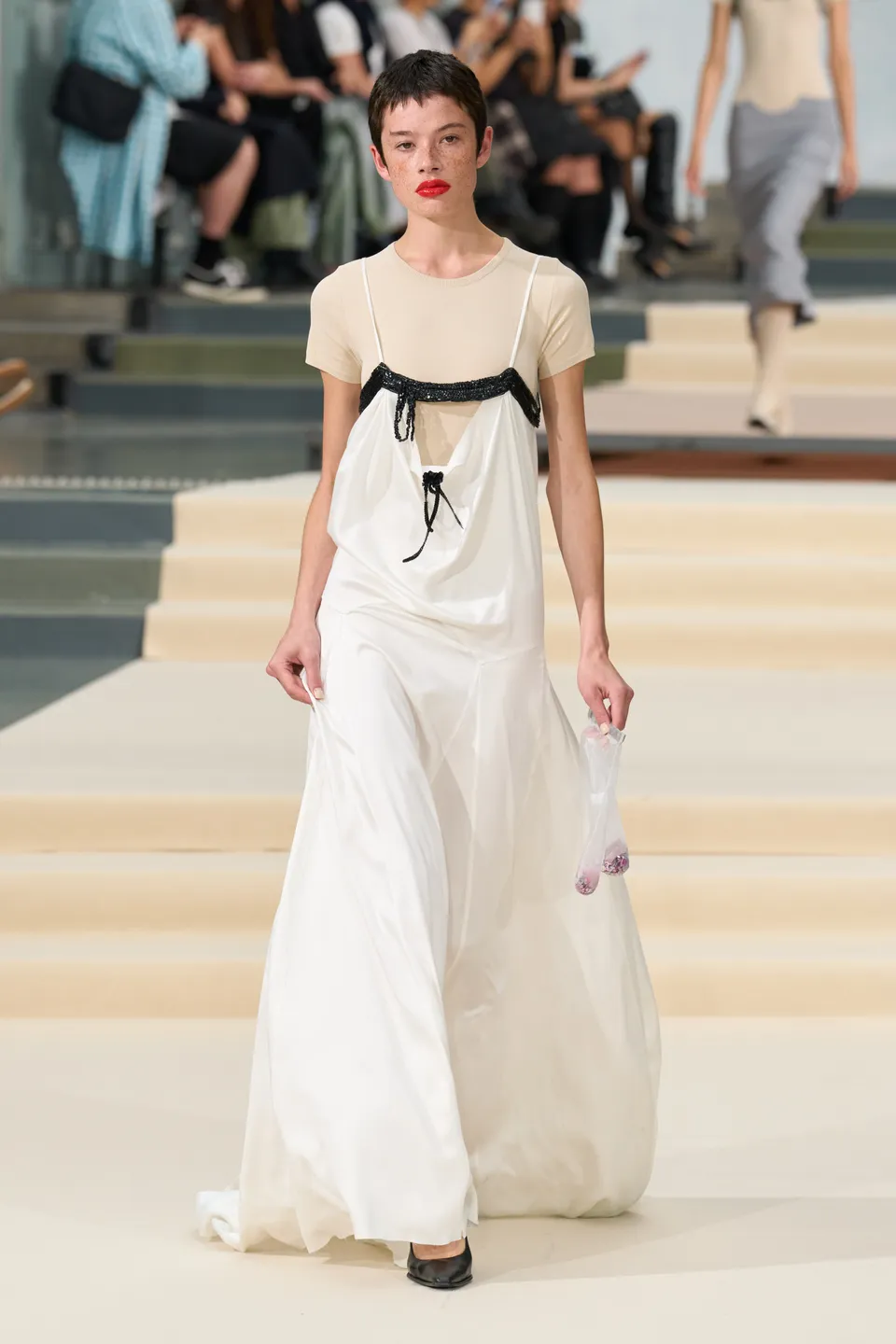
Kegels embeds physical weight inside the garments, allowing gravity to participate in their final shape. Tablecloth weights pull hems toward the floor. Small objects and pigments move through transparent fabric, changing position as the model walks. Brass elements shift inside garments, while embroidery appears visually dragged downward.
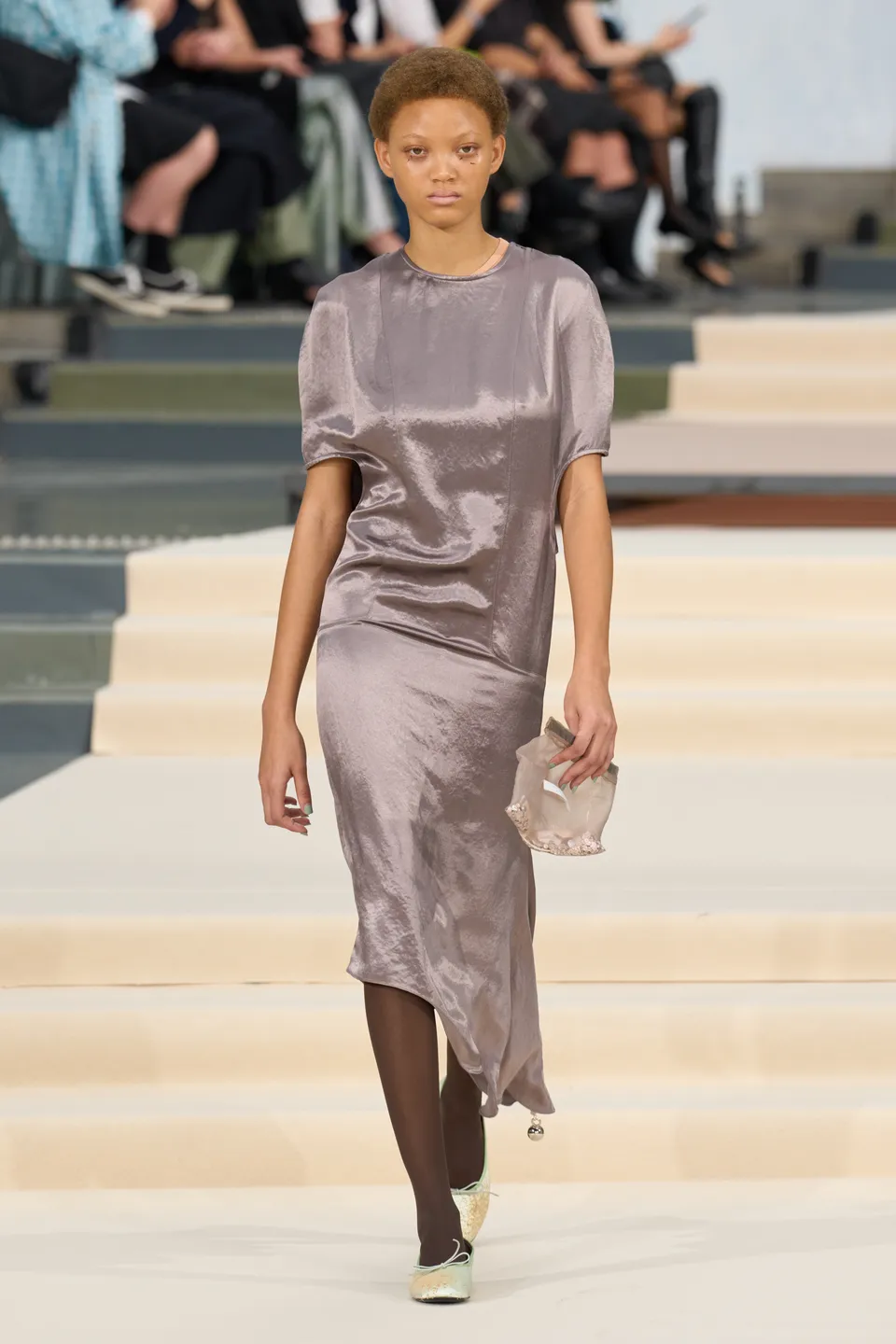
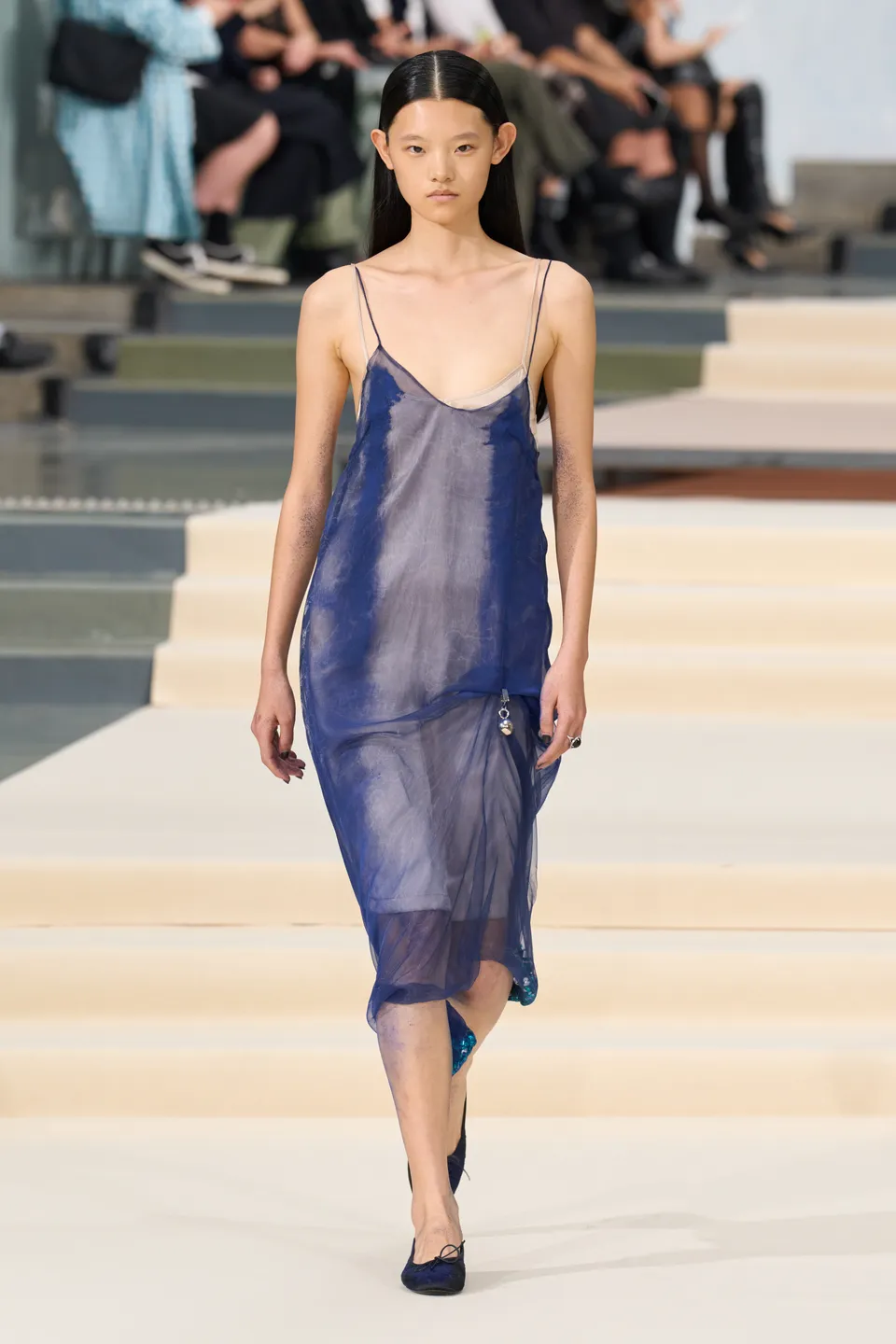
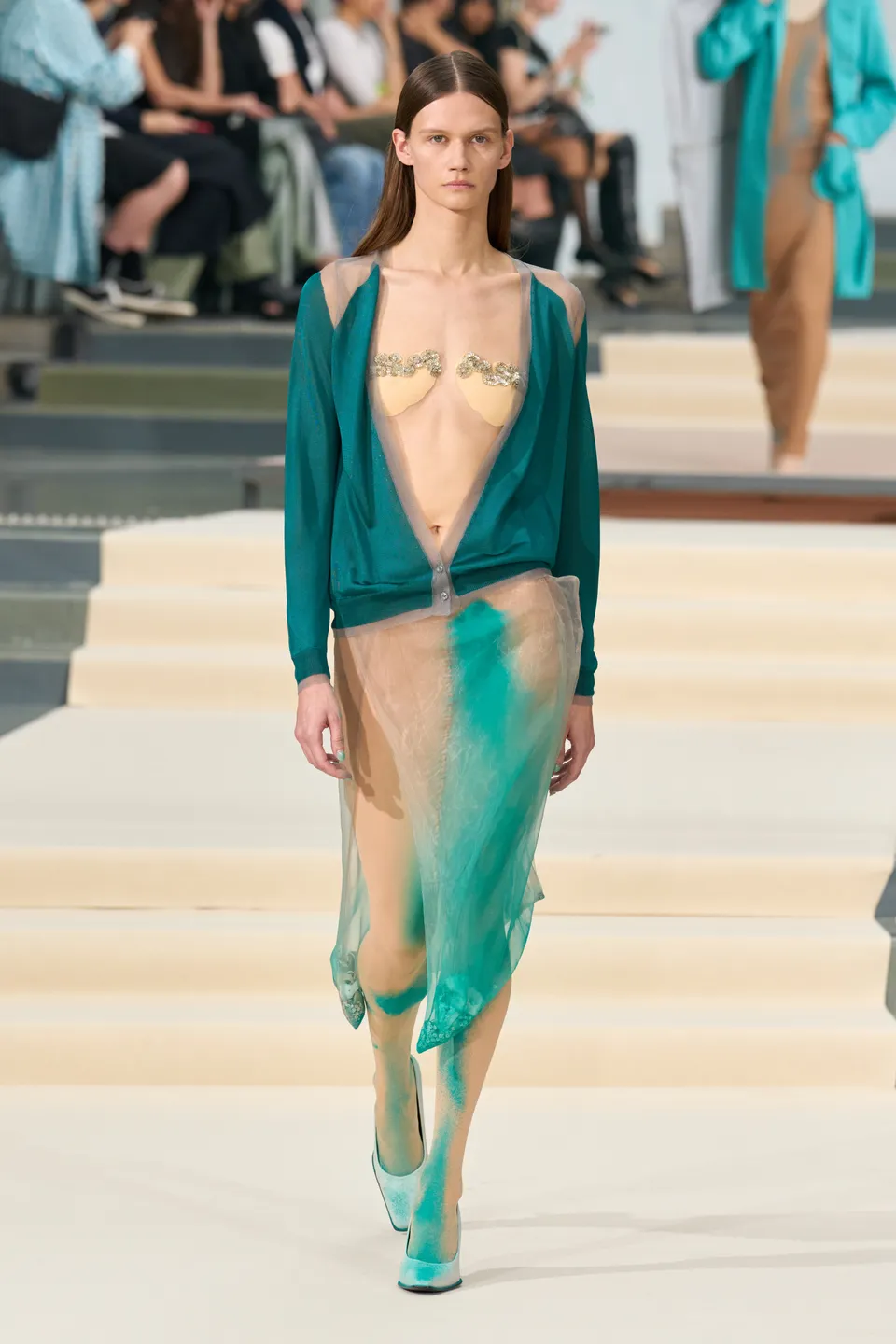
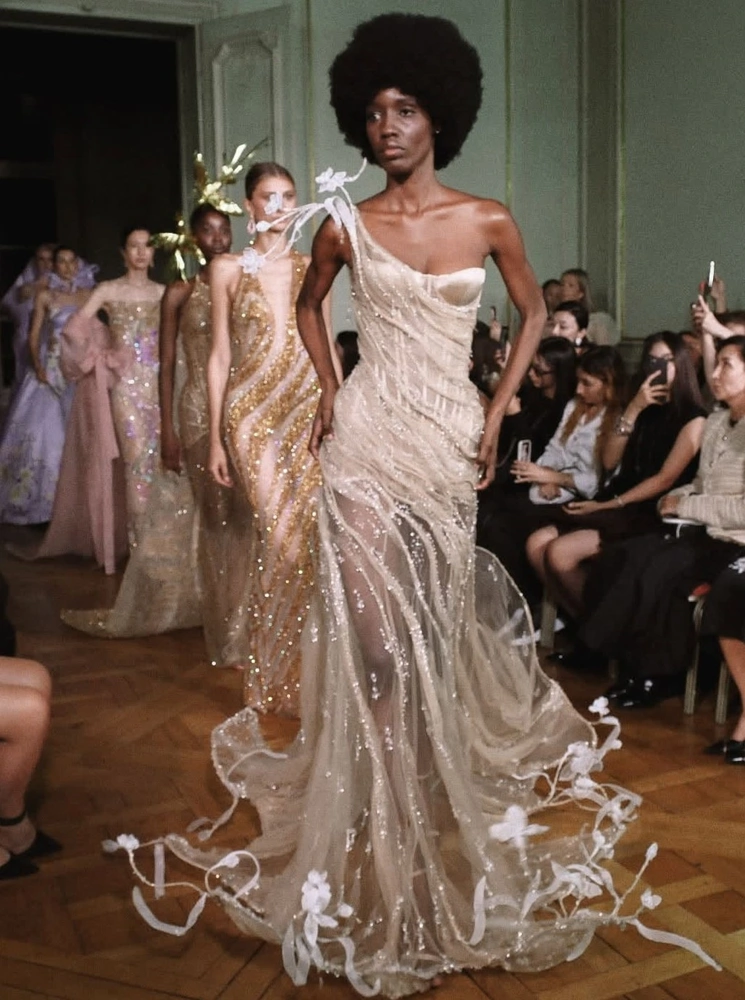
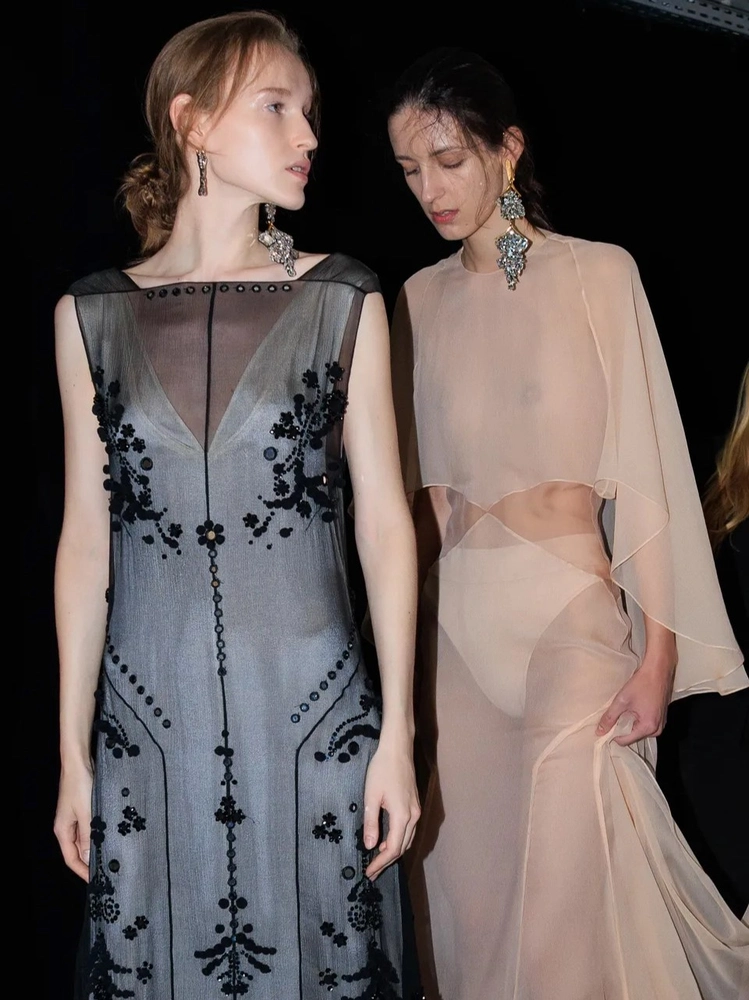
Super organza becomes particularly effective because its transparency exposes the mechanics of movement. Sequins, pigment and pearl-like filling collect differently depending on motion, turning the garment into a small system governed by the same force that inspired the collection.
Elsewhere, rigid taffeta structures meet sheer Lycra, producing a clash between volume and skin. Nylon and jersey behave differently under tension, while silk and traditional suiting provide familiar surfaces against which the experimental interventions become easier to read.
The most convincing techniques give gravity a practical consequence. Fabric stretches differently, a hem acquires an unexpected trajectory or an embellishment visibly migrates across the body. At those moments, the concept becomes construction.
The strongest pieces in Julie Kegels SS27 allow one intervention to dominate.
Low pleated skirts create an elegant disruption because their placement alone changes the proportion of the body. The weighted dresses gain character through altered movement without requiring an additional visual explanation. Organza filled with falling particles gives transparency an active role, allowing the material to transform during the runway.
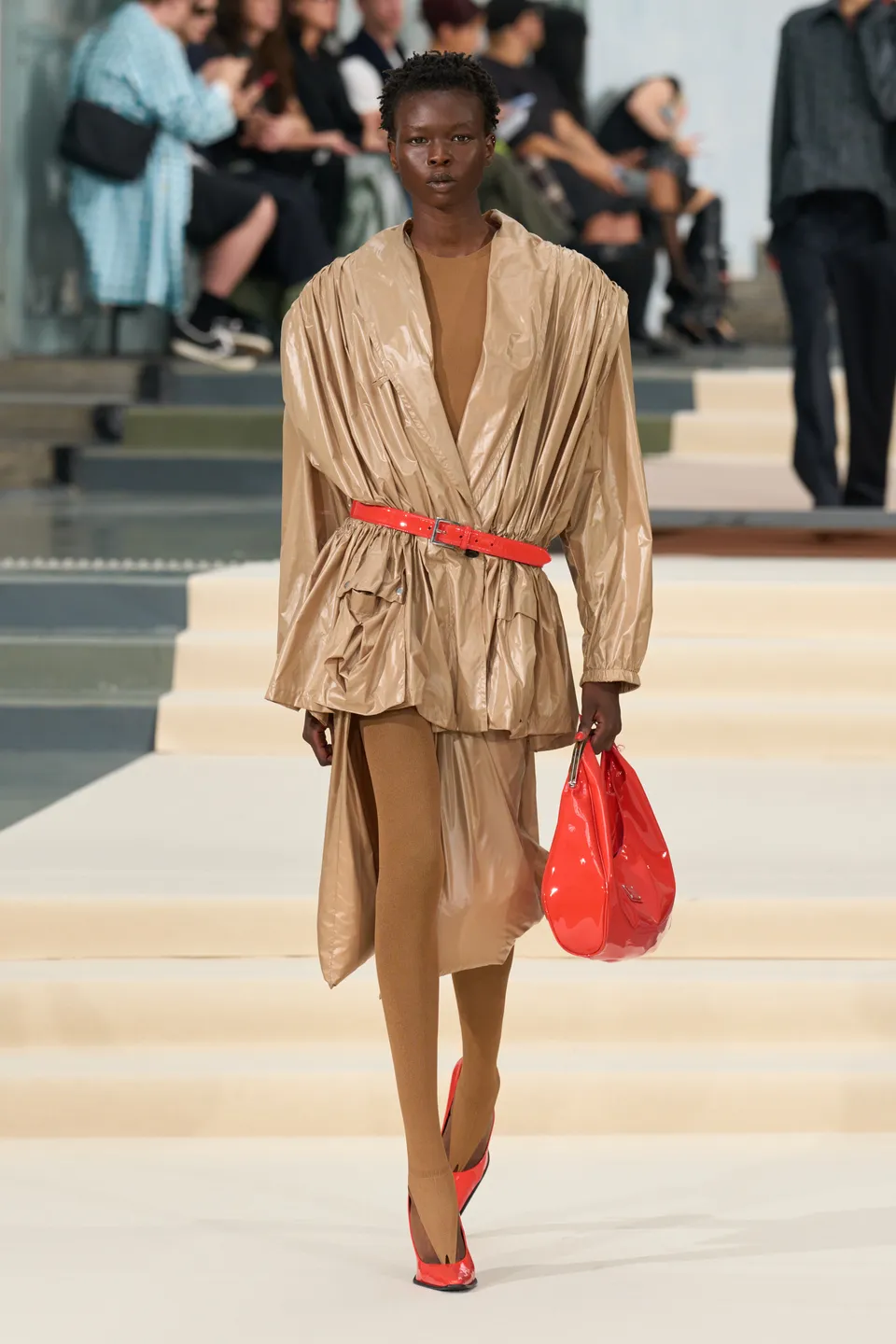
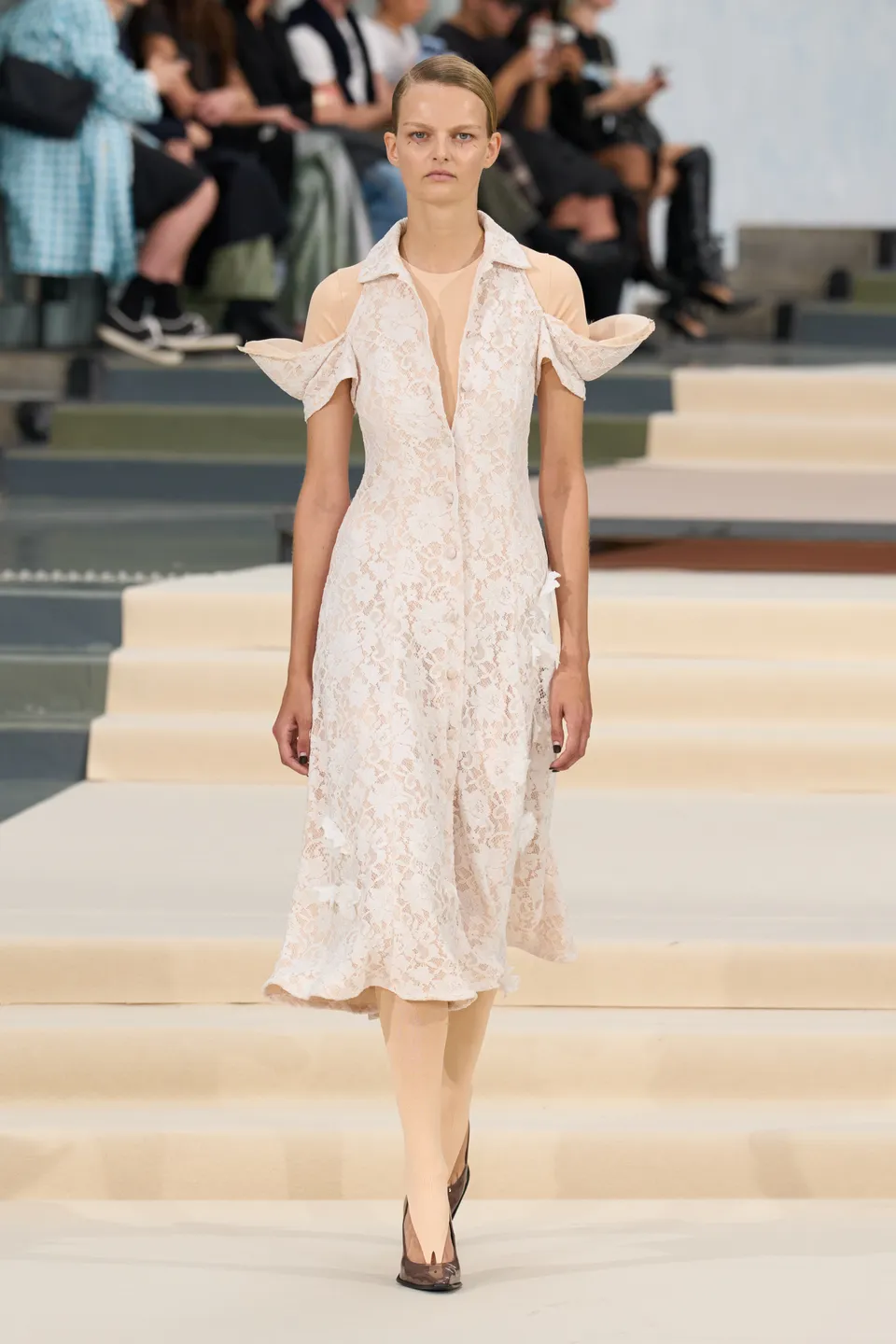
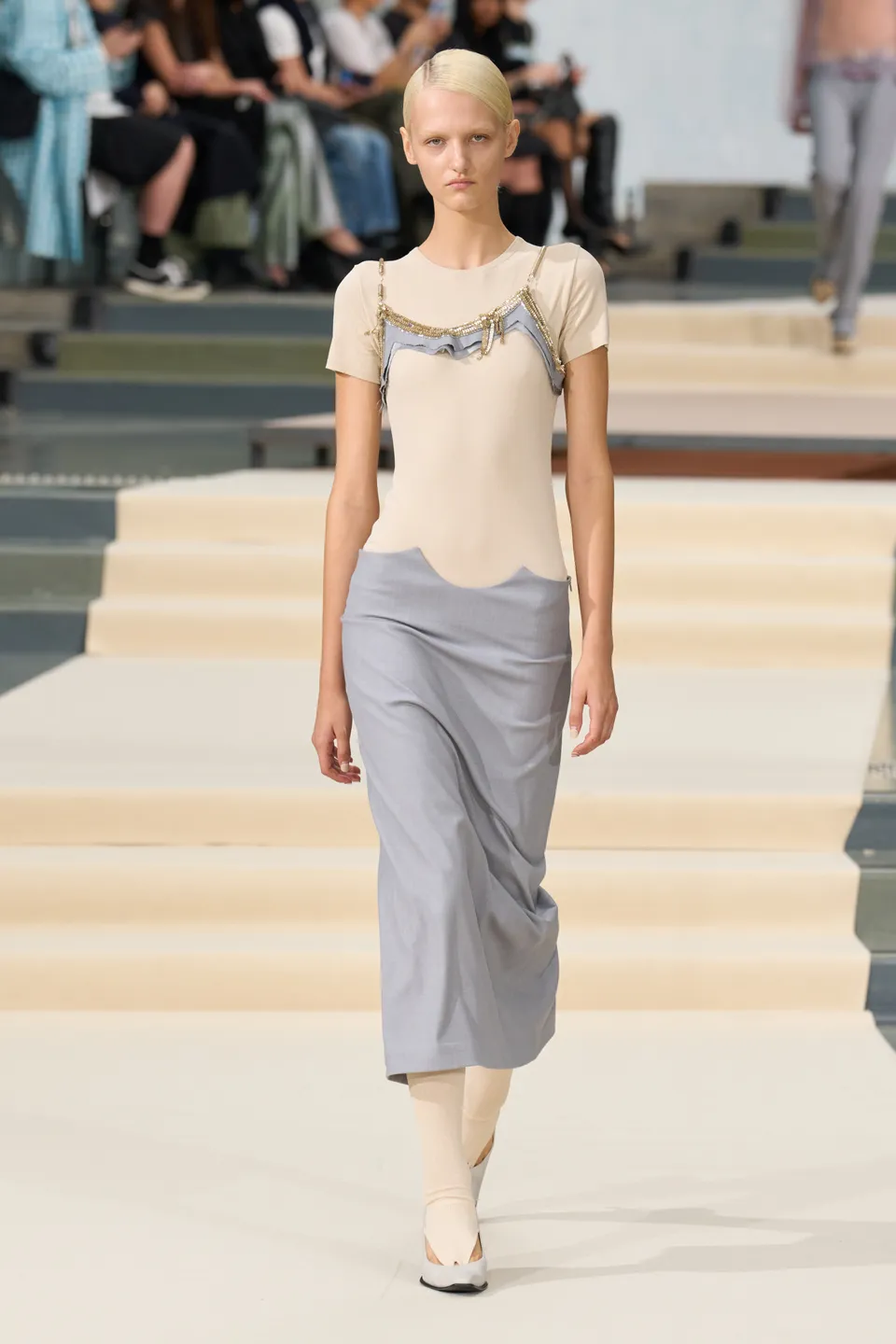
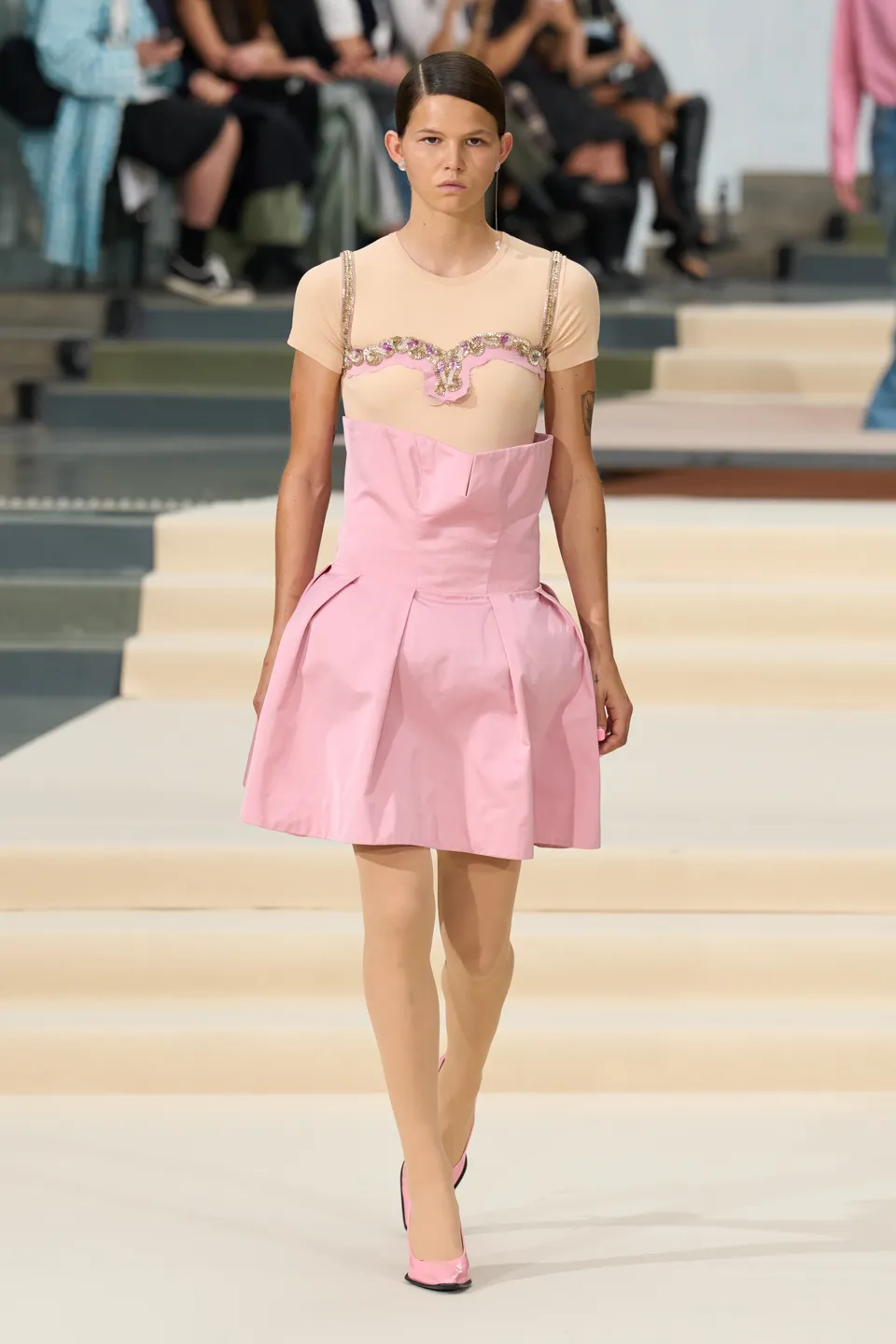
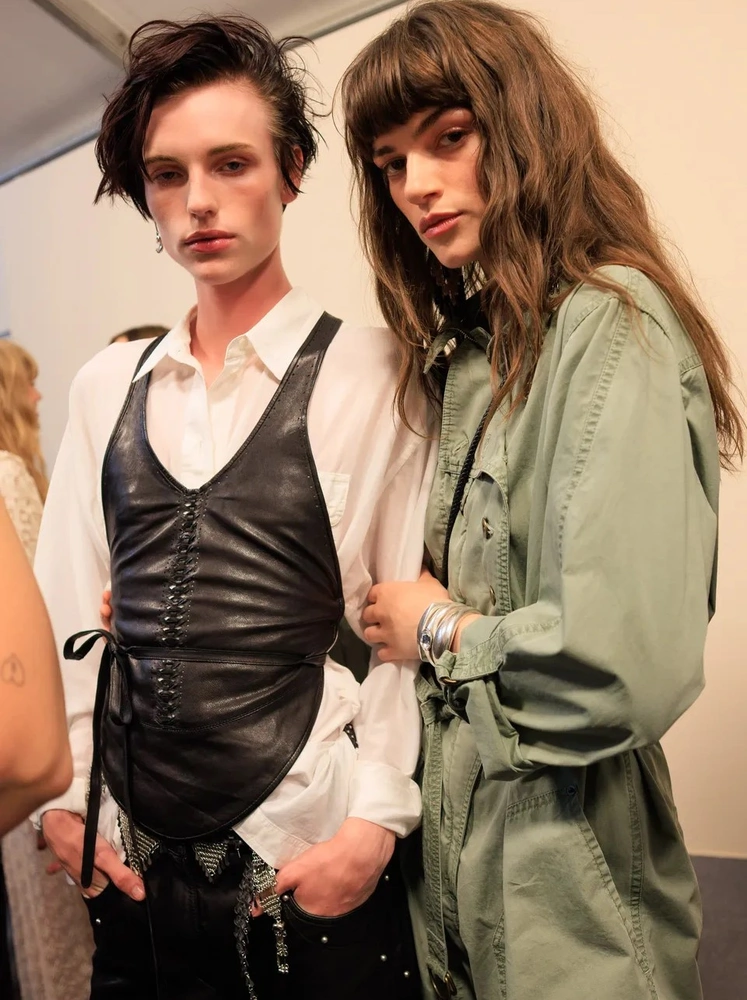
Modular garments also reveal a useful avenue for the designer. Shirts, jackets and skirts can be connected through buttons and bands, giving the wearer some authority over how the pieces are assembled. This turns transformation into function and suggests a commercial life beyond the runway concept.
The collection becomes harder to follow when several experiments compete within one silhouette. Padding, unusual placement, surface treatment and displaced proportion can each carry a strong idea independently. Combining all of them risks obscuring the initial gesture.
Julie Kegels has enough ideas to fill several seasons. SS27 occasionally tries to fit too many of them into one.
The runway styling pushes gravity beyond the garment.
Hair appears manipulated into suspended shapes, making sections of ponytail look displaced from their natural fall. Sheer layers reveal underwear and bodysuits beneath, continuing Kegels’ fascination with dressing as an unfinished process. Tights gather unusually low on the body, while straps visually extend from the leg into footwear.
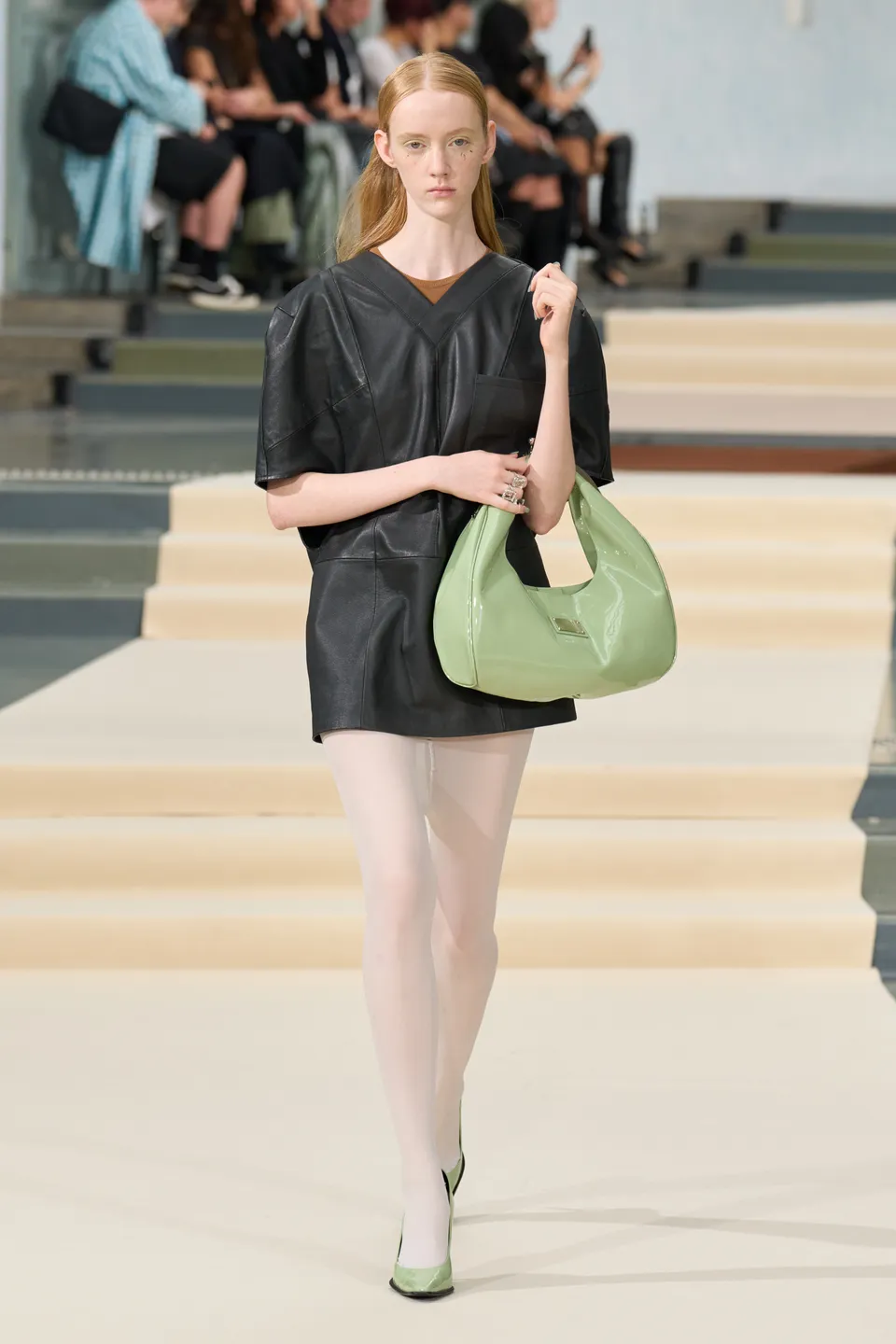
Shoes become one of the collection’s more contentious elements. Several designs intentionally create visual tension around the foot, extending the idea of a body being pulled or held in an awkward position. Conceptually, the decision belongs to the same world as the dropped trousers and sliding garments.
Visually, the fit sometimes appears uncomfortable enough to compete with the clothes themselves.
That tension reveals something important about Kegels’ current approach. She commits fully to a concept across casting, beauty, footwear, accessories and construction. Such commitment creates a coherent universe, yet it also amplifies any idea whose execution lacks resolution.
SS27 also introduces Julie Kegels’ first official accessory line, with the Gravity bag appearing in half-moon, barrel and pouch formats.
For a label launched in 2024, moving into bags so early is significant. Julie Kegels already has a wholesale footprint spanning influential stores across Europe, Asia and North America, while the LVMH Prize brings additional mentoring, visibility and financial support into the business.
Accessories give the young house a product category capable of carrying the label beyond a runway audience. The Gravity name also allows the season’s central idea to survive in a recognizable object, providing continuity between concept and commerce.
This expansion suggests that Kegels is increasingly operating as a designer responsible for building a house, not simply producing experimental collections. That distinction will become important as the attention around her grows.
Winning the 2026 LVMH Prize inevitably changed the expectations surrounding Julie Kegels. From more than 2,400 applicants, she emerged with one of fashion’s most visible endorsements for a young designer, and SS27 became an immediate opportunity to demonstrate how that recognition would translate into development.
The collection confirms her appetite for experimentation, technical research and conceptual fashion. It also exposes the growing pains that arrive when ambition outpaces editing.
The issue lies less in experimentation itself than in accumulation.
Julie Kegels frequently appears to push a garment forward by adding another intervention, when refinement could create greater impact. The collection therefore carries moments of genuine invention alongside others that read as underdeveloped, with experimentation taking over the clarity that her strongest ideas already possess.
Now the task becomes selection. Julie Kegels has plenty to say. Paris is now waiting to see which part of that language she chooses to make unmistakably her own.
Advertisement