MENU
Close





Helen Frankenthaler changed postwar American painting by turning color into atmosphere, surface into sensation, and the canvas itself into an active participant in abstraction.

Helen Frankenthaler changed postwar American painting by turning color into atmosphere, surface into sensation, and the canvas itself into an active participant in abstraction.
April 18, 2026


Helen Frankenthaler occupies a singular place in the story of modern art because she made the transition itself look glorious. Born in New York in 1928, trained early under Rufino Tamayo, and shaped by the charged atmosphere of postwar abstraction, she arrived just after the first heroic wave of Abstract Expressionism and redirected it from muscular drama toward something more porous, luminous, and open.
Her work did not reject Jackson Pollock so much as absorbing his lesson and then softening it into weather, breath, and light. That is why Frankenthaler is so often understood as the bridge between Pollock’s radical freedom and the more spacious language that came to define Color Field painting. In 2025 and 2026, major museum presentations at the Guggenheim Bilbao, MoMA, and Kunstmuseum Basel have only sharpened that view, reaffirming her as one of the decisive inventors of postwar painting.
Helen Frankenthaler’s breakthrough still feels startling because it altered the basic relationship between paint and support. After studying at Bennington College, she entered a New York art world electrified by abstraction, and after seeing Pollock’s work she began searching for a way to preserve the freedom of gesture without remaining trapped inside his exact syntax. She extended Pollock’s drip-and-pour approach toward large, collage-like zones of color, while Guggenheim materials describe her as a pivotal figure in the transition from Abstract Expressionism to Color Field painting. Her answer arrived in 1952 with Mountains and Sea, the painting that transformed her career and, in time, the trajectory of American abstraction.
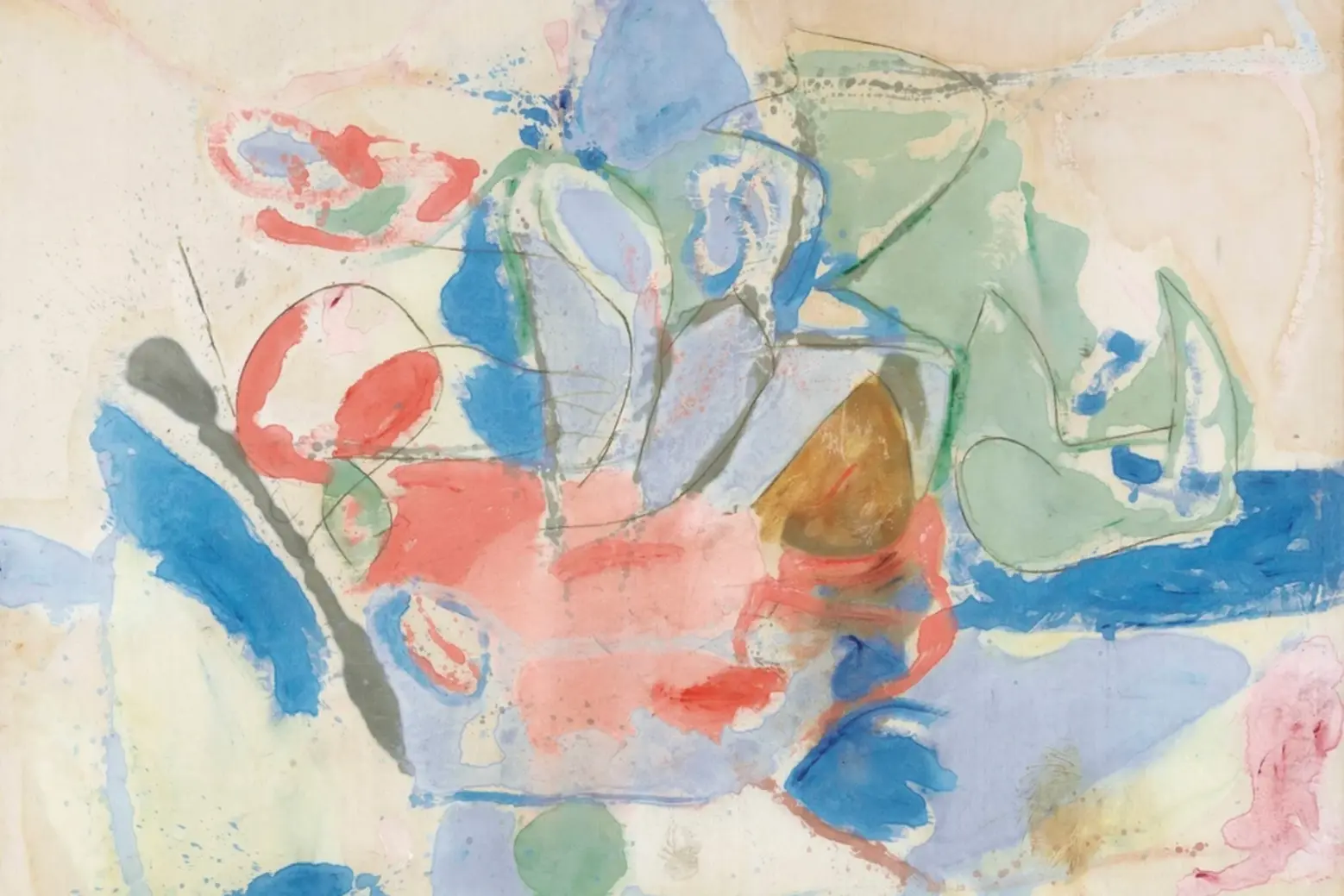
Made when she was twenty-three, Mountains and Sea took inspiration from a trip to Nova Scotia, yet it never translates landscape into a fixed image. Instead it drifts between memory, weather, and stain. Guggenheim describes it as the first work she made using her celebrated soak-stain technique, and MoMA’s retrospective materials identify it as the most historically famous work in her oeuvre.
The shock of that innovation was not only technical. It was philosophical. Pollock had exploded composition through movement and allover energy. Helen Frankenthaler opened space again, though on new terms. Her paintings could remain abstract while still evoking water, sky, horizon, and air. They gave abstraction a more atmospheric emotional register, one less clenched and more lyrical. In a mid-century scene often narrated through force and bravado, her work felt expansive without becoming bombastic, intimate without becoming minor. That shift is one reason her art continues to feel so contemporary. It privileges permeability over conquest.
Helen Frankenthaler’s soak-stain method was radical in its simplicity. Rather than laying paint onto a primed barrier, she thinned oil paint with turpentine or kerosene and poured it directly onto unprimed canvas laid on the floor, allowing the pigment to soak into the raw fibers. Guggenheim’s 1998 exhibition materials describe exactly that process, and later scholarship around Mountains and Sea emphasizes how the paint seeped into and through the cotton surface, creating openness and atmospheric space without relying on traditional illusionism. The result was neither watercolor nor conventional oil painting, but something astonishingly hybrid. Fluid, absorbent, and almost fused with the fabric itself.
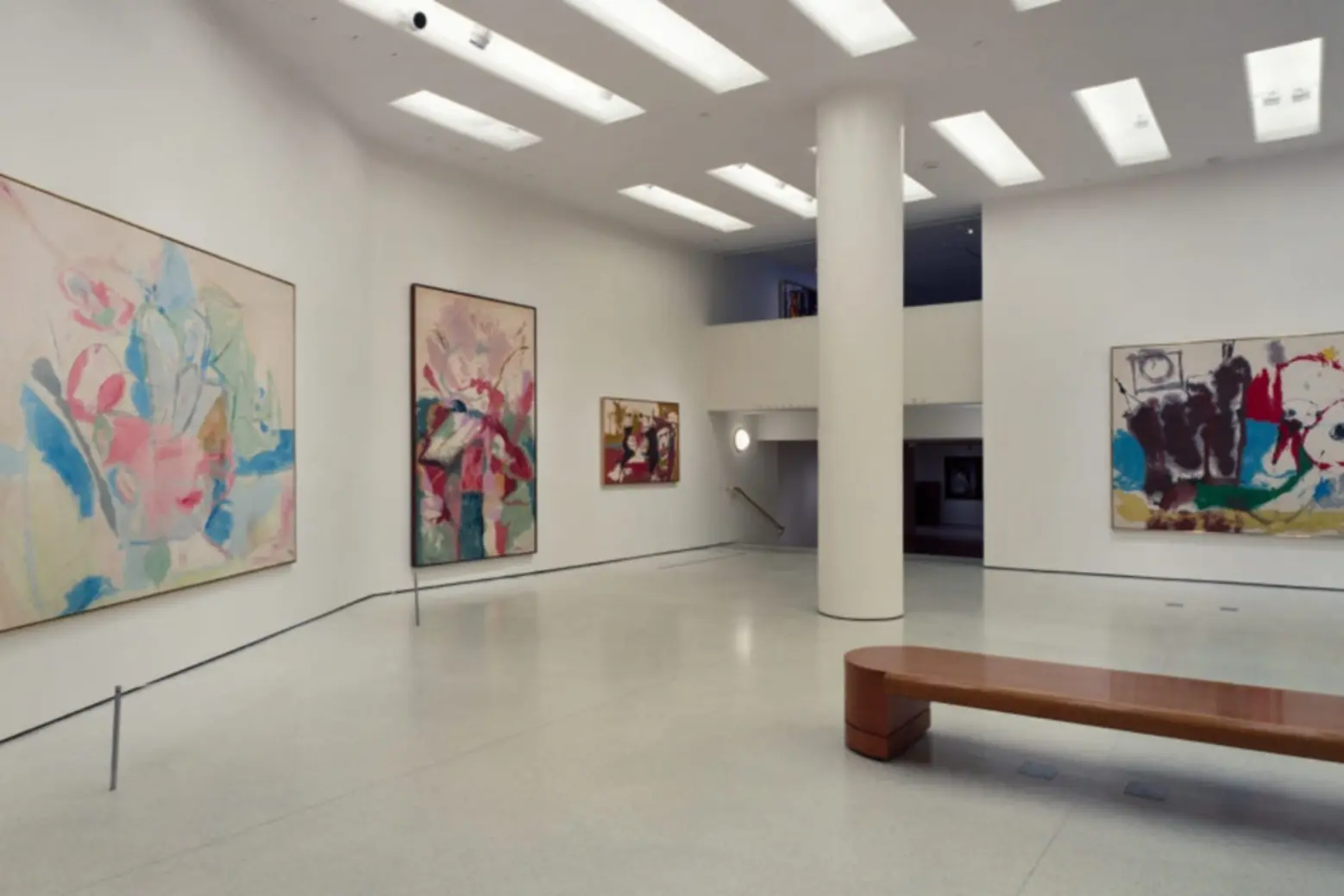
That breakthrough became foundational for the next chapter of American abstraction. Helen Frankenthaler’s approach proved influential to Morris Louis and Kenneth Noland, and its Kenneth Noland materials specify that their encounter with Mountains and Sea inspired them to begin experimenting with stain painting themselves. Morris Louis catalogue goes further, stating that the painting caused Louis to change direction abruptly. This is why Frankenthaler’s place in art history is so much larger than the old shorthand of “female Abstract Expressionist.” She was not a peripheral participant in a movement dominated by men. She was an engine of formal change whose discoveries helped create another movement altogether.

Her experimentation did not stop with the early 1950s. A Helen Frankenthaler Foundation press release notes that she later abandoned the more gestural drawing of her earlier oils as she transitioned to acrylic paint, a move that sharpened edges, intensified color, and opened new possibilities for opacity and clarity. By the 1960s and after, Helen Frankenthaler’s art had become less about the romantic accident of stain alone and more about orchestrating large chromatic events across the canvas. The airy washes remained, but they could now coexist with bolder intervals, firmer contours, and that extraordinary halo effect in which one zone of color seems to breathe into another.

Helen Frankenthaler’s biography also helps explain the unusual range of her influence. As the daughter of a New York State Supreme Court judge and a student of Rufino Tamayo, who taught her to value craftsmanship and materials, she therefore entered the art world with both cultural confidence and an unusually refined sensitivity to the surface. Yet privilege alone does not explain what followed. She joined the most volatile and demanding artistic milieu in New York and established herself there through invention, not pedigree.

Her relationship with the critic Clement Greenberg placed her close to the center of postwar debates about modernism, flatness, and abstraction, and later Greenberg’s landmark 1964 exhibition Post-Painterly Abstraction helped canonize the broader tendency to which her work was essential. Frankenthaler also married Robert Motherwell in 1958, their partnership linked two major figures of postwar painting, though Frankenthaler’s best work was never merely derivative of the circles around her. If anything, her achievement shows how completely she could absorb influence and still remain unmistakably herself.
What is especially striking is how little Frankenthaler allowed herself to be confined by a single medium. She designed sets and costumes for the Royal Ballet’s production of Number Three at Covent Garden, while Guggenheim Bilbao’s 2025 exhibition stressed that over six decades she also produced sculptures, ceramics, tapestries, and print editions. Her ukiyo-e woodcuts, in particular, have gained renewed admiration for translating painterly spontaneity into a medium usually associated with resistance and carving.

The afterlife of Helen Frankenthaler is marked by two intertwined developments: Stronger institutional visibility and firmer market confidence. MoMA’s Helen Frankenthaler: A Grand Sweep ran from November 18, 2025, through February 8, 2026, focusing on monumental works, while Kunstmuseum Basel opened a major exhibition in April 2026 with extensive loans from the Helen Frankenthaler Foundation. These follow the Guggenheim Bilbao’s 2025 survey Painting Without Rules, which positioned her as a pioneering abstractionist who never stopped reinventing her approach. Together, these shows suggest a broader correction in how museums frame her legacy: Not as a lyrical footnote to male giants, but as a major architect of postwar painting.

The market tells a related story. Royal Fireworks set a world auction record for Frankenthaler in 2020 at $7.9 million, a number that still functions as the benchmark for her top tier. More recent sales show sustained appetite rather than a one-off spike: Christie’s reported that Strike (1965) sold in New York on February 26, 2026, for $1,492,250, well above estimate. At the edition level, Wright listed Solar Imp (2001), a screenprint, in April 2026 with an estimate of $7,000 to $9,000. Taken together, those data points support a clear market picture. Major canvases from the 1950s through the 1970s remain scarce, institutionally validated, and highly prized, while prints keep her work active and accessible in a broader collector ecosystem.

What has changed most is the tone of the conversation around her. For years, Frankenthaler was celebrated, yet often discussed through the men around her, whether Pollock, Greenberg, or Motherwell. The recent museum cycle suggests a more mature reading. It emphasizes her technical invention, her long-range experimentation, and her insistence that abstraction could be sensuous, spacious, and structurally daring all at once. In that sense, the renewed attention is not a rediscovery so much as a recalibration. The work was always there. The frame around it has finally widened.
Helen Frankenthaler offered a way out of the density and aggression of first-generation Abstract Expressionism without sacrificing risk, scale, or seriousness. Through Mountains and Sea and the soak-stain breakthrough that followed, she opened the door for Morris Louis and Kenneth Noland, expanded her own practice across painting, printmaking, theater design, and sculpture, and continues in 2026 to command both curatorial and market attention.