MENU
Close





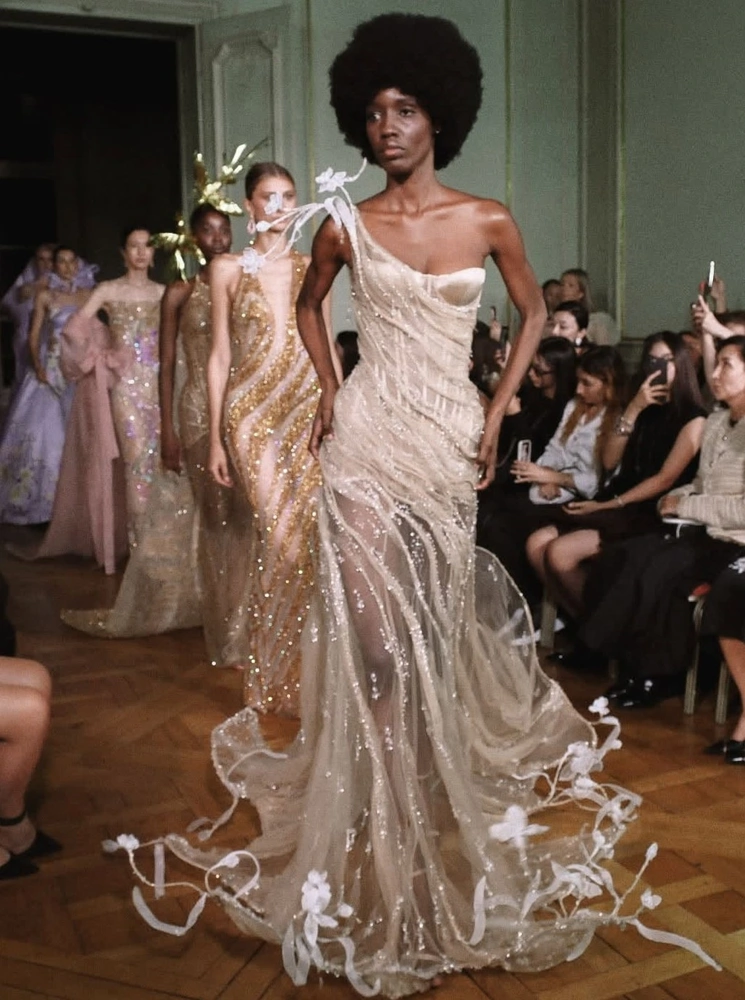
Gianfranco Ferré at Dior felt like entering a couture construction site after midnight. The flowers were beautiful, the gold was seductive, yet every gown seemed held by scaffolding, calculation, and a spine built before the dream was allowed to breathe.
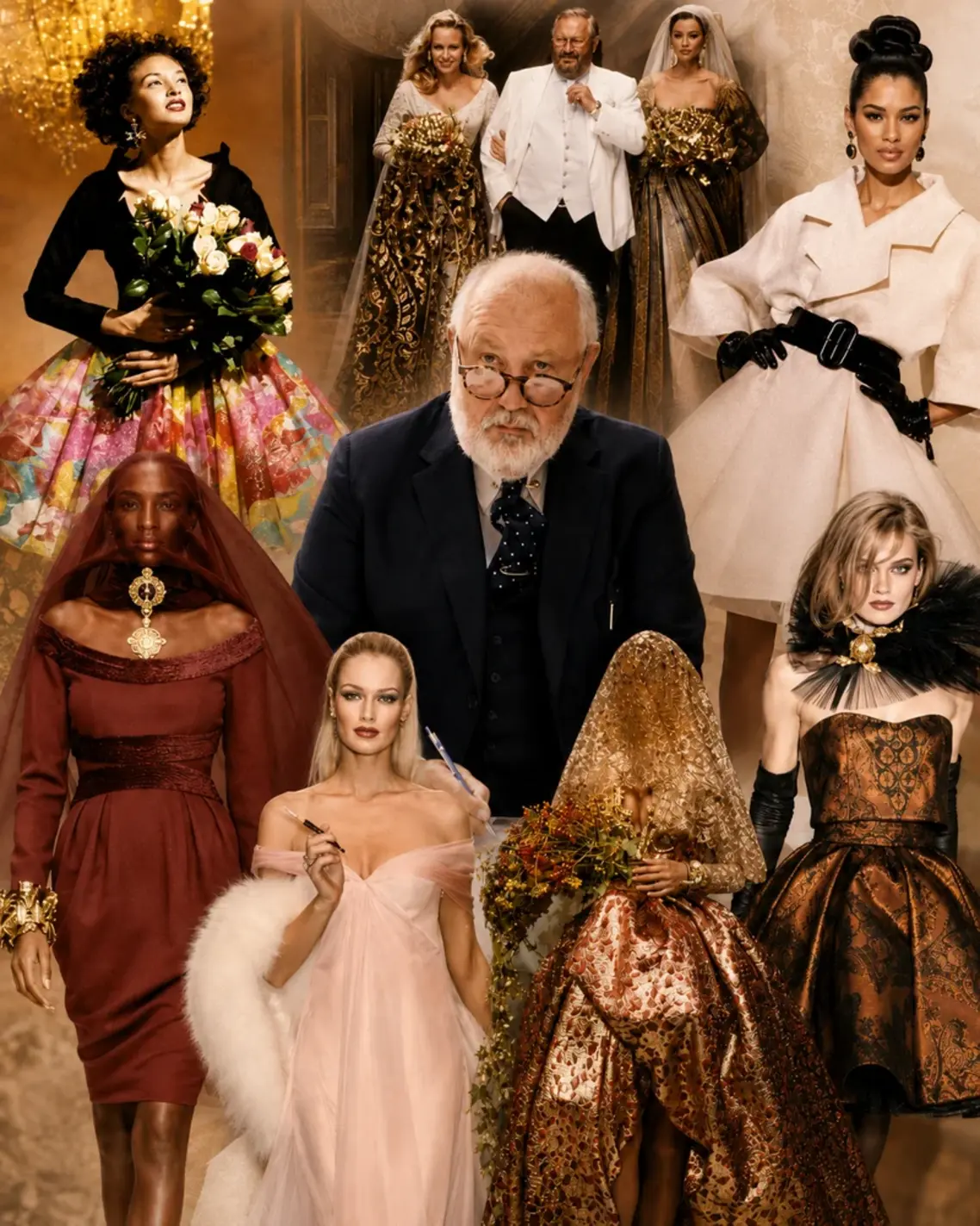
Gianfranco Ferré at Dior felt like entering a couture construction site after midnight. The flowers were beautiful, the gold was seductive, yet every gown seemed held by scaffolding, calculation, and a spine built before the dream was allowed to breathe.
May 30, 2026
Advertisement
Advertisement


Born in Legnano in August 1944, Gianfranco Ferré entered fashion through a discipline outside fashion itself. Trained in architecture, he brought to clothing a rigorous understanding of proportion, structure, balance, and construction, qualities that would later define his contribution to haute couture.
Gianfranco Ferré’s earliest contact with the fashion world came through bijoux and accessories, which he initially designed for friends and former architecture classmates. These handcrafted objects soon attracted the attention of Rosy Biffi, the owner of an avant-garde Milanese boutique, who recognized their originality and introduced them to her clients. Their appearance in fashion magazines, followed by Camilla Cederna’s mention in L’Espresso, gave Ferré his first significant public visibility.
In 1973, Gianfranco Ferré travelled to India for the first time to work on the Ketch collection for the Genoese company San Giorgio Impermeabili. India became a formative territory for his imagination. He studied its craftsmanship, textiles, ornament, and production techniques, absorbing a decorative and material vocabulary that would remain central to his work. His engagement with India continued until 1977, alongside collaborations with established figures such as Walter Albini and Christiane Bailly, as well as with companies specializing in knitwear and swimwear.
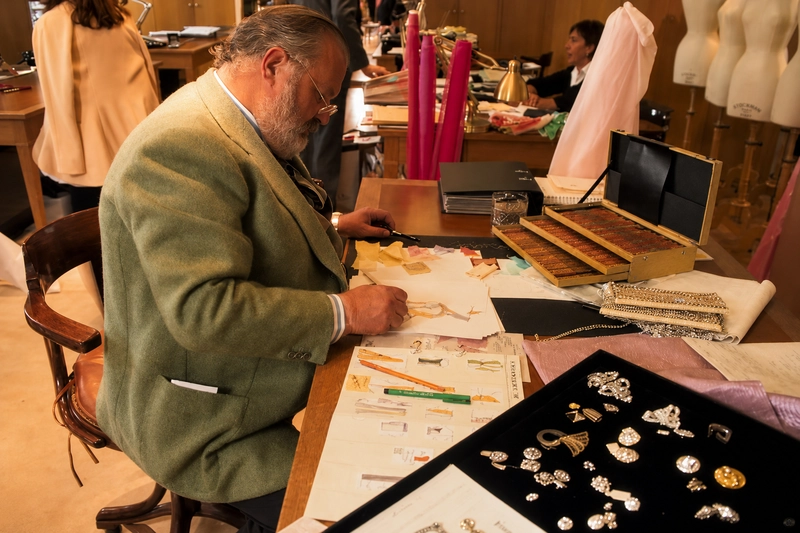
Gianfranco Ferré’s fashion career expanded rapidly in the mid-1970s. In 1974, he presented his first collections with entrepreneur Franco Mattioli, who later became his business partner. In May 1978, they founded the Gianfranco Ferré company, first based in Via San Damiano and later moved to Via della Spiga. In October of that year, Ferré presented his first women’s prêt-à-porter show at the Hotel Principe di Savoia in Milan, marking the official arrival of a designer whose work combined architectural discipline with sensual material force.
Throughout the 1980s, Gianfranco Ferré expanded his creative universe. From 1986, he entered haute couture through shows in Rome, where his command of volume, fabric, and formal construction became increasingly visible.
In 1983, he contributed to the development of Domus Academy, the postgraduate design school in Milan, where he directed the course Design of the Suit until 1989. That same year, he was appointed Artistic Director of Christian Dior, a role he held until 1996.
When Gianfranco Ferré entered Dior in 1989, the appointment carried the charge of a cultural incident. Dior had lived as a French monument since 1947: Avenue Montaigne, salon perfume, soft flowers, disciplined waistlines, and the postwar miracle of Christian Dior’s New Look. The maison had passed through Yves Saint Laurent’s youthful brilliance and Marc Bohan’s long reign of polish. Then came Gianfranco Ferré, an Italian architect from Lombardy, a designer whose reputation had grown through Milanese rigor, travel, jewelry, India, Japan, and a mind trained to think through proportion. Paris received him as both guest and intruder. Couture loves ceremony; it also loves territory.
His arrival followed wider shifts in Dior’s ownership and management under Bernard Arnault’s expanding luxury structure. The house needed grandeur with business force behind it, heritage with a sharper pulse, and couture with visual authority. Ferré offered a rare combination: academic discipline, sensual scale, and a practical understanding of modern wardrobes. During his Dior period from 1989 to 1996, he designed fifteen haute couture collections, an intense body of work that treated the maison as both archive and construction site.
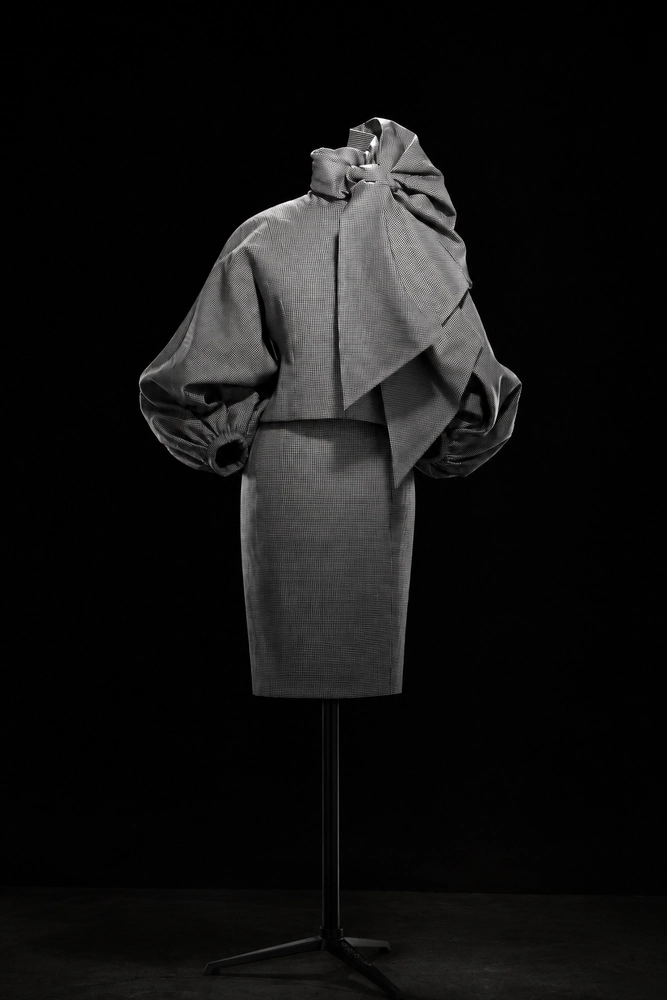
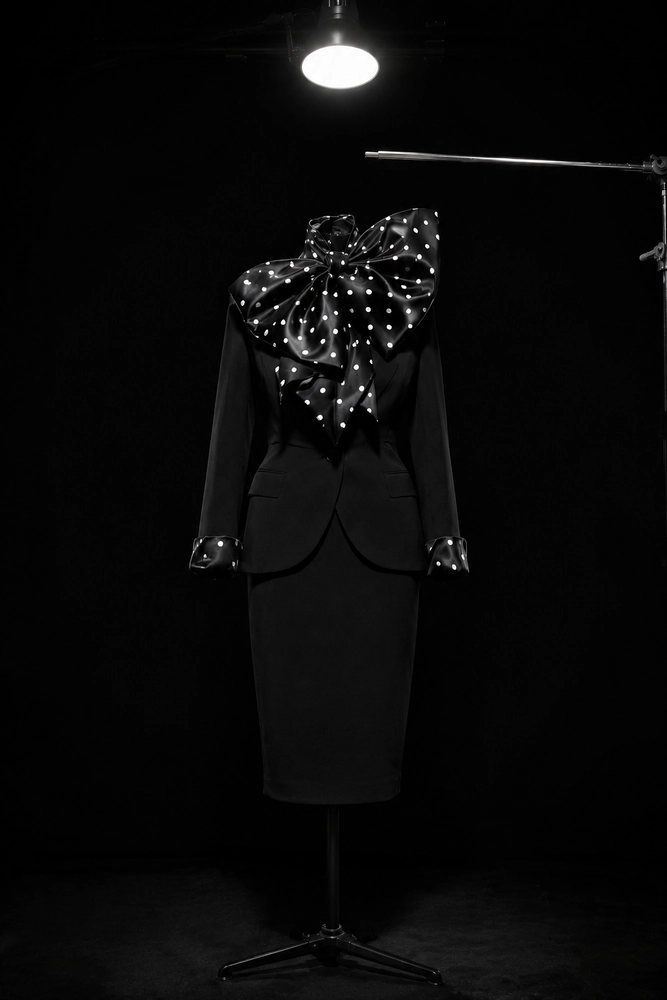
Gianfranco Ferré’s debut, Autumn-Winter 1989 Haute Couture, Ascot–Cecil Beaton, became the public hearing. The title alone staged a conversation between British social theater and Dior’s salon codes: racecourse elegance, Beaton’s photographic eye, hats, bows, suits, and aristocratic wit. The collection had to prove that Ferré could speak Dior fluently while preserving his own accent. He answered through tailoring, volume, and attitude. His first Dior haute couture collection won the Dé d’Or in July 1989, turning suspicion into validation almost immediately.
The Arbitre suit from that debut gives the article its first piece of evidence. A black gabardine suit with turned-back sleeves, a large bow at the neck, and detachable black organza cuffs with white polka dots, it condensed Gianfranco Ferré’s method into one silhouette: severity softened by theater, tailoring made flirtatious through accessory, Dior femininity held inside an architect’s frame. The look also carried a cinematic afterlife. A special creation inspired by the Walt suit was worn by Sophia Loren in Robert Altman’s Prêt-à-Porter in 1994, giving Ferré’s Dior an image that moved from couture salon to film mythology.
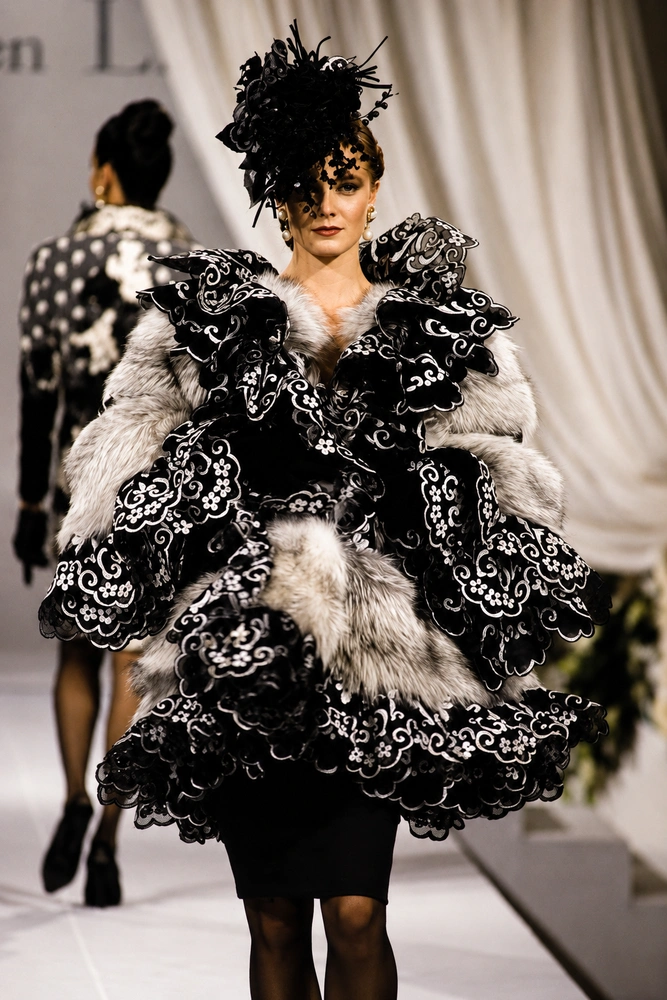
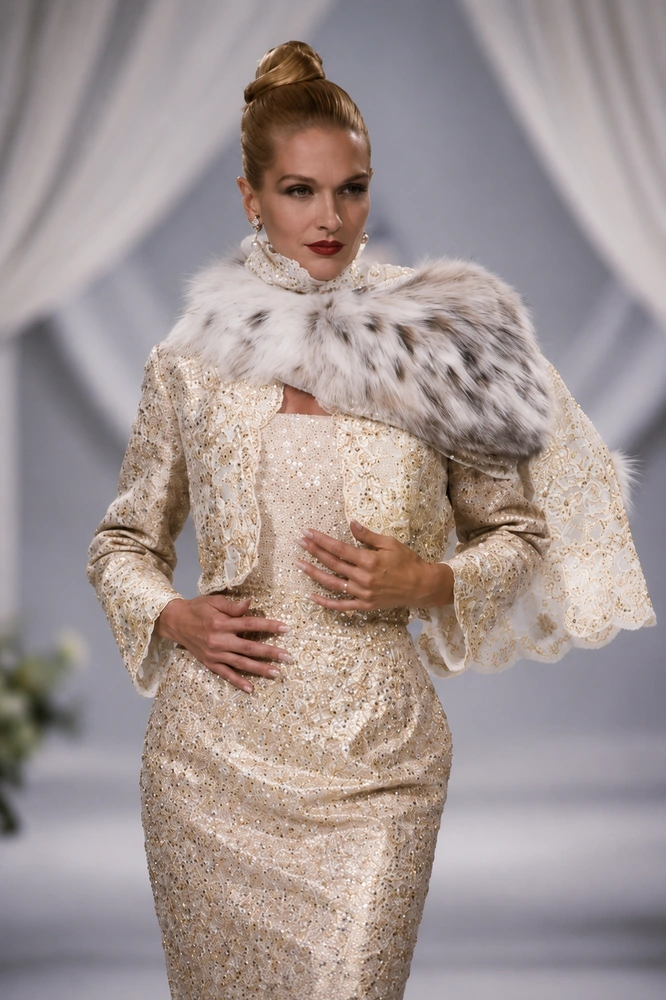
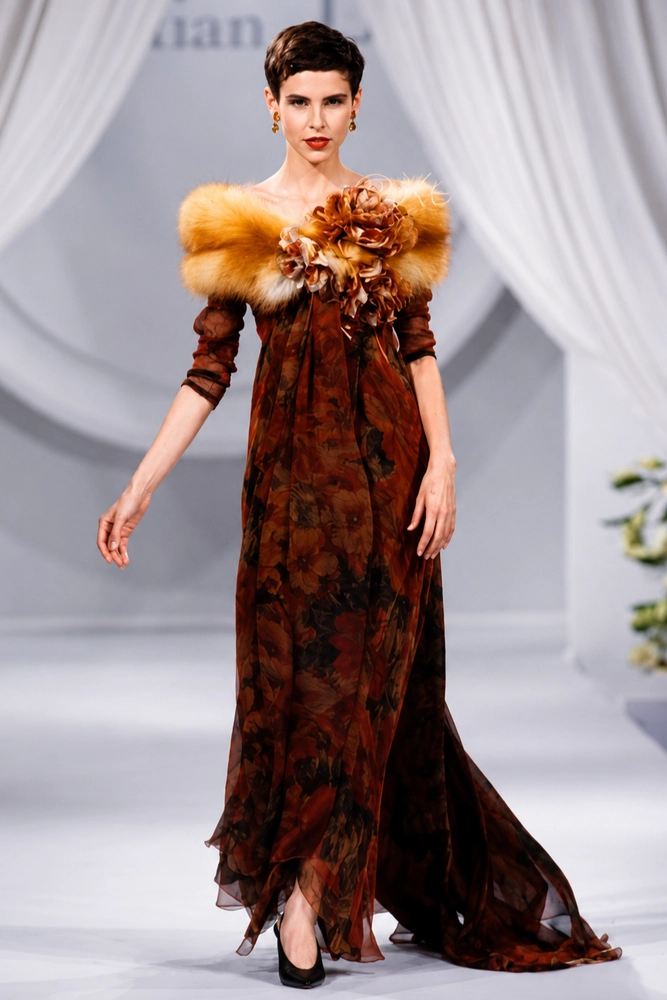
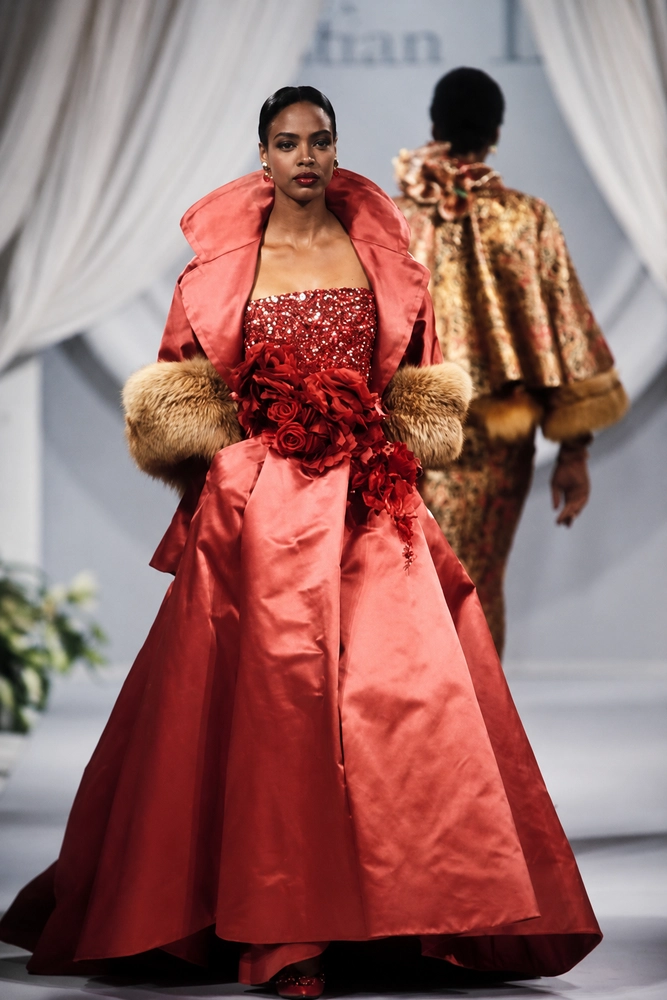
Christian Dior Autumn-Winter 1989 Haute Couture
That suit shows Gianfranco Ferré’s first Dior argument in miniature. The large bow referenced Dior’s romantic vocabulary. The black gabardine gave the silhouette discipline. The removable organza cuffs added wit and lightness. The turned-back sleeves sharpened the arm like a drawn line. The woman inside this suit carried a strange balance: ceremonial, amused, alert, slightly armored. Gianfranco Ferré understood that Dior’s elegance had always been built, even when it appeared soft. His achievement was to make the construction visible enough to feel modern.
Gianfranco Ferré’s most famous title, “the architect of fashion,” often risks becoming decorative shorthand. At Dior, the phrase acquired real technical weight. His architecture appeared in the relationship between sketch and garment, between internal support and external flourish, between the exact line of a collar and the theatrical volume of a skirt. Gianfranco Ferré studied architecture at the Politecnico di Milano, and his design philosophy repeatedly returned to formal balance and the golden ratio, which he described as part of his training transferred into fashion.
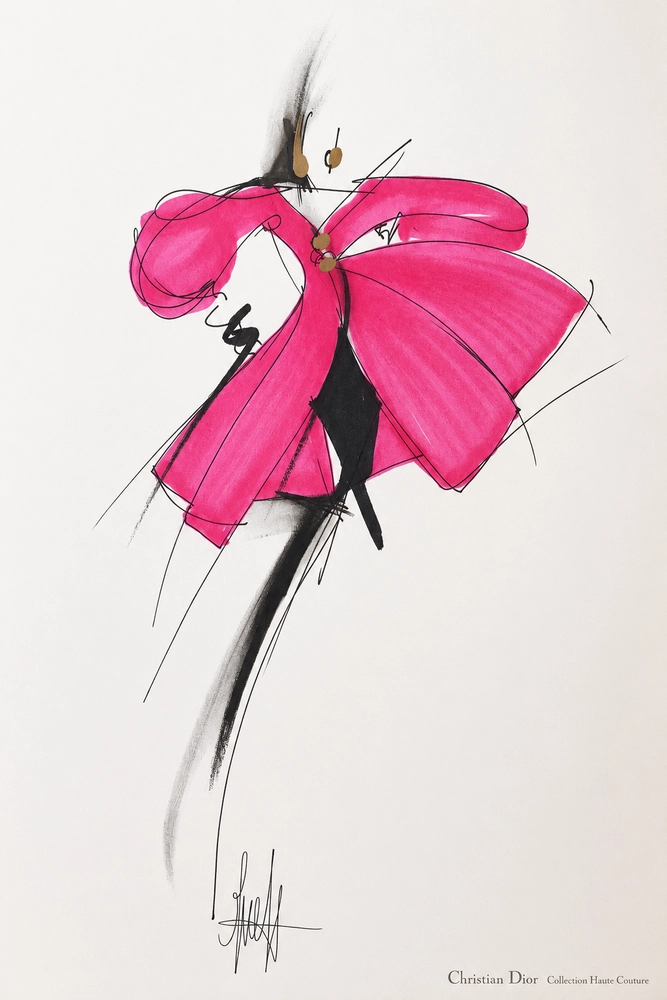
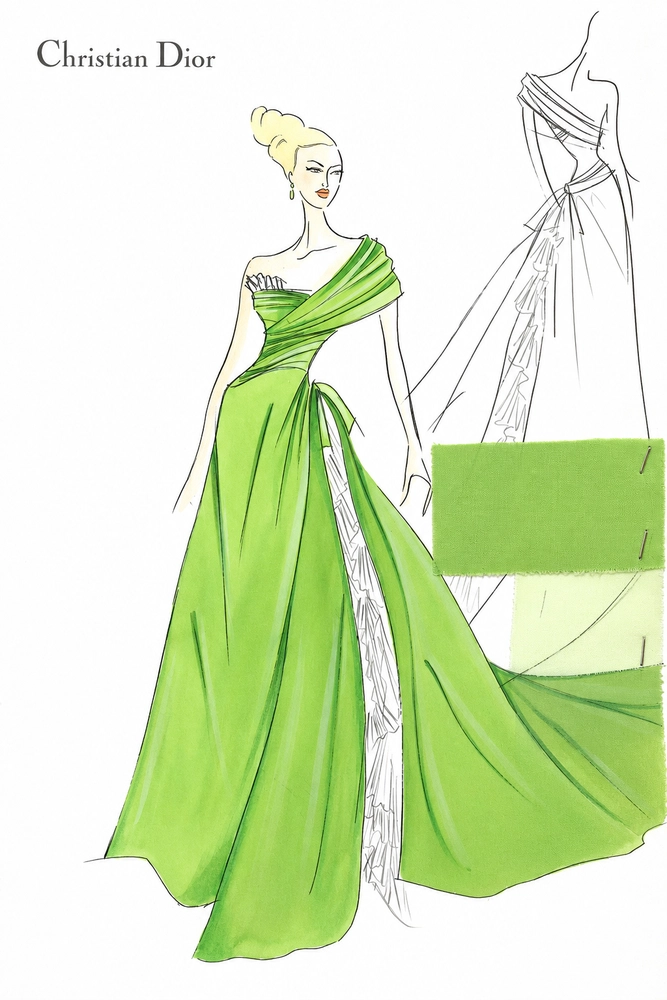
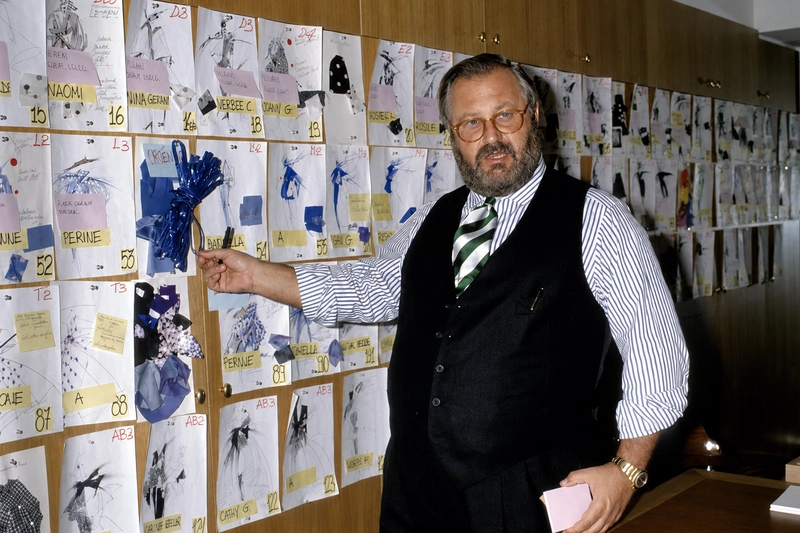
Gianfranco Ferré's Sketches
His drawings help explain this more clearly than any myth. His sketches are evidence of a creative process moving from idea to garment, from two-dimensional image to runway form. The clothes were dramatic, yet the drama began in discipline: line first, body second, surface third, impact last.
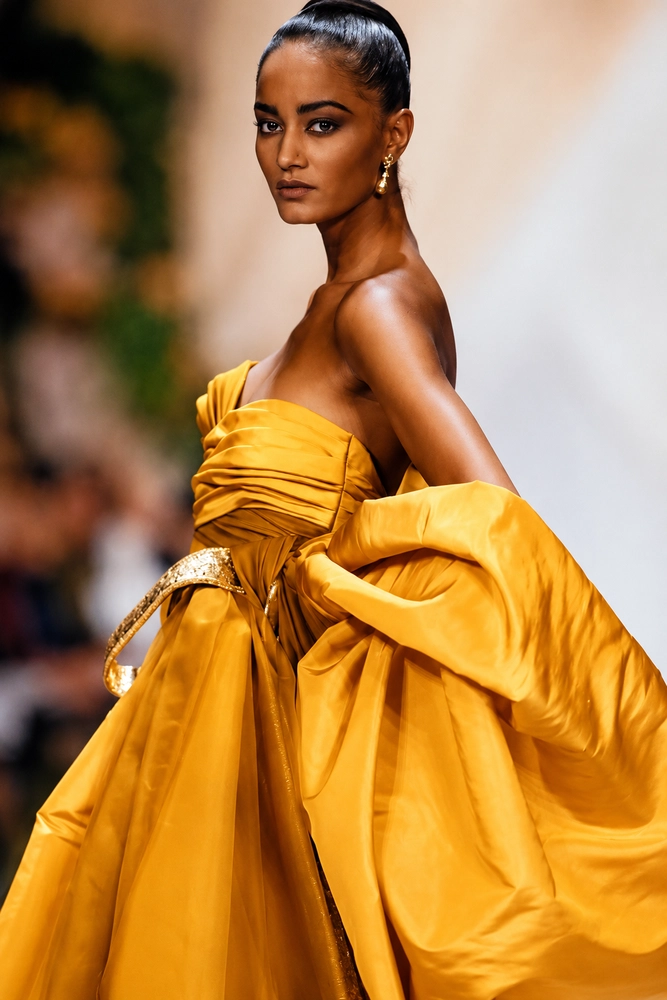
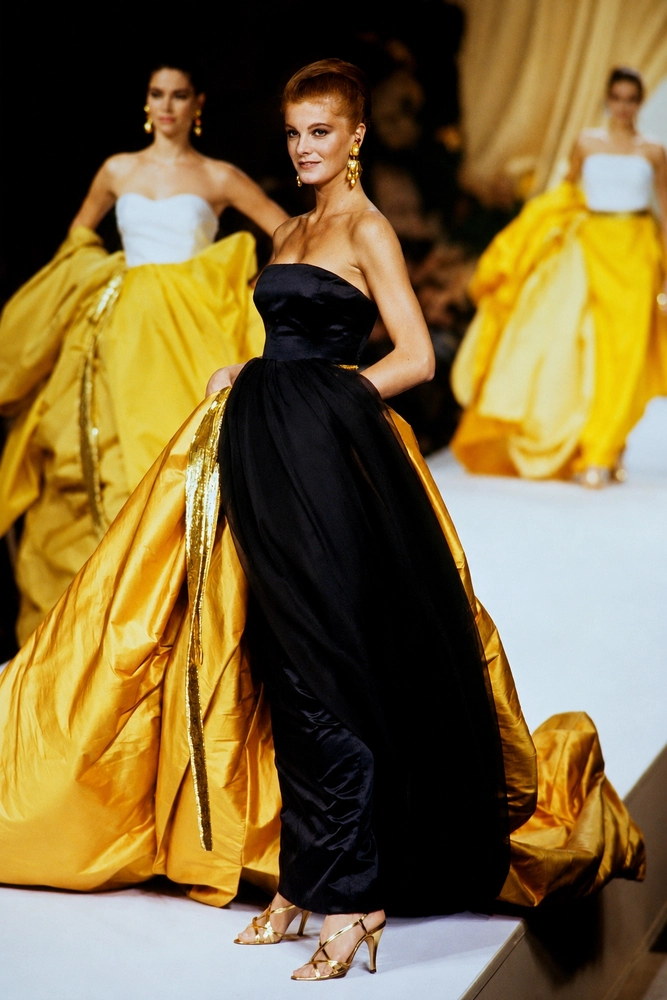
Christian Dior Spring-Summer 1990 Haute Couture
Gianfranco Ferré approached Dior as a system of engineered femininity. Christian Dior had already established fashion as architecture through the Bar jacket, the flower-woman, the waist, the rounded hip, the calculated skirt. Gianfranco Ferré entered this system and gave it heavier masonry. Shoulders grew assertive. Belts became structural punctuation. Bows gained the scale of cornices. Organza behaved like air held under command. Gazar created a dense white surface with the authority of plaster. The waist remained essential, yet the line around it grew more imperial, more carved, more conscious of space.
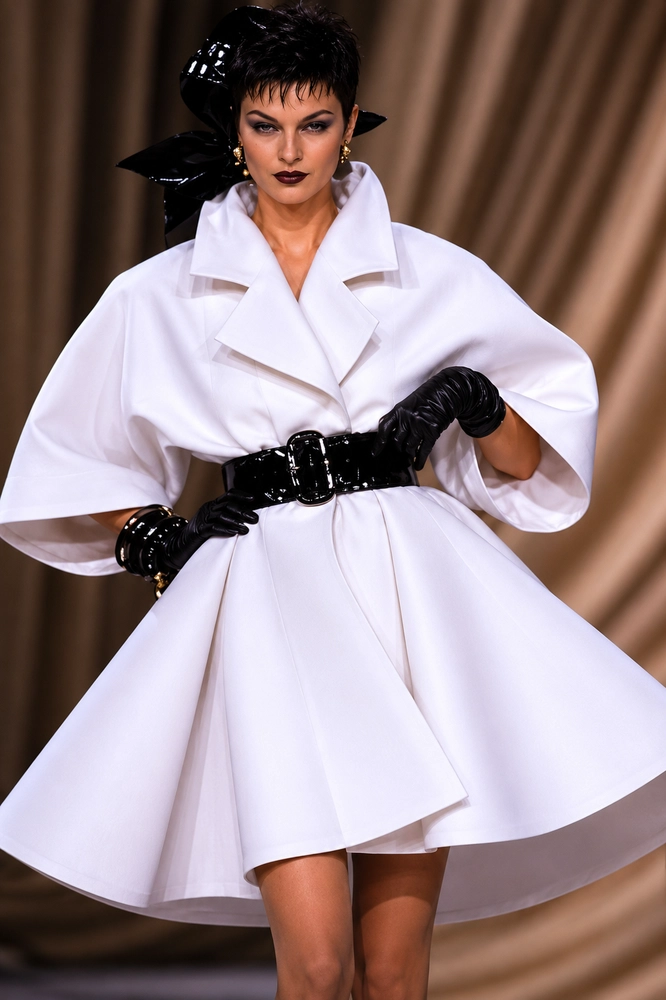
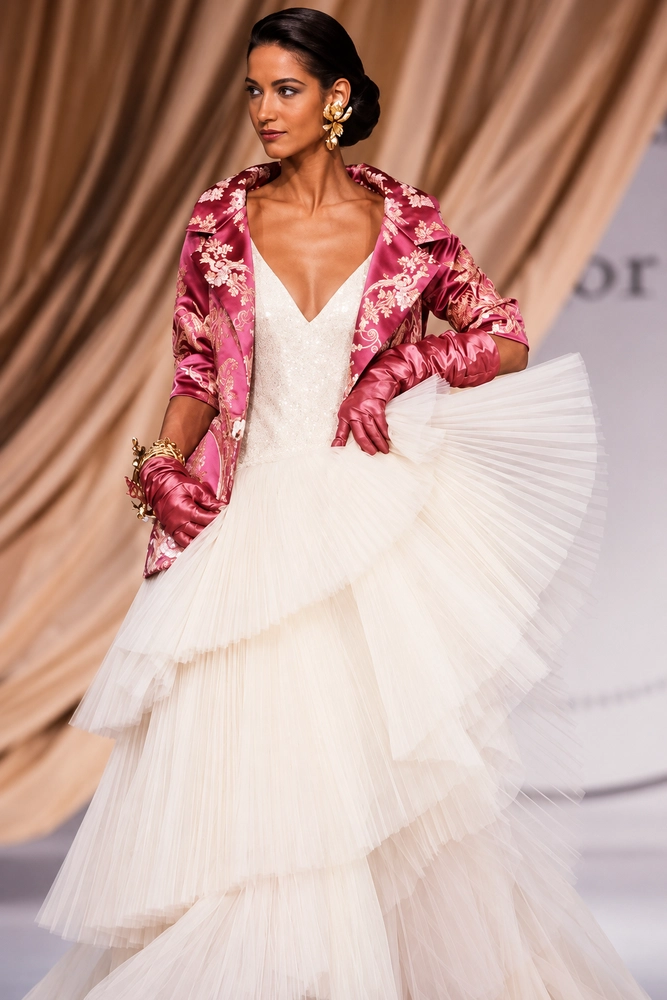
Christian Dior Spring-Summer 1991 Haute Couture
The white gazar trench coat Forcément, from Spring-Summer 1991 Haute Couture, Rendez-vous d’Amour, gives this logic its clearest form. The garment took a familiar wardrobe form, the trench coat, and translated it into couture architecture. The white surface gave purity and glare. The black belt cut the body with graphic force. The shantung dress beneath created a second layer of controlled light. This was daywear language transformed into salon severity.
Forcément also reveals Gianfranco Ferré’s gift for converting function into ceremony. A trench coat usually suggests movement, weather, travel, and the street. In Ferré’s hands, it became a column with a waist. It carried the intelligence of a coat and the authority of a gown. This was one of his most modern contributions to Dior: he could bring practical garments into couture and raise them through proportion.
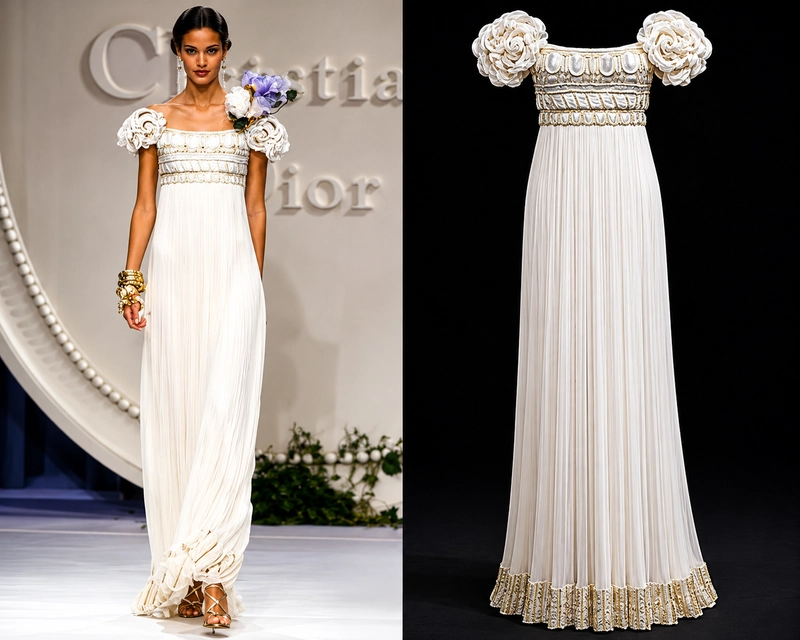
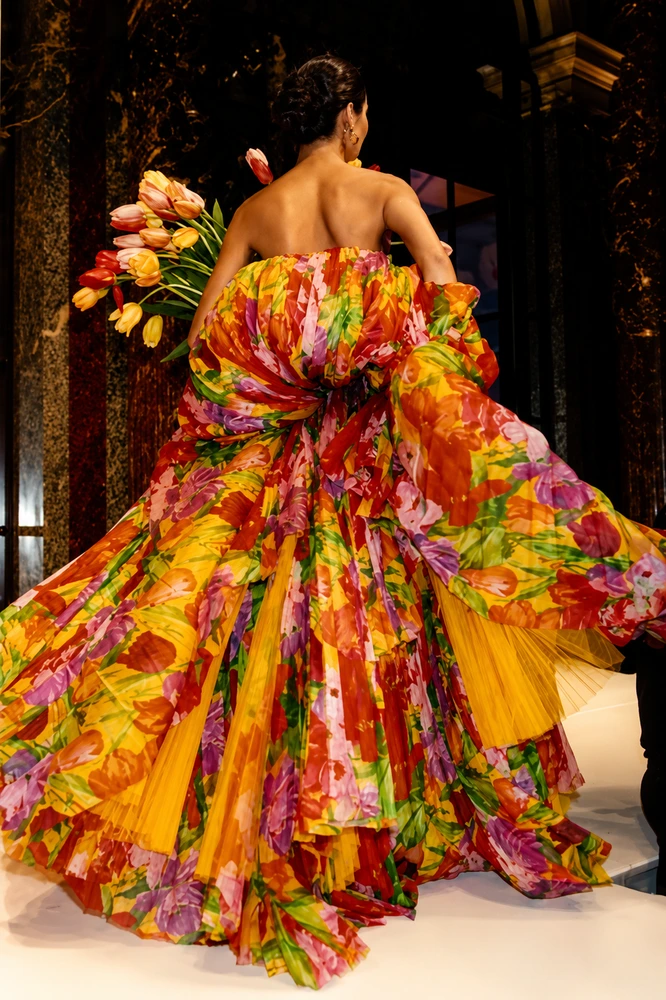
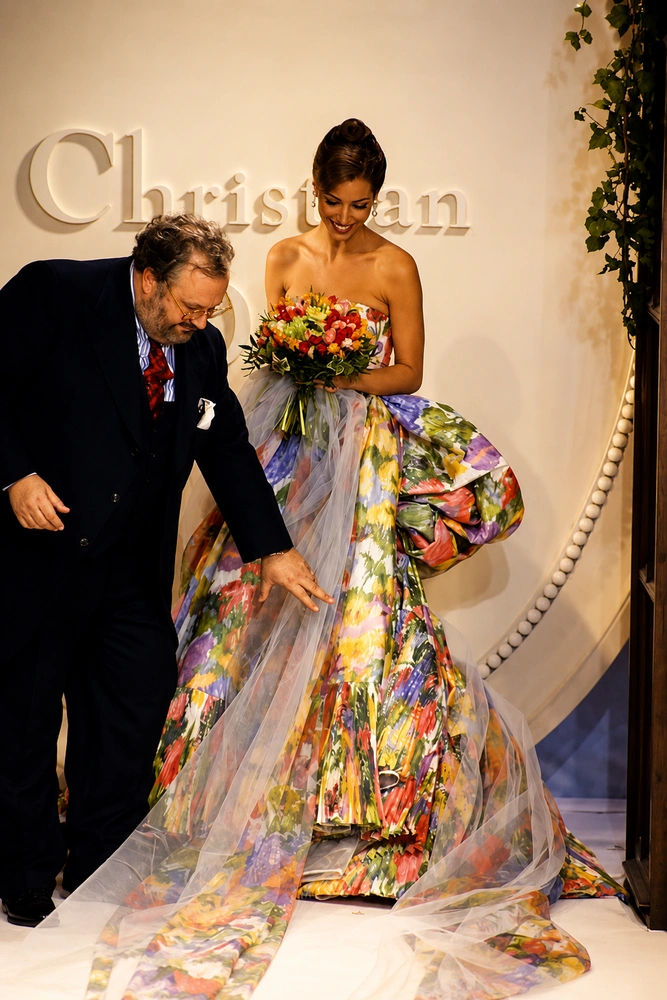
The Palladio dress from Spring-Summer 1992 Haute Couture sharpened the architecture metaphor into an explicit cultural reference. Palladio summons Renaissance villas, façades, columns, order, classical proportion, and the Italian obsession with measured beauty. In the Dior context, the name becomes a declaration. Gianfranco Ferré was building a bridge between Christian Dior’s flower-woman and the Italian palazzo. The body became a site where Paris couture met Renaissance geometry. The gown became a façade in motion.
Christian Dior Spring-Summer 1992 Haute Couture
His cut carried an academic intelligence, yet the result remained emotional. Ferré’s Dior never feels like a dry exercise in structure. It has flesh, perfume, heat, and narrative. The seams organize desire. The fabrics hold memory. The line persuades the eye before the embellishment begins. His clothes ask to be studied first as construction, then as fantasy. In his best Dior work, the viewer feels both the hand and the blueprint: the pressure of the atelier, the argument of the fitting, the moment when the fabric accepts a curve.
Gianfranco Ferré revived one of Dior’s most seductive habits: the named garment. Names turn clothes into characters. They give fabric a destination, a temperament, a rumor. Under Ferré, names such as Venise, Shalimar, Floridante, Elixir, Koh-I-Noor, Lalita, Delly, Niué, Corps de Feu, and Flambeaux Terrestres formed a private atlas of couture. These names prevent the work from dissolving into generic splendour. They point toward cities, stones, flowers, perfumes, flames, paintings, and empires.
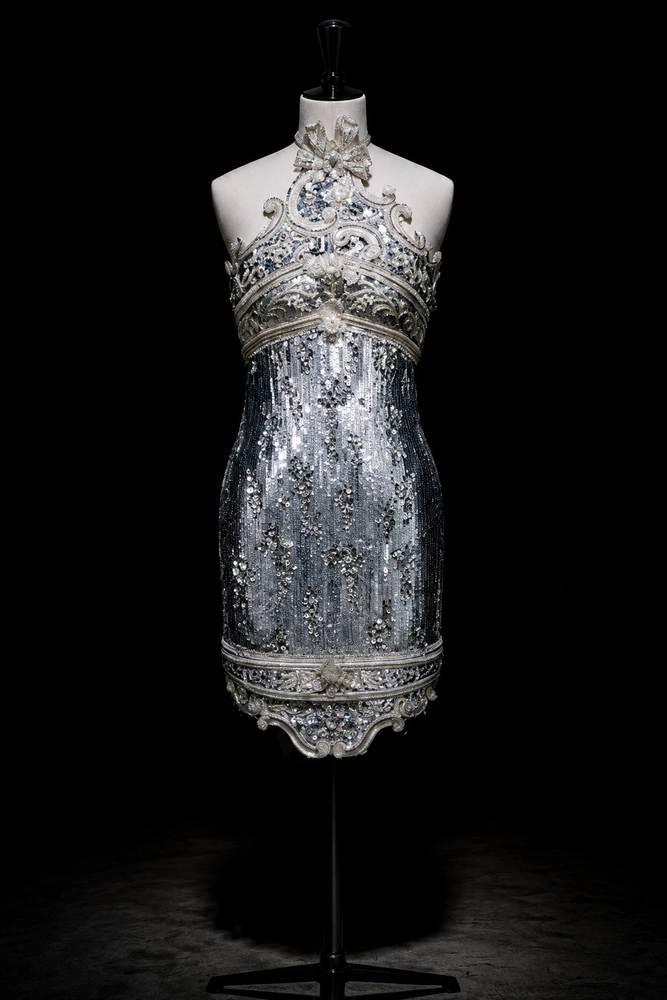
The short dress Venise, Venise, from Autumn-Winter 1991 Haute Couture, Soleils d’Automne, offers one of the most vivid examples. Embroidered with silver beads, strass, sequins, and paillettes, it reads like Venice compressed into a body: water at night, mosaic glare, candlelight over stone, the glittering decay of a city that turns reflection into architecture. Gianfranco Ferré approached embellishment as atmosphere. The dress carried Venice through surface, scale, and shine, translating place into texture.
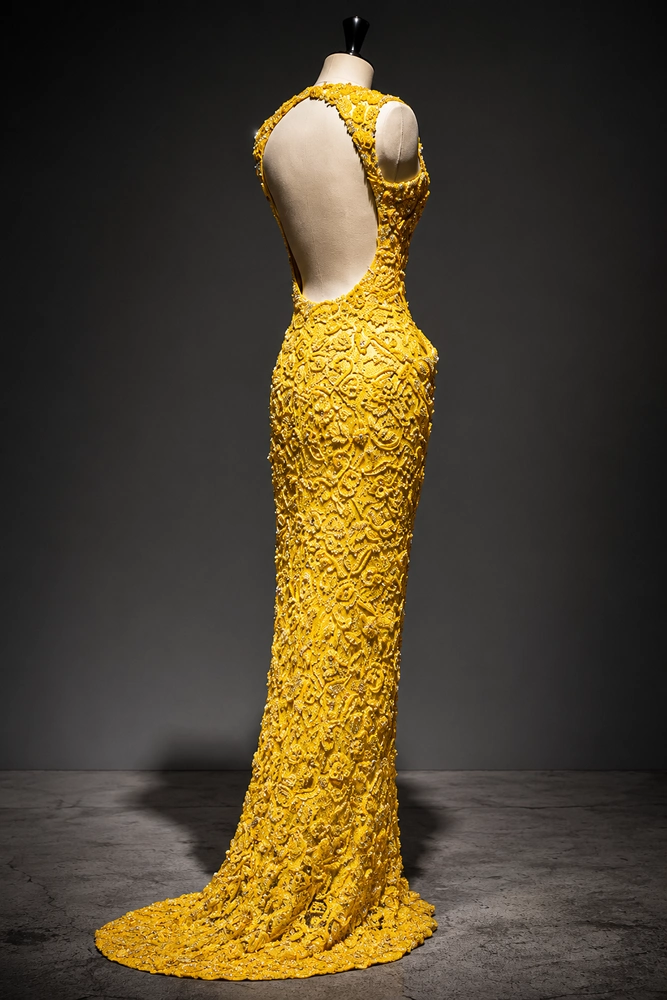
The Spring-Summer 1995 Haute Couture collection, Extrême…, pushed the language of named gowns into floral heat and moving architecture. Floridante, a bright yellow embroidered-lace sheath dress, concentrated the flower into a vertical blaze. It had the directness of a column and the saturated charge of summer. The flower became streamlined, almost dangerous in its clarity. This was Dior’s garden translated through Ferré’s taste for force.
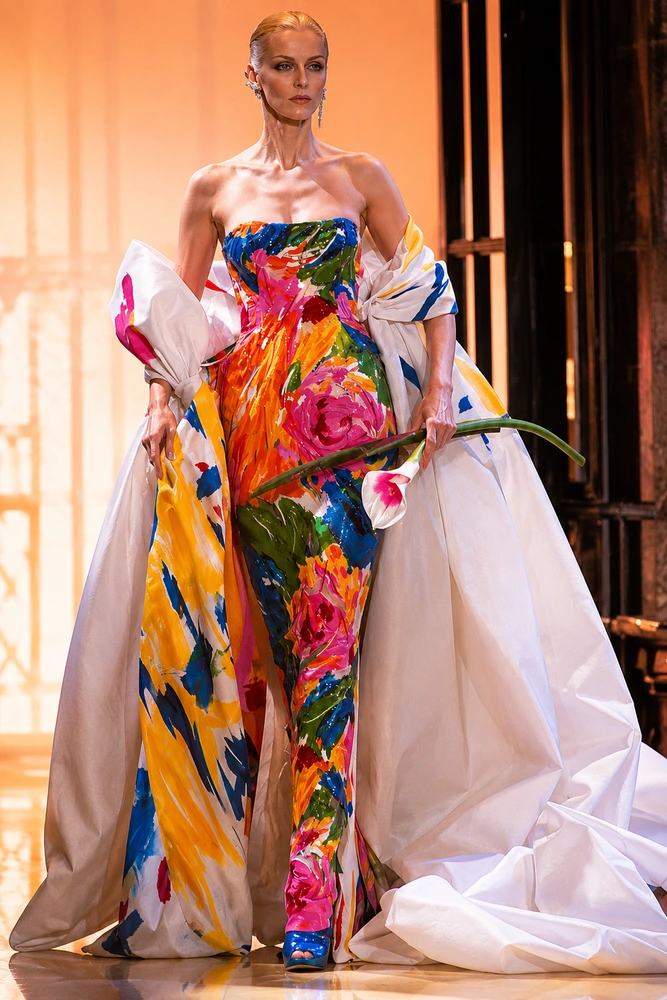
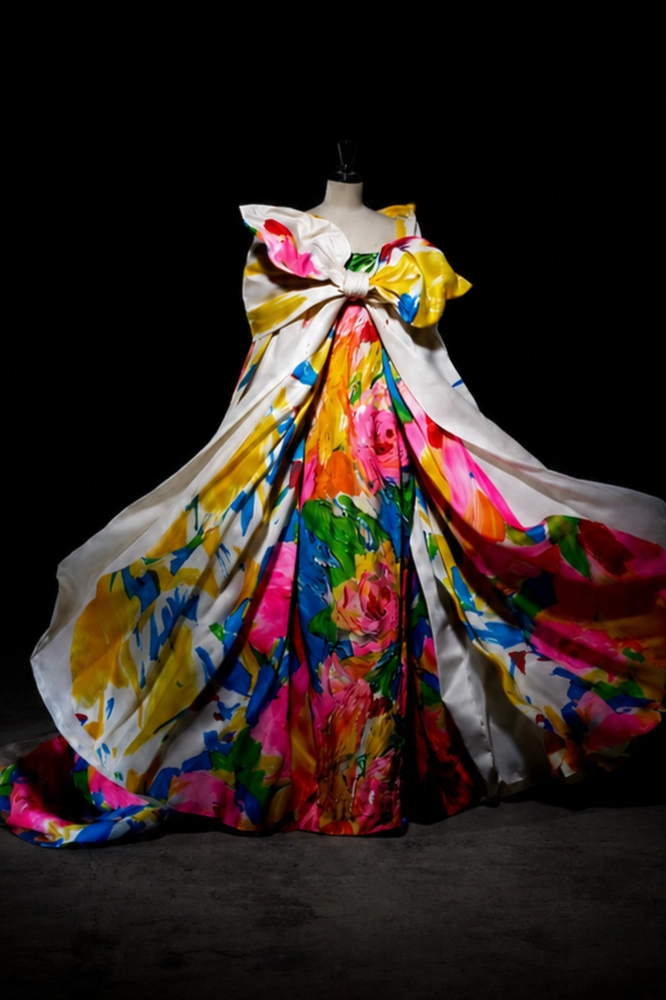
In the same collection, Niué offered a more complex spatial idea: a long white satin-organza coat with train effect, a painted floral interior, and a long strapless embroidered dress. The garment turned the coat into a moving room. The exterior carried purity and line; the interior carried painted intimacy. As the wearer moved, the garment opened like a private fresco. Gianfranco Ferré often created this kind of double experience: public structure outside, secret image inside. Niué makes couture behave like architecture with a hidden chapel.
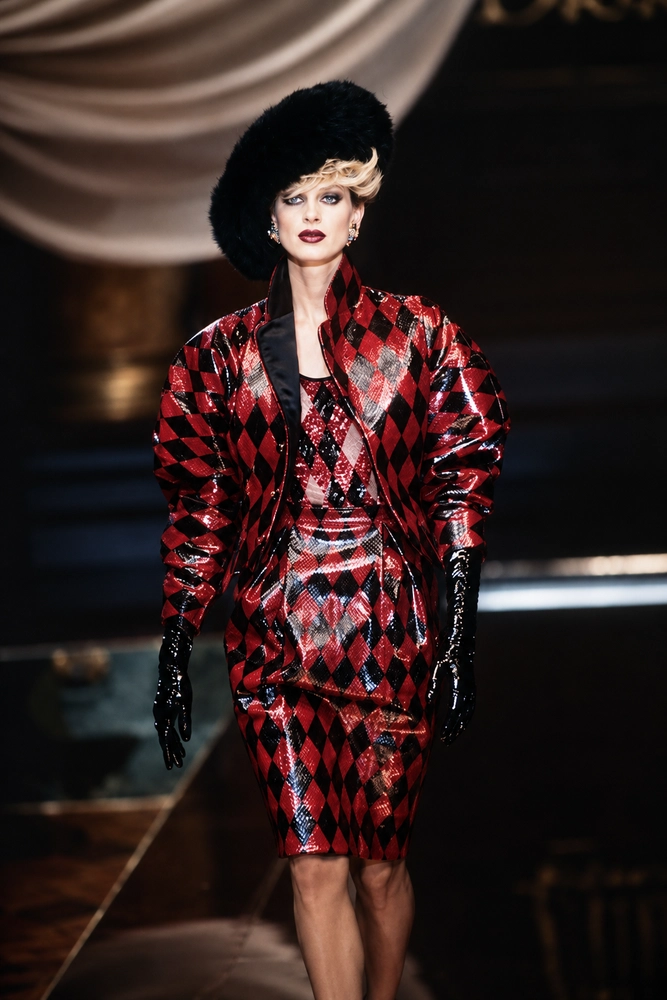
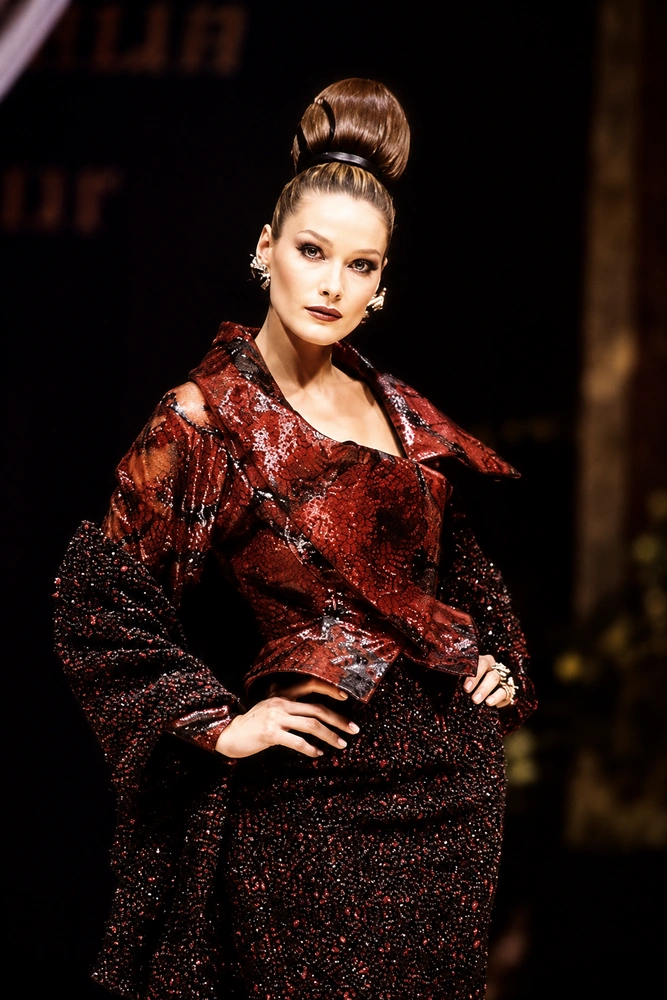
The Autumn-Winter 1995 Haute Couture collection, Hommage à Paul Cézanne, brought Ferré’s painterly intelligence into focus. La Galerie Dior connects the collection to the Cézanne retrospective at the Grand Palais, giving the work a precise cultural frame. Corps de Feu, a red python suit painted with a harlequin pattern and shaped through a kimono-sleeve jacket, turned the suit into a field of planes and heat. Flambeaux Terrestres, with a floral-patterned lamé chiffon blouse over iridescent burgundy and green tulle, treated color as vibration, almost like pigment in motion.
This Cézanne chapte shows Ferré reading art through construction. He translated painting through silhouette, surface, and material tension. Corps de Feu used python and painted pattern to create a fierce, planar body. Flambeaux Terrestres used lamé chiffon and tulle to create layered luminosity. The clothes absorbed art history through matter. They felt learned, yet alive.
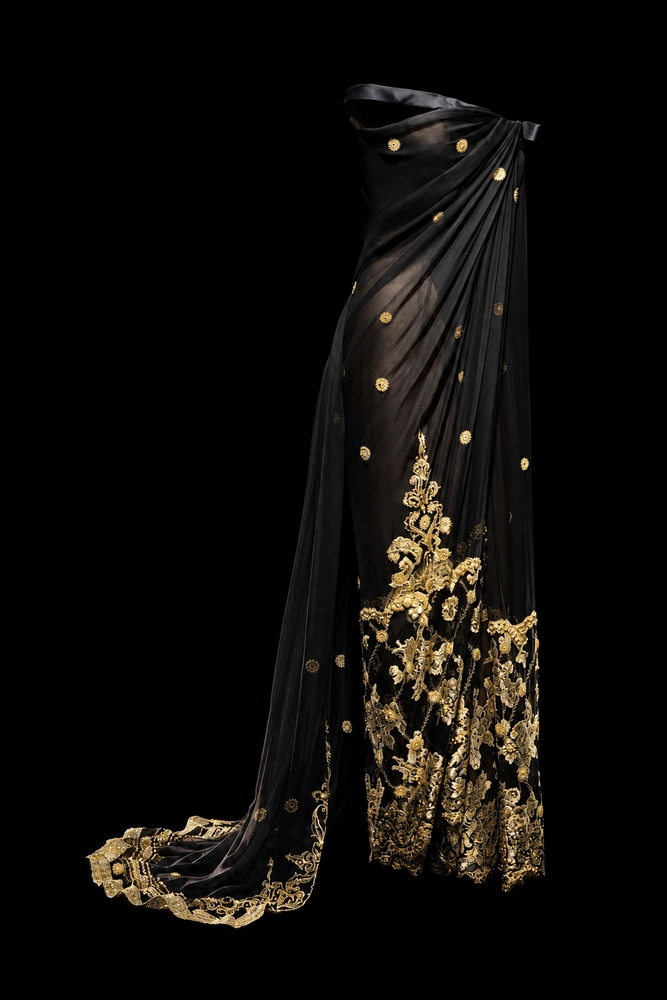
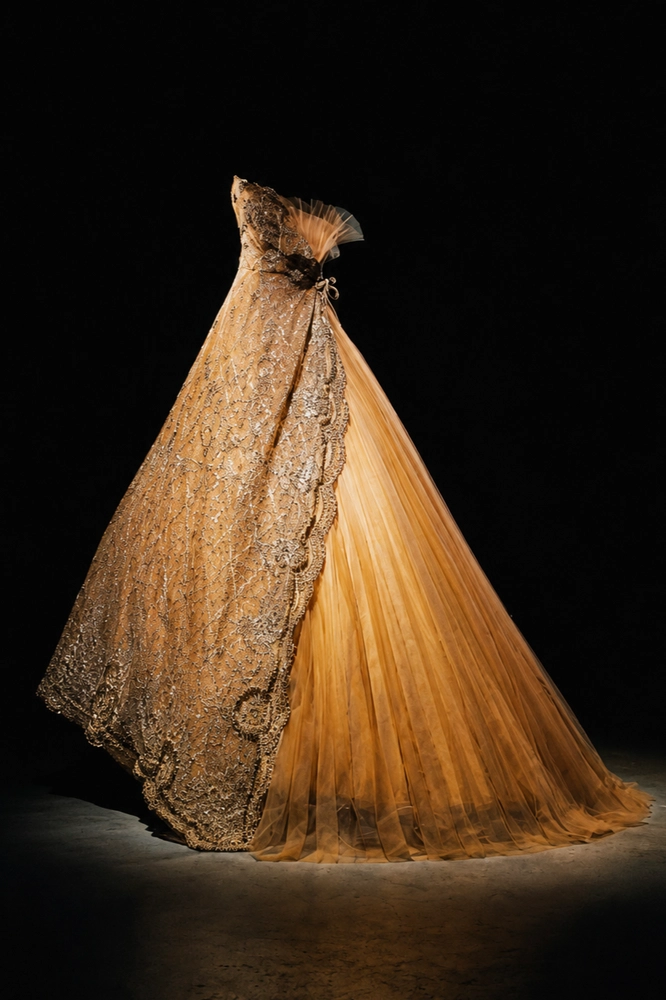
Then came Autumn-Winter 1996 Haute Couture, Indian Passion, Ferré’s final Dior myth. The names alone create a charged farewell: Shalimar, Elixir, Koh-I-Noor, Delly, Lalita. Shalimar is a long black chiffon dress embroidered and inset with gold lace; Elixir is a fuchsia pleated tulle with a gold-embroidered bustier; Koh-I-Noor is a peach pleated tulle and lace embroidered with arabesques, strass, crystals, and gold beads; Delly is a black silk crepe and organza embroidered with Mughal-style gold flowers; Lalita is a a slate-gray wool suit with ostrich-feather cuffs.
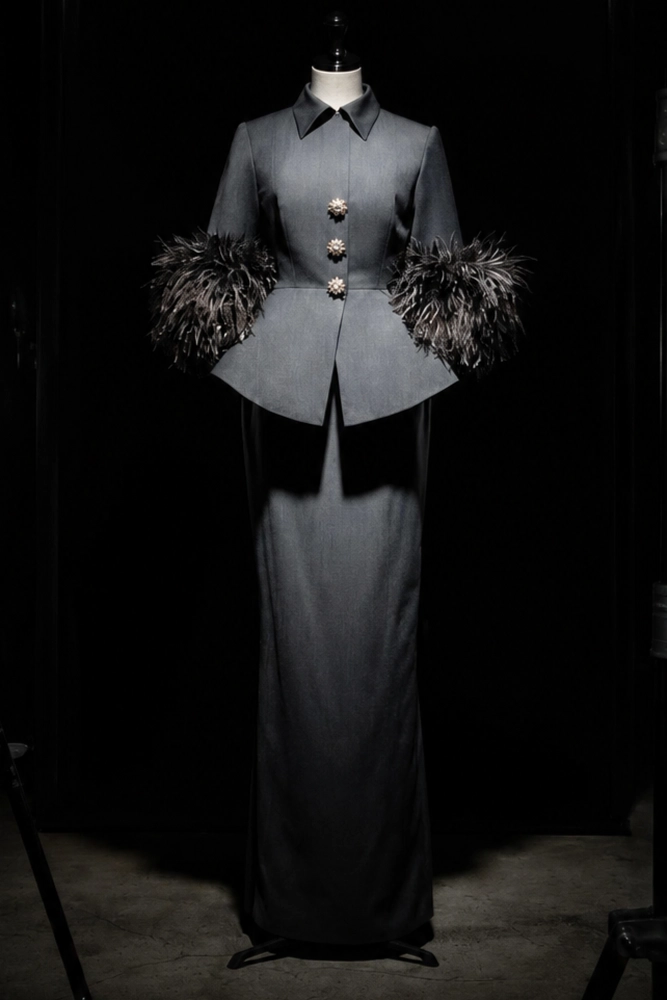
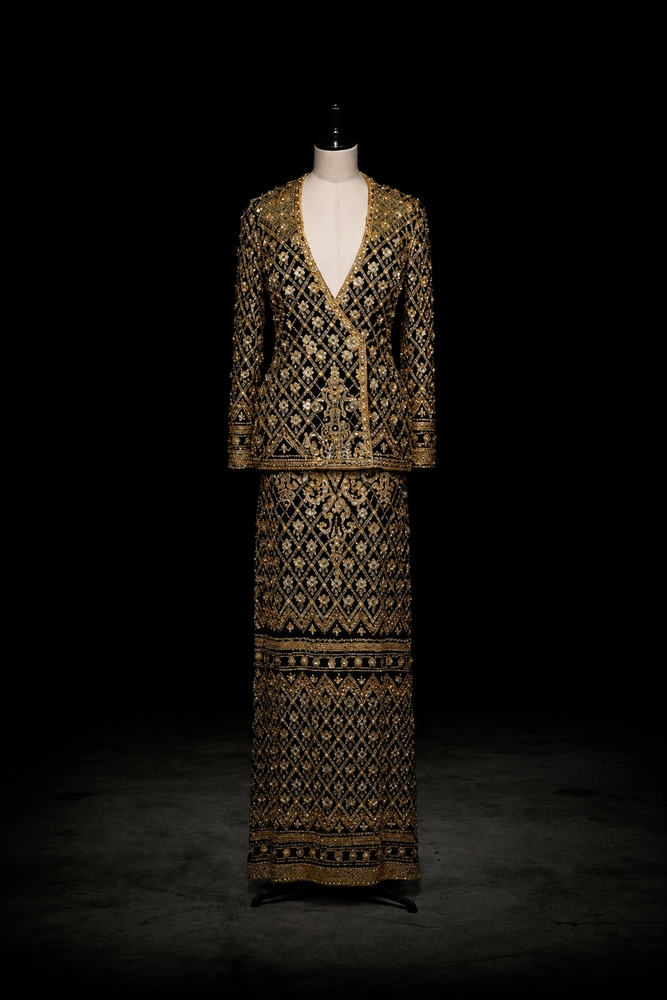
Indian Passion is one of the richest keys to Gianfranco Ferré’s Dior because it brought biography and maison together. Ferré had long been fascinated by India; his early career included travel and design work shaped by jewelry, ornament, craft, and non-European decorative systems. At Dior, that memory became grander, filtered through haute couture and the house’s own romance with travel, fantasy, and named dresses. Shalimar carried perfume and night. Elixir carried fuchsia, pleating, and ritual. Koh-I-Noor carried gem logic and imperial shine. Delly translated Mughal flowers through black silk and gold embroidery. Lalita gave the suit a feathered ceremonial edge.
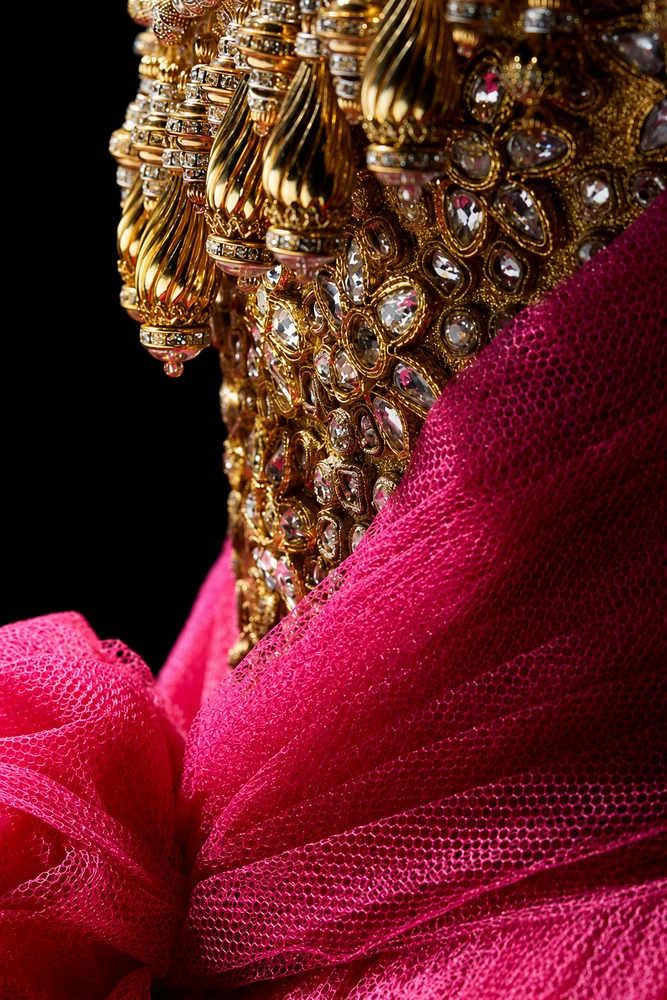
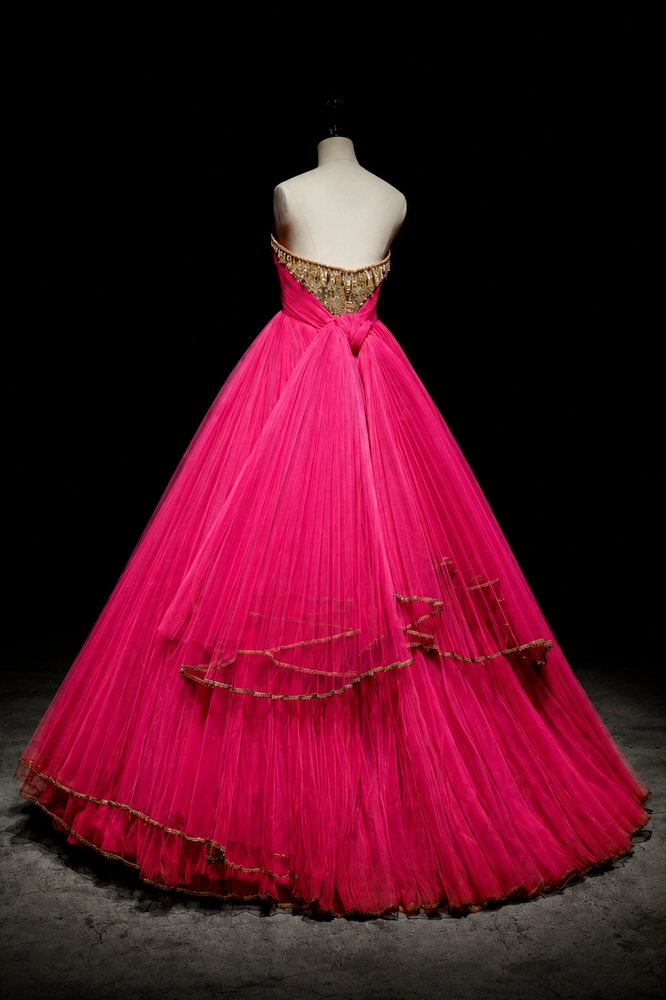
Elixir
The collection also reveals Ferré’s control over excess. Gold lace, pleated tulle, crystals, arabesques, ostrich feathers, chiffon, organza, silk crepe: the materials sound almost delirious in sequence. Yet the best looks remain anchored by line. Gianfranco Ferré’s genius lay in making abundance feel structured. The eye travels across embroidery, then returns to the body’s axis. The garment gives spectacle, then asks for posture. Indian Passion closed his Dior tenure with a final lesson: fantasy can carry discipline; ornament can serve architecture.
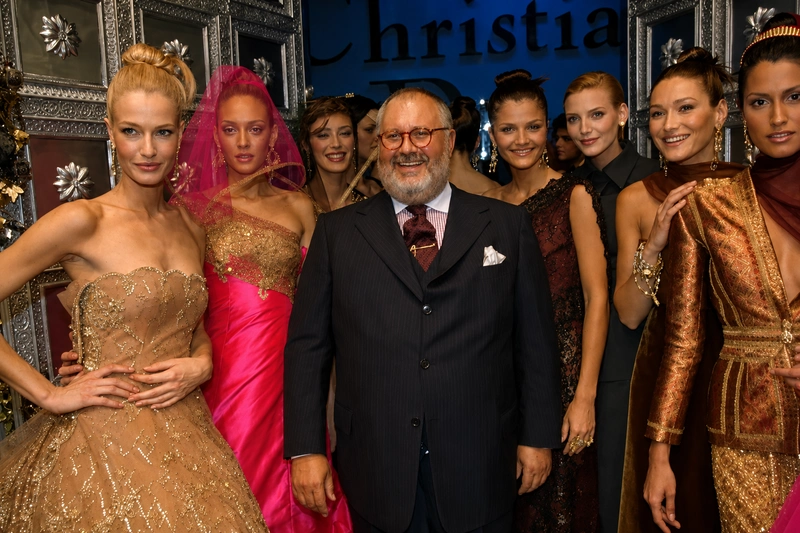
Gianfranco Ferré’s final Dior moment arrived in July 1996 with Indian Passion, a collection already heavy with farewell energy. The Independent described the show through Indian princesses, Scheherazade atmosphere, fitted embroidered jackets, gold lamé, candy-pink column dresses, and a standing ovation. The scene reads like a threshold: Ferré closing his tenure in a room filled with gold, myth, chiffon, and applause, while Dior stood on the edge of another era.
The transition soon became official. On October 14, 1996, John Galliano replaced Gianfranco Ferré at Dior. John Galliano arrived at Dior with extravagance, dreamlike imagination, spectacular scenography, and global artisanal fantasy. The sequence now looks almost theatrical in hindsight: Gianfranco Ferré fortified Dior’s structure, then John Galliano converted the house into a dream factory.
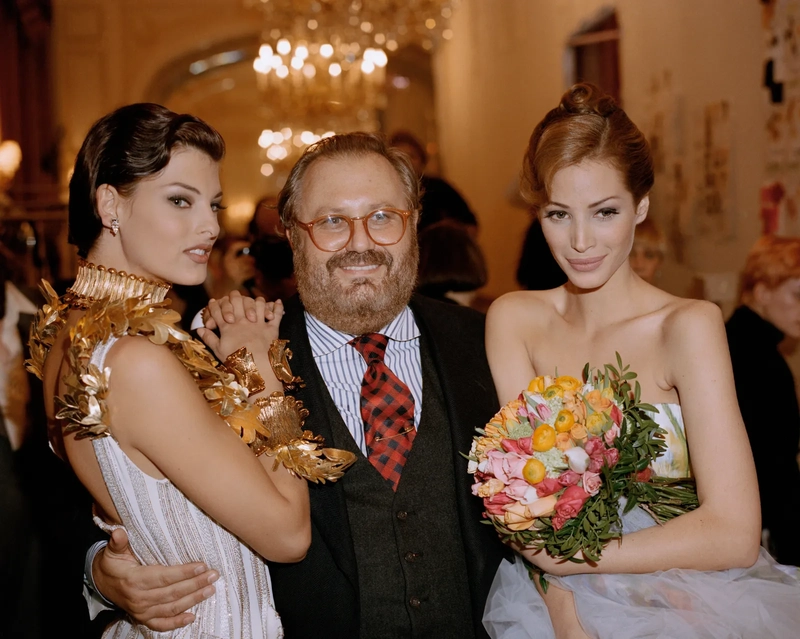
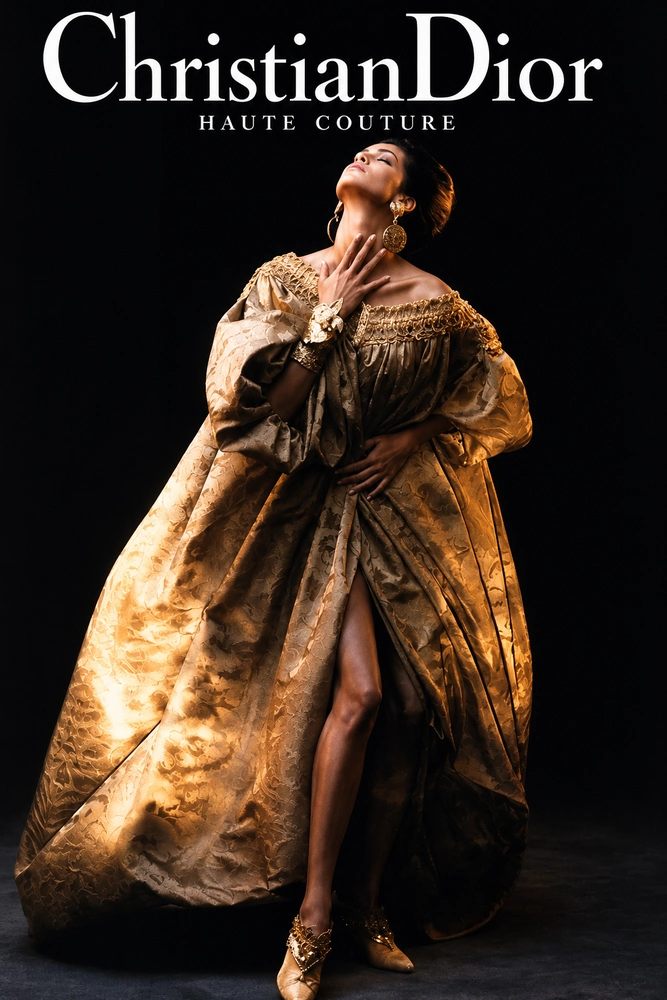
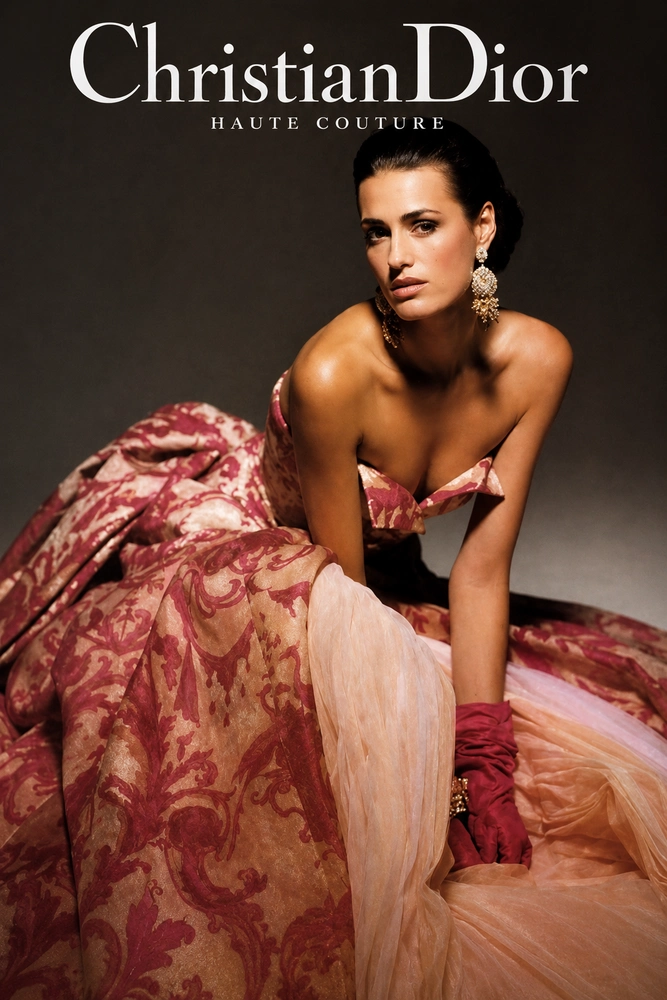
Yasmeen Ghauri for Christian Dior Haute Couture Spring 1993
Together, these looks prove that Ferré’s Dior was never a simple interlude. It was a full architectural campaign. He took Dior’s inherited codes and gave them new pressure. Gianfranco Ferré’s Dior also speaks to a deeper question in fashion history: how does a house survive succession? Every designer at Dior must negotiate ghosts. Christian Dior’s ghost is floral and exacting. Saint Laurent’s ghost is youthful and sharp. Bohan’s ghost is graceful and social. Ferré’s ghost is architectural. It asks the viewer to look beneath beauty and study the support system: the seam, the belt, the shoulder, the sketch, the proportion.
That is the soul of his chapter. Gianfranco Ferré at Dior was a story of translation: Italy into France, architecture into couture, discipline into romance, archive into future. He entered a house built on flowers and taught it to stand like stone. His most memorable clothes shimmered with beads, lace, sequins, feathers, and gold, yet their real force came from the mind beneath the surface.
Advertisement