MENU
Close





“Right angles don’t attract me.” With a single sentence, Oscar Niemeyer declared war on the rigid geometry of the 20th century.

“Right angles don’t attract me.” With a single sentence, Oscar Niemeyer declared war on the rigid geometry of the 20th century.
April 29, 2026


Oscar Niemeyer never treated architecture as a neutral act of construction. For him, a building was a gesture, a belief, a line drawn against rigidity. Where much of orthodox modernism leaned on discipline, grids, and hard angles, Niemeyer opened space for seduction.
"I am not attracted to straight angles or of the straight line, hard and inflexible... I am attracted to free-flowing, sensual curves. The curves that I find in the mountains of my country, in the sinuousness of its rivers, in the waves of the ocean, and on the body of the beloved woman."
Like a true Brutalist, Oscar Neimeyer's body of works, typically built in concrete, understandably evoke scale, mystery and out-of-this-worldness. While most people convey the austere forms of his design with planes and UFOs, Oscar Niemeyer created them with organic and poetic intents, like buildings that look like flowers and butterflies.
Oscar Niemeyer's works hold much wonder, not only in form but also in lore. nowhere more powerfully than in Brasília. Long before the city rose from the Brazilian highlands, an aura of destiny already seemed to hover over its future site. In 1883, the Italian saint John Bosco described a vision of a futuristic civilization flourishing between the 15th and 20th parallels, the very region where Brasília would later stand. For many Brazilians, that coincidence gave the capital the feeling of something foreseen, almost consecrated, and the Ermida Dom Bosco, the first structure built there in his honor, sealed that sense of prophecy into the story of the city.
Built in just 41 months on Brazil’s central plateau, the Brasília Project is the civic core of Brazil's new capital, a UNESCO World Heritage site and one of the most astonishing urban construction efforts of the 20th century.

Designed in collaboration with urban planner Lúcio Costa, the site famously resembles an airplane, though he also described it in more organic terms, like a bird or butterfly. Its Monumental Axis formed the civic spine, while the residential wings housed the superquadras, self-contained blocks imagined with schools, shops, and green spaces.
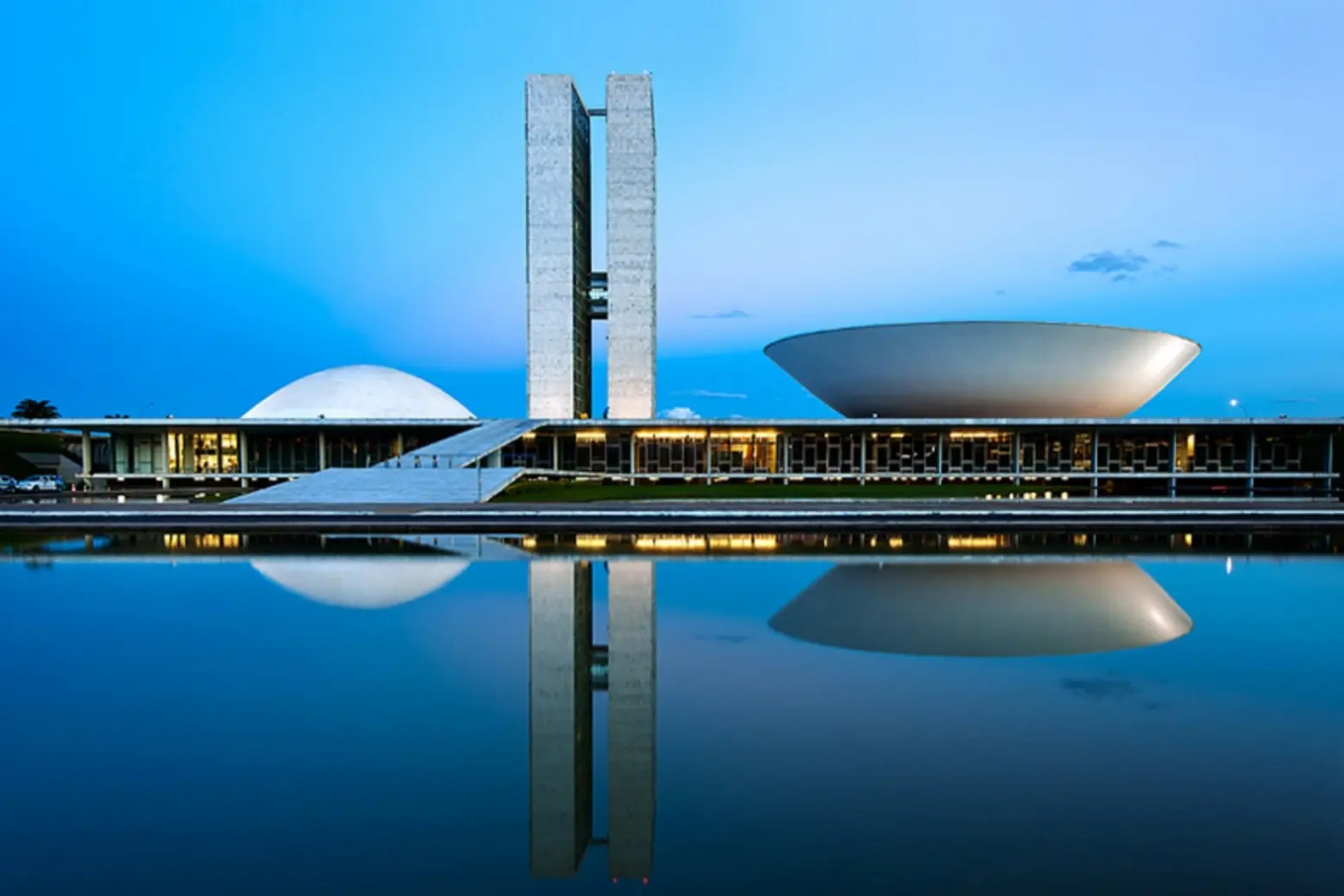
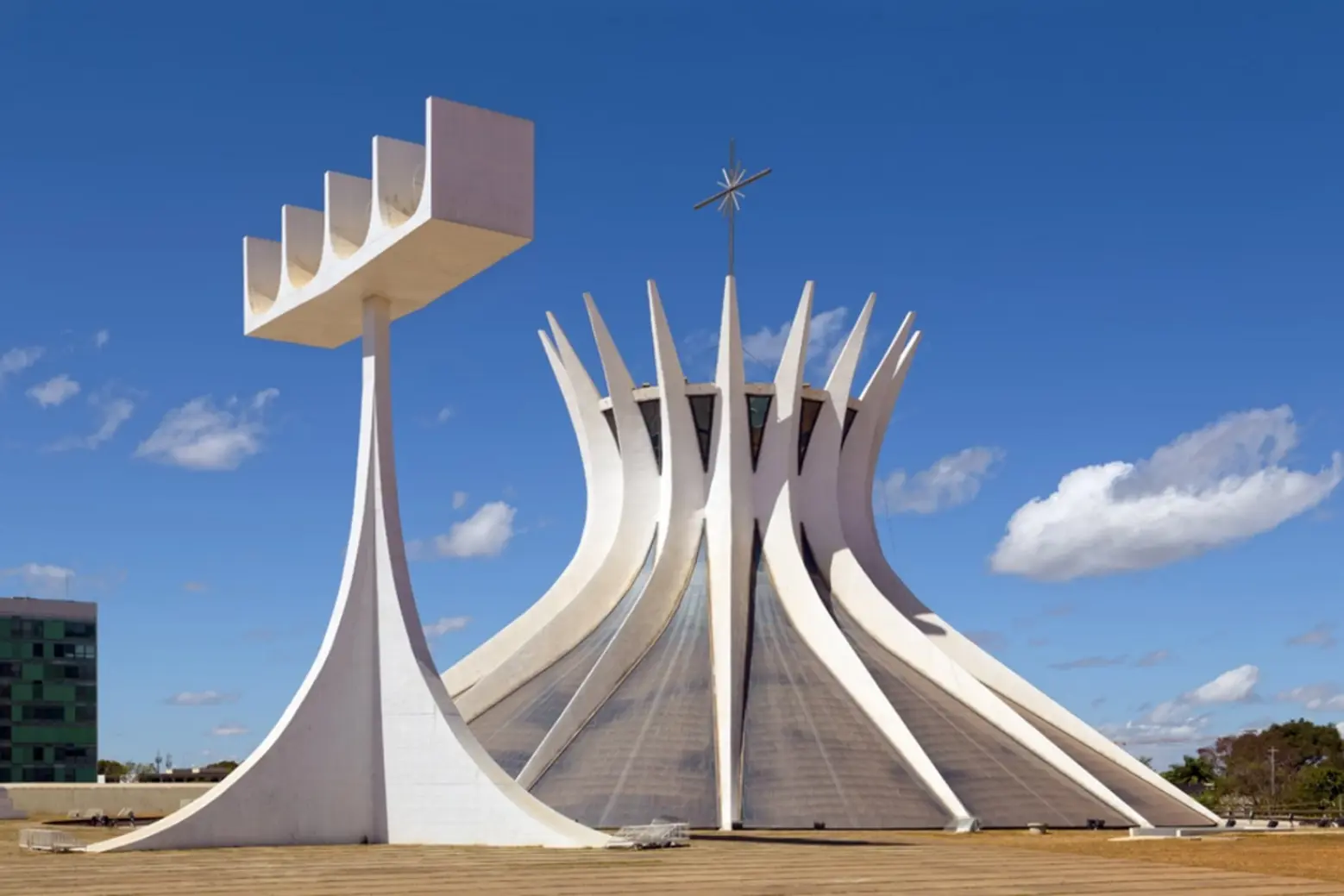
Within this framework, Oscar Niemeyer gave Brasília its symbolic center. The Cathedral of Brasília rises in sixteen hyperbolic concrete columns that seem to stretch skyward like hands in prayer, joined by glass that pours light into space. The National Congress balances a horizontal platform with two opposing domes, one concave and one convex, turning state power into a sculptural composition of tension and equilibrium. At the Palácio do Planalto, the "balletic" columns touch the ground with such delicacy that they seem to land rather than stand.
Brasília is often described as utopian, and rightly so. It was conceived as the visual language of a modern republic, detached from colonial precedent and coastal hierarchy. Yet the city also exposes the limits of grand planning. Its devotion to the automobile, with cloverleaf interchanges and no traffic lights, privileged flow over walkability. The dream of perfect order produced a place many admire and many critique. Some call it a masterpiece of human determination; others see a concrete desert, magnificent yet estranged from the improvisational life that animates older cities.

If Brasília is a butterfly that looks like an airplane, MAC Niterói is a flower that looks like a red UFO performing a circus trick. A building sixteen meters high and fifty meters in diameter rests on a narrow cylindrical base only nine meters wide, creating the impression that the museum has landed lightly on the cliff rather than been anchored to it. The reflecting pool below amplifies this illusion, making the structure seem to float while also cooling its environment. Once again, mass is present, yet visually suspended.
"The terrain was narrow, surrounded by the sea, and the solution came naturally... the cup emerged like a flower."
Then there is the ramp. At ninety-eight meters long and painted in a vivid red, it transforms arrival into procession. The museum is not entered abruptly. It is approached gradually, through a slow spiral of anticipation, framed by sea, sky, and horizon. Niemeyer understood that architecture can heighten consciousness before one even crosses the threshold. The ramp is both access and performance, a gesture that turns the visitor into part of the composition.
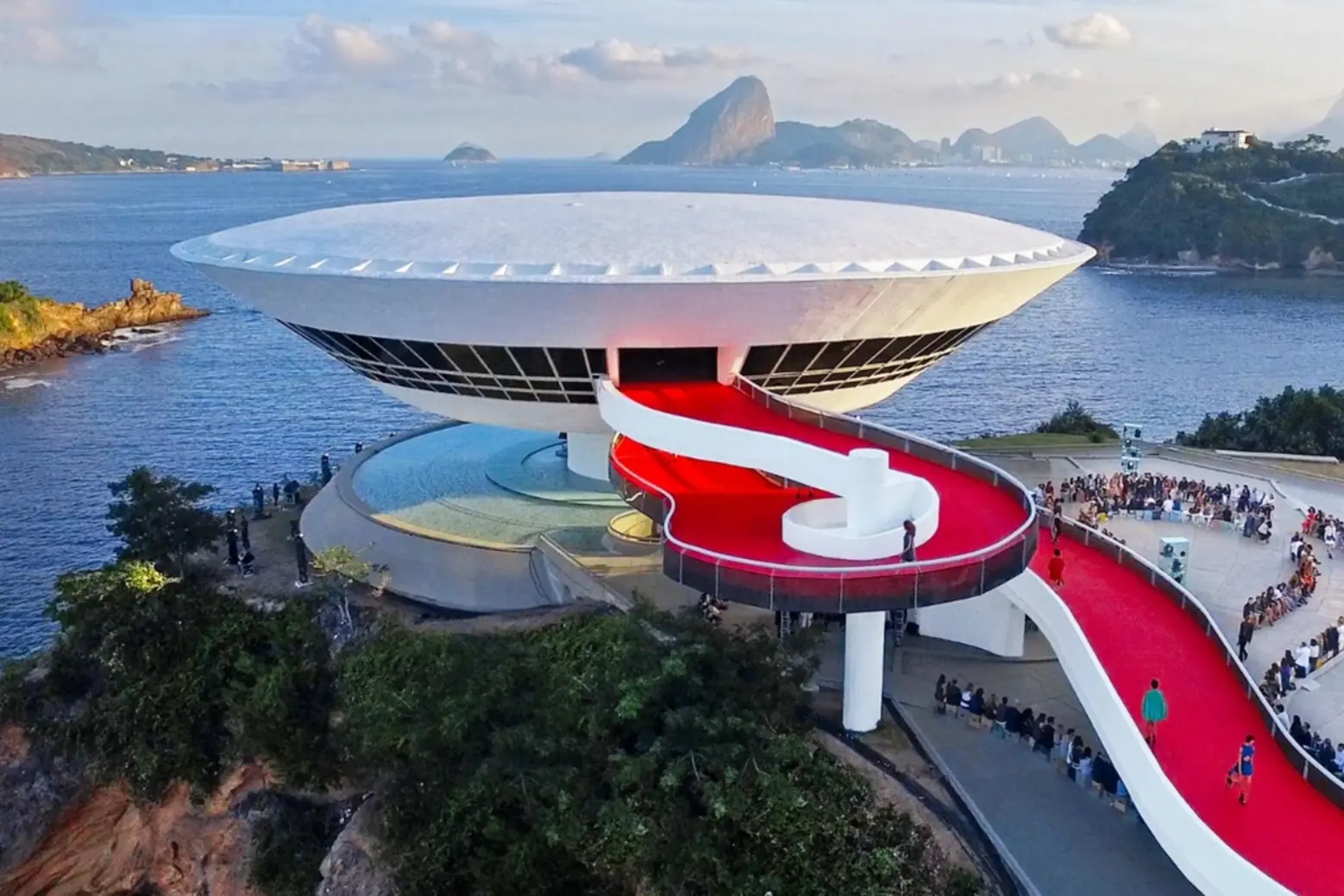
That theatrical quality helps explain why MAC Niterói became a magnet for fashion, cinema, and image-making. The Louis Vuitton Cruise 2017 show remains one of the clearest examples, when Nicolas Ghesquière used the red ramp as a runway and let the museum’s futuristic elegance become part of the collection’s narrative. The building did not serve as background. It acted.
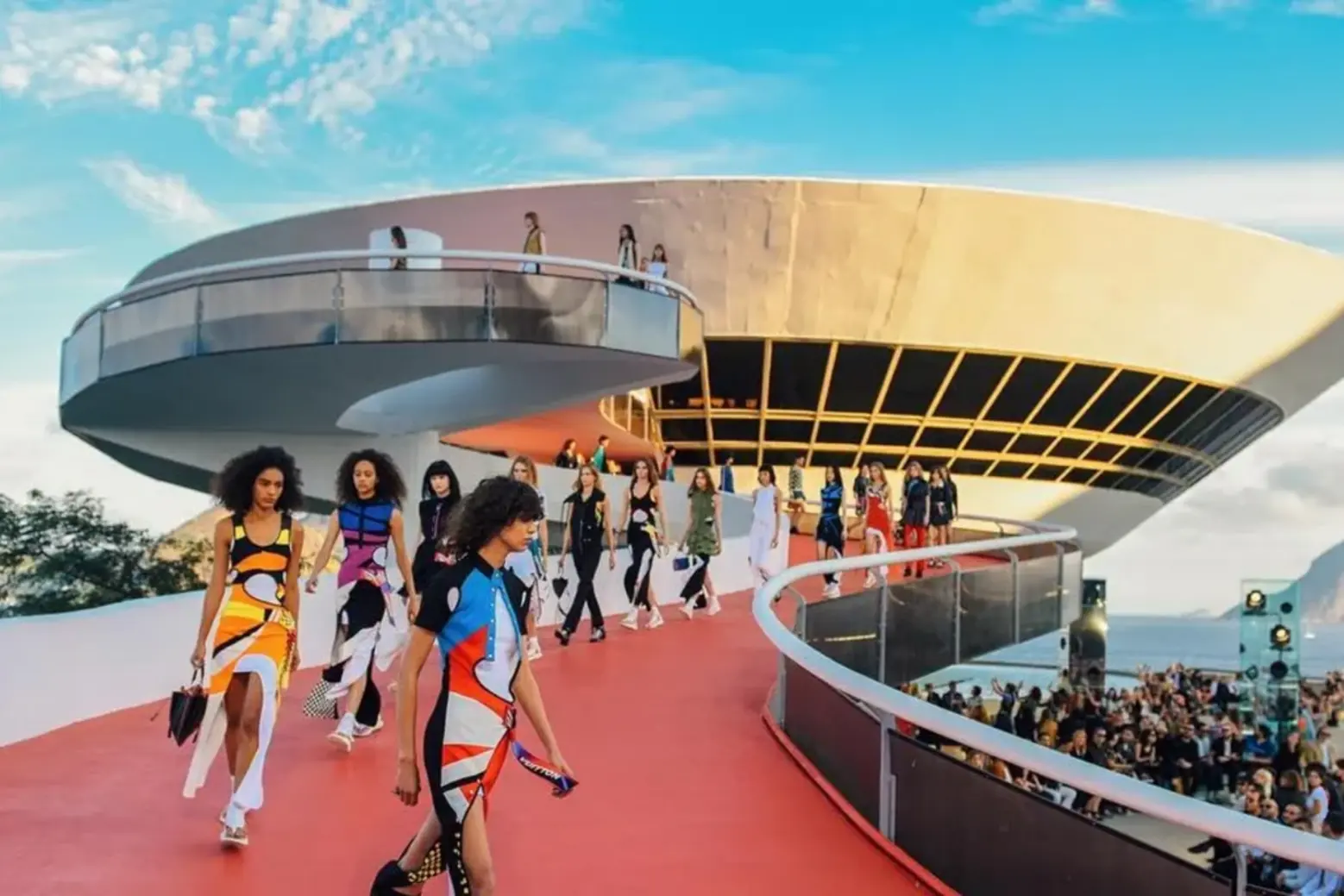
Yet what makes MAC Niterói enduring is that it never slips into pure gimmick. Its interior remains intentionally open and circular, allowing the surrounding landscape to compete with the artworks inside. The view becomes exhibition. The building frames not only objects but also the city, the bay, and the drama of Brazilian light. In that sense, the museum distills Niemeyer’s genius: he turns architecture into an experience of looking outward as much as inward.
Before Brasília and long before Niterói, Niemeyer had already left a mark on one of the world’s most symbolic modern complexes: the United Nations headquarters in New York.
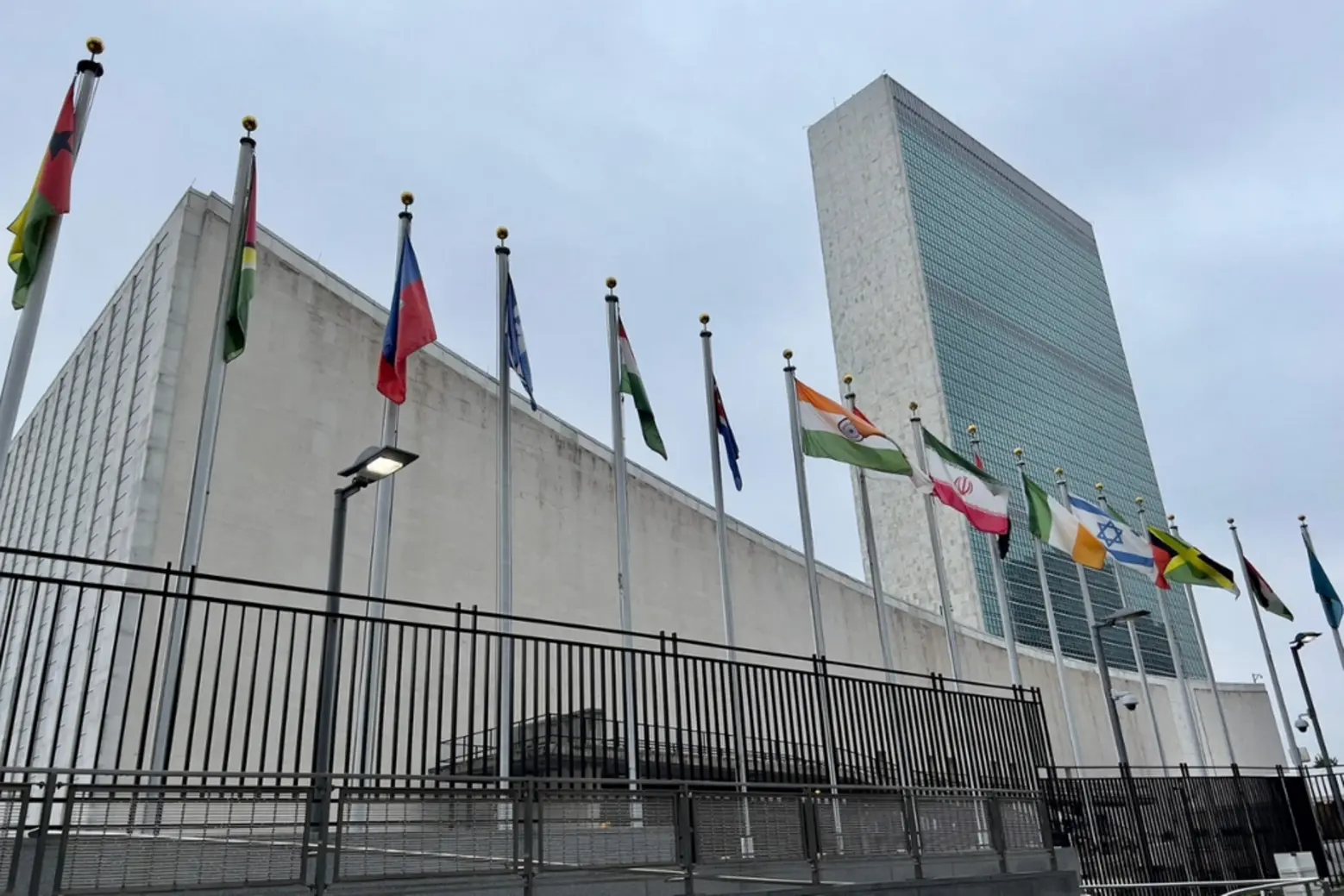
The project was the work of an international board of designers, and the process was famously fraught, especially between Le Corbusier and Niemeyer. Le Corbusier favored a heavier centralized scheme, while Niemeyer proposed a more open arrangement that separated the buildings and created a generous civic plaza. The final compromise, known as Project 23/32, retained the vertical force of the Secretariat tower while embracing the spatial openness Niemeyer advocated.
That contribution matters. It reveals that even in a collaborative and contested environment, Niemeyer was already thinking about transparency, lightness, and the ceremonial power of open public space. The headquarters also stood at the forefront of material innovation. Its glass curtain wall, green-tinted and expansive, helped establish a new vocabulary for the modern skyscraper. Even when his signature curves were less explicit, Niemeyer’s instinct for visual clarity and spatial drama was already present.
His later career only deepened that global stature. He worked across decades, across continents, and across political eras, continuing to design into his final years. He received the Pritzker Prize in 1988, and his influence radiated far beyond Brazil. Architects drawn to fluid form, from late modernists to digitally enabled figures such as Zaha Hadid, inherited something from his refusal of the hard edge and his conviction that structure could still feel free.
What remains striking is how coherent his legacy feels. Whether designing a capital city, a museum on a cliff, or contributing to an international diplomatic complex, Oscar Niemeyer kept returning to the same essential proposition: architecture must serve public life, but it should also elevate it. It should solve problems, certainly, yet it should also surprise the eye, stir the body, and offer a vision of collective experience larger than utility alone.

Since its inauguration in 1952, the United Nations headquarters has stood at the center of global history, witnessing episodes as charged as the 1960 “Broken Gavel” incident during Nikita Khrushchev’s furious outburst, the unprecedented filming of The Interpreter in 2005, and the hauntingly empty chambers of the virtually held 75th General Assembly in 2020. The complex also carries a quieter symbolic power through works such as Non-Violence and the replica of Guernica, both woven into its diplomatic memory. In Oscar Niemeyer’s early contribution to the project, one can already sense the ideas he would later refine so brilliantly elsewhere: A belief in lightness, openness, and structural elegance, shaped through his near-alchemical use of concrete, where hidden supports, parabolic forms, and luminous white surfaces made even massive buildings seem to float.

Oscar Niemeyer changed the emotional temperature of modern architecture, proving that monumentality could move with grace, that public buildings could hold sensuality, and that concrete could carry the softness of a sketch. Yet his legacy was never only formal. It was inseparable from conviction.
A lifelong member of the Brazilian Communist Party, Oscar Niemeyer believed architecture belonged to the people, and that belief shaped both his practice and his life. After the 1964 military coup in Brazil, the hostility of the new regime drove him into self-exile in France, where he remained for nearly two decades and continued to build with the same clarity of purpose, most notably in the headquarters of the French Communist Party in Paris. Even far from home, his work never lost its faith in beauty as a public force. That is what makes Oscar Niemeyer endure: He left behind buildings of extraordinary elegance, and within them, a vision of architecture as courage, poetry, and political imagination made visible.