MENU
Close





Hublot began with a gesture that Swiss watchmaking once considered almost improper: setting an 18-karat gold watch on a black rubber strap. Hublot’s luxury brand history is built on making unlikely materials, cultures and ideas occupy the same object.

Hublot began with a gesture that Swiss watchmaking once considered almost improper: setting an 18-karat gold watch on a black rubber strap. Hublot’s luxury brand history is built on making unlikely materials, cultures and ideas occupy the same object.
September 22, 2026


When Italian entrepreneur Carlo Crocco established MDM Genève in Switzerland in 1980, his first watch challenged one of the quieter assumptions of traditional watchmaking: precious materials should look precious. Gold belonged to leather, refinement with restraint, and rubber belonged somewhere far outside the vocabulary of haute horlogerie.

Crocco ignored that hierarchy.
His watch placed an 18-karat gold case on a natural black rubber strap. The case itself borrowed its geometry from a ship’s porthole, complete with visible screws around the bezel. Its name followed the same nautical reference. Hublot means “porthole” in French.


The rubber strap was far from an inexpensive afterthought. According to the brand history summarized in the supplied research, its development took roughly three years, including work on vulcanization to produce a soft, durable and scent-free material suitable for daily wear.
Seen from the present, gold beside rubber hardly feels radical. In 1980, the pairing carried far more friction. Luxury watches still communicated status largely through precious metals, traditional straps and inherited codes. Hublot introduced another possibility: luxury could emerge from contradiction.
That idea eventually became its entire business philosophy.
Hublot’s earliest design was considerably calmer than the watches that later made the name famous. The original model had a restrained dial, broad bezel and clean nautical outline. Its visual signature came from material contrast more than mechanical spectacle.
The essential elements were already present, however. Visible screws emphasized construction. Rubber sat proudly beside gold. The case presented itself as an assembled industrial object instead of disguising the way its components met.
Those decisions would survive several decades of aesthetic escalation.
Through the 1980s and 1990s, Hublot occupied an unusual corner of the luxury market. Its Mediterranean associations and unconventional material language gave it recognition, yet the company lacked the scale and momentum of the largest Swiss manufacturers.
By the beginning of the 2000s, the concept needed another act. Jean-Claude Biver arrived in 2004.
Few figures in modern Swiss watchmaking have possessed Biver’s instinct for turning product philosophy into cultural narrative. His career had already included the revival of Blancpain and an influential period at Omega when he joined Hublot.
Instead of abandoning Crocco’s original idea, he amplified it.
Biver organized the house around a phrase that could explain both its past and its future: The Art of Fusion. Gold and rubber had provided the first fusion. From there, the idea could expand almost infinitely: ceramic beside titanium, carbon beside precious metal, traditional mechanics enclosed within experimental synthetic materials, haute horlogerie mixed with football, tattoo culture or contemporary art.

The philosophy gave Hublot something particularly valuable in a crowded luxury industry: a system capable of generating new products without erasing recognizable identity. Then came the watch that transformed the company.
Presented at Baselworld in 2005, the Big Bang took Crocco’s porthole idea and pushed it into a far more muscular visual language.
Its case was large and layered. Screws became graphic elements. Rubber, resin, ceramic, titanium and other materials could appear within the same construction. Instead of the relatively seamless surfaces associated with classical Swiss watchmaking, the Big Bang exposed divisions between components.


The case looked built. Hublot’s research describes this as a “sandwich” construction, with separate bezel, middle case, inserts, seals and caseback creating a modular architecture.
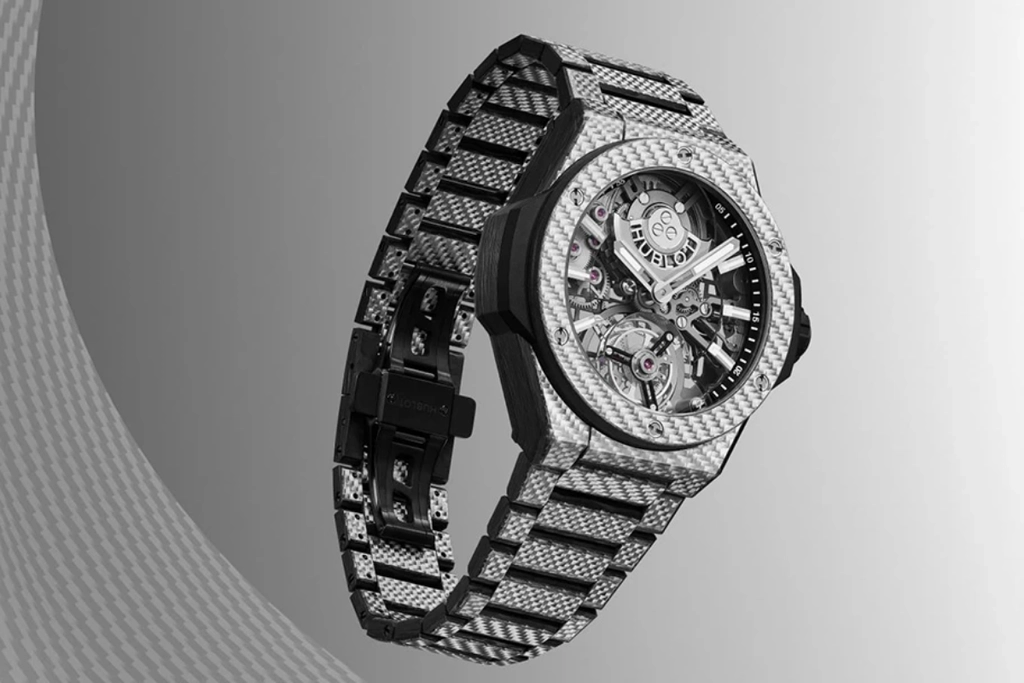
That modularity became enormously important. A recognizable silhouette could absorb endless permutations of color and material while remaining visibly Hublot.
Commercially, the effect was dramatic. The Big Bang became the brand’s defining collection and received the Design Prize at the Grand Prix d’Horlogerie de Genève in 2005.
For anyone studying luxury brand history, this chapter is especially revealing. Hublot did not reinvent itself by searching backward for forgotten heritage codes. It strengthened a relatively young idea until that idea became unmistakable.
LVMH acquired Hublot in 2008, bringing the company into a luxury group whose watch portfolio also includes TAG Heuer and Zenith.
The acquisition coincided with a more ambitious phase of technical development. Hublot expanded its facilities in Nyon and increasingly positioned itself as a manufacture capable of developing movements and advanced materials internally.
This mattered because Hublot’s success had also attracted criticism.
Earlier watches frequently used movements supplied by established external manufacturers such as ETA and Sellita. For traditional collectors, premium pricing combined with outsourced calibres could create tension between the brand’s commercial positioning and conventional definitions of watchmaking value.
The HUB1242 and later HUB1280 Unico movements helped establish Hublot’s modern mechanical identity. These automatic flyback chronographs feature elements such as a column wheel and double-clutch mechanism, with much of the chronograph architecture deliberately visible from the dial side.
The decision makes conceptual sense within Hublot’s wider design vocabulary. The case reveals its layers. The movement reveals its mechanics. Construction becomes part of appearance.
The 2013 Big Bang Unico crystallized this direction. Openworked surfaces turned the mechanism itself into a visual field, allowing gears, bridges and chronograph components to participate in the watch’s industrial aesthetic.
From there, Hublot could pursue increasingly unconventional mechanical projects.

The MECA-10 offered a 10-day power reserve through a movement inspired visually by construction systems such as Meccano. The MP series moved further into experimental territory. Its MP-05 LaFerrari arranged eleven series-coupled barrels vertically to deliver an extraordinary 50-day power reserve.

Here Hublot’s extroversion begins to reveal another side. Beneath the scale, color and publicity lies a persistent fascination with engineering as theatre.
Many historic maisons distinguish themselves through hand finishing, métiers d’art or mastery of traditional precious metals. Hublot has increasingly treated material science itself as a form of luxury authorship.
Magic Gold is one of its most discussed examples. Developed through work involving EPFL, the alloy combines 18-karat gold with ceramic reinforcement to create a material considerably more resistant to scratching than conventional gold. The supplied research places its hardness at around 1,000 Vickers.
Colored ceramic opened another direction. Producing strong, saturated ceramic tones requires control over pigmentation at extreme firing temperatures, turning color into a technical challenge as much as an aesthetic decision.


Then came sapphire. Hublot’s 2016 Big Bang Unico Sapphire helped push transparent synthetic sapphire from a material used primarily for crystals and highly limited experimental cases toward much larger-scale case production.


SAXEM extended the fascination with translucency and optical color, while carbon composites and Texalium provided still more combinations. The company’s philosophy suddenly becomes literal. Fusion happens at the level of matter.
Biver also recognized that horology could speak to audiences beyond established watch culture.
Hublot moved aggressively into football, an arena that luxury watch brands had historically approached with less intensity than sports such as golf, sailing or Formula 1. Partnerships surrounding FIFA competitions and UEFA football placed the brand before a global audience far larger than the traditional collector community.


Collaborations widened the cultural vocabulary again.
Tattoo artist Maxime Plescia-Büchi translated the geometry of Sang Bleu into watches composed of rotating polygons and faceted forms. Takashi Murakami brought his smiling flower into the Classic Fusion, transforming its petals into a moving kinetic element.


These projects work because Hublot has never relied heavily on an image of quiet antiquity. Its relatively short history provides unusual freedom.
A collaboration can become part of the watch itself.
Few major Swiss brands divide enthusiasts as reliably.
Collectors shaped by classical watchmaking may question its large cases, conspicuous branding, frequent limited editions or historical use of outsourced movements. Others point toward the development of Unico, the MP series and Hublot’s materials laboratory as evidence that the company now possesses substantial technical capability.
Both reactions reveal something important about Hublot. The brand has rarely pursued universal approval.
Its watches are engineered for immediate recognition. Their surfaces are layered, screws are exposed, materials clash deliberately, and mechanisms frequently become part of the visual composition. Even its famous all-black watch of 2006 explored what Hublot called “invisible visibility,” creating recognition through shape and texture while suppressing conventional legibility. Polarization, in this case, functions almost like another brand code.
Hublot entered Swiss watchmaking without centuries of archival mythology behind it. That apparent disadvantage gave the company unusual permission to experiment.
The first gold case on rubber already contained the blueprint.
Later came gold with ceramic. Sapphire with mechanical complications. Watchmaking with football. Tattoo geometry with chronographs. Murakami flowers with rotating diamond petals. Ferrari engineering with a 50-day movement.
Through each transformation, the house has kept returning to the same question: what happens when two things traditionally separated by luxury convention are forced together?
Hublot’s place in luxury brand history comes from continuing to ask it.