MENU
Close





Why does smoking in fashion still seduce the lens so easily, when the cigarette is less an accessory than a beautifully styled contradiction with ash on its fingers?

Why does smoking in fashion still seduce the lens so easily, when the cigarette is less an accessory than a beautifully styled contradiction with ash on its fingers?
May 16, 2026
Advertisement
Advertisement



Smoking in fashion has never been only about the cigarette. The cigarette is too small for that. What fashion has kept returning to is the gesture around it: the hand paused near the mouth, the body leaning against a wall, the face arranged into boredom, the smoke turning air into atmosphere. The cigarette gives a photograph something fashion constantly craves: tension. It makes stillness look charged. It makes silence look intentional. It makes a woman appear as though she has just left something, survived something, or is about to refuse something.
That is why the cigarette became one of fashion’s most persistent and morally uncomfortable props. It is not beautiful in itself. It is beautiful only after the image has edited out the smell, the dependence, the health reality, the social consequence. In public-health terms, cigarette smoking harms nearly every organ of the body, and tobacco remains a major preventable cause of disease and death. In fashion-image terms, the cigarette has been treated as a line, a shadow, a punctuation mark, an attitude. That gap between reality and image is the entire problem.

A cigarette creates a whole personality. It tells the viewer that the subject is not available for easy approval. She is not smiling for comfort. She is not performing health, sweetness, optimism, or usefulness. She is waiting, withholding, disappearing into herself. It instantly gives the body a script. The empty hand is passive. The cigarette hand is narrative. It turns a model into a character without needing a plot. Who is she? Where has she been? Why does she look tired? Why does she seem powerful and ruined at the same time? The cigarette does not answer these questions. It plants them. It suggests control through an object associated with dependence. It suggests freedom through an industry that has historically sold addiction as lifestyle. It suggests rebellion through one of the most heavily marketed products of modern consumer culture. That is why the image is so sticky. It is aesthetically fluent and ethically dirty at the same time.
But the rebellion is slippery. Is the smoking It-girl actually resisting perfection, or is she performing a different version of perfection, one with darker lighting? Is the cigarette really anti-algorithm, or has the algorithm already learned how to sell us the anti-algorithm aesthetic? A blurry cigarette photo may look spontaneous, but it can circulate with the precision of any luxury campaign. Carelessness becomes content. Damage becomes mood. The bad habit becomes another good image.

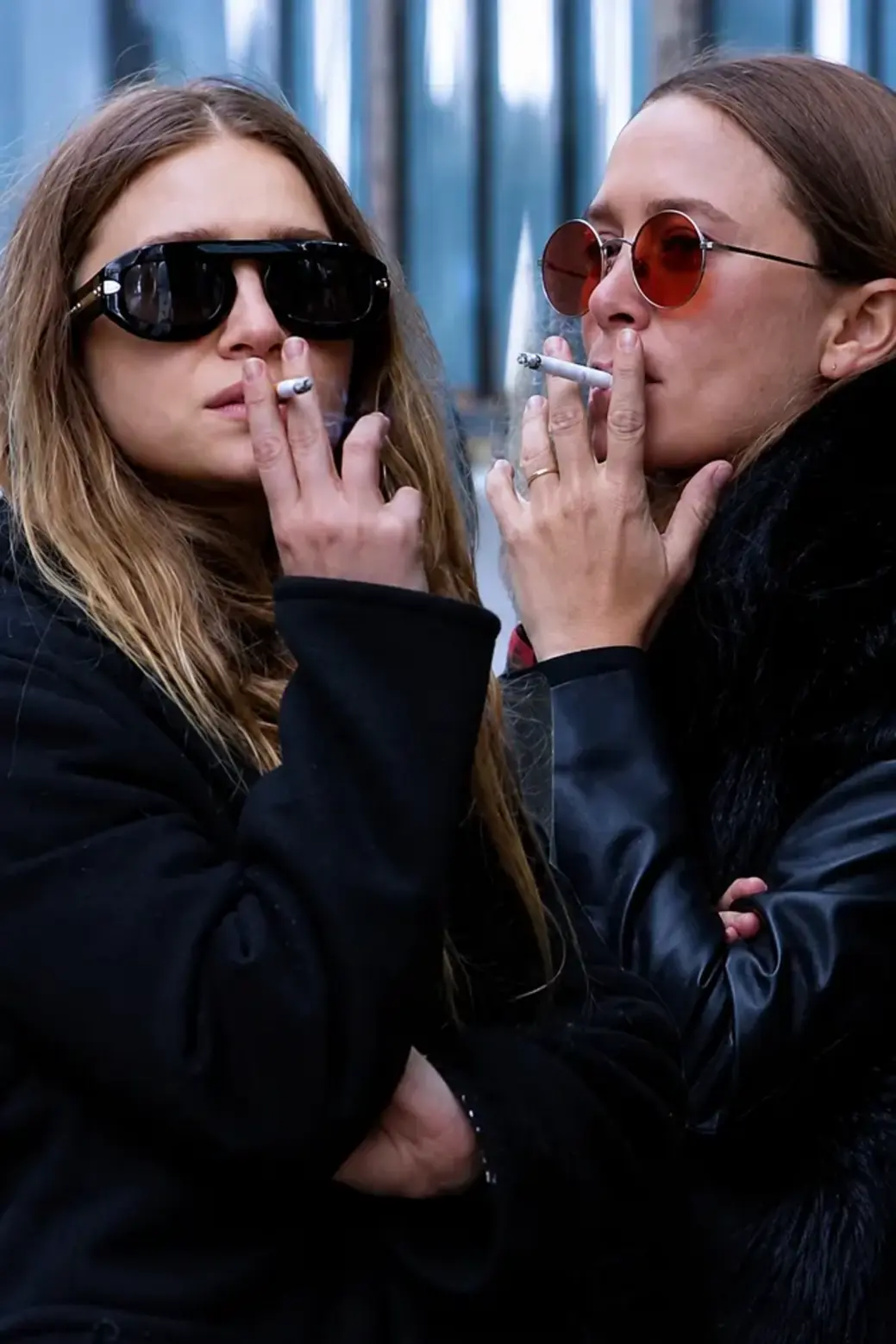
Fashion’s attachment to cigarettes is a lingering example of advertisers manipulating women’s self-image, noting that the dangling cigarette still functions as a sign of danger and delight in editorials. The point is not that cigarettes are newly stylish. The point is that fashion never fully deleted the code. It only hid it, revived it, ironized it, softened it, pushed it into backstage images, then brought it back as mood. Smoking in fashion survives because the cigarette is one of the fastest visual shortcuts to a certain kind of character: difficult, bored, elegant, unavailable, lightly doomed. It is a lazy symbol, but an effective one.
Why does a cigarette make a woman look more interesting in an image? Why does self-destruction become more acceptable when it is styled with a good coat? Why does fashion so often require a little damage to escape looking sterile? If the cigarette is removed from the frame, what emptiness does it expose? Maybe the problem is not only that fashion glamorizes smoking. Maybe the deeper problem is that fashion has trained itself to confuse harm with depth.
The female smoker is one of fashion’s most complicated images because she often appears powerful. She looks self-owned. She looks indifferent to judgment. She looks like she has stepped outside the script of agreeable femininity. In fashion photography, the smoking woman is rarely framed as weak. She is framed as unreachable. She is the woman who refuses to explain herself.
That is why the image feels so seductive and so false. The cigarette seems to give her autonomy, but the history behind that autonomy is not innocent. In the early twentieth century, cigarette marketers deliberately tied women’s smoking to independence and emancipation. Stanford’s tobacco advertising archive notes that marketers in the 1920s and 1930s transformed cigarettes into symbols of women’s independence, including the 1929 “Torches of Freedom” stunt in New York. Tobacco companies attached their products to women’s liberation movements.

Before the wellness trend tried to scrub the world clean, the cigarette was the ultimate scepter of the screen siren. In the hazy glow of Old Hollywood, smoking wasn't an addiction, it was a high-stakes performance. The Femme Fatale didn't just light up; she conducted a cinematic ritual, manipulating that slim white stick with a delicacy that bordered on the predatory. It was the era of the slow-burn, where the exhale was a weapon and the cigarette itself was the most essential accessory in the wardrobe of mystery.

Then came the 1990s, and the theater was unceremoniously stripped bare. The glamour evaporated, replaced by a cold, skeletal indifference that felt even more intoxicating. Enter Kate Moss, the high priestess of "Heroin Chic," turning backstage hallways and gritty editorials into a sermon on nihilism. Under the lens of Mario Testino and the watchful eye of Karl Lagerfeld, the cigarette lost its polish and gained a je ne sais quoi that whispered of late nights, blurred vision, and a total, fashionable lack of a pulse.
By the time Carrie Bradshaw started pacing her Manhattan apartment, the cigarette had evolved into a core identity trait, the frantic punctuation mark of the urban neurotic. This tradition of the narrative prop is currently peaking in Ryan Murphy’s 2026 hit Love Story, where Sarah Pidgeon’s portrayal of Carolyn Bessette-Kennedy uses the cigarette as a performative tool to reclaim that specific, icy 90s autonomy. It’s not about the nicotine; it’s about the brand.

We are currently living through the great romanticization of the dirty little habit. Lana Del Rey has spent a decade turning self-destruction into a vintage-filtered prayer, treating the cigarette as a romantic motif rather than a health hazard. It’s poetic rot at its finest. Even Charli XCX has folded that rebellious flicker into the Brat aesthetic, nodding to the torches of freedom of the past. From the Olsen Twins hiding behind oversized sunglasses to Lily-Rose Depp and Bella Hadid looking effortlessly unbothered, the common denominator remains the same: the cigarette is the entry fee for the Cool Girl club.
The allure is, of course, a delicious contradiction. In a world that is increasingly rigid, exclusive, and obsessed with optimization, the cigarette feels like a frantic act of rebellion. It creates the illusion of attainable luxury, a way to buy into a gated world for the price of a pack. Much like overpriced matcha or overpriced workout class, it is a curated indulgence. It’s not true luxury, but it is a perfect aesthetic echo of it; a way to look like you have something to lose while pretending you don't care at all.
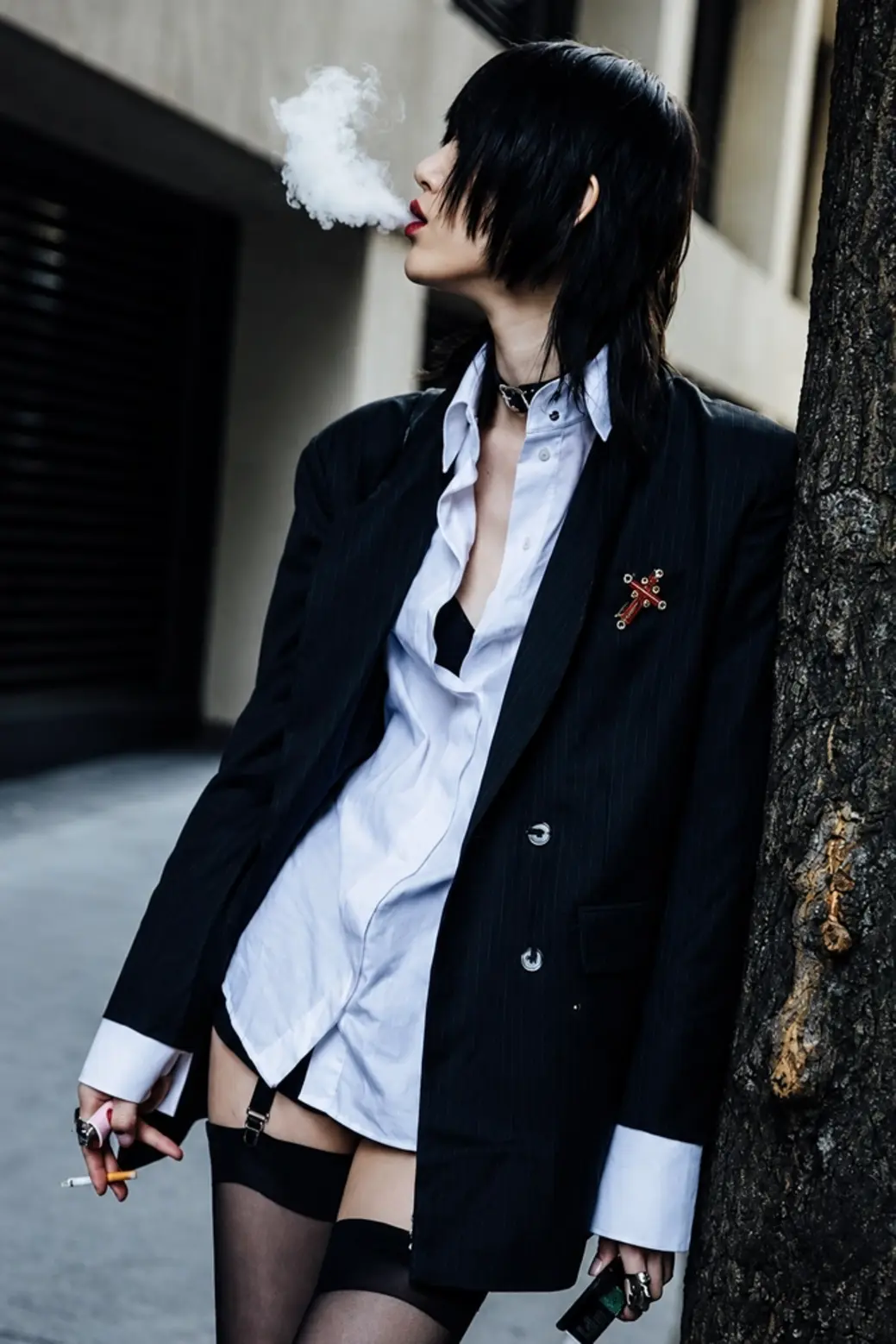

This is the great detachment at the heart of the cigarette image. Fashion wants smoking without smoking. It wants the symbol without the substance. It wants the body language without the body. A cigarette in an editorial becomes almost abstract: a thin object, a glow, a diagonal line, a reason for the hand to move. But images are not neutral just because they are beautiful.
The irony is brutal. The cigarette is used to suggest a woman who cannot be controlled, yet its entire commercial history is built on controlling desire. It is used to symbolize rebellion, yet it became iconic through repeatable visual codes. It is used to show a woman beyond approval, yet the image still depends on being approved by the viewer. The cigarette is not freedom. It is the picture of freedom, and fashion has always been dangerously good at selling pictures.
The issue is that fashion often borrows the drama of harm while pretending harm has vanished from the frame. It takes the cigarette’s cultural charge and launders it into atmosphere. That is why smoking in fashion remains such a revealing subject. It exposes fashion’s deepest talent and its deepest weakness: the ability to transform almost anything into style. Even dependency can look like control. Even danger can become elegance. Even a product with a long history of manipulation can reappear as an accessory to female power.
Advertisement