MENU
Close





The Prada Linea Rossa campaign lives on as one of fashion’s most haunting images, and Phil Poynter’s account reveals exactly how that hypnotic vision took shape.
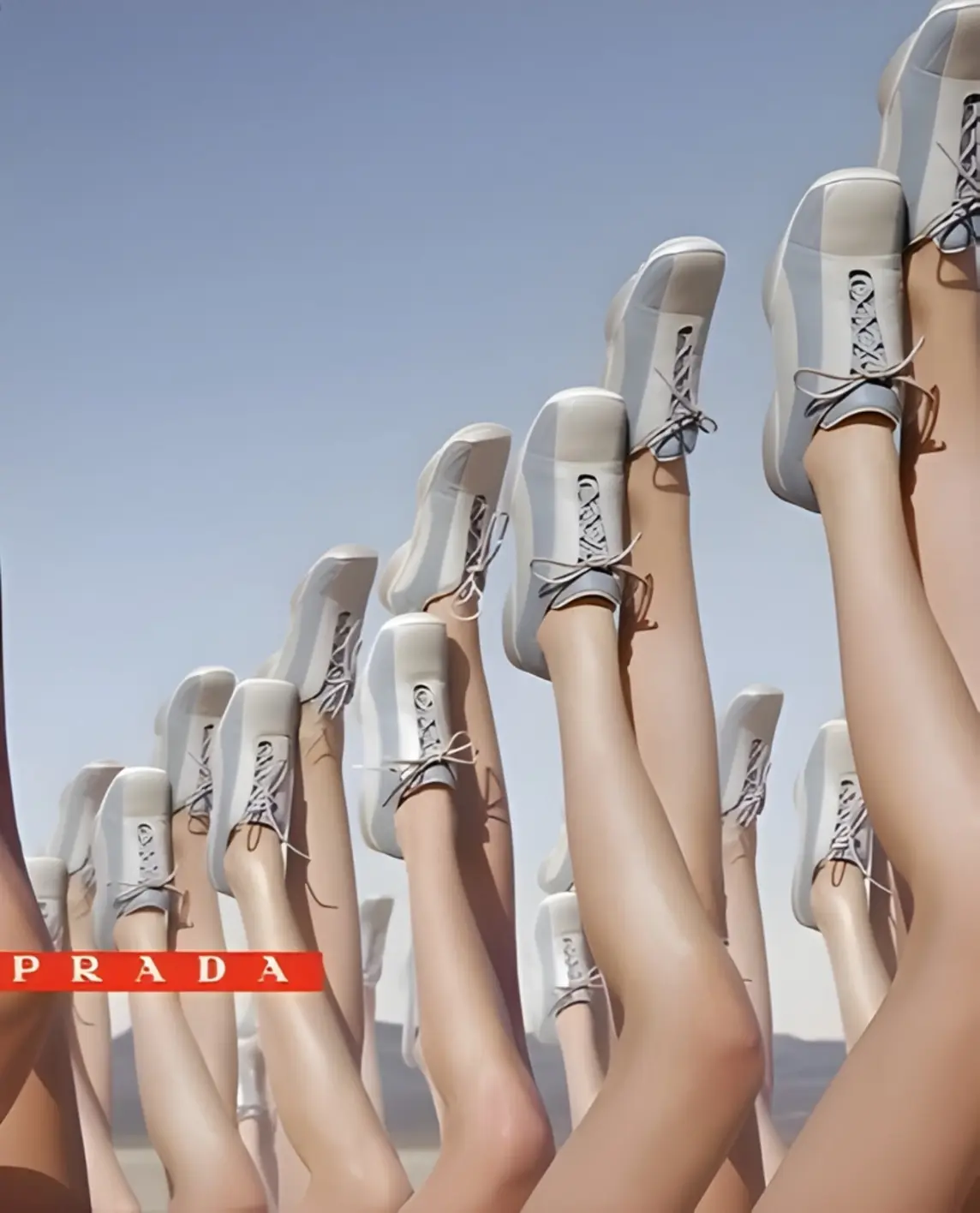
The Prada Linea Rossa campaign lives on as one of fashion’s most haunting images, and Phil Poynter’s account reveals exactly how that hypnotic vision took shape.
March 25, 2026
Advertisement
Advertisement



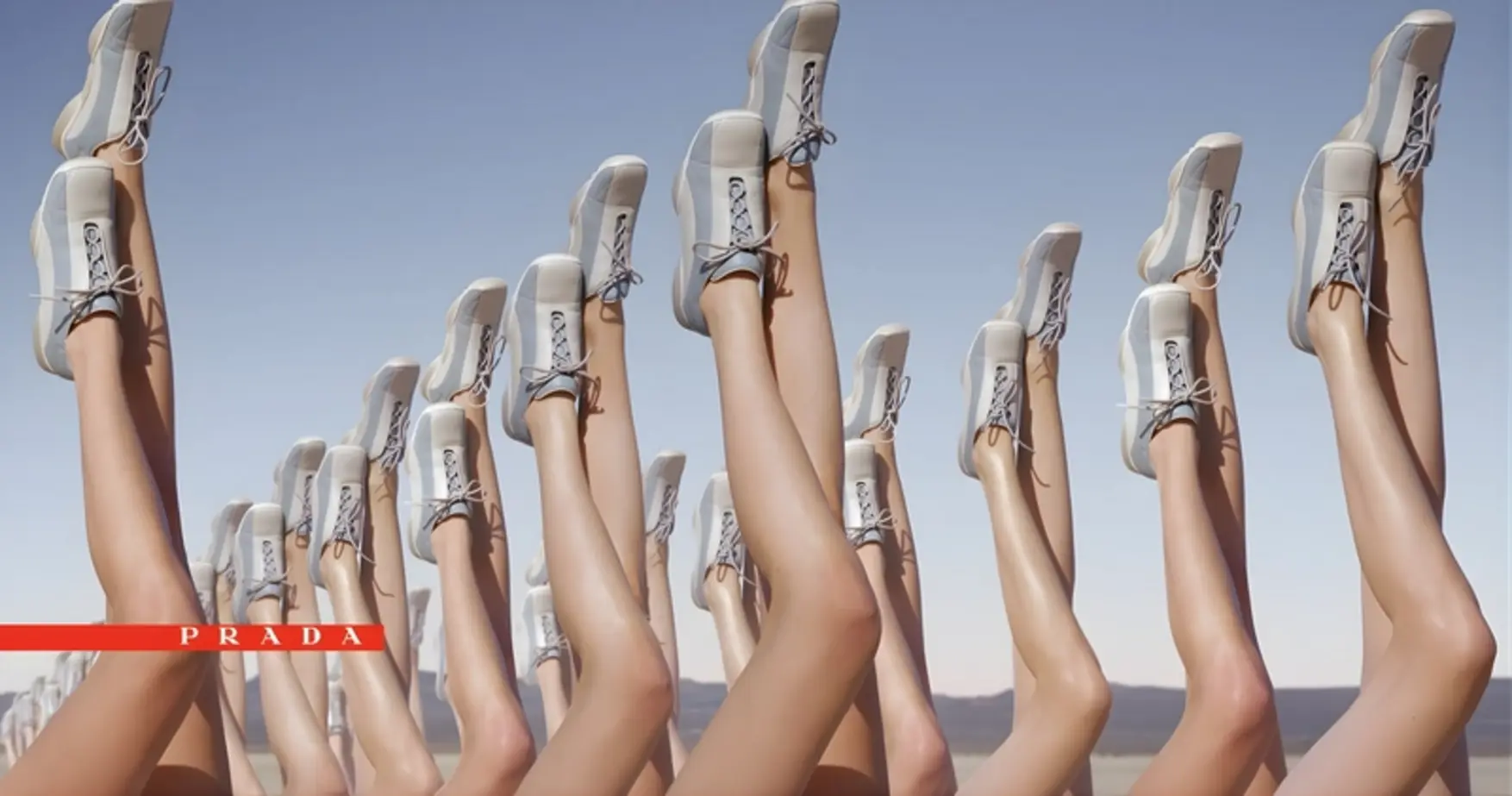
Prada Linea Rossa began in 1997 as Prada’s high performance, technical luxury sportswear sub-brand, and from the start it already had that delicious little contradiction Prada does so well: ruthless function dressed up in immaculate seduction. Imbued with Italian style and driven by the functional needs of pro sailing teams, it quickly became a key signifier of British youth culture. The line’s America’s Cup trainer, released to the public in Spring/Summer 1999, was the key piece and fully transcended its sports origins. By the turn of the Millennium, the shoes were appearing on knowing celebrities and across the dancefloors of UK Garage raves. For a tribe whose weekend uniform of luxury labels was shaping a new visual identity for aspirational clubbing, the America’s Cup did the job perfectly.
Its appeal had always been rooted in genuine performance, in light-weight comfort and technical design, though the real hook sat elsewhere too, in that sleek, modernist shape with all its streamlined sex appeal. Practical, yes. But also very aware of its own legs.
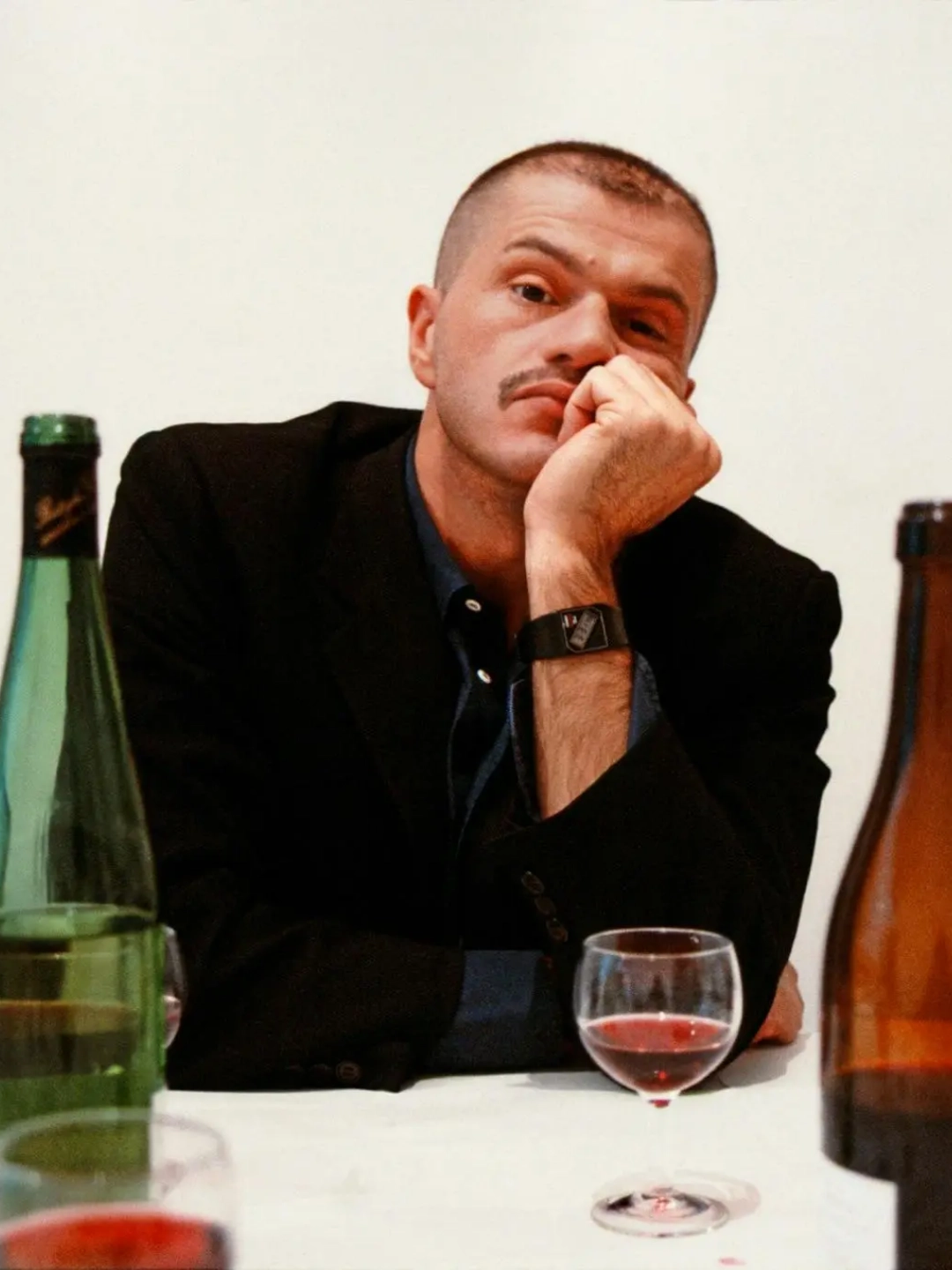
There to capture the birth of Prada Linea Rossa was photographer Phil Poynter. He began his career in London in the 1990s at Dazed and Confused, where he worked his way up from Rankin’s assistant to creative director, and later built a career across fashion, beauty, and celebrity for publications including Vogue and Vanity Fair. His commercial work would go on to include commissions for Loewe, Alexander McQueen, and Louis Vuitton. Yet one body of work, above all, sealed his reputation: the three campaigns he made for Prada Sport, as Prada Linea Rossa was originally called, beginning in Spring/Summer 2001. They involved hundreds of models, a painstaking process, an enormous budget, and almost absurd levels of ambition. Twenty-five years on, they still sit there in fashion history looking smug and correct, as some of the most celebrated and referenced images of the century so far.
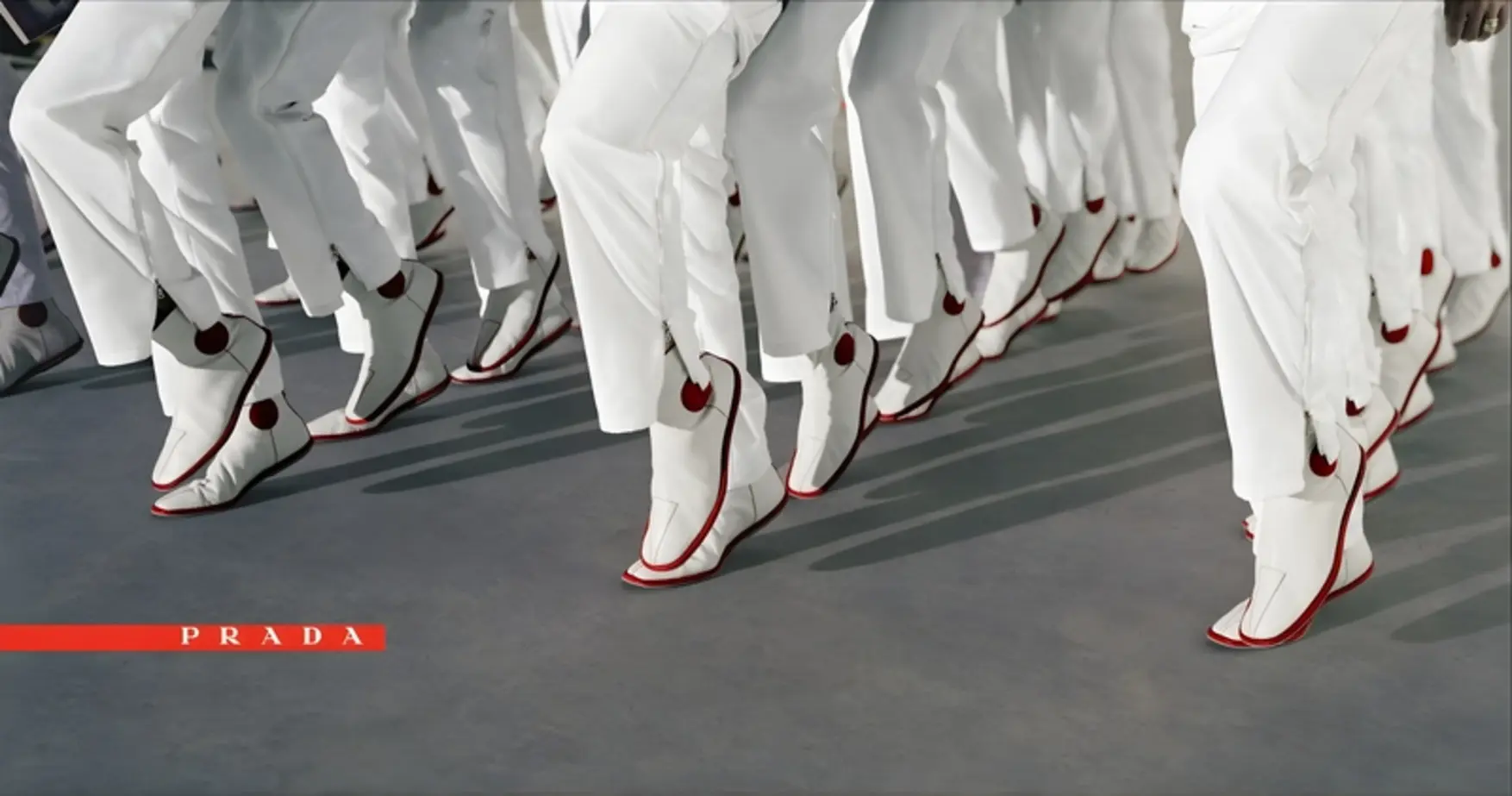
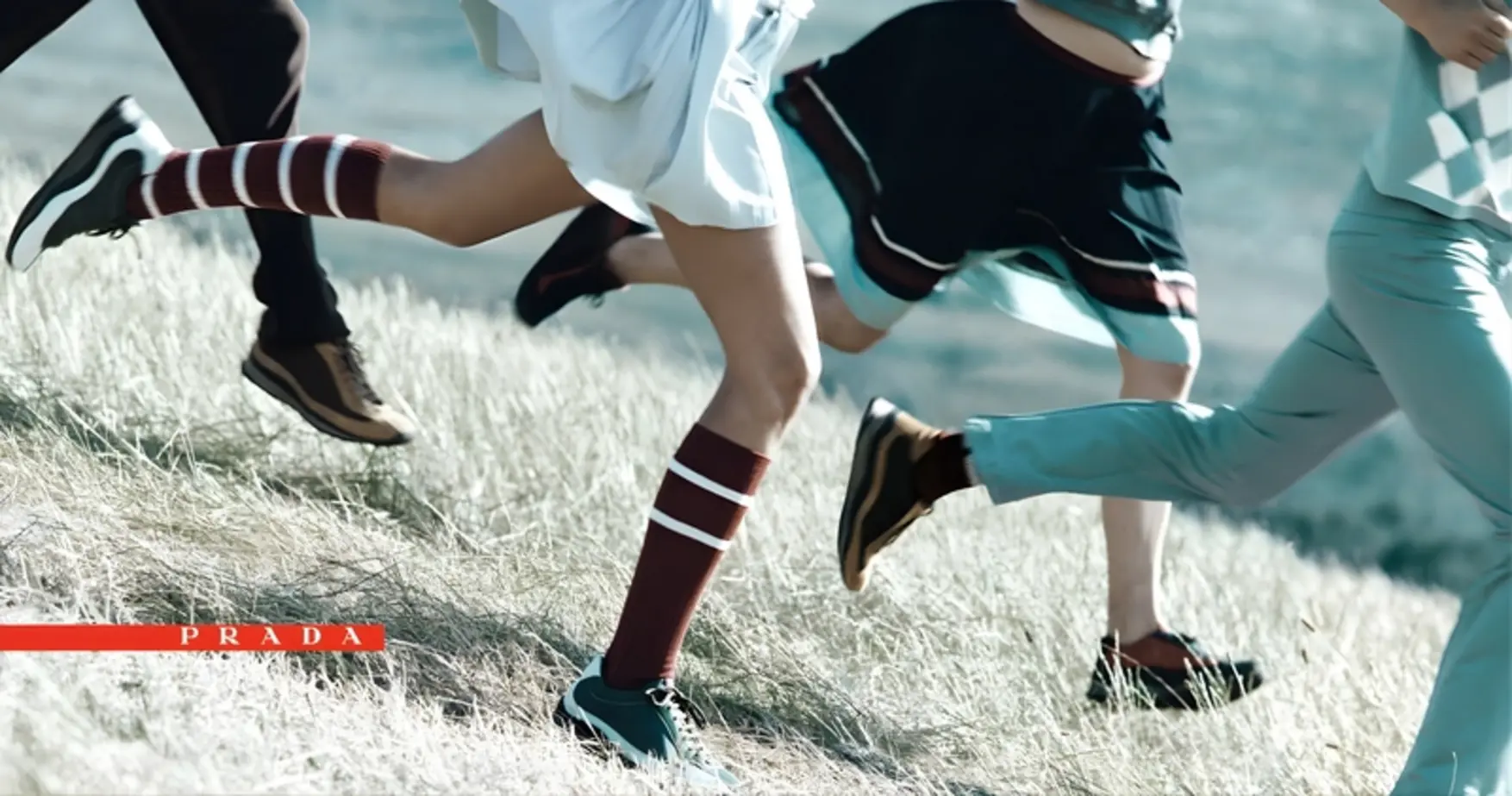
The whole saga unfolded across three shoots over an 18-month period. The first was the desert campaign, the one people still tend to recognize instantly. After that came Autumn/Winter, which was eventually shot in Pinewood Studios, and then a second Spring/Summer campaign in Cape Town. Even the Pinewood campaign arrived through a kind of glorious logistical madness. Phil Poynter had spent three weeks in St Moritz trying to make the mountain concept work, only to realize the conditions were too cold and too slippery. The answer, naturally, was to build a mountain instead. A very different era, certainly, though one defined by something rare and intoxicating: ideas were trusted. Phil Poynter remembered that these were the days when Miuccia Prada created a culture where conviction backed imagination. Once she signed off on something, the next step was simply to go and figure out how it could exist. Her faith in ideas, he said, was and remains amazing.
The original desert shoot began when creative director David James and stylist David Bradshaw approached him. Both had worked with Glenn Luchford on those iconic Prada campaigns and were beginning to work with Norbert Schoerner on Prada Mainline. They had seen a set of school portraits Phil Poynter had made for Dazed and Confused, a large-scale group project, and they came to him because they wanted a really big idea for Prada Sport. The timing was perfect, because he already had one germinating.
At the time, Phil Poynter was looking closely at Bauhaus references, especially Oskar Schlemmer’s Triadic Ballet, that extraordinary 1920s performance in which the body became architecture, costume, geometry, and movement rather than emotional narrative. He was thinking about physical culture, mass movement, the synchronized body, discipline, and form over expression. That visual logic offered a sharp break from the dominant fashion mood of the period, which he saw as steeped in 1990s supermodel glamour, a weirdly sexualized chaos, or documentary realism. There were, he acknowledged, elements in the imagery that touched broader histories of European choreography and performance, including visual languages often associated with totalitarianism, though he was clear that he was not borrowing a single ideological code. He was interested in what happens when the visual language of order is emptied of propaganda and placed in a strange contemporary ambiguity, allowed to speak for itself. He was not over-intellectualizing it at the time. It simply felt right.
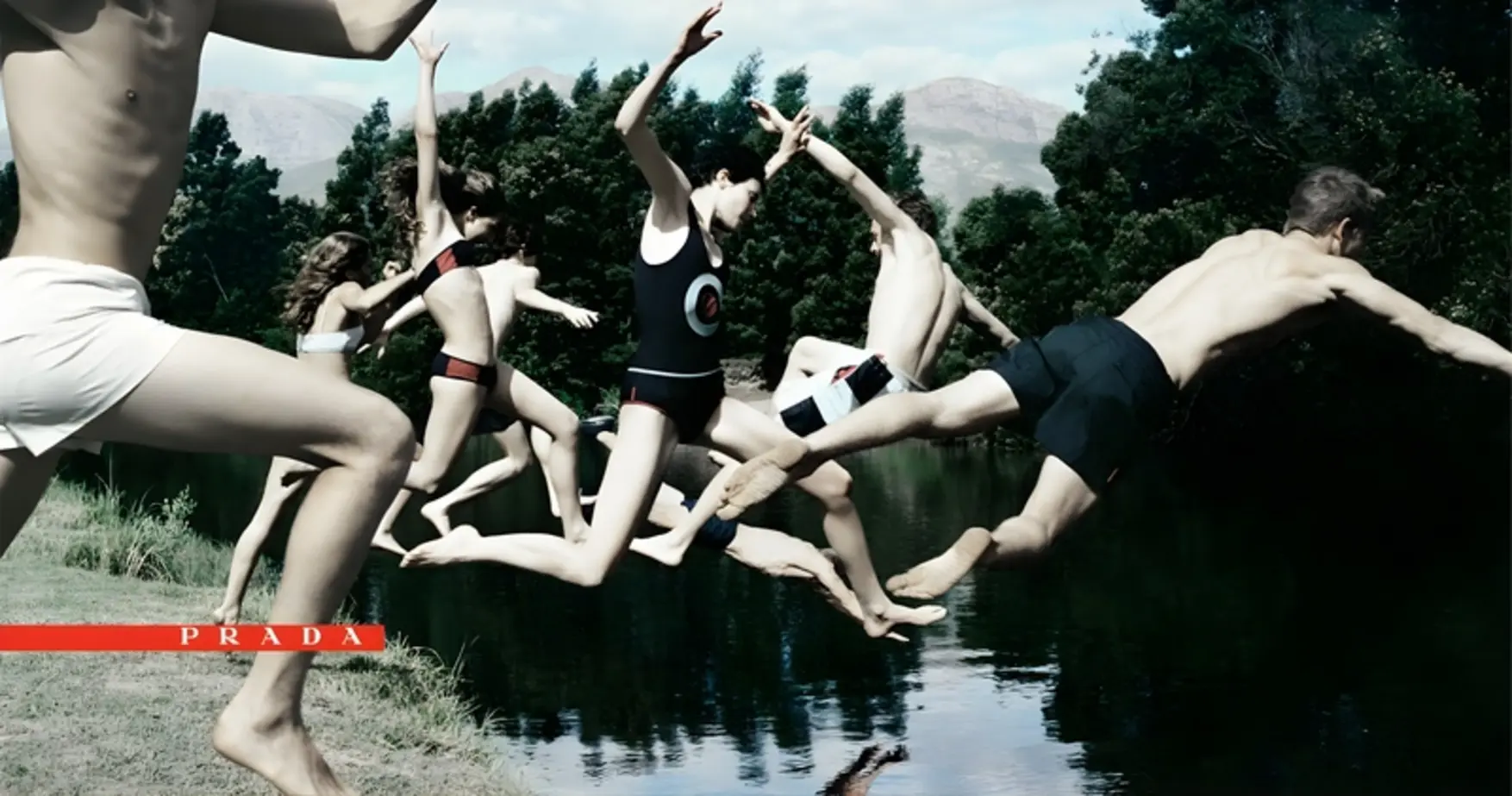
That feeling still needed money, nerve, and institutional backing, and there was risk all over it. Phil Poynter knew the concept was a major step on from the group shots he had been making. He told David James that if they went down this road, it had to be properly supported or it would collapse into an expensive mess. Miuccia Prada, though, backed it intellectually, emotionally, and financially. She had the curiosity and the confidence to support young artists, and that confidence proved decisive.
Getting Prada to buy in involved a number of meetings with David James, followed by meetings with Miuccia Prada in Milan, an experience Phil Poynter found terrifying as a young photographer. He knew he had to get it right. Turning up with a stack of references would never be enough. So instead he had an illustrator draw the whole thing out, creating large group images of what he imagined happening in the desert. Miuccia Prada understood it immediately and asked what the next step would be.
The next step was technical. Phil Poynter and his team went into a studio to test the image structurally. He wanted to study high vantage points, wide framing, flattened depth of field, and the tension between structure and style in the making of the photograph. Following Glenn Luchford and other great photographers into Prada’s orbit meant the pressure was real. He could not propose something this large and then fail to deliver it. So they bought 150 Action Men and shot the whole thing on miniature figures, then took that test shoot back to Prada.
From there the fantasy entered the real world with hard numbers and even harder planning. The questions became brutally practical: where to shoot, how many models, what exact dimensions, what scale. Phil Poynter had previously shot on a dry lake bed in California called El Mirage, in Victor Valley, a couple of hours from Los Angeles. In the 1990s it had practically been booked out by Peter Lindbergh. It was the site of those enormous Vogue productions, a place where, whenever you turned up, there seemed to be Peter Lindbergh, supermodels, Mad Max cars, and explosions all happening at once. Phil Poynter knew the terrain, and so he returned there with his team carrying 100 C-stands and 100 polystyrene heads. They mapped the whole thing out and repeated the shoot with mannequins in order to test the time of day, the duration of light, the length of shadows, and every other technical variable that could make or ruin the campaign. They spent two weeks in the desert running those tests.
The equipment itself belonged to another level of image-making entirely. Everything was shot on 10x8 film using a Sinar camera with huge Rodenstock lenses. Beautiful gear, and a wildly demanding process. They shot thousands upon thousands of sheets of film, stored in large box trucks, which were sent back to Los Angeles every night to be processed and then returned. There were 10x8 Polaroids too, and those could be FedExed to Milan to be checked. The operation had the scale of a military exercise and the glamour of one of fashion’s old impossible dreams.
By that point, after the mannequin tests, the framework was locked. They knew the shoot worked. They knew where it would happen. They knew it needed 100 to 150 models, both male and female. They knew they would shoot only during the first seven minutes of sunrise and the last seven minutes of sunset so that the light would remain consistent and the shadows would fall at the same length throughout the campaign. They knew they would go out there for a month, take over a hotel, live together, and produce the campaign inside that narrow band of perfect time. In actual shooting terms, that meant only 14 minutes a day. The shadows were essential. Without them, the perspective would collapse and the figures would simply read as nails in the desert. Those long shadows shifted quickly, shortening fast after sunrise, which meant everybody had to be in place in the dark, camera ready, crew ready, bodies ready, and then the sun came up.
Phil Poynter felt they already knew it would work because they had tested it twice, even if those tests could never deliver full clarity. The mannequin version told them they had something strange and potent. Yet the real charge arrived when the human bodies replaced the dummies. There they were: 100 models standing in place, dressed in identical white looks, hitting the right poses, waiting as he stood up a ladder with his 10x8 camera. Then the sun rose. He clicked. It was one of those moments in a career that sends a chill straight up the spine. The thing existed. They had done something.
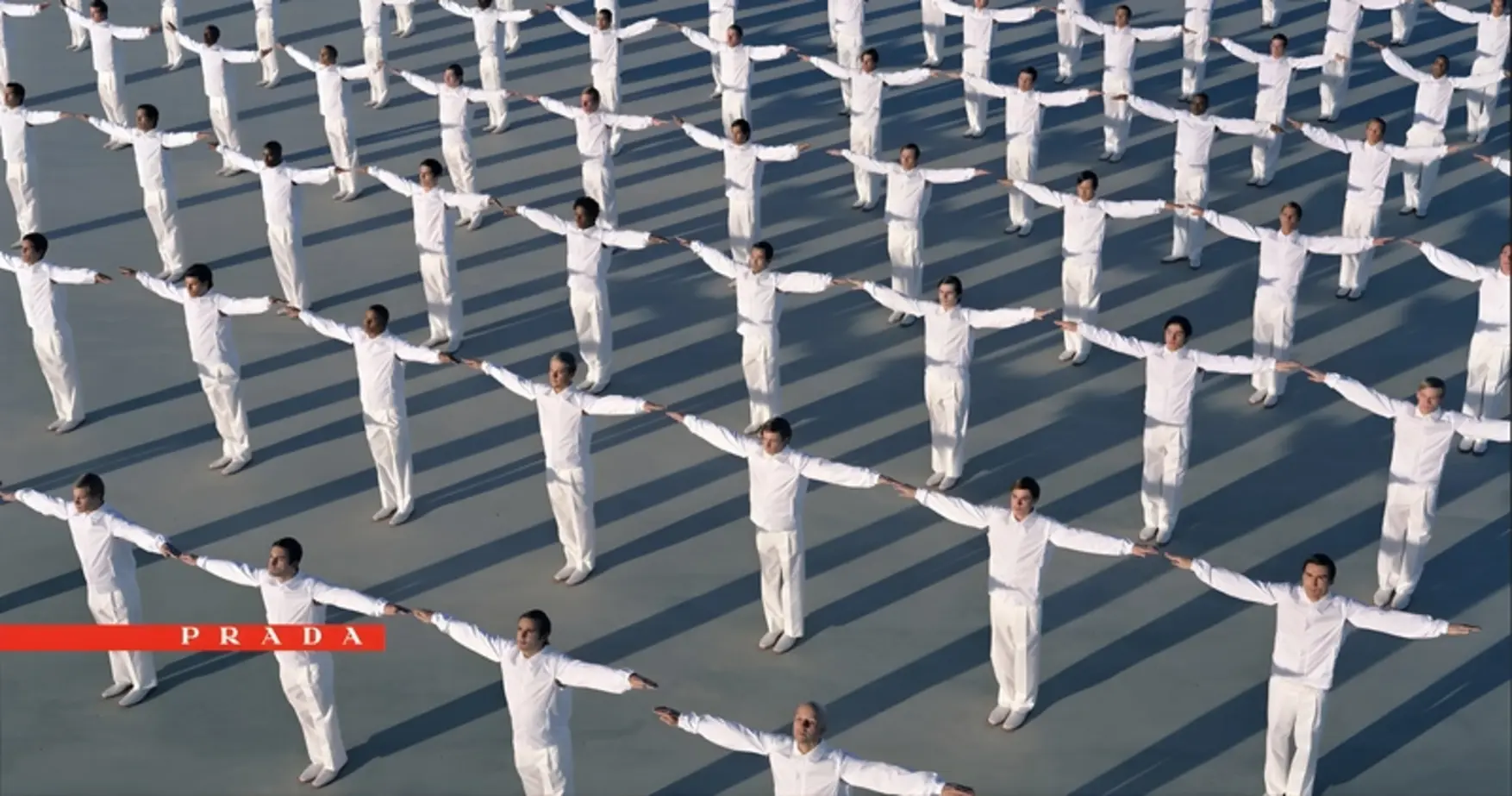
When the campaign appeared, it landed with force because early-2000s fashion was still saturated with personality, excess, chaos, and attitude. This, by contrast, was anonymity, repetition, discipline, and calm authority. It carried a slightly unsettling mood, which only sharpened its hold. The first time Phil Poynter saw it on a billboard, he felt how resistant it was to trend. That resistance is exactly why it still stuns. It has barely aged. It carries a very quiet confidence, the kind that comes from doing something almost ludicrously committed, something no one else would quite dare to do in the middle of a desert fifty miles from anywhere.
Asked how such a campaign would land now, Phil Poynter turned to the obvious contemporary complication: many people would assume it had been made with AI. He felt the initial impact would still register, though today the image would need a whole parallel life around it, a PR backstory, proof of labor, behind-the-scenes evidence that a group of analog obsessives had really gone out and done it for real. In that environment, the making of the image might become more important than the image itself, which is the complete opposite of how they approached it then. Back then the method was almost cinematic in reverse, film language applied to still imagery. They shot from high angles and looked down so that the whole scene tipped toward abstraction.
And maybe that is part of why the campaign still grips. It was technical sportswear, yes. It was a fashion campaign, yes. But it also became something eerier, sleeker, and much more hypnotic: a choreography of control, discipline, and distance rendered with insane analog rigor. It looked futuristic then. It still does now. That is the nasty little thrill of it. The Prada Linea Rossa campaign by Phil Poynter came out of the desert with its cool white uniforms, its long shadows, its silence, and its unnerving beauty, and it never really came back down to earth.
Advertisement