MENU
Close





Loewe Fall 2026 by Jack McCollough and Lazaro Hernandez turns luxury into a sly act of deception, where outrageous silhouettes hide immaculate technique beneath their mischief.
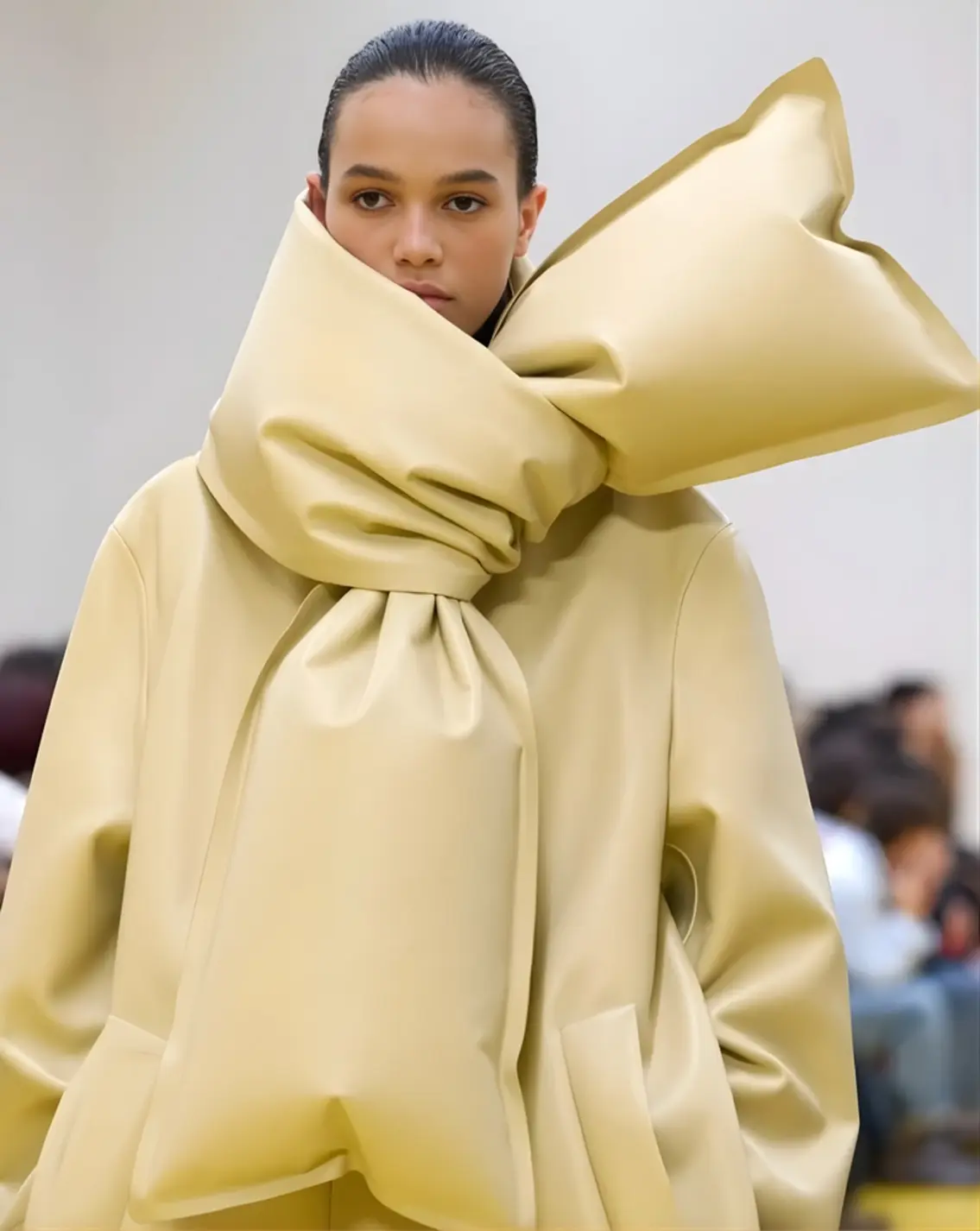
Loewe Fall 2026 by Jack McCollough and Lazaro Hernandez turns luxury into a sly act of deception, where outrageous silhouettes hide immaculate technique beneath their mischief.
March 17, 2026
Advertisement

Advertisement



Loewe Fall 2026 asks the eye to trust what it sees, then quietly humiliates that trust a few steps later. A slip dress looks knitted and delicate, then reveals itself as latex. A shaggy surface reads like fur, then turns out to be built from something stranger. A coat seems toy-like, buoyant, almost unserious, until its engineering becomes impossible to ignore. This was the real thrill of Jack McCollough and Lazaro Hernandez’s Loewe: luxury behaving badly on purpose, then proving it has the technique to get away with it.
That is why the collection landed so sharply. The official framing centered joy, process, and playfulness, while the runway itself translated those ideas into a wardrobe of material betrayal, inflated wit, and object-level precision. The result never felt like a random pile of clever tricks. It felt like a full argument: that craft becomes more alive when it is mischievous, and that luxury grows more seductive when it stops taking itself so solemnly.
Jack McCollough and Lazaro Hernandez were unusually clear about the spirit behind this collection. For them, making is both joyful and intellectual, a process-driven pursuit charged with playfulness and surprise. That matters because it explains why Loewe Fall 2026 never treats technique as a museum piece or a house code to be preserved under glass. They chose this direction because they wanted craft to move, joke, distort, pretend, and keep inventing itself in public.
There is also a deeper confidence in that choice. Several critics read this show as a stronger, freer second act, one less concerned with proving arrival and more willing to explore. That difference is visible everywhere. The silhouettes are bolder. The surfaces are more deceptive. The humor is less cautious. Jack McCollough and Lazaro Hernandez are not simply offering beautiful clothes here. They are testing how much wit a luxury house can absorb before it loses dignity, and the thrilling answer is: much more than most brands dare.
The show space made the argument before the clothes fully arrived. Cosima von Bonin’s plush creatures, the lacquered yellow runway, and the exaggerated seating all built a world that felt toy-box surreal, a little perverse, and perfectly knowing. Sea creatures, dogs, shells, and stuffed animal scale games gave the room a childlike charge, but never an innocent one. This was play with adult intelligence inside it, the kind that understands scale, absurdity, and softness as tools of disruption.
That atmosphere matters because it kept the collection from being read as mere technical exhibitionism. The world of Loewe Fall 2026 was bratty in the best sense: spoiled, inventive, over-resourced, and utterly unwilling to behave. The clothes inherited that mood. They looked as if an elite atelier had been handed over to the smartest child in the room, one who wanted the toys bigger, the colors stranger, the surfaces more deceptive, and the silhouettes just a little more impossible.
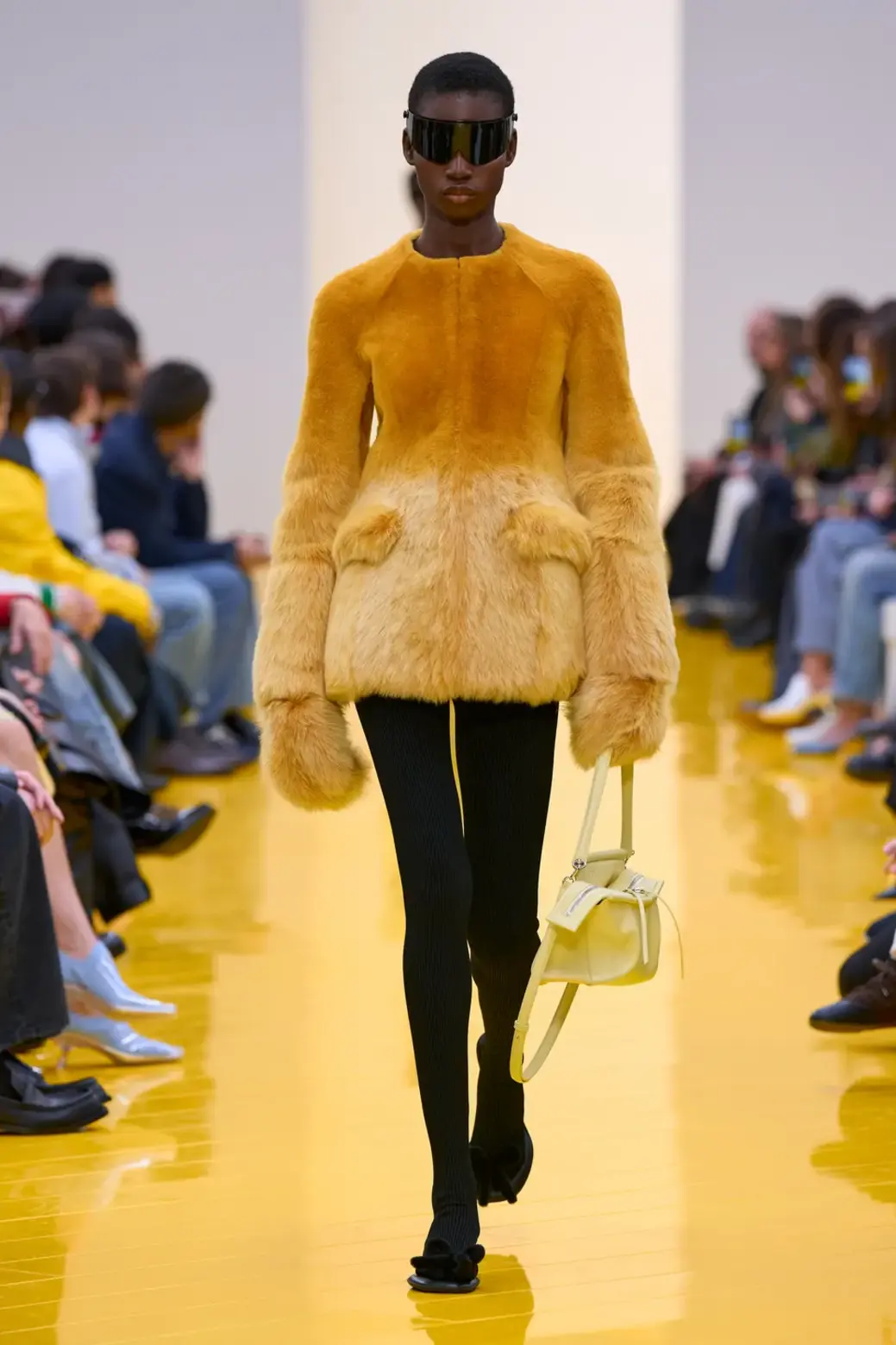
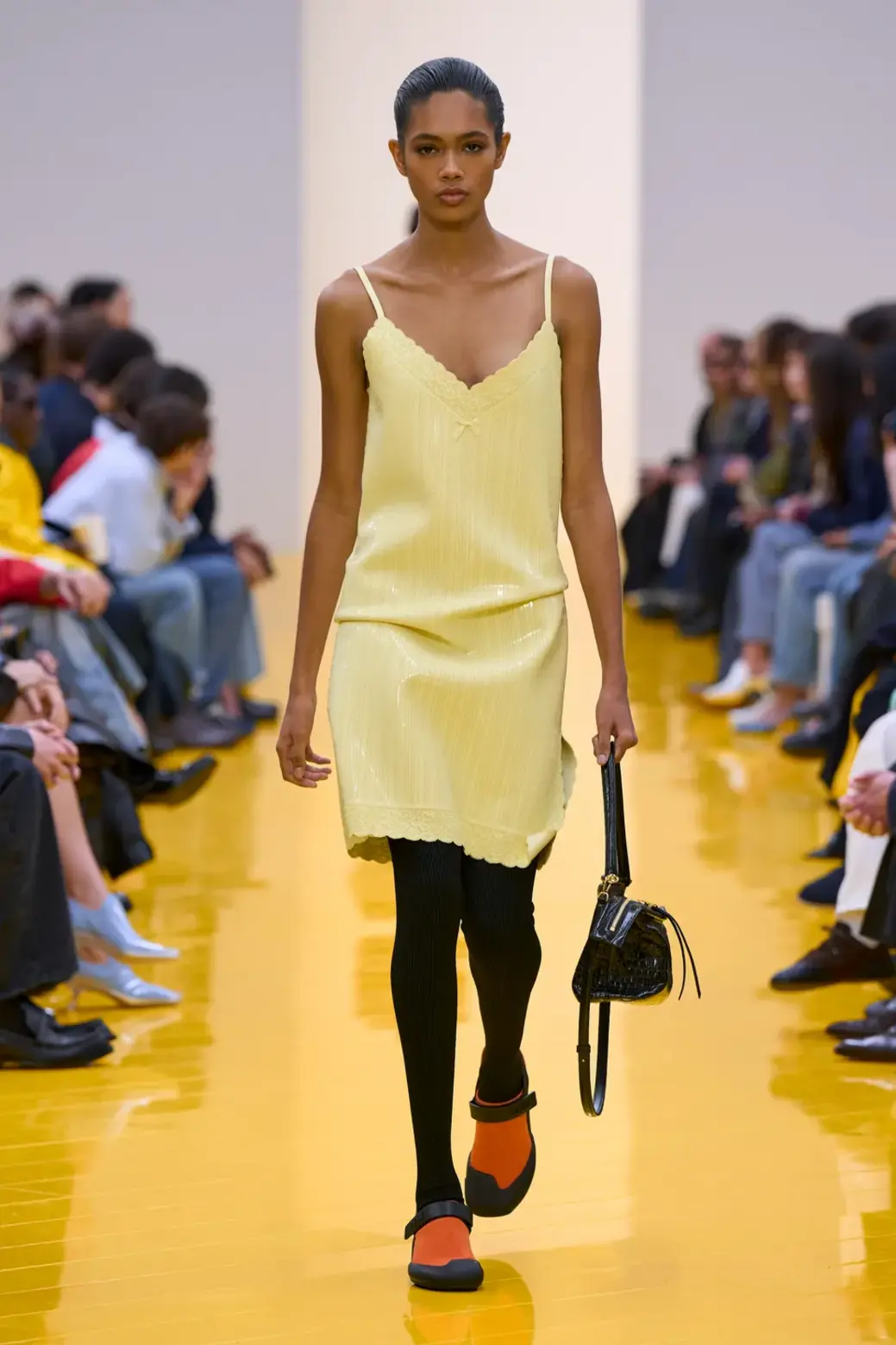
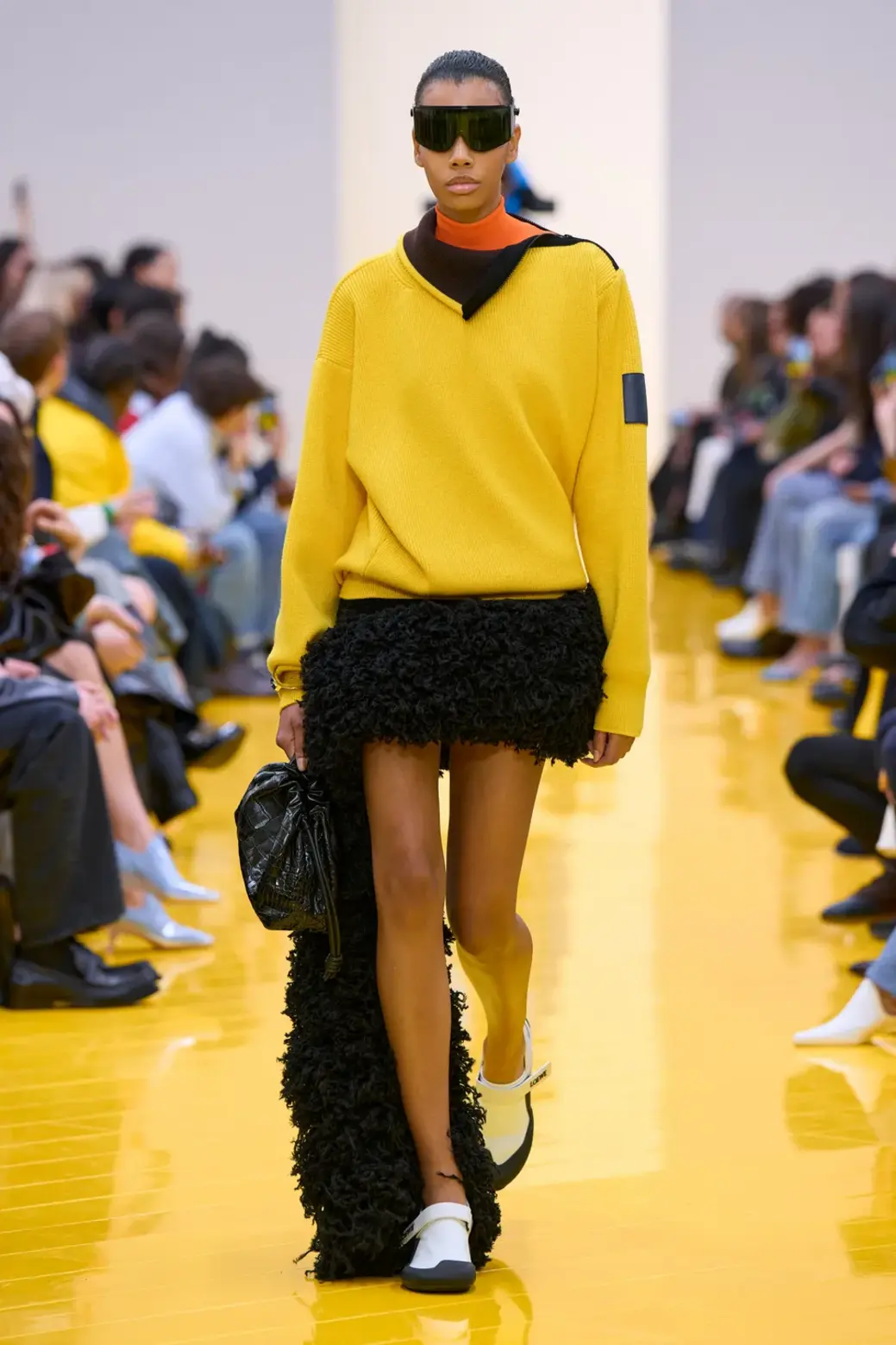
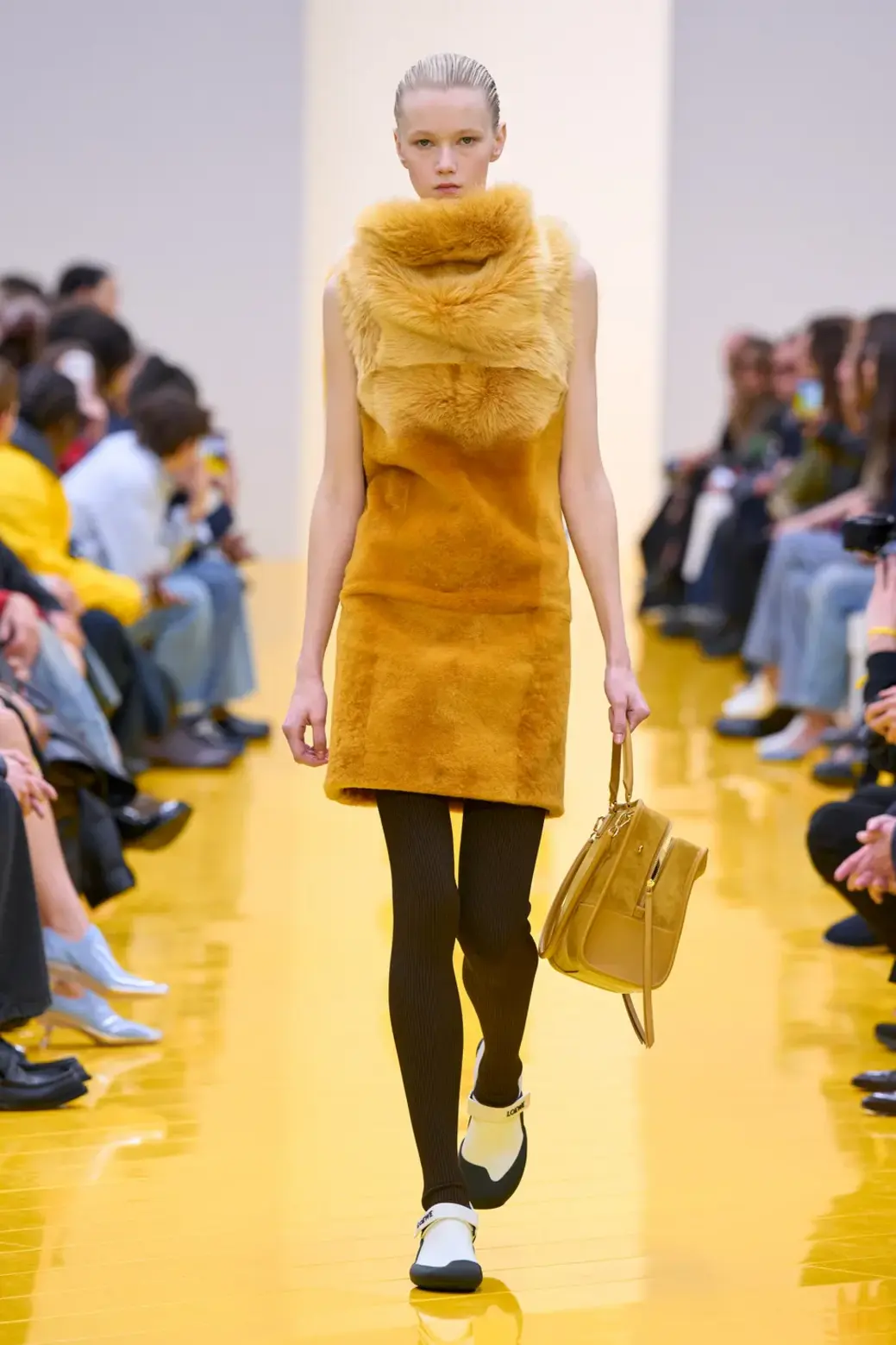
The silhouette story is where the collection’s wit becomes physical. Jack McCollough and Lazaro Hernandez build forms that flirt with toy logic without surrendering to formlessness. Parkas swell like inflatables. Coats zip up with the bounce of water balloons. Skirts widen into shapes that feel half couture, half pool float. Then, against those exaggerated volumes, come pieces that cling with unnerving smoothness: second-skin latex slips, body-following dresses, and sharply controlled silhouettes whose restraint makes the surrounding puff and bob feel even more unruly.
What keeps these shapes from collapsing into novelty is discipline. A silhouette may look like a prank, but it is cut with total seriousness. A parka may suggest an inflatable raft, but its proportion is calibrated. A swollen skirt may read as childish exaggeration, yet the balance of body to hem is exact. This is the collection’s secret: Jack McCollough and Lazaro Hernandez understand that distortion is most effective when it behaves impeccably. The joke lands because the line is so controlled.
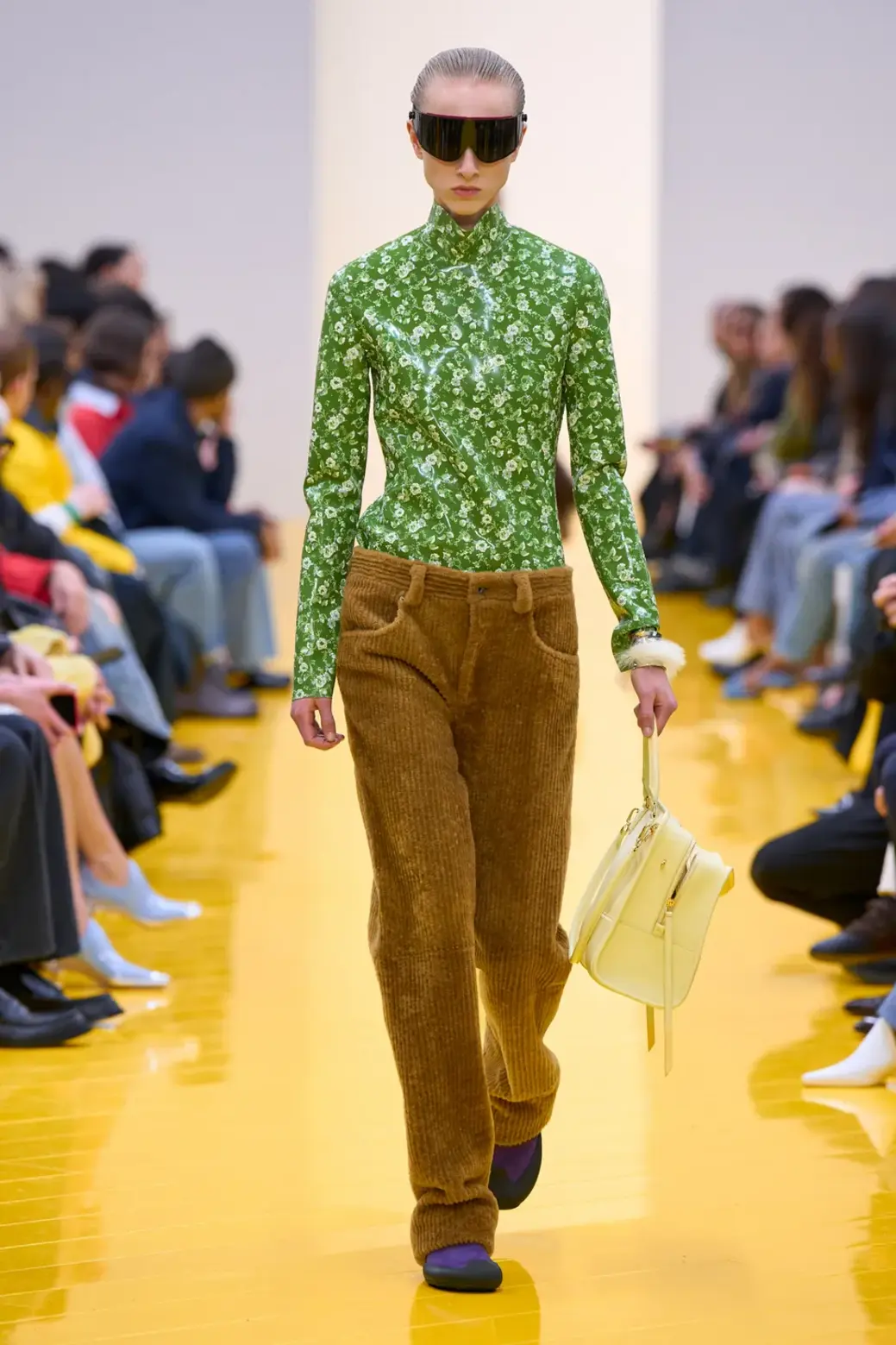
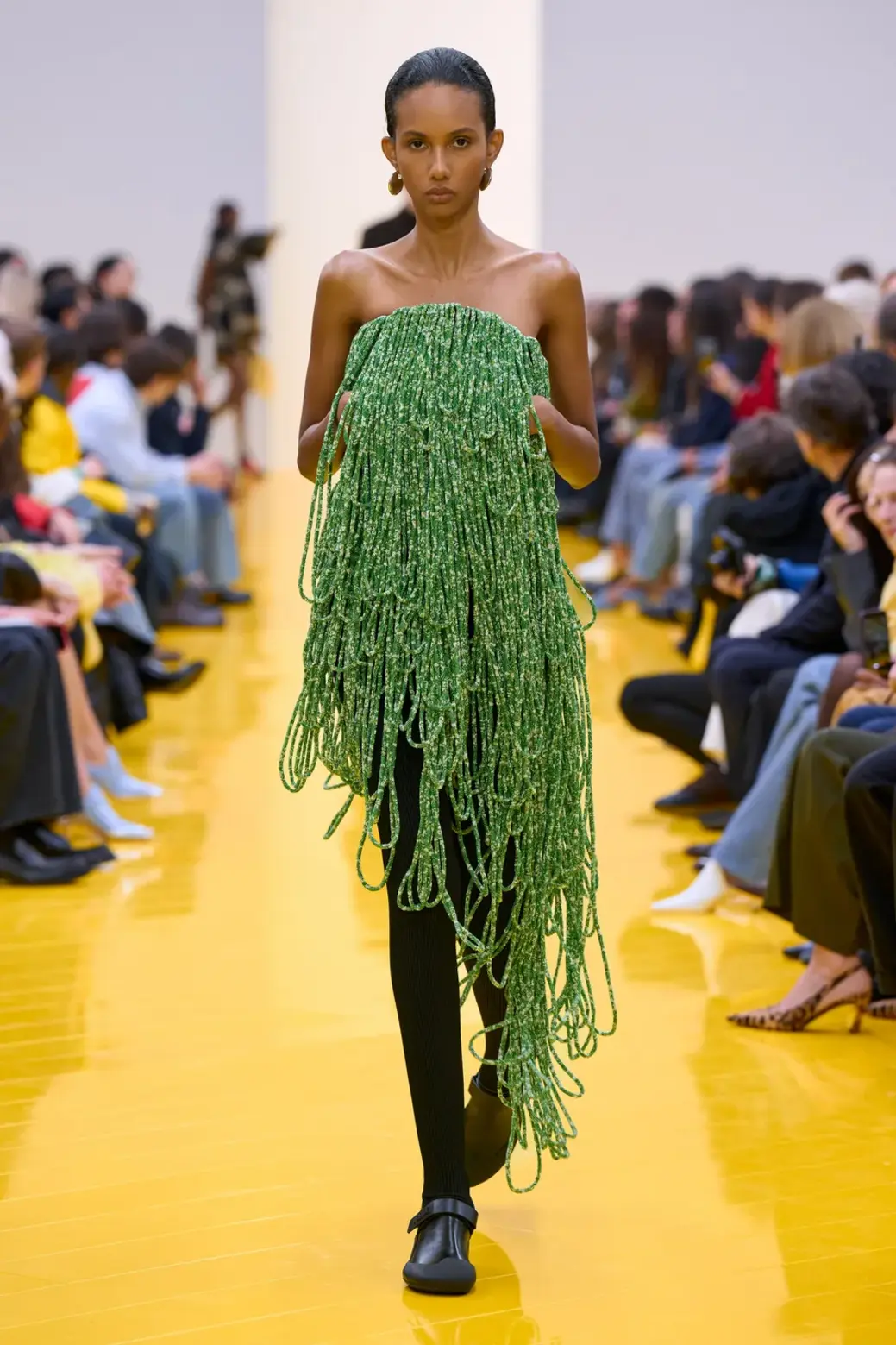
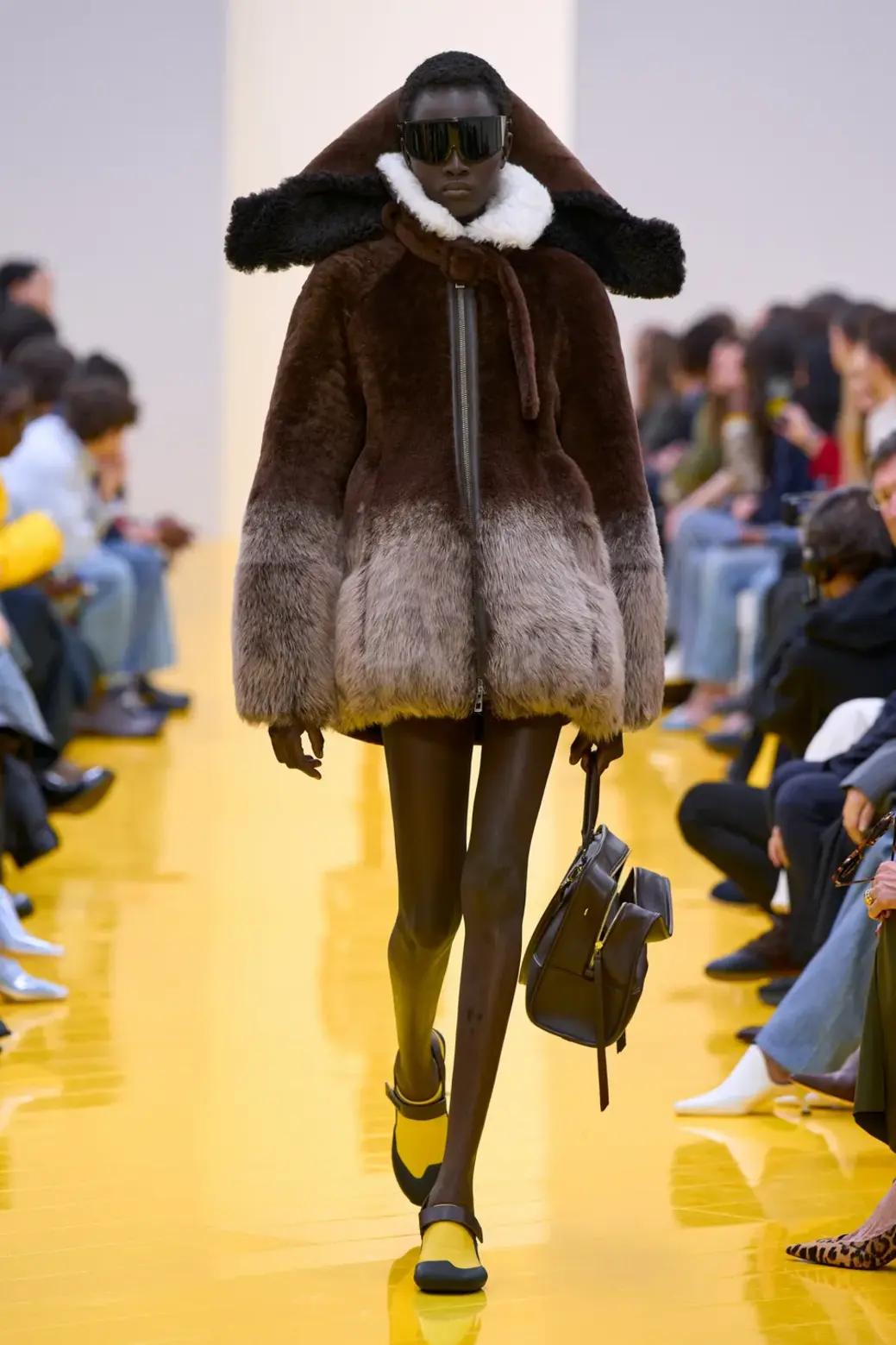
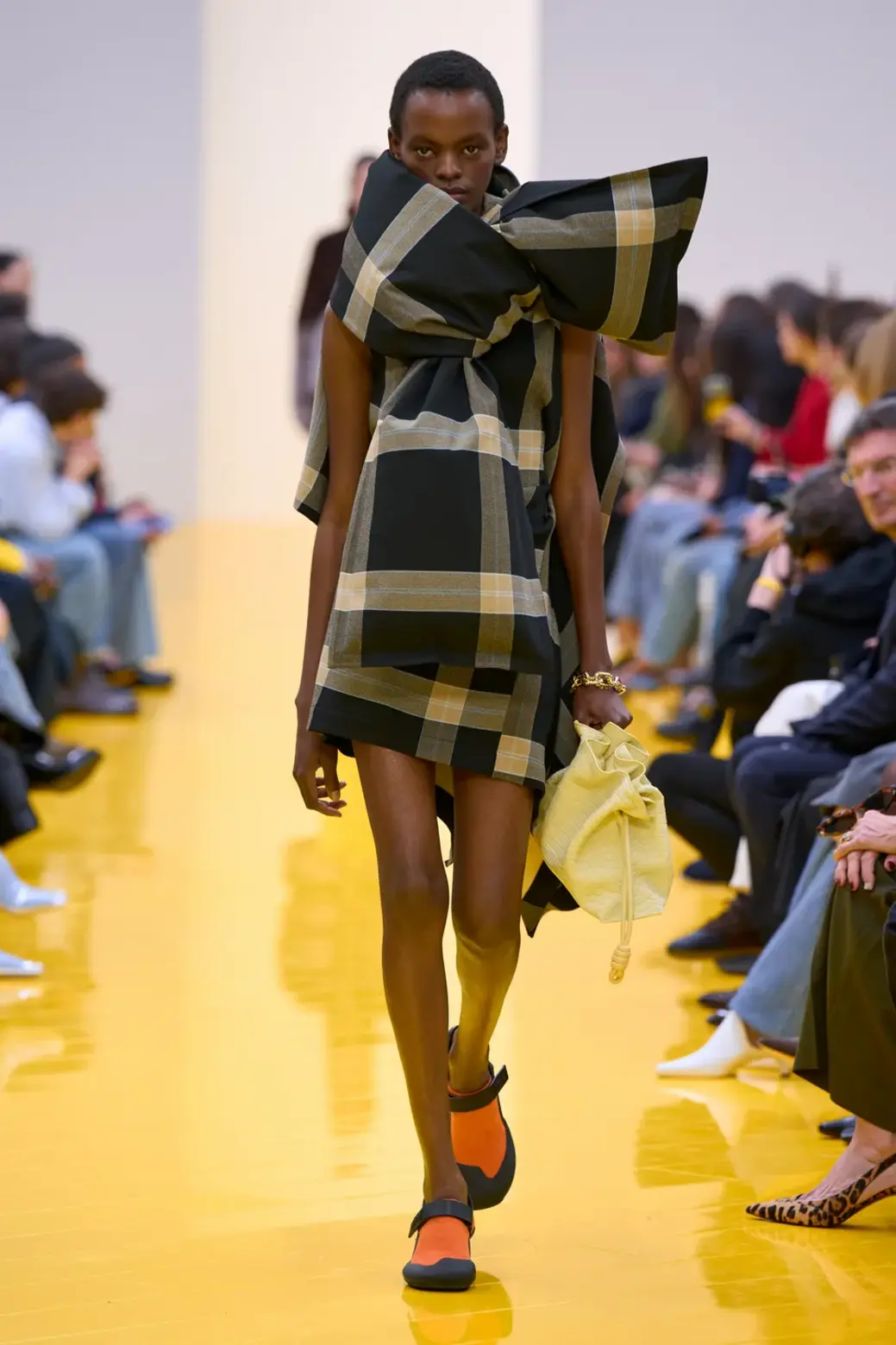
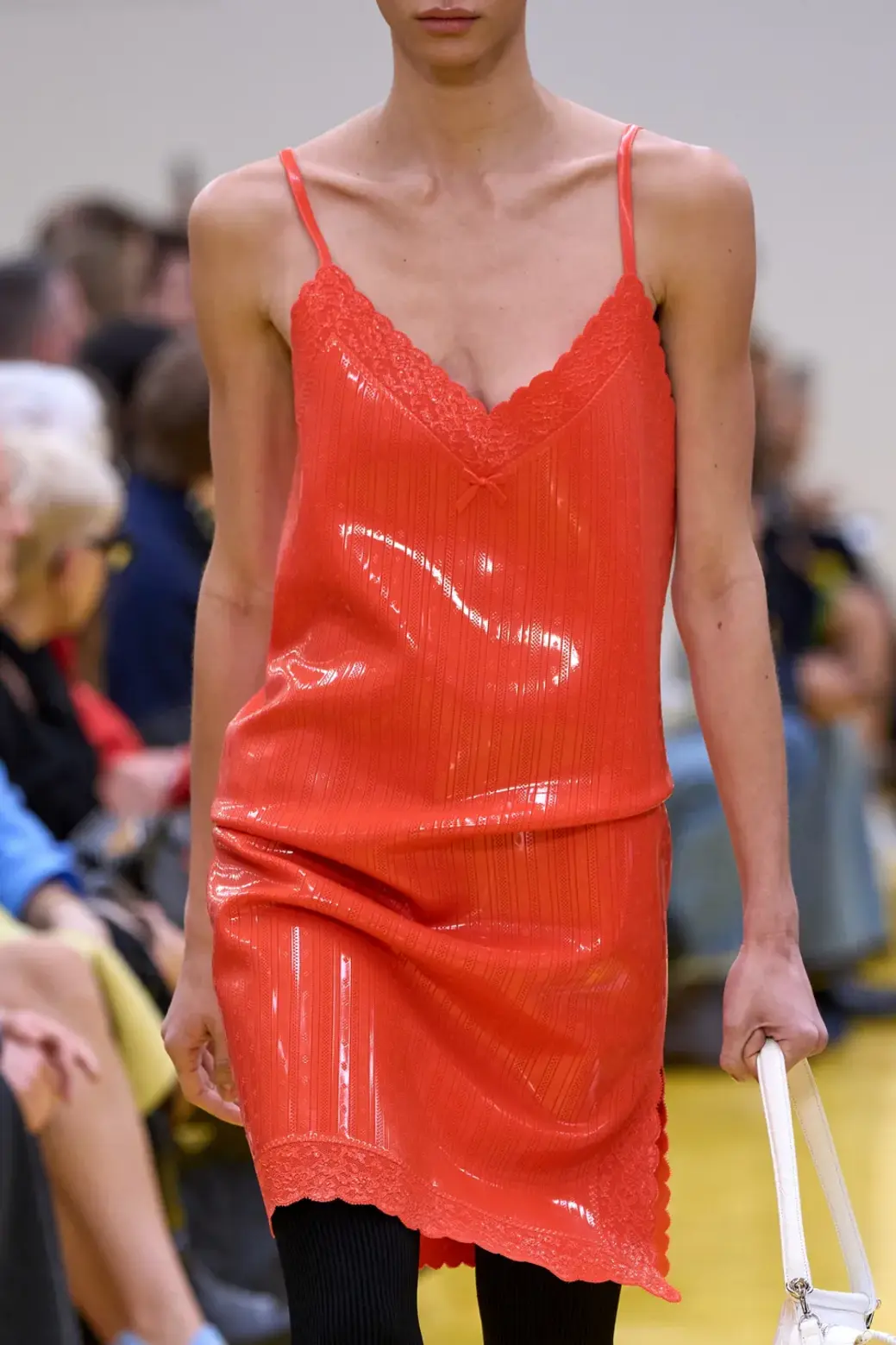
The deepest seduction of Loewe Fall 2026 lies in material fraud. Again and again, the collection makes one thing look like another, then dares you to look closer. The clearest example is the slip dresses, which appear pointelle-knit, lace-trimmed, and ribboned, but were actually 3-D printed and cast in latex, with the bow details, lace edges, and tiny textile-like surface effects stamped into bas relief. It is a beautiful lie, and an intellectually delicious one, because it turns intimacy into simulation and softness into slick sculpture.
That logic spreads across the whole collection. Knitted tartans and dresses were made from ultra-thin leather yarn. Bouclé-like surfaces were built from looped, lacquered leather. Wide-wale corduroy was in fact shearling. Bell-shaped jackets were cut from shaved and dyed brushed shearling so that the body looked both padded and sculpted, familiar and bizarre. This is where the collection becomes truly exotic, because it turns the familiar into something alien through technique. It keeps manufacturing visual misrecognition, and that misrecognition becomes its luxury.
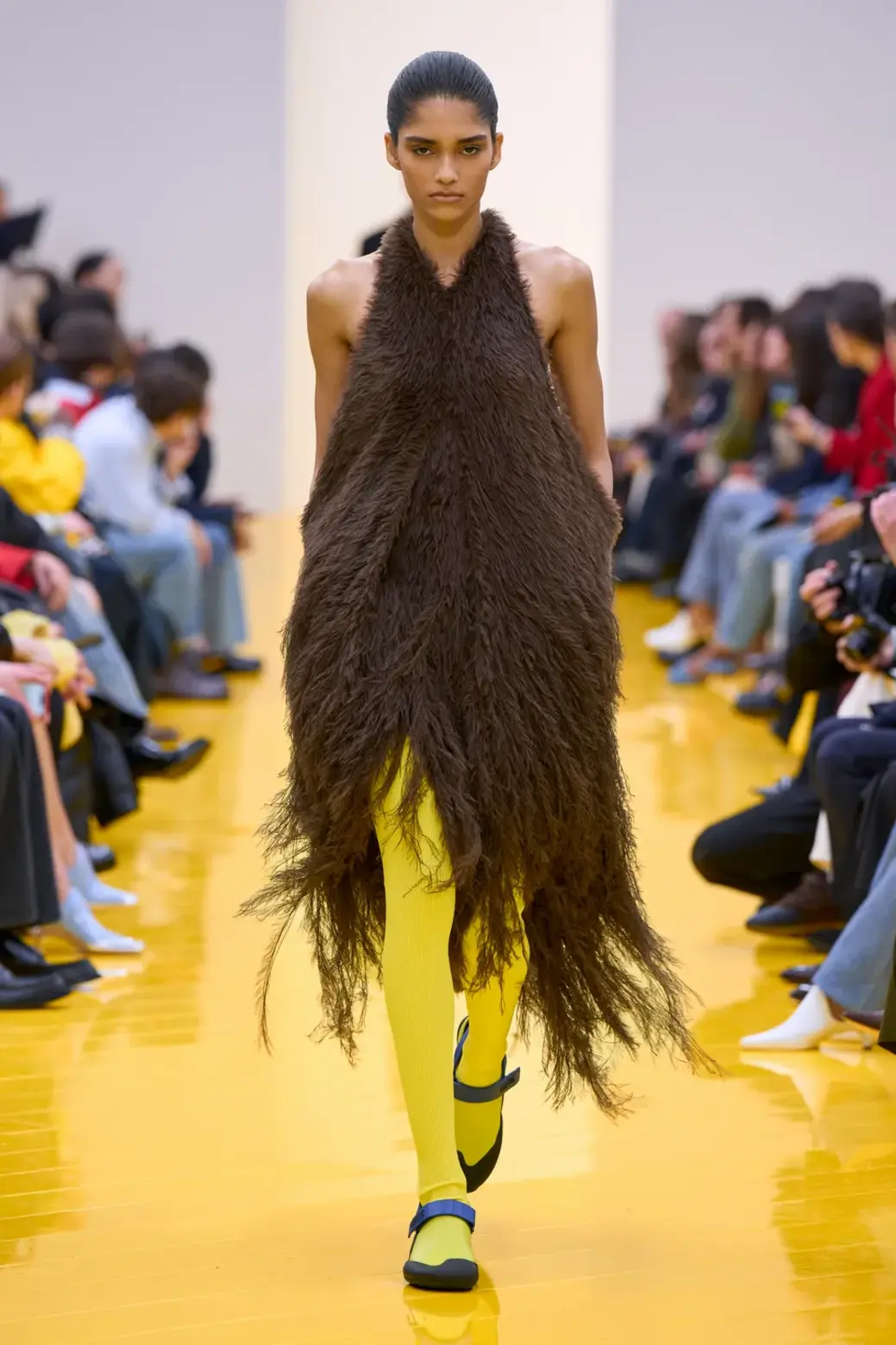
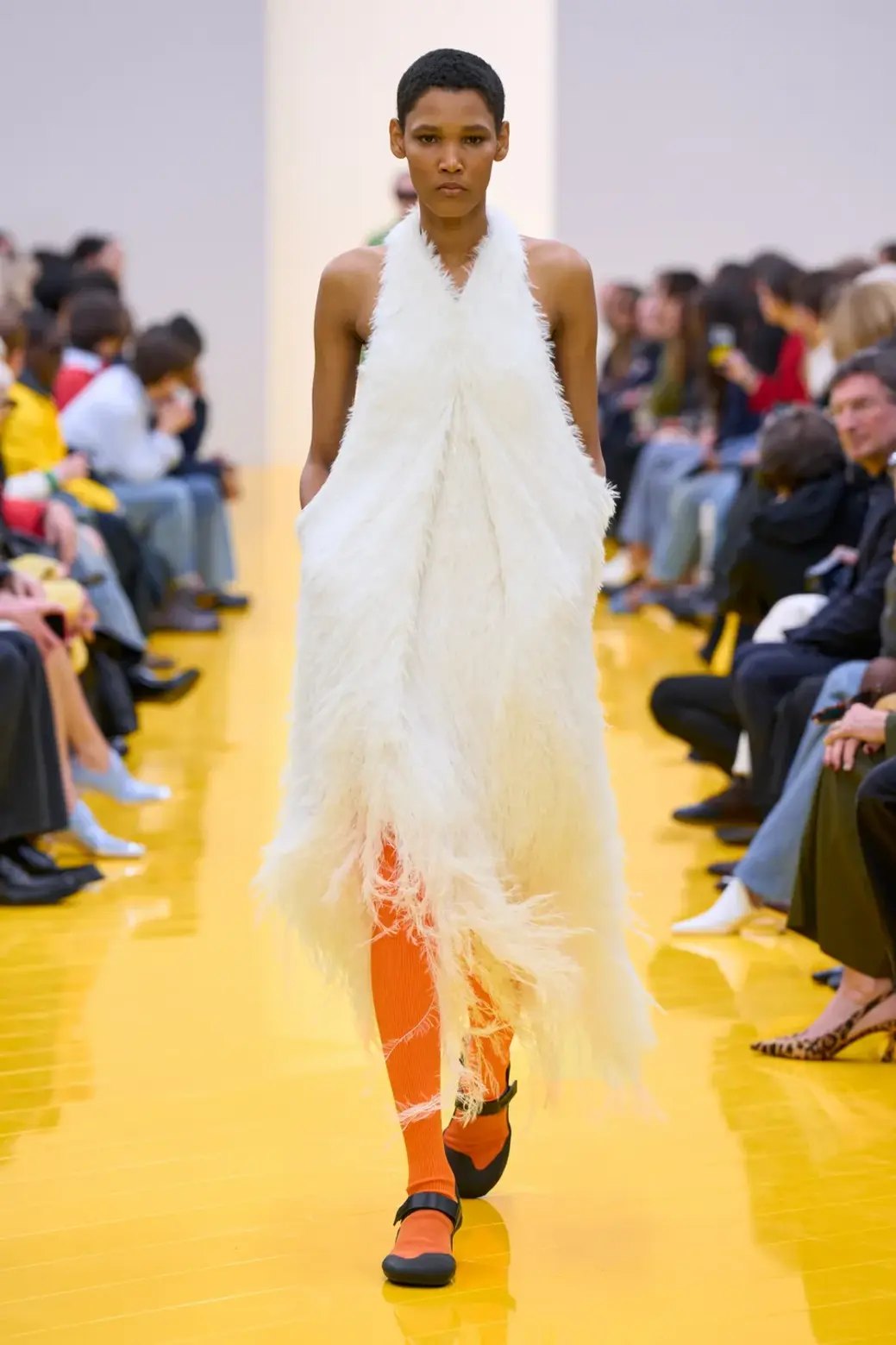
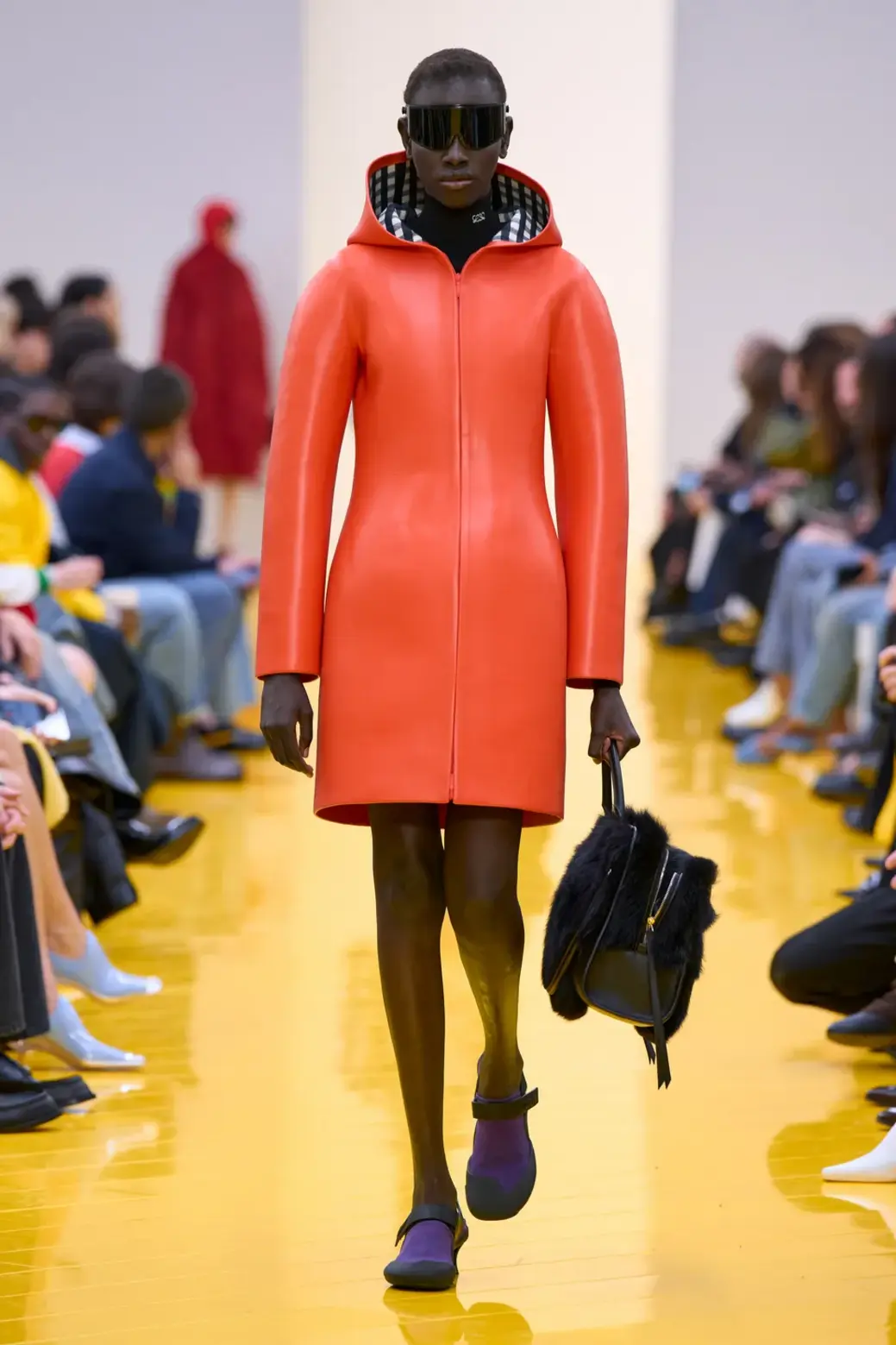
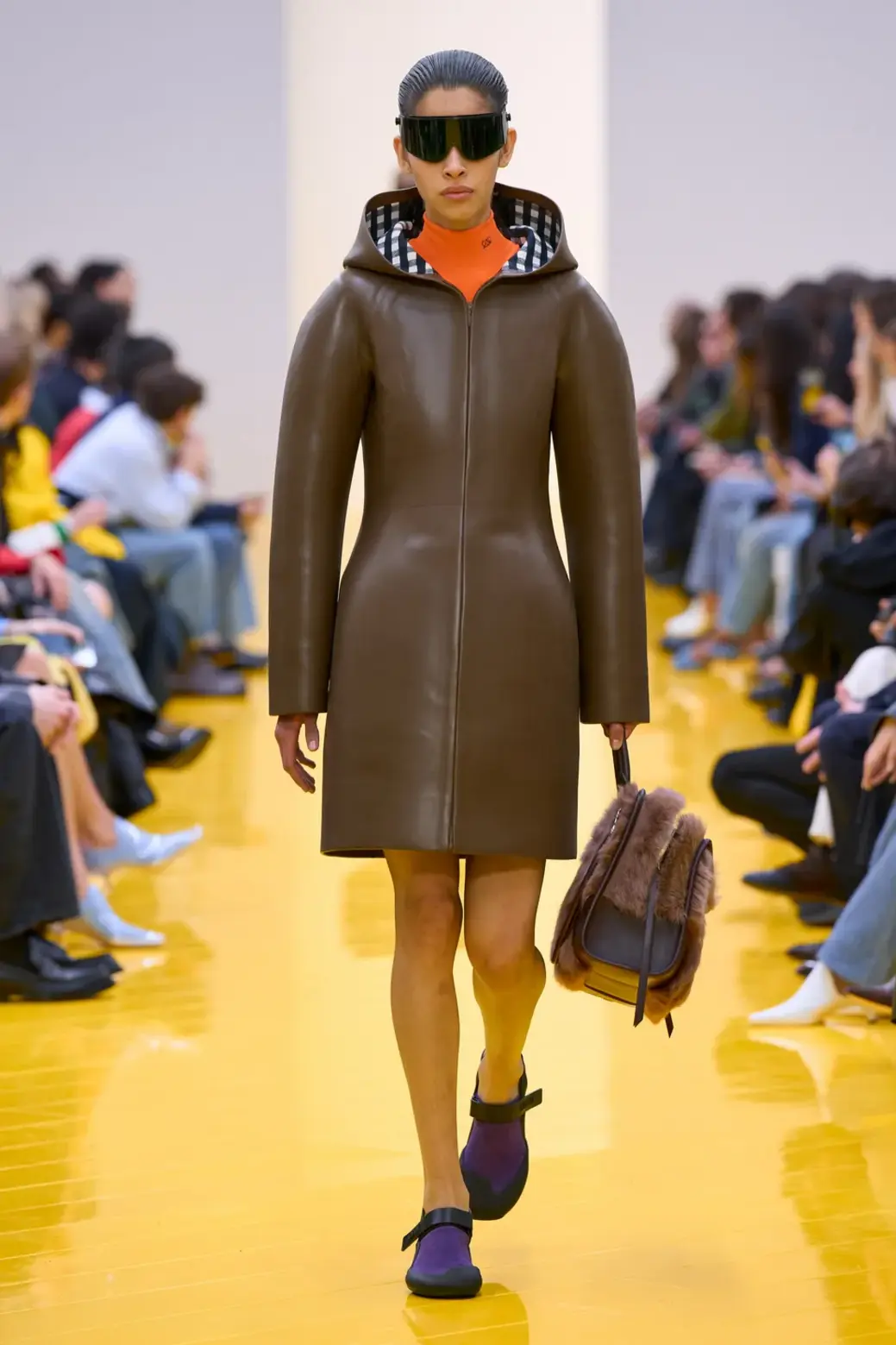
Some garments carry the whole thesis with ruthless clarity. The latex slip dresses do, of course, because they compress innocence, kink, humor, and technical audacity into one object. So do the latex hooded coats, which turn outerwear into something glossy, inflated, and faintly absurd without losing elegance. Then there are the parkas that appear buoyant enough to float away, and the wool coats paired with inflatable scarves, which take the language of cold-weather practicality and push it through cartoon logic. These pieces prove that Loewe Fall 2026 is not merely playful in tone. It literalizes play in construction.
Just as important are the pieces that reintroduce warmth and tactile seduction into all that visual trickery. Fringed halter dresses, evening looks made from long loops of beads, the brushed-shearling bells, and the leather-knit sweaters keep the collection from becoming all punchline and no pulse. Jack McCollough and Lazaro Hernandez are careful about this. Every outrageous proposition is answered by something beautiful to the hand, something rich in labor, something that reminds you this is still a luxury wardrobe and not simply a concept show with expensive lighting.
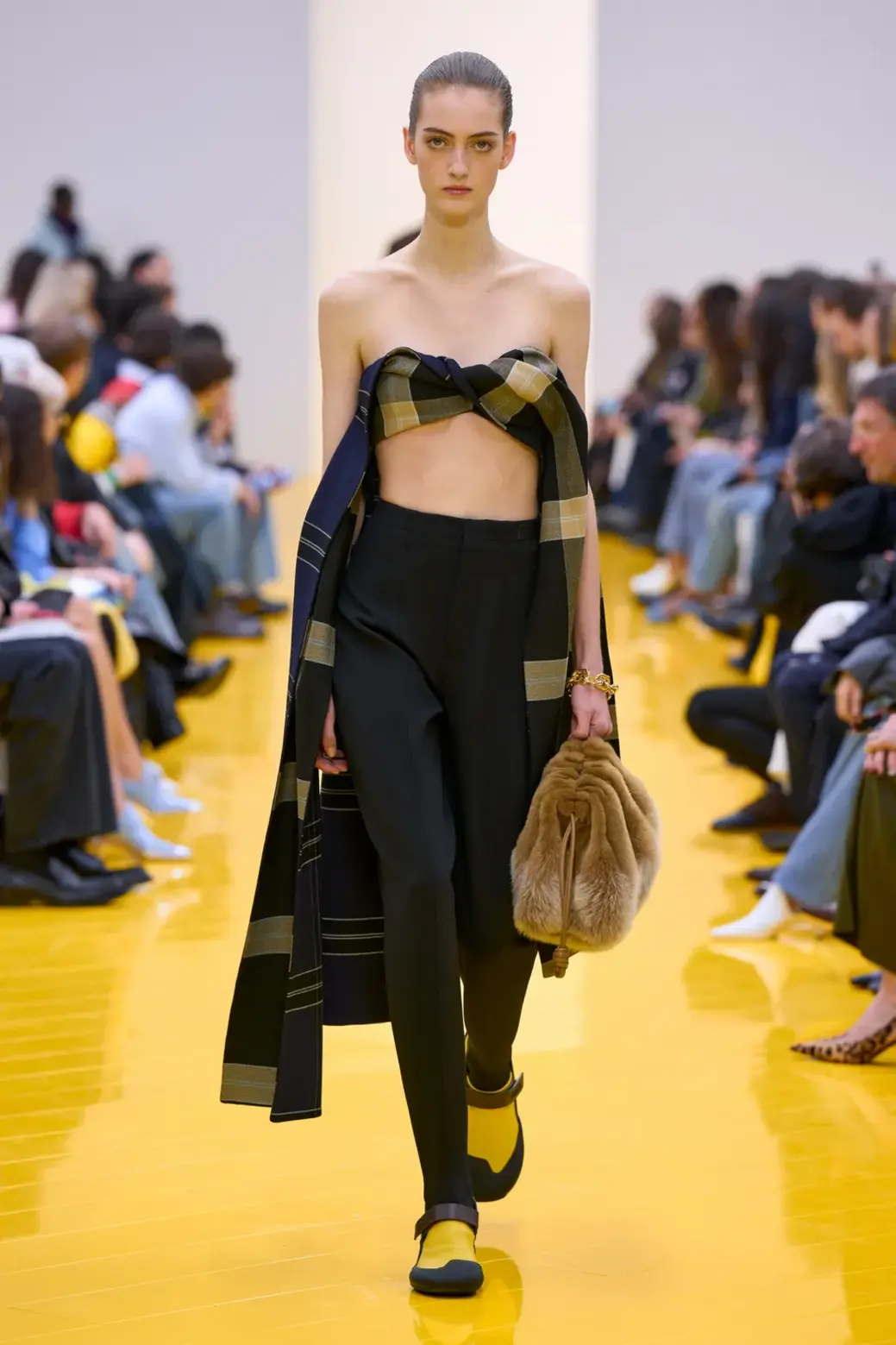
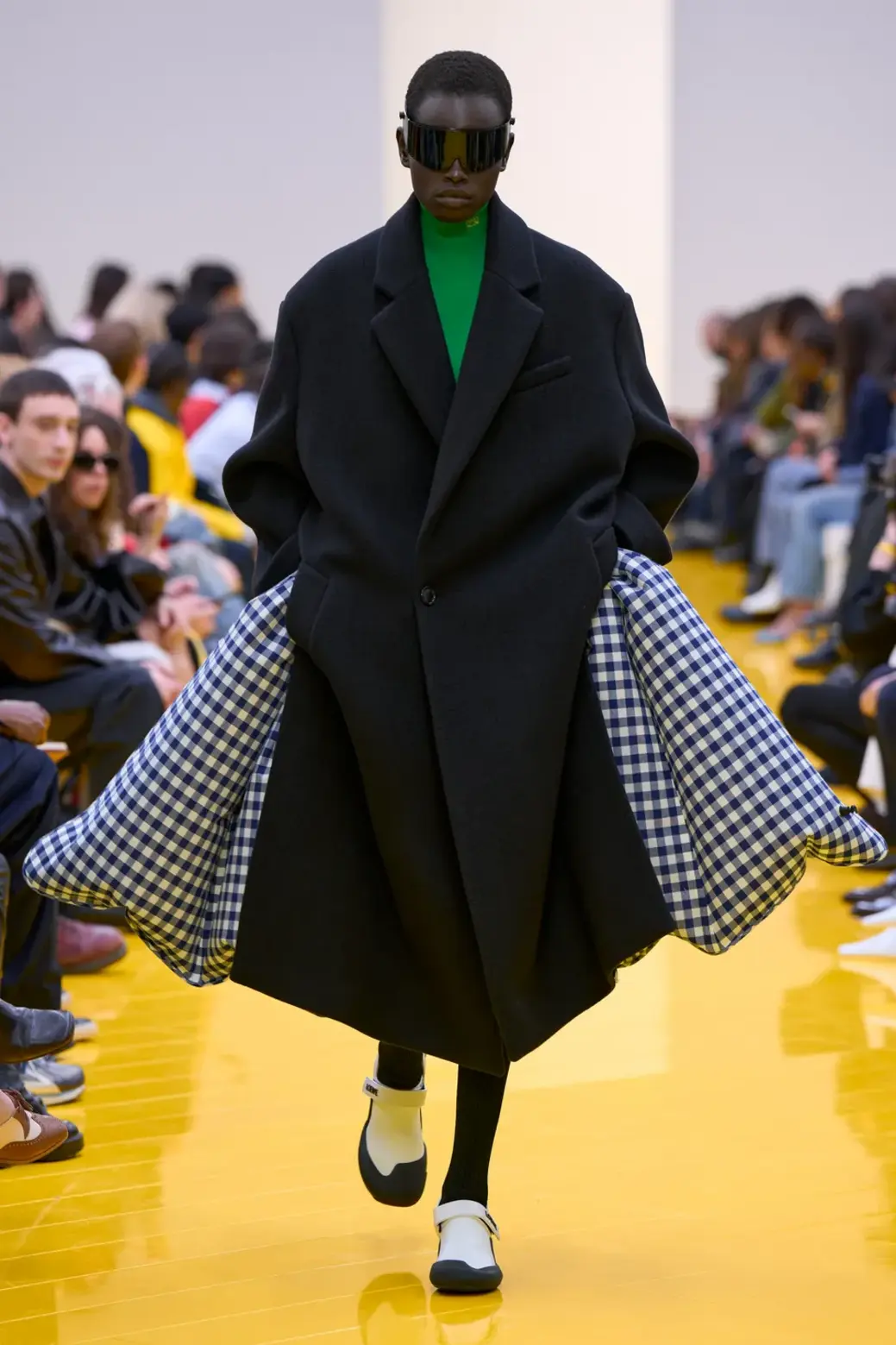
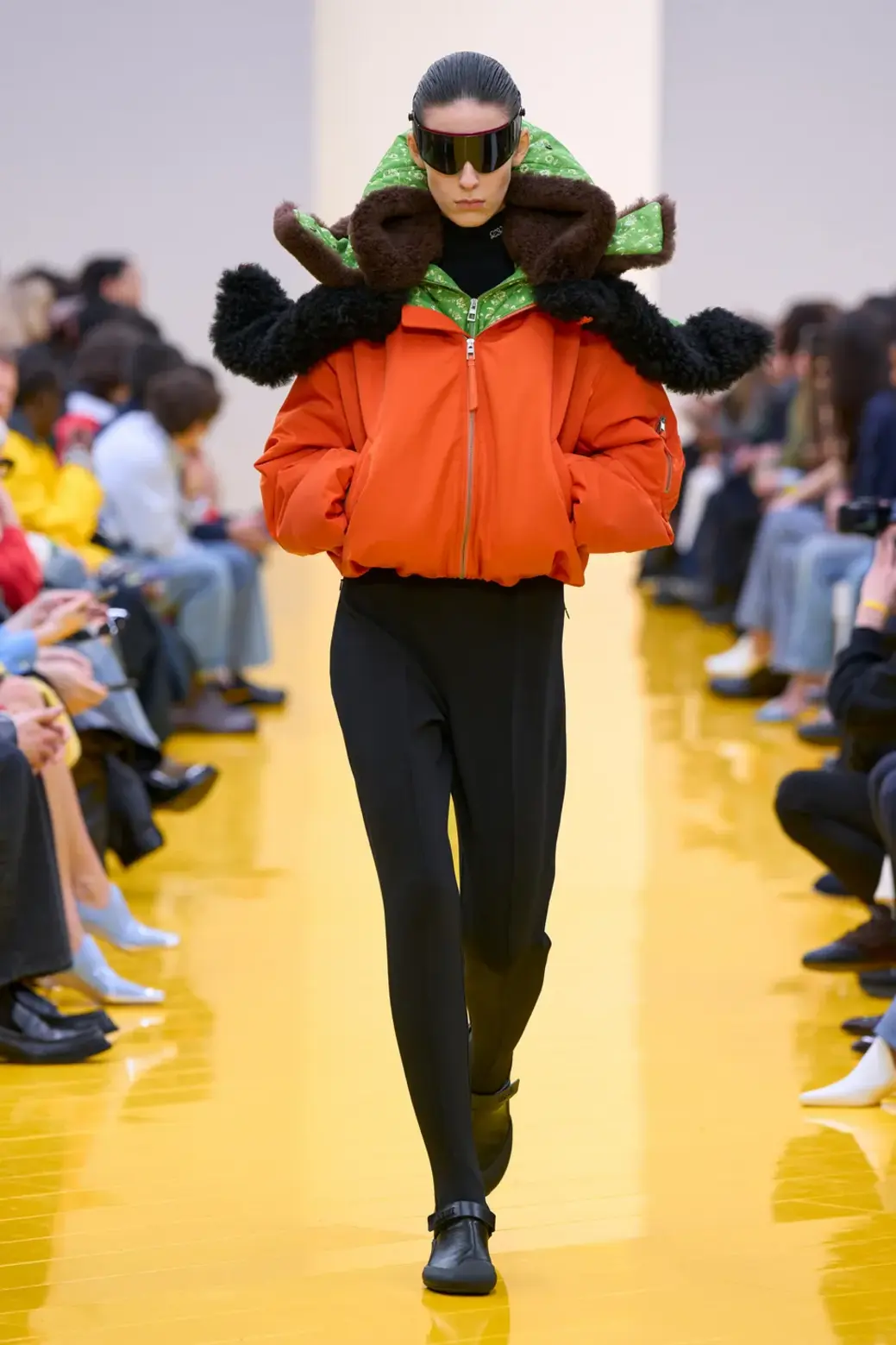
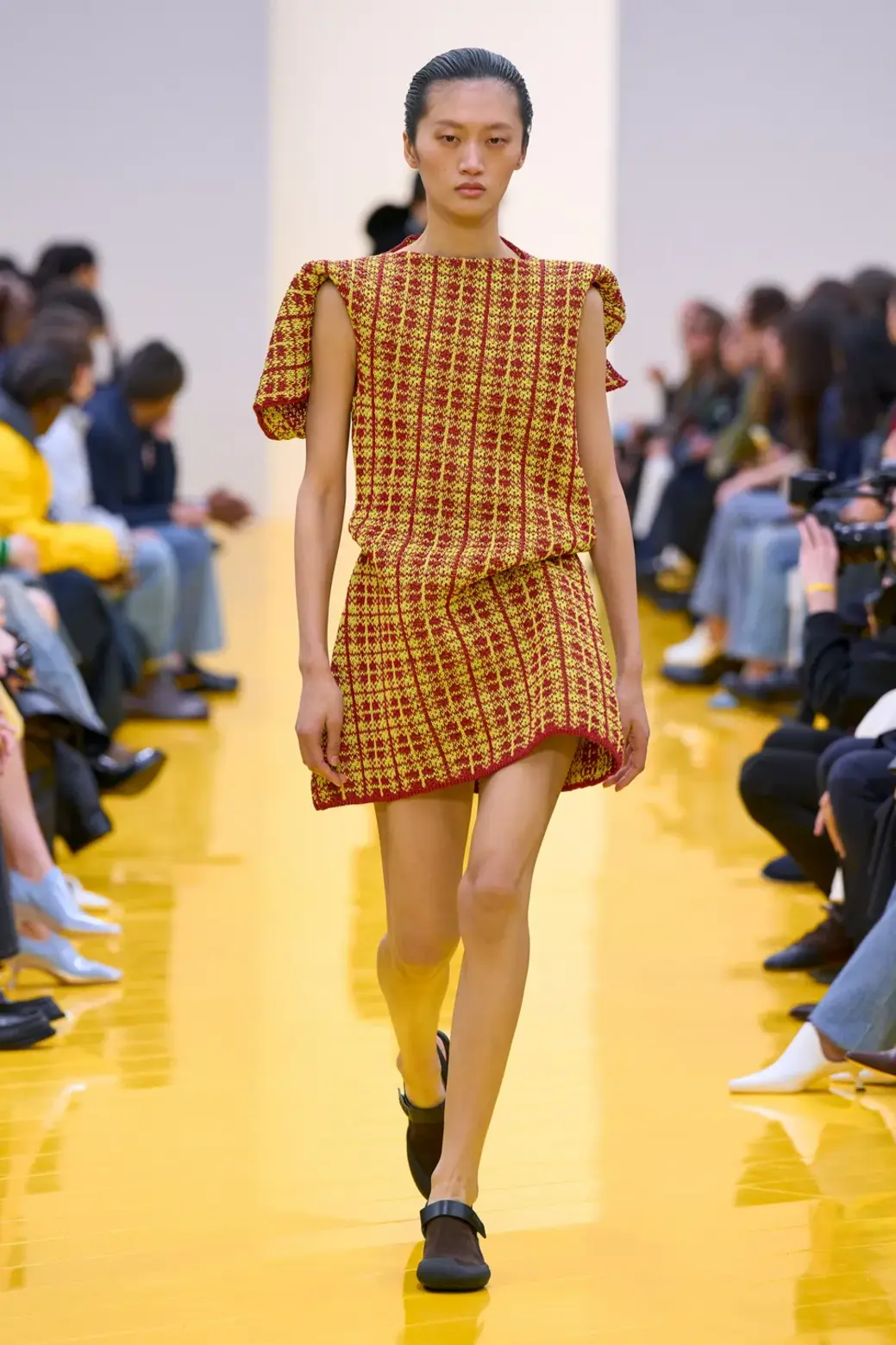
The reason the collection works is that the atelier hides the joke inside the making. Fringed and embroidered leather, shaved and sculpted shearling, injection-moulded Storm boots, latex stamping techniques that produce ripples and floral effects, hand-painted motifs, and surface manipulations that mimic pointelle, bouclé, corduroy, or inflated plastic all demand real process.
That is the truly smart thing about Loewe Fall 2026. The punchline always arrives after the craft. First you register the object’s beauty, or at least its authority. Then you begin to suspect something off. Then you realize the surface is lying. That order matters. It means Jack McCollough and Lazaro Hernandez understand that wit in fashion has to be supported by execution severe enough to hold it. Without that, a joke is only a gimmick. Here, the joke becomes a demonstration of mastery.
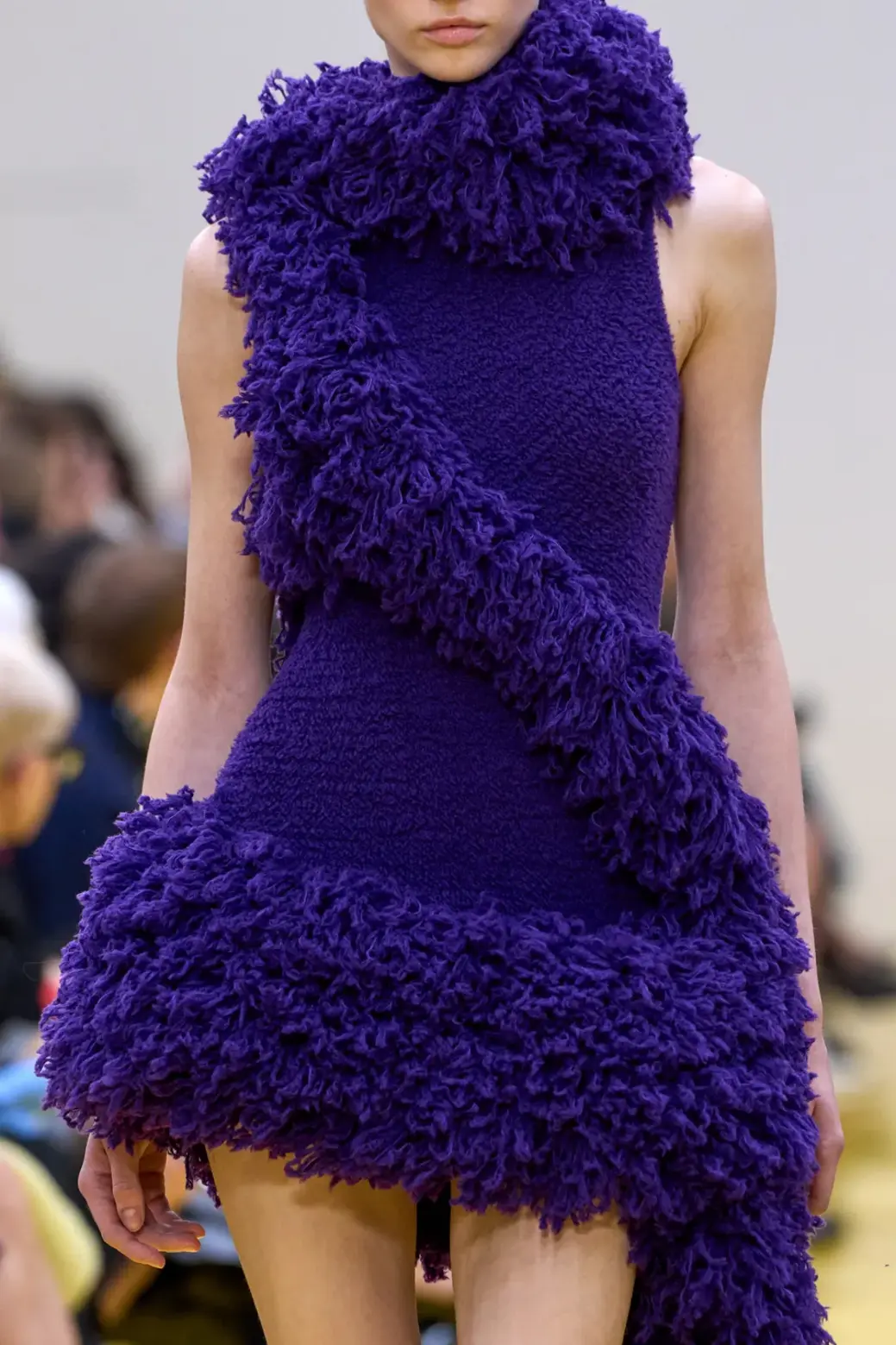
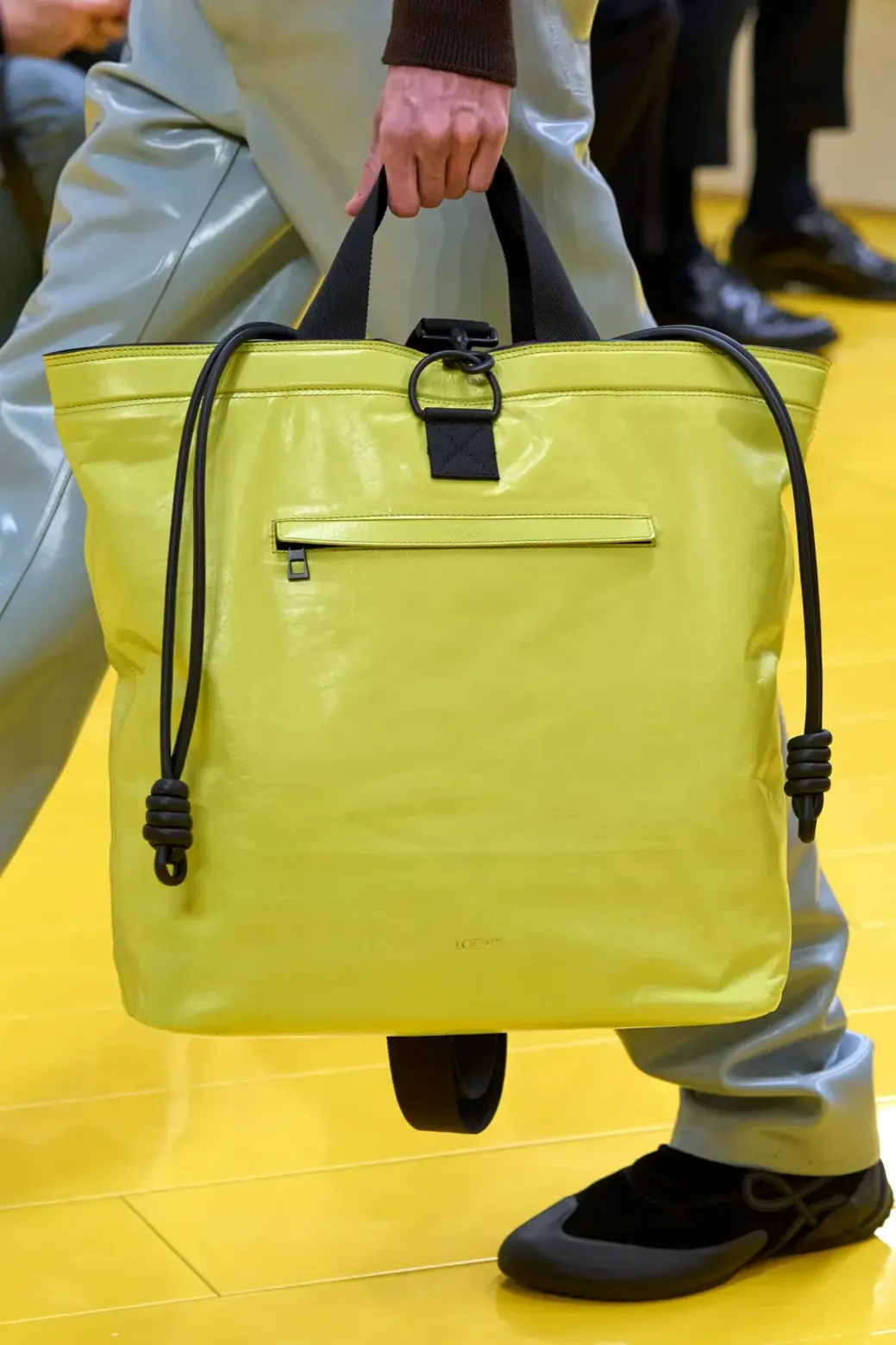
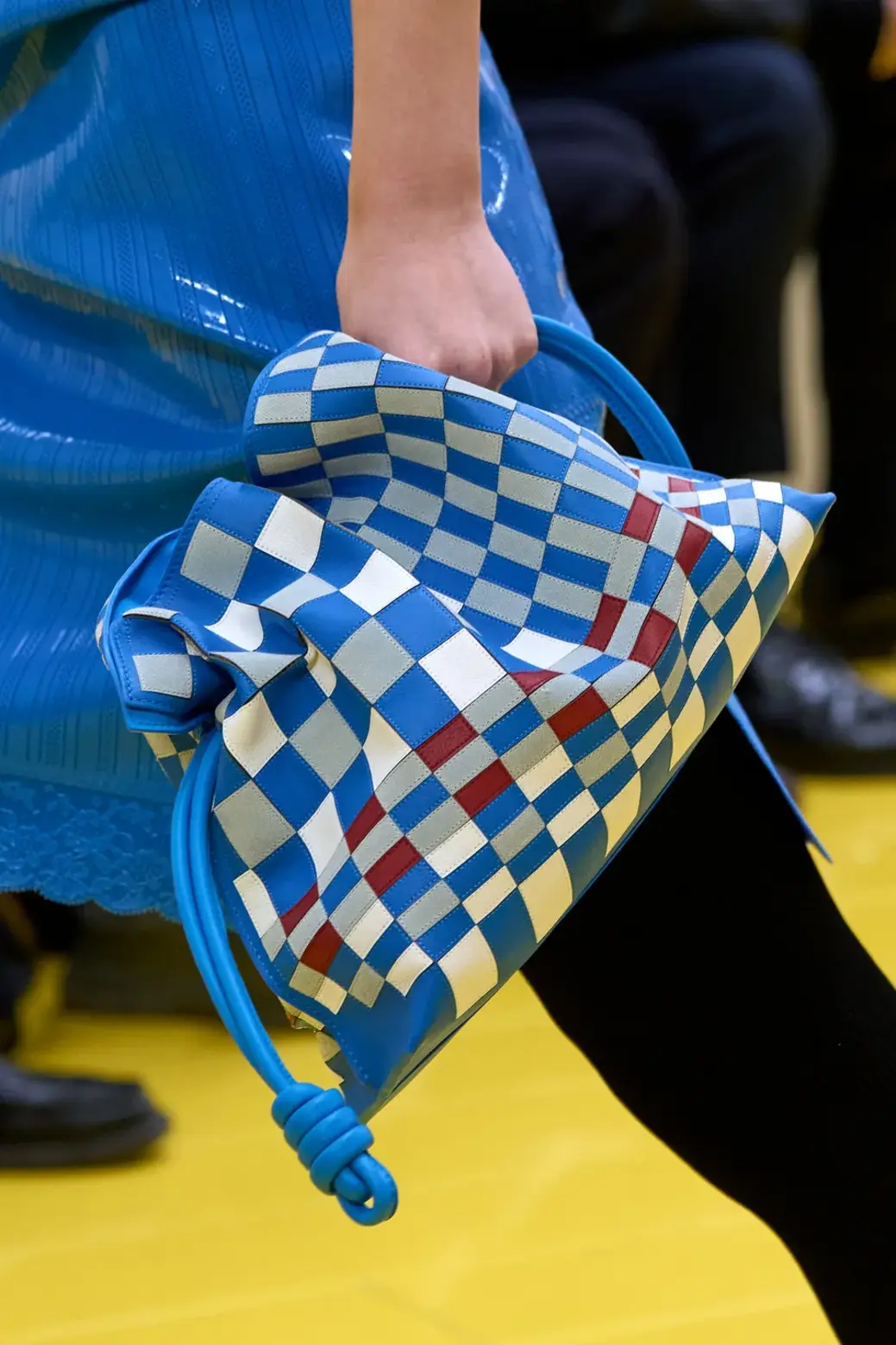
Color gives the collection its mischievous bloodstream. Against the yellow runway and Cosima von Bonin’s visual world, the clothes moved through florals, ginghams, marigolds, ultramarines, and those delicious toy-coded notes that make the collection feel as though someone has kicked open the lid on a luxury play chest. Yet the color never cheapens the work. It keeps the show from disappearing into monochrome intellectualism and reminds you that pleasure is one of the house’s materials too.
What makes this color story so successful is that it behaves like insolence with excellent breeding. The bright moments appear like interruptions in a room full of connoisseurs, and because the execution is so refined, the interruption only increases the sense of taste rather than undermining it. This is spoiled-child energy at its finest: excessive, amused, and somehow still impeccably raised.
The accessories complete the collection’s worldview. Swim shoes become kitten heels. Sea creatures and dogs mutate into charms and minaudières. The Amazona is remade in porcelain. Studio details included lobster-claw air pumps and other object-level interventions that keep the collection in a state of low, delicious absurdity. These are not stray jokes hanging off serious clothes. They are part of the same thesis: that an object can be both exquisitely made and slightly naughty, both collectible and unserious.
This is where Loewe’s humor proves its discipline. The collection’s sense of humor has bite because it remains inseparable from material intelligence. It knows exactly how far to push before chicness gives way, and it stops one inch before that line.
The real achievement of Loewe Fall 2026 is that Jack McCollough and Lazaro Hernandez make experimental craft feel joyous again. They are not parading technique to earn reverence. They are using technique to produce delight, deceit, surprise, and a distinctly intelligent kind of luxury misbehavior. The collection is witty, outrageous, playful, and faintly dirty-minded, but each of those pleasures is held together by work of extraordinary control. It does not merely ask what clothes are made of. It asks what they are allowed to impersonate, how beautifully they can lie, and how much pleasure can be hidden inside process before luxury forgets to be serious. Jack McCollough and Lazaro Hernandez answer with a collection that looks like a toy box, thinks like a laboratory, and lands like a dare. It is wickedly smart because it knows the oldest secret in fashion: the surface is never innocent, and the finest craft may be the one that makes deception feel irresistible.
Advertisement