MENU
Close





What if Maison Margiela Fall 2026 by Glenn Martens is not a runway show at all, but a visceral séance designed to summon the uncanny ghosts trapped within the very fibers of our clothes?
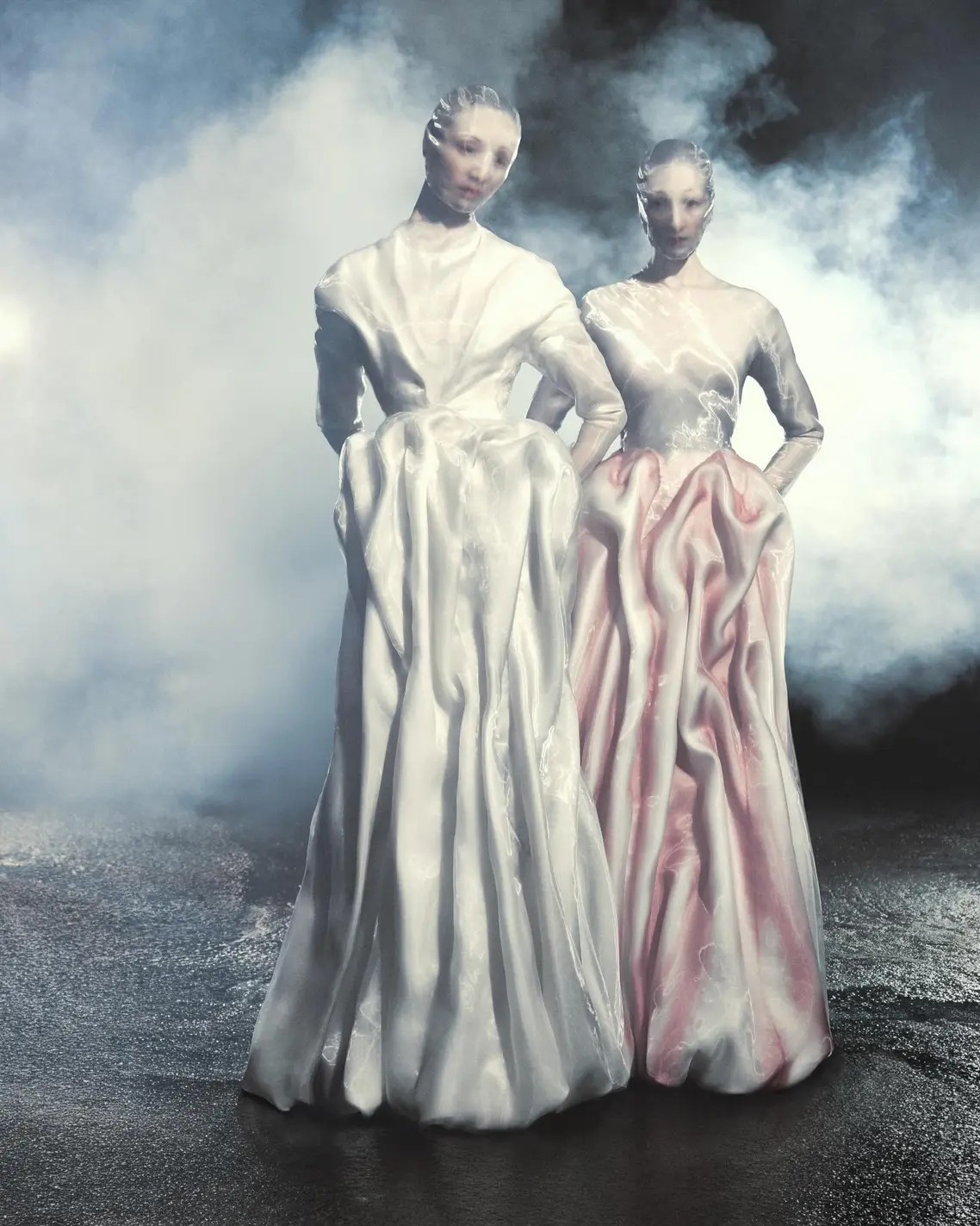
What if Maison Margiela Fall 2026 by Glenn Martens is not a runway show at all, but a visceral séance designed to summon the uncanny ghosts trapped within the very fibers of our clothes?
April 7, 2026
Advertisement

Advertisement



Maison Margiela Fall 2026 by Glenn Martens arrived at Shanghai like a fever dream dragged through a shipyard after midnight, wearing an Artisanal mask and the perfume of the flea market still clinging to its sleeves. This was the house’s first runway outside Paris, part of a wider Chinese chapter built around Maison Margiela’s foundational codes, yet nothing about the show felt diplomatic or softened for export. It felt more nocturnal, more depraved in its beauty. The whole thing moved like a ritual of elegant damage.
Glenn Martens took anonymity, bianchetto, found-object ugliness, porcelain, paint, wax, and fracture, then bound them together until the eye could no longer tell where corruption ended and luxury began.
Glenn Martens has been direct about what interests him here: craftsmanship, anonymity, reality, and fun. He chose this direction because Maison Margiela is a house obsessed with what happens when identity is stripped away and the object takes over, when surface becomes argument, when beauty must survive disguise. The house was opening itself outward, yet Glenn Martens answered by making the clothes even stranger, less legible, more difficult to own in a single glance.
The real thesis is more perverse than that. He seems to be asking whether reality itself can be reconstructed. Can porcelain become skin. Can paint become memory. Can a flea-market relic become couture. Can a thing look ruined and still feel more expensive than polish. Margiela has always lived inside those contradictions, but Glenn Martens drags them somewhere harsher and more industrial. He lets the house’s old intelligence rot a little at the edges, and somehow that rot makes it gleam harder.

The imaginative world of this show is neither Paris nor Shanghai alone. It is a salvage kingdom under hypnosis. Part shipyard, part after-hours market, part porcelain mausoleum, part masked procession of ghosts who still know where the best things are hidden. Porcelain becomes a central fetish. Masks erase the face. Found objects return with the insolence of things that refuse to die. The atmosphere feels assembled from broken plates, old paintings, wax drips, dust, painted skin, and a thousand private superstitions.
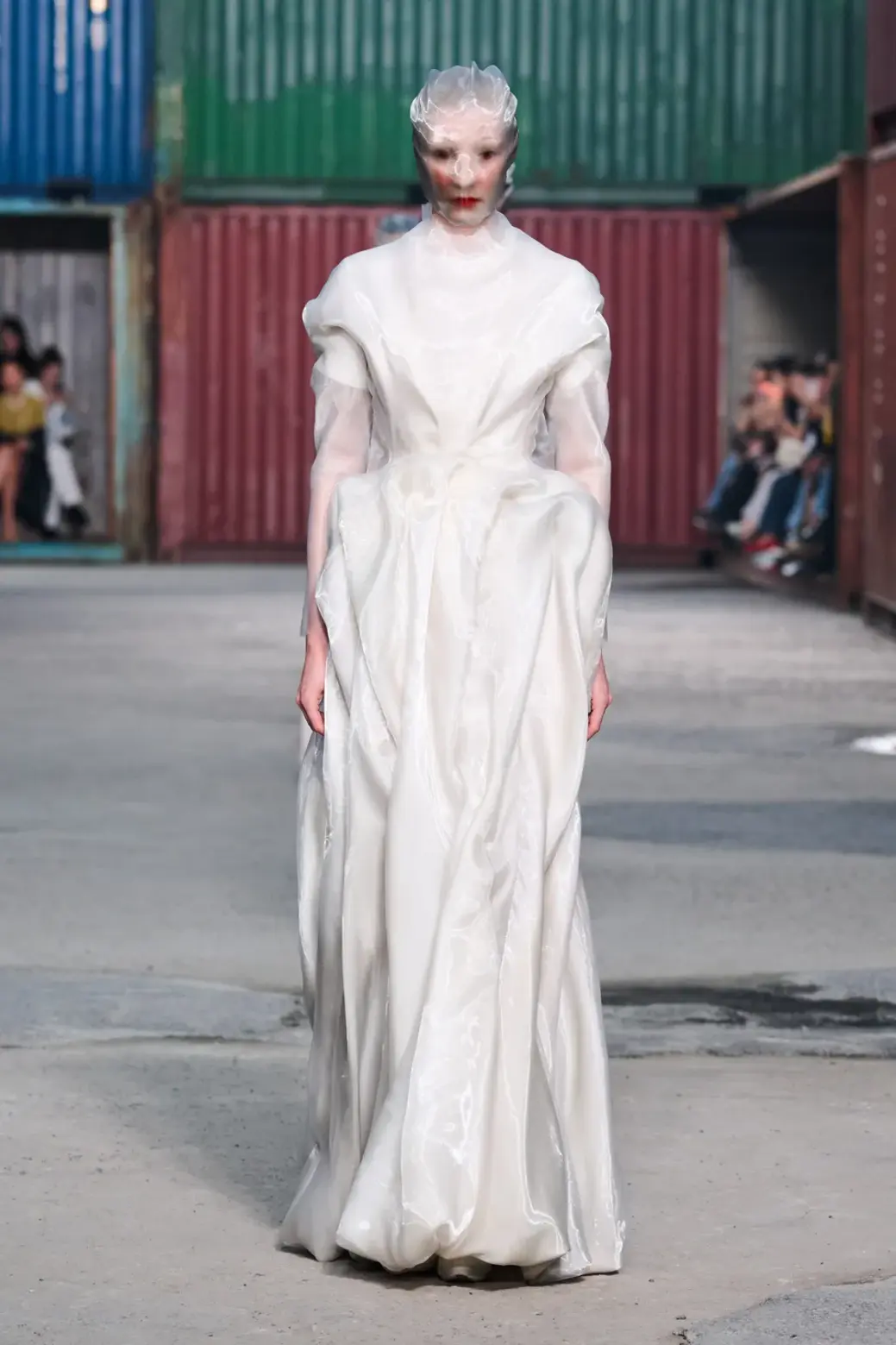
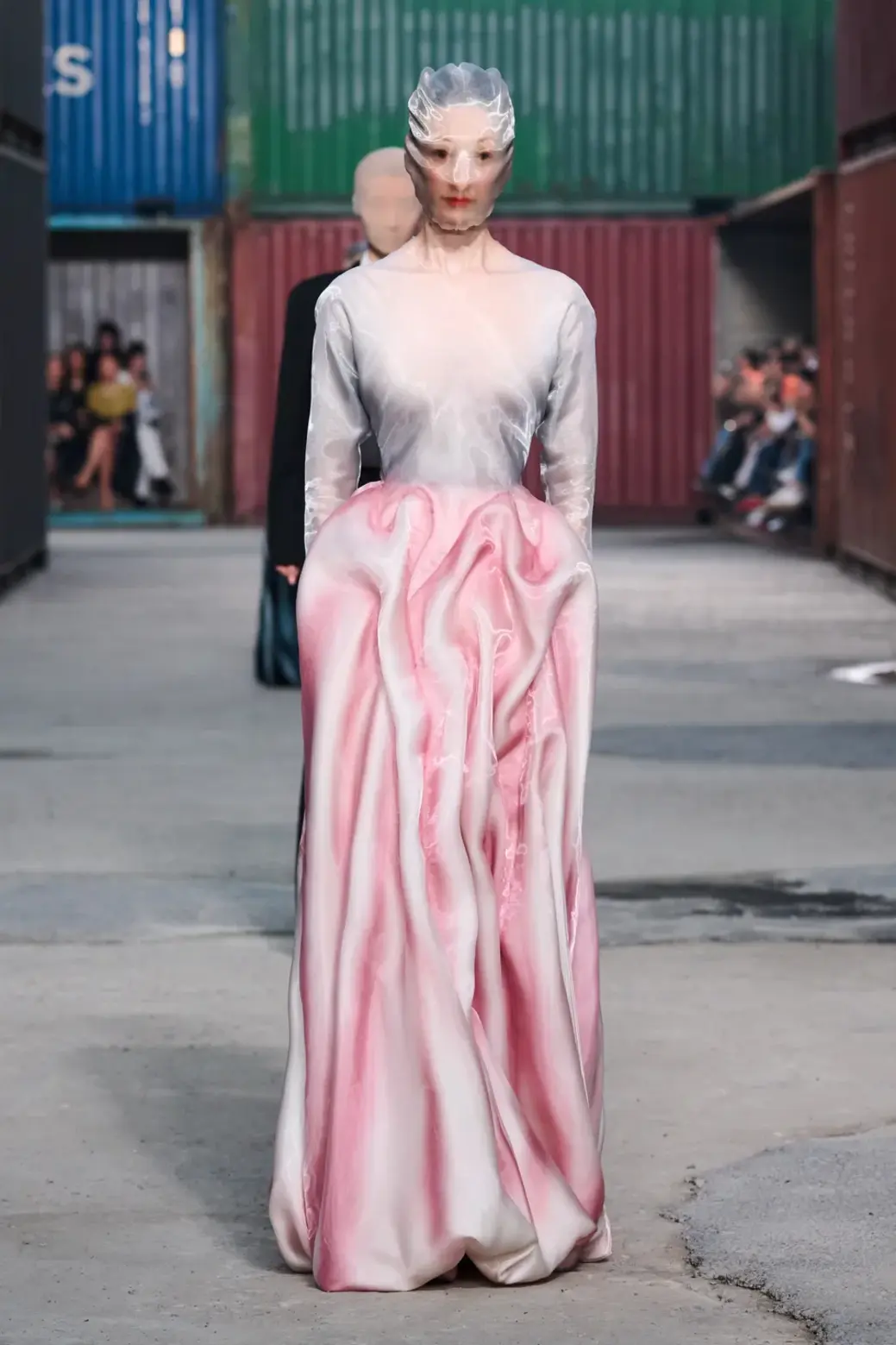
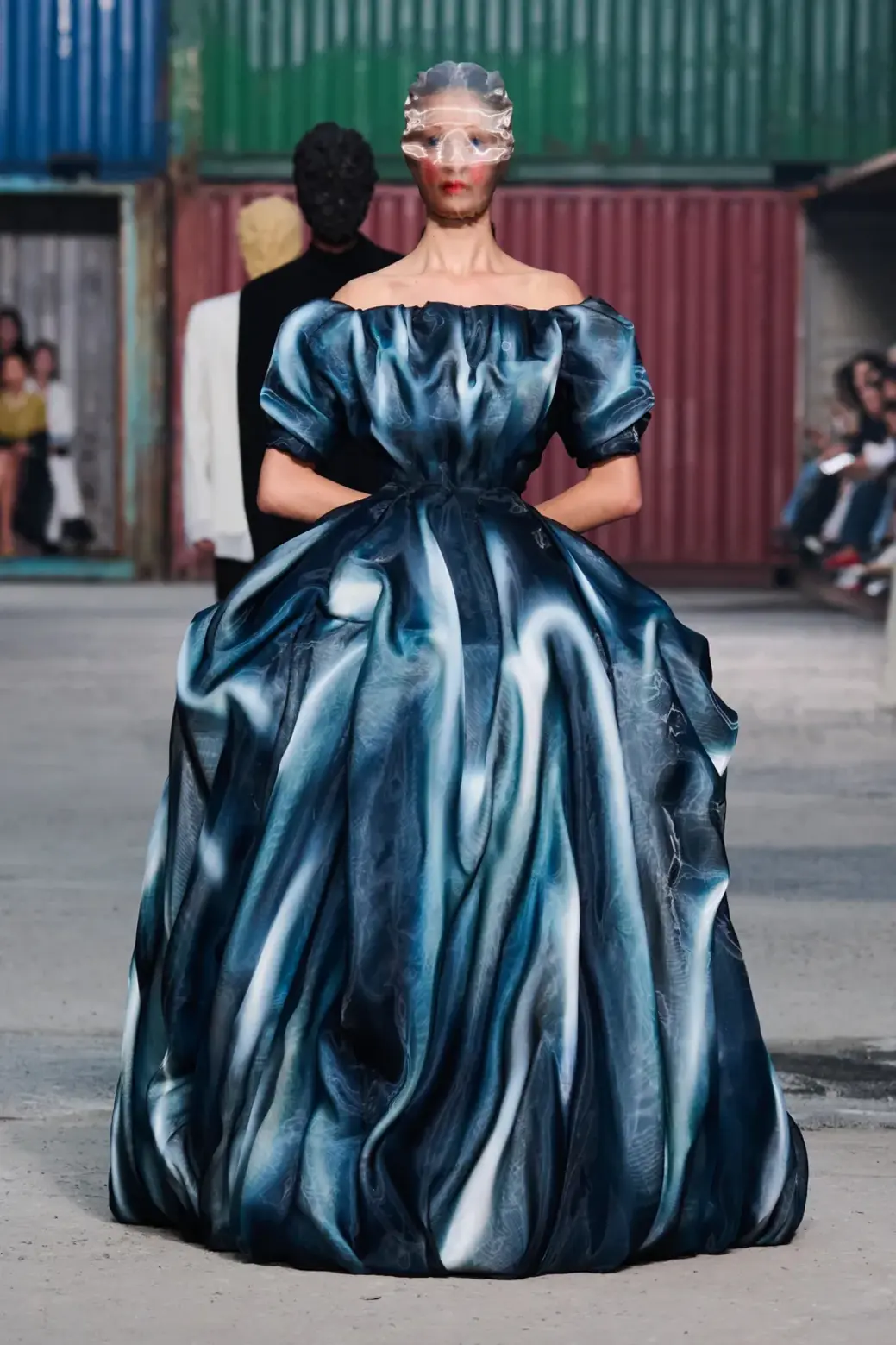
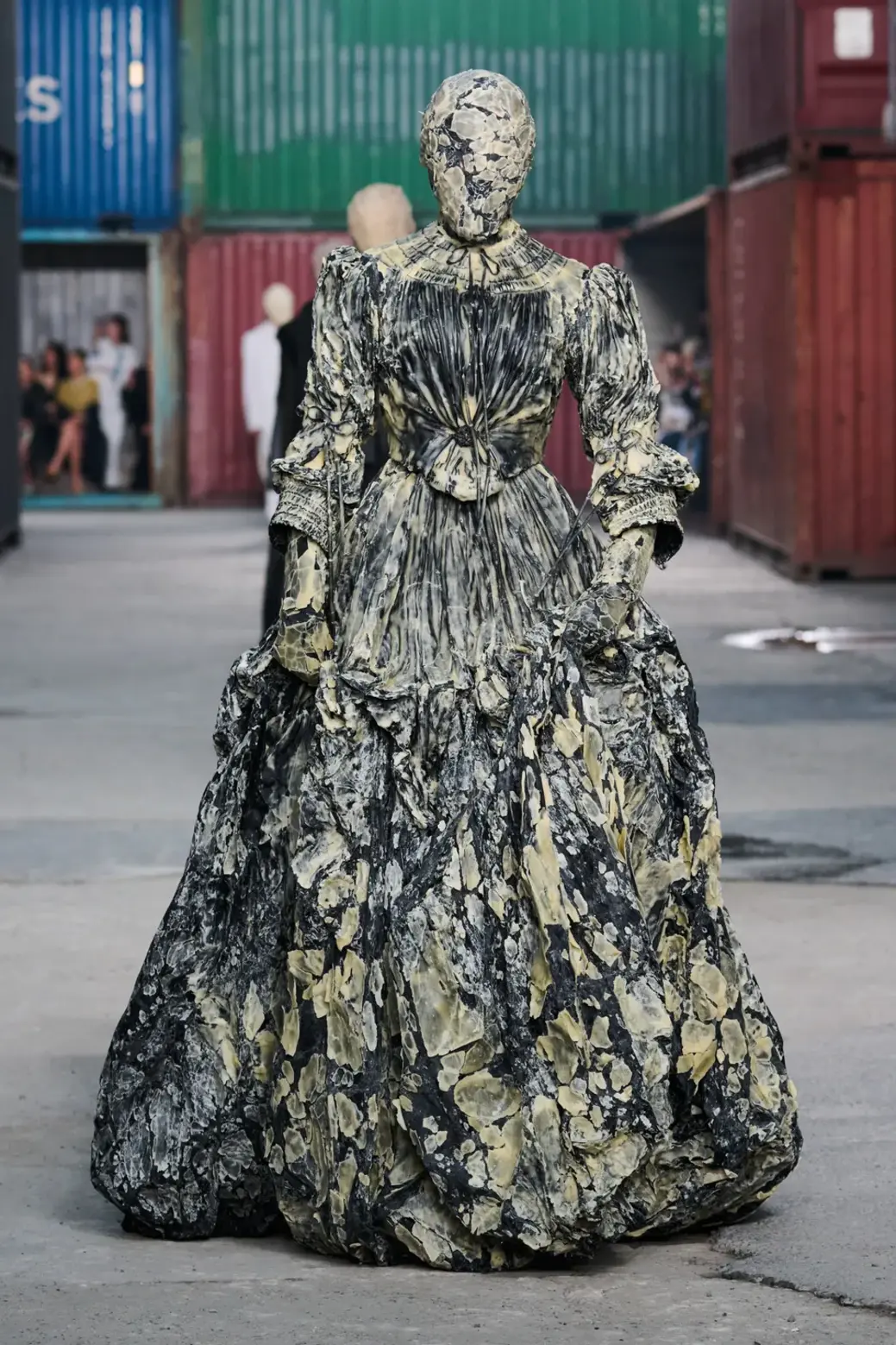
And the woman in this collection, if woman is even the right word once the mask seals over the face, does not wear perfection. She wears evidence. Evidence of fracture. Evidence of pressure. Evidence of having been pieced back together more beautifully than before. That is why the collection feels so forbidden and so attractive at once. It keeps making contamination look like a privilege. It makes the cracked thing the thing you want to touch.
A first show outside Paris, a major market expansion, a set of exhibitions devoted to house codes, all of that might have pushed another brand toward a friendlier, more explanatory kind of runway. Glenn Martens did the opposite. He made the collection denser, stranger, more occult. The industrial setting only intensified that impulse. Instead of smoothing Margiela for a wider audience, he let the city receive the house at its most veiled and most feral.
It remained aesthetically uncompromised, and therefore genuinely persuasive. Shanghai did not function as a glossy backdrop. It functioned as metal, echo, darkness, moisture, scale. It gave the collection a harder perimeter. It made the masks feel more ritualistic, the surfaces more suspicious, the whole proposition more like a luxury crime scene than a market expansion exercise.
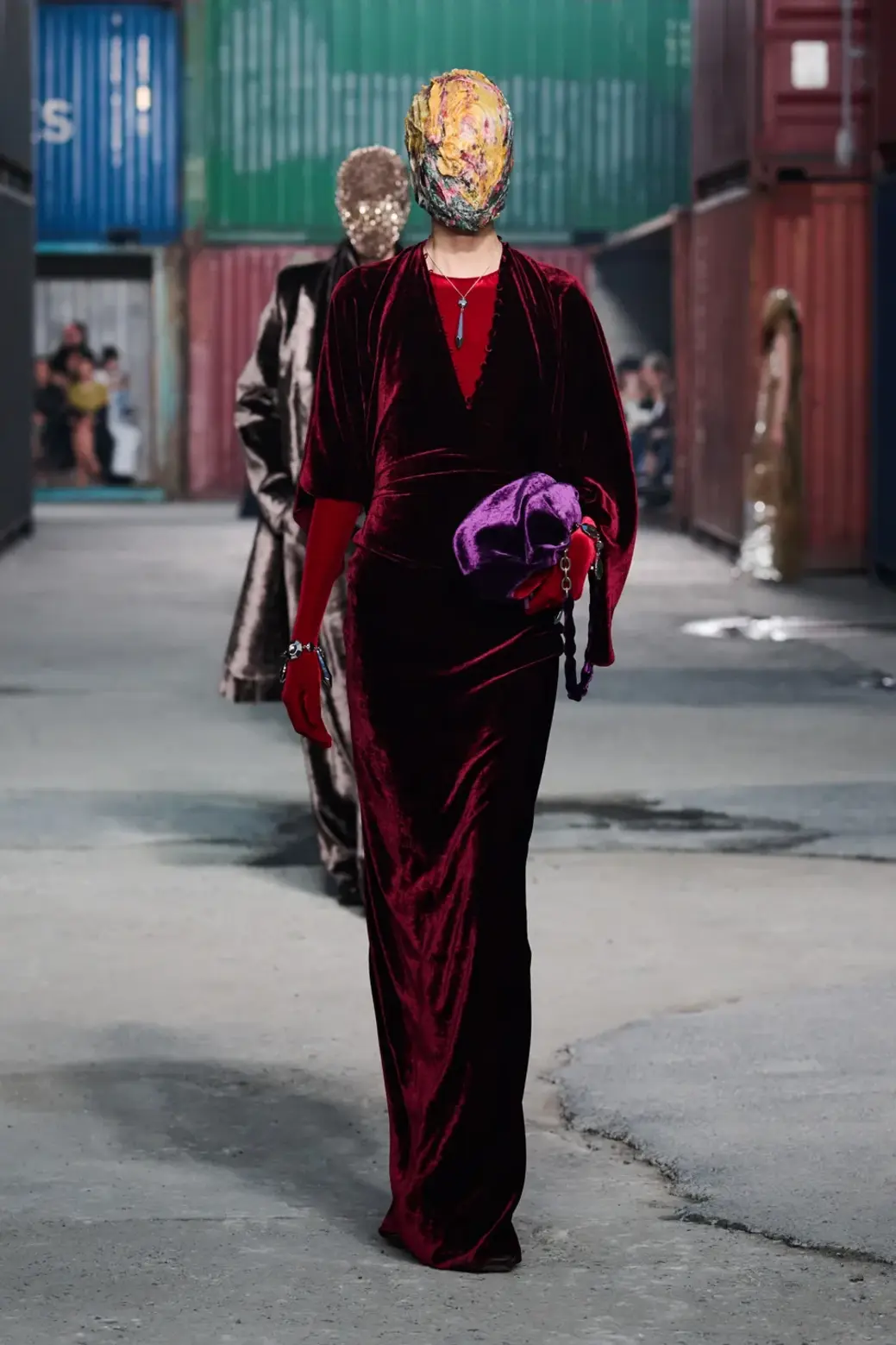
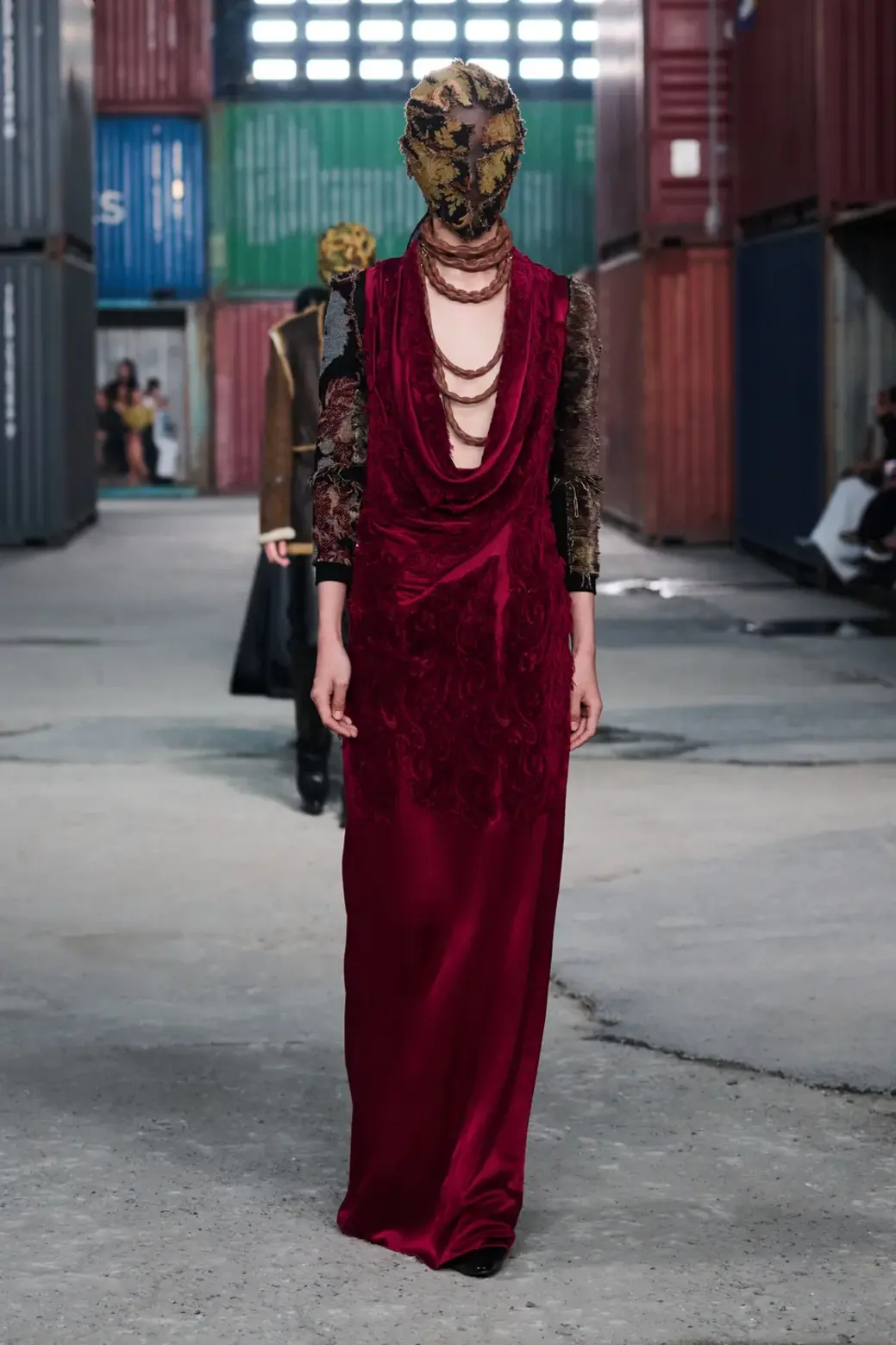
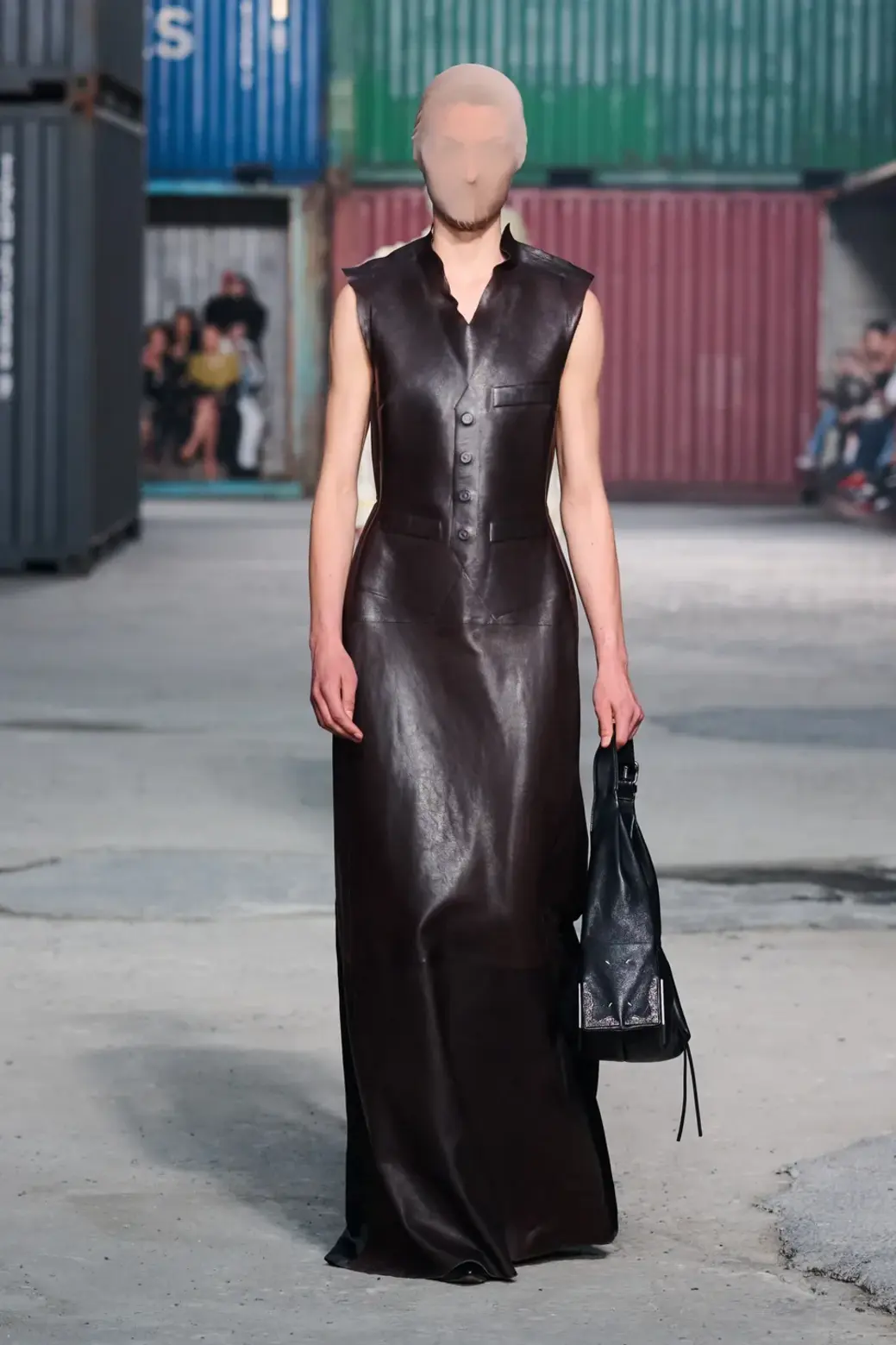
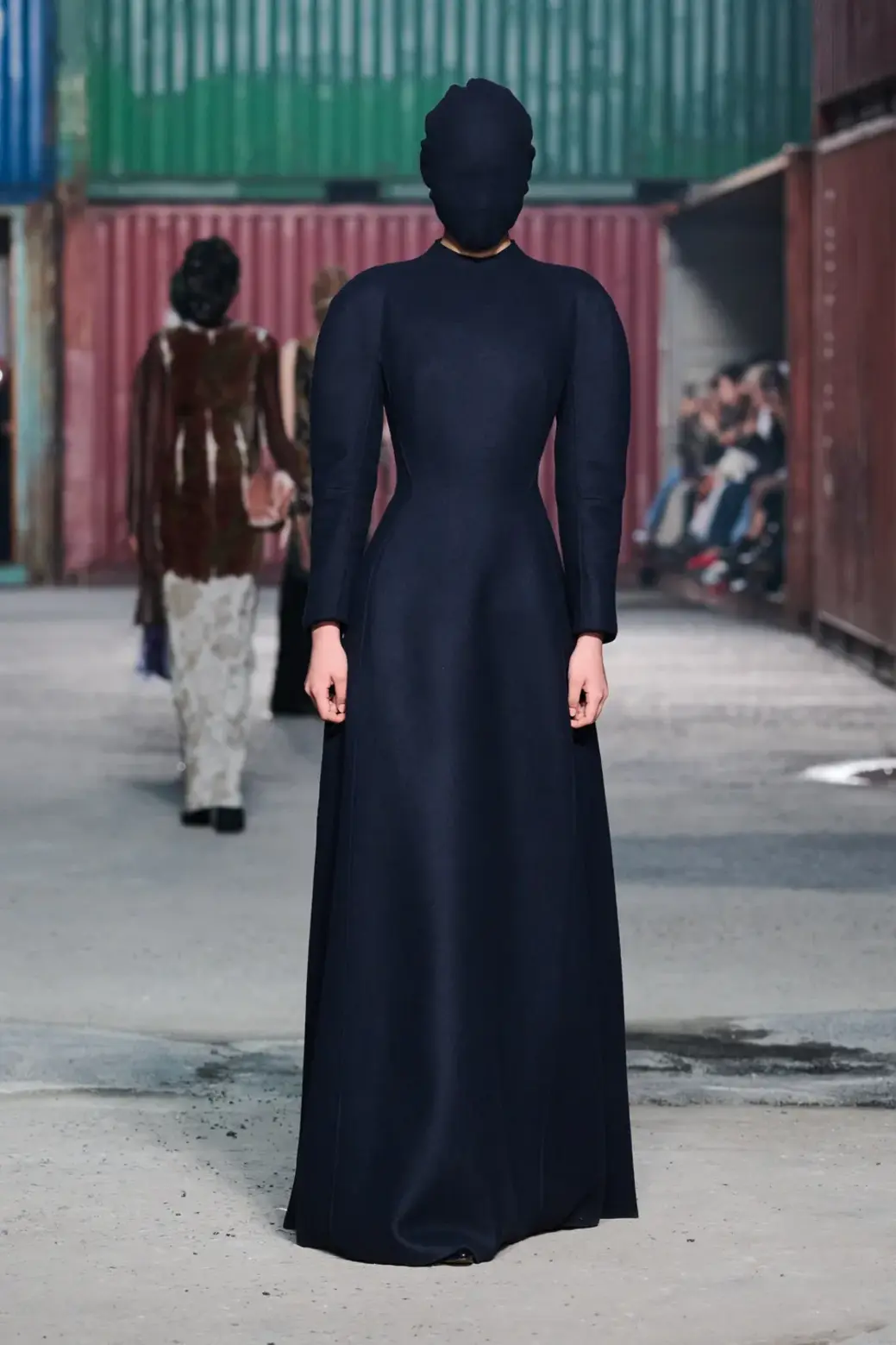
The silhouettes in Maison Margiela Fall 2026 by Glenn Martens are strongest when they look half historical relic, half industrial mutation. There is an upright, elongated severity running through them, sometimes with an Edwardian echo, but Glenn Martens never lets history remain intact. He bends it, crusts it over, enlarges it, cracks it open. A-line dresses stand away from the body like fired clay. Suits look painted into existence rather than tailored. Dresses seem less worn than cast, less draped than recovered.
That is exactly what the porcelain-doll sequence achieves. One artisanal dress begins as a draped and corseted gazar shape, then is airbrushed to exaggerate shadow before being covered in multiple layers of printed glass organza. The body underneath becomes eerie and over-defined, like a doll lacquered into life. The mask repeats that same porcelain logic in blurred form, as though the face itself has been printed through ceramic memory. What should have felt delicate becomes uncanny. What should have felt sweet becomes unnerving.
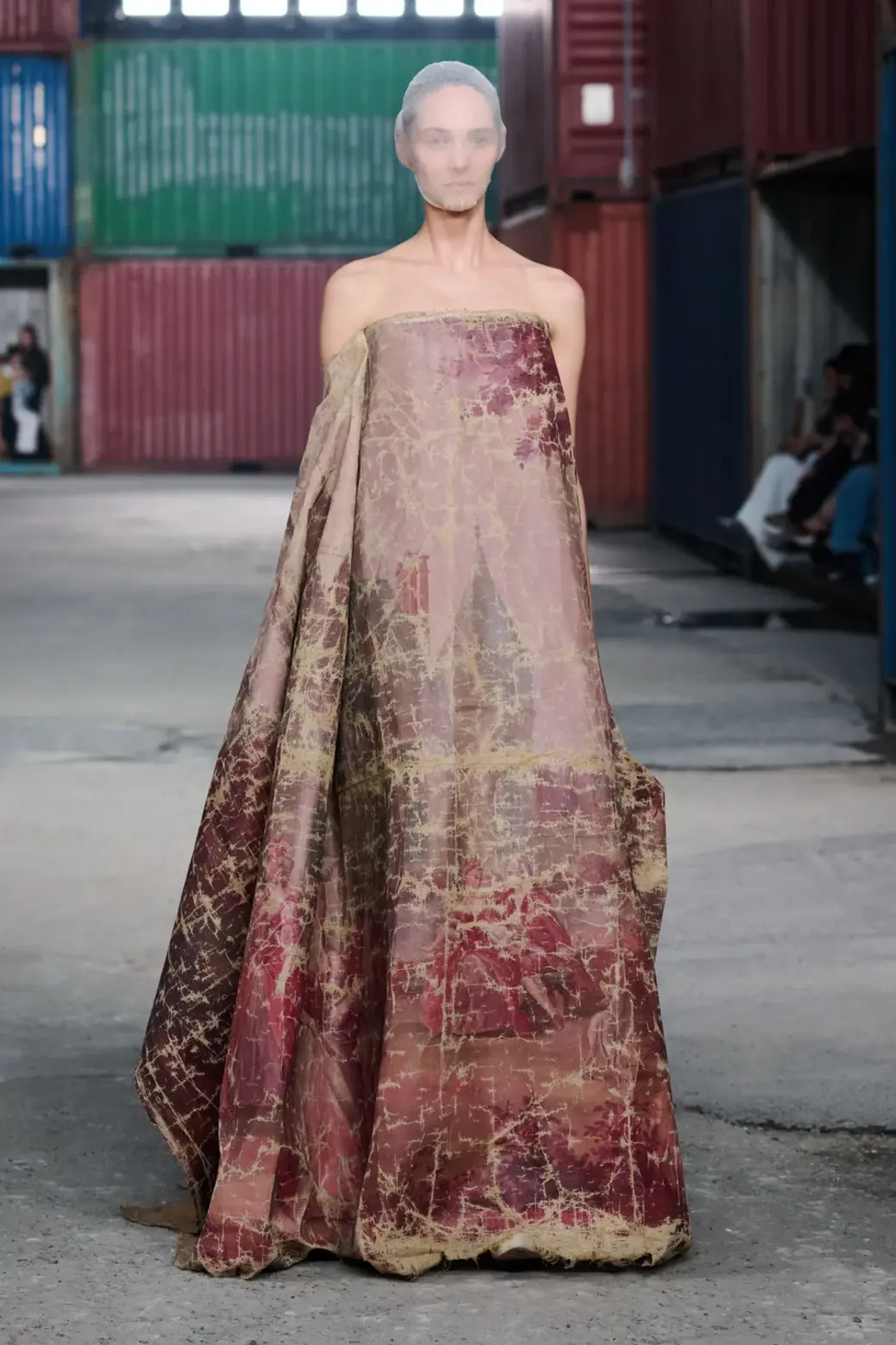
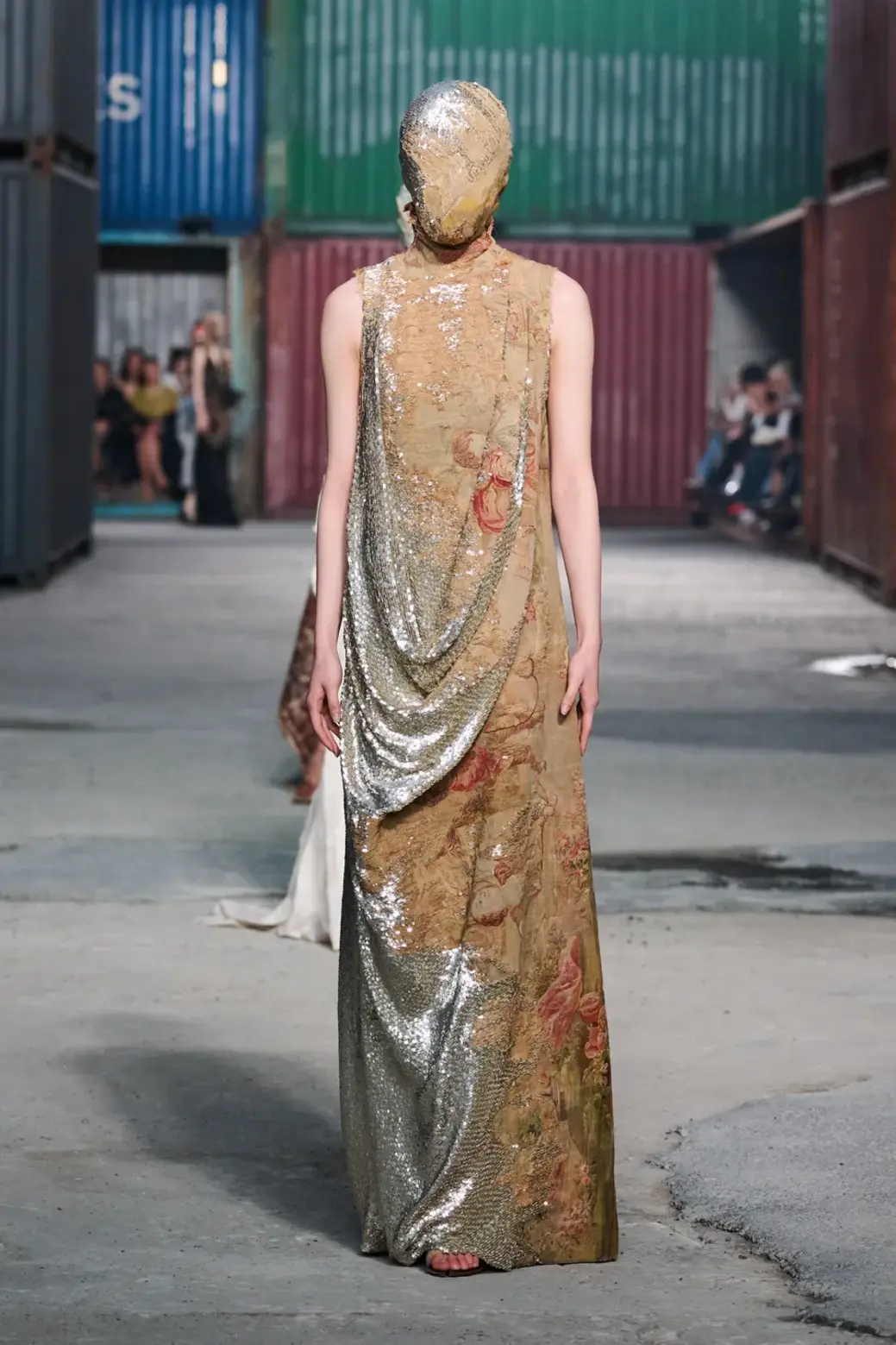
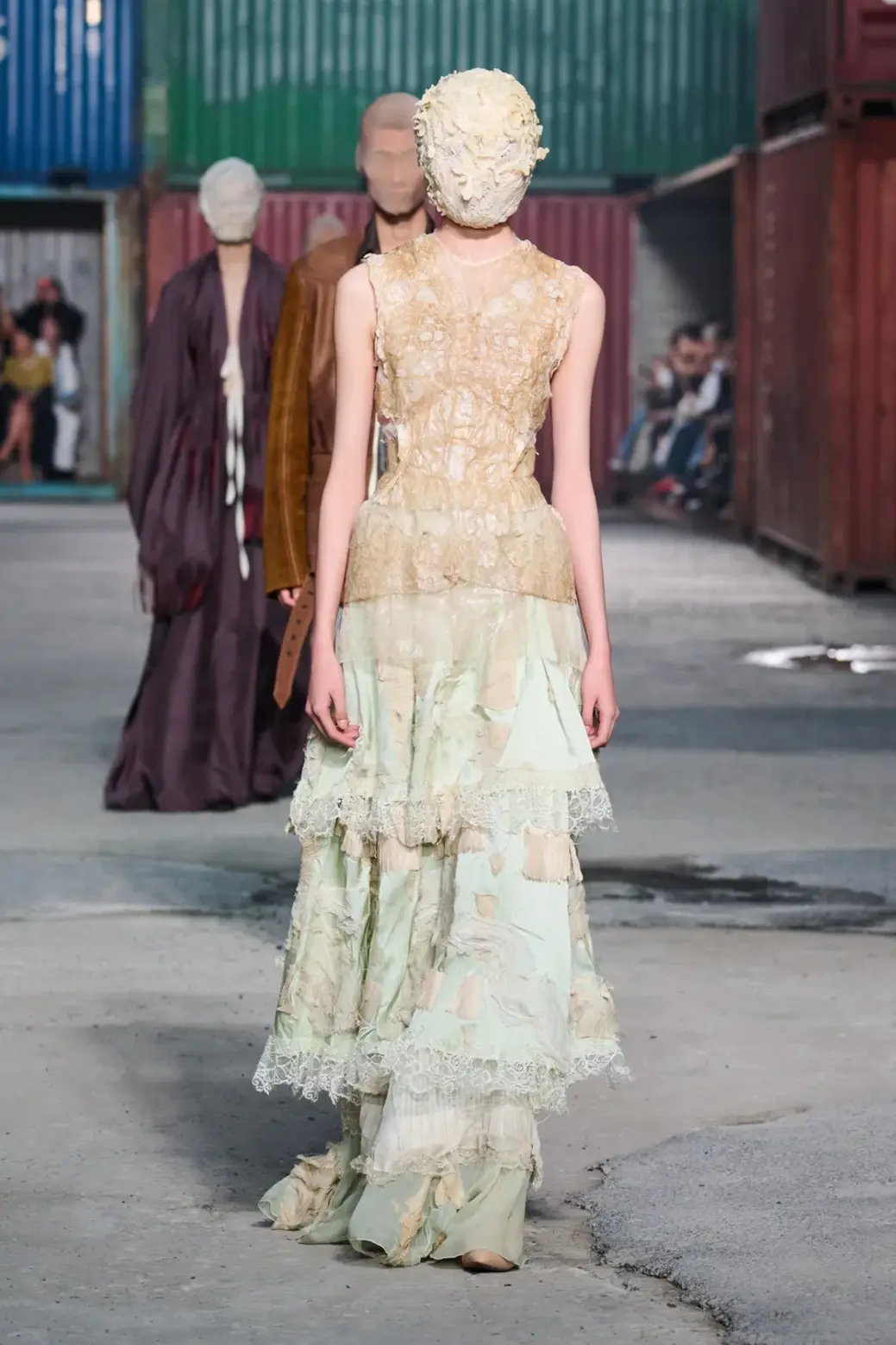
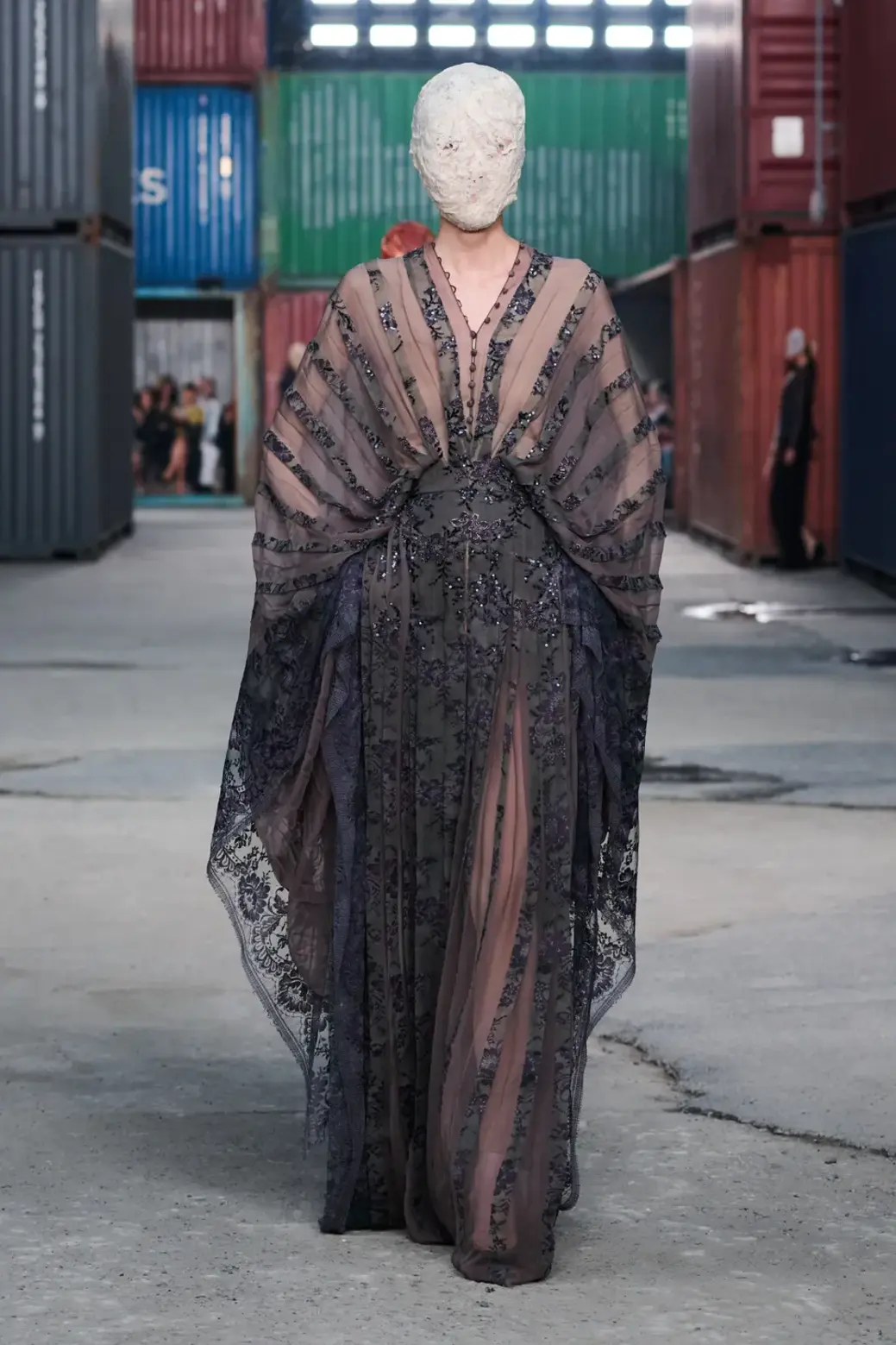
Even the skirts behave strangely. Their layers feel held in suspension rather than simply sewn together, as though the fabric had been stopped mid-fall. In the atelier notes, each layer was built from continuous cloth and hand-stitched to create a suspended-animation effect, which is exactly how the eye experiences them: not as soft movement, but as movement trapped inside form. Glenn Martens keeps turning garments into objects that seem to have paused between one state and another. That interruption is where the danger lives.
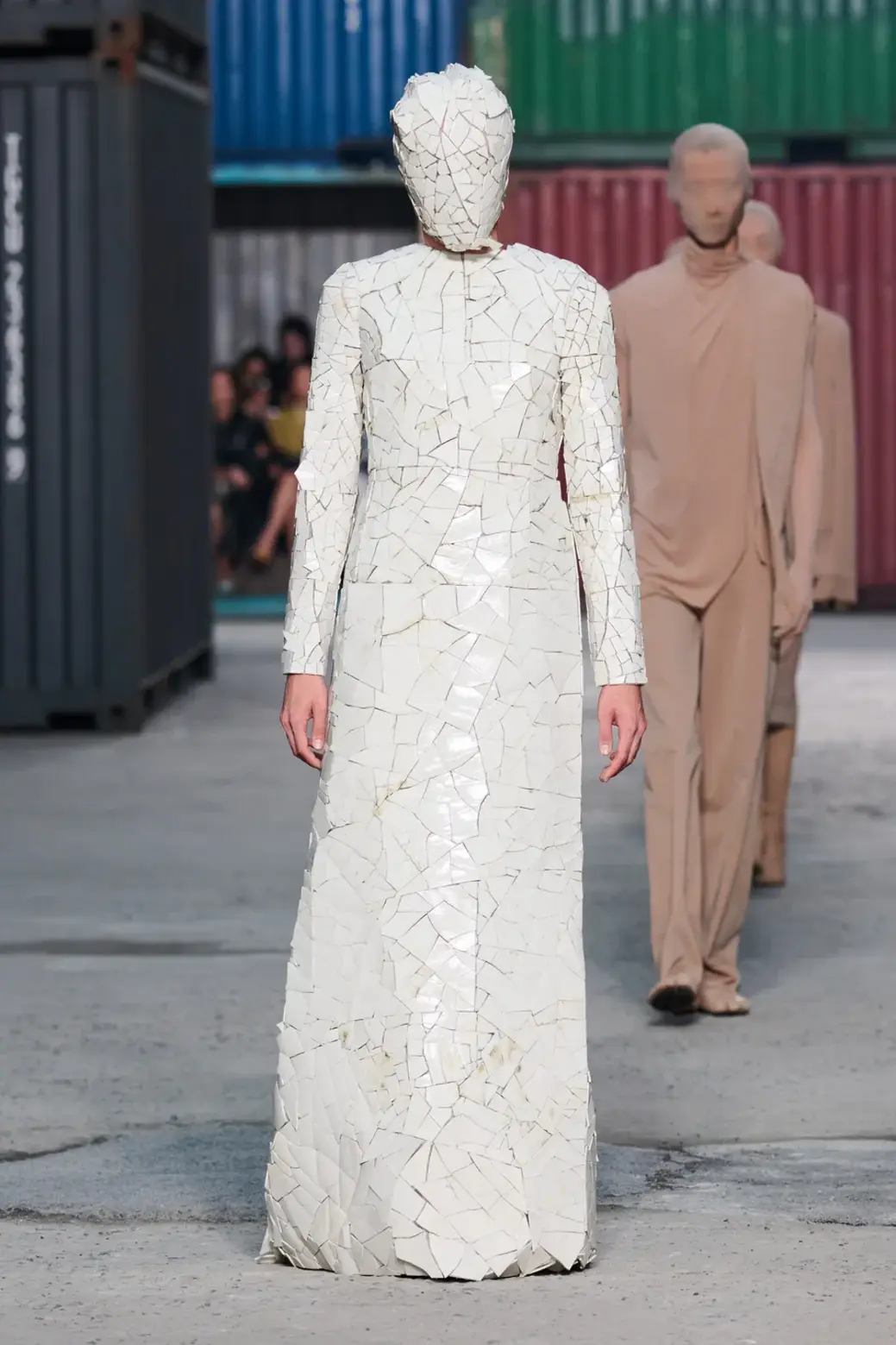
The most seductive violence in the collection is material. Porcelain is a season-long obsession. The house itself explains that the porcelain-doll effect comes from airbrushed gazar covered in layers of printed glass organza, while one of the standout dresses is formed from porcelain panels broken by hand into around five hundred pieces, rounded off, then fixed onto an organza underlay. That process alone would have been enough to justify the collection’s dark glamour. But Glenn Martens does not stop at one type of ruin. He multiplies it.
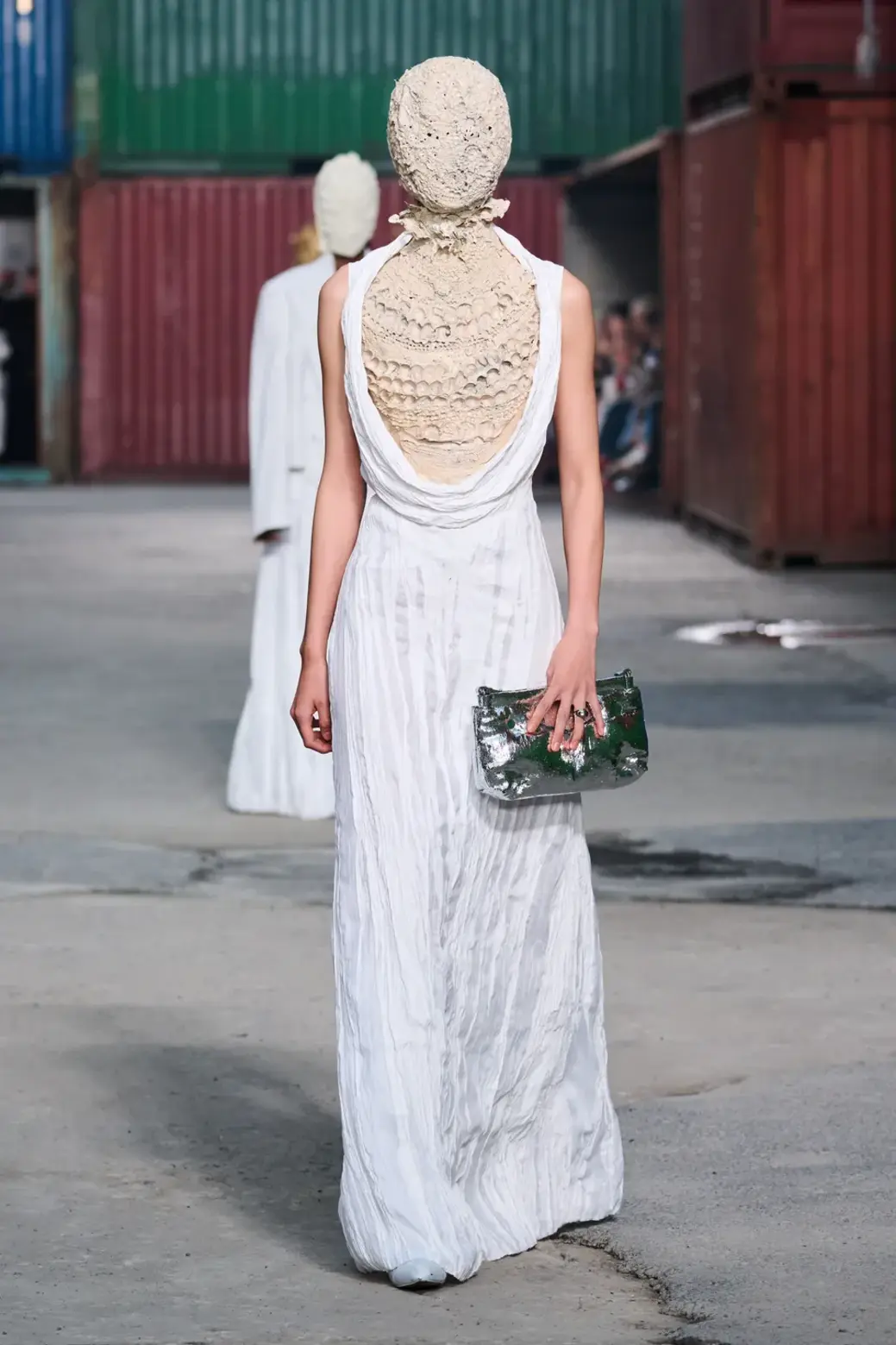
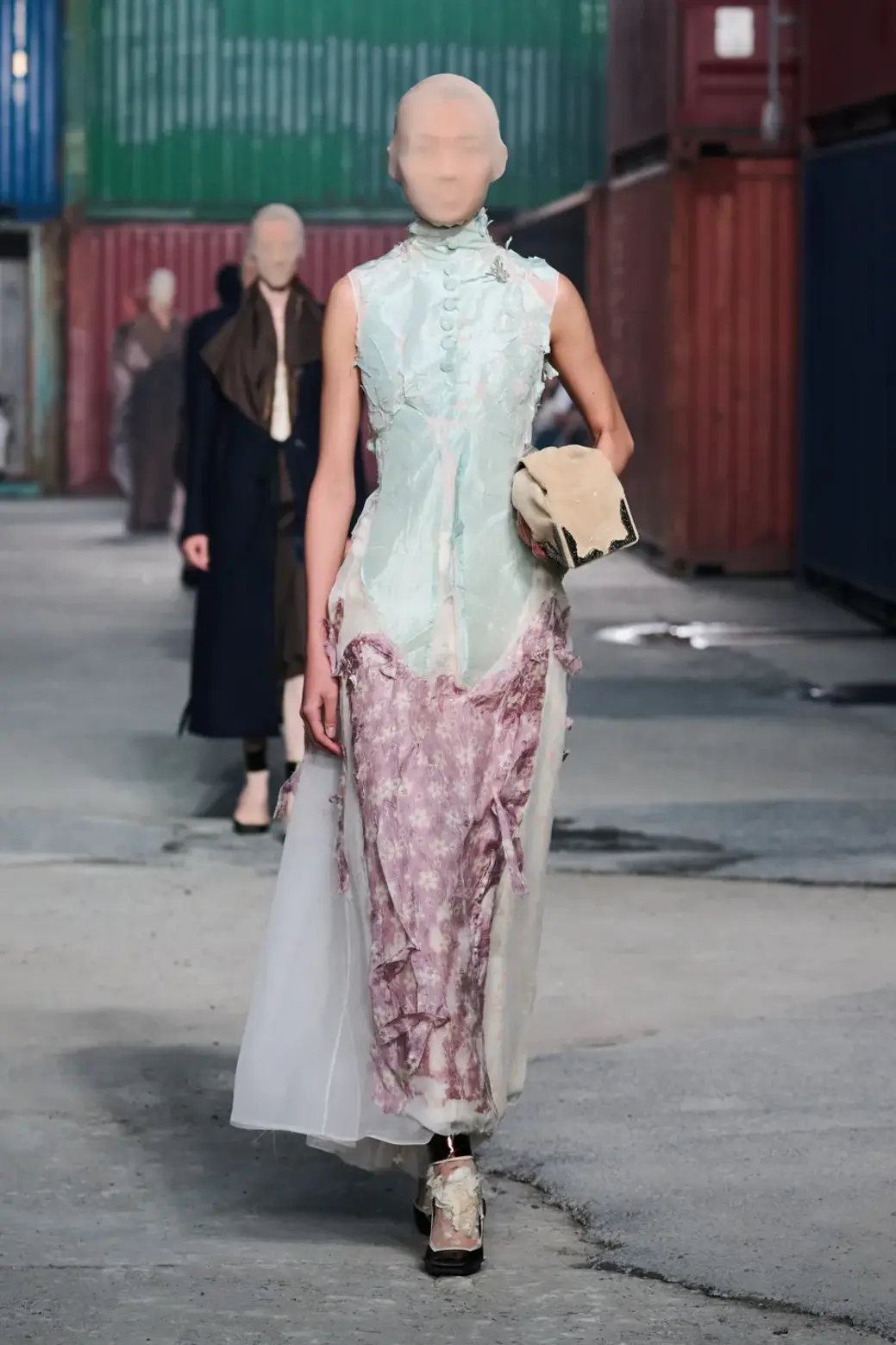
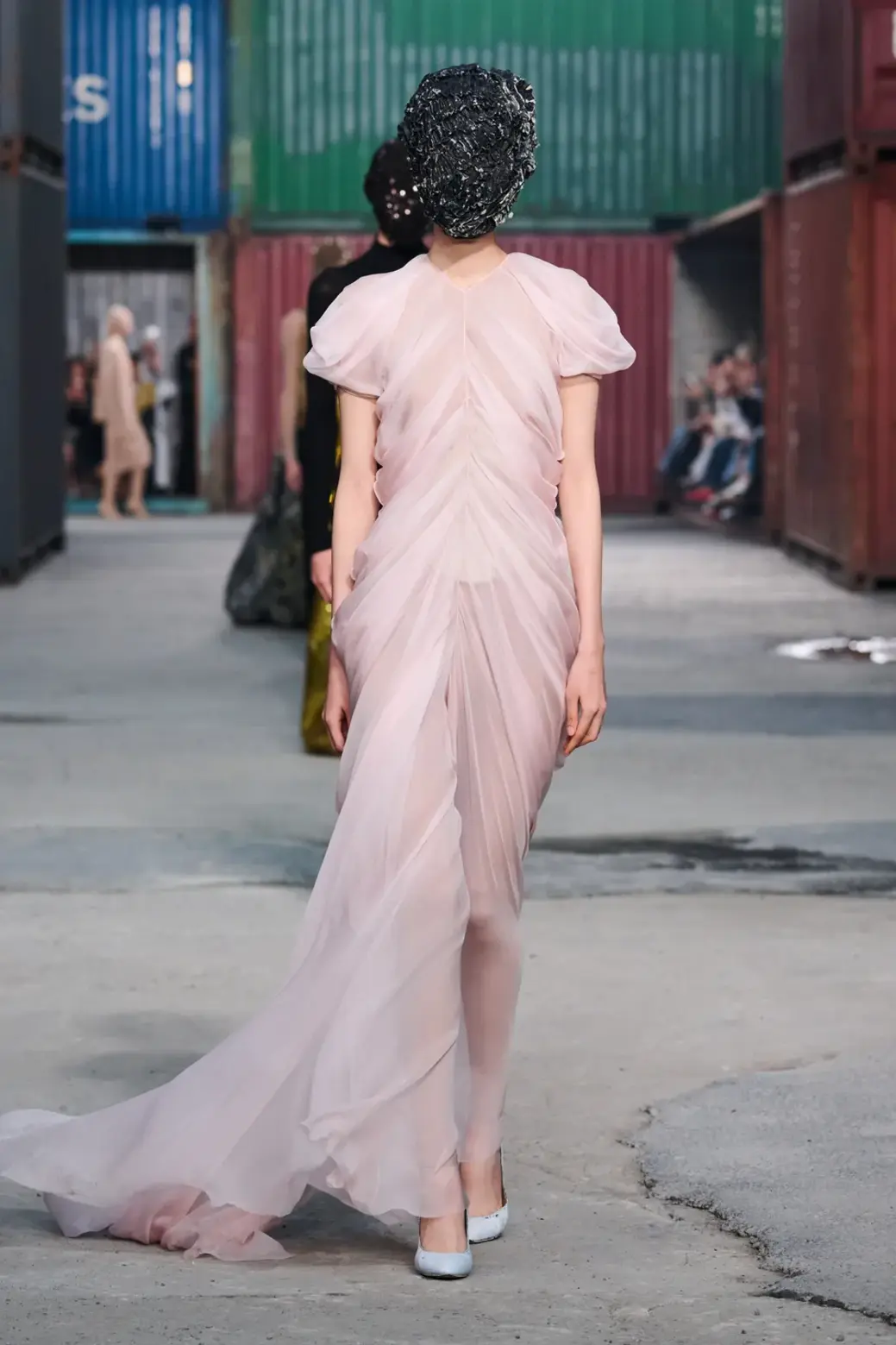
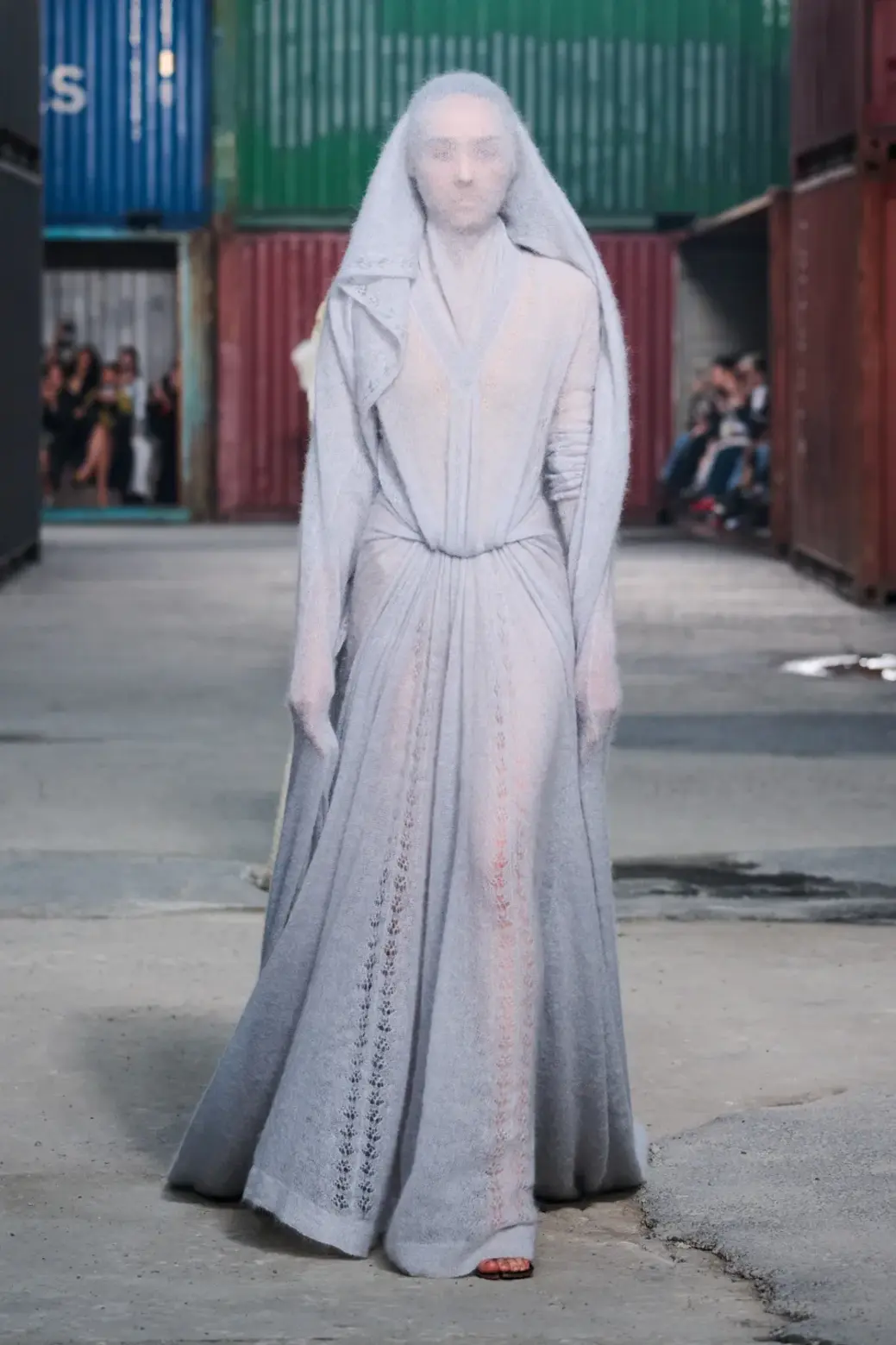
That ceramic dress deserves to be understood in full monstrosity. It began as a calico toile. Its pattern shapes were fired once, glazed, fired again, then broken deliberately by hand. Each shard was rounded one by one so the body could wear the fracture without being cut by it, then mounted back onto the organza base. The whole thing took around three hundred hours in the atelier notes you shared, and it feels every minute of that labor. The dress does not glitter. It wounds. It looks like a body plated in the remains of a broken room.
Then there is wax. Beeswax was poured onto a dress with a seemingly endless drape, and that an artisanal silk dress was coated in beeswax until its surface solidified and cracked, as though excavated from another life. That is one of the collection’s most brilliant gestures because beeswax turns softness into fossil. A drape that should flow begins to hold itself. A dress that should breathe begins to keep secrets. Wax here is not finish. It is embalming.

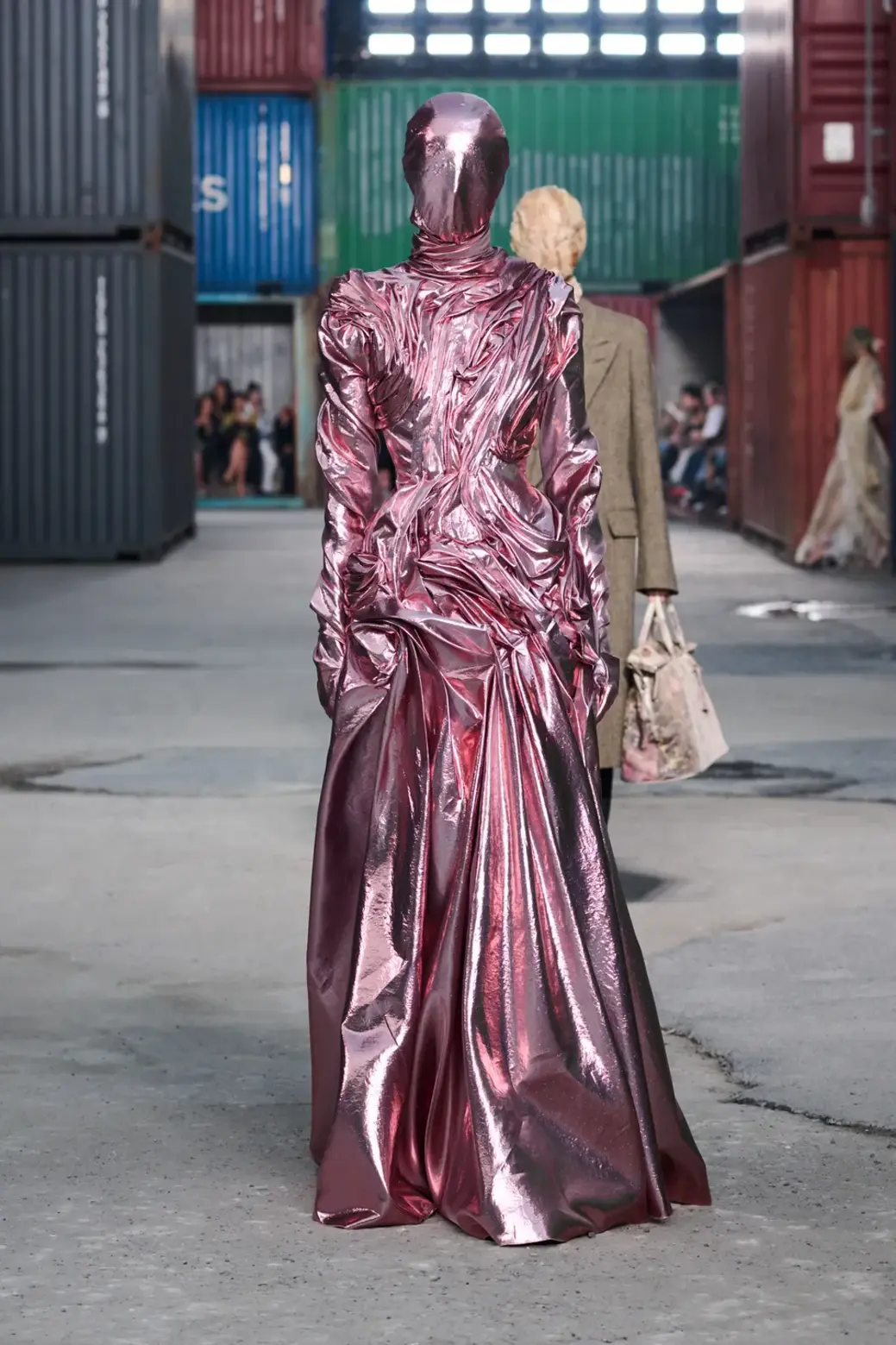
Paint does something equally sinister. The white-painted suit is not a clean bianchetto exercise. It feels more like paint forced into cloth until the garment starts to resemble dried skin. Glenn Martens uses bianchetto as if it were a living substance: cracked open, peeled back, made fluid, then re-frozen. One Edwardian-inspired dress was baked, cracked open, and made to carry a fluid bianchetto effect. Another cowl-neck dress used a corset bustier beneath, then was overlaid with a latex impression of antique jewellery, as though ornaments had melted into the body and left only their negative trace. That kind of making is less tailoring than séance.
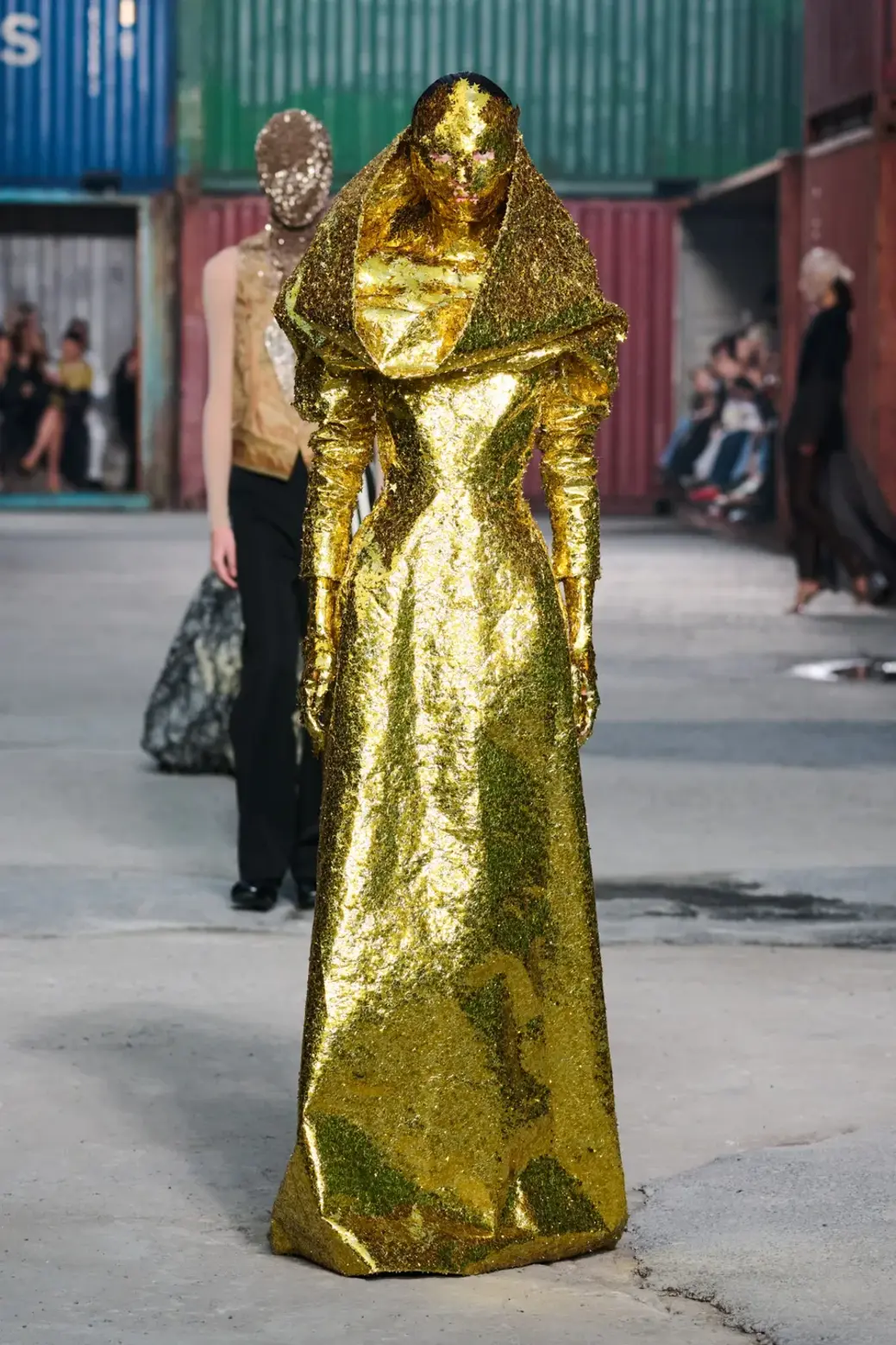
The stars push this logic to delirium. The house confirms that over 150,000 gold stars were applied by hand to an Edwardian silhouette dress, taking 2,975 hours. Read that again and the garment stops being embellishment and becomes obsession. The exaggerated funnel neckline rises in old-world formality, then crushes downward into a cowl, so the body looks both exalted and compressed. The star field does not make the dress heavenly. It makes it feverish. It turns almost three thousand hours of human fixation into a celestial skin.
The genius of Maison Margiela Fall 2026 by Glenn Martens is that every dirty effect is produced through frightening control. Nothing decays by accident. Every stain, crack, ghosted edge, glaze, shard, and peeled surface is method. Airbrushing. Printing. Firing. Breaking. Rounding. Coating. Casting. Peeling. Fixing. The atelier is not polishing matter into perfection. It is manufacturing ruin with the rigor usually reserved for polish. That inversion is the whole collection’s black heart.
The porcelain-doll dress makes that plain. So does the found-jewellery sequence, which the house describes as jewellery moulded into a cast until only the negative impression remains, the ghost of pearls and pendants after the object itself has gone missing. It is such a wickedly Margiela idea: remove the jewel, keep the bruise. What remains on the body is not ornament but memory of ornament, impression without possession. Luxury becomes absence made tactile.
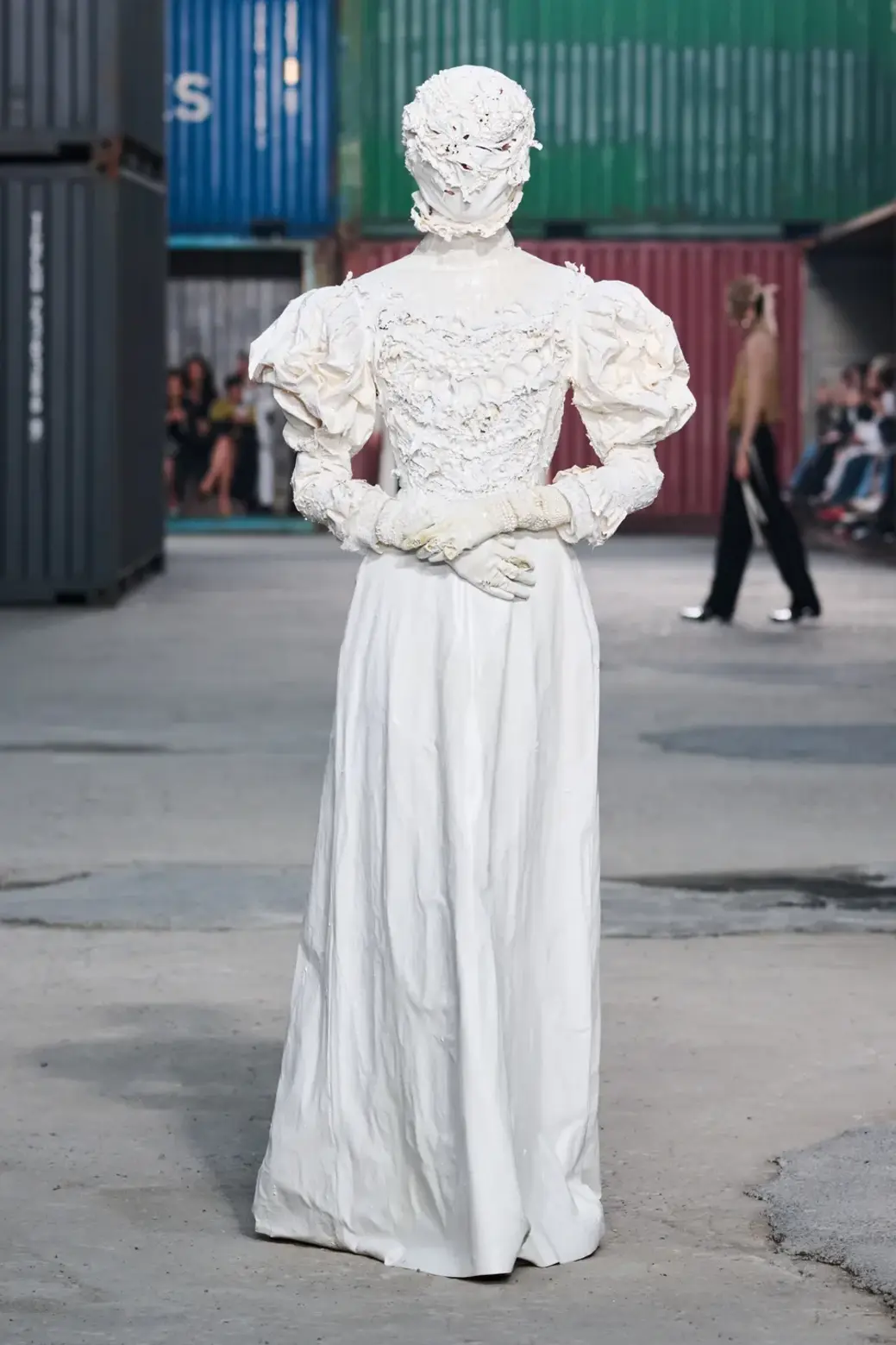
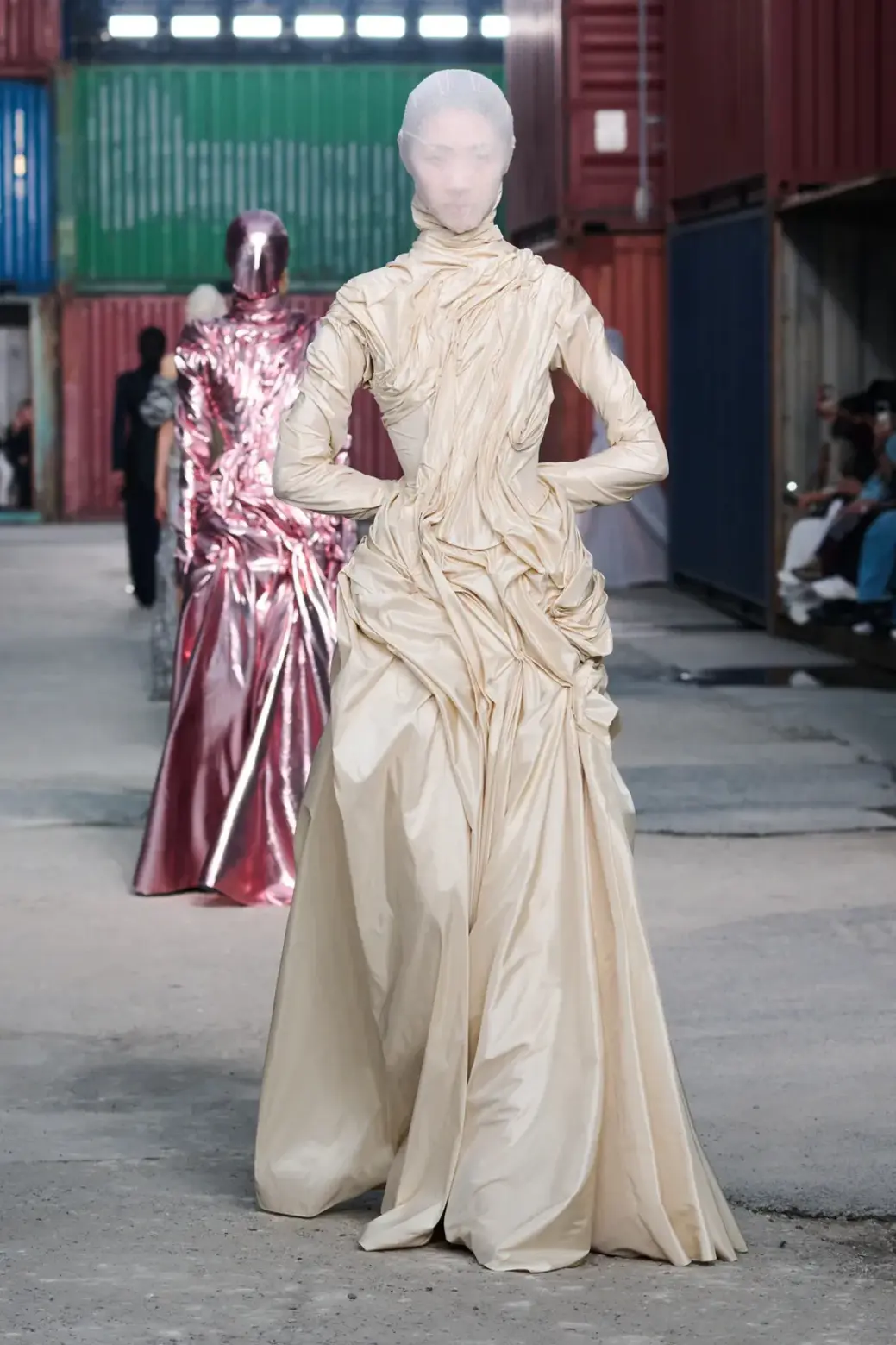
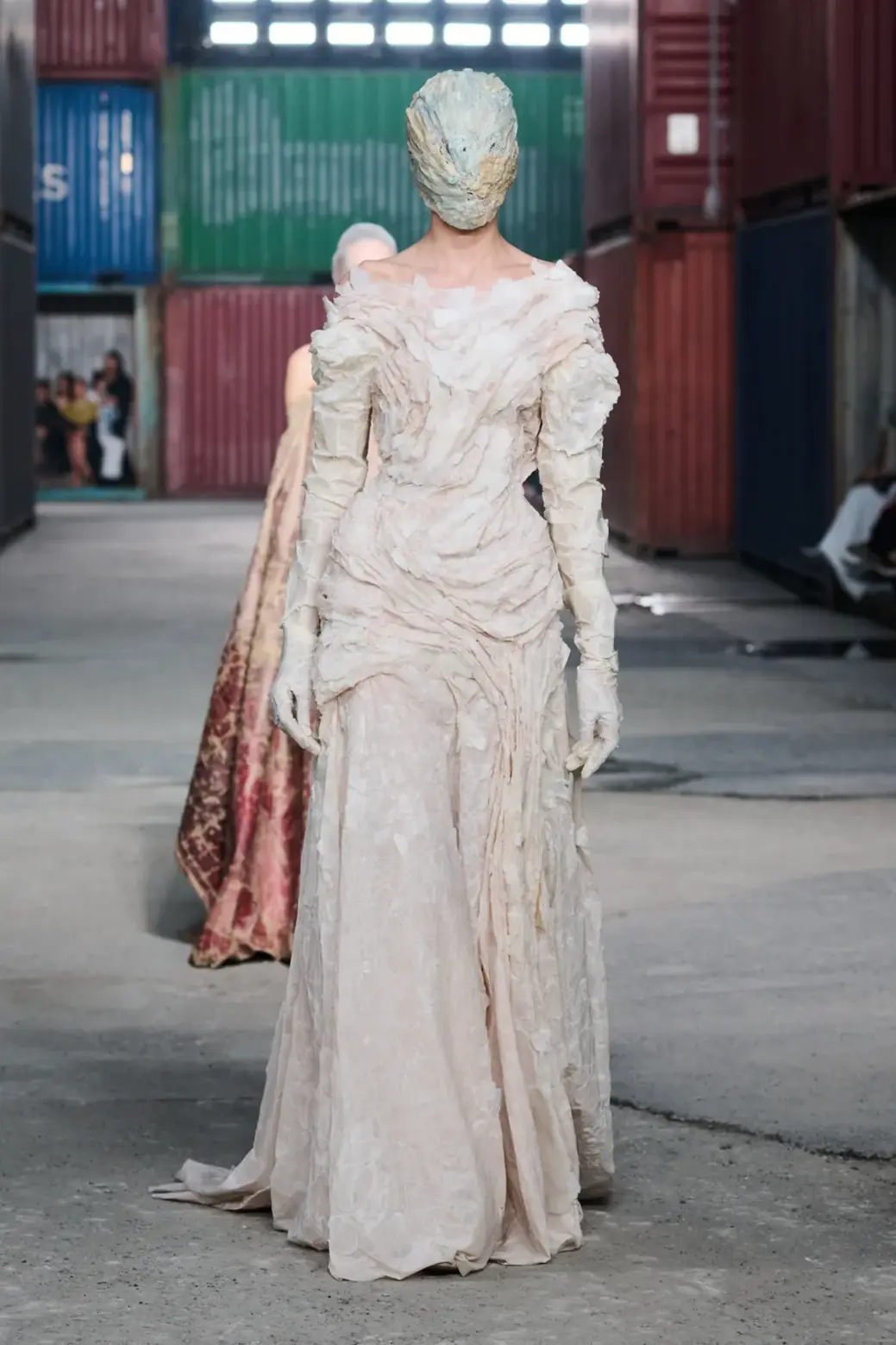
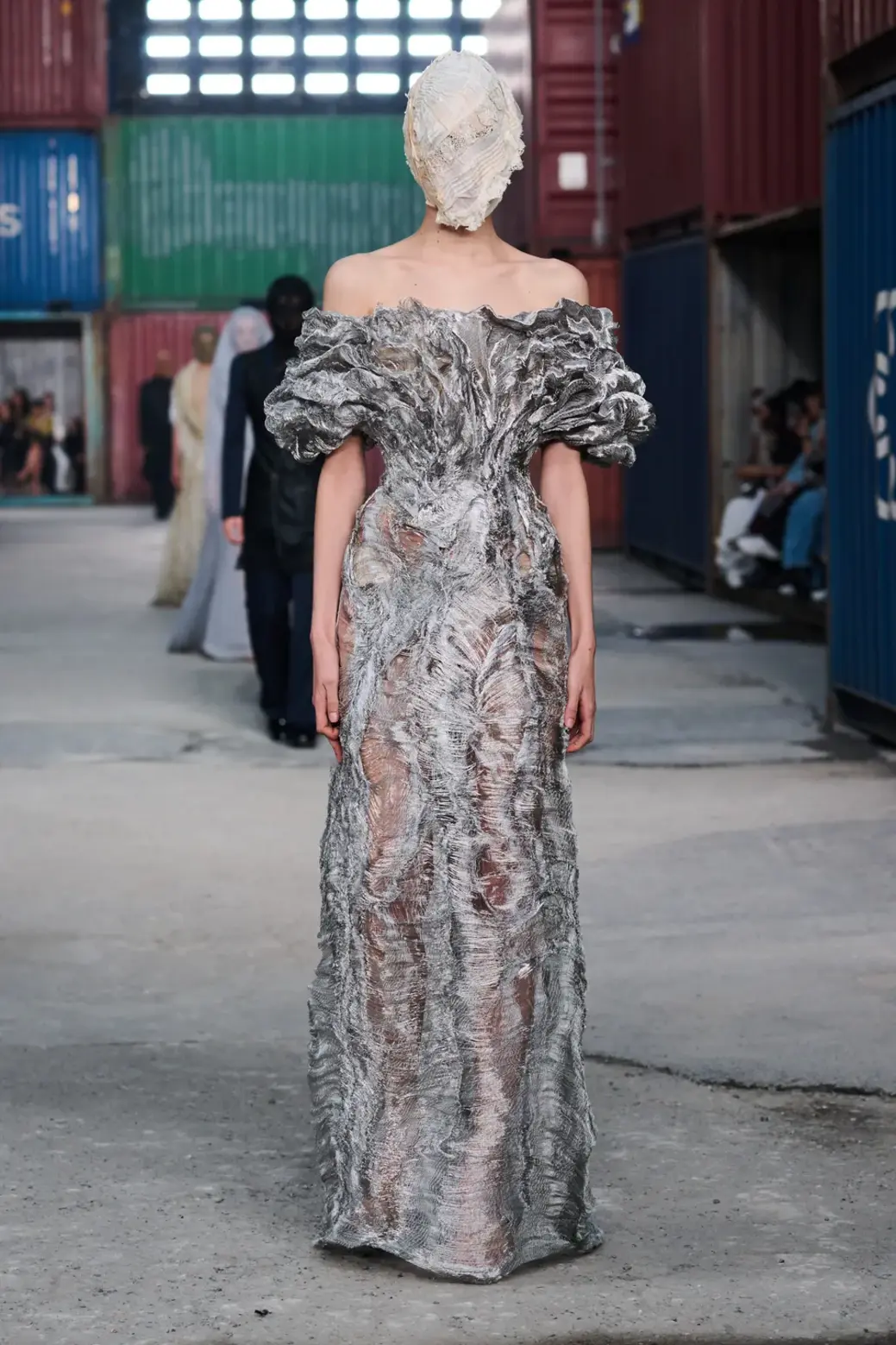
A painted-on mould. An Edwardian form built from plastic sheeting, then burdened with an excess jewel breastplate. The whole effect peeled off and mounted onto a raw-edge corset with visible lacing, taking around 330 hours. A draped chiffon dress cut almost into a continuous spiral, like a snail shell unwinding in slow motion. A fluffy jacquard twinset brushed until it begins to read less like knitwear and more like some small nocturnal animal. They are acts of transfiguration.
Glenn Martens does not merely drape or tailor. He subjects matter to ordeal. Porcelain is fired twice and smashed. Cloth is painted until it ceases to behave like cloth. Wax stiffens drape into archaeological evidence. Latex preserves the impression of jewellery like skin stripped from an heirloom. Organza becomes ceramic mirage. The atelier hides the sin so well that the audience first reads enchantment and only later realizes how much violence to material had to happen to make that enchantment possible.
Maison Margiela Fall 2026 by Glenn Martens almost delights in being difficult. It is masked, industrial, impure, sometimes hostile to quick comprehension. It makes the audience work. But that confusion is not self-indulgence. It is architecture. The strongest critical response called the collection close to a masterpiece, and that feels right, because every strange surface is anchored by process and every bizarre image by logic. The confusion is seduction precisely because the garments are too well-made to dismiss.
The collection keeps offering the eye something it should reject, grime, fracture, dirt, old-market ugliness, weird masks, historical ghosts, a dress that looks as though it might shatter if you breathed too hard, and then forces the eye to submit to it by sheer craft. That is a very particular kind of beauty. Not innocent beauty. Not even generous beauty. More like dangerous beauty that has decided it no longer needs to please in a wholesome way. It can mesmerize by becoming more difficult, more wrong, more contaminated. It can make you desire the crack more than the polish. That is the ultimate Margiela seduction.
Maison Margiela Fall 2026 by Glenn Martens is seductive because it is cracked, masked, waxed, painted, shattered, star-studded, bianchetto-streaked, and gloriously wrong at the edges. It looks as though it has survived damage and become finer for it. That is why it feels so exotic, so dangerous, so attractive. It refuses to separate beauty from risk. And perhaps that is the deepest achievement of the Shanghai show. Glenn Martens did not merely make Margiela dark. He made it bewitched. He built a house where the forbidden surface is the most carefully made one of all, where the dirtiest-looking dress may be the most labor-intensive in the room, where a broken thing acquires more authority than a pristine one ever could. He does not ask you to admire perfection. He dares you to fall for the contaminated object, the masked body, the painted skin, the ceramic shard, the waxed drape, the star-crusted fever dream. He dares you to desire the crack, and, monstrously, beautifully, you do.
Advertisement