MENU
Close





Stefano Gallici staged Ann Demeulemeester Fall 2026 like a confession written after midnight and read back at dawn with a cigarette still burning in the ashtray.
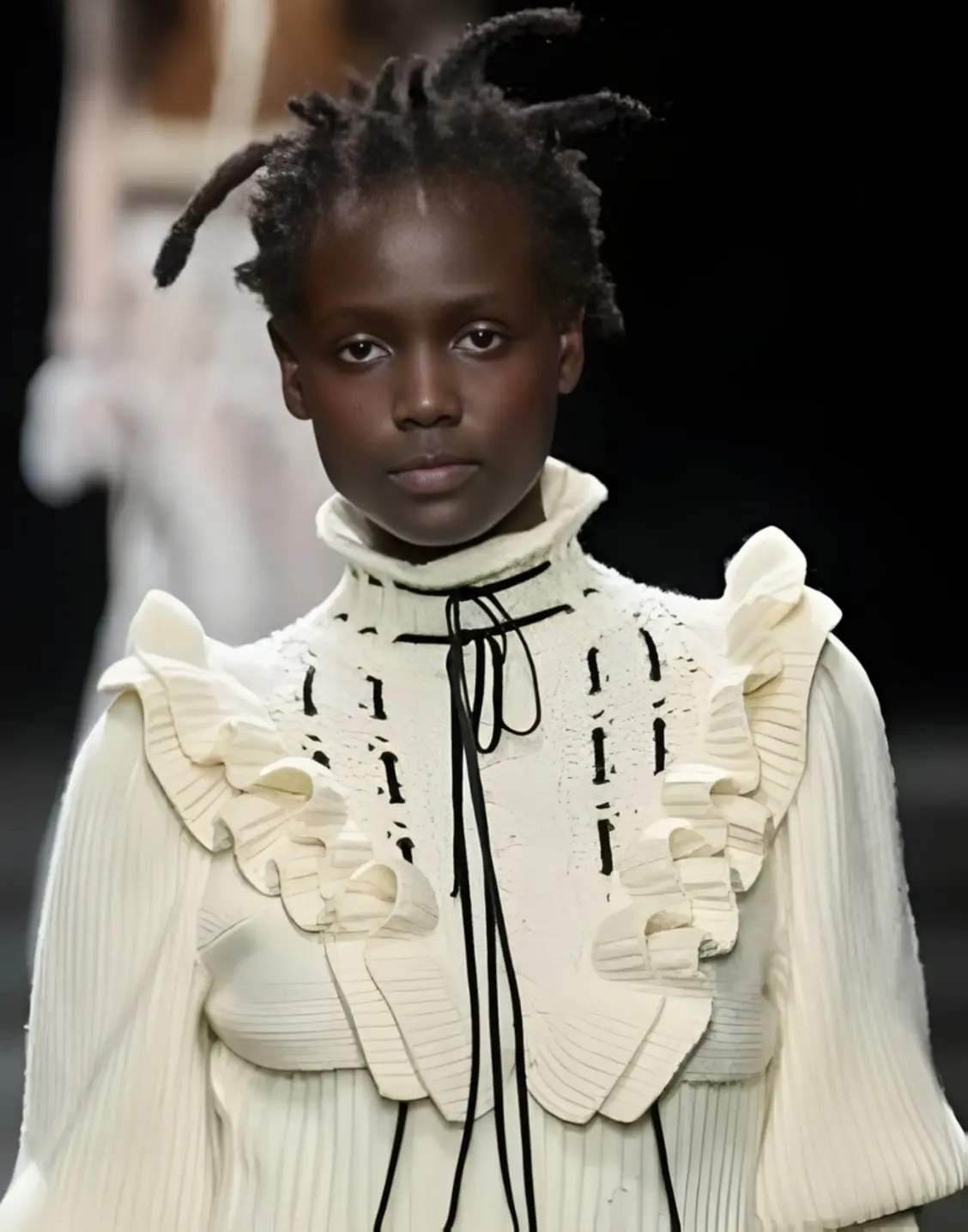
Stefano Gallici staged Ann Demeulemeester Fall 2026 like a confession written after midnight and read back at dawn with a cigarette still burning in the ashtray.
March 16, 2026
Advertisement

Advertisement



The title, Dear Night Thoughts, already gave the game away: this was a season built from private writing, rebellious memory, and the strange theater of youth when every feeling arrives overdressed.
What makes that setup so potent is that Ann Demeulemeester has always known how to make black clothing feel literary rather than merely chic. Stefano Gallici understands that heritage, but he refuses to worship it from a safe distance. He drags it toward the messier temperature of adolescence: band practice, scribbled journals, damaged denim, old records, school-uniform severity loosened by lust and boredom. The result is not a museum restoration of Ann Demeulemeester. It is Ann Demeulemeester with her pulse quickened.
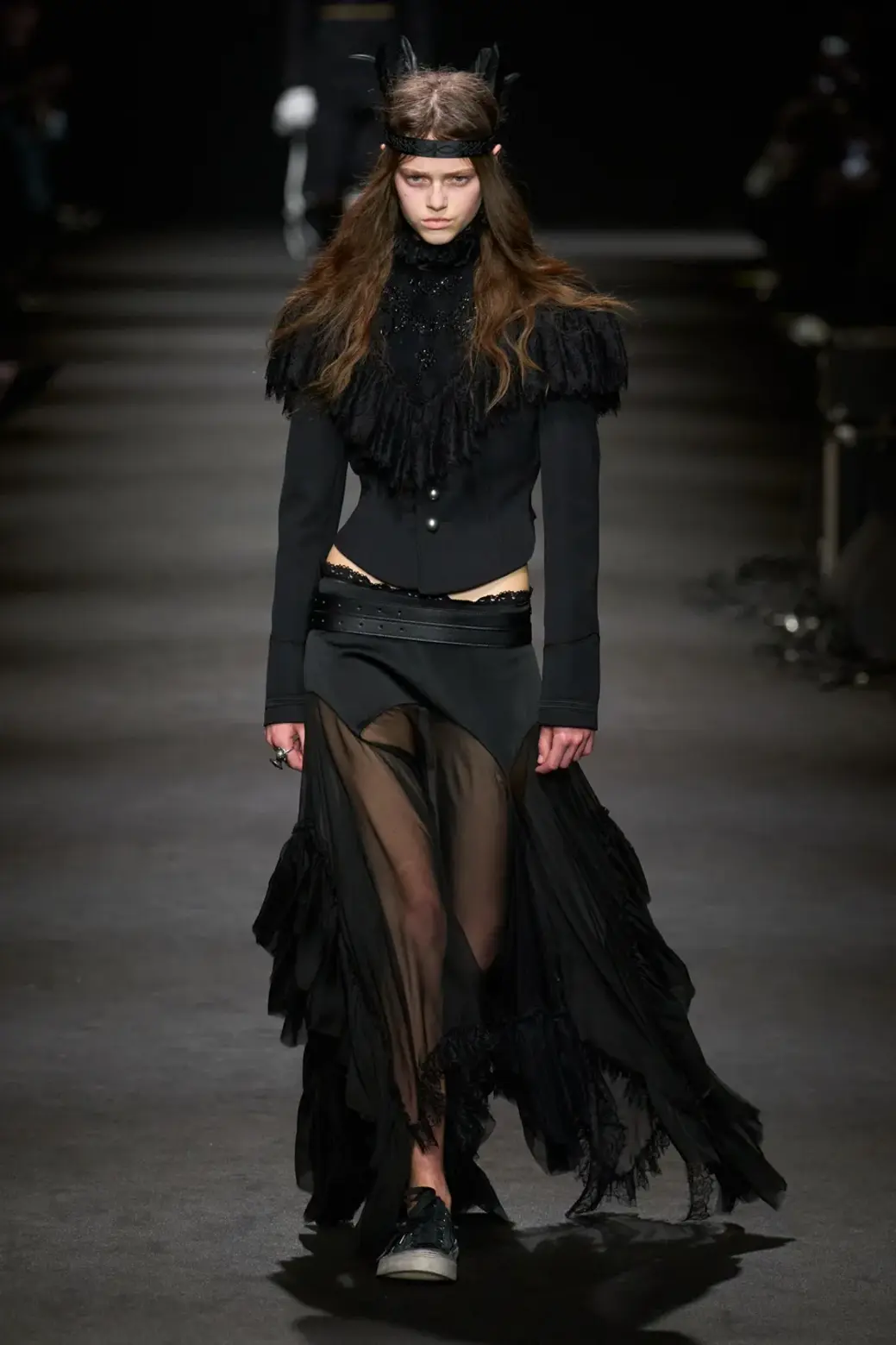
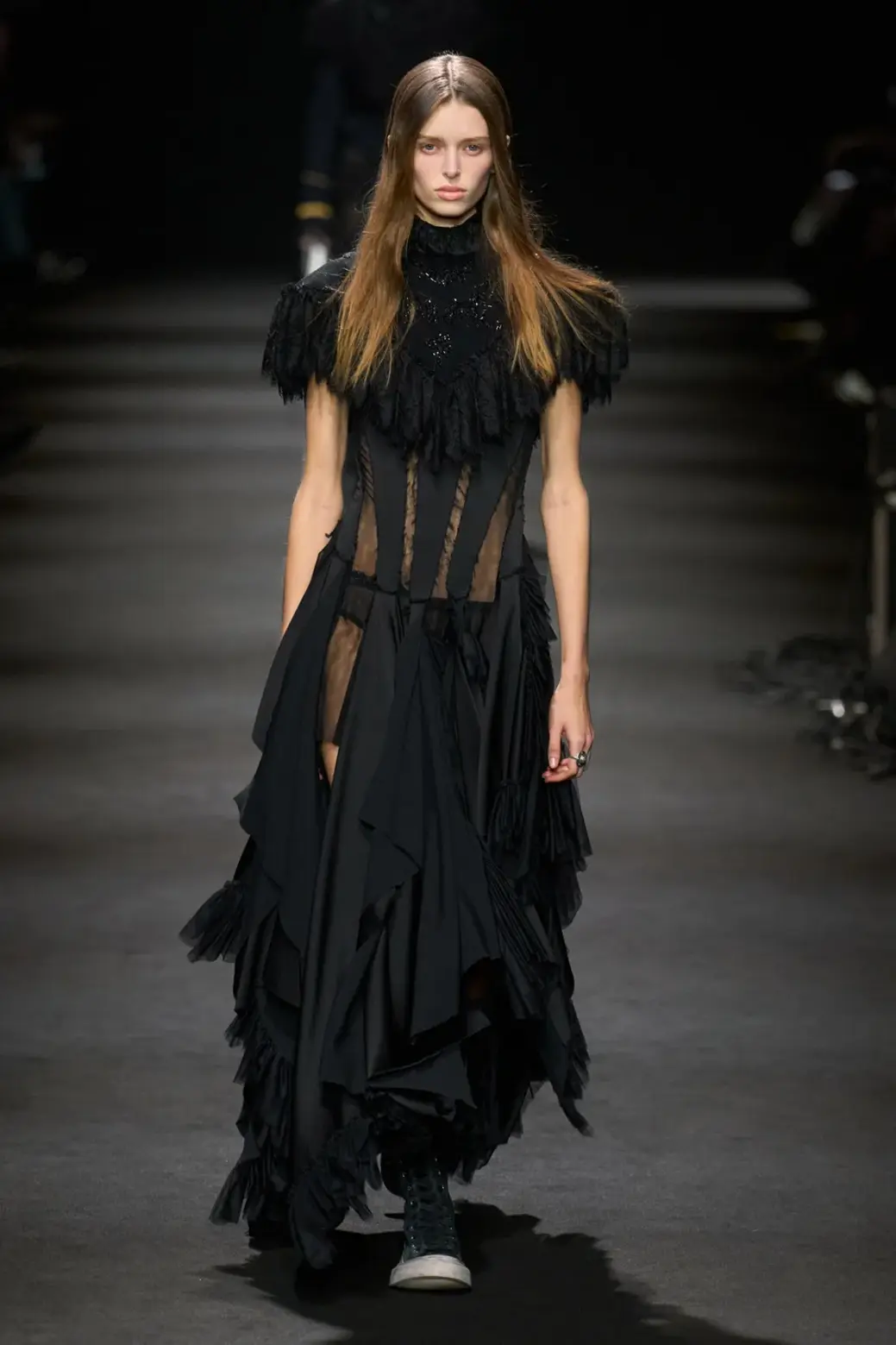
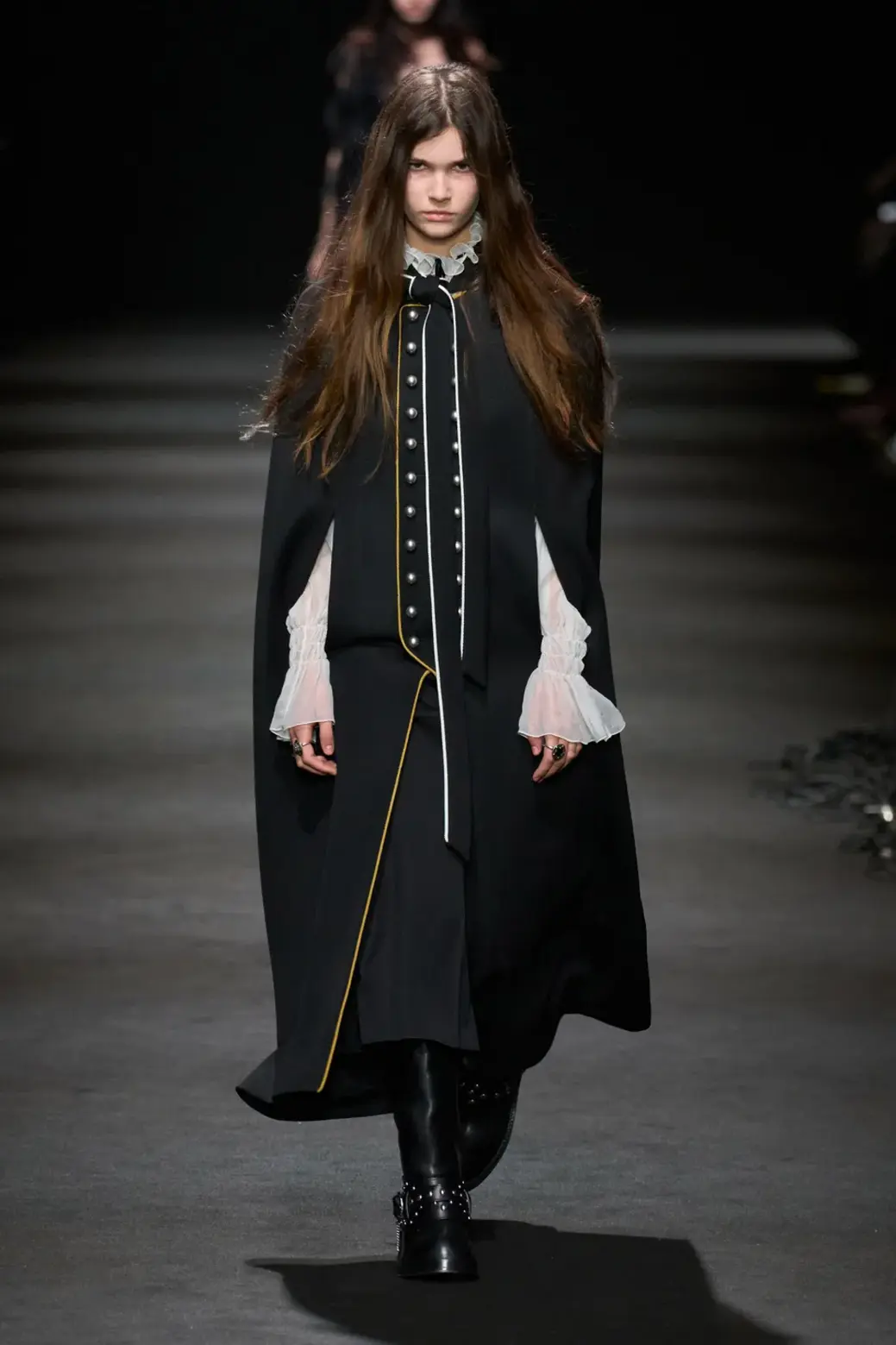
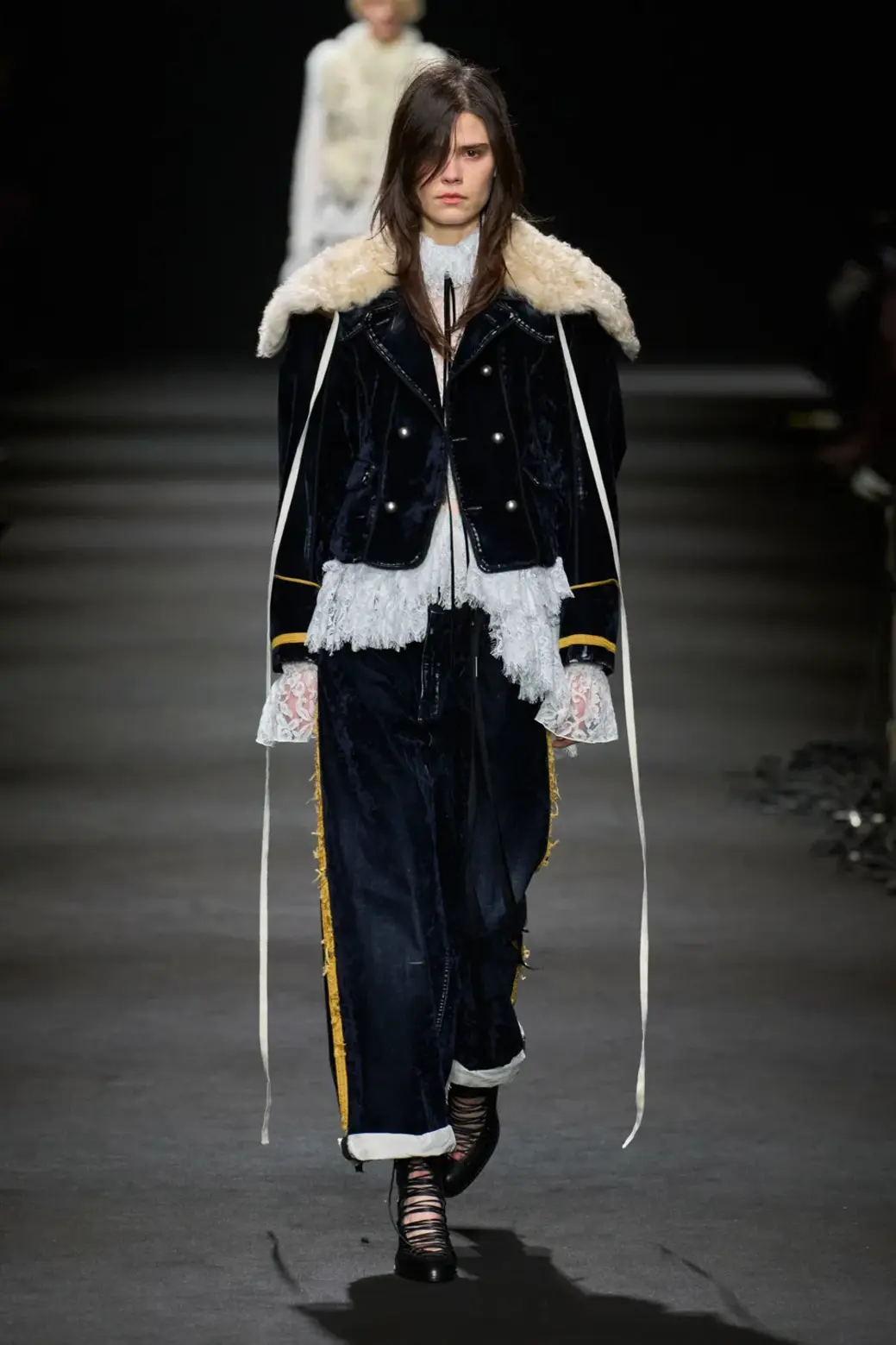
The most intelligent thing Stefano Gallici did was choose youth not as nostalgia, but as method. The collection’s biographical thread is unusually clear: his teenage years in Teor, Italy, playing in a band, writing in journals, drawing on his jeans, and eventually discovering Ann Demeulemeester through Patti Smith. That biography matters because it explains why Ann Demeulemeester Fall 2026 feels like rebellion remembered from the inside, then disciplined by a house that has long understood romance as something sharpened by thought.
There is strategy in that choice too. Stefano Gallici has been rebuilding the label not by embalming old codes, but by making them seductive to a younger creative crowd who want darkness with feeling still in it. The revival is on the right track, while another season roundup singled out the show’s gothic energy and the brand’s growing sales. That matters because this collection does not behave like heritage management.
The imaginative world here is deliciously unstable. It is part dormitory, part ruined chapel, part rehearsal room, part 19th-century fever novel. Ann Demeulemeester Fall 2026 feels as though a school uniform wandered into a crypt, read too much poetry, fell in love with a guitarist, and emerged three hours later speaking fluent black romanticism.
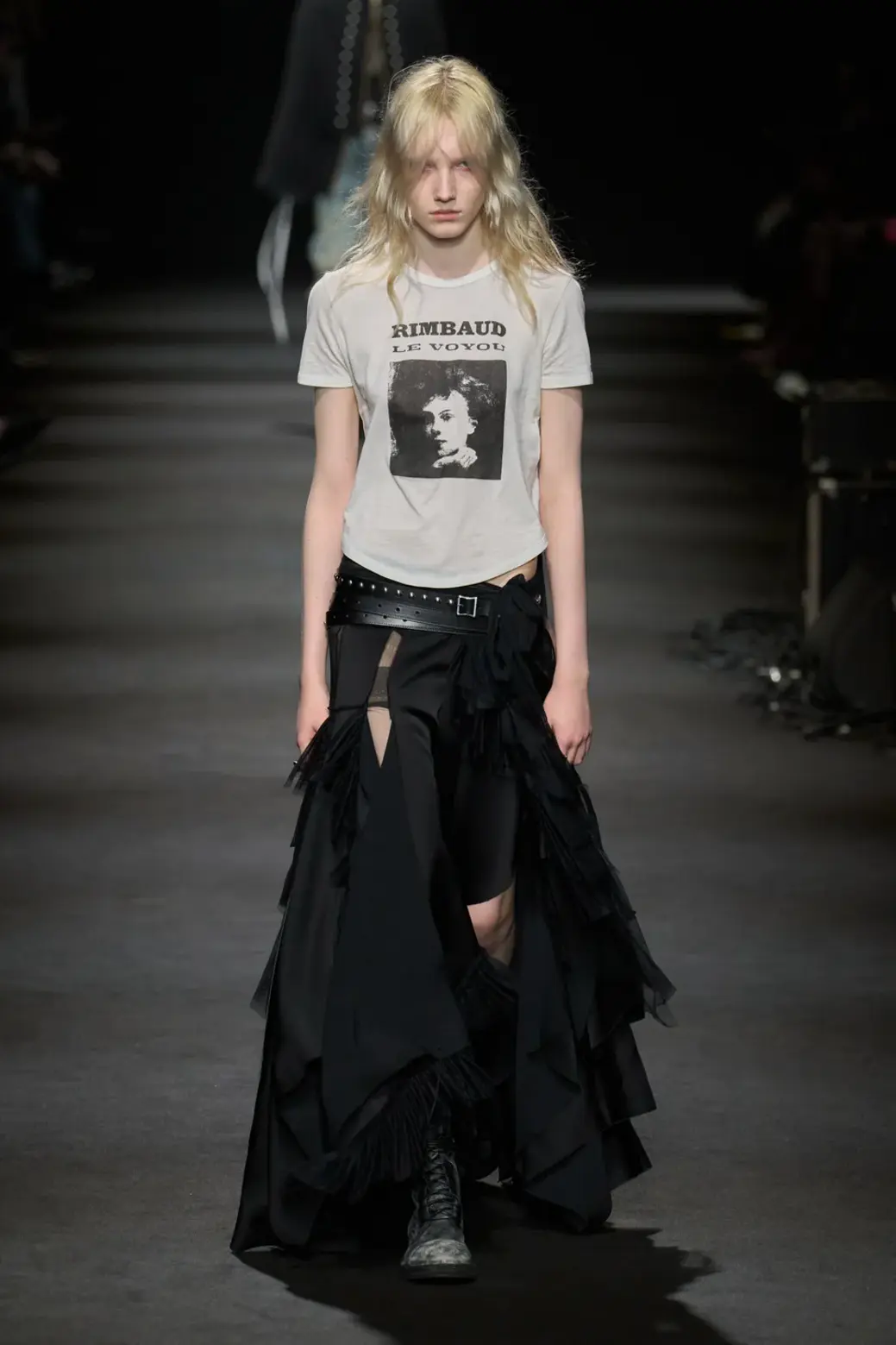
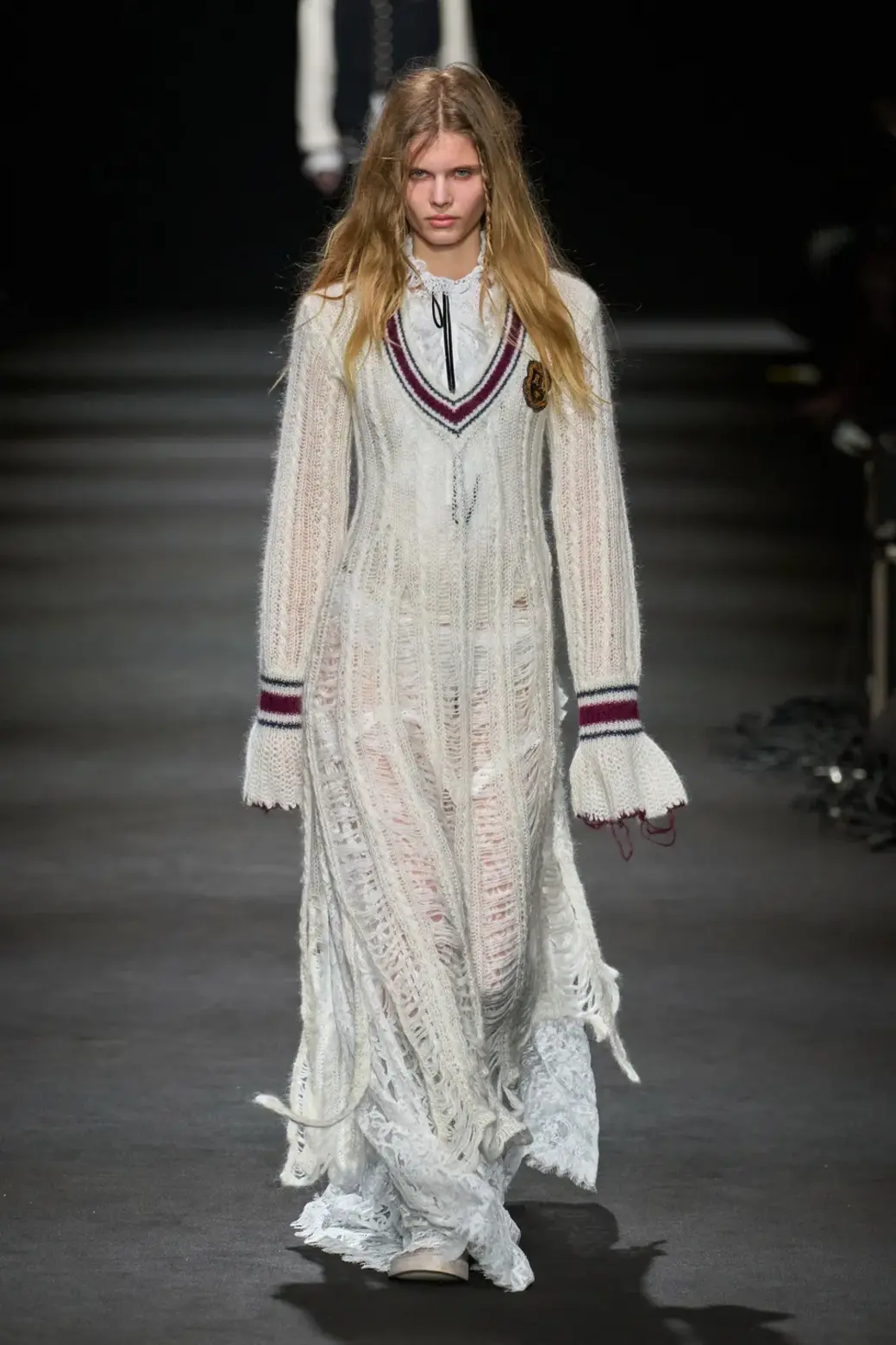
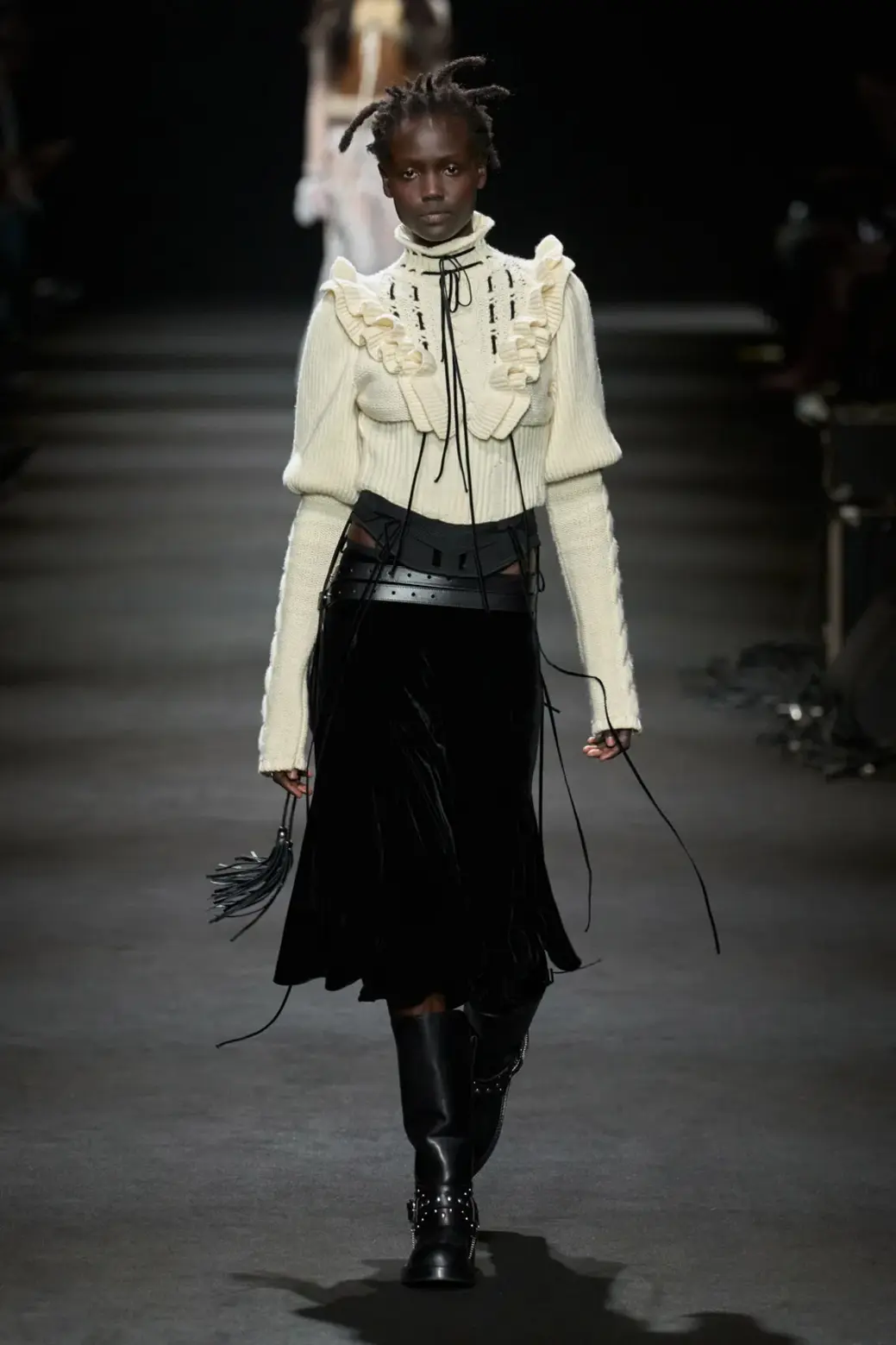
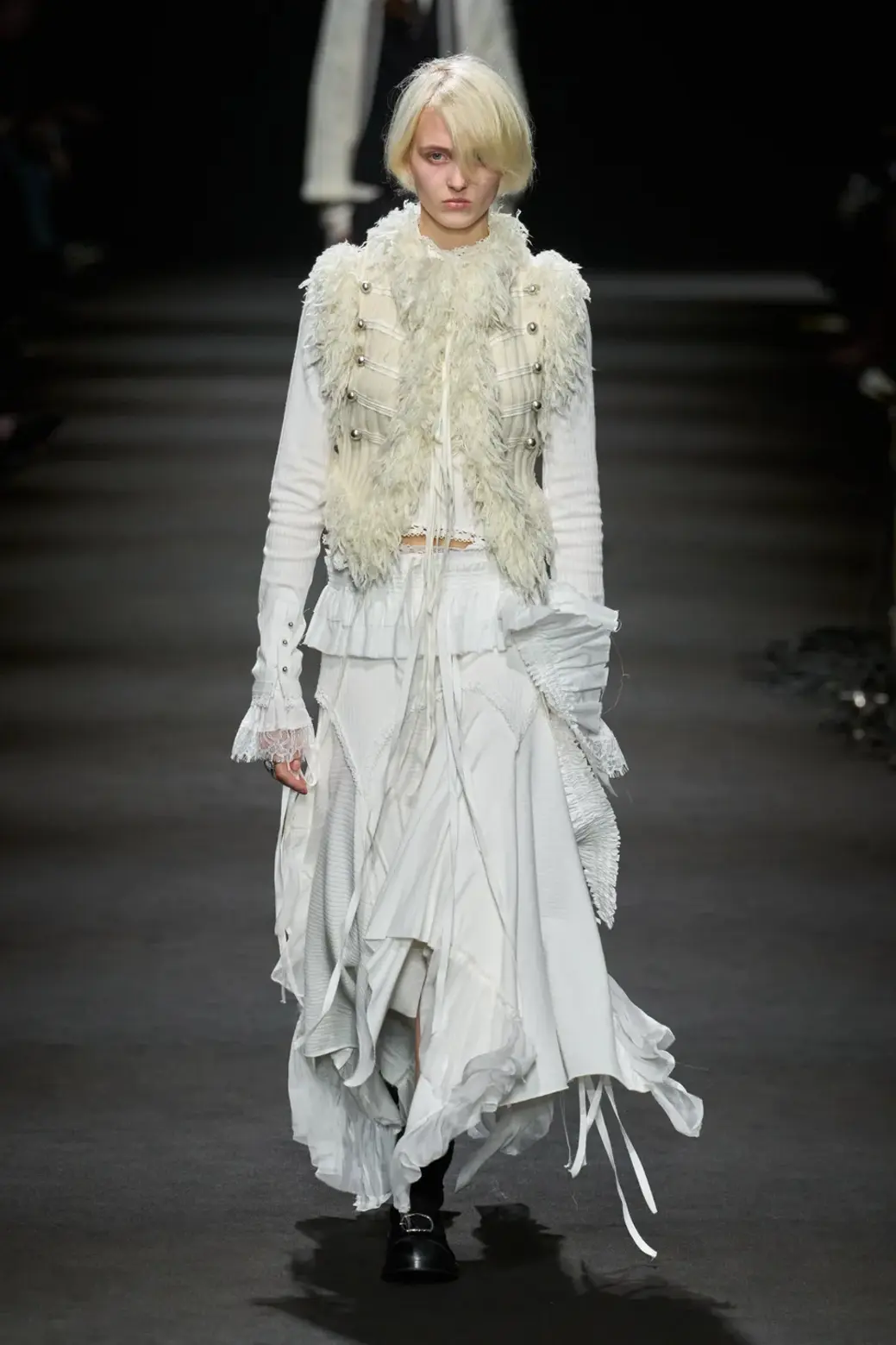
That is why the historical feeling works so well even though the collection is not literally period dress. The darkness has the hush of an older century, the kind that smells faintly of dust, wool, candle smoke, and old paper. Yet the body inside it remains unmistakably modern: restless, insolent, half-dressed, emotionally overlit. Stefano Gallici is not recreating the past. He is using its emotional furniture, chapel severity, school discipline, aristocratic residue, a hint of funeral elegance, to give adolescent rebellion a more haunted room to live in.
The silhouette tells the story before the fabrics do. Stefano Gallici keeps Ann Demeulemeester’s famous long line intact, but he lets it slacken just enough to suggest a body that has already survived a night. Shirts slide off shoulders. Waistcoats hang with looseness. Tailoring looks softened by time rather than newly pressed into obedience. This is a crucial shift: the old Ann Demeulemeester severity exhales, and in that exhale the collection finds its sexiness.
Then come the dropped waistlines, which are one of the collection’s smartest gestures. They pull the body downward, away from crisp composure and into a more vulnerable, juvenile slouch. That proportion change does a great deal of emotional work. It makes the wearer look less like a completed adult and more like a beautiful delinquent, someone still carrying the awkward glory of youth but already learning how to turn it into style. The silhouette is preppy in structure, romantic in drag, and rebellious in posture.
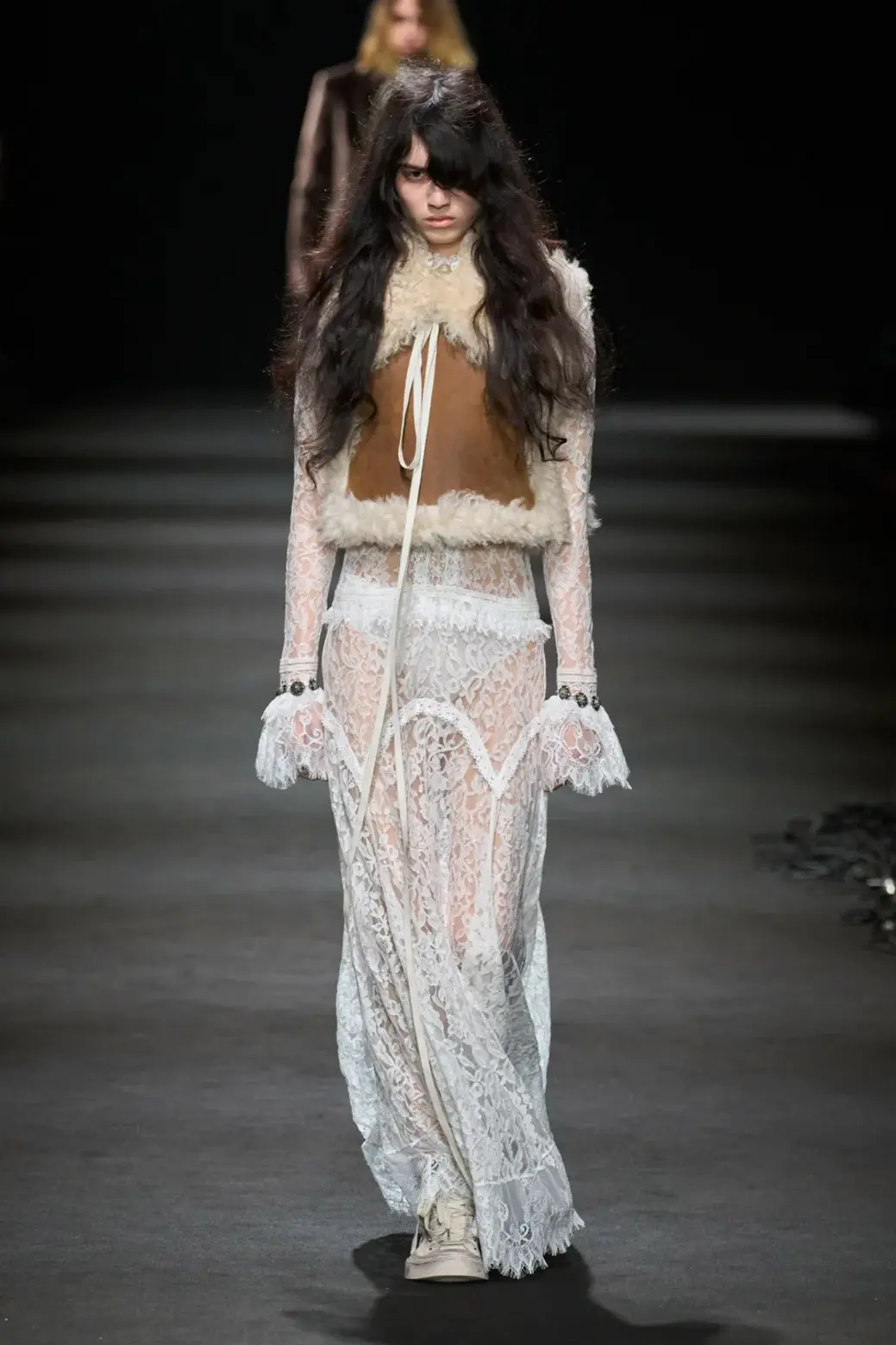
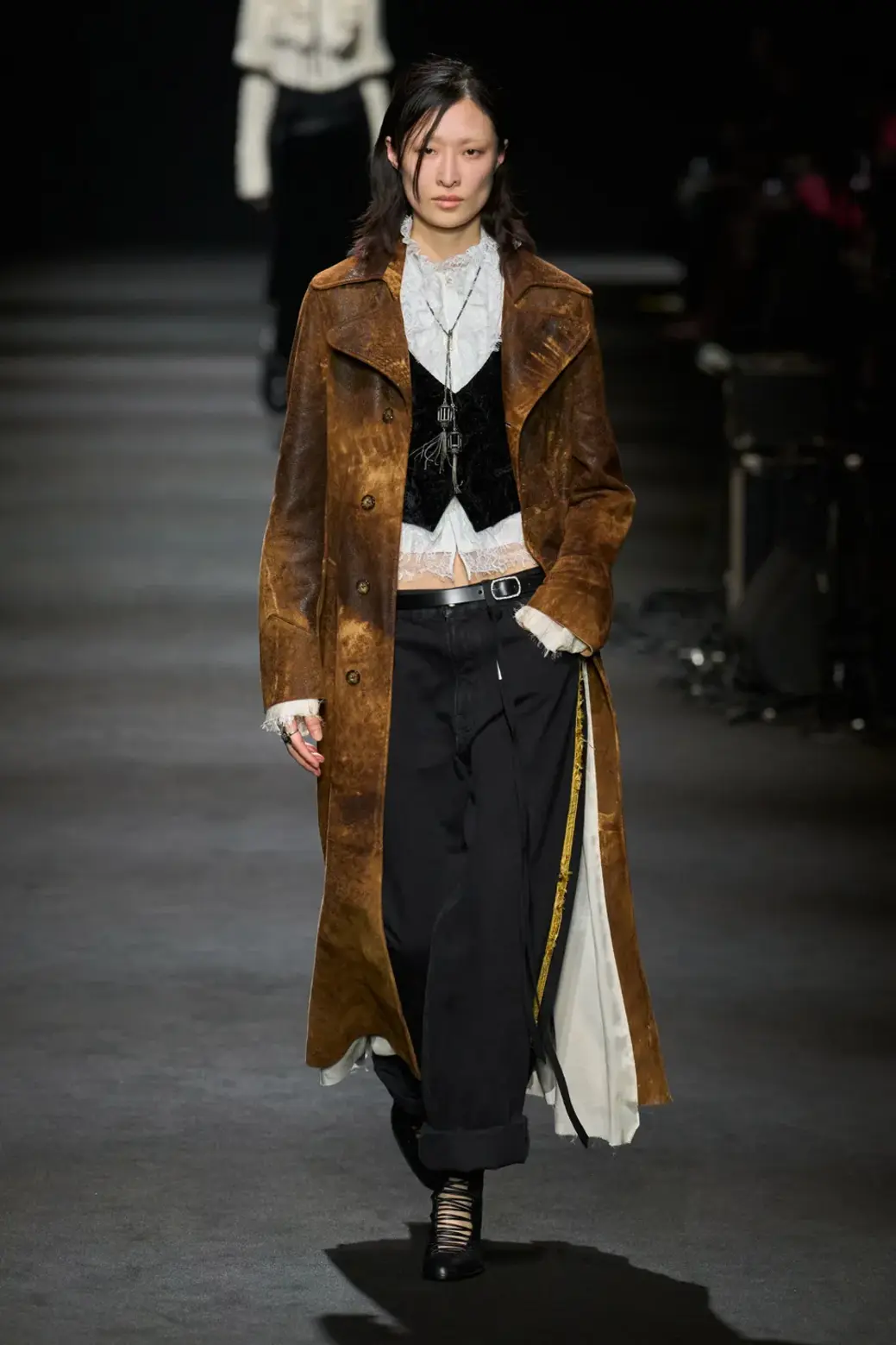
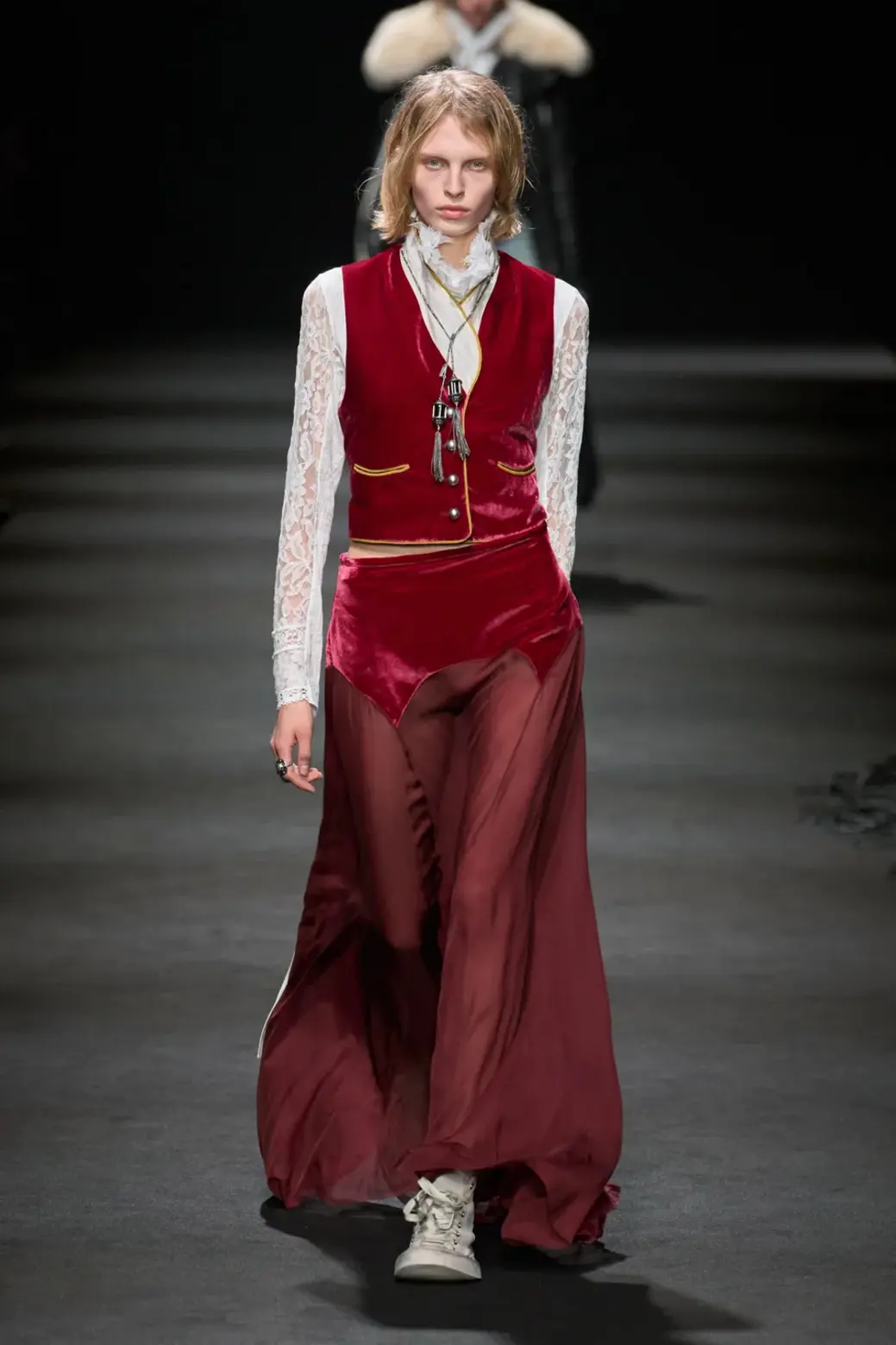
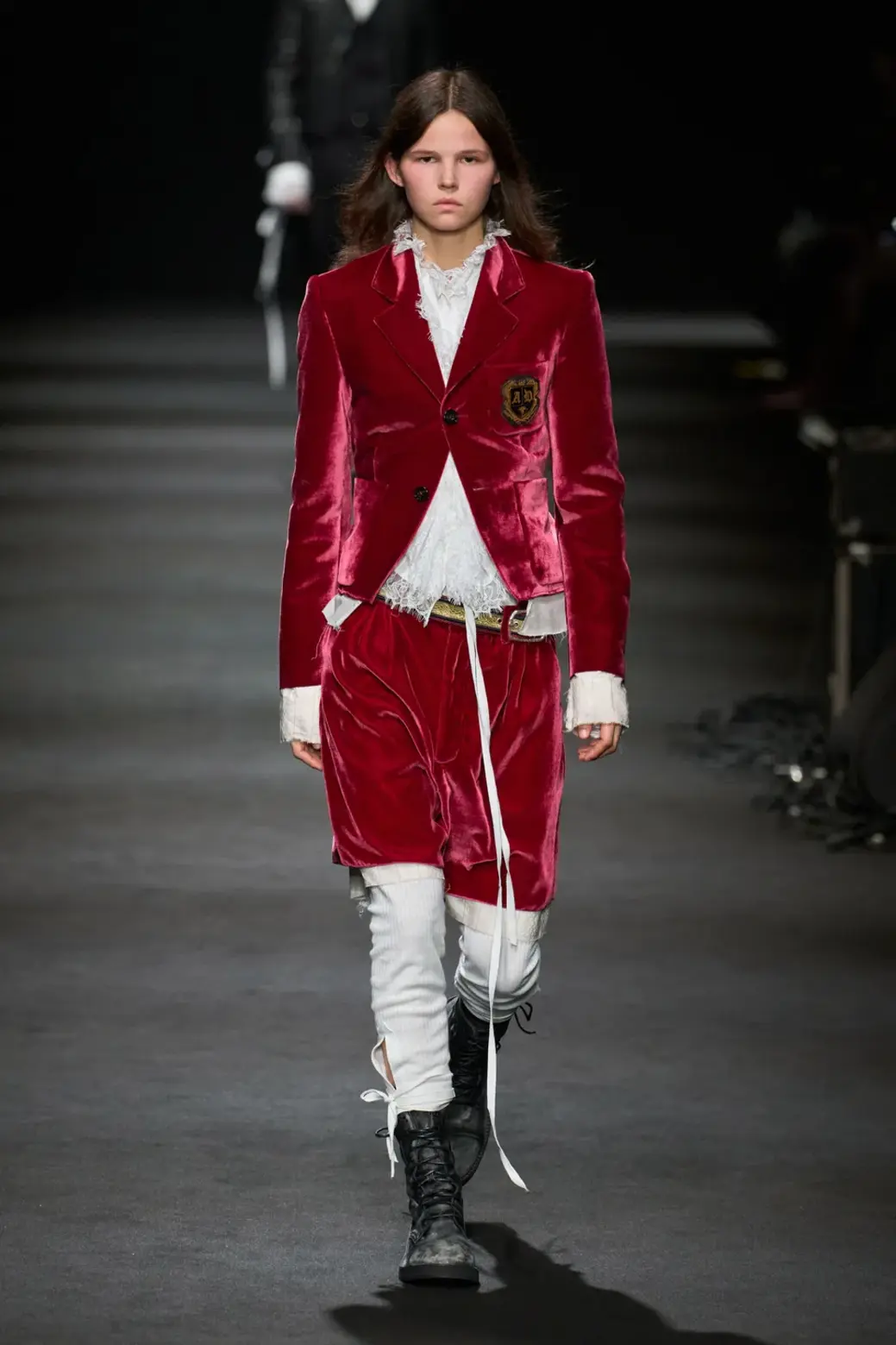
The garment vocabulary is where Stefano Gallici gets dangerous. Biker-jacket echoes, ripped uniforms, distressed denim, embroidered sheer pieces, loose waistcoats, and softened tailoring all pull against one another without ever collapsing into chaos. The thrill lies in how naturally they coexist. A schoolboy code appears, then immediately gets roughed up. A romantic transparency arrives, then is weighted down by blackness and wear. A biker relic cuts through the room like a threat. These clothes look accumulated.
That accumulation is what makes the collection feel lived rather than styled. The garments seem to come from a wardrobe of memory: jackets stolen, trousers slept in, shirts pulled on after dawn, a piece of tailoring inherited from someone too glamorous to trust. Stefano Gallici understands that the most convincing youth myth is never pristine. It is built from things kept too long, damaged beautifully, and made to mean more than they should.
The material palette is where the poetry turns tactile. Blue wool felts and distressed velvet bring in the weight of winter and the hush of old rooms. Faded black denim keeps the collection grounded in adolescence, abrasion, and ordinary damage. Repatched gold jacquard bands cut across that darkness like remnants of some dead ceremonial world, as if a formal past had been dragged into punk life and forced to survive there. Black tulle and azalea-toned floral embroidery soften the mood, but only just. They appear like fleeting recollections rather than innocent prettiness.
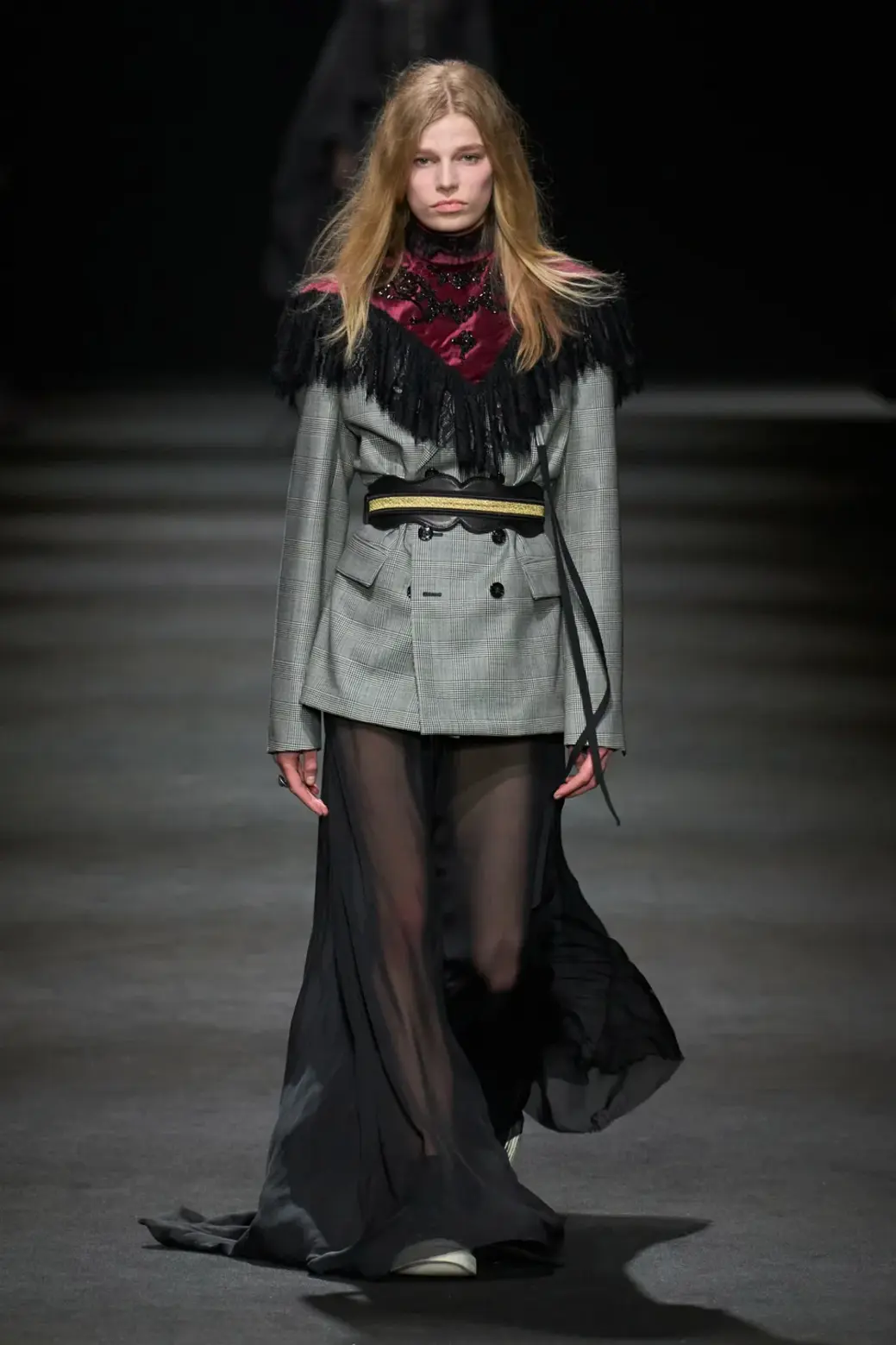
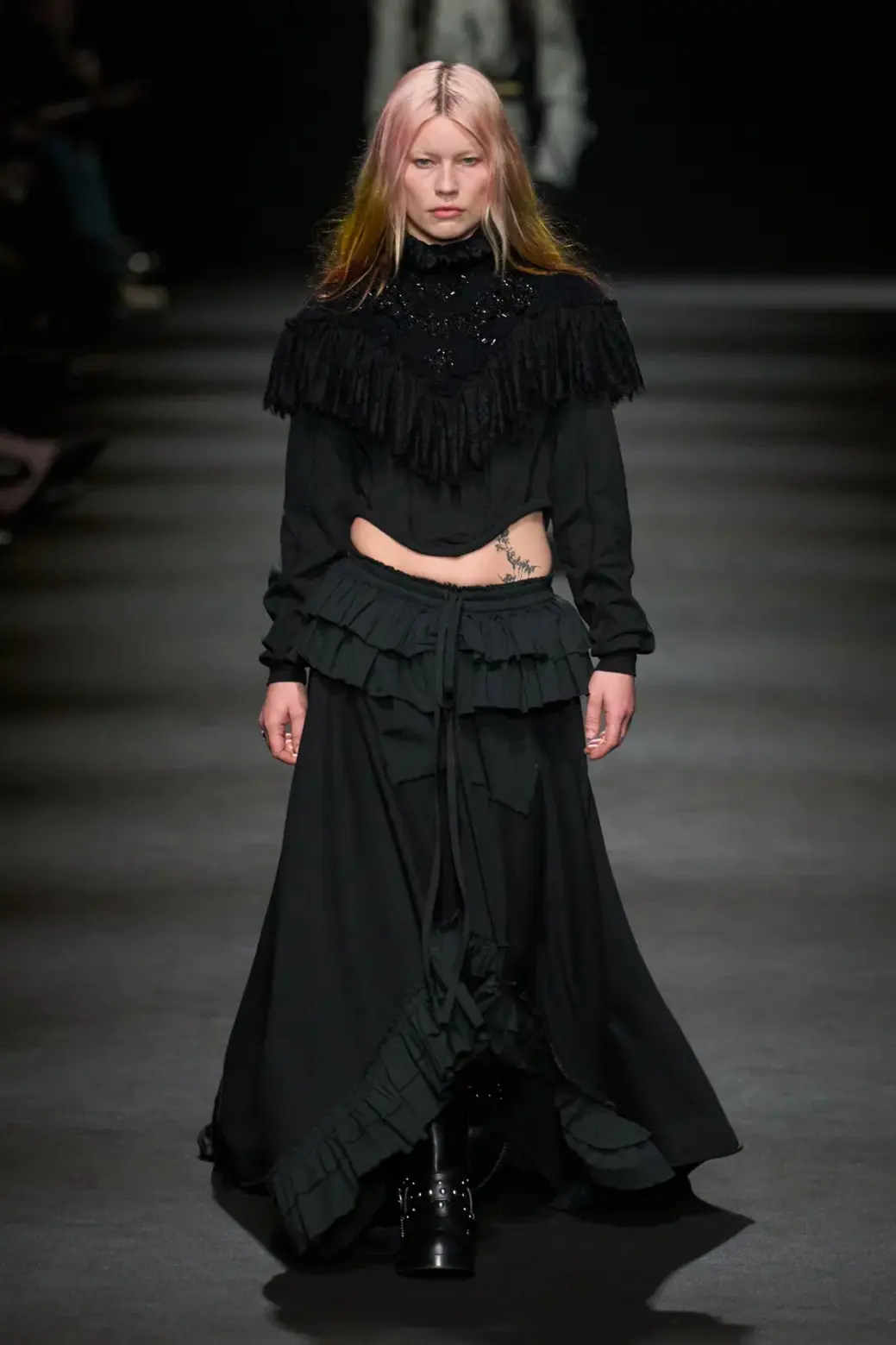
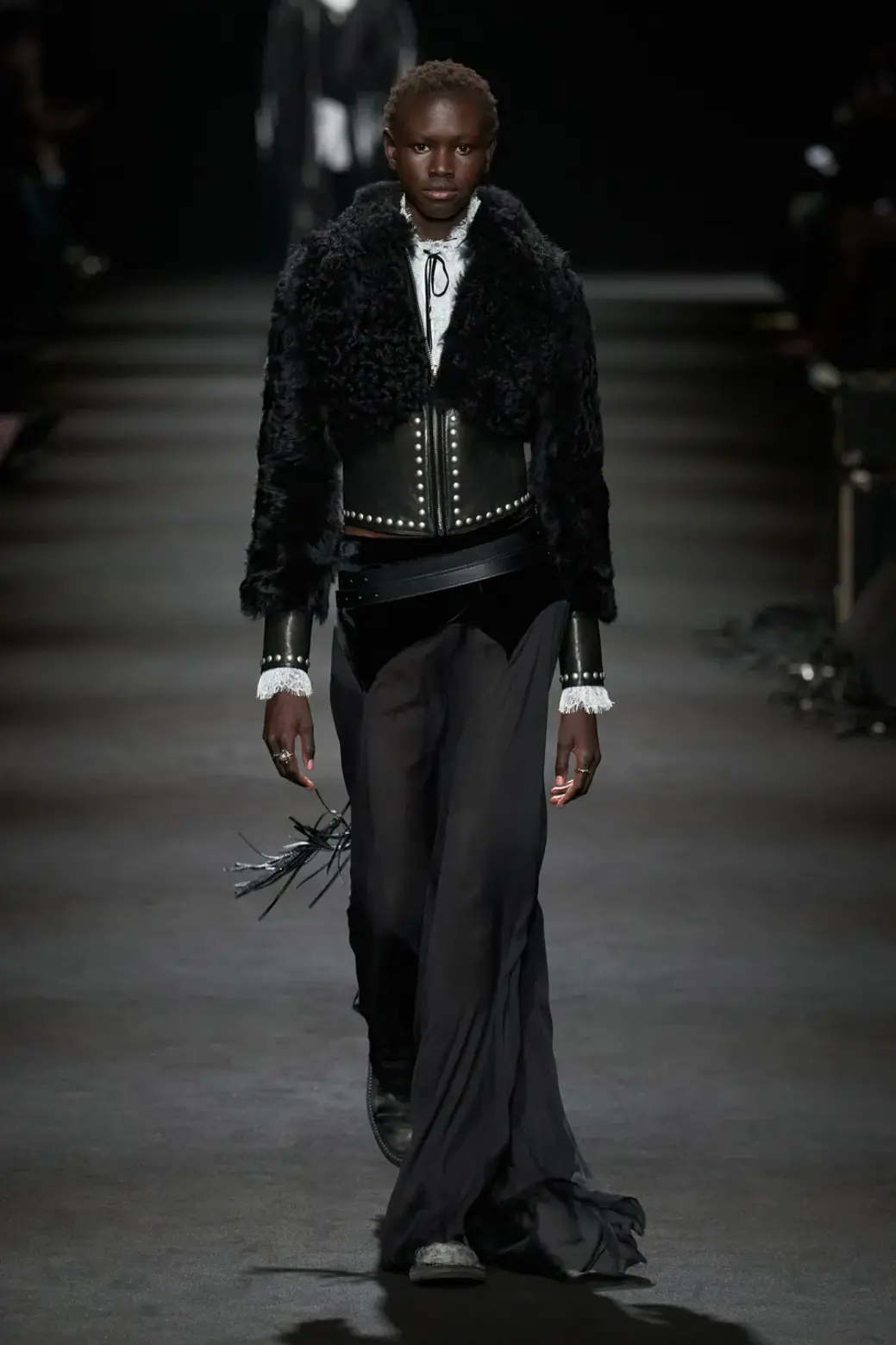
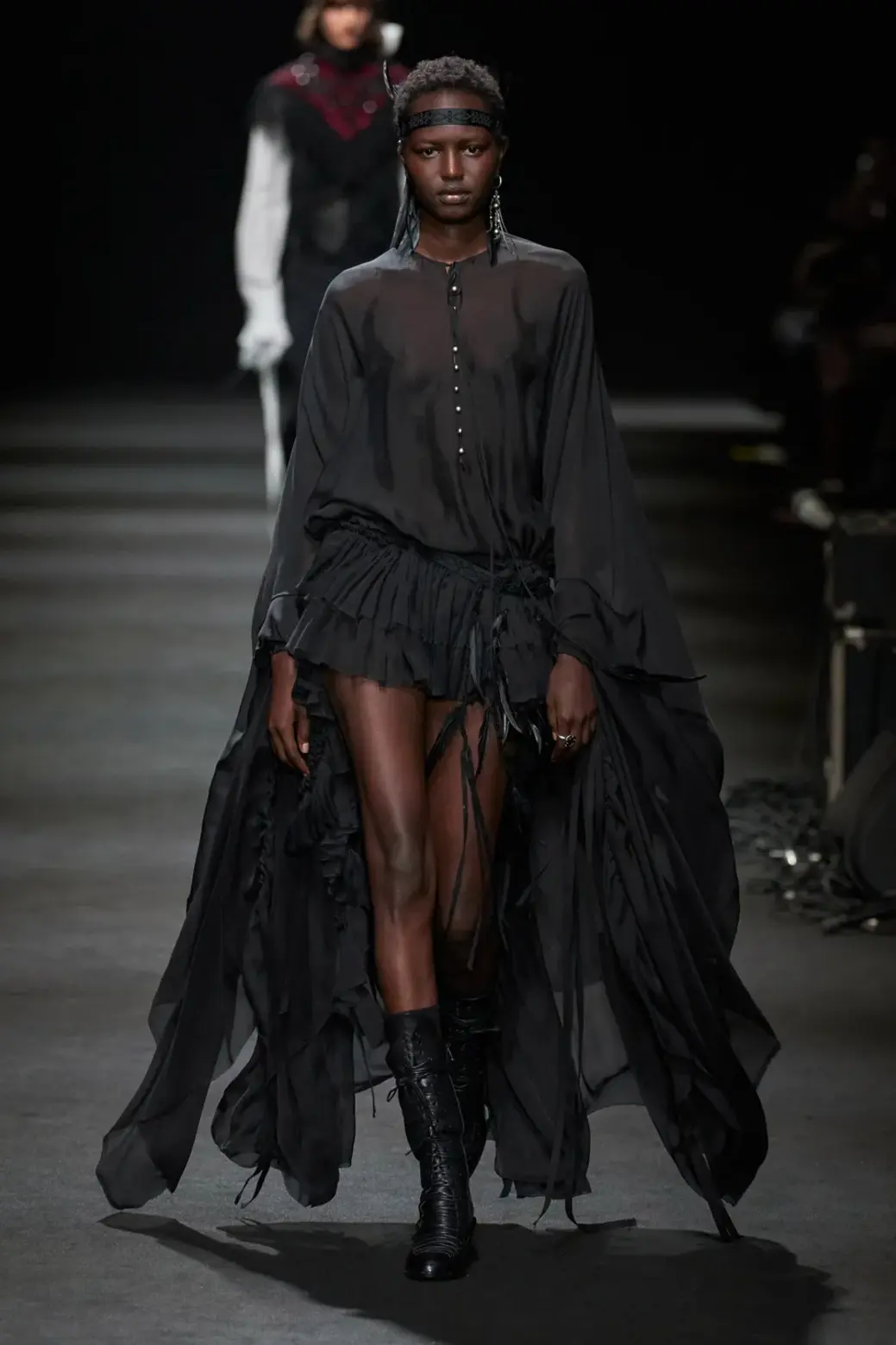
It is this exact balance that gives the show its haunting voltage. Felt and velvet say winter, chapel, dormitory gloom. Denim says teenage stubbornness. Gold jacquard says history clinging to the hem. Tulle says dream. Floral embroidery says memory trying not to disappear. Stefano Gallici does not let one register dominate. He bruises them together until softness looks damaged and damage looks lyrical.
The styling is one of the collection’s secret triumphs because it understands the body as aftermath. Silver pearls, chains, and rusted leather were used not to decorate the clothes but to corrode them slightly, to make refinement look as though it had been left out in the rain. A pearl on this runway does not read ladylike. It reads inherited, then mishandled. A chain does not read merely hard. It reads like the sound of a night that has not ended properly. Rusted leather is the whole collection in miniature: beauty put into contact with time until it acquires its own damage.
This is where Stefano Gallici’s version of Ann Demeulemeester becomes especially seductive. That in-between state is the right one for this collection. It is the body after the party, after the poem, after the lie, after the music has stopped but before the feeling has.
This is the right difficult question to ask. Is Gallici reviving Ann Demeulemeester, or is he projecting his own youth mythology into the house so intensely that the label becomes something else entirely? The answer is that the tension itself is the engine. He is not interested in cold fidelity. He is strongest when he lets his biography contaminate the archive: the journals, the band years, the Patti Smith devotion, the punk melancholy, the sense that adolescence is not a phase but a permanent black undertow.
And frankly, that contamination is exactly why the collection lives. A dutiful Ann tribute would have been elegant and dead on arrival. Stefano Gallici gives the house back its danger by refusing to keep it pure. He lets the old elongation meet teenage slackness, lets gothic restraint meet school-uniform insolence, lets historical shadow meet rock-and-roll pulse. This is not revival by reverence. It is revival by possession.
That could have been a mess. Instead, it comes out with the peculiar coherence of a song you are not sure is beautiful or dangerous until it has already lodged in your bloodstream. That is the rare thing Gallici has achieved here: he makes contradiction feel like instinct.
And perhaps that is the real victory. Stefano Gallici has not turned Ann Demeulemeester into a tribute band for its own archive. He has turned it into a night school for the fashionably damned: for the girls and boys who want poetry with nicotine on it, tailoring with a bruise. Ann Demeulemeester Fall 2026 feels bold because it is willing to be juvenile.
Advertisement