MENU
Close





Smart AI-Powered sunglasses like Ray-Ban Meta and Snap Inc.’s Spectacles are fast becoming one of the most intriguing crossroads between fashion and technology.

Smart AI-Powered sunglasses like Ray-Ban Meta and Snap Inc.’s Spectacles are fast becoming one of the most intriguing crossroads between fashion and technology.
March 17, 2026
Advertisement

Advertisement



They are reshaping the way people observe, interact with, and interpret the world through artificial intelligence, while turning advanced tech into a seamless extension of modern style.
Sooner or later, fashion was always going to join hands with AI, and now sunglasses have emerged as the latest frontier. As the era of “Googling” gives way to intelligent chatbots, the arrival of AI-integrated eyewear feels almost inevitable. The real question is this: could a pair of glasses that answers information instantly become the next leap we have been waiting for all along?
These glasses may not yet deliver the full Tony Stark fantasy of stepping into an Iron Man suit, though that future feels closer by the day. For now, AI-powered sunglasses occupy a thrilling in-between space: part accessory, part interface, part glimpse of tomorrow. Elegant, functional, and quietly intelligent, they hide microphones, speakers, and even cameras inside frames that appear deceptively ordinary. They prove how far wearable technology has traveled since Google Glass first entered the conversation in 2014.
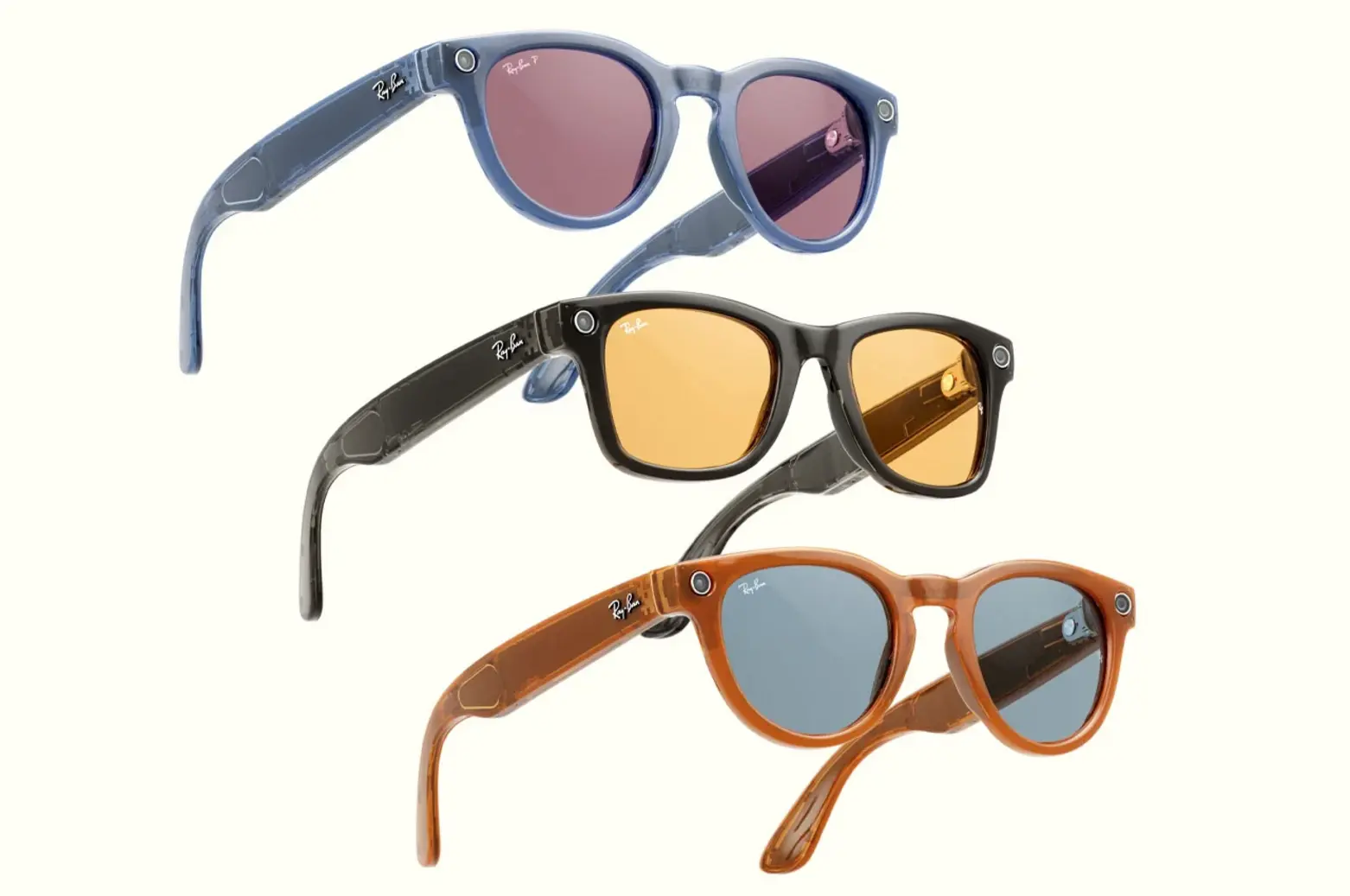
A major turning point arrived in 2021, when Meta Platforms, the parent company of Facebook, Instagram, and WhatsApp, partnered with EssilorLuxottica to launch the Ray-Ban Meta smart glasses. In February 2025, EssilorLuxottica described Ray-Ban Meta at 2 million units sold since launch, a strong result for a young product line. One year later, the company’s full-year 2025 release talks about AI-glasses units sold (including Ray-Ban Meta, launched September 2023, and Oakley Meta, launched June 2025) reaching above 7 million in 2025.
These are sunglasses that do far more than shield the eyes from UV rays or make the wearer look cooler. They merge the familiar elegance of traditional eyewear with the functions of a voice assistant, a wearable camera, and, in certain versions, even an augmented reality display.
Unlike bulky AR and VR devices such as Apple Vision Pro or Microsoft HoloLens, AI sunglasses are designed for everyday life. The idea itself is not entirely new. Google Glass once served as the early prototype, though it quickly disappeared amid privacy concerns and public discomfort.
What sets today’s generation apart is the sophistication of both their design and their AI integration. AI-Powered sunglasses like Ray-Ban Meta look almost identical to premium fashion eyewear, yet inside they carry an entire ecosystem of cameras, microphones, speakers, and Bluetooth connectivity. Paired with AI assistants, they can identify objects, translate conversations in real time, and deliver contextual information on command. In other words, they are miniature computers disguised as chic accessories.
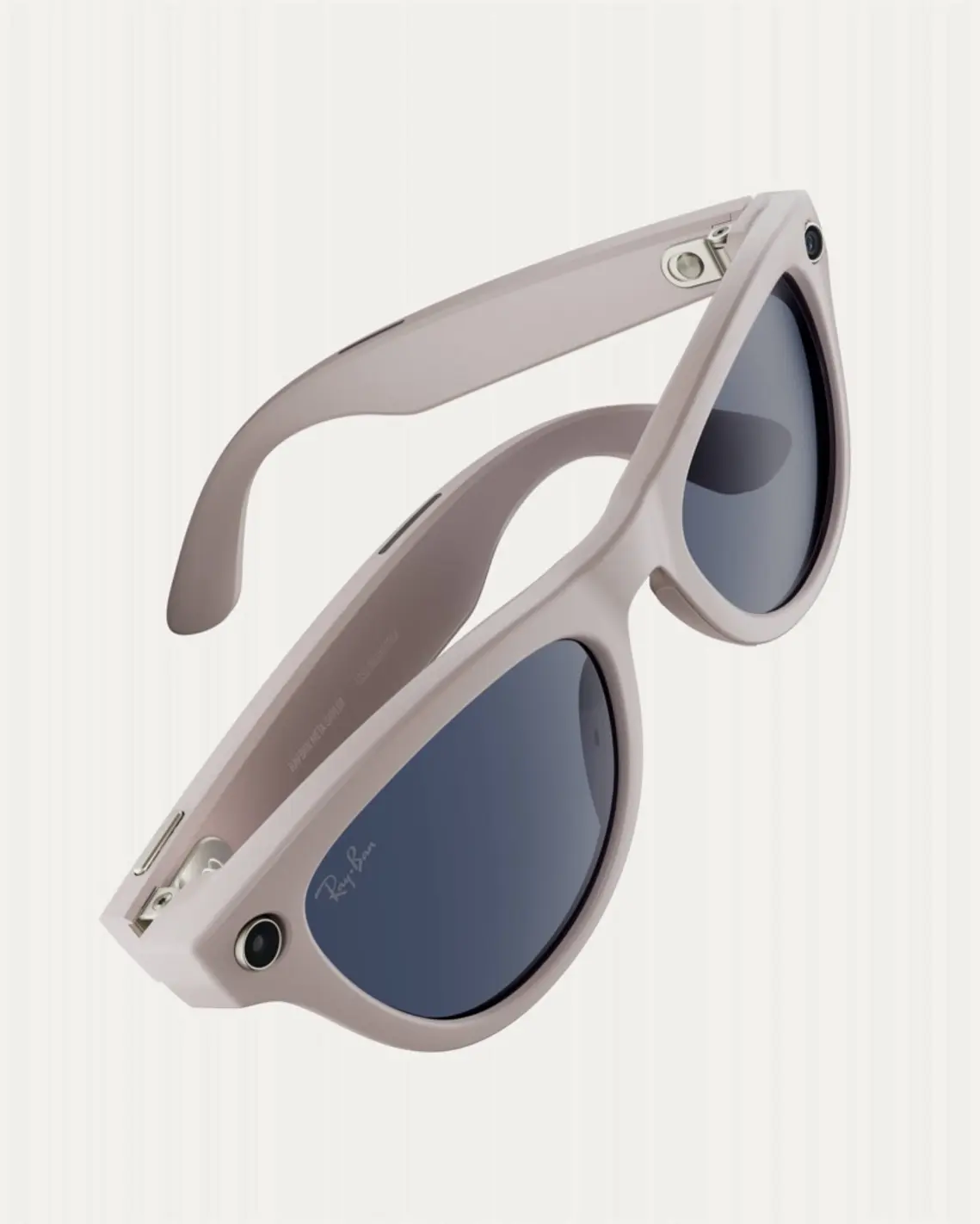
Today’s AI-Powered sunglasses are typically engineered to feel light, durable, and stylish. Many are made from acetate, carbon fiber, or titanium alloy, giving them strength without sacrificing elegance. Some models are also water-resistant and dust-resistant, making them suitable for outdoor life as well as city wear. Lenses may be polarized, photochromic, or fitted with prescription options depending on the user’s needs.
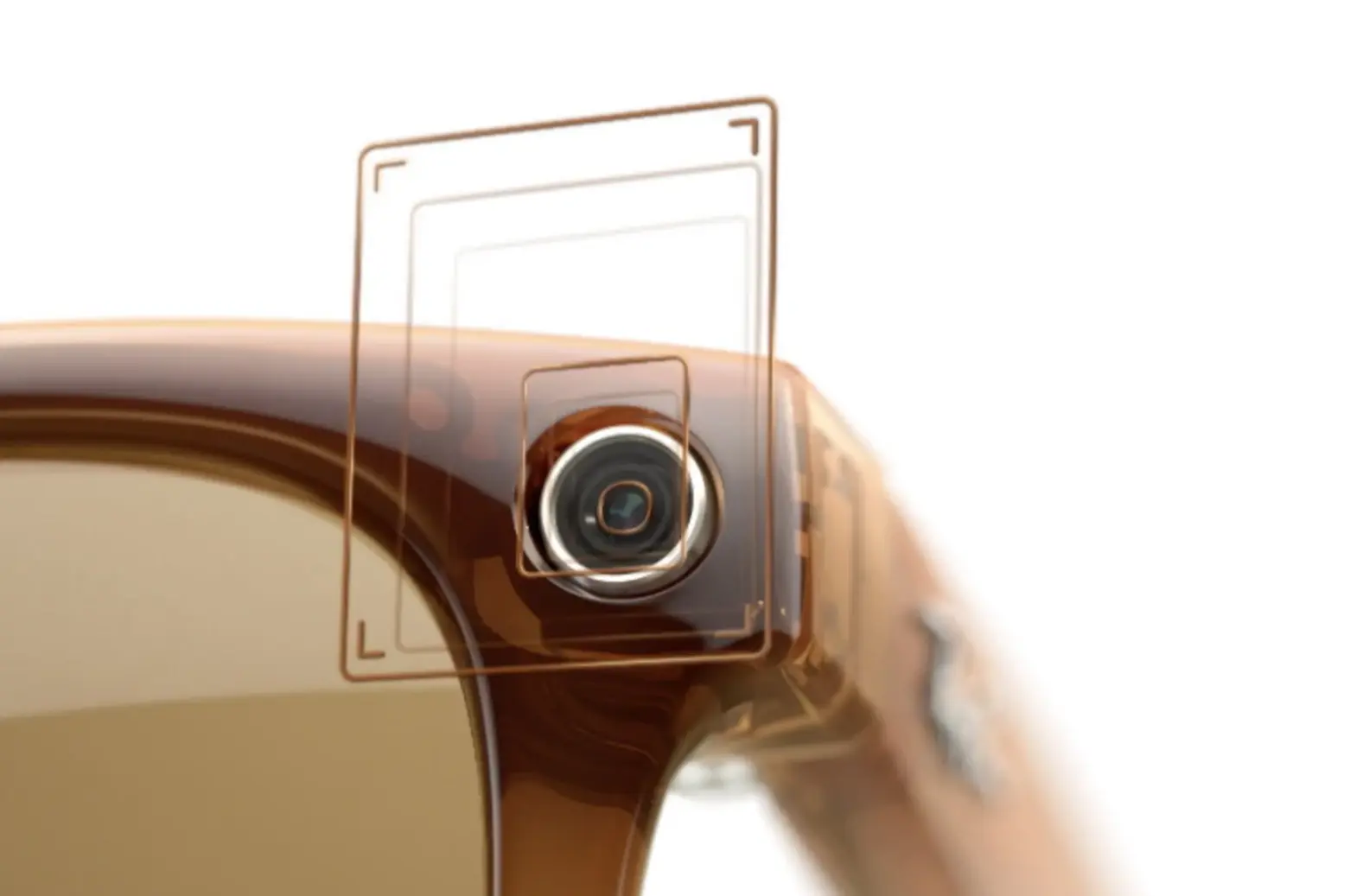
Their integrated cameras usually range from 5MP to 12MP, with support for 1080p or even 4K video recording. Some AI-Powered sunglasses models also feature ultra-wide-angle lenses. Audio systems often use an open-ear design, allowing wearers to hear the surrounding environment while listening to music, taking calls, or speaking with AI through directional microphone arrays.
The most fascinating element of smart sunglasses lies in their display systems and built-in or connected AI. In premium models such as Ray-Ban Meta, this technology can appear through a tiny AR interface embedded near the lens, enabling translations, navigation prompts, or contextual information to hover directly within the wearer’s field of vision. Virtual assistants powered by natural language processing, such as Meta AI or ChatGPT, make the glasses feel less like devices and more like intelligent companions. Some reports even suggest that AI can identify landmarks, plants, or fashion brands captured by the camera.
Users can speak commands to take photos, record video, livestream, share content to social platforms, play music or podcasts, and communicate through voice calls or voice-to-text messaging without ever reaching for a phone. For visually impaired users, these glasses can become especially transformative, offering spoken descriptions of the surrounding environment and creating a more independent, confident daily experience.
Most AI-Powered sunglasses connect via Bluetooth to sync with smartphones, while some models also support Wi-Fi for direct cloud access. Battery life usually lasts between four and eight hours, depending on the model, and the glasses case often doubles as a charging dock. Charging points are discreetly placed near the hinges, preserving both convenience and visual elegance.
Their usefulness depends on the wearer and the rhythm of their life, but for many people, smart sunglasses can become a powerful everyday assistant. For content creators and journalists, hands-free video capture and automatic note support offer a major advantage. For travelers, real-time translation and intuitive navigation make unfamiliar destinations feel instantly more legible. For people with limited vision, voice-based scene recognition and environmental description open the door to a safer and more autonomous way of moving through the world.
With all the excitement surrounding this new category, there is also a growing concern around privacy and personal data.
The clearest issue is surveillance. The cameras are designed to be extremely discreet, and recording indicators may be difficult for others to notice, which means people may have little awareness that they are being filmed. This was one of the central reasons Google Glass fell from favor and was even banned from various bars and public spaces before it left the market in 2015.
Another major concern centers on data collection and storage. Ray-Ban Meta is, after all, a product of Meta, a company whose history includes repeated privacy controversies and questions about data use in advertising. That legacy has prompted widespread debate: could audio recordings, images, or private conversations be used to train AI systems or feed advertising ecosystems?
Regulators are watching closely. Since August 2024, the AI Act, the European Union’s first major legal framework for artificial intelligence, has officially come into force. The law classifies AI systems according to levels of risk and bans certain applications outright, including real-time biometric identification in public spaces. If AI-Powered sunglasses collect facial data, they may fall within the scope of this regulation.
Although the market is still young, Ray-Ban Meta and Snap Inc.’s Spectacles currently stand out as its two most recognizable names. Spectacles, the brainchild of Snapchat, first appeared in 2016 with a retro aesthetic inspired by the 1970s.
At the same time, Solos, a Hong Kong-based technology company, is emerging as a serious rival to Ray-Ban Meta. Its AirGo V2 line integrates ChatGPT, supports voice commands, and features a 16MP camera capable of taking photos and recording high-quality video.
Beyond these headline names, more affordable versions have also appeared on e-commerce platforms such as Amazon, though the quality and user experience vary widely, and reviews remain mixed.
AI-Powered sunglasses still belong to an early chapter of wearable technology, yet they already reveal something larger about the future. The accessory of tomorrow may no longer sit quietly on the face. It may listen, translate, recognize, remember, and whisper the world back to us in real time. In that sense, these glasses are more than a passing gadget trend. They are the beginning of a new visual language, where fashion becomes interface and style learns how to think.
Advertisement